2.20
Situation:
The term dV/dy,thevelocitygradient
a. has dimensions of L/T, and represents shear strain
b. has dimensions of T−1, and represents the rate of shear strain
SOLUTION
21
2.21
Situation:
For the velocity gradient dV/dy
a. The change in velocity dV is in the direction of flow
b. The change in velocity dV is perpendicular to flow
SOLUTION
22
2.22
Situation:
The no-slip condition
a. only applies to ideal flow
b. only applies to rough surfaces
c. means velocity, V, is zero at the wall
d. means velocity, V, is the velocity of the wall
SOLUTION
23
2.23
Situation:
Kinematic viscosity (select all that apply)
a. is another name for absolute viscosity
b. is viscosity/density
c. is dimensionless because forces are canceled out
d. has dimensions of L2/T
SOLUTION
24
2.24
Situation:
Change in viscosity and density due to temperature.
T1=10◦C,T2=70◦C.
Find:
Change in viscosity and density of water.
Change in viscosity and density of air.
Properties:
p=101kN/m2.
PLAN
For water, use data from Table A.5. For air, use data from Table A.3
SOLUTION
Water
Air
25
2.25
Situation:
Air at certain temperatures.
T1=10◦C,T2=70◦C.
Find:
Change in kinematic viscosity.
Properties:
From Table A.3, ν70 =1.99 ×10⁻⁵m2/s, ν10 =1.41 ×10⁻⁵m2/s.
PLAN
UsepropertiesfoundinTableA.3.
SOLUTION
REVIEW
Sutherland’s equation could also be used to solve this problem.
26
2.26
Situation:
Viscosity of SAE 10W-30 oil, kerosene and water.
T=38◦C=100◦F.
Find:
Dynamic and kinematic viscosity of each fluid.
PLAN
Use property data found in Table A.4, Fig. A.2 and Table A.5.
SOLUTION
27
2.27
Situation:
Comparing properties of air and water.
Find:
Ratio of dynamic viscosity of air to that of water.
Ratio of kinematic viscosity of air to that of water.
Properties:
Air (20 ◦C,1atm), Table A.3, μ=1.81 ×10⁻⁵N·s/m2;ν=1.51 ×10−5m2/s
Water (20 ◦C,1atm), Table A.5, μ=1.00 ×10⁻³N·s/m2;ν=1.00 ×10−6m2/s
SOLUTION
Dynamic viscosity
Kinematic viscosity
REVIEW
1. Water at these conditions (liquid) is about 55 times more viscous than air (gas).
2. However, the corresponding kinematic viscosity of air is 15 times higher than
the kinematic viscosity of water. The reason is that kinematic viscosity includes
28
2.28
Situation:
At a point in a flowing fluid, the shear stress is 1×10⁻⁴psi, and the velocity gradient
is 1 s−1.
Find:
a. What is the viscosity in traditional units?
b. Convert this viscosity to SI units.
c. Is this fluid more, or less, viscous than water?
SOLUTION
a.
b. Convert to SI units, using grid method
29
2.29
Situation:
SAE 10W30 motor oil is used as a lubricant between two machine parts
μ=1×10⁻⁴lbf ·s/ft2
dV =6ft/s
τmax =2lbf/ft2
Find:
What is the required spacing, in inches?
SOLUTION
1. Use
τ=μdV
dy
30
2.30
Situation:
Water flows near a wall. The velocity distribution is
u(y)=a³y
b´1/6
a=10m/s,b=2mmand yis the distance (mm) from the wall.
Find:
Shear stress in the water at y=1mm.
Properties:
Table A.5 (water at 20 ◦C): μ=1.00 ×10⁻³N·s/m2.
SOLUTION
Rate of strain (algebraic equation)
Shear Stress
31
2.31
Situation:
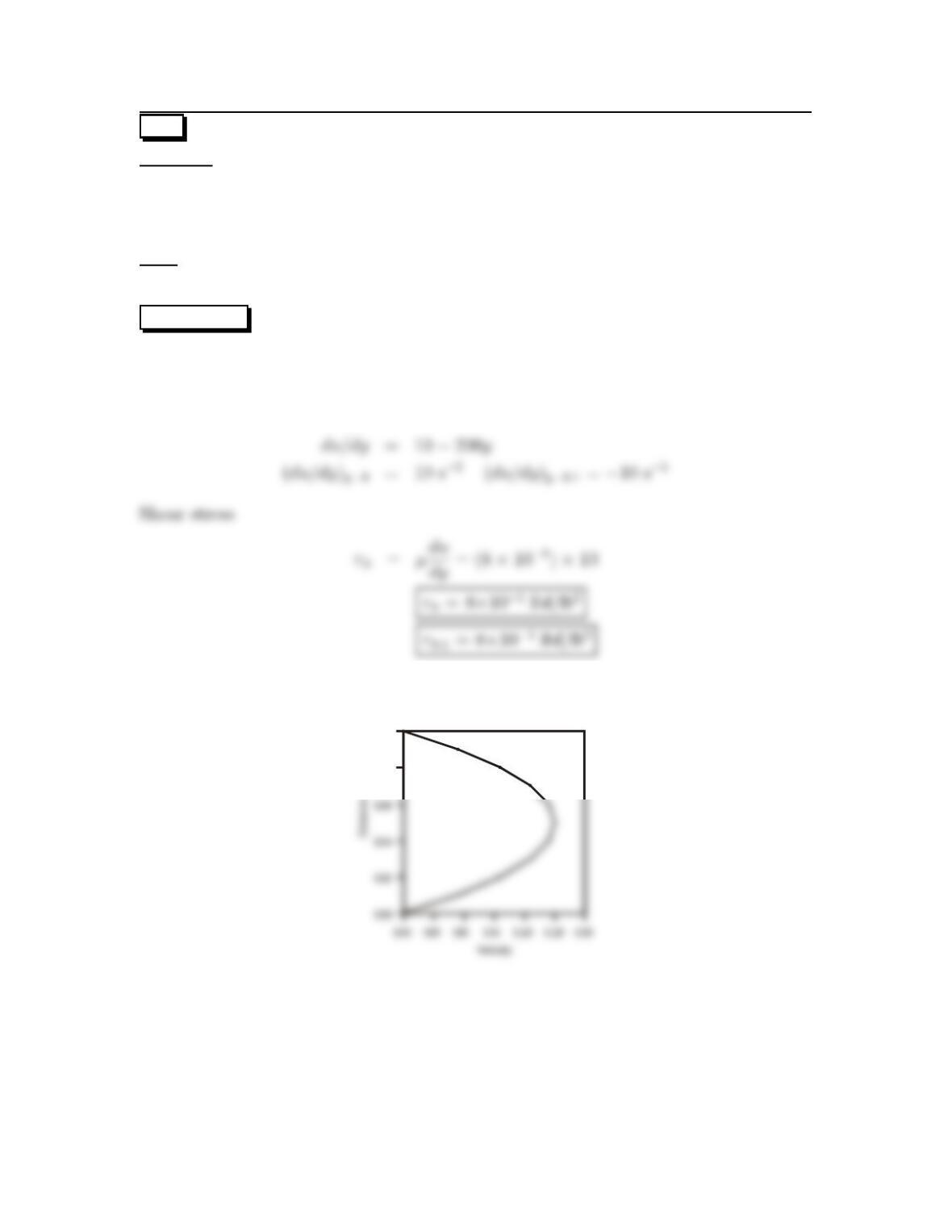
Velocity distribution of crude oil between two walls.
μ=8×10⁻⁵lbf s/ft2,B=0.1ft.
u=100y(0.1−y)ft/s,T=100◦F.
Find:
Shear stress at walls.
SOLUTION
Velocity distribution
u=100y(0.1−y)=10y−100y2
Rate of strain
Plot
0
.08
0
.10
32
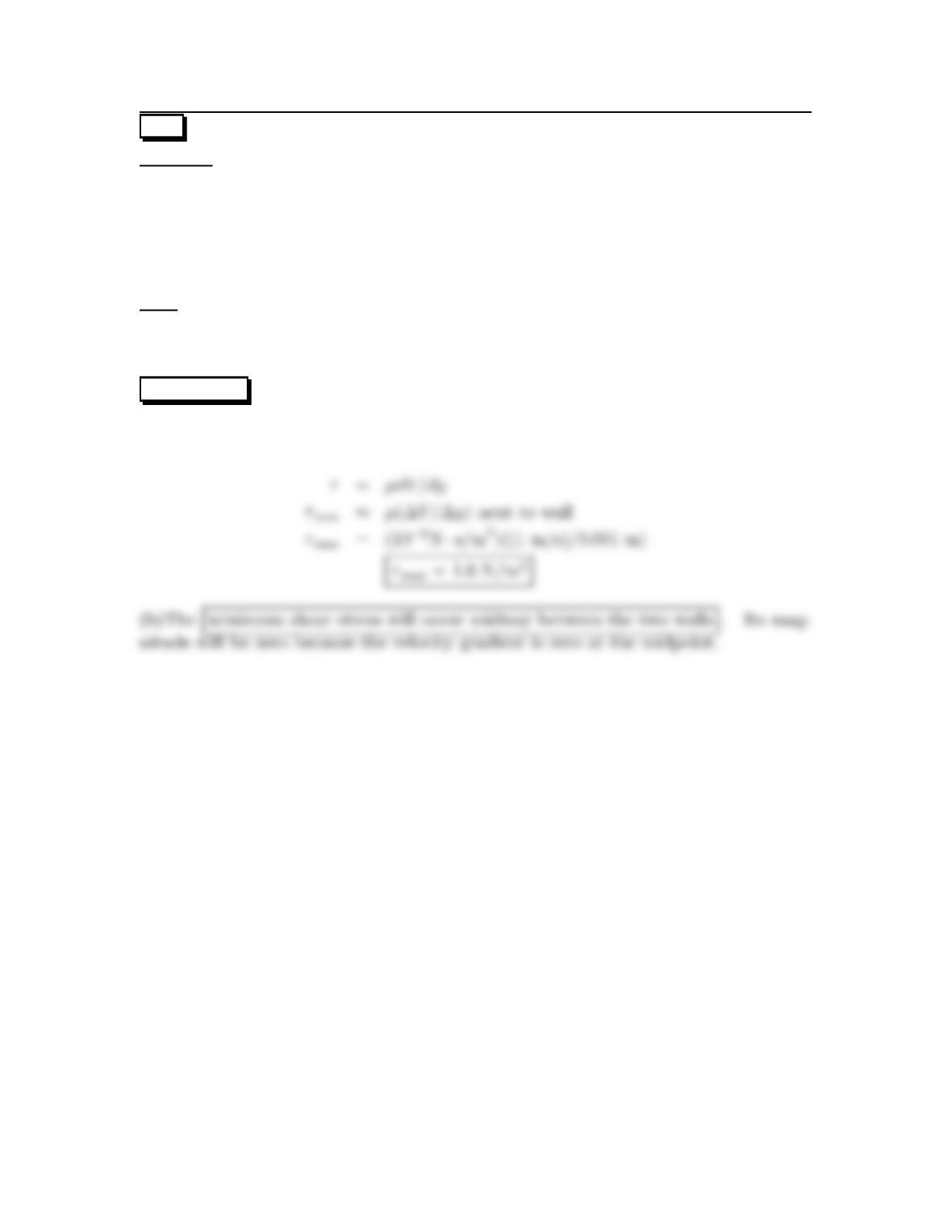
2.32
Situation:
A liquid flows between parallel boundaries.
y0=0.0mm,V0=0.0m/s.
y1=1.0mm,V1=1.0m/s.
y2=2.0mm,V2=1.99 m/s.
y3=3.0mm,V3=2.98 m/s.
Find:
(a) Maximum shear stress.
(b) Location where minimum shear stress occurs.
SOLUTION
(a) Maximum shear stress
33
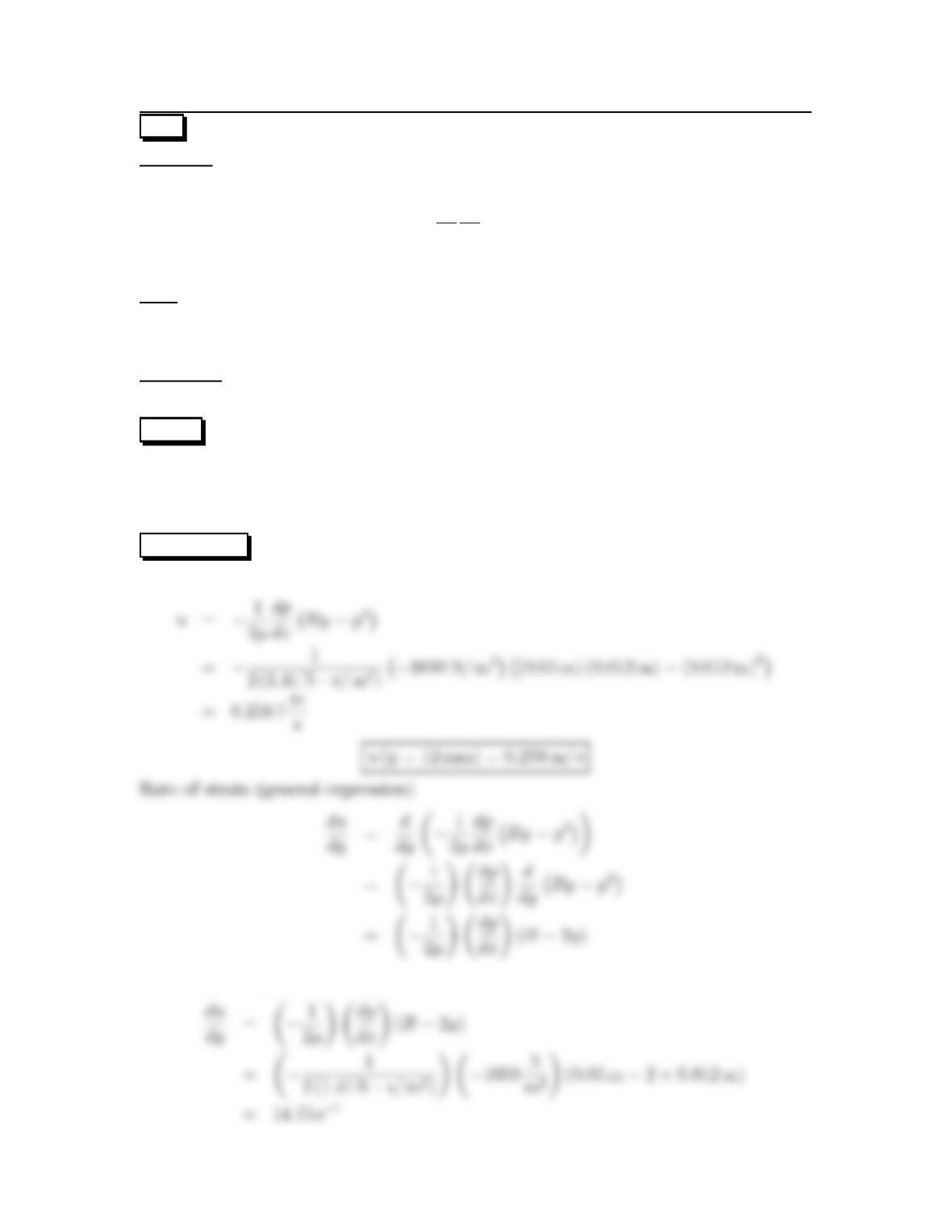
2.33
Situation:
Glycerin is flowing in between two stationary plates. The velocity distribution is
u=−1
2μ
dp
dx ¡By −y2¢
dp/dx =−1.6kPa/m,B=5cm.
Find:
Velocity and shear stress at a distance of 12 mm from wall (i.e. at y=12mm).
Velocity and shear stress at the wall (i.e. at y=0mm).
Properties:
Glycerin (20 ◦C),TableA.4:μ=1.41 N ·s/m2.
PLAN
Find velocity by direct substitution into the specified velocity distribution.
Find shear stress using the definition of viscosity: τ=μ(du/dy), where the rate-of-
strain (i.e. the derivative du/dy)isfoundbydifferentiating the velocity distribution.
SOLUTION
a.) Velocity (at y=12mm)
Rate of strain (at y=12mm)
34
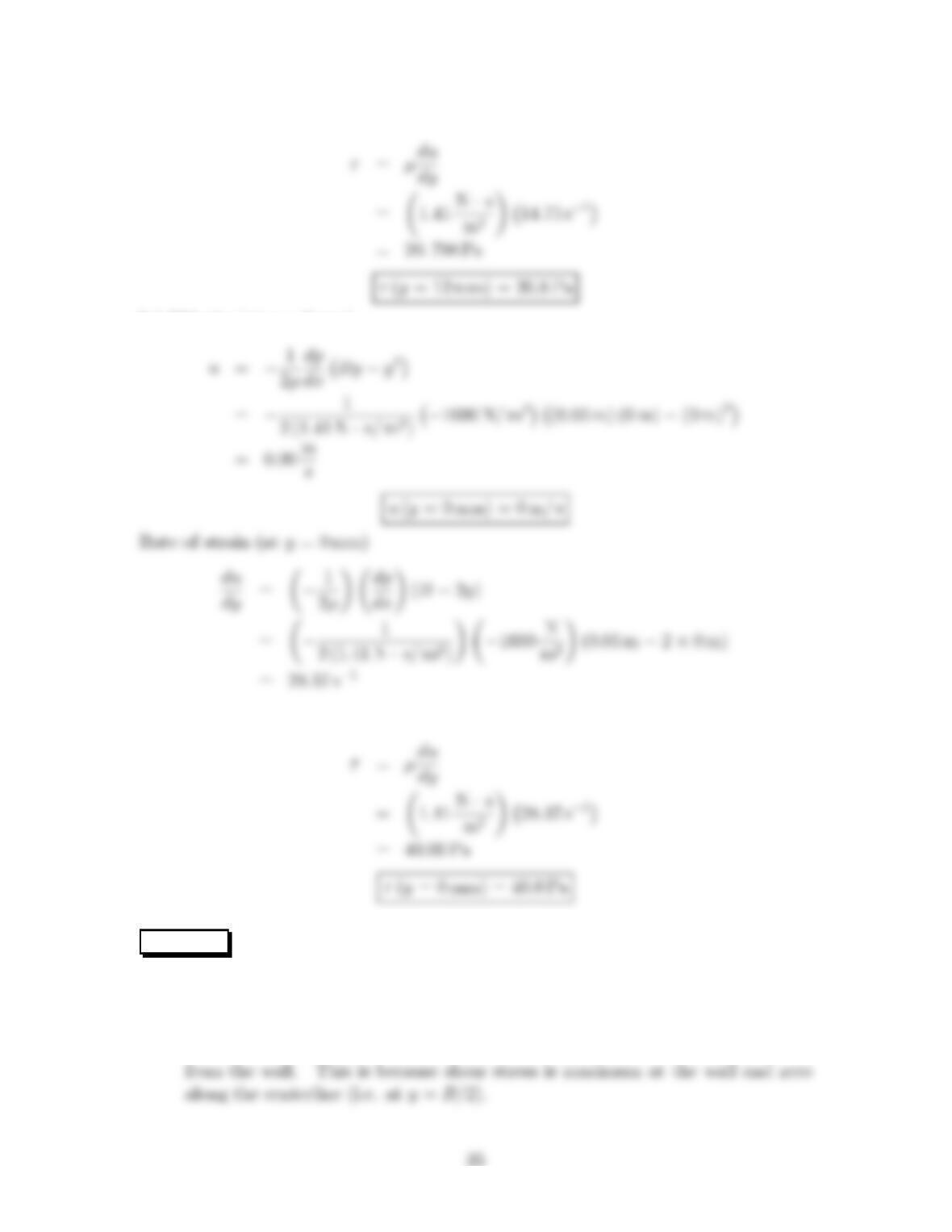
Definition of viscosity
b.) Velocity (at y=0mm)
Shear stress (at y=0mm)
REVIEW
1. As expected, the velocity at the wall (i.e. at y=0)is zero due to the no slip
condition.
2. As expected, the shear stress at the wall is larger than the shear stress away
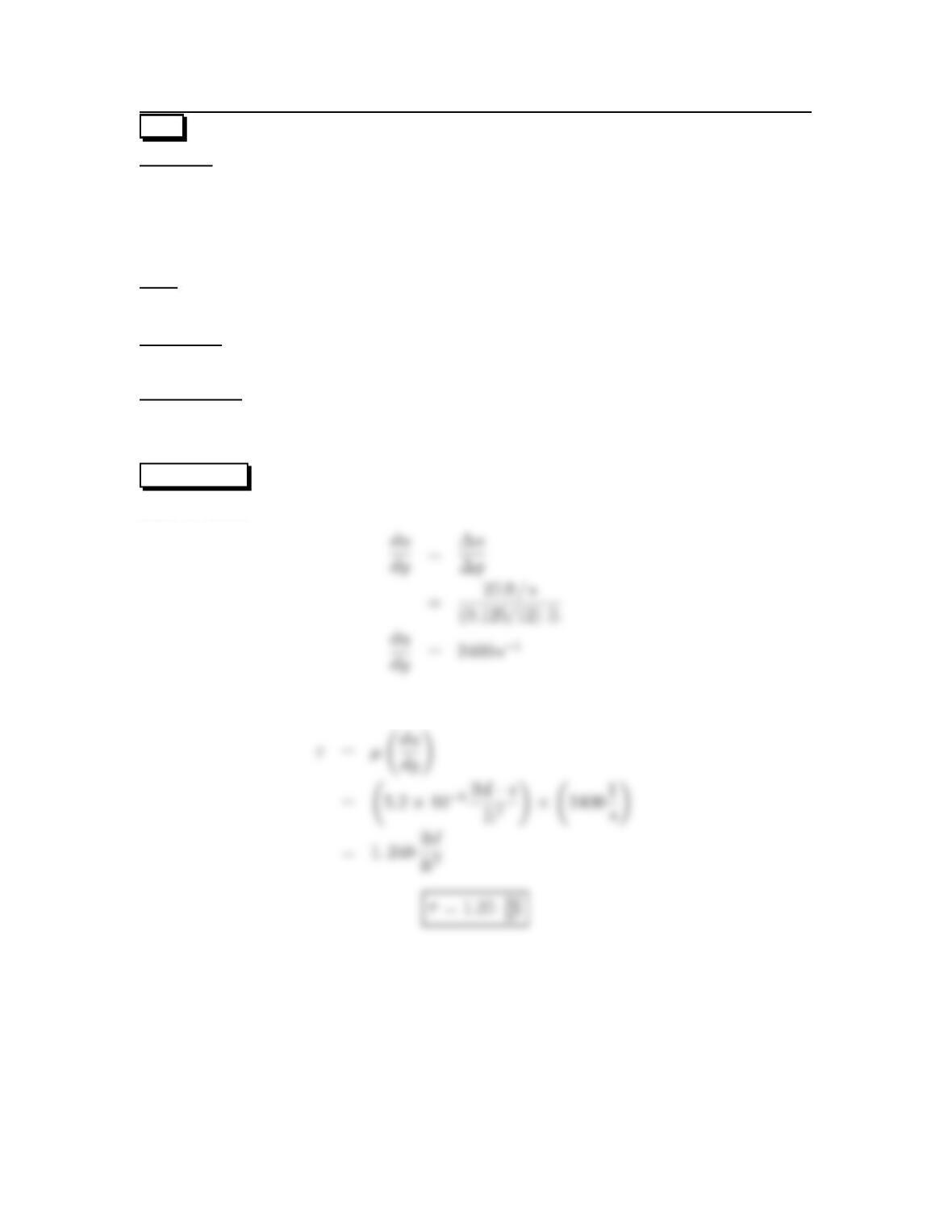
2.34
Situation:
Oil (SAE 10W30)fills the space between two plates.
∆y=1/8=0.125 in,u=25ft/s.
Lower plate is at rest.
Find:
Shear stress in oil.
Properties:
Oil (SAE 10W30 @ 150 ◦F) from Figure A.2: μ=5.2×10⁻⁴lbf·s/ft2.
Assumptions:
1.) Assume oil is a Newtonian fluid.
2.) Assume Couette flow (linear velocity profile).
SOLUTION
Rate of strain
Newton’s law of viscosity
36
2.35
Situation:
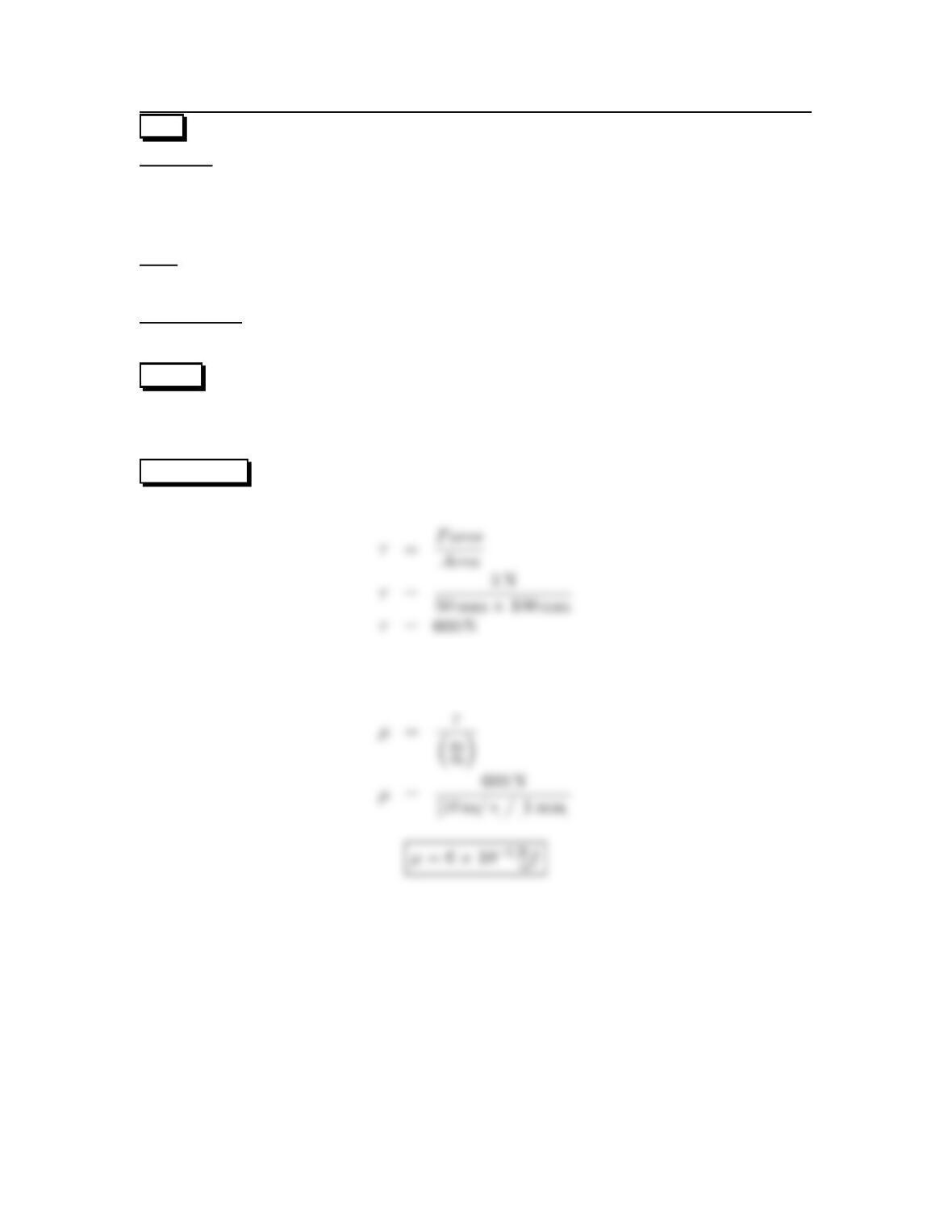
Sliding plate viscometer is used to measure fluid viscosity.
A=50×100 mm,∆y=1mm.
u=10m/s,F=3N.
Find:
Viscosity of the fluid.
Assumptions:
Linear velocity distribution.
PLAN
1. The shear force τis a force/area.
2. Use equation for viscosity to relate shear force to the velocity distribution.
SOLUTION
1. Calculate shear force
2. Find viscosity
37
2.36
Situation:
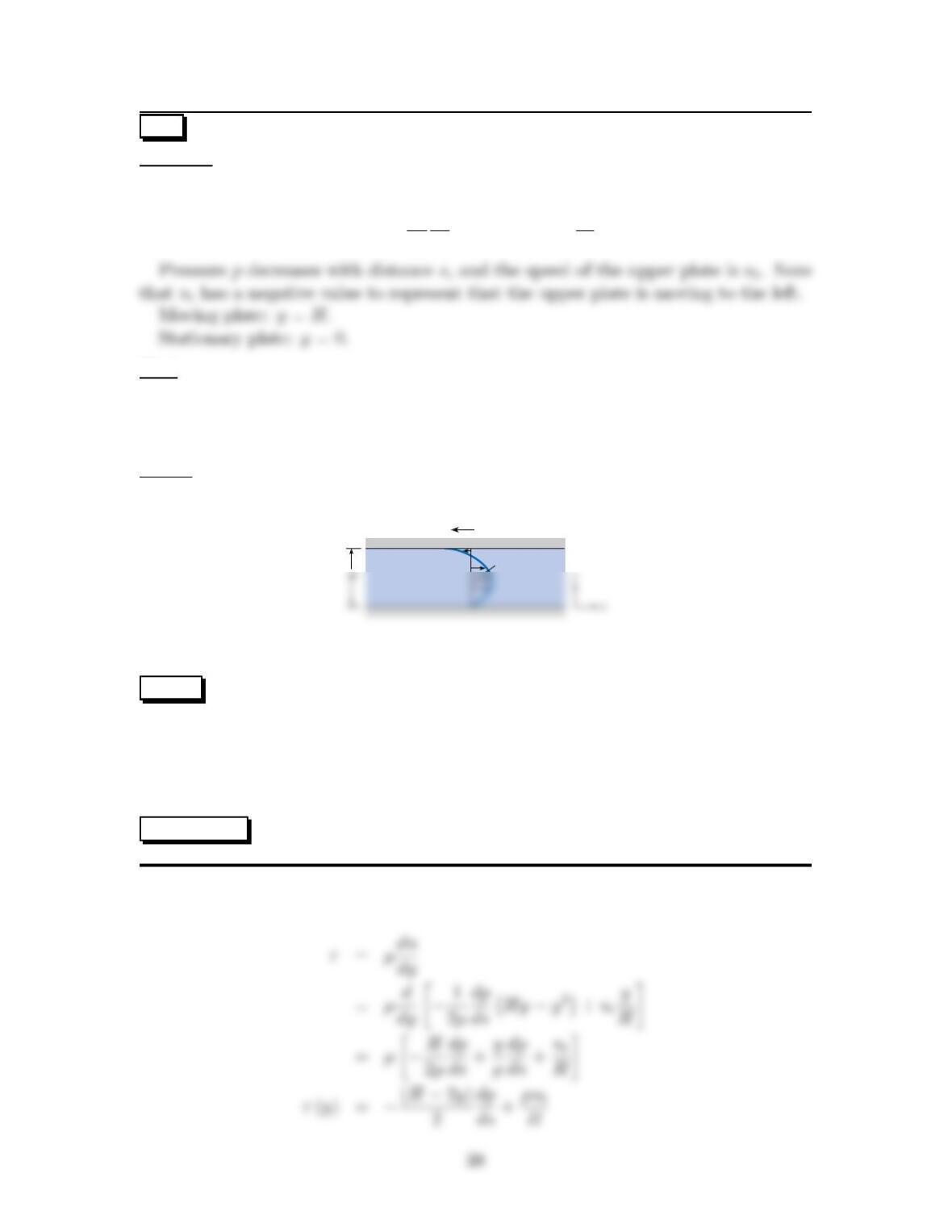
Laminar flow occurs between two horizontal parallel plates. The velocity distrib-
ution is
u=−1
2μ
dp
ds ¡Hy −y2¢+ut
y
H
Find:
(a) Whether shear stress is greatest at the moving or stationary plate.
(b) Location of zero shear stress.
(c) Derive an expression for plate speed to make the shear stress zero at y=0.
Sketch:
u
u
t
PLAN
By inspection, the rate of strain (du/dy)or slope of the velocity profile is larger at
the moving plate. Thus, we expect shear stress τto be larger at y=H. To check
this idea, find shear stress using the definition of viscosity: τ=μ(du/dy).Evaluate
and compare the shear stress at the locations y=Hand y=0.
SOLUTION
Part (a)
1. Shear stress, from definition of viscosity
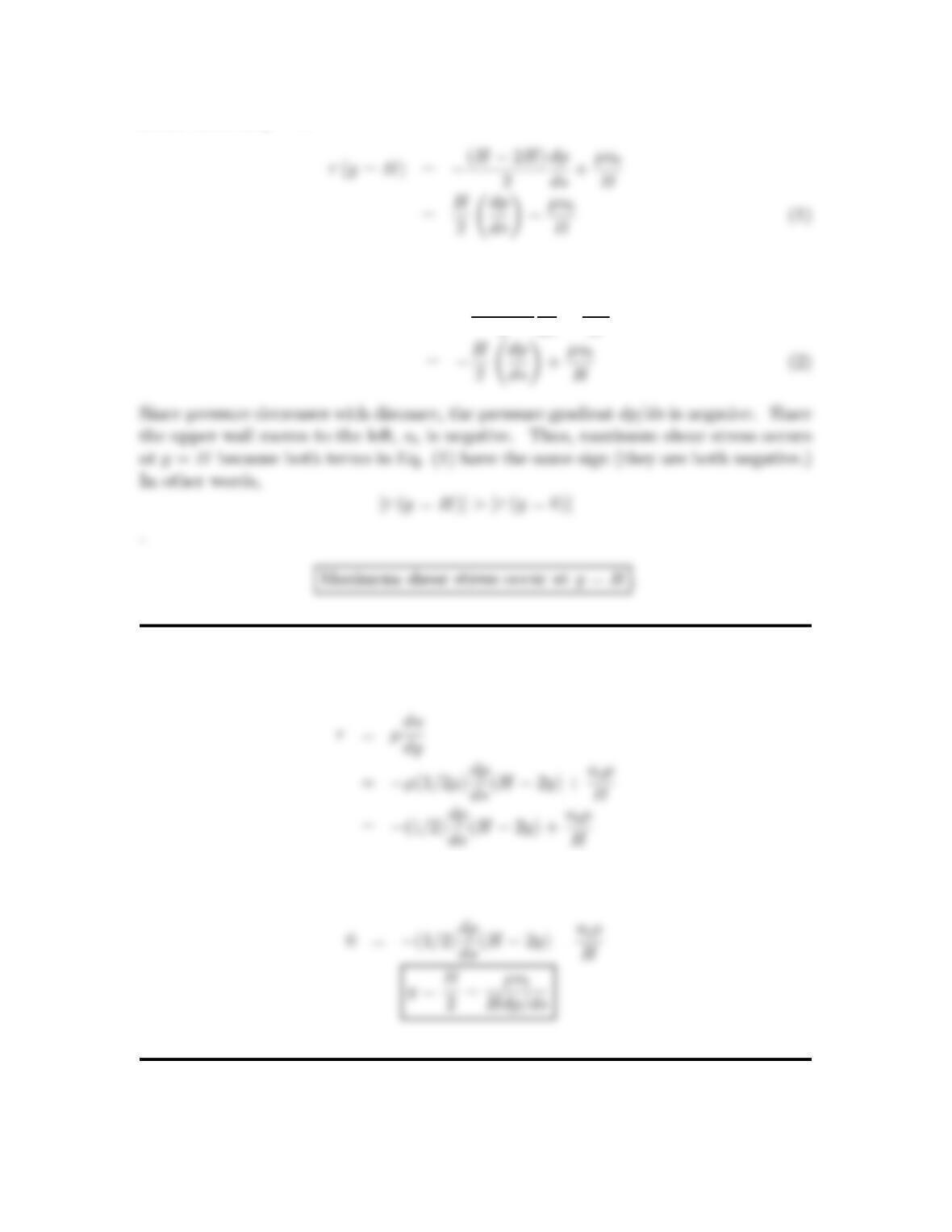
Shear stress at y=H
2. Shear stress at y=0
τ(y=0) = −(H−0)
2
dp
ds +μut
H
Part (b)
Use definition of viscosity to find the location (y)of zero shear stress
Set τ=0and solve for y
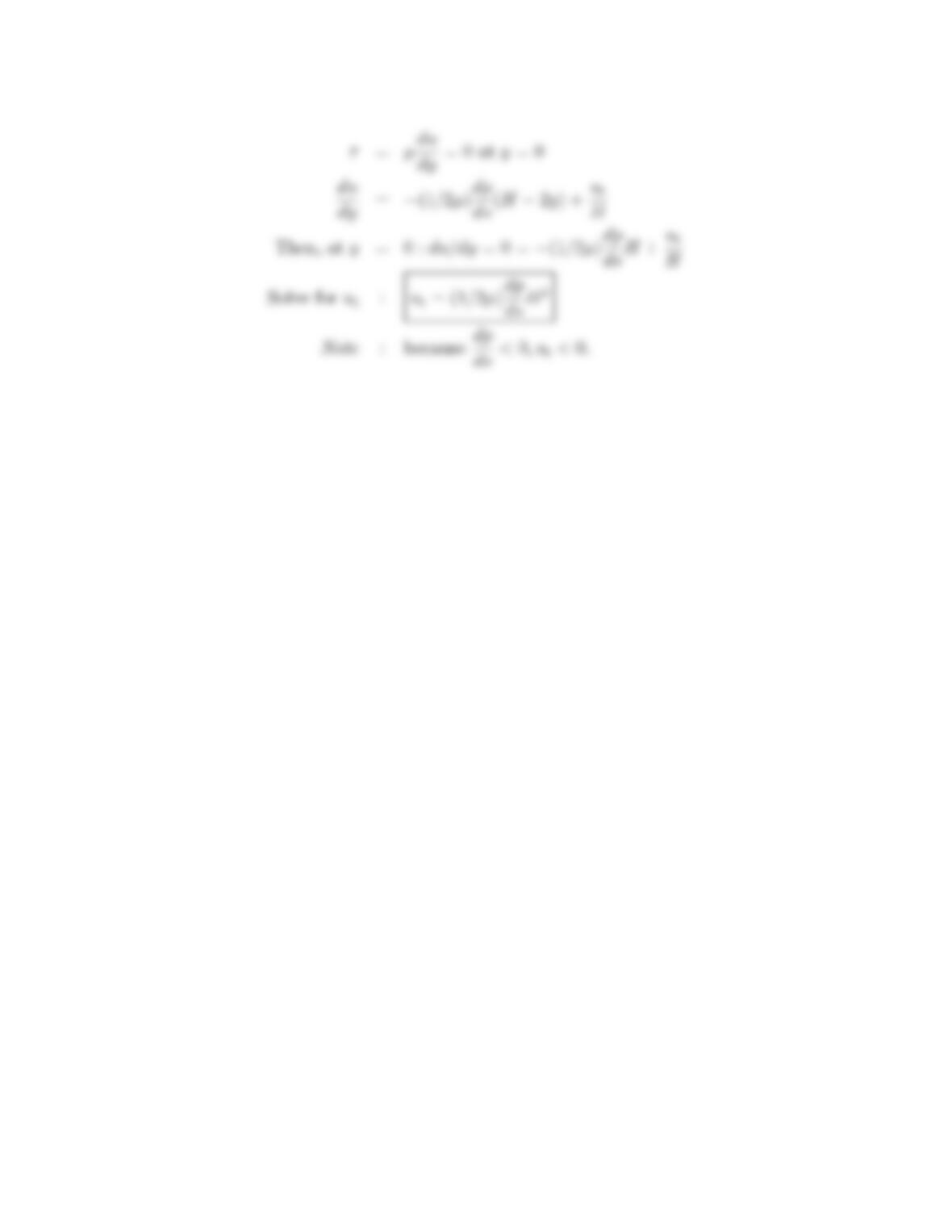
Part (c)
39
40