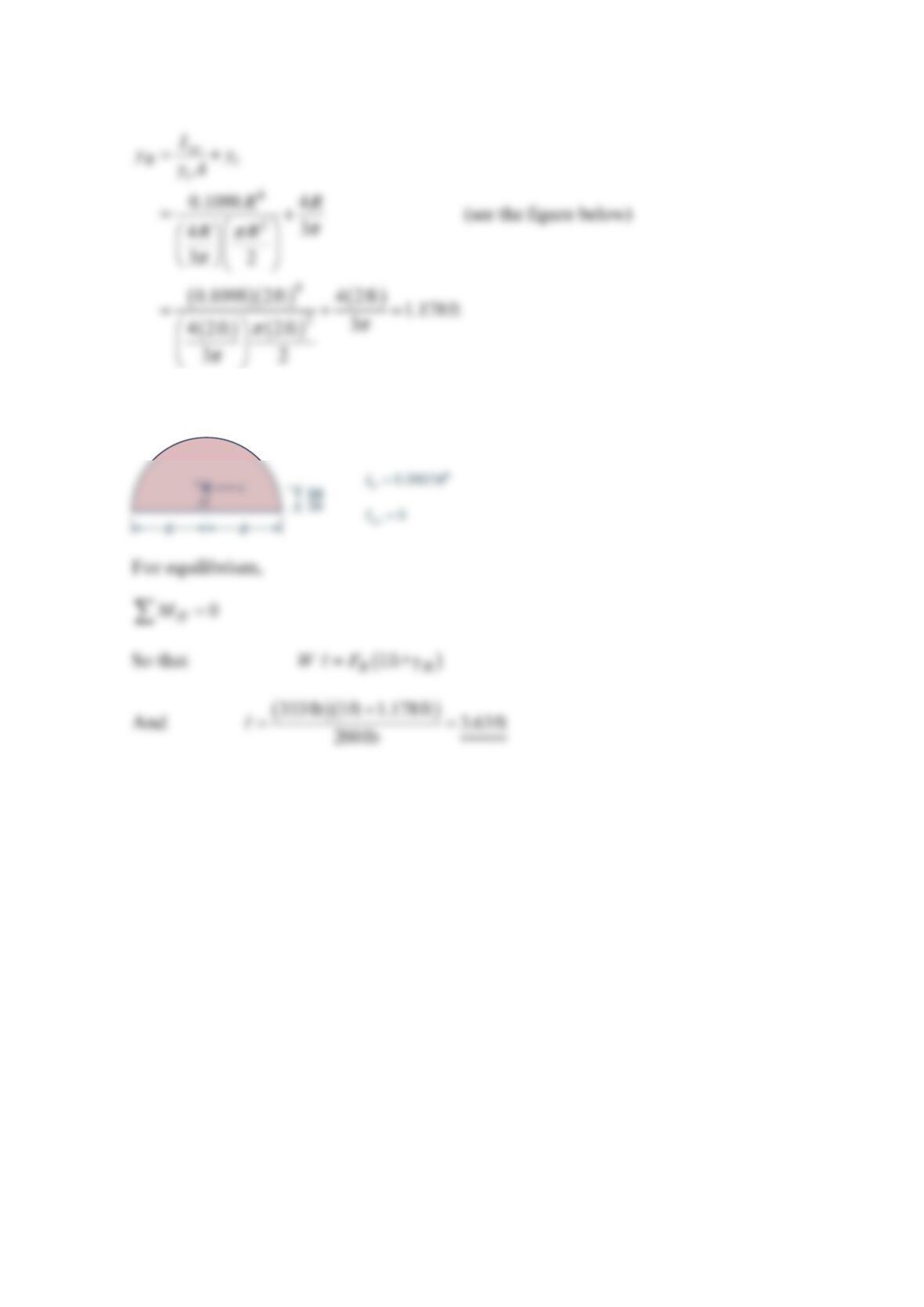
To locate R
F
,
A = R
2
–––––
2
π
I
xc
= 0.1098R
4
Problem 2.109
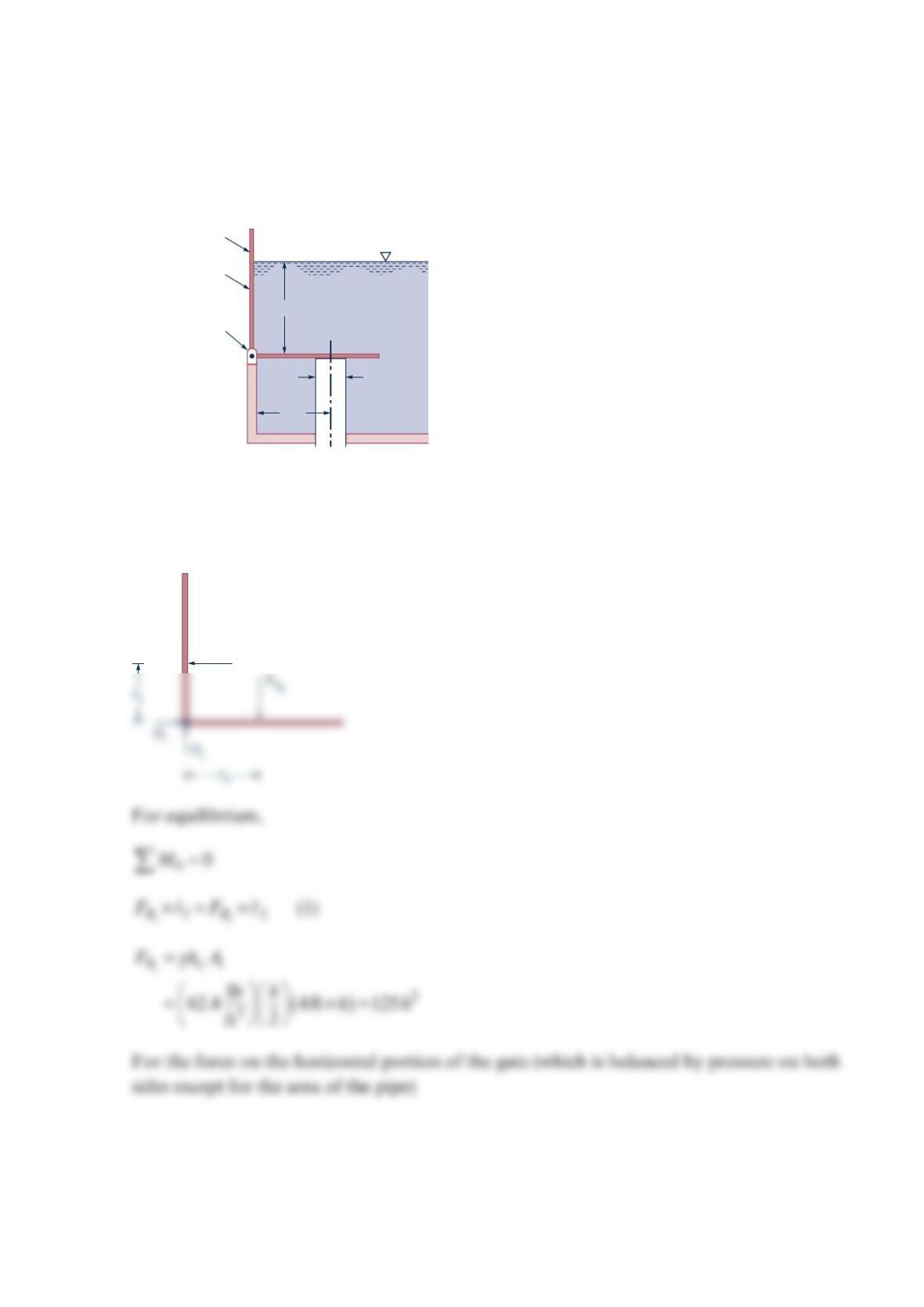
A thin 4-ft-wide, right-angle gate with negligible mass is free to pivot about a frictionless
hinge at point O, as shown in the figure below. The horizontal portion of the gate covers a
1-ft-diameter drain pipe that contains air at atmospheric pressure. Determine the minimum
water depth,
h
, at which the gate will pivot to allow water to flow into the pipe.
Solution 2.109
Water
Hinge
Right-angle gate
Width = 4 ft
1-ft-diameter pipe
O
h
3 ft
F
R1
Problem 2.110
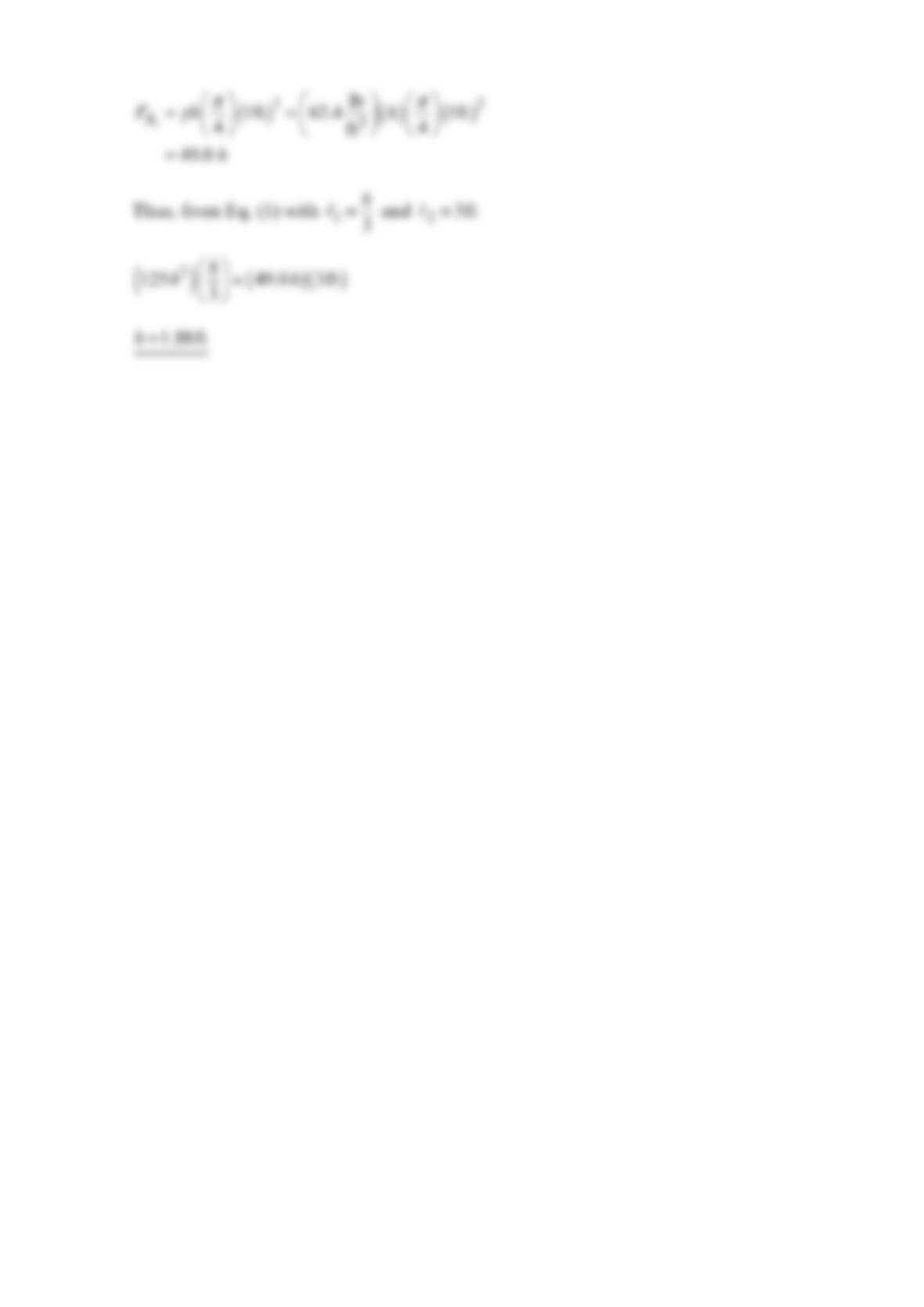
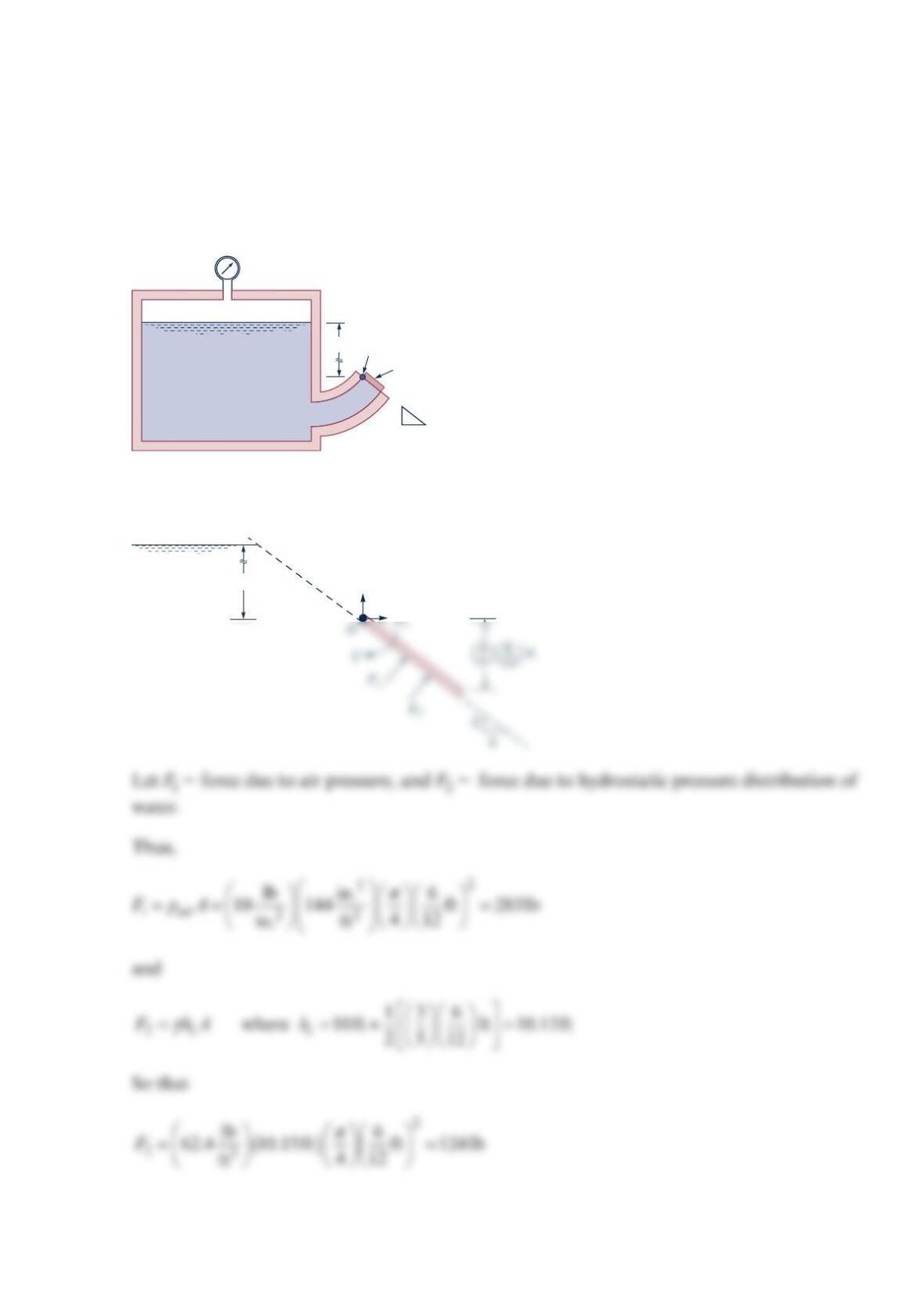
The closed vessel of the figure below contains water with an air pressure of 10 psi at the
water surface. One side of the vessel contains a spout that is closed by a 6-in.-diameter
circular gate that is hinged along one side as illustrated. The horizontal axis of the hinge is
located 10 ft below the water surface. Determine the minimum torque that must be applied
at the hinge to hold the gate shut. Neglect the weight of the gate and friction at the hinge.
Solution 2.110
Water
Air
10 psi
Axis
6-in.-diameter
gate
3
4
10 ft
H
y
10 ft
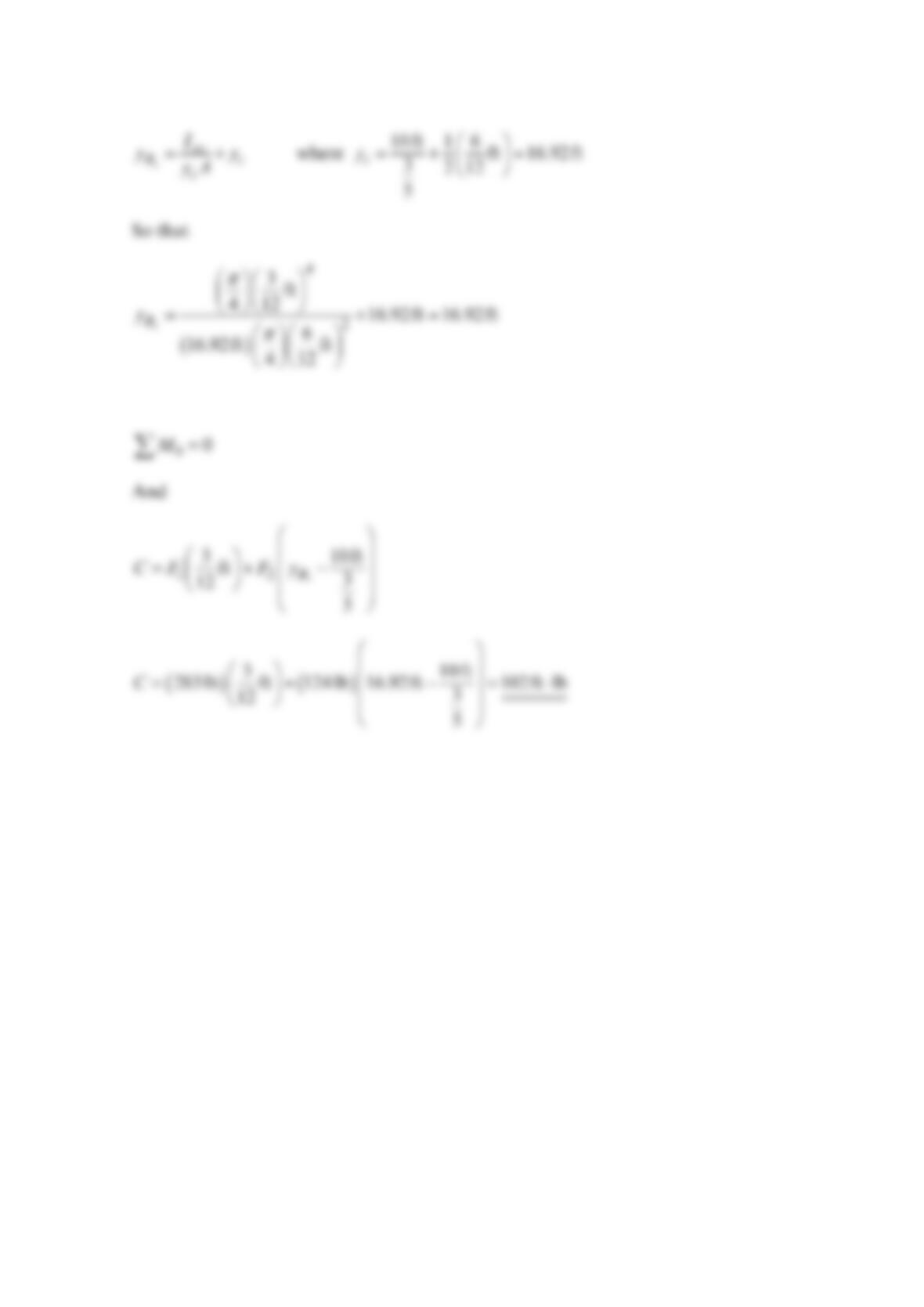
Also,
For equilibrium,
Problem 2.111
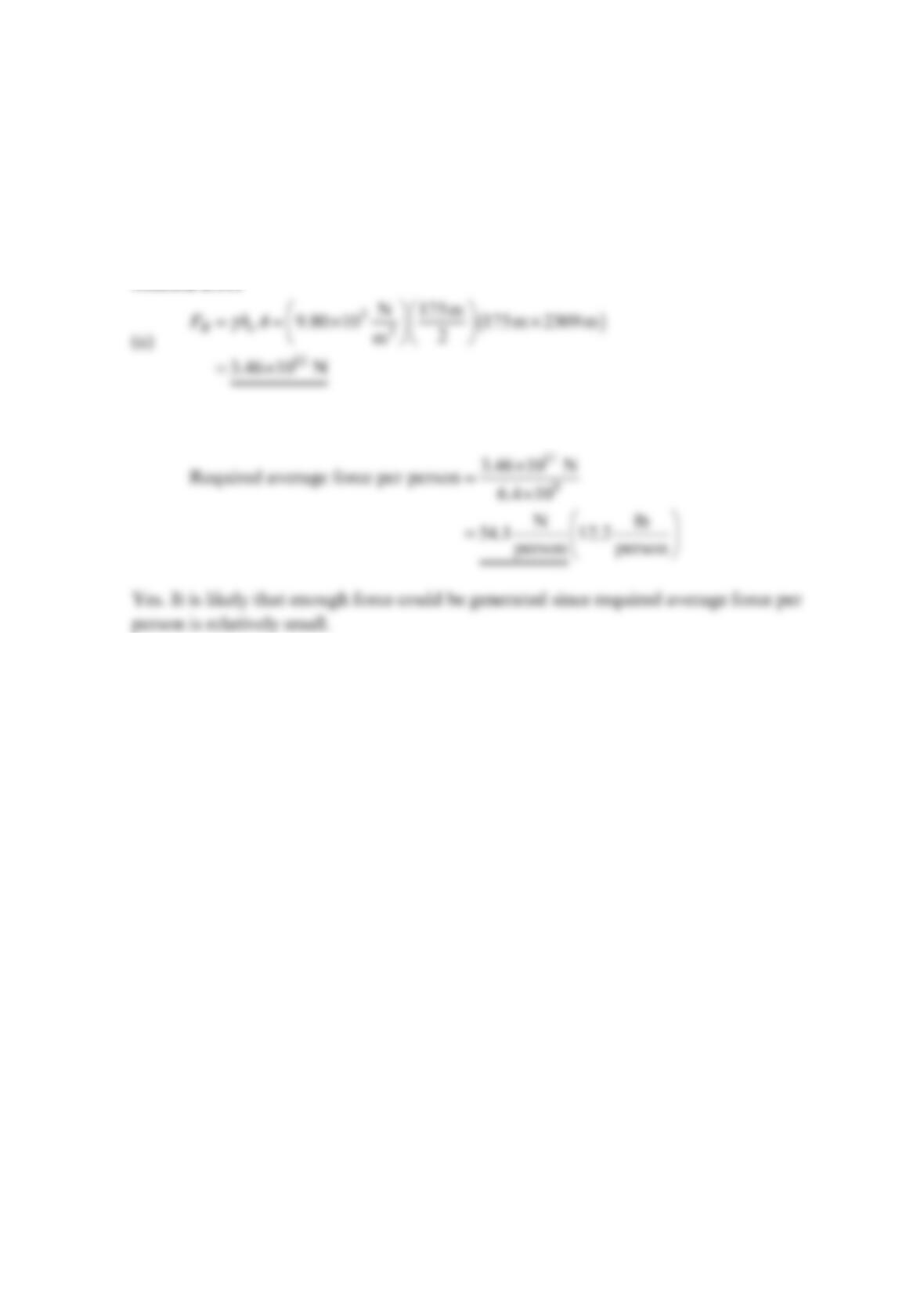
(a) Determine the horizontal hydrostatic force on the 2309-m-long Three Gorges Dam
when the average depth of the water against it is
1
75 m. (b) If all of the 6.4 billion people on
Earth were to push horizontally against the Three Gorges Dam, could they generate
enough force to hold it in place? Support your answer with appropriate calculations.
Solution 2.111
(b)
Problem 2.113
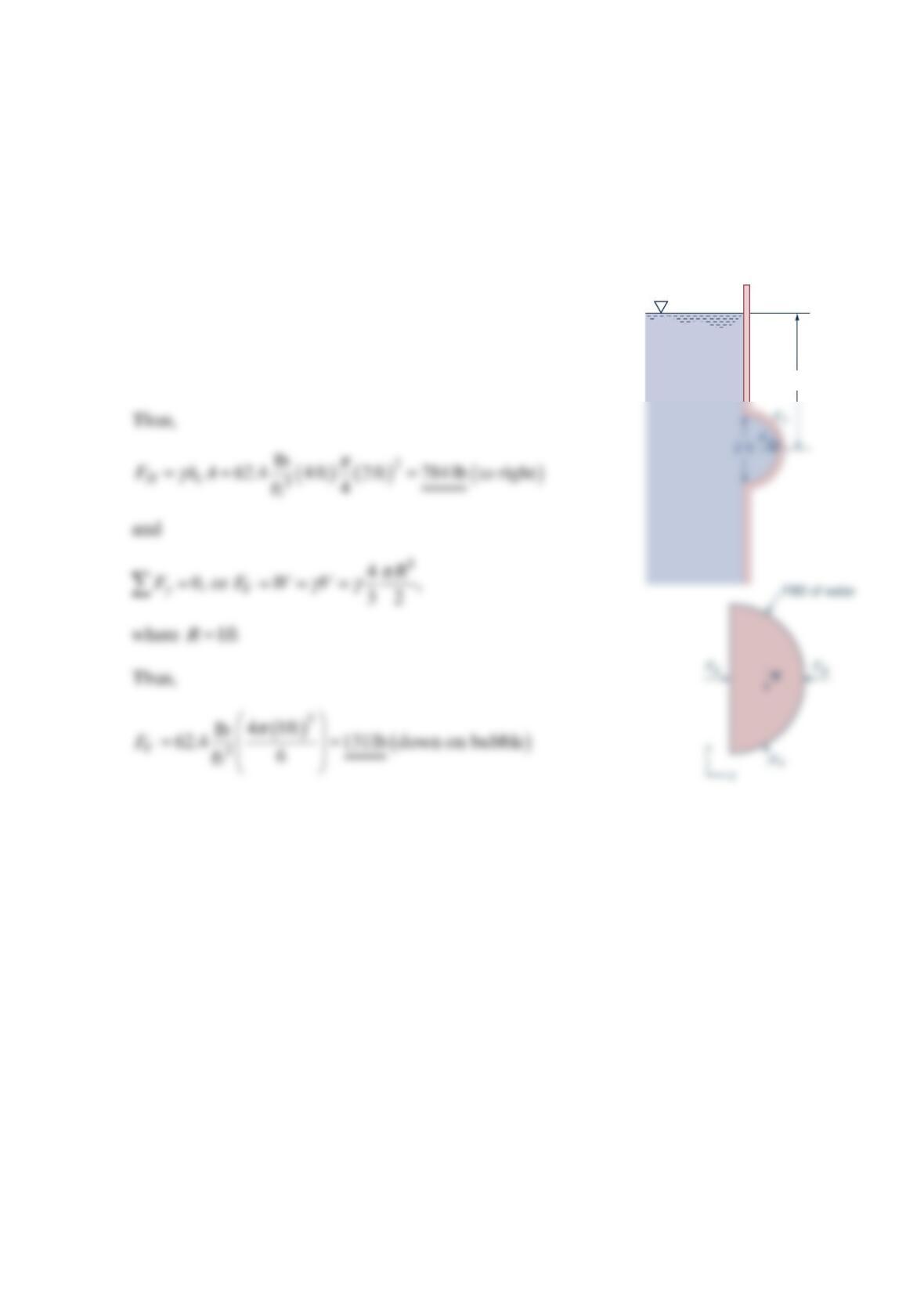
A 2-ft-diameter hemispherical plexiglass “bubble” is to be used as a special window on the
side of an above-ground swimming pool. The window is to be bolted onto the vertical wall
of the pool and faces outward, covering a 2-ft-diameter opening in the wall. The center of
the opening is 4 ft below the surface. Determine the horizontal and vertical components of
the force of the water on the hemisphere.
Solution 2.113
=
0
x
F, or ==
HRc
FFpA
h
c = 4 ft
Problem 2.114
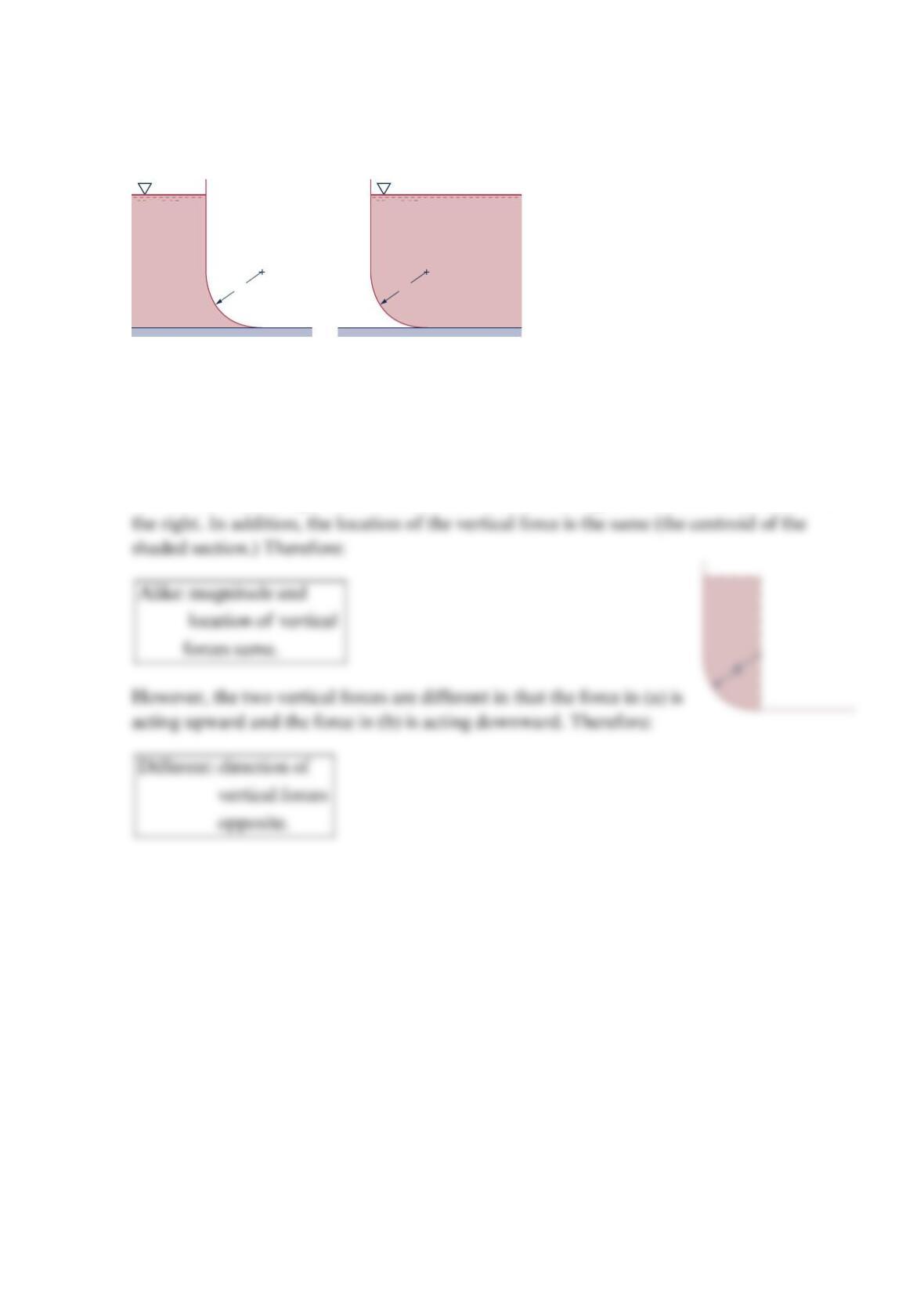
Consider the curved surface shown in the figure below (a) and (b). The two curved surfaces
are identical. How are the vertical forces on the two surfaces alike? How are they different?
Solution 2.114
In both cases, the magnitude of the vertical force is the weight of shaded section shown on
Oil
(
a
)
R
Oil
(
b
)
R
Problem 2.115
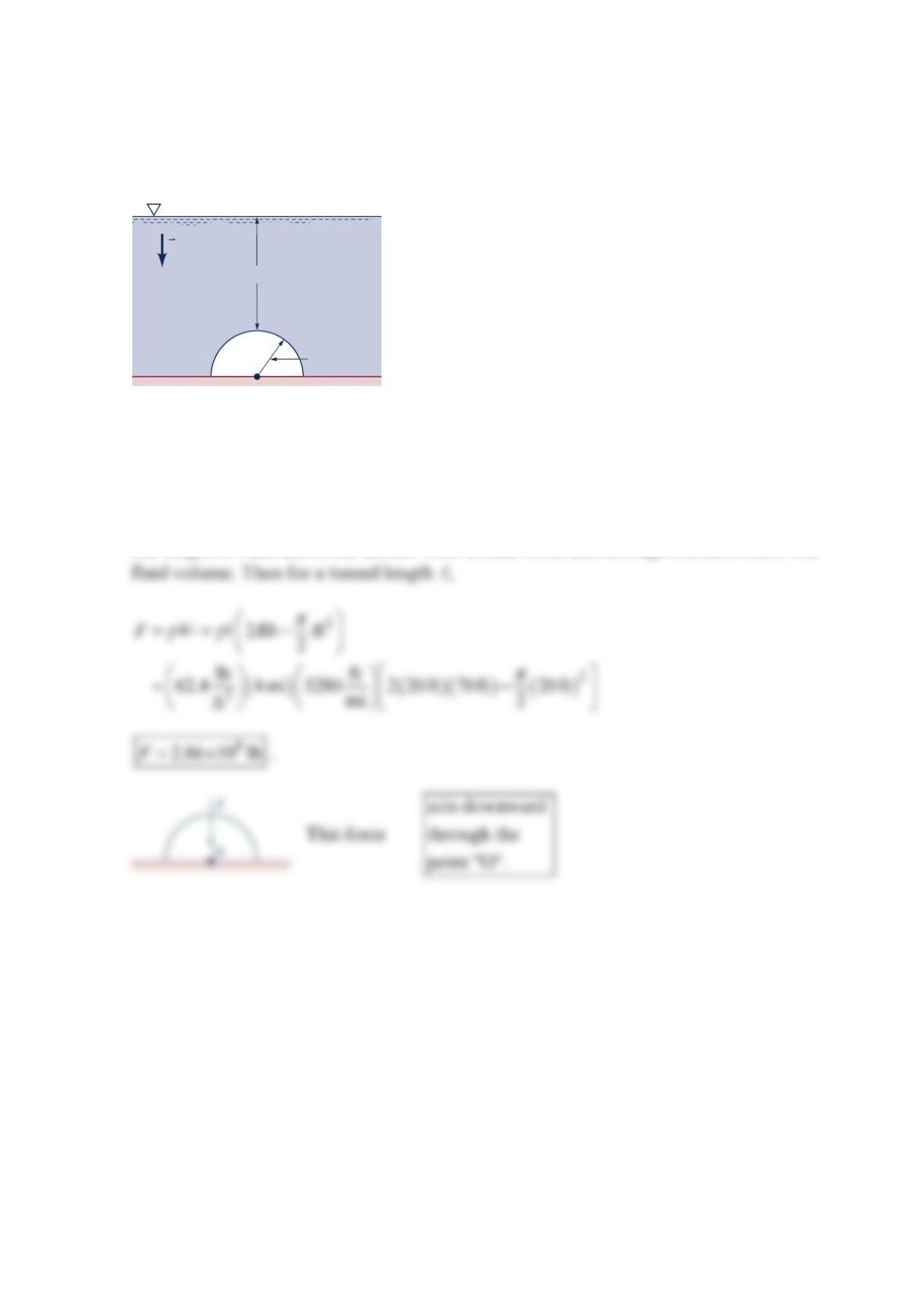
The figure below shows a cross section of a submerged tunnel used by automobiles to travel
under a river. Find the magnitude and location of the resultant hydrostatic force on the
circular roof of the tunnel. The tunnel is 4 mi long.
Solution 2.115
Due to symmetry, there is no net horizontal force on the roof. The vertical force is equal to
the weight of fluid above the tunnel. This vertical force acts through the centroid of the
50′
R = 20′
g
Problem 2.116
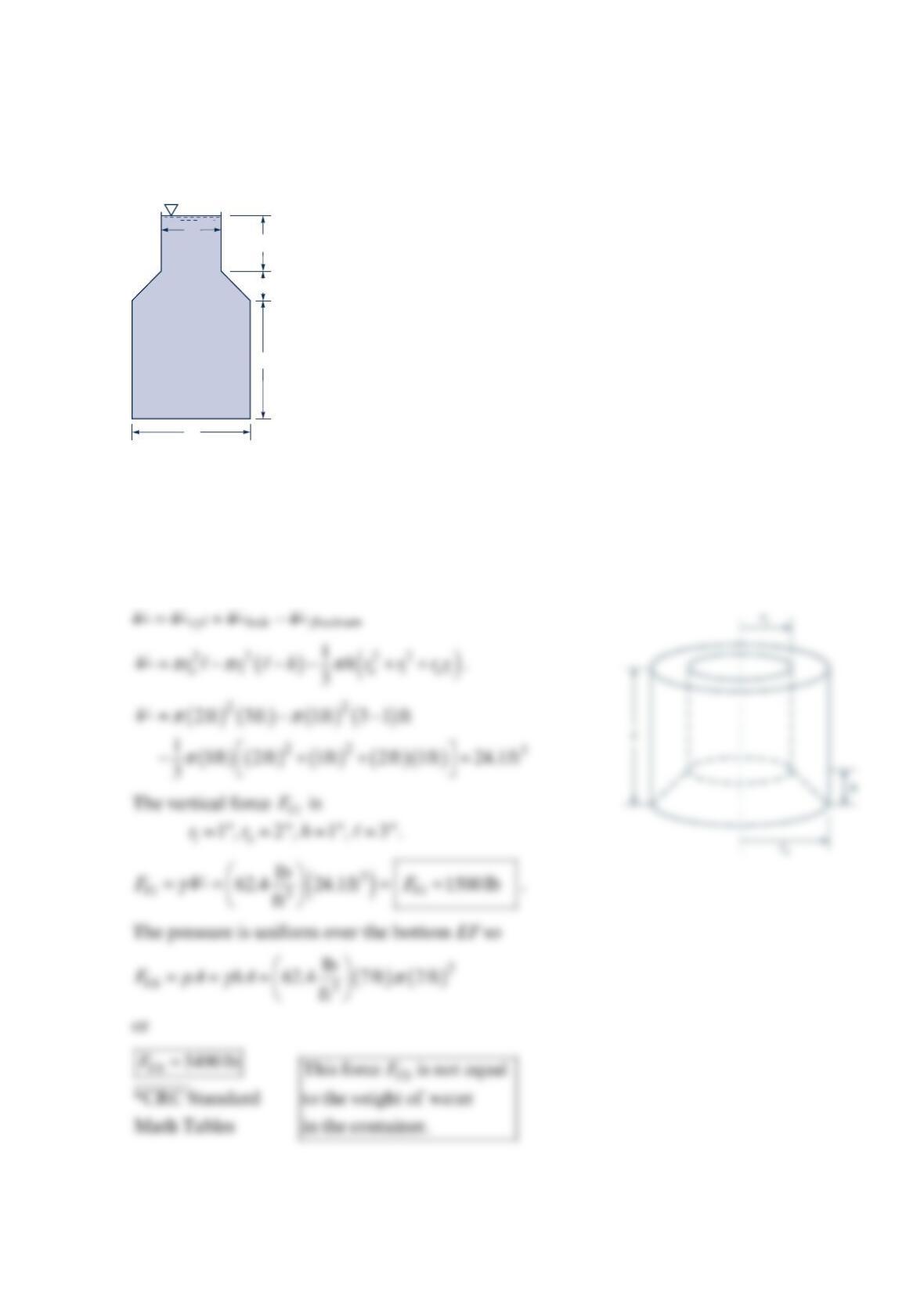
The container shown in the figure below has circular cross sections. Find the vertical force
on the inclined surface. Also find the net vertical force on the bottom, EF. Is the vertical
force equal to the weight of the water in the container?
Solution 2.116
The vertical force on the inclined surface is equal to the weight of the water “above” it.
This “water volume” is
4′
A
E
D
F
BC
Water
4′
2′
1′
2′
Problem 2.117
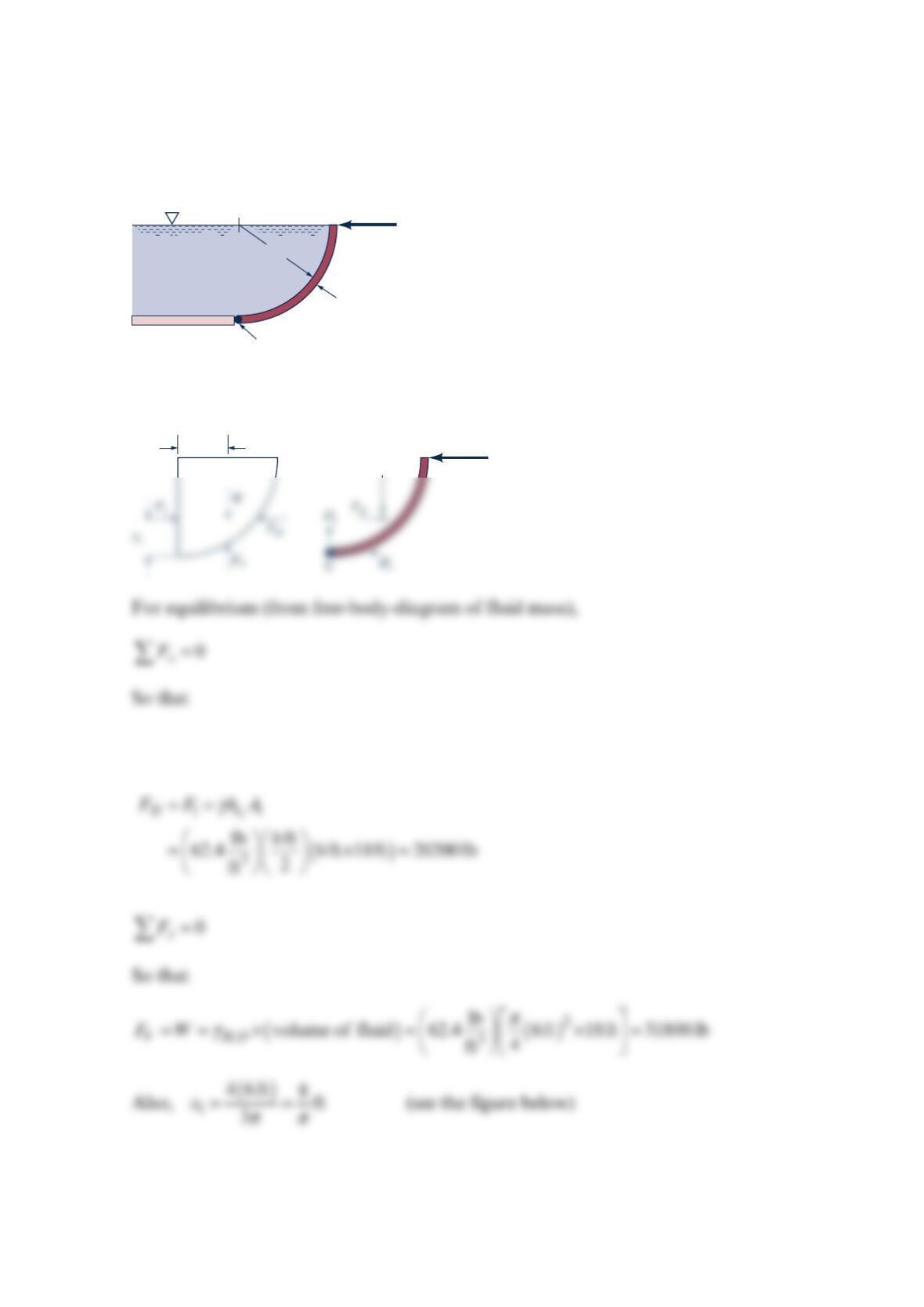
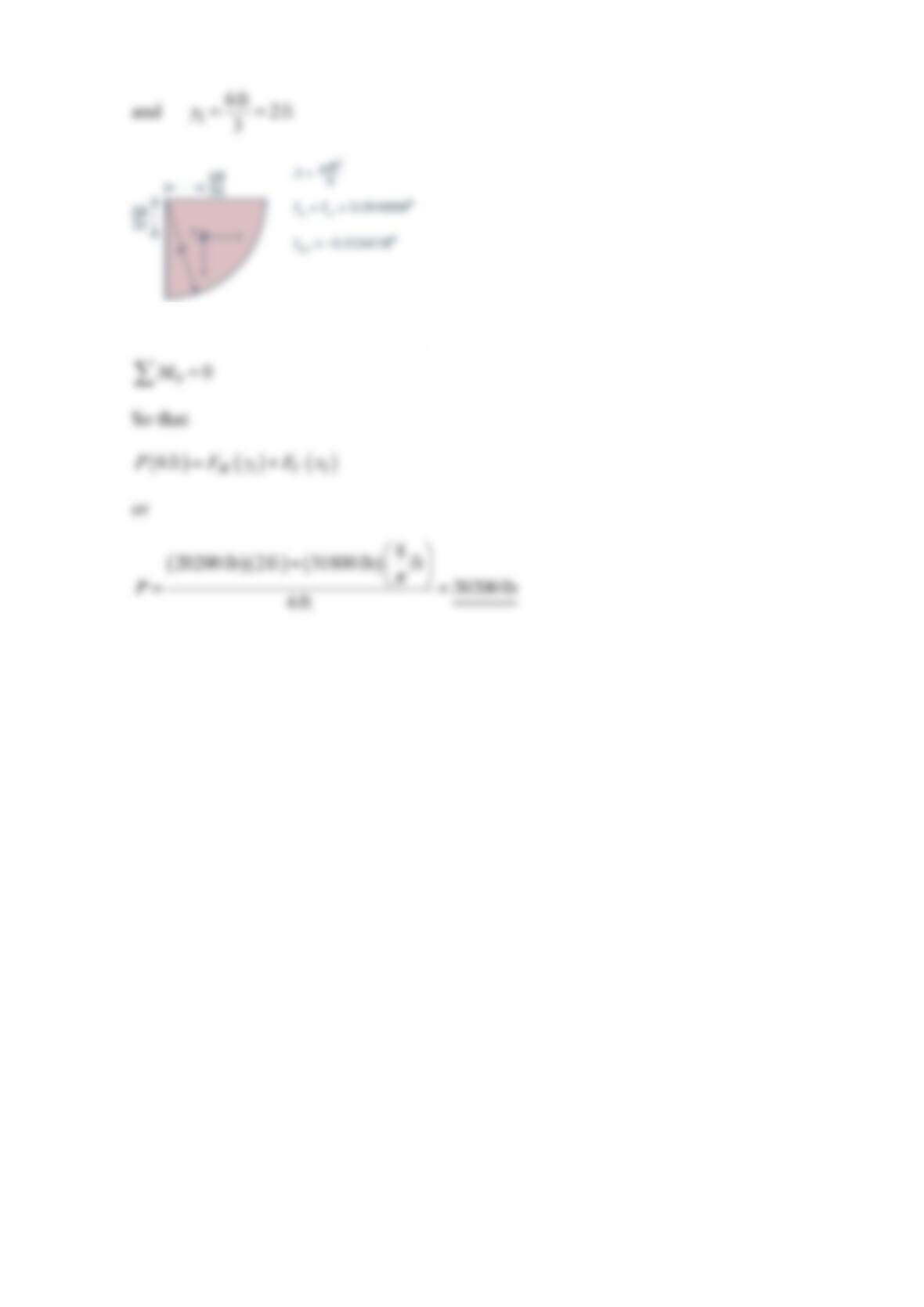
The 18-ft-long lightweight gate of the figure below is a quarter circle and is hinged at H.
Determine the horizontal force, P, required to hold the gate in place. Neglect friction at the
hinge and the weight of the gate.
Solution 2.117
Similarly,
P
6 ft
Gate
Hinge
H
Water
P
F
V
x
1
For equilibrium (from free-body-diagram of gate)
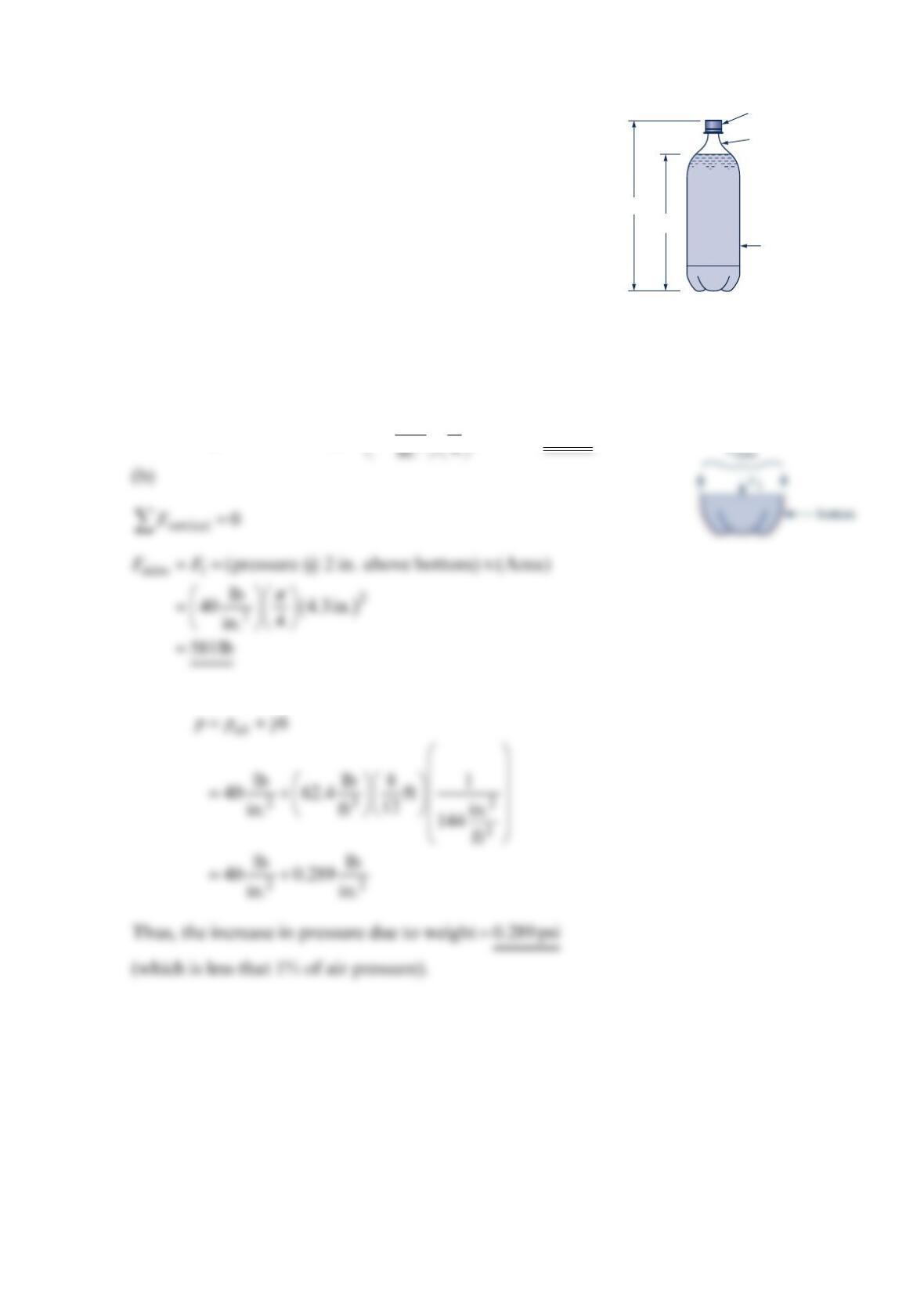
Problem 2.118
The air pressure in the top of the 2-liter pop bottle and the
figure below is 40 psi , and the pop depth is 10 in. The
bottom of the bottle has an irregular shape with a diameter
of 4.3 in. (a) If the bottle cap has a diameter of 1 in. what is
the magnitude of the axial force required to hold the cap in
place? (b) Determine the force needed to secure the bottom
2 in. of the bottle to its cylindrical sides. For this
calculation assume the effect of the weight of the pop is
negligible. (c) By how much does the weight of the pop increase the pressure 2 in. above the
bottom? Assume the pop has the same specific weight as that of water.
Solution 2.118
(a)
()
π
=× = =
2
2
lb
Area 40 1in. 31.4 lb
cap air cap
Fp
(c)
12 in.
10 in.
1-in. diameter
4.3-in. diameter
pair = 40 psi
Problem 2.119
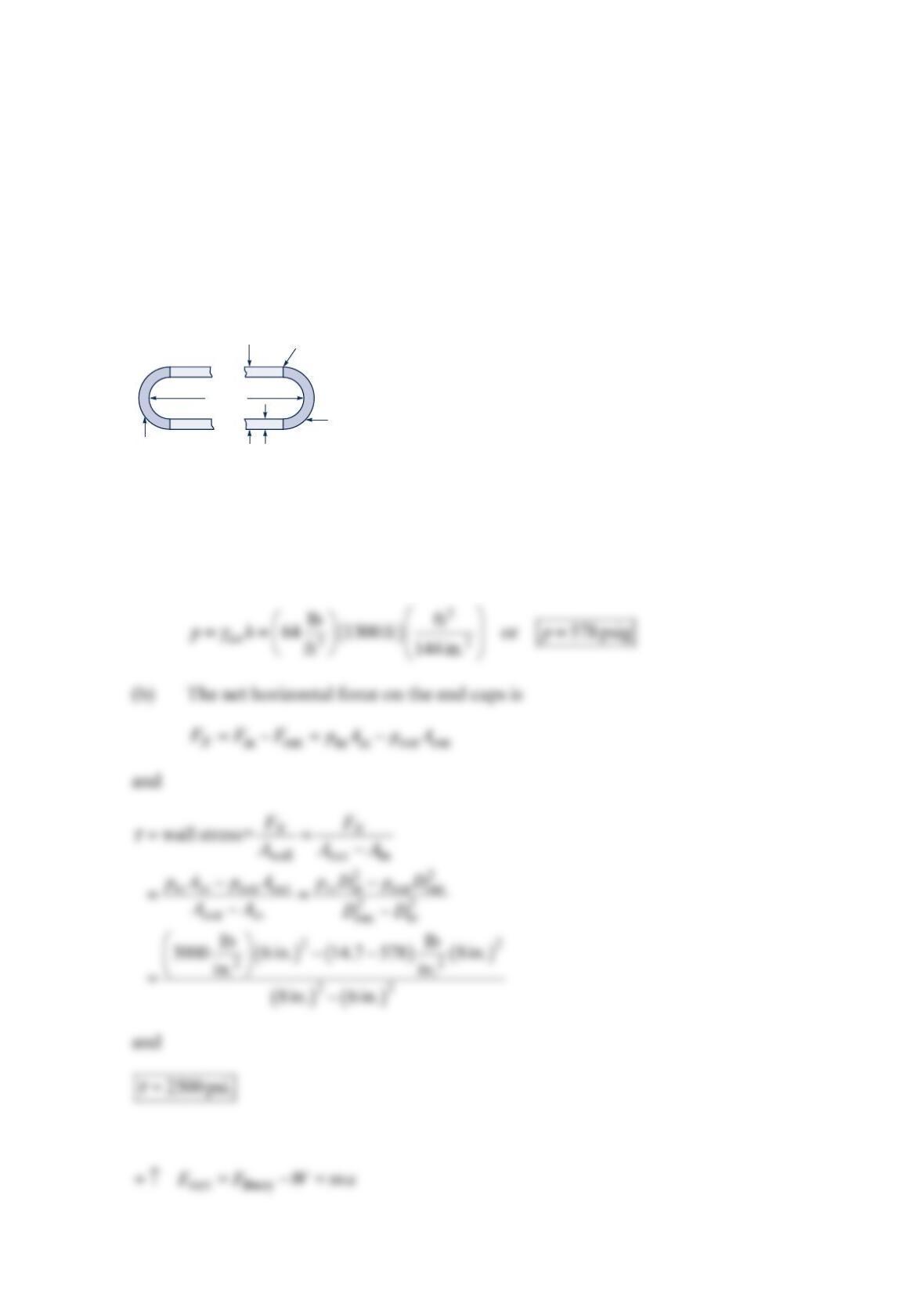
In drilling for oil in the Gulf of Mexico, some divers have to work at a depth of 1300 ft.
(a) Assume that seawater has a constant density of 3
64 lb/ft and compute the pressure at
this depth. The divers breathe a mixture of helium and oxygen stored in cylinders, as shown
in the figure below, at a pressure of 3000 psia . (b) Calculate the force, which trends to blow
the end cap off, that the weld must resist while the diver is using the cylinder at 1300 ft .
(c) After emptying a tank, a diver releases it. Will the tank rise or fall, and what is its initial
acceleration?
Solution 2.119
(a) The hydrostatic pressure is
(c) The net vertical force on an empty tank and Newton’s second law give
30 in.
Steel
p
= 489 lbm/ft
3
1.0 in.
thickness
Spherical
cap
Weld
8.0 in.
diameter
Substituting into the equation for a gives
The numerical values give
Problem 2.120
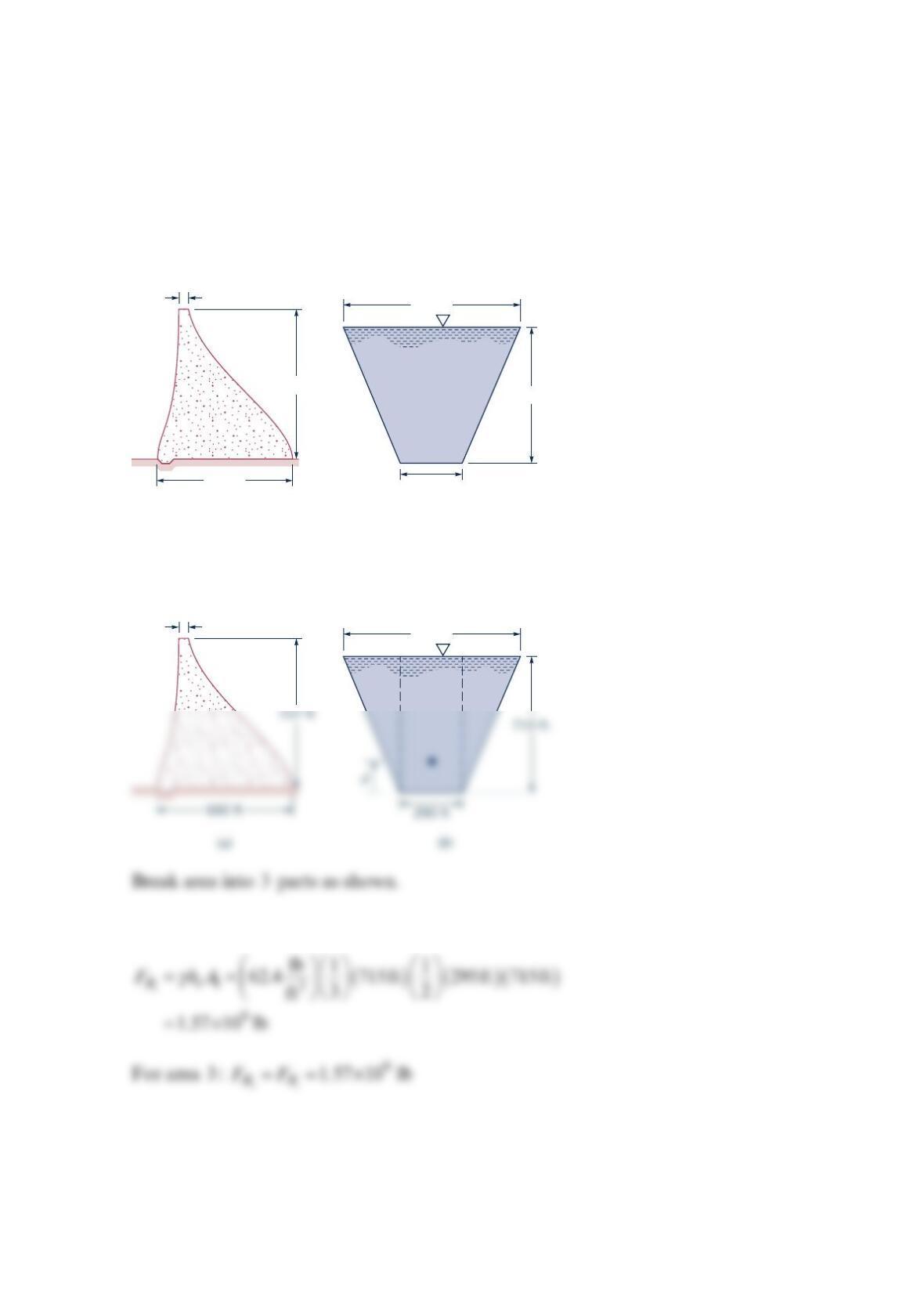
Hoover Dam is the highest arch-gravity type of dam in the United States. A cross section of
the dam is shown in the figure below (a). The walls of the canyon in which the dam is
located are sloped, and just upstream of the dam the vertical plane shown in the figure
below (b) approximately represents the cross section of the water acting on the dam. Use
this vertical cross section to estimate the resultant horizontal force of the water on the dam,
and show where this force acts.
Solution 2.120
For area 1:
45 ft
727 ft
660 ft
715 ft.
(b)(a)
880 ft
290 ft
45 ft
880 ft
A2A3
A1
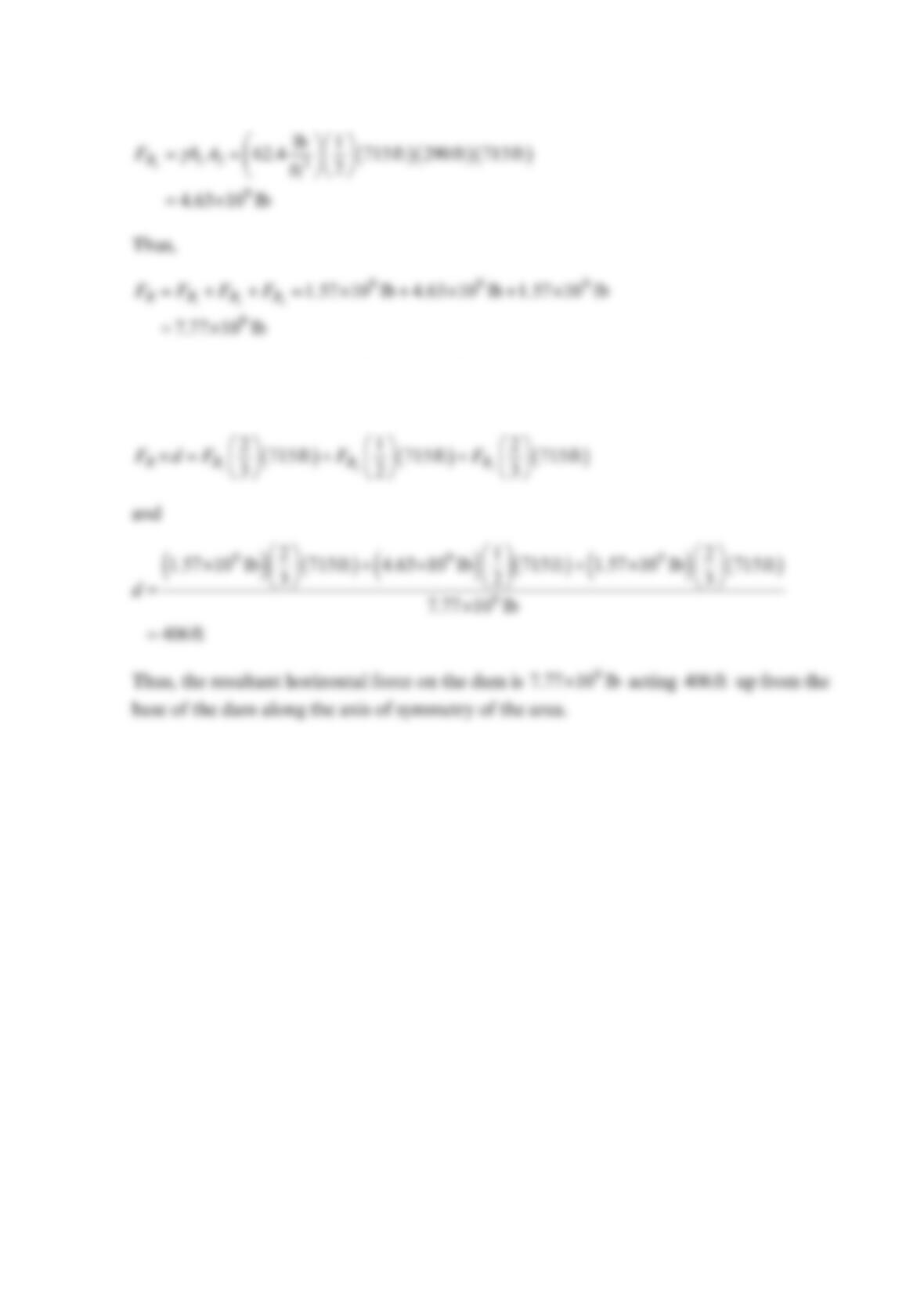
For area 2 :
Since the moment of the resultant force about the base of the dam must be equal to the
moments due to 1
R
F
, 2
R
F
, and 3
R
F
it follows that
Problem 2.121
A plug in the bottom of a pressurized tank is conical in shape, as shown in the figure below.
The air pressure is 40 kPa, and the liquid in the tank has a specific weight of 3
2
7 kN/m .
Determine the magnitude, direction, and line of action of the force exerted on the curved
surface of the cone within the tank due to the −40 kPa pressure and the liquid.
Solution 2.121
=2
tan30 1
d
Air
Liquid
40 kPa
3 m
1 m
60°
Pair A
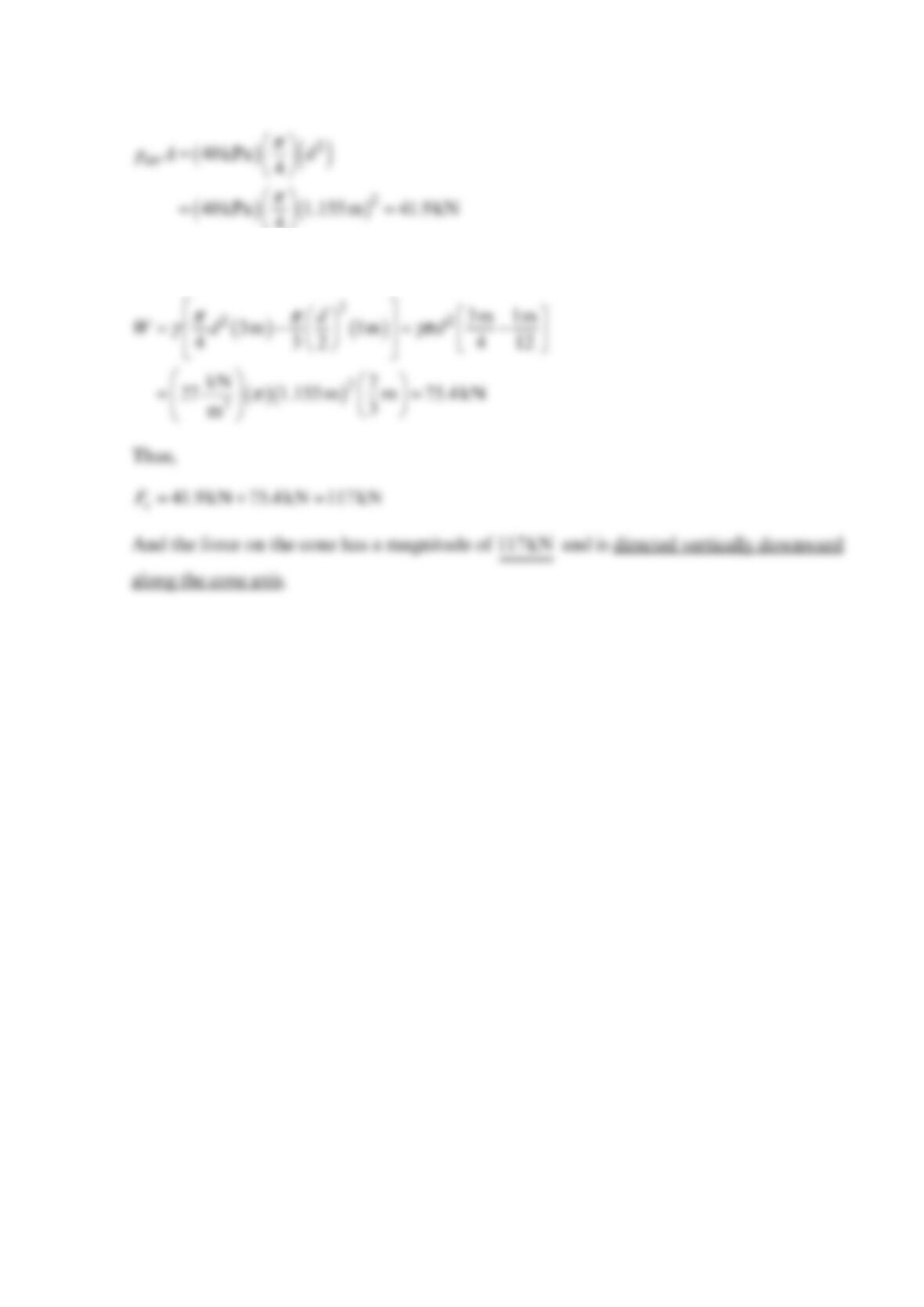
Also,
4
And
Problem 2.122
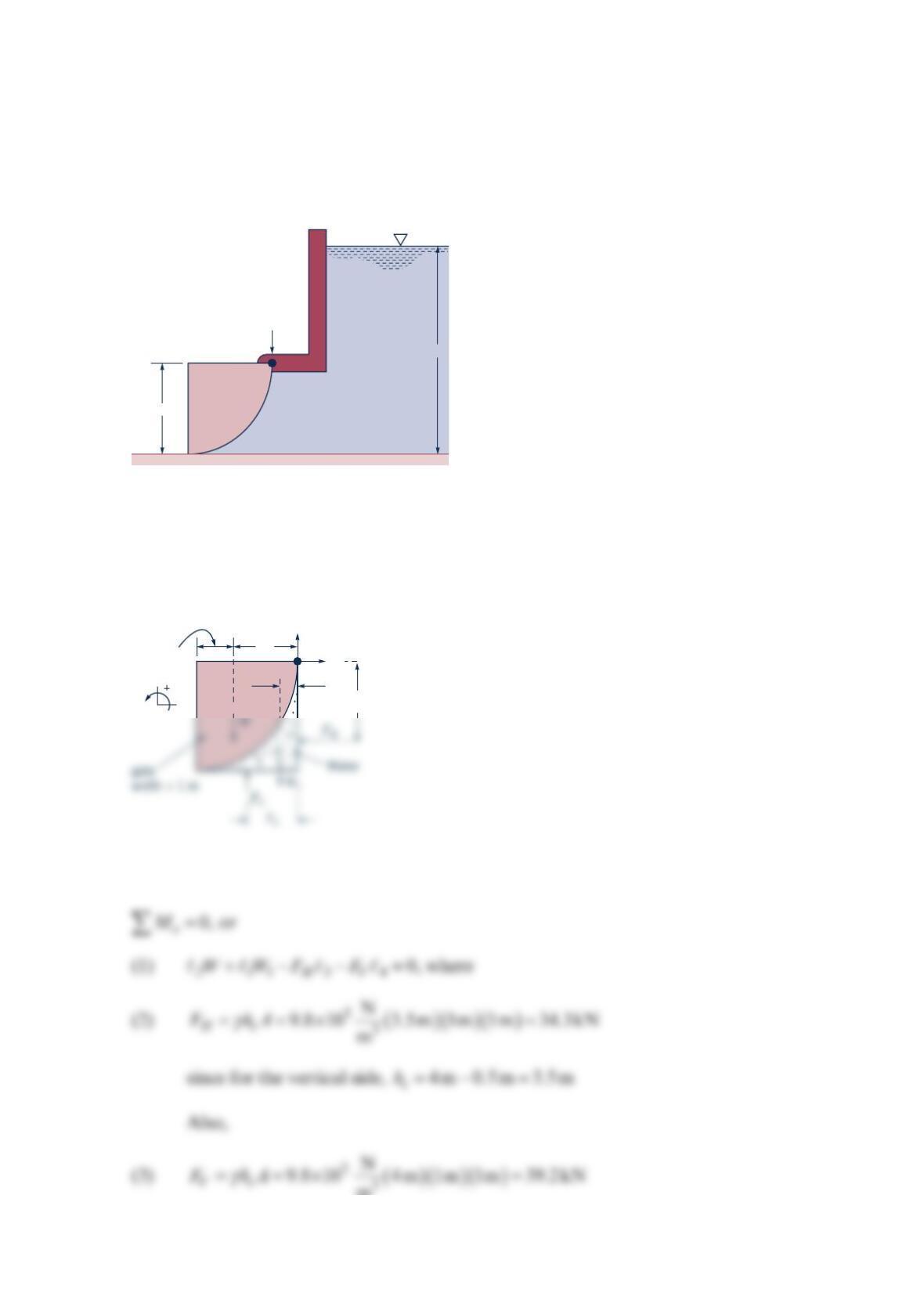
The homogeneous gate shown in the figure below consists of one quarter of a circular
cylinder and is used to maintain a water depth of4 m. That is, when the water depth
exceeds 4 m , the gate opens slightly and lets the water flow under it. Determine the weight
of the gate per meter of length.
Solution 2.122
Consider the free body diagram of the gate and a portion of the water as shown.
m
4 m
1 m
Pivot
Oy
O’
x
ℓ
3
ℓ
1
ℓ
2
x
y
4
R
–––
3
π