Chapter 2
Product Costing: Manufacturing Processes, Cost
Terminology, and Cost Flows
Concept Questions
1. (LO1—Inventory accounts—raw materials, WIP, and finished goods)
Raw materials inventory is the inventory of materials needed for the
2. (LO1 and 2—Comparison of traditional manufacturing environment and JIT)
JIT systems are called pull systems because they start with the customer order
3. (LO2—Description of JIT system)
4. (LO2—JIT and lean production benefits)
Advantages of JIT and lean production manufacturing are likely to include:
1. A reduction in waste and scrap
Solutions Manual
2-2
5. (LO2—Applying Lean production to a service company)
A bank might apply lean production techniques in an effort to reduce the time that
customers wait in line to make deposits or conduct other business with a bank
6. (LO 3—Direct vs. indirect costs)
Direct costs such as direct materials and direct labor can be directly and
7. (LO 3—Manufacturing costs)
The three components of manufacturing costs are direct materials, direct labor,
8. (LO 3—Nonmanufacturing costs)
Nonmanufacturing costs include all costs incurred outside the factory and are
9. (LO 4—Cost flows in a manufacturing environment)
Manufacturing costs (i.e., direct materials, direct labor, and manufacturing
Chapter 2: Product Costing: Manufacturing Processes, Cost Terminology, and Cost Flows
2-3
10. (LO 5—Cost vs. expense)
Although often used interchangeably, cost and expense are not synonymous
terms. Costs can be classified in a number of ways including manufacturing
11. (LO 5—Product vs. period costs)
Manufacturing costs are called product costs because they attach to the product
12. (LO 5—The need for product costing)
Companies need to determine accurate product costs in order to determine if
Exercises
1. (LO2—JIT and lean production)
a. decrease
2. (LO2—Features of lean production)
Solutions Manual
2-4
3. (LO 3—Product costs)
A. Total product costs are $90,000 and include direct materials used of
4. (LO 3—Product costs)
A. The cost of direct labor for each desk is $60 (4 direct labor hours per desk
$15 per hour).
5. (LO 3—Types of manufacturing costs)
a. IL
6. (LO4—Cost flows: Raw materials used)
Beginning raw materials inventory $ 25,000
Chapter 2: Product Costing: Manufacturing Processes, Cost Terminology, and Cost Flows
2-5
7. (LO4—Cost of goods manufactured)
The cost of goods manufactured is:
Beginning inventory of work in process
$ 25,000
Plus: Raw materials used in production
95,000
**
Plus: Direct labor
30,000
Subtotal
$200,000
Less: Ending work-in-process
Cost of goods manufactured
$185,000
Beginning inventory of raw materials
$ 40,000
Plus: Raw materials purchased
Raw material available for use
$115,000
Raw materials used in production
$ 95,000
8. (LO 4—Cost of goods sold)
9. (LO 5—Calculation of net income)
The corrected income statement is as follows:
10. (LO 5—Calculation of net income)
Sales (5,300 units $25 per unit) $132,500
Solutions Manual
2-6
Problems
11. (LO 3, 4, and 5—Cost of goods manufactured, cost of goods sold, and impact on
financial statements)
A. The cost of goods manufactured is $305,000, as shown below.
Beginning inventory of work-in-process $ 20,000
Plus: Raw materials used in production 118,0001
Cost of goods sold equals:
C. Advertising, selling, and administrative expenses are period or
D. If raw materials and work-in-process inventories had decreased during the
year, then the financial statements would be different. A decrease in the
Chapter 2: Product Costing: Manufacturing Processes, Cost Terminology, and Cost Flows
12. (LO 3, 4, and 5—Direct vs. indirect costs, impact on financial statements)
A. Wood and springs would be direct materials while glue and stain are
B. The finished goods inventory balance at the end of June is $11,600
calculated as follows:
The cost of materials for 500 chairs is transferred from raw materials
inventory to work-in-process:
C. If 380 of the chairs are sold, the cost of goods sold is $11,020 ($29 380
chairs).
D. Balance in June 30 Work-in-process:
Solutions Manual
2-8
13. (LO 4 and 5—Basic cost flows, income statement)
A. Company #1:
Direct materials used $ 9,000
Company #2
DM + DL + MOH = TMC
Let x = Manufacturing overhead:
Chapter 2: Product Costing: Manufacturing Processes, Cost Terminology, and Cost Flows
2-9
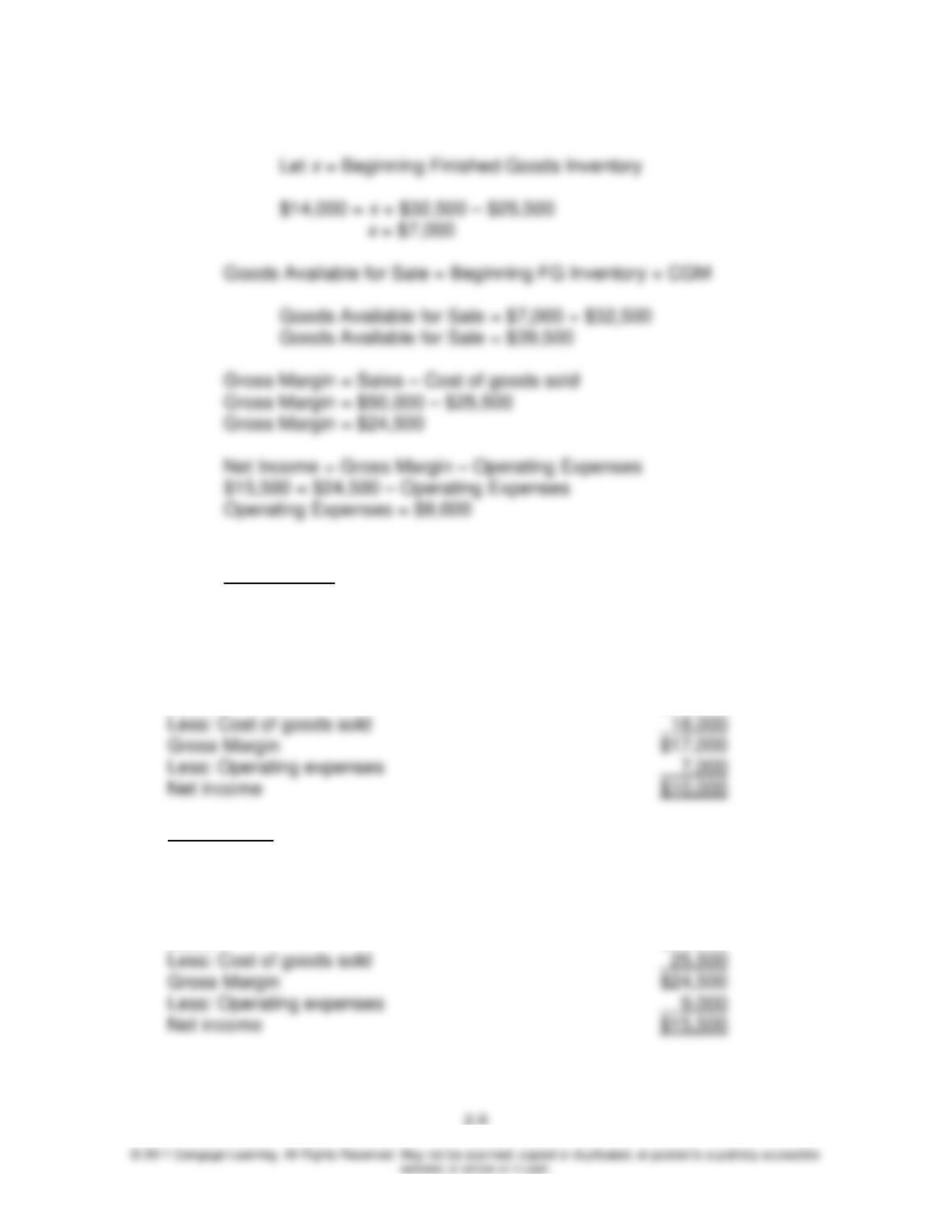
Ending FG Inventory = Beginning FG Inventory + CGM – CGS
B. Company #1:
Company #1
Income Statement
For the Period Ended December 31
Sales $35,000
Company #2:
Company #2
Income Statement
For the Period Ended December 31
Sales $50,000