Problem 2.20
Assume that a person skiing high in the mountains at an altitude of 15,000 ft takes in the
same volume of air with each breath as she does while walking at sea level. Determine the
ratio of the mass of oxygen inhaled for each breath at this high altitude compared to that at
sea level.
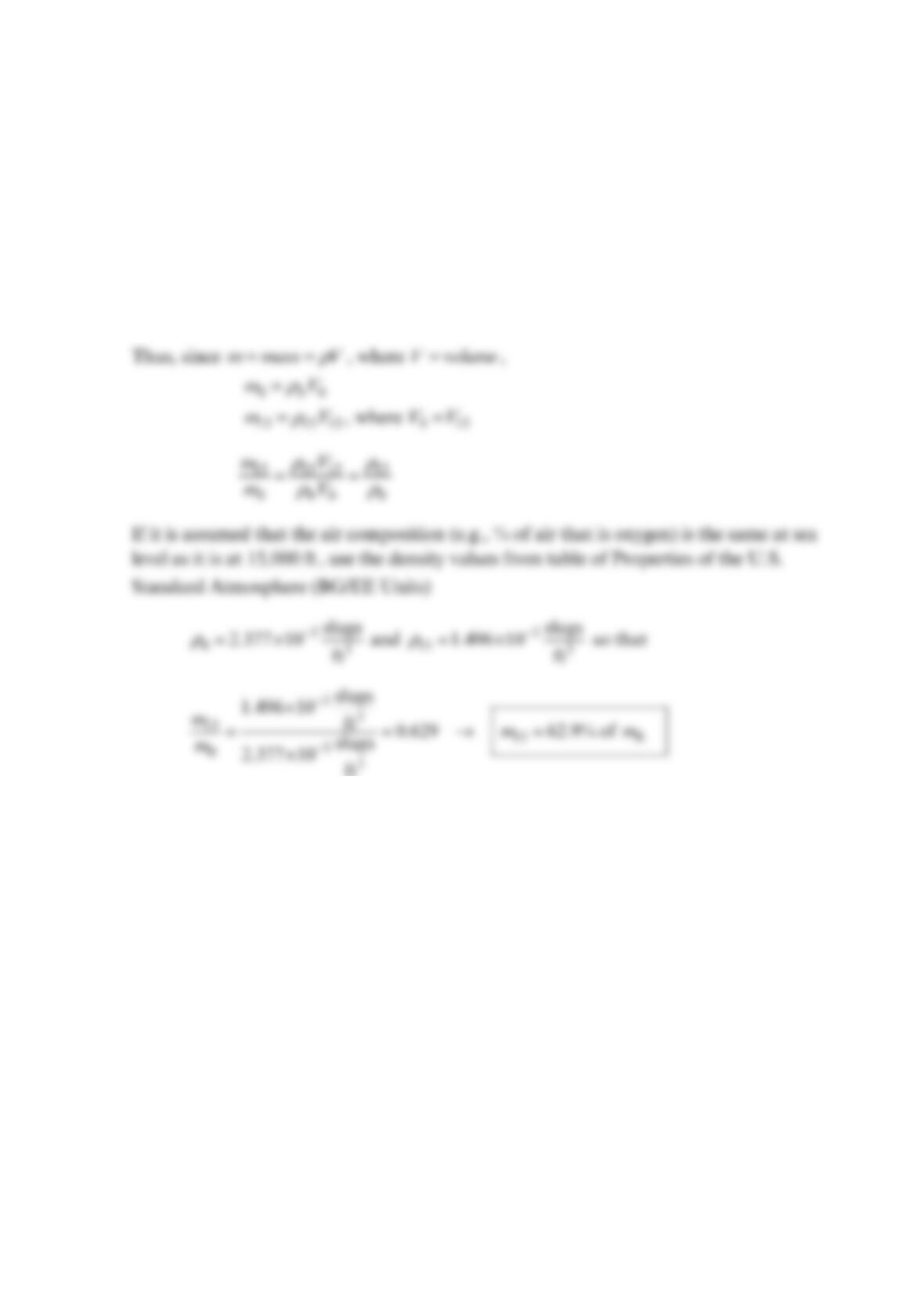
Solution 2.20
Let
()
0 denote sea level and
()
15 denote 15,000 ft altitude.
Problem 2.21
Pikes Peak near Denver, Colorado, has an elevation of
1
4,110 ft. (a) Determine the pressure
at this elevation, based on the equation below. (b) If the air is assumed to have a constant
specific weight of 3
0.07647 lb/ft , what would the pressure be at this altitude?
(c) If the air is assumed to have a constant temperature of °59 F , what would the pressure
be at this elevation? For all three cases assume standard atmospheric conditions at sea level
as provided in the table of Properties of U.S. Standard Atmosphere at Sea Level).
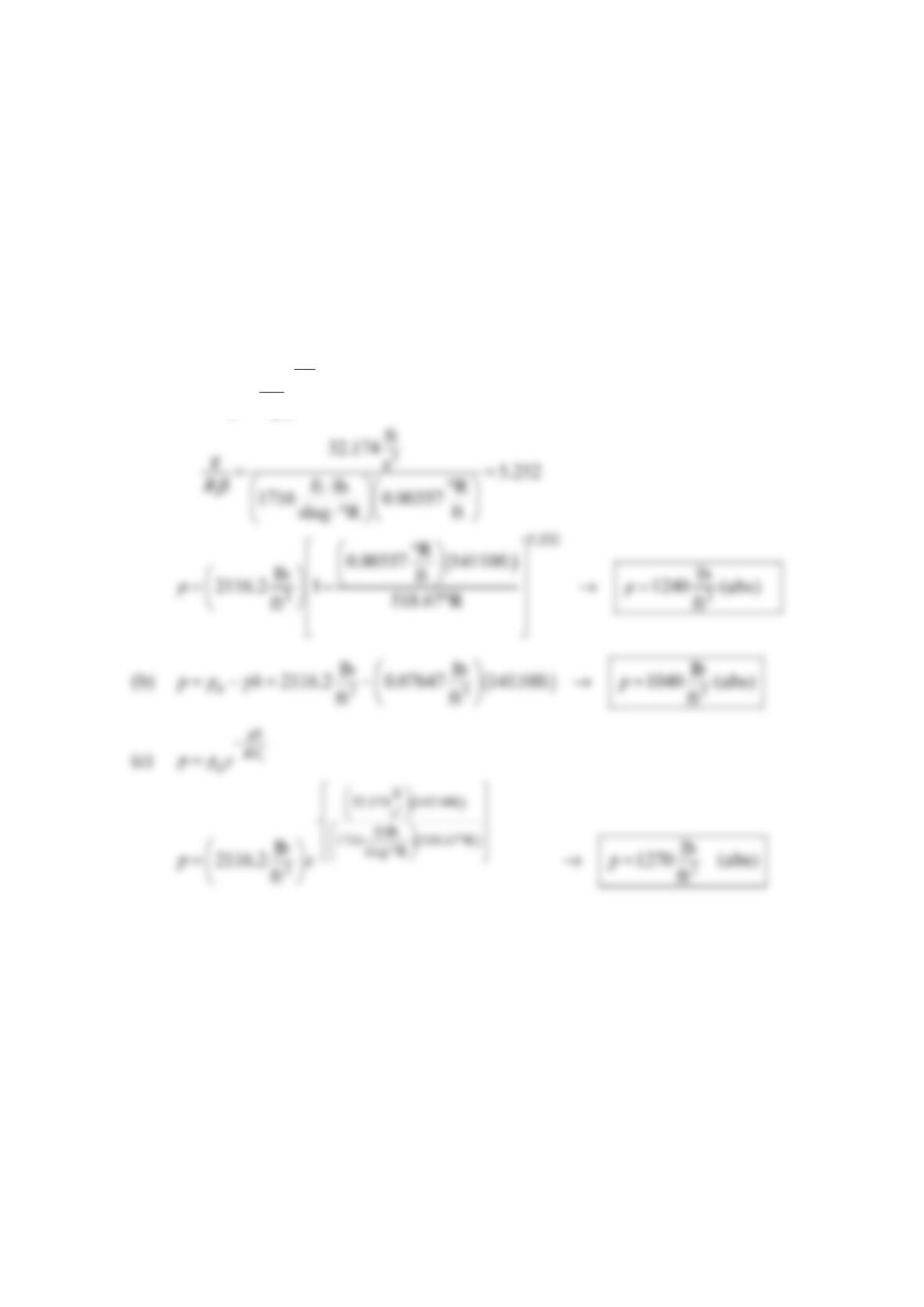
Solution 2.21
(a)
β
β
=−
1
g
R
a
a
z
pp T
Problem 2.22
Equation
β
β
=−
1
g
R
a
a
z
pp Tprovides the relationship between pressure and elevation in the
atmosphere for those regions in which the temperature varies linearly with elevation. Derive
this equation and verify the value of the pressure given in the table of Properties of the U.S.
Standard Atmosphere (SI Units) for an elevation of 5km.
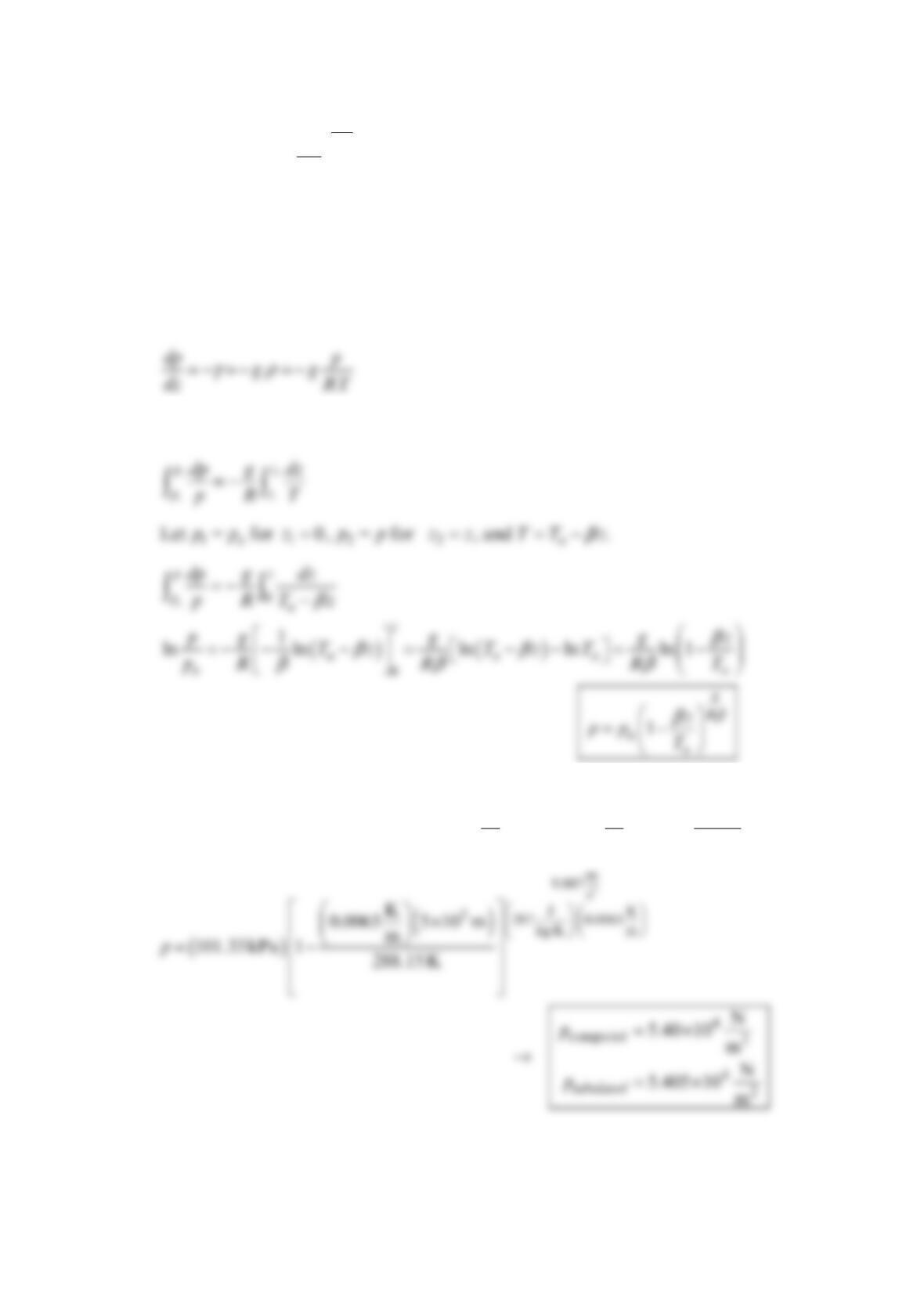
Solution 2.22
For an ideal gas, the hydrostatic equation becomes
then
p
p
β
For =5kmz:
101.33kPa
a
p
=, 288.15K
a
T=, 2
m
9.807 s
g=, K
0.00650 m
β
=,=⋅
J
287 kg K
R,
Problem 2.23
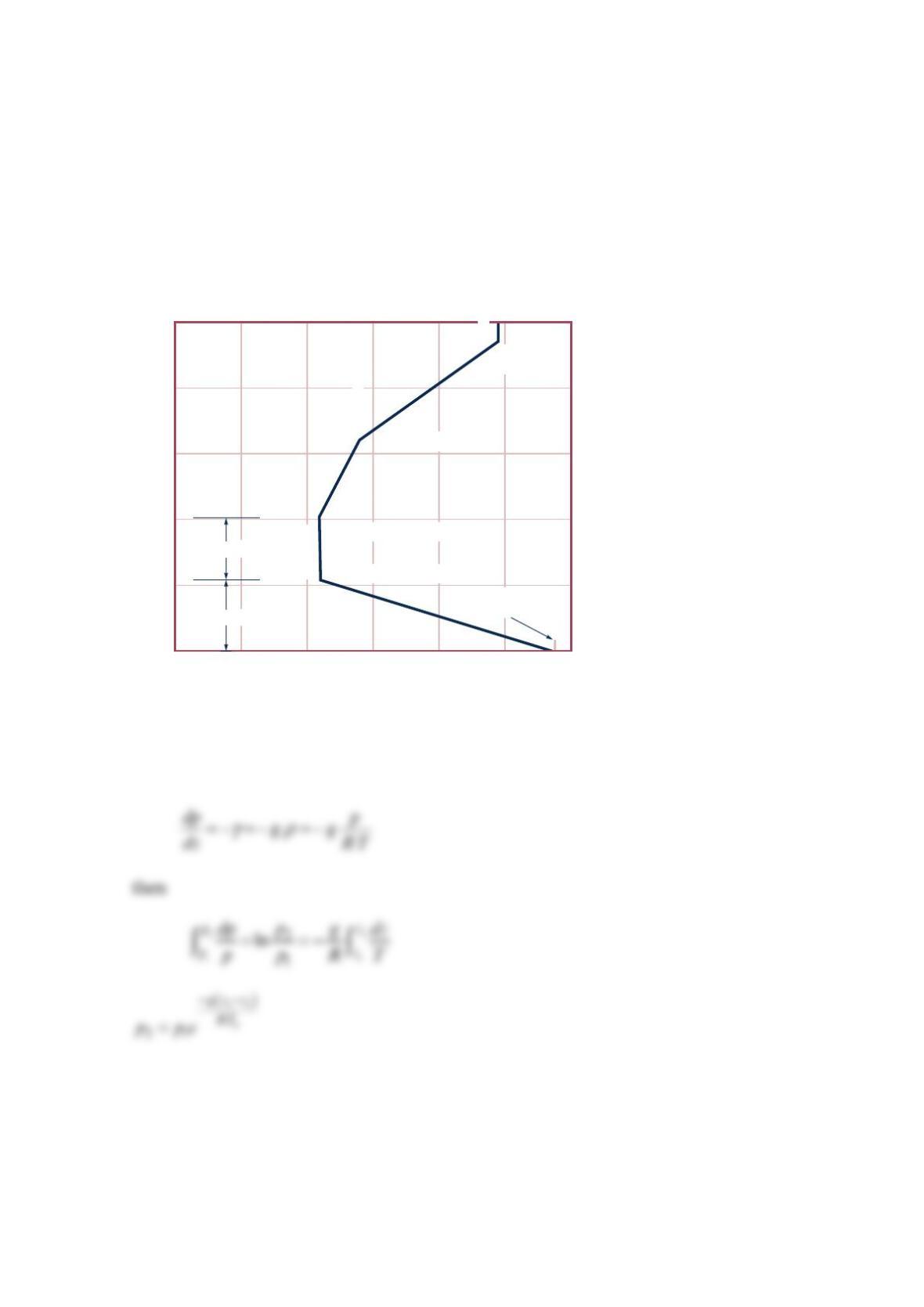
As shown in the figure below for the U.S. standard atmosphere, the troposphere extends to
an altitude of 11km where the pressure is
()
2
2.6 kPa abs . In the next layer, called the
stratosphere, the temperature remains constant at 56.5 C
−
°. Determine the pressure and
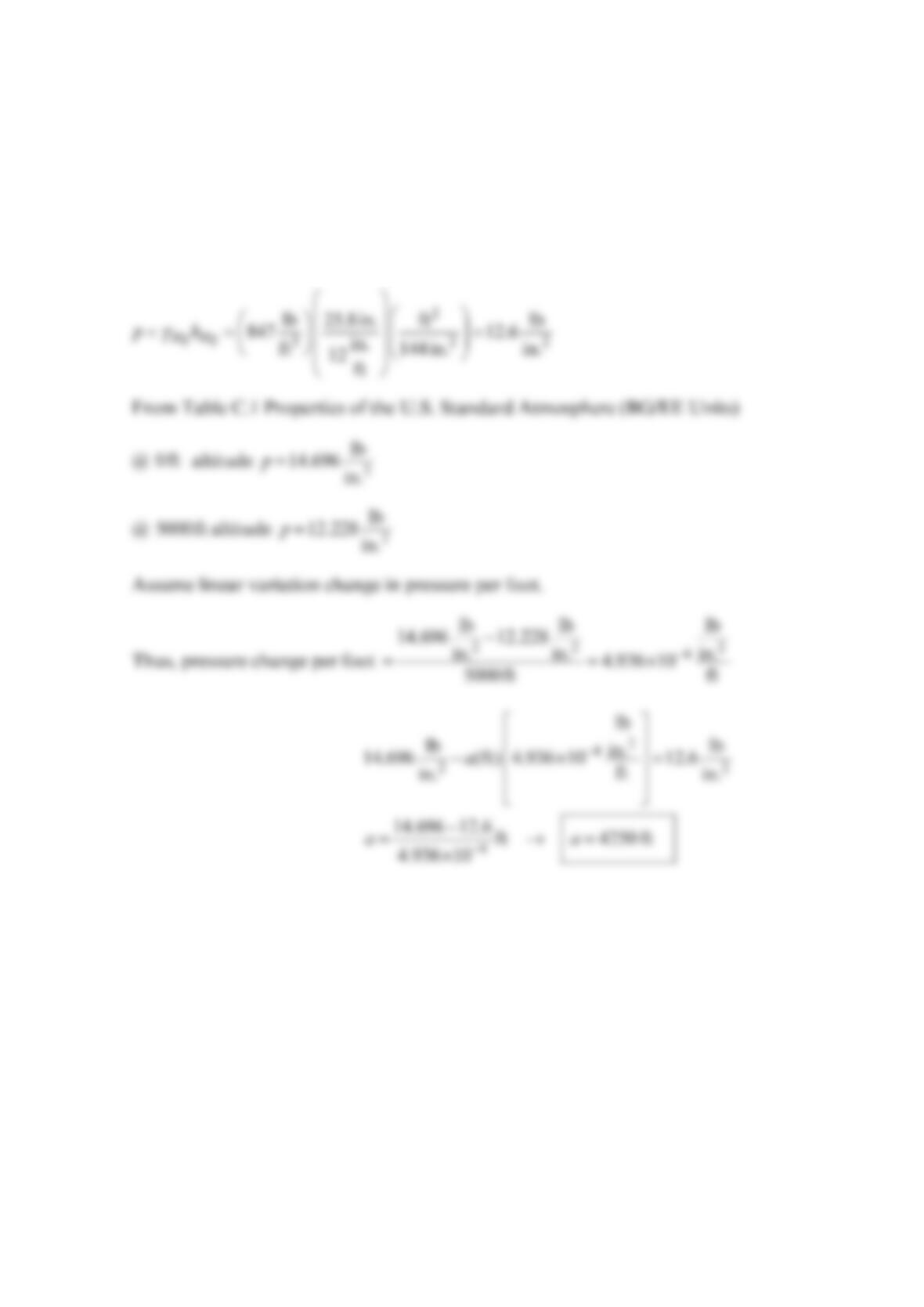
density in this layer at an altitude of
1
5km. Assume =2
g 9.77 m / s in your calculations.
Compare your results with those given in Table C.2 Properties of the U.S. Standard
Atmosphere (SI Units).
Solution 2.23
For isothermal conditions, for an ideal gas the hydrostatic equation becomes
50
40
30
20
10
0
–100 –80 –60 –40 –20 0 +20
Temperature T (°C)
Altitude z (km)
Stratosphere
Troposphere
–56.5 °C
–44.5 °C
–2.5 °C
32.2 km (p = 0.9 kPa)
20.1 km (p = 5.5 kPa)
11.0 km (p = 22.6 kPa)
p = 101.3 kPa (abs)
15 °C
47.3 km
(p = 0.1 kPa)
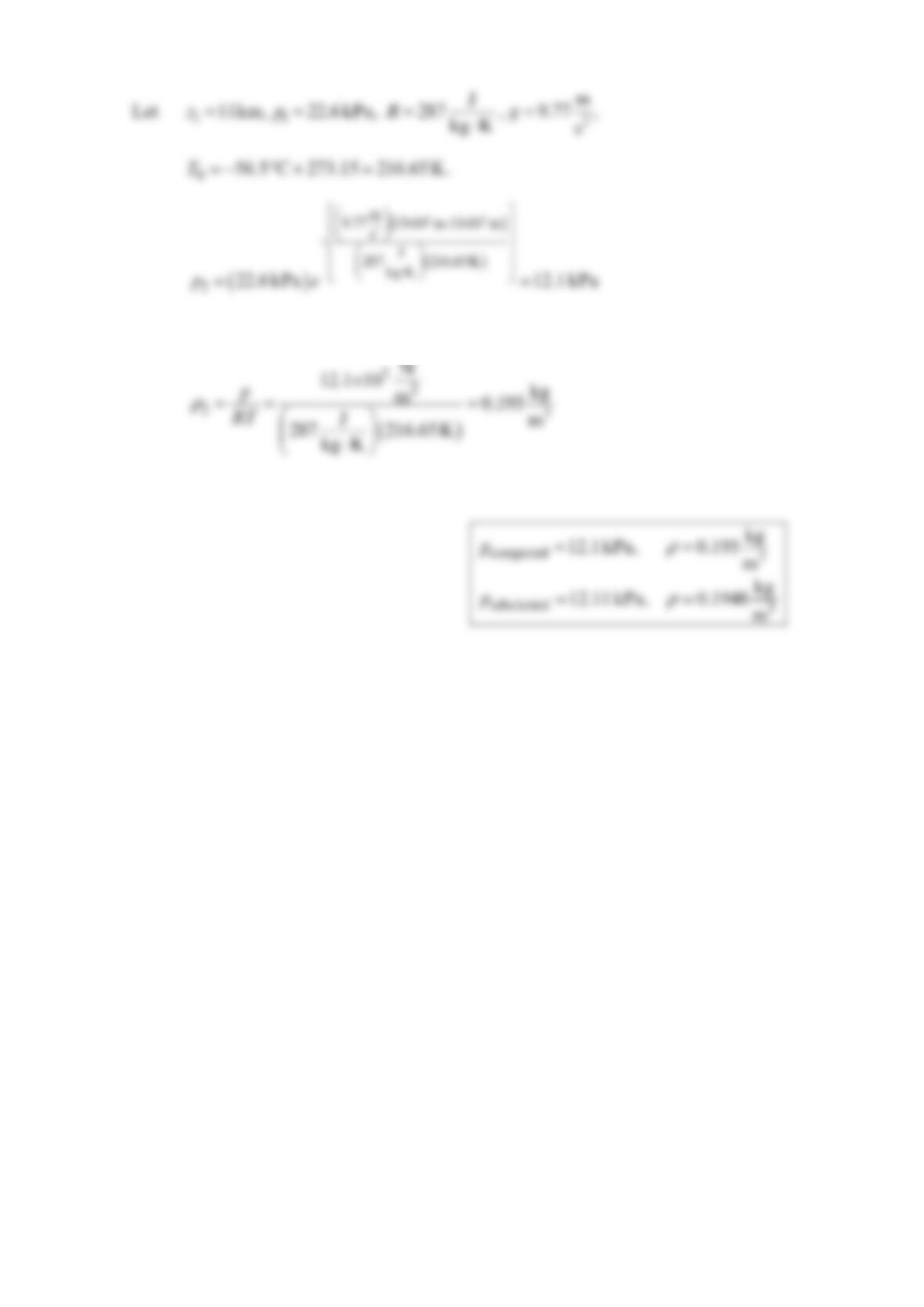
Using the ideal gas model:
In comparison to published values:
Problem 2.24
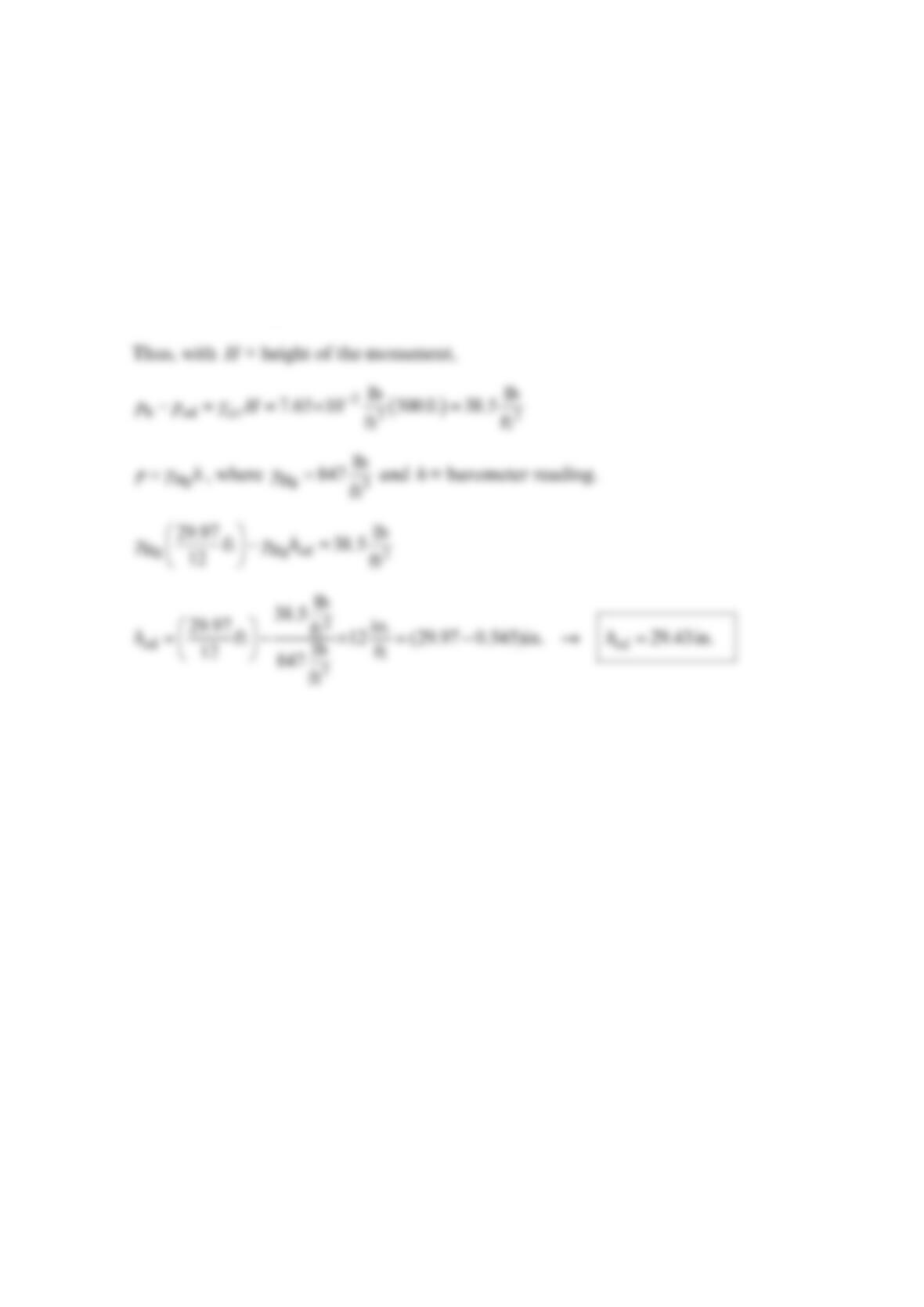
The record low sea-level barometric pressure ever recorded is 25.8in. of mercury. At what
altitude in the standard atmosphere is the pressure equal to this value?
Solution 2.24
For record low pressure,
Problem 2.25
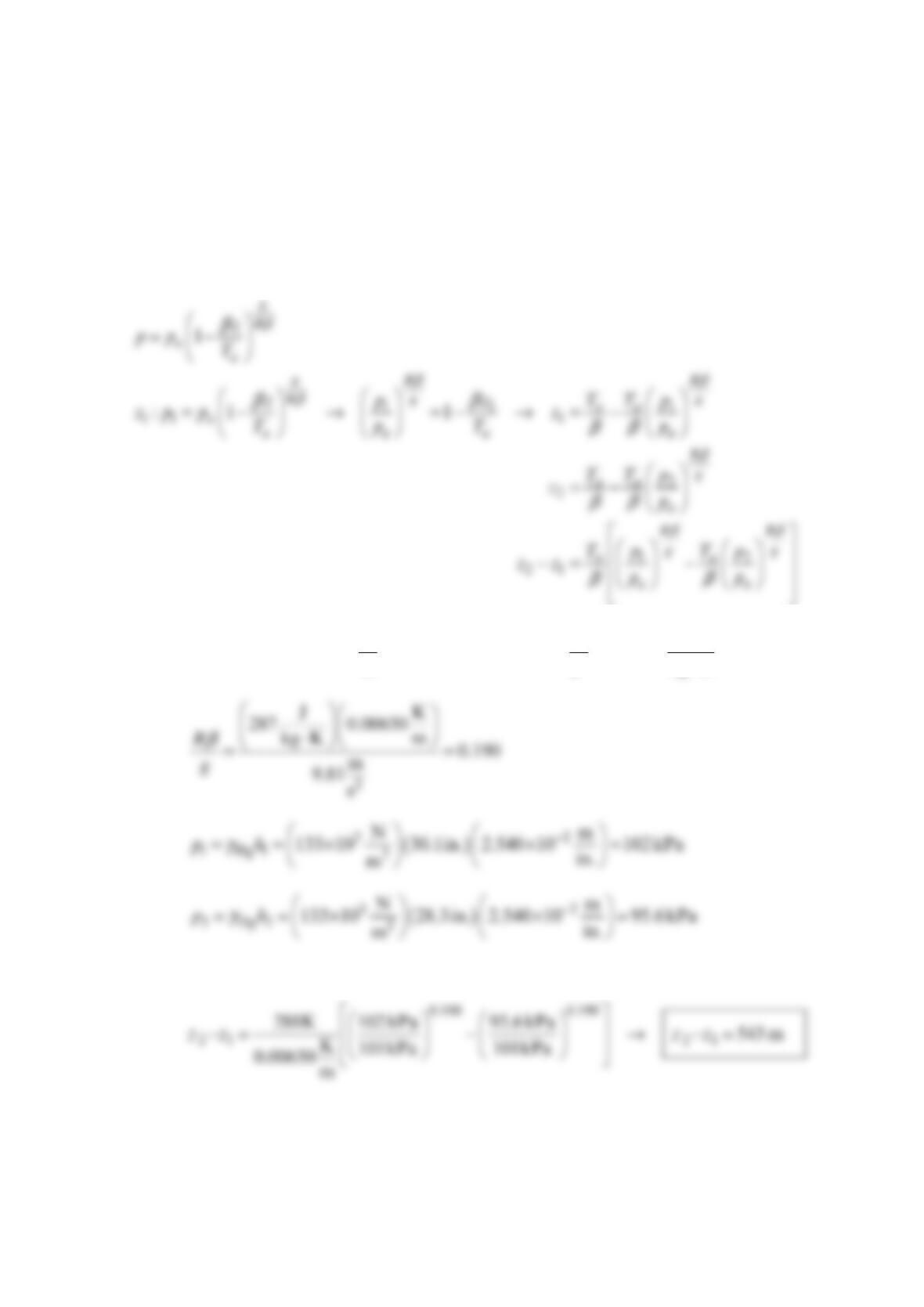
On a given day, a barometer at the base of the Washington Monument reads 29.97 in. of
mercury. What would the barometer reading be when you carry it up to the observation
deck 500 ft above the base of the monument?
Solution 2.25
Let
()
b and
()
od correspond to the base and observation deck, respectively.
Problem 2.26
Aneroid barometers can be used to measure changes in altitude. If a barometer reads 30.1
in. Hg at one elevation, what has been the change in altitude in meters when the barometer
reading is 28.3 in. Hg? Assume a standard atmosphere and that the equation below is
applicable over the range of altitudes of interest.
Solution 2.26
For 288K
a
T=,
β
=K
0.00650 m, 101kPa
a
P=, =2
m
9.81s
g, =⋅
J
287 kg K
R
Substitution yields:
Problem 2.27
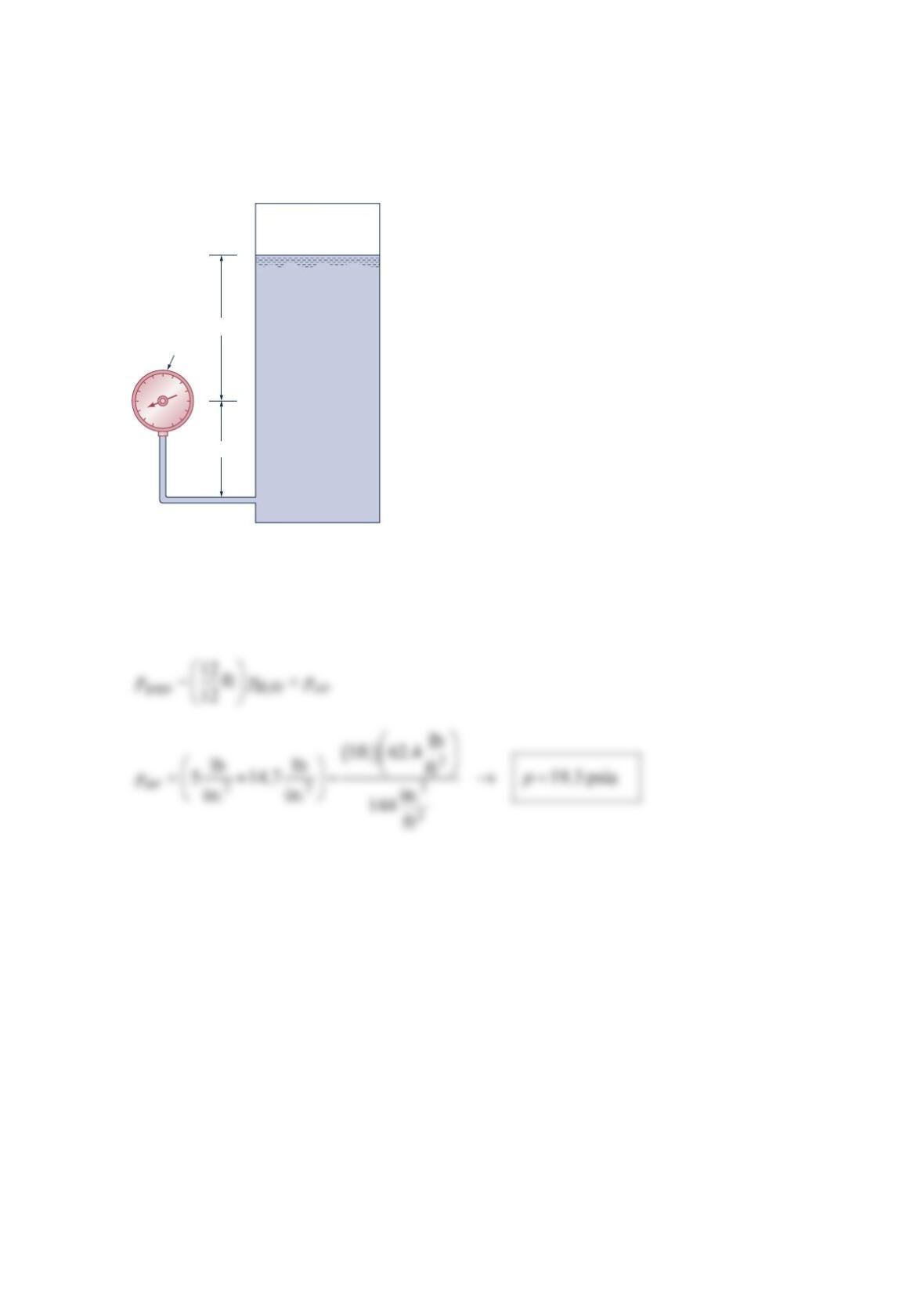
Bourdon gages (see the figure below) are commonly used to measure pressure. When such a
gage is attached to the closed water tank of figure below the gage reads 5 psi. What is the
absolute air pressure in the tank? Assume standard atmospheric pressure of 14.7 psi.
Solution 2.27
γ
=+
0
p
hp
Air
Water
15 20
25
30
35
10
5
0
12 in.
Bourdon gage
6 in.
p

Problem 2.28
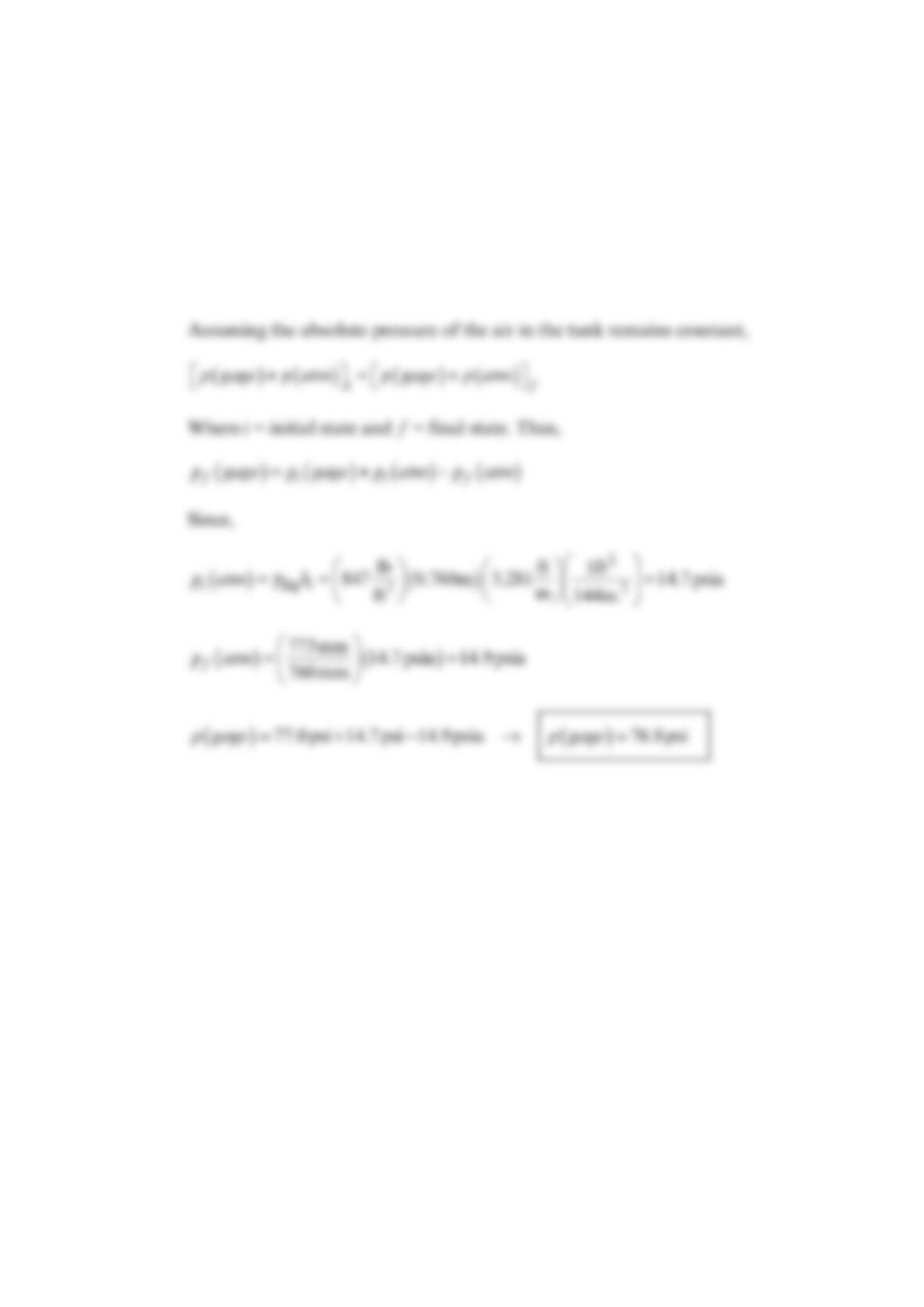
On the suction side of a pump, a Bourdon pressure gage reads 40 kPa vacuum. What is the
corresponding absolute pressure if the local atmospheric pressure is 100 kPa (abs)?
Solution 2.28
Problem 2.29
A Bourdon pressure gage attached to the outside of a tank containing air reads 77.0 psi
when the local atmospheric pressure is 760 mm Hg. What will be the gage reading if the
atmospheric pressure increases to 773 mm Hg?
Solution 2.29
() ( )( )
=+
p
abs p gage p atm
Problem 2.31
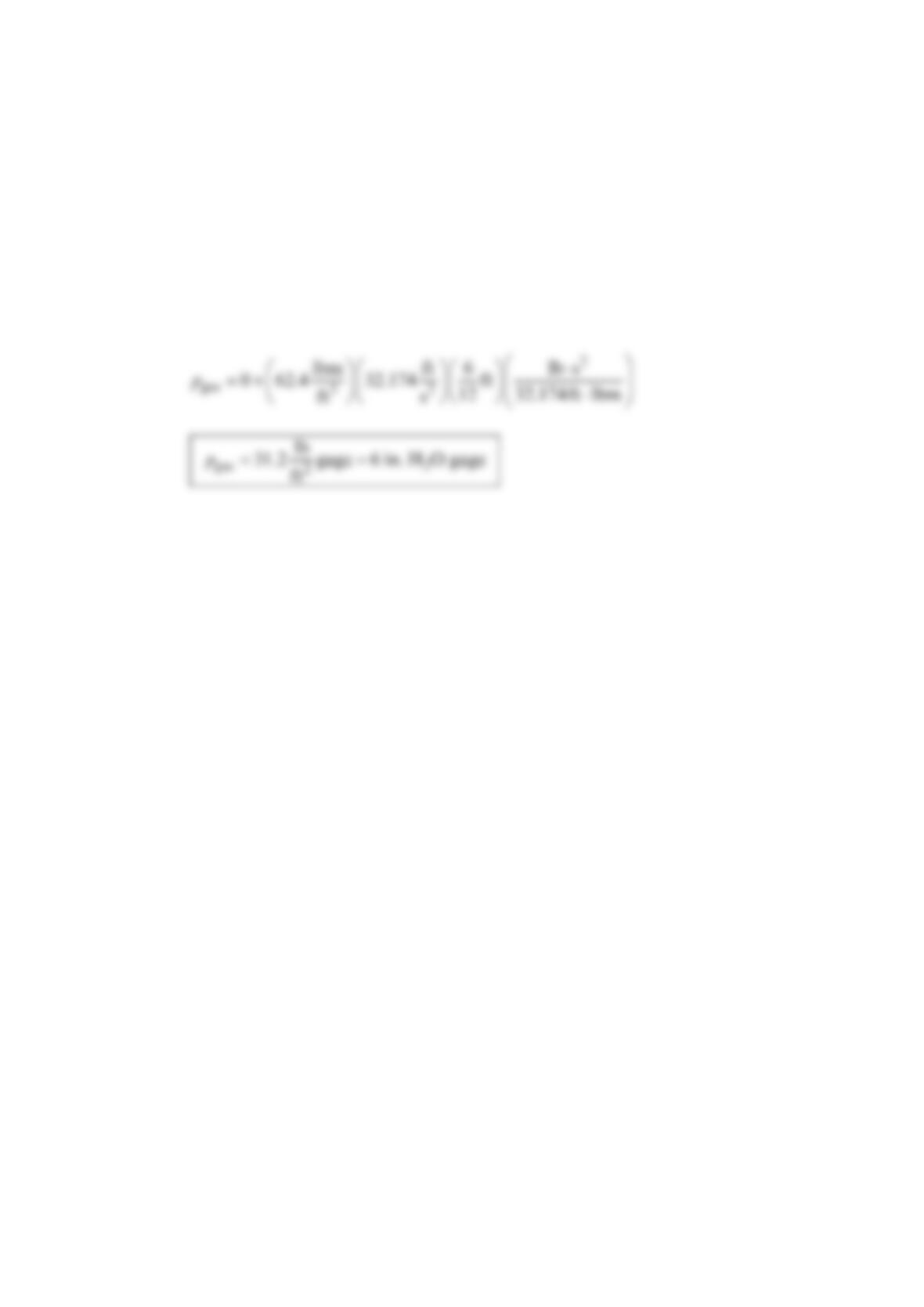
A U-tube manometer is used to check the pressure of natural gas entering a furnace. One
side of the manometer is connected to the gas inlet line, and the water level in the other side
open to atmospheric pressure rises 3 in. What is the gage pressure of the natural gas in the
inlet line in in. 2
H O and in 2
lb/in gage ?
Solution 2.31
ρ
+Δ=
2
atm H O gas
p
gh p
Problem 2.32
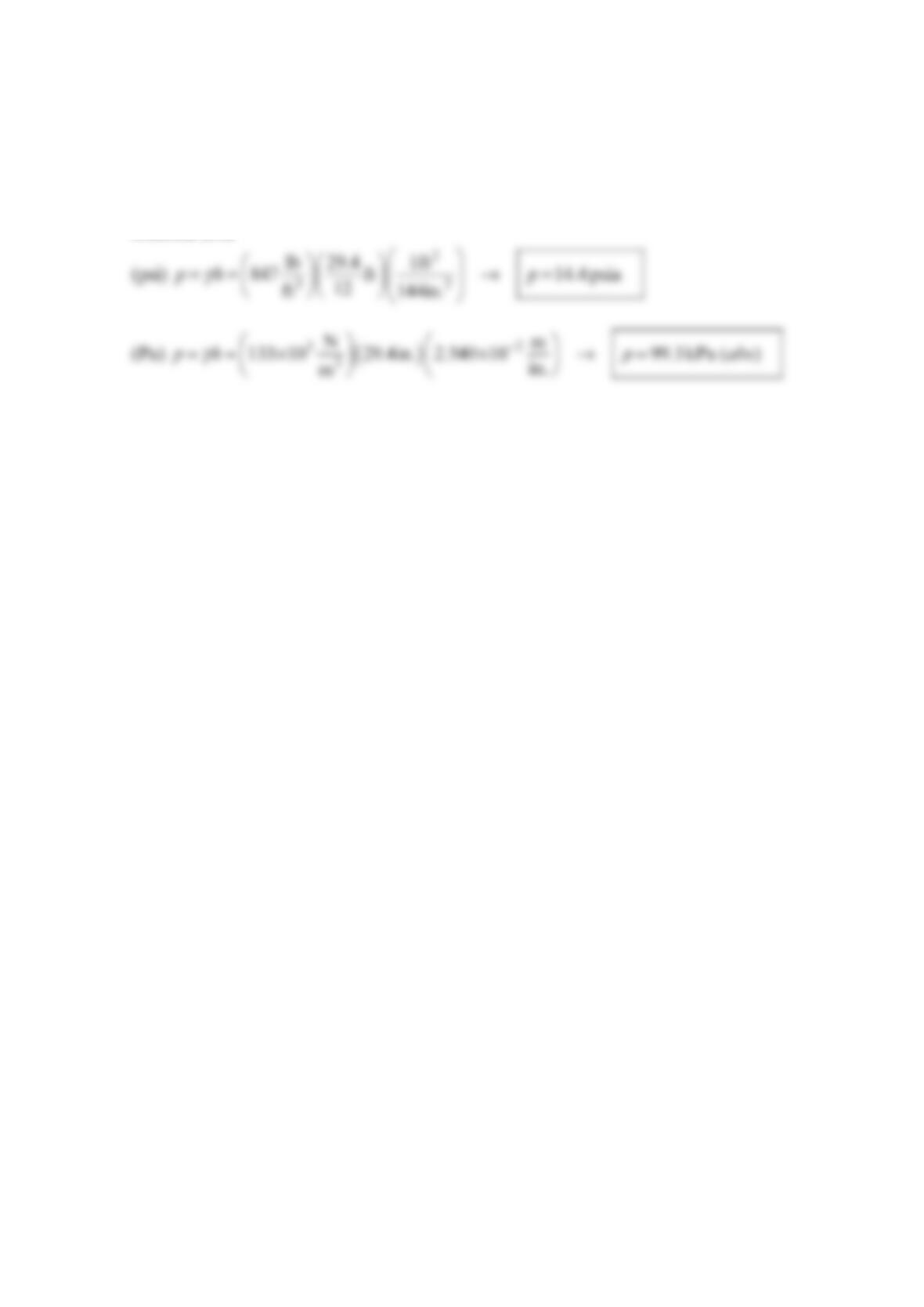
A barometric pressure of 29.4 in. Hg corresponds to what value of atmospheric pressure in
psia, and in pascals?
Solution 2.32
Problem 2.33
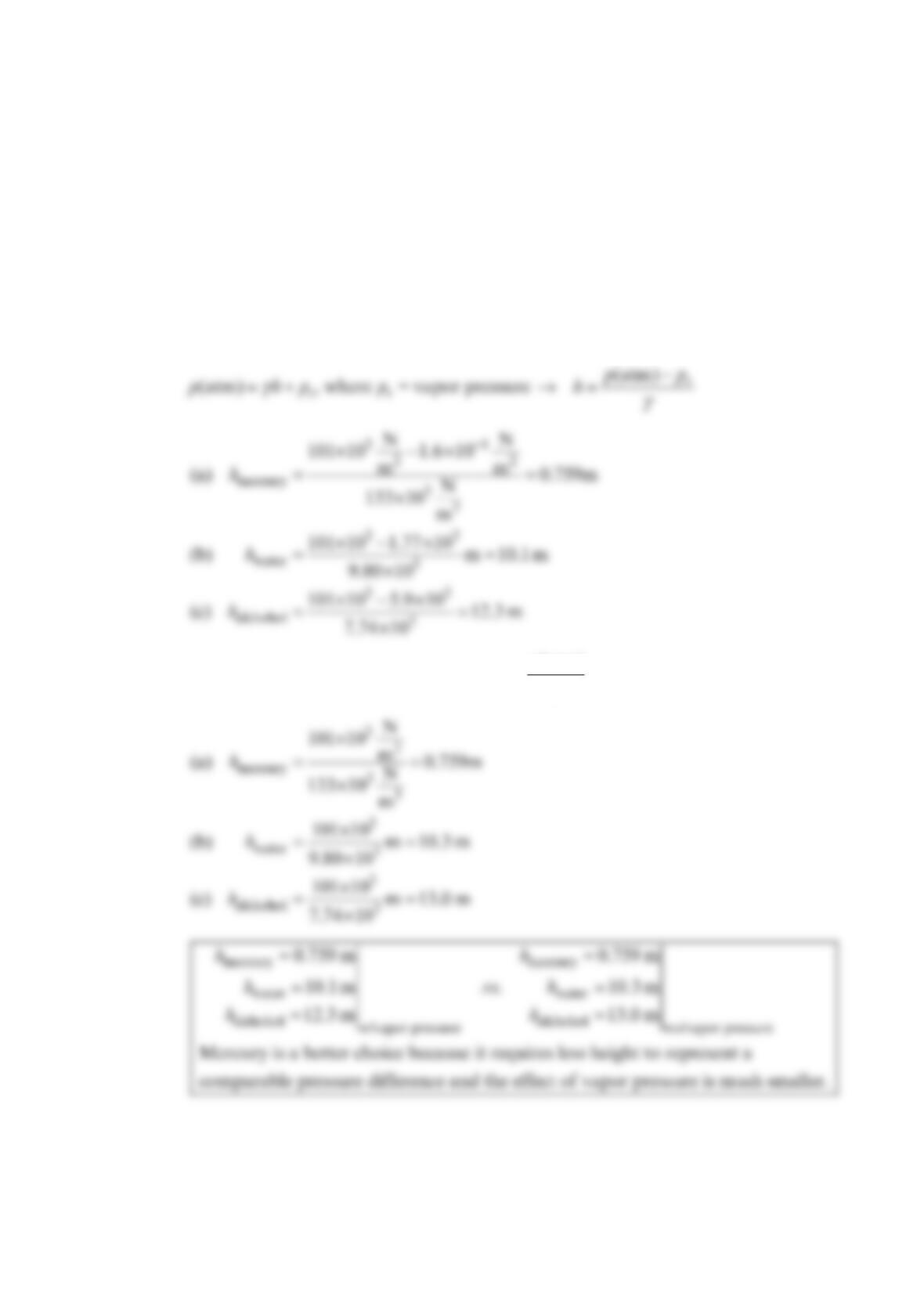
For an atmospheric pressure of 101 kPa (abs), determine the heights of the fluid columns in
barometers containing one of the following liquids: (a) mercury, (b) water, and (c) ethyl
alcohol. Calculate the heights including the effect of vapor pressure and compare the results
with those obtained neglecting vapor pressure. Do these results support the widespread use
of mercury for barometers? Why?
Solution 2.33
(Including vapor pressure)
(Without vapor pressure):
γγ
=→=
()
()
p
atm
patm h h
p
Problem 2.34
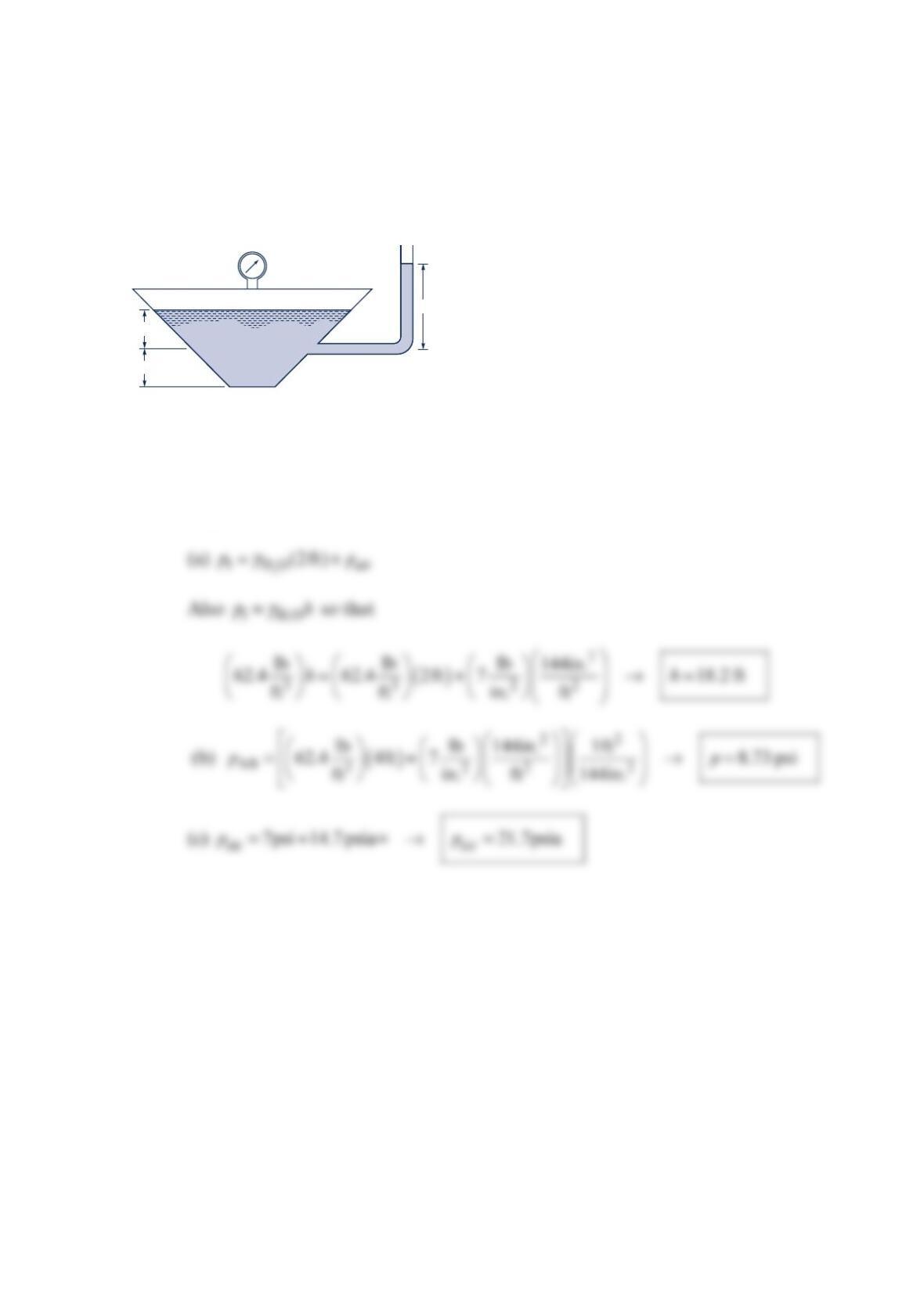
The closed tank of the figure below is filled with water and is 5 ft long. The pressure gage
on the tank reads 7 psi. Determine: (a) the height, h, in the open water column, (b) the gage
pressure acting on the bottom tank surface AB, and (c) the absolute pressure of the air in
the top of the tank if the local atmospheric pressure is 14.7 psia.
Solution 2.34
γ
=+
0
p
hp
Water
Air
Open
7 psi
h
2 ft
2 ft
AB
Problem 2.35
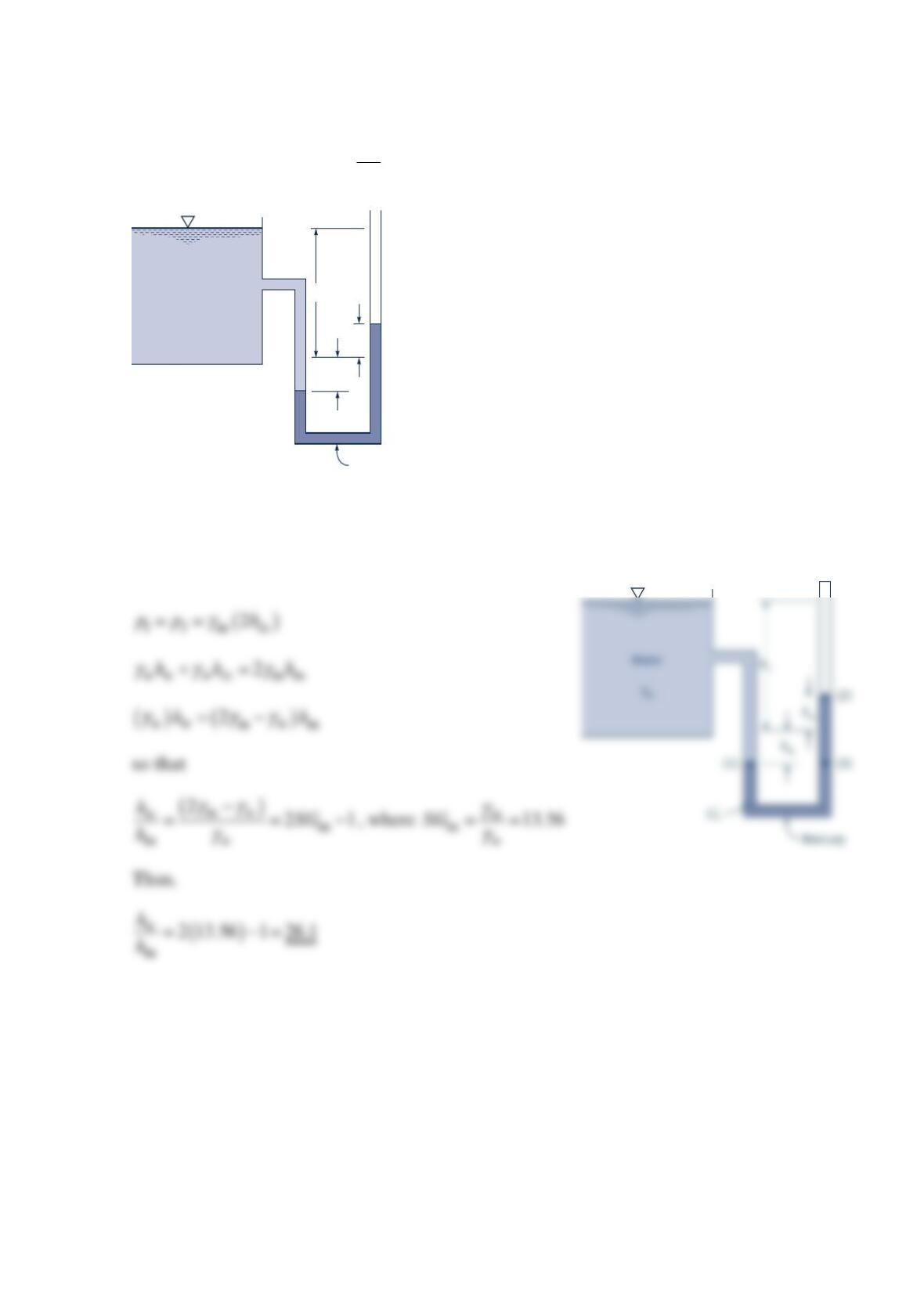
A mercury manometer is connected to a large reservoir of water as shown in the figure
below. Determine the ratio, w
m
h
h, of the distances w
h and m
hindicated in the figure.
Solution 2.35
γγ
=+
1wwwm
p
hh
Mercury
Water
h
w
h
m
h
m
Problem 2.36
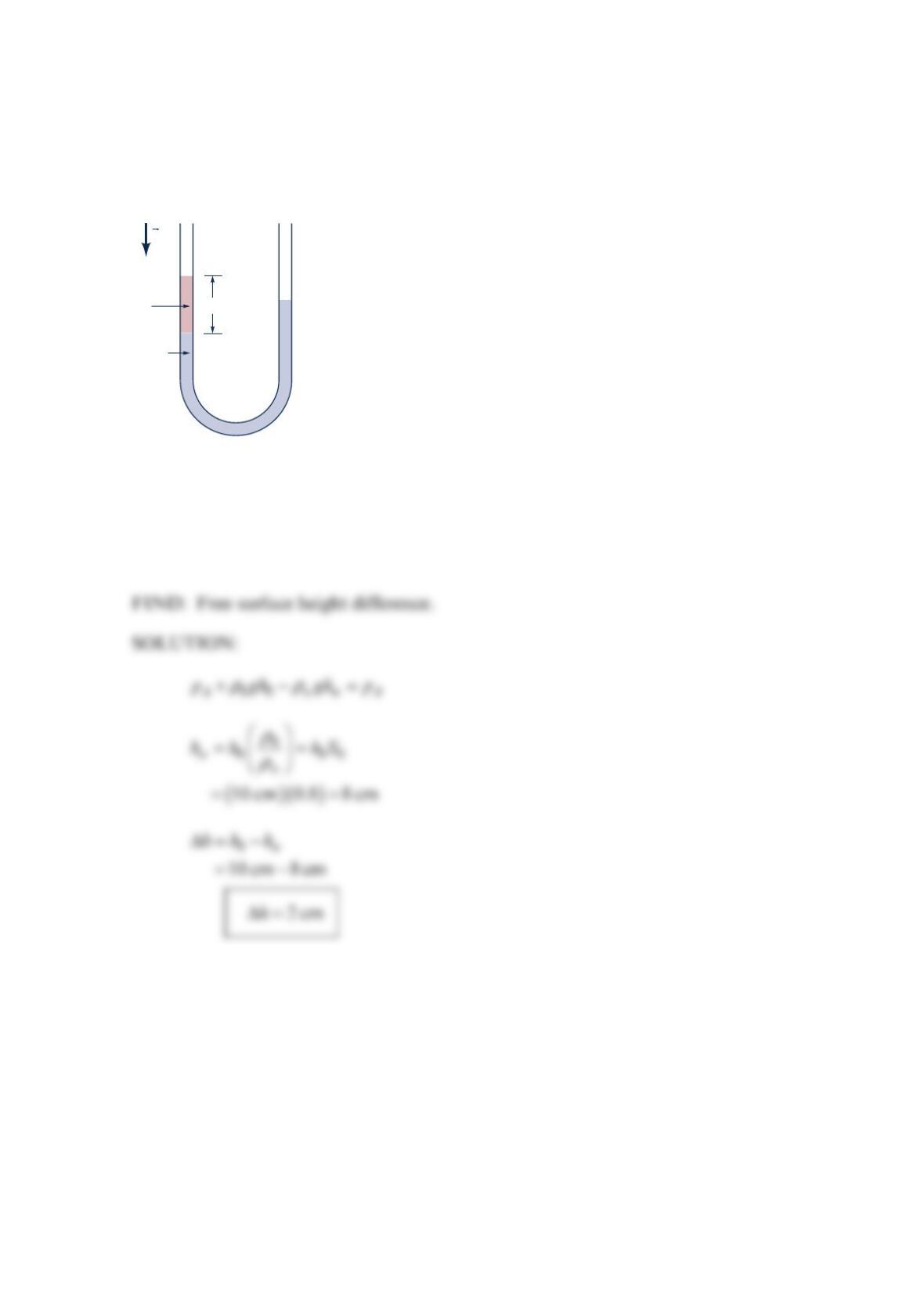
The U-tube manometer shown in the figure below has two fluids, water and oil ( =0.80S).
Find the height difference between the free water surface and the free oil surface with no
applied pressure difference.
Solution 2.36
GIVEN: =
oil 0.8S (see the figure in the problem)
Water
10 cm
p
A
p
A
Oil
g
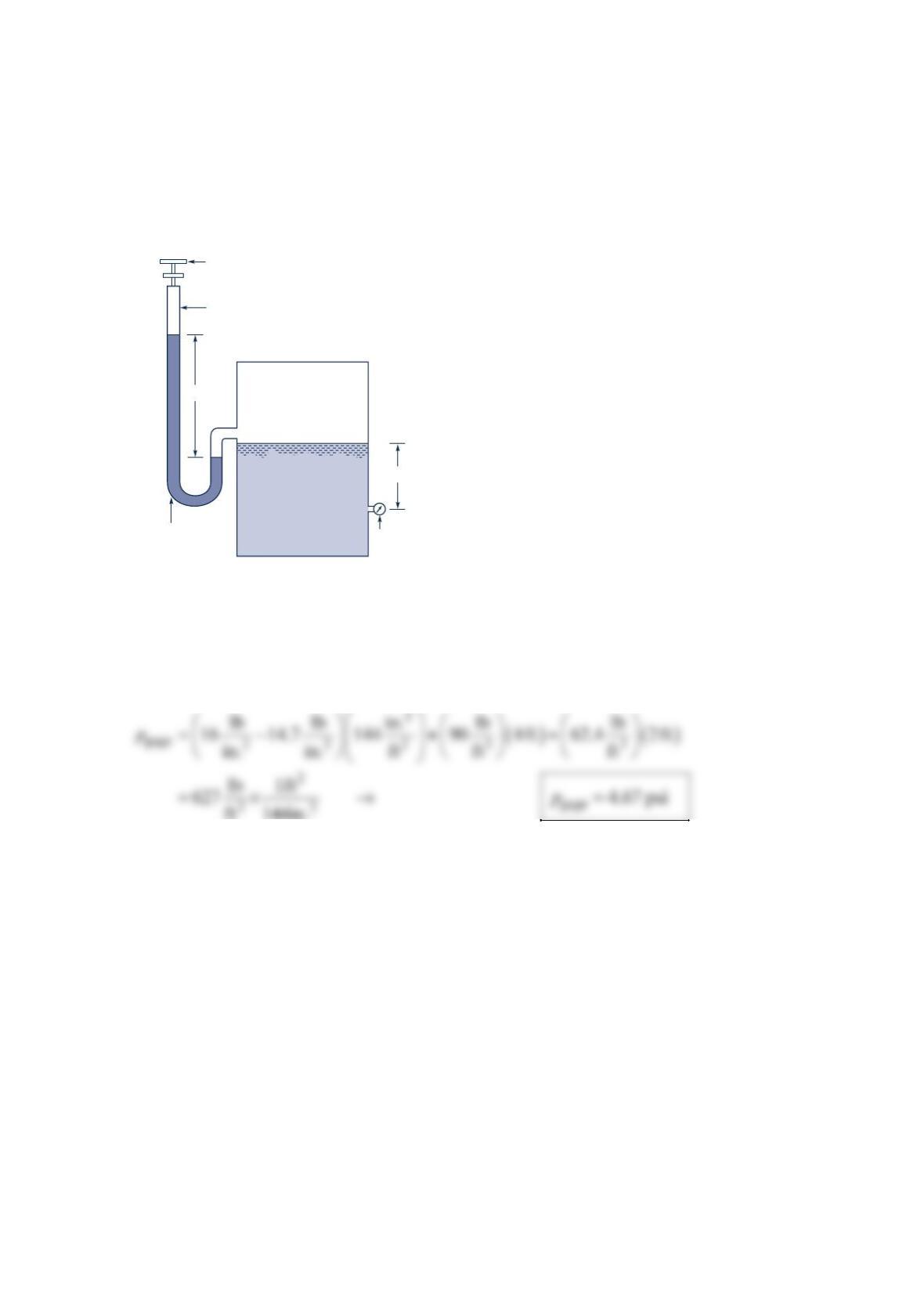
Problem 2.37
A U-tube manometer is connected to a closed tank containing air and water as shown in
the figure below. At the closed end of the manometer, the air pressure is 16 psia. Determine
the reading on the pressure gage for a differential reading of 4 ft on the manometer. Express
your answer in psi (gage). Assume standard atmospheric pressure and neglect the weight of
the air columns in the manometer.
Solution 2.37
γγ
++ =
2
1 gf H O gage
(4ft) (2ft)pp
Pressure
gage
Air
Water
Air pressure = 16 psia
Gage fluid
( = 90 lb/ft
3
)
γ
Closed valve
4 ft
2 ft
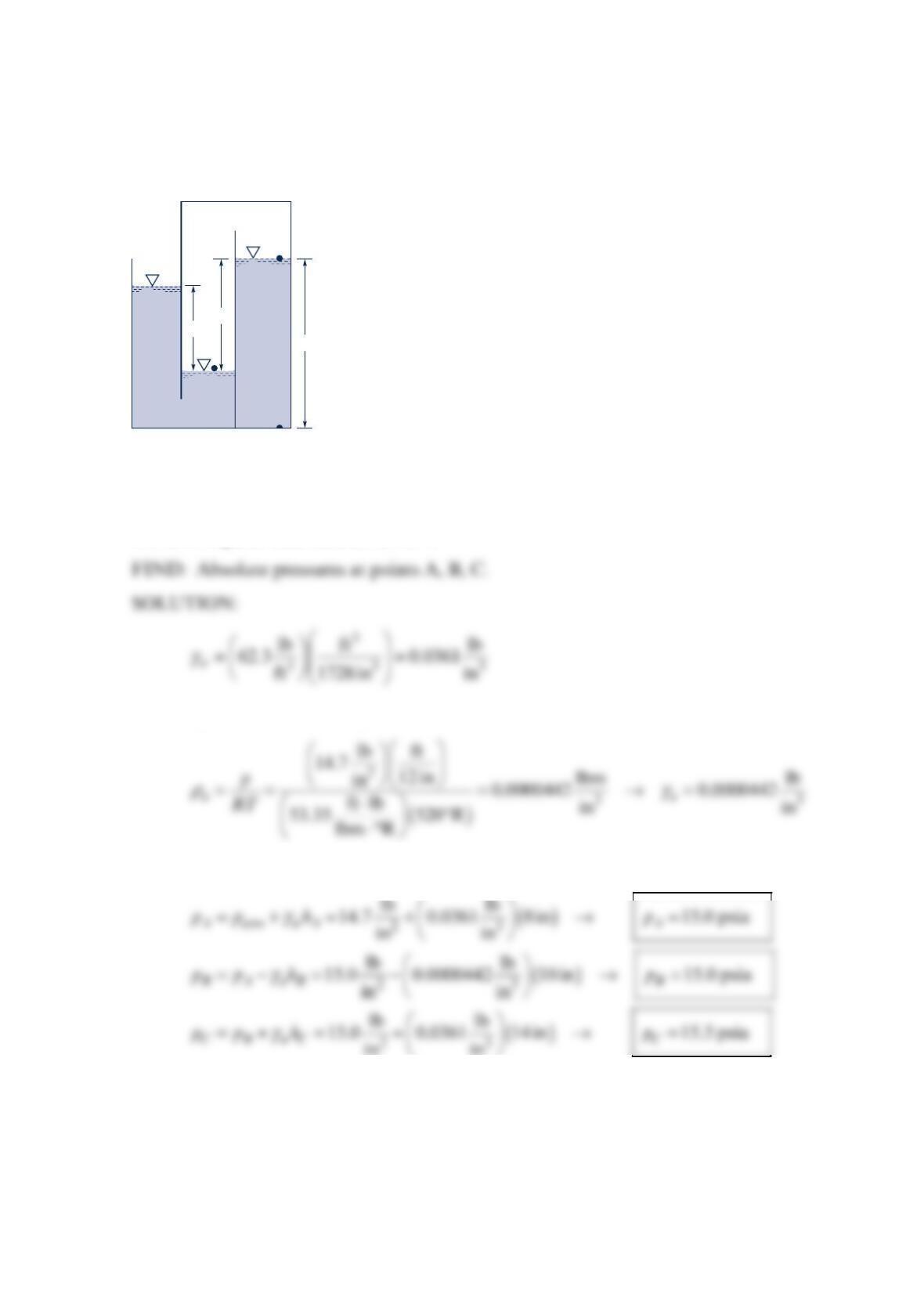
Problem 2.38
The container shown in the figure below holds °60 F water and °60 F air as shown. Find
the absolute pressures at locations A, B, and C.
Solution 2.38
GIVEN: Figure, water and air at °60 F
Modeling the air as an ideal gas:
The hydrostatic equation gives:
p
atm = 14.7 lb/in.2
14
″
10″
8″
Water
Water
Air
C
B
A
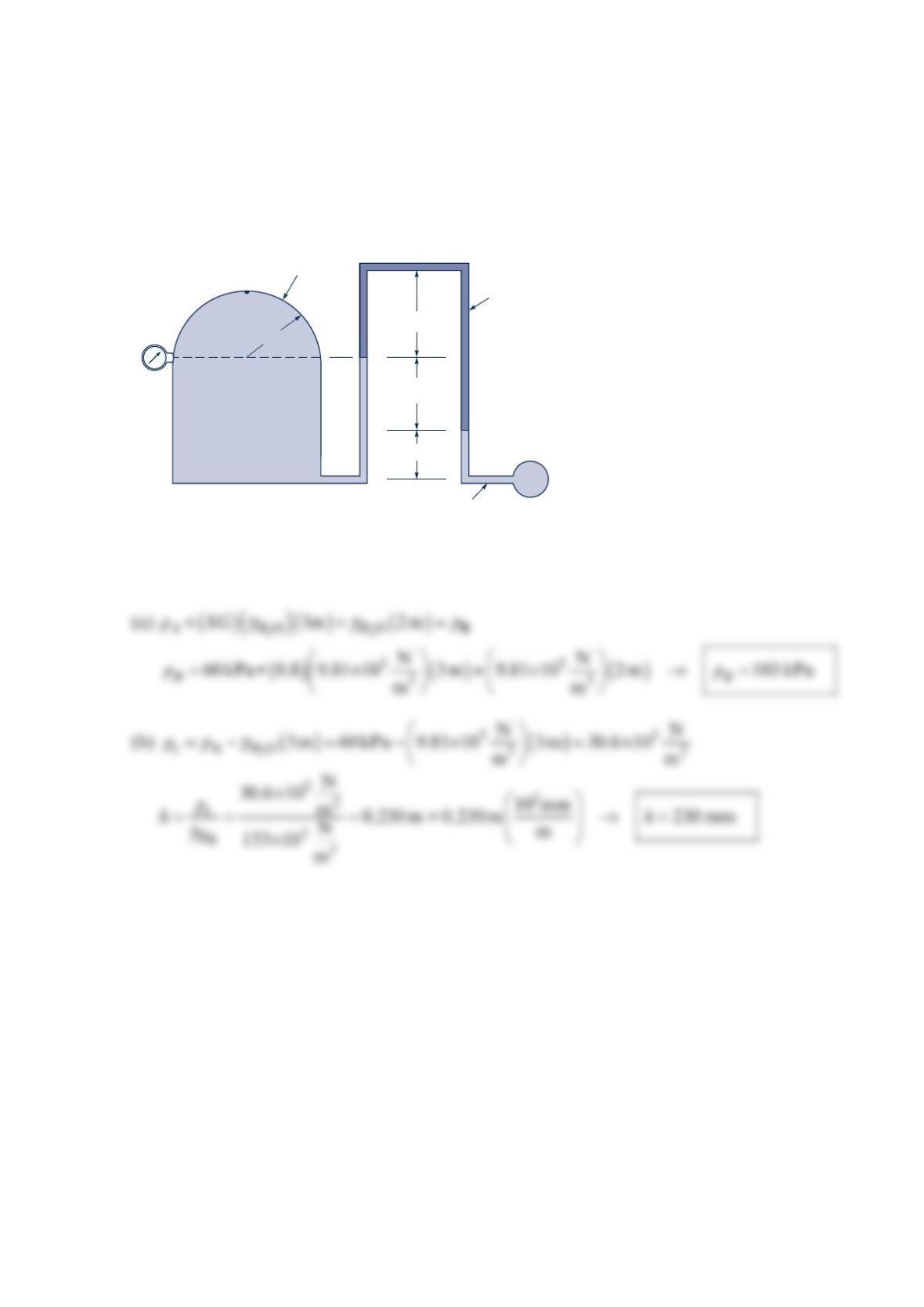
Problem 2.39
A closed cylindrical tank filled with water has a hemispherical dome and is connected to an
inverted piping system as shown in the figure below. The liquid in the top part of the piping
system has a specific gravity of 0.8, and the remaining parts of the system are filled with
water. If the pressure gage reading at A is 60 kPa, determine (a) the pressure in pipe B, and
(b) the pressure head, in millimeters of mercury, at the top of the dome (point C).
Solution 2.39
p
A
=
60
kPa
Water
B
2 m
4 m
3 m
3 m
SG
= 0.8
Water
Hemispherical dome
C
A