
CHAPTER 2
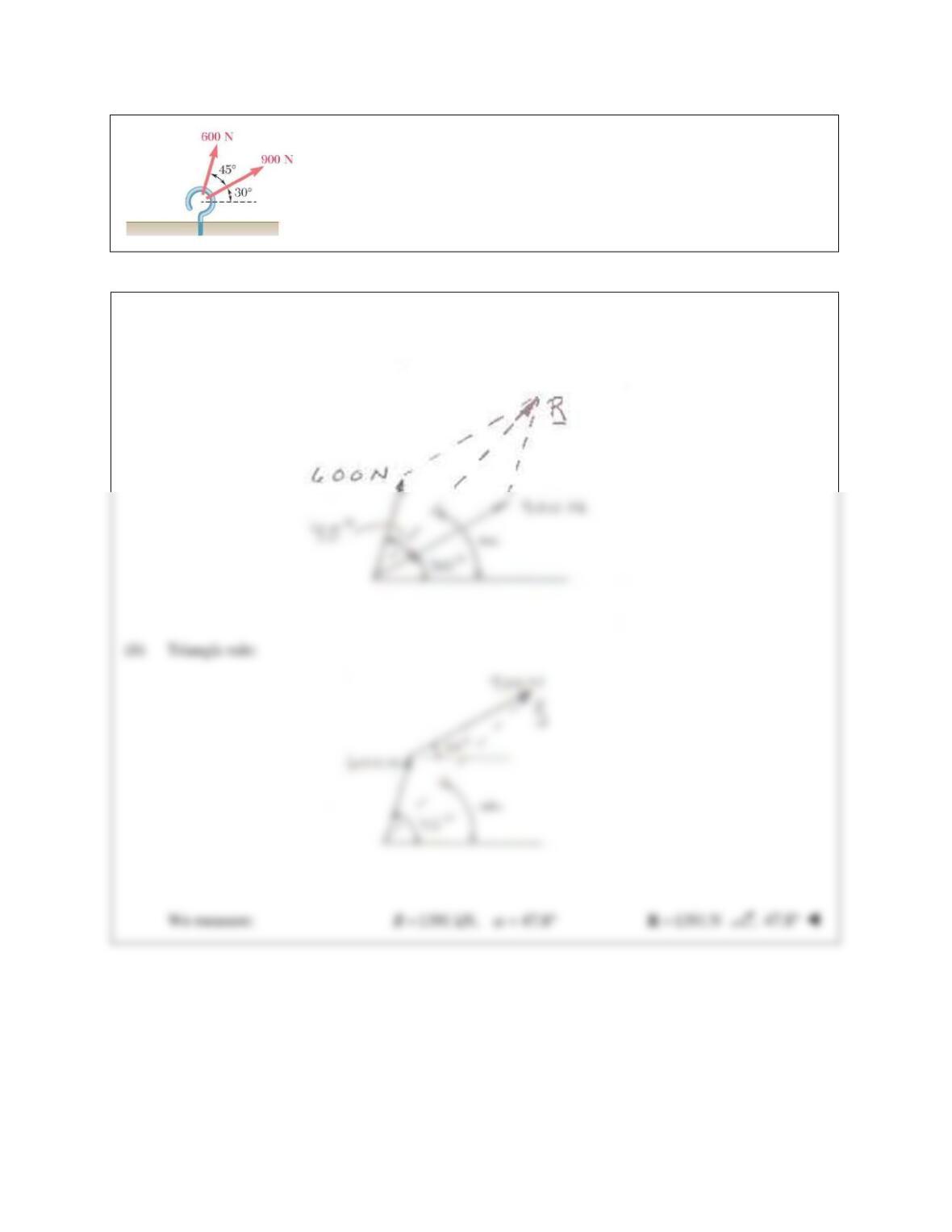
PROBLEM 2.1
Two forces are applied as shown to a hook. Determine graphically the
magnitude and direction of their resultant using (a) the parallelogram law,
(b) the triangle rule.
SOLUTION
(a) Parallelogram law:
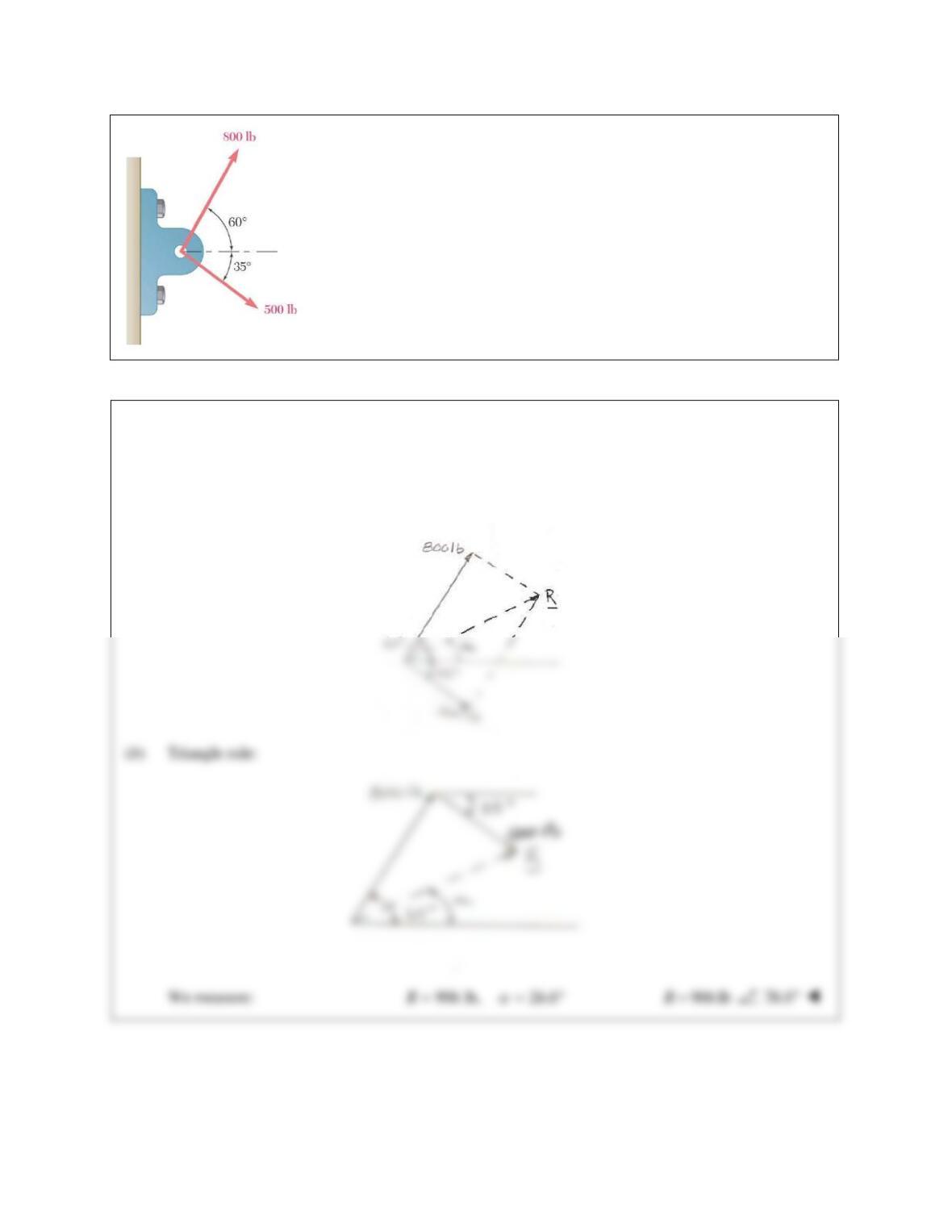
PROBLEM 2.2
Two forces are applied as shown to a bracket support. Determine
graphically the magnitude and direction of their resultant using
(a) the parallelogram law, (b) the triangle rule.
SOLUTION
(a) Parallelogram law:
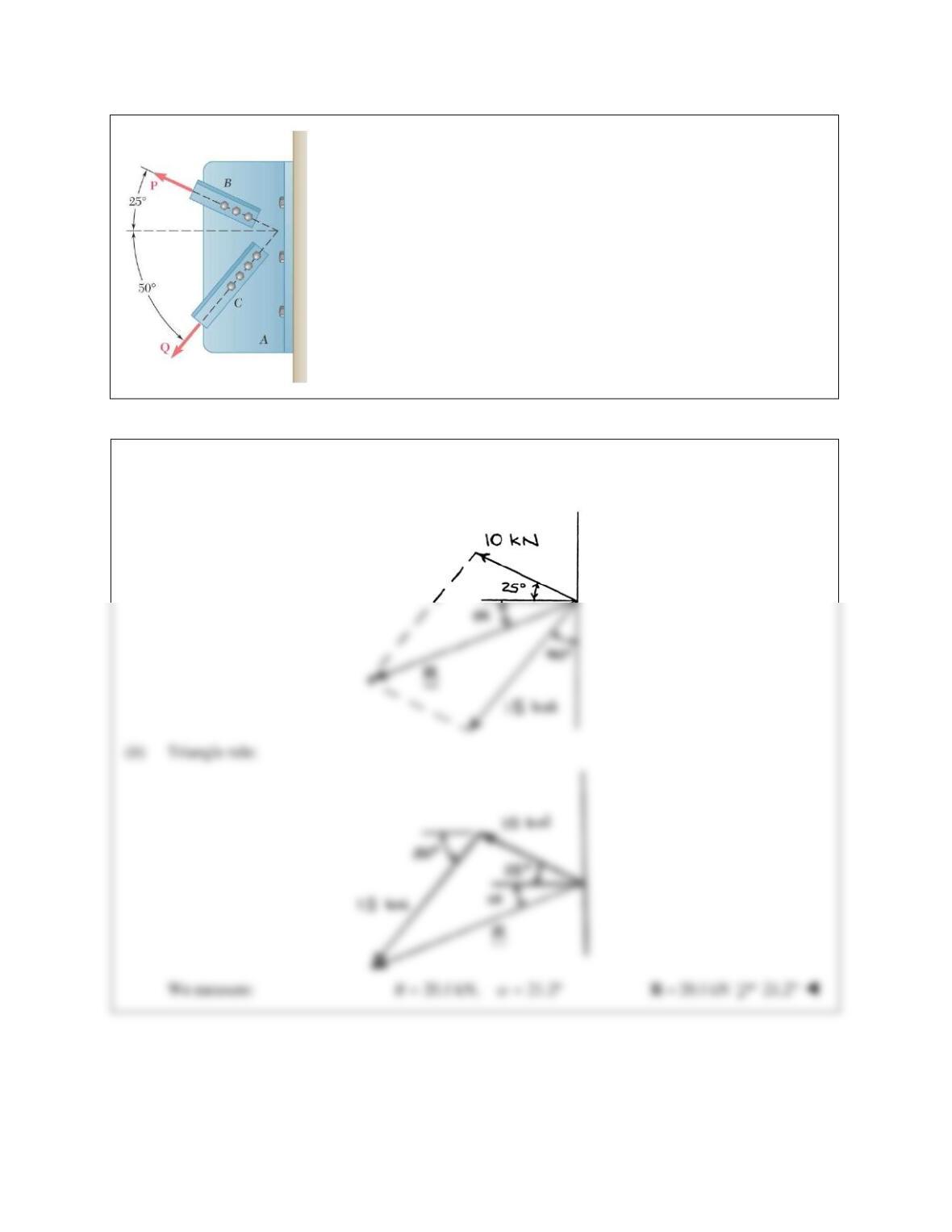
PROBLEM 2.3
Two structural members B and C are bolted to bracket A. Knowing that
both members are in tension and that P = 10 kN and Q = 15 kN,
determine graphically the magnitude and direction of the resultant force
exerted on the bracket using (a) the parallelogram law, (b) the triangle
rule.
SOLUTION
(a) Parallelogram law:
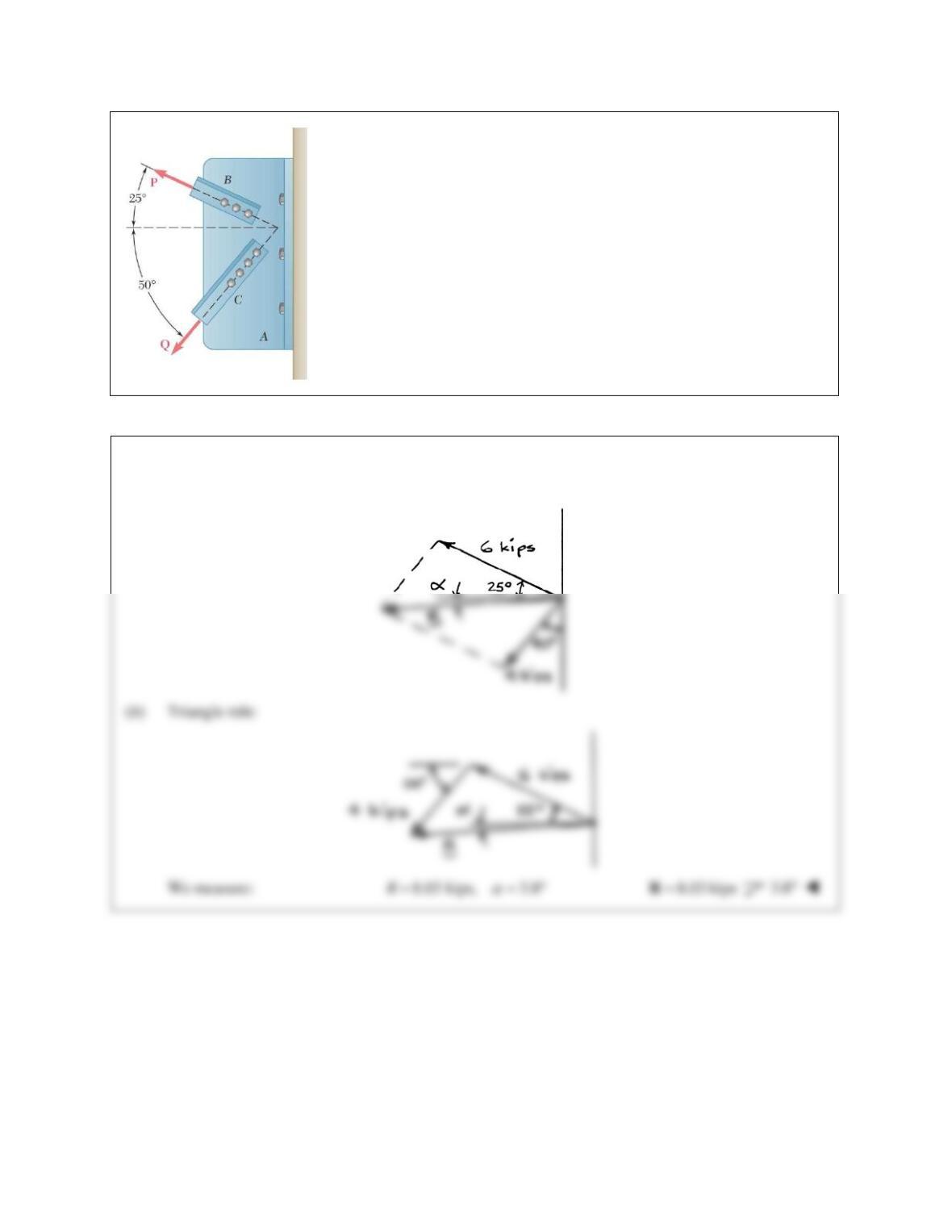
PROBLEM 2.4
Two structural members B and C are bolted to bracket A. Knowing that
both members are in tension and that P = 6 kips and Q = 4 kips,
determine graphically the magnitude and direction of the resultant force
exerted on the bracket using (a) the parallelogram law, (b) the triangle
rule.
SOLUTION
(a) Parallelogram law:
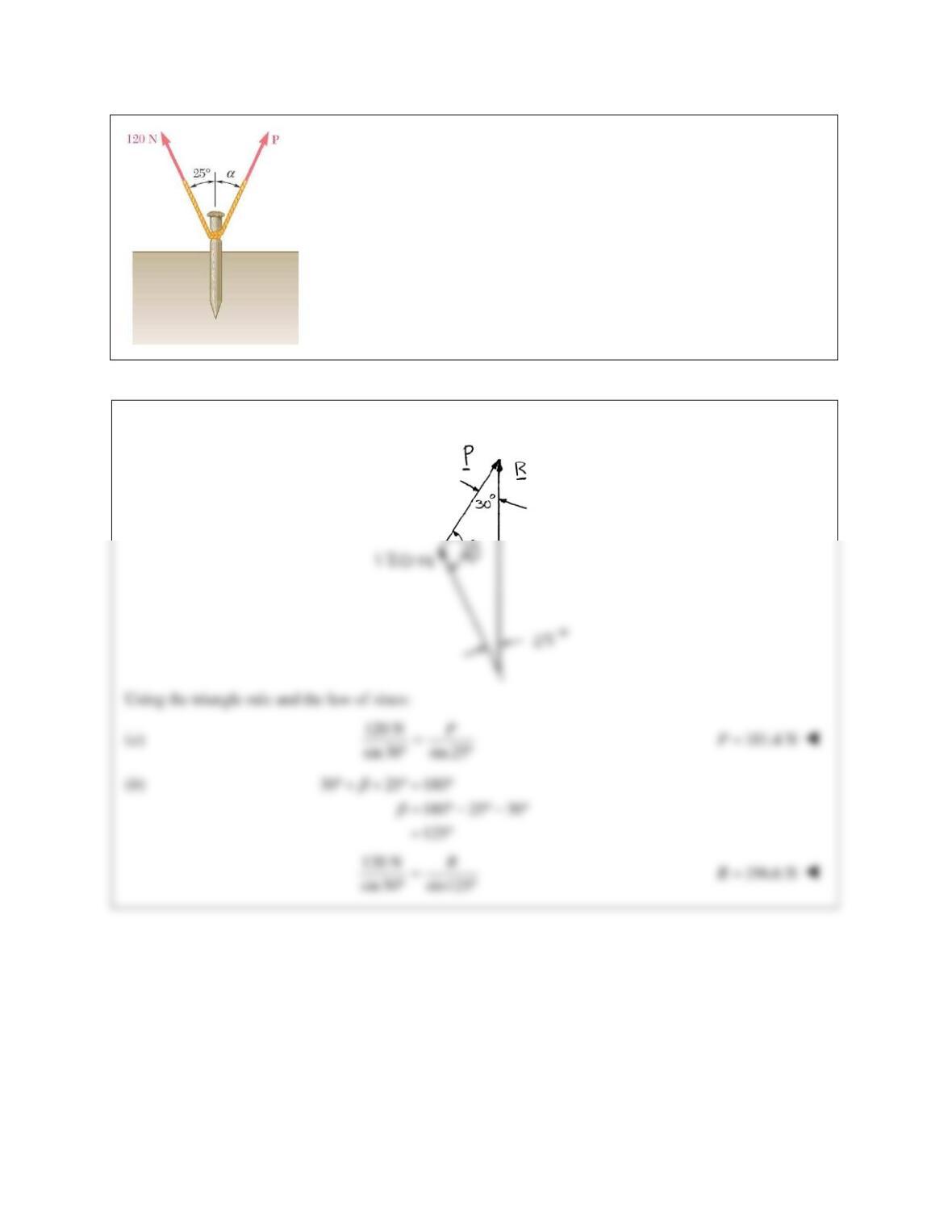
PROBLEM 2.5
A stake is being pulled out of the ground by means of two ropes as shown.
Knowing that α = 30°, determine by trigonometry (a) the magnitude of the
force P so that the resultant force exerted on the stake is vertical, (b) the
corresponding magnitude of the resultant.
SOLUTION
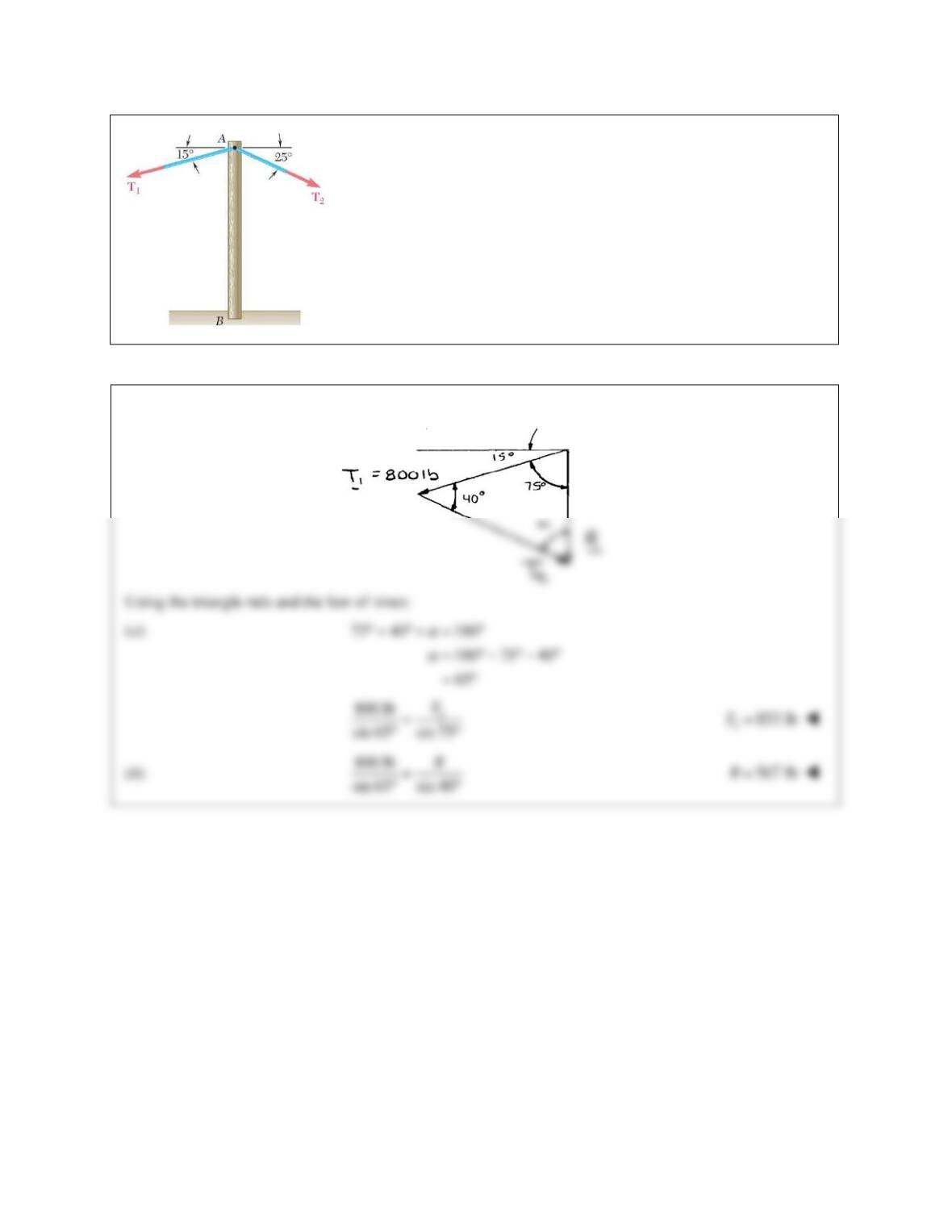
PROBLEM 2.6
A telephone cable is clamped at A to the pole AB. Knowing that the
tension in the left–hand portion of the cable is T1 = 800 lb, determine
by trigonometry (a) the required tension T2 in the right-hand portion if
the resultant R of the forces exerted by the cable at A is to be vertical,
(b) the corresponding magnitude of R.
SOLUTION
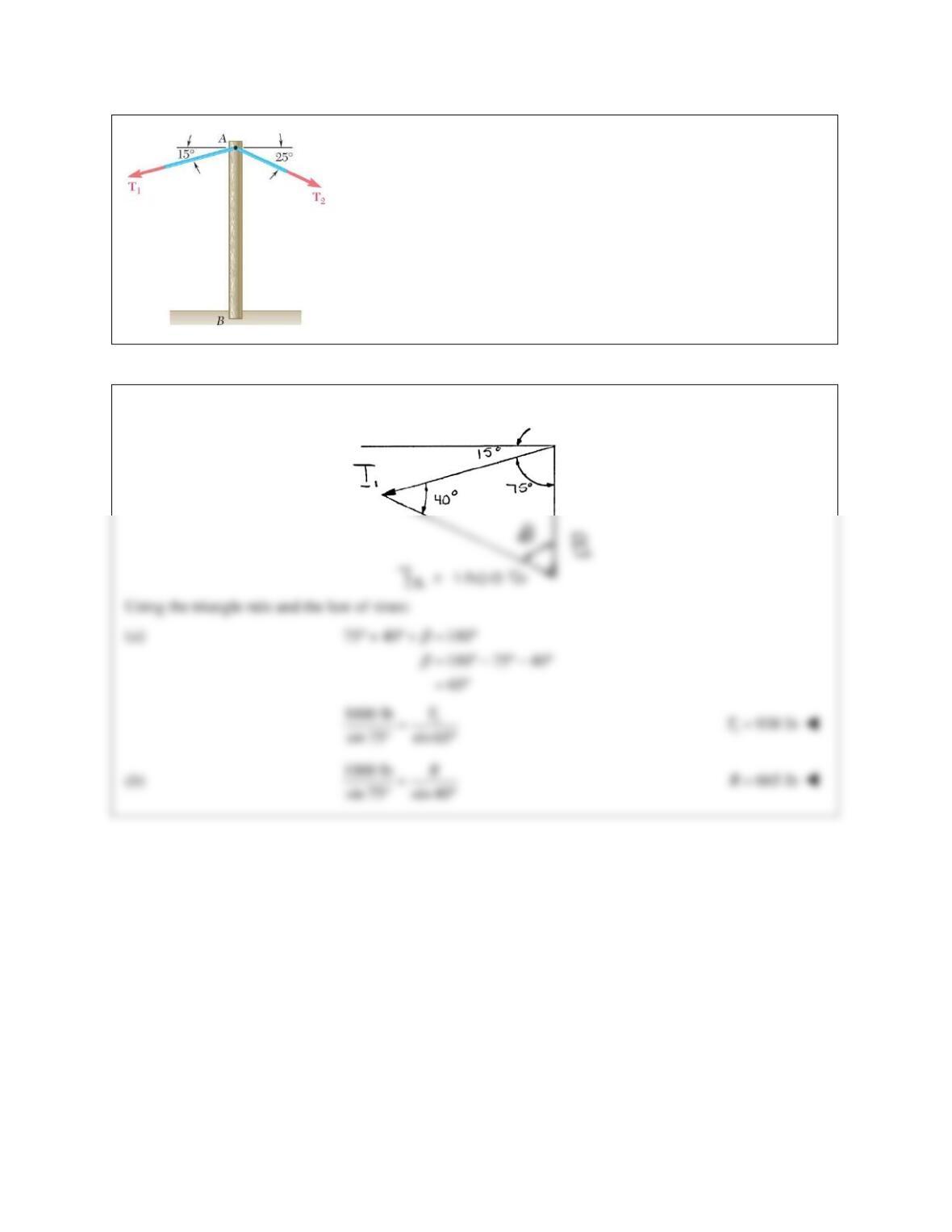
PROBLEM 2.7
A telephone cable is clamped at A to the pole AB. Knowing that the
tension in the right-hand portion of the cable is T2 = 1000 lb, determine
by trigonometry (a) the required tension T1 in the left–hand portion if
the resultant R of the forces exerted by the cable at A is to be vertical,
(b) the corresponding magnitude of R.
SOLUTION
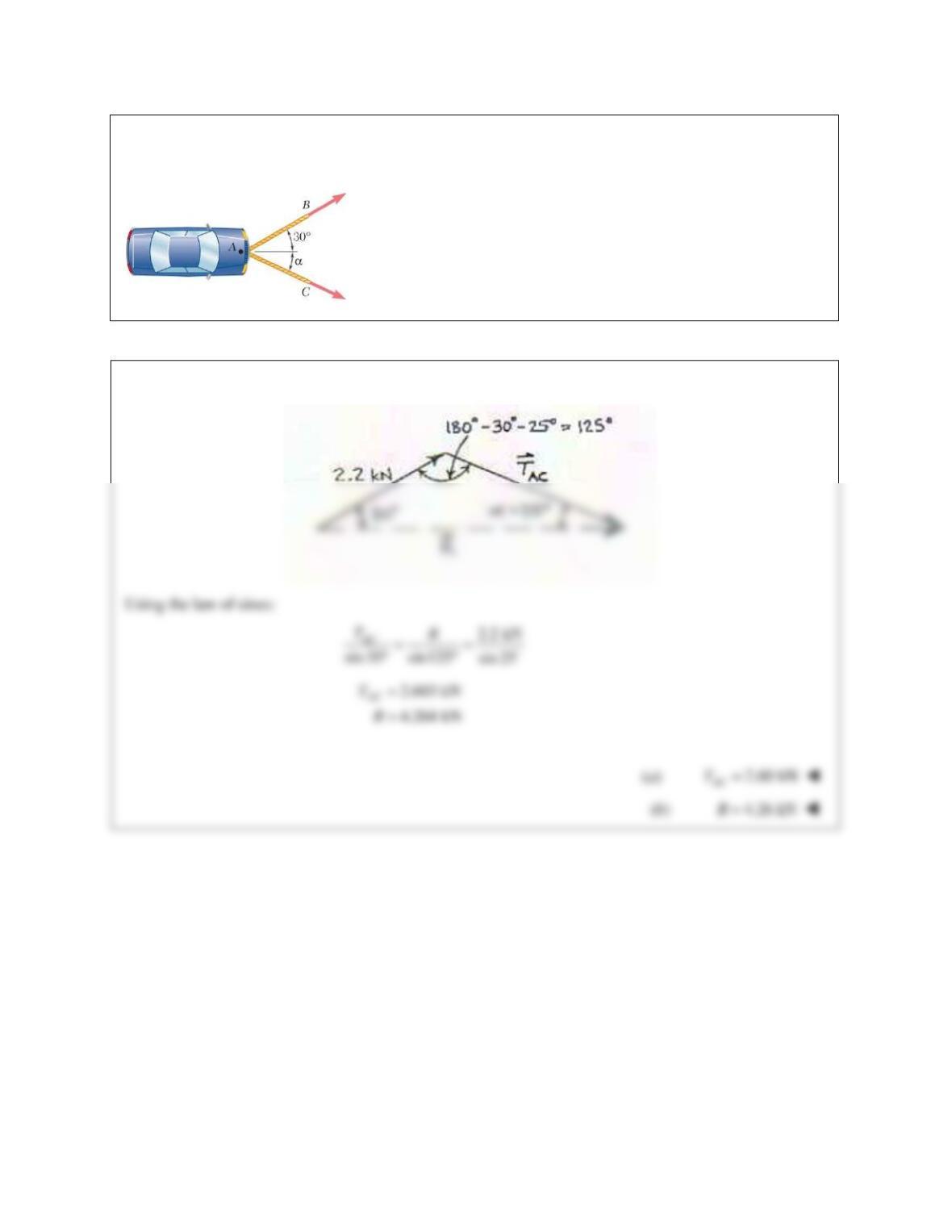
PROBLEM 2.8
A disabled automobile is pulled by means of two
ropes as shown. The tension in rope AB is 2.2 kN,
and the angle α is 25°. Knowing that the resultant
of the two forces applied at A is directed along the
axis of the automobile, determine by trigonometry
(a) the tension in rope AC, (b) the magnitude of the
resultant of the two forces applied at A.
SOLUTION
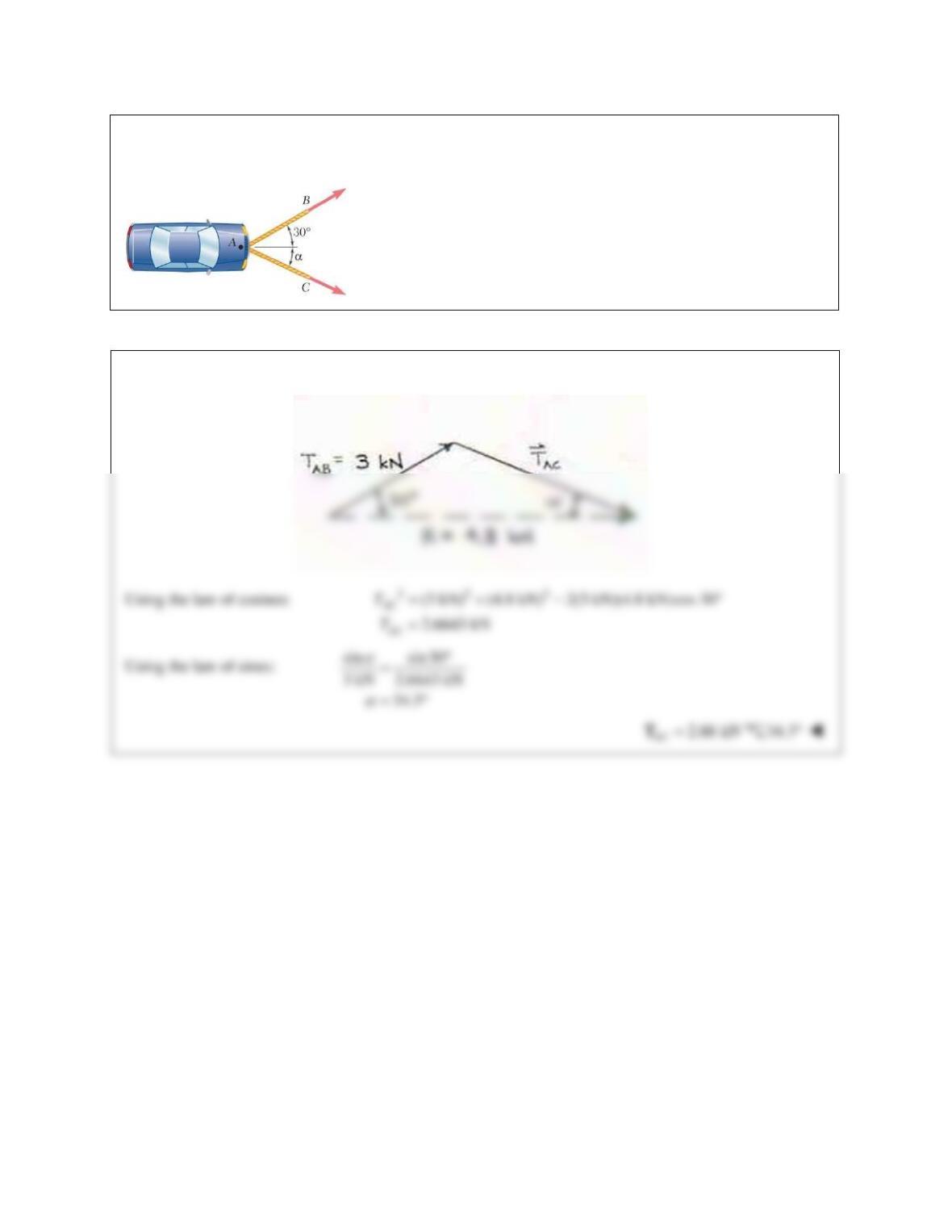
PROBLEM 2.9
A disabled automobile is pulled by means of two
ropes as shown. Knowing that the tension in rope
AB is 3 kN, determine by trigonometry the tension
in rope AC and the value of α so that the resultant
force exerted at A is a 4.8–kN force directed along
the axis of the automobile.
SOLUTION
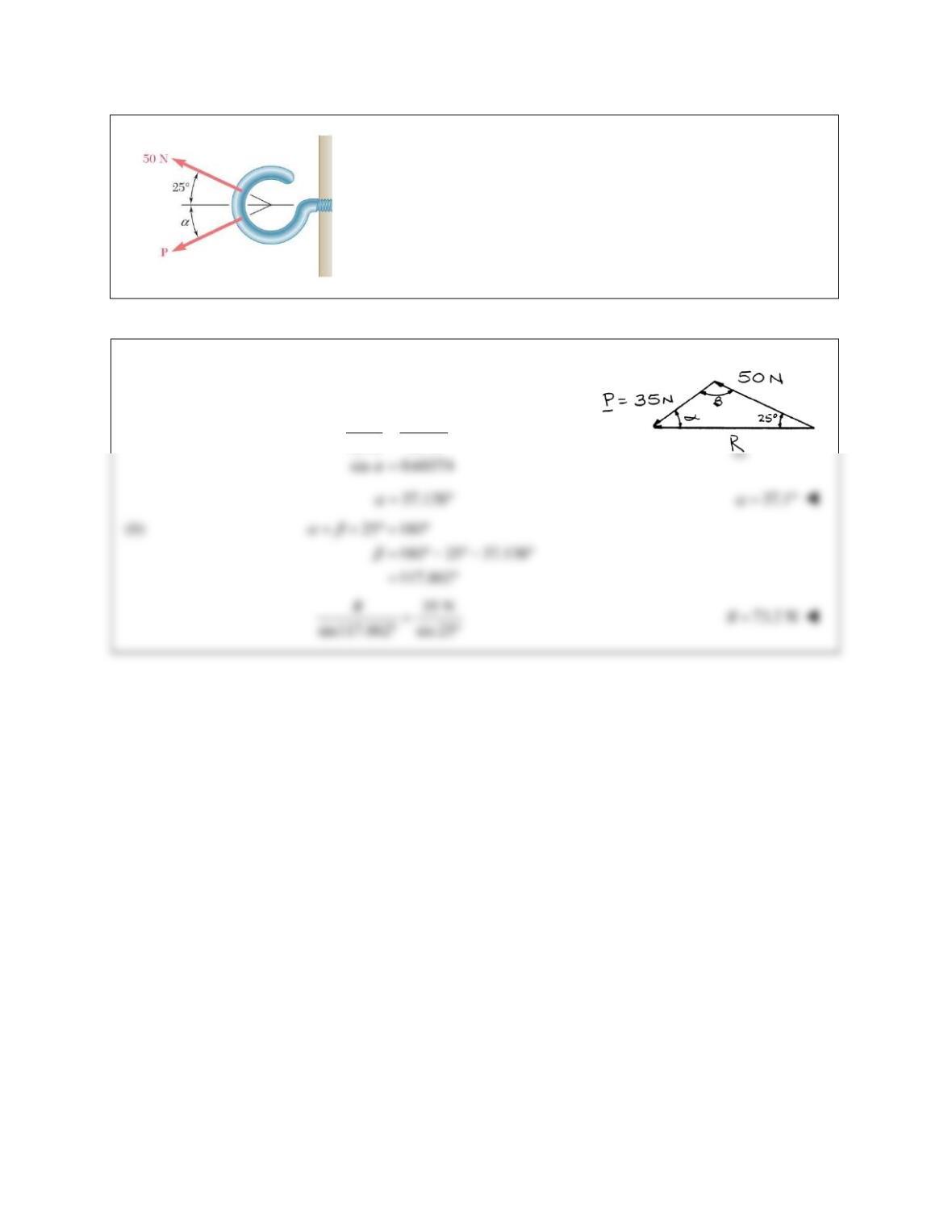
PROBLEM 2.10
Two forces are applied as shown to a hook support. Knowing that the
magnitude of P is 35 N, determine by trigonometry (a) the required
angle
α
if the resultant R of the two forces applied to the support is to
be horizontal, (b) the corresponding magnitude of R.
SOLUTION
Using the triangle rule and law of sines:
(a)
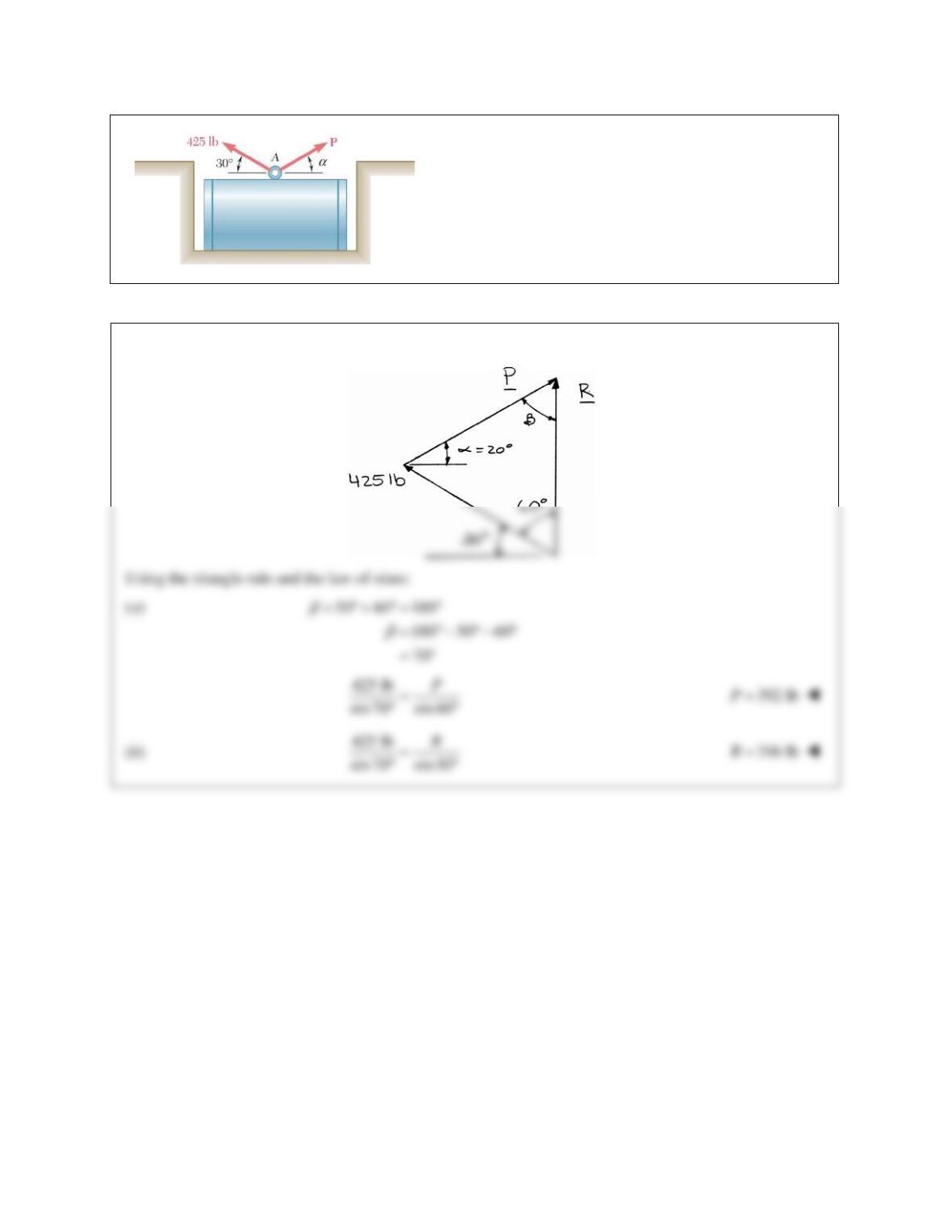
PROBLEM 2.11
A steel tank is to be positioned in an excavation. Knowing
that
α
= 20°, determine by trigonometry (a) the required
magnitude of the force P if the resultant R of the two
forces applied at A is to be vertical, (b) the corresponding
magnitude of R.
SOLUTION
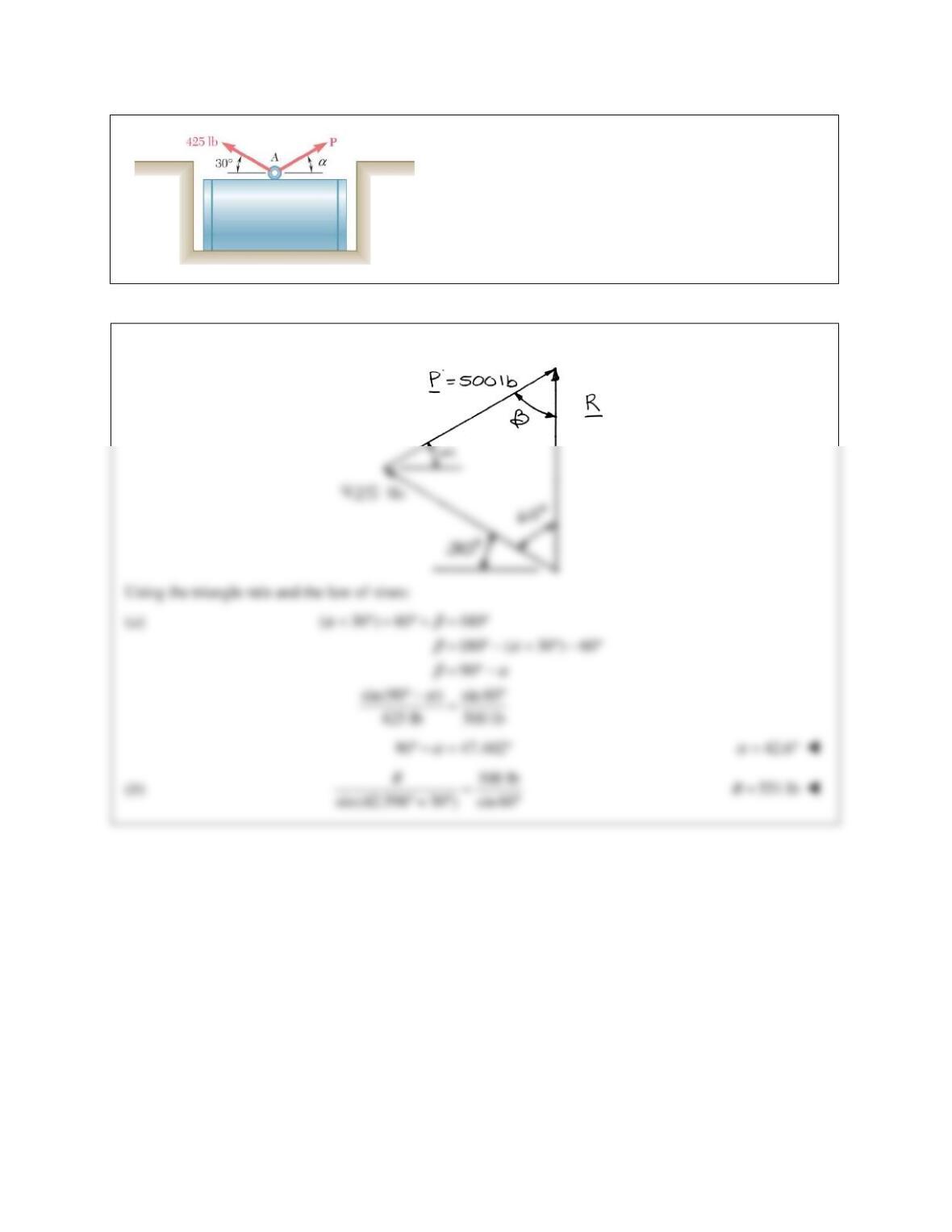
PROBLEM 2.12
A steel tank is to be positioned in an excavation. Knowing
that the magnitude of P is 500 lb, determine by
trigonometry (a) the required angle
α
if the resultant R of
the two forces applied at A is to be vertical, (b) the
corresponding magnitude of R.
SOLUTION
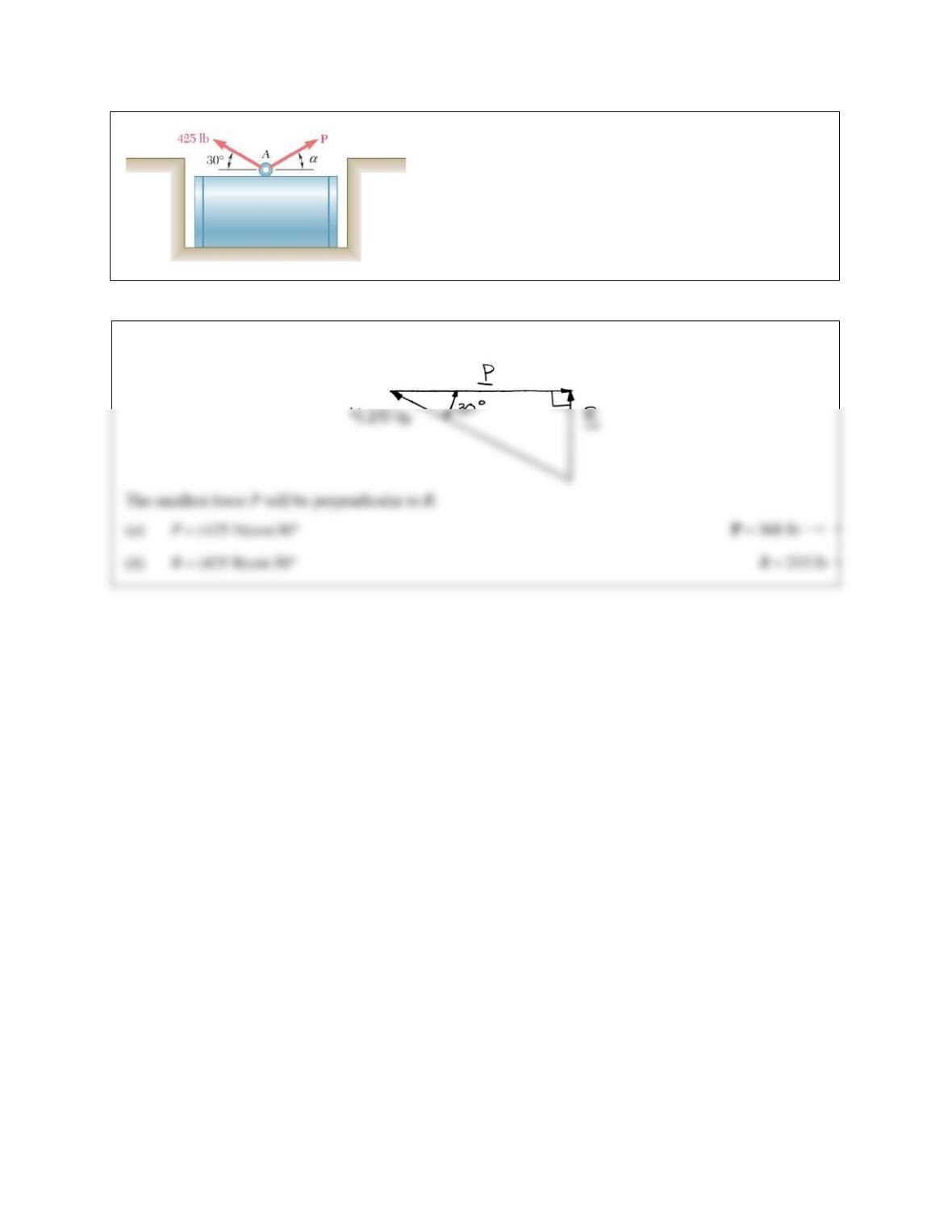
PROBLEM 2.13
A steel tank is to be positioned in an excavation.
Determine by trigonometry (a) the magnitude and
direction of the smallest force P for which the resultant R
of the two forces applied at A is vertical, (b) the
corresponding magnitude of R.
SOLUTION
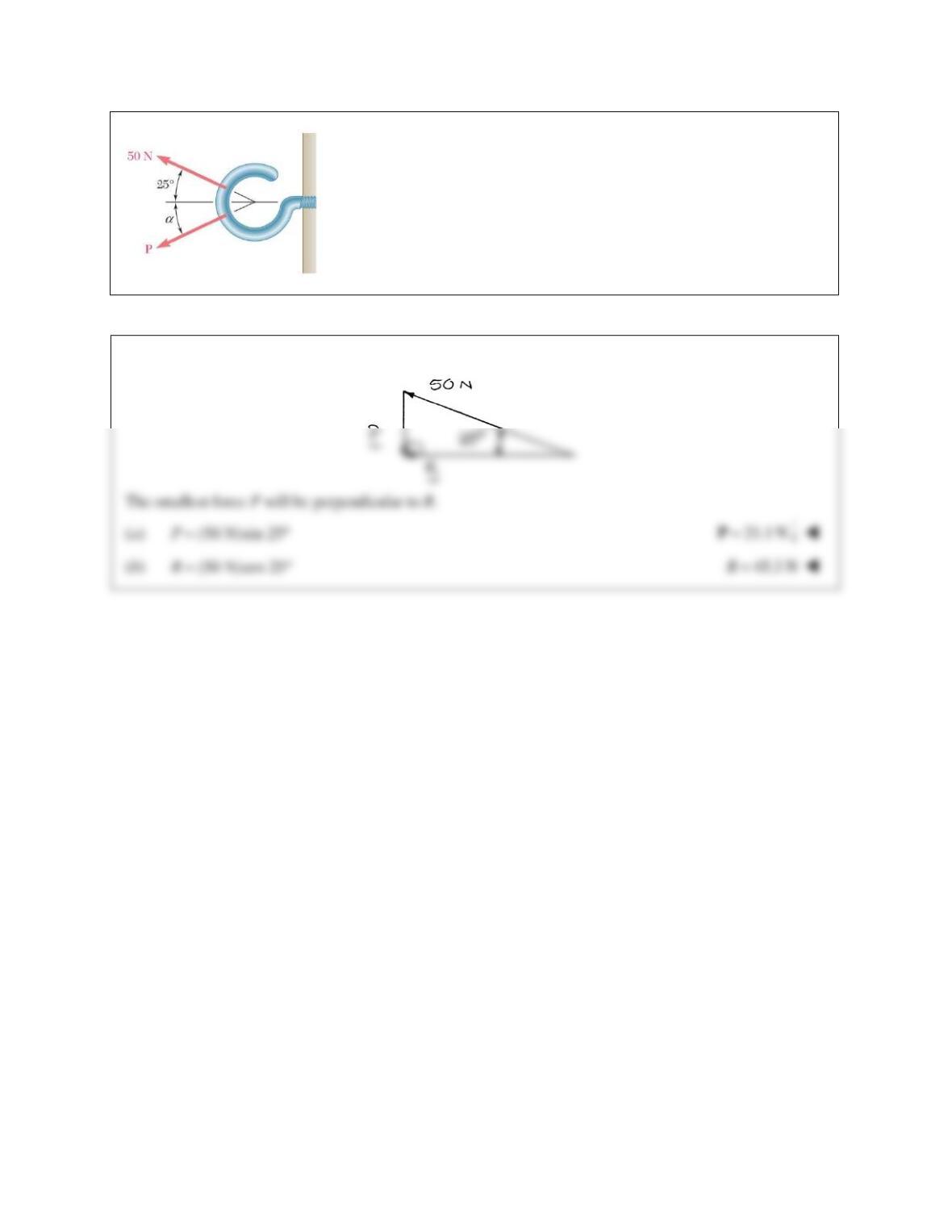
PROBLEM 2.14
For the hook support of Prob. 2.10, determine by trigonometry (a) the
magnitude and direction of the smallest force P for which the resultant
R of the two forces applied to the support is horizontal, (b) the
corresponding magnitude of R.
SOLUTION
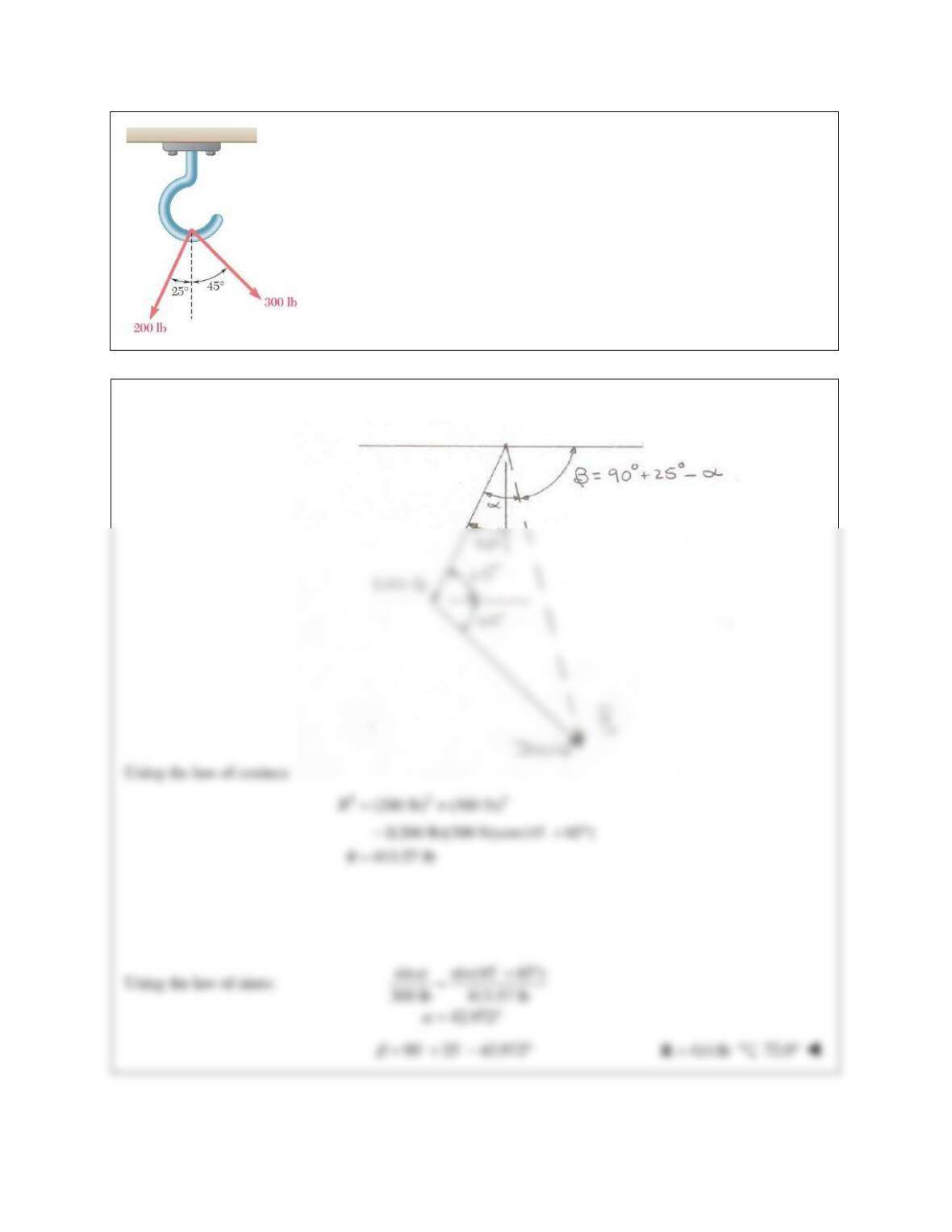
PROBLEM 2.15
For the hook support shown, determine by trigonometry the
magnitude and direction of the resultant of the two forces applied
to the support.
SOLUTION
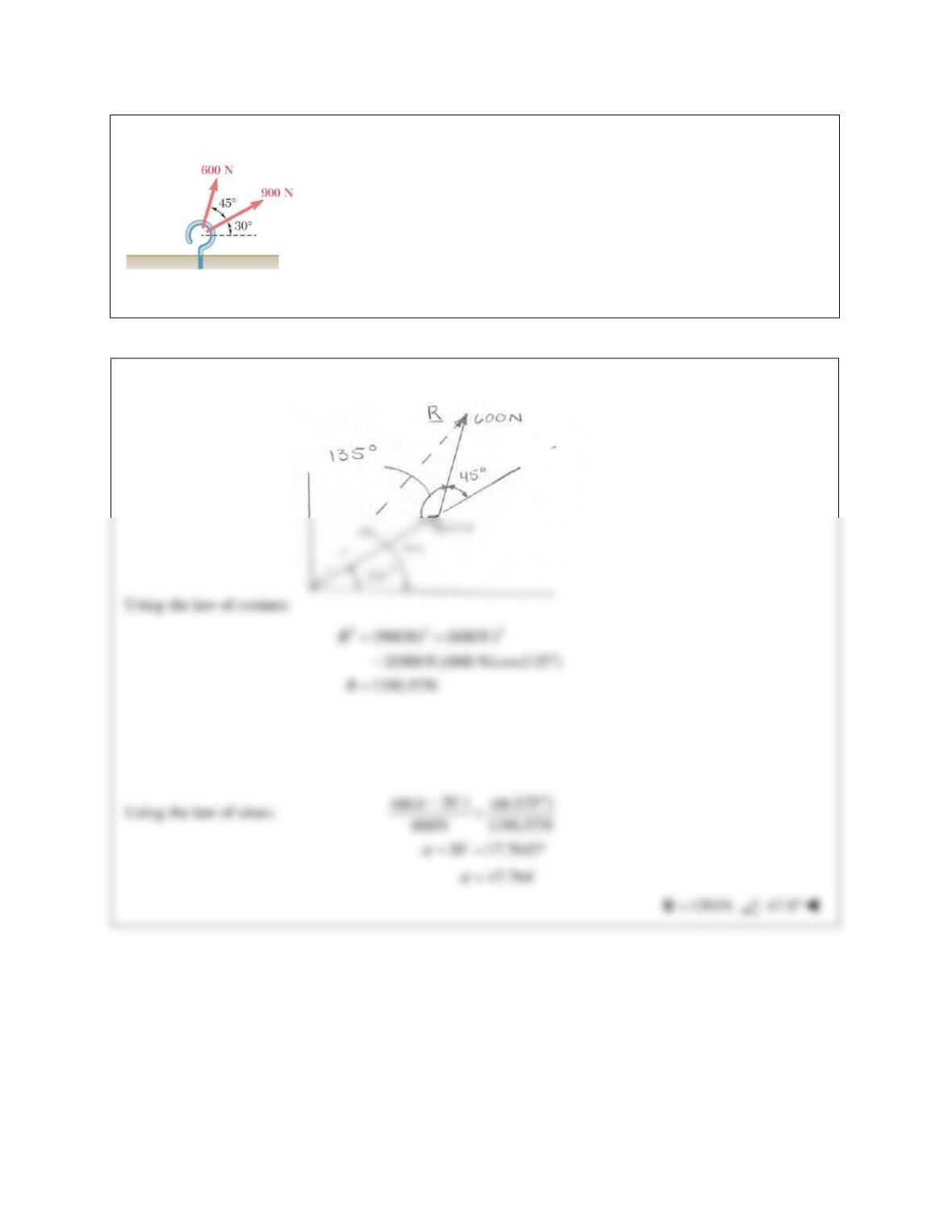
PROBLEM 2.16
Solve Prob. 2.1 by trigonometry.
PROBLEM 2.1
Two forces are applied as shown to a hook. Determine graphically the
magnitude and direction of their resultant using (a) the parallelogram law,
(b) the triangle rule.
SOLUTION
PROBLEM 2.17
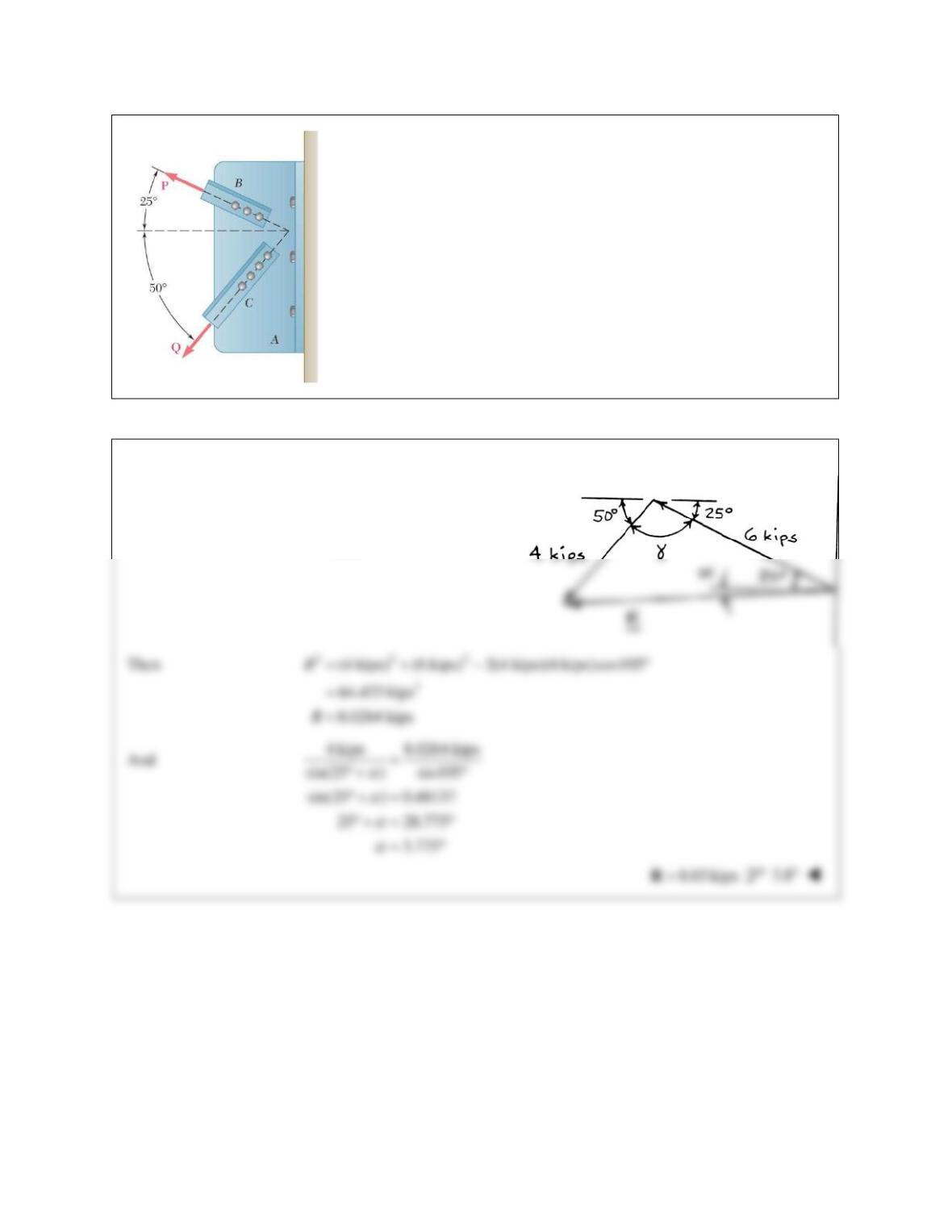
Solve Problem 2.4 by trigonometry.
PROBLEM 2.4 Two structural members B and C are bolted to bracket
A. Knowing that both members are in tension and that P = 6 kips and
Q = 4 kips, determine graphically the magnitude and direction of the
resultant force exerted on the bracket using (a) the parallelogram law,
(b) the triangle rule.
SOLUTION
Using the force triangle and the laws of cosines and sines:
We have:
180 (50 25 )
105
γ
= °− °+ °
= °
PROBLEM 2.18
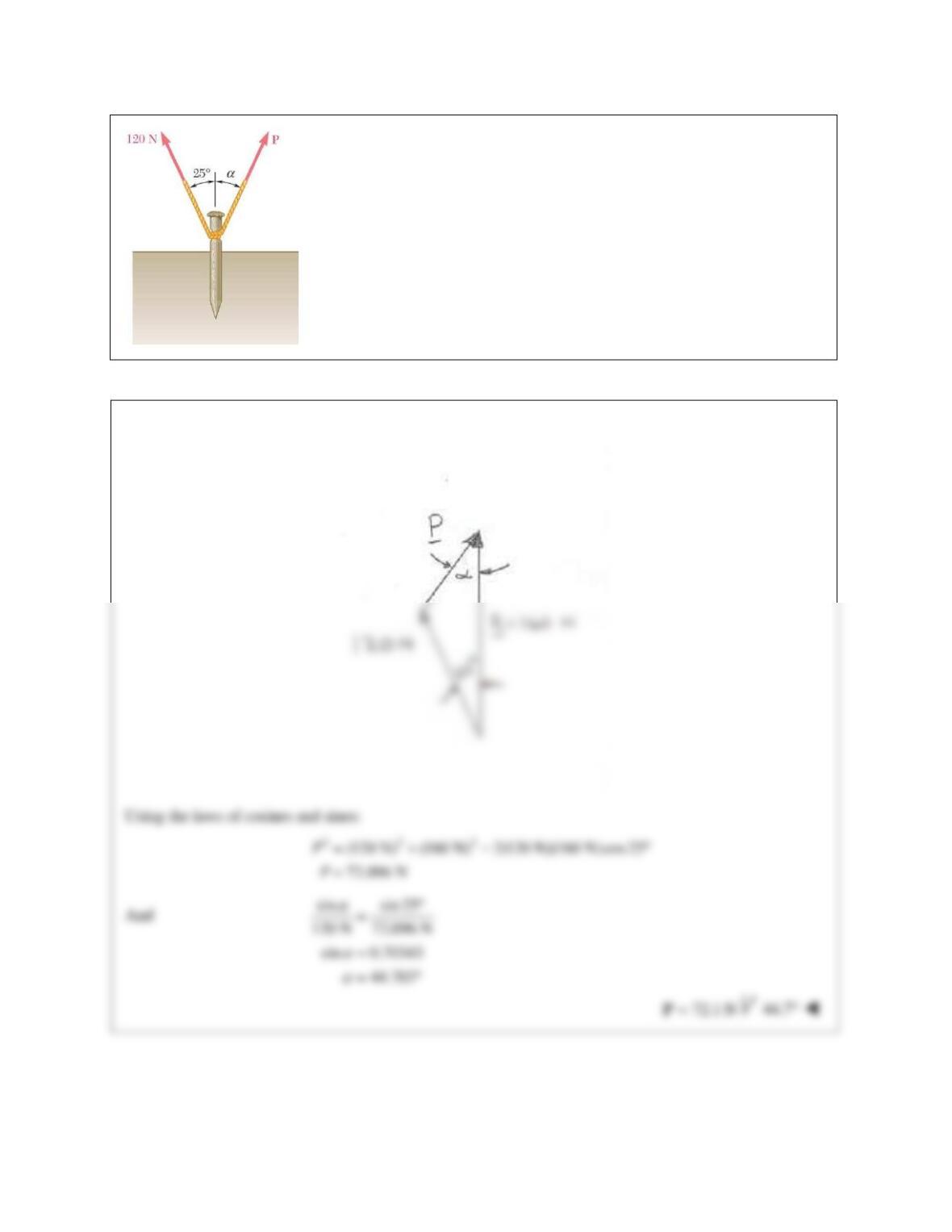
For the stake of Prob. 2.5, knowing that the tension in one rope is 120 N,
determine by trigonometry the magnitude and direction of the force P so
that the resultant is a vertical force of 160 N.
PROBLEM 2.5 A stake is being pulled out of the ground by means of two
ropes as shown. Knowing that α = 30°, determine by trigonometry (a) the
magnitude of the force P so that the resultant force exerted on the stake is
vertical, (b) the corresponding magnitude of the resultant.
SOLUTION