An Ethics Role-Playing Case:
Stockholders versus Stakeholders Case
Discussion
Tim Manuel1
University of Montana, USA
Abstract. This paper discusses a role playing ethics case suitable for business students in which
participants must balance shareholder and stakeholder concerns. Students take on the role of
operations manager and are challenged to consider the effects of their choices on the local society
as they balance the demands of stockholders, employees, and family when the concerns of the
Keywords: ethics, stakeholders, shareholder wealth, international operations, role playing cases.
Teaching Note and Case Discussion
This teaching note accompanies the case titled, “An Ethics Role Playing Case:
Stockholders versus Stakeholders”. The case consists of a role playing exercise
that highlights ethical conflicts between the stockholder wealth goal and
managing for multiple stakeholders. Students take on the role of an expatriate
1. This project was funded by a Department of Education Northwest International Business
Educators Network grant and by a University of Montana School of Business Summer
Research Grant. I would like to thank two anonymous reviewers and editor John Hooker for
providing detailed suggestions that tremendously improved the paper.
156 An Ethics Role-Playing Case: Stockholders versus Stakeholder Case Discussion
The note is organized as follows: The first section briefly discusses the
importance of ethics in finance and why a role playing exercise was chosen. This
material can be used to motivate student interest in the case, or it can be used as
follow-up material after the case is administered. The second section provides a
Motivation for the Case
Imagine how the last 10 to 15 years would have been different if there had been
no egregious ethical breaches in business and finance. Would we have had the
financial crisis and incurred the huge losses if financial managers had not taken
on such high levels of risk, if all lenders had followed ethical practices in making
home loans, and all homebuyers had refused to falsify loan documents? Has the
finance paradigm’s emphasis on maximizing shareholder wealth as the sole goal
I first became interested in teaching ethics because of the increased number
of ethical failures that were occurring in business. In attempting to include a
discussion of ethical thinking in a basic corporate finance class, I discovered that
the majority of students were not particularly interested, and I was unable to
generate meaningful classroom discussions. I then tried giving students short
structured role playing exercises and had better student discussions. Heartened, I
then turned to creating longer role playing exercises that (1) encourage students
to become aware of ethical considerations in their business decision making
process and (2) allow them to see the consequences of their choices. I had learned
Journal of Business Ethics Education 7 157
include ethical considerations in business decisions. A good ethics case should
require students to apply their values and morals in a self-discovery process in an
ambiguous setting. In teaching ethics we do not seek to instill our own value
system onto others. It is better to encourage students to think about their own
values in a meaningful way and assist them in finding their own guidelines for
their behavior. It is a major first step to get students to realize that they are
expected to apply a set of ethical values to a business decision.
Trevino and Nelson (2004) distinguish between an obvious moral choice of
right and wrong and an ethical dilemma. The choice to steal or not from the
company is an example of a moral choice between right and wrong. Presenting
students with this type choice does not result in much introspection or growth in
Shareholders versus Stakeholders
Milton Friedman (1976) argued that the social responsibility of business is to
make a profit, albeit while operating within the law and the moral customs of
society. The gist of Friedman’s argument is that managers have a fiduciary
responsibility to owners (the stockholders) and should not use the owner’s money
to benefit other stakeholders at the expense of stockholders. The basis of
Friedman’s arguments lies in the rights of property ownership, but not everyone
158 An Ethics Role-Playing Case: Stockholders versus Stakeholder Case Discussion
investments. Reduced investment may result in lower levels of economic growth
and fewer opportunities for betterment of members of society.
Once the positive moral role of increasing shareholder wealth is understood,
other stakeholders. This “profits over people” argument makes many
uncomfortable and leads some to conclude that stakeholder theory is inherently
more moral than stockholder theory. Freeman (2000) and others have postulated
stakeholder theories. For instance, Boatright (1994) argues that managers do not
have a special fiduciary relationship to shareholders, nor do they meet the
and Jensen (2005) argue that in the United States, the legal fiduciary
responsibility to stockholders obviates the possibility of simultaneously
managing for multiple stakeholders. Conflicts of interest of the different
stakeholders will inevitably arise, and management is legally duty bound to put
the interests of the shareholders above other stakeholders.
3. Boatright’s (1994) argument is interesting and it revolves around the implications of
incomplete contracting. One of the arguments for the “specialness” of stockholders as a
stakeholder is the residual risk they bear. Boatright argues that other stakeholders have claims
with similar characteristics because they, too, involve incompletely specified (explicit or
implicit) contracts with residual risks.
Journal of Business Ethics Education 7 159
problems observed with state-run firms that serve the interests of multiple
coalitions, in the long run it is conceivable that all stakeholders would lose if
management actively pursues a stakeholder as opposed to a shareholder policy.
struggle with stakeholders, with the uppermost political power at the moment
swaying decisions. Later, other stakeholders that were previously hurt are likely
to marshal political power to limit their future losses. Efficiency losses would
seem to be potentially large in this type of scenario.
incentives or an inability to monitor the reasonableness of managerial decisions
encourage managers to engage in short-term decisions to increase share price.
The focus on the short term may actually lead managers to engage in activities
that may destroy long-term value for many stakeholders. This provides a public
policy argument for rules that require a consideration of stakeholder value.4 For
4. With adequate government regulation and corporate governance, and a perfectly efficient
stock market where prices always reflect the long term value of equity, managers could neither
manipulate stock price nor profit from short-term fluctuations, and this argument would not
hold. Most financial economists believe that markets approach efficiency but are not perfectly
efficient. Doubts about efficiency have grown since the financial crisis. Failures in regulation
and corporate governance also abound. A brief nontechnical discussion may be found in Smith
and Wassenhove (2010).
160 An Ethics Role-Playing Case: Stockholders versus Stakeholder Case Discussion
employing firm only in so far as they are provided with the proper incentives to
do so. Dobson rejects this stereotype and posits that managers are not solely
motivated by external rewards, noting that they also value intrinsic rewards that
result from acting virtuously. Ghoshal (2005) draws on examples of altruism to
make a similar argument that mangers act ethically for its own benefits. There is
undoubtedly truth to these assertions. Thus finance agency models that assume
opportunistic behavior don’t capture the reality of many business relationships
where trust is honored by contracting parties because to do so is virtuous, even
when it may not be in the parties’ own (or their shareholders’) pecuniary interest
Reconciling the Two Views
According to Hendry (2001), business ethicists have been unable to construct a
stakeholder model of the firm that is not fatally flawed. Nevertheless, managers
do consider the interests of multiple stakeholders, and they undoubtedly should.
One reason for this is that the potential conflicts between stakeholders are not as
pervasive as they are often pictured. Jensen (in Agle et.al. 2008), among others,
correctly indicates that in many cases concern for the welfare of multiple
stakeholders will be in the long-term best interests of the shareholders. Treating
customers with respect, fairly paying employees, not polluting, and so forth, serve
as general rules that contribute to shareholder wealth in the long run. Danielson,
Journal of Business Ethics Education 7 161
Managers will always have to make tradeoffs among different stakeholder
groups that require nuanced ethically mature judgments. No rule or theory can
substitute for this. Nevertheless, many, if not most, of the conflicts between the
shareholder and stakeholder schools of thought can be resolved by (1)
encouraging managers to manage for long term value, (2) improving corporate
incentive systems to reinforce the focus on long-term value and managerial
integrity, and (3) to inculcate ethical training and education into both business
school curricula and on-the-job training that emphasizes the value of virtue and
integrity.5
Analysis and Discussion of the Ethics Case
The case employs a simple role-playing exercise written to illustrate ethical
considerations of business decisions. The case can be completed in one eighty-
minute class period, although some follow-up discussion in the subsequent class
period may be desirable. The context of the case is the decision to close a plant
facility that is a major part of the local economy in a developing country in order
to meet shareholder demands for better profitability. The case asks students to
grapple with the moral ramifications of maximizing shareholder wealth when this
appears to conflict with other stakeholders and pushes them to decide how far
they are willing to go to protect a stakeholder group.
162 An Ethics Role-Playing Case: Stockholders versus Stakeholder Case Discussion
exercise: an international finance capital budgeting spreadsheet model that
includes ethical decision variables as part of the decision process.6 In the
semesters before I began using this case, most students failed to consider the
ethical implications in the ethics portion of the final exam. The scores on the
ethical component of the final exam improved after including this case.
discussions and written exercises.
The case introduction (Handout I in the case) is made available to the students
one class period before the case is administered, and students are instructed to
read the introduction and be prepared to discuss it in class. Students are told that
it is an ethics role playing case with multiple decisions, and the outcomes they will
face will depend on their choices. It is important to encourage students to express
their thoughts freely and ensure that participants do not fear being criticized for
their decisions.
Journal of Business Ethics Education 7 163
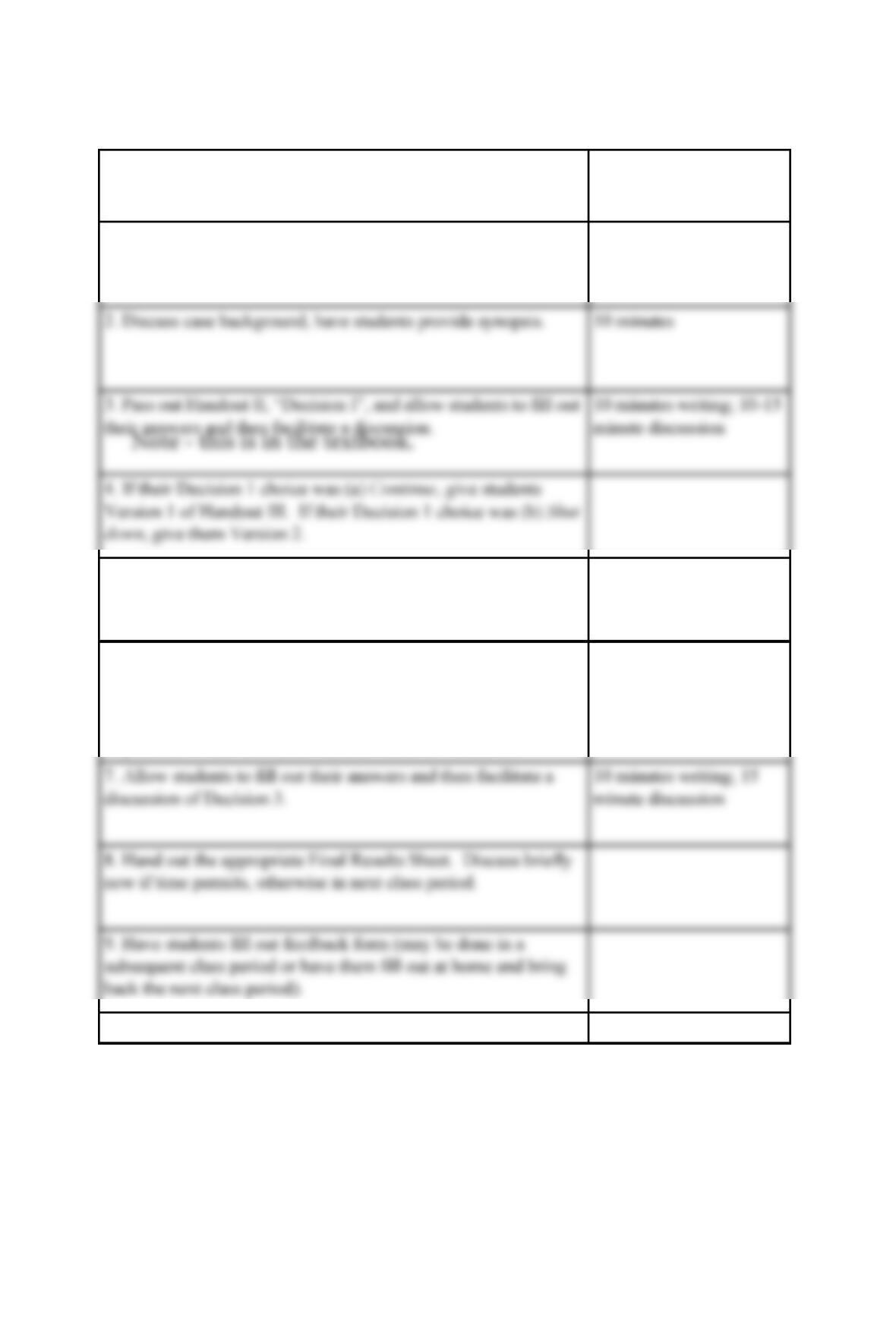
Figure 1: Suggested Case Usage Timeline
Case Introductory Information
The instructor should elicit discussion on the case setup at the start of the class
section. The discussion should be limited to no more than ten minutes. The
introduction indicates that the student will play the role of the chief operating
Case Chronology (80 minute class period) Estimated Time
1. Give students background for the case the prior class period.
5. Allow students to fill out their answers for Decision 2 and then
facilitate a discussion.
10 minutes writing; 10
minute discussion
6. If their Decision 2 choice was (c) Recommend that the company
sell, give students Version 1 of Handout IV. If their Decision 2
choice was (d1) Keep going as planned to cut costs, the students
receive Version 2. If their Decision 2 choice was (d2) Keep going
as planned to shut down, the students receive Version 3.
10. Turn in all forms.
Note – this is in the textbook – Case 1.
164 An Ethics Role-Playing Case: Stockholders versus Stakeholder Case Discussion
officer in an overseas subsidiary of a U.S. firm that operates in a developing
economy. The officer is a U.S. citizen but has extensive local ties and is married
The instructor may wish to use some or all of the following suggested
questions to encourage discussion:
1. Who are you in the case? What do you do?
2. Do you have any real or potential conflicts of interest? Are the
conflicts sufficient to require you to excuse yourself from the
decision?
5. Do you think the firm is making a decision with long term-effects
based primarily on short-term events?
The instructor should be careful to elicit both sides of the shareholder-
stakeholder debate rather than push one viewpoint over another. There are many
ideas available in the Shareholders versus Stakeholders section above that the
instructor can draw upon. Placing the students in the role of a local manager
whose decision can significantly affect the lives of many people is a method to
help students understand how their decisions can affect other stakeholders. The
instructor should limit the time allowed for discussion to ten to fifteen minutes.
The time requirement may not allow the instructor to use all of the questions.
Journal of Business Ethics Education 7 165
Decision 1
After the instructor has elicited a synopsis and discussion of the introductory
material, Decision 1 found on Handout II should be given to the students. It may
be useful to color code the decision sheets to ensure the proper sheets are handed
Suggested questions to encourage discussion after they make their decision
include:
1. Synopsis:
(a) Describe the situation now.
(b) What is really behind the pressure to cut costs? Are these short-
term or long-term effects? Does this matter?
(c) If you try to cut costs what has to happen to make it work?
2. Do you have any personal risk here? How did that affect your
decision if at all?
It is useful if all students contribute to the discussion, and the instructor may
wish to call on individual students who are not actively participating. The current
generation of students enjoys expressing its opinion, and most are willing to
reveal their choice and explain why they made it. The instructor should be careful