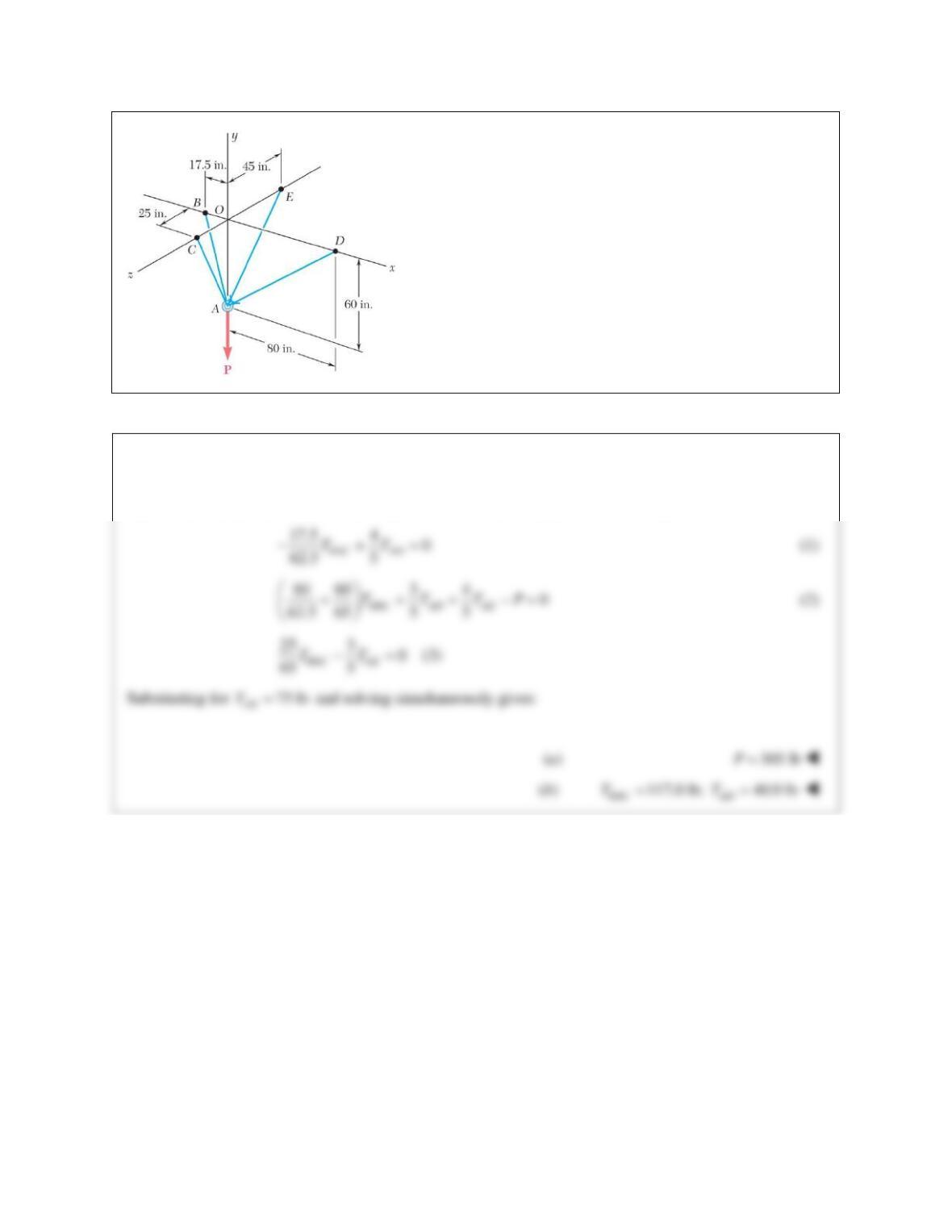
PROBLEM 2.124
Knowing that the tension in cable AE of Prob. 2.123 is 75 lb,
determine (a) the magnitude of the load P, (b) the tension in
cables BAC and AD.
PROBLEM 2.123 Cable BAC passes through a frictionless
ring A and is attached to fixed supports at B and C, while
cables AD and AE are both tied to the ring and are attached,
respectively, to supports at D and E. Knowing that a 200-lb
vertical load P is applied to ring A, determine the tension in
each of the three cables.
SOLUTION
Refer to the solution to Problem 2.123 for the figure and analysis leading to the following set of
equilibrium equations, Equation (2) being modified to include Pj as an unknown quantity:
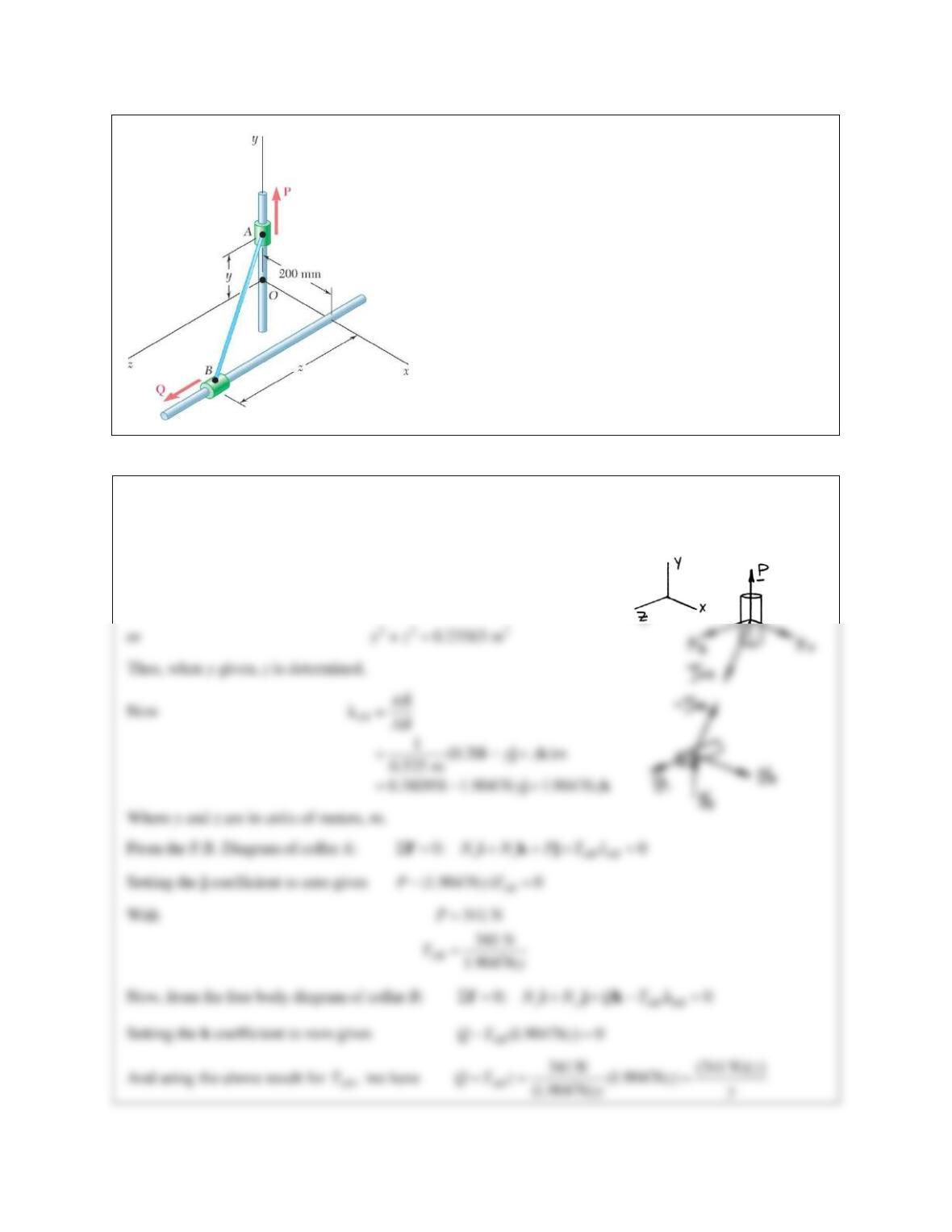
PROBLEM 2.125
Collars A and B are connected by a 525-mm-long wire and
can slide freely on frictionless rods. If a force
(341 N)=Pj
is applied to collar A, determine (a) the
tension in the wire when y
155 mm,=
(b) the magnitude
of the force Q required to maintain the equilibrium of the
system.
SOLUTION
For both Problems 2.125 and 2.126: Free–Body Diagrams of Collars:
2 2 22
()AB x y z=++
Here
2 2 22
(0.525 m) (0.20 m) yz= ++
PROBLEM 2.125 (Continued)
Then from the specifications of the problem,
155 mm 0.155 my= =
2 22
0.23563 m (0.155 m)
0.46 m
z
z
= −
=
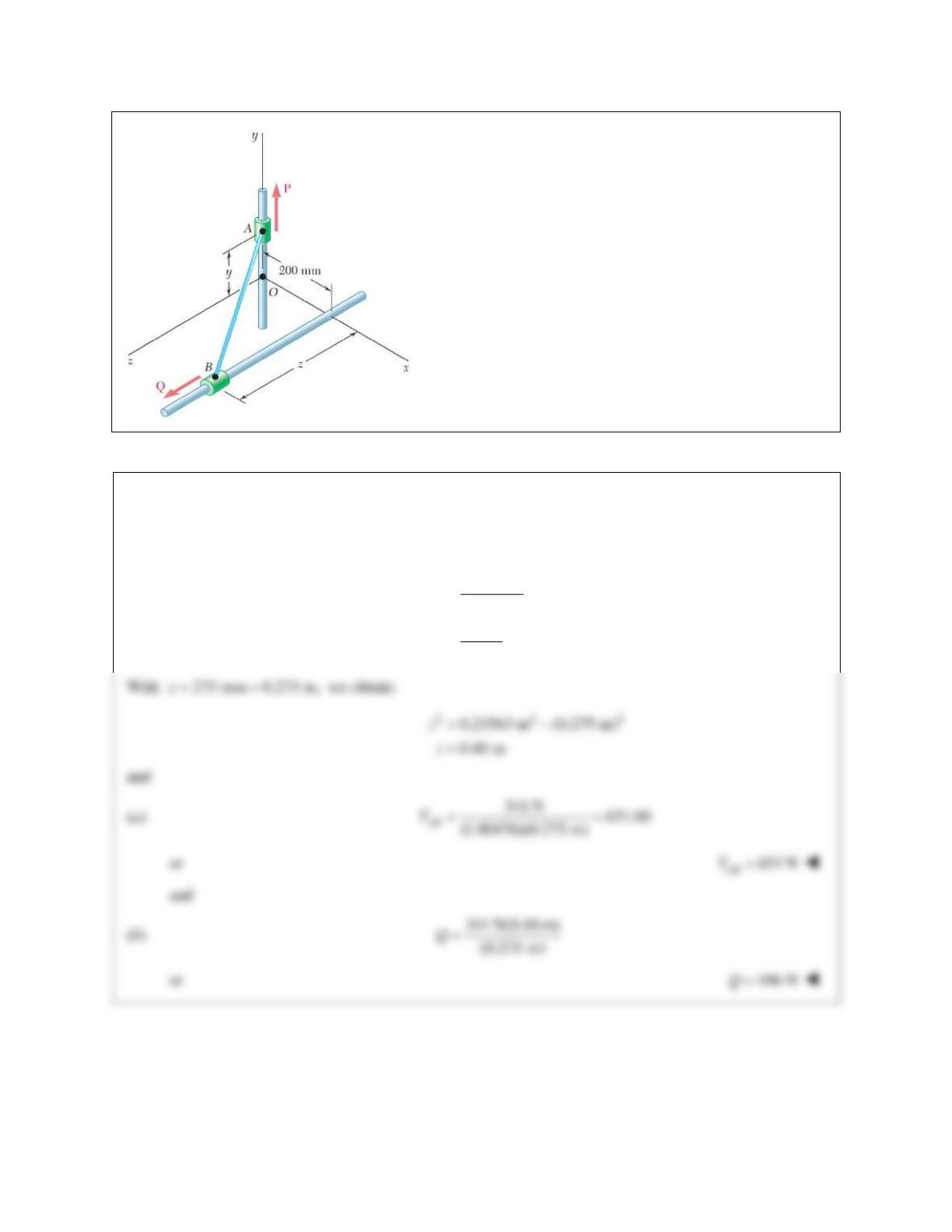
PROBLEM 2.126
Solve Problem 2.125 assuming that
275 mm.y=
PROBLEM 2.125 Collars A and B are connected by a
525-mm–long wire and can slide freely on frictionless
rods. If a force
(341 N)=Pj
is applied to collar A,
determine (a) the tension in the wire when y
155 mm,=
(b) the magnitude of the force Q required to maintain the
equilibrium of the system.
SOLUTION
From the analysis of Problem 2.125, particularly the results:
22 2
0.23563 m
341 N
1.90476
341 N
AB
yz
Ty
Qz
y
+=
=
=
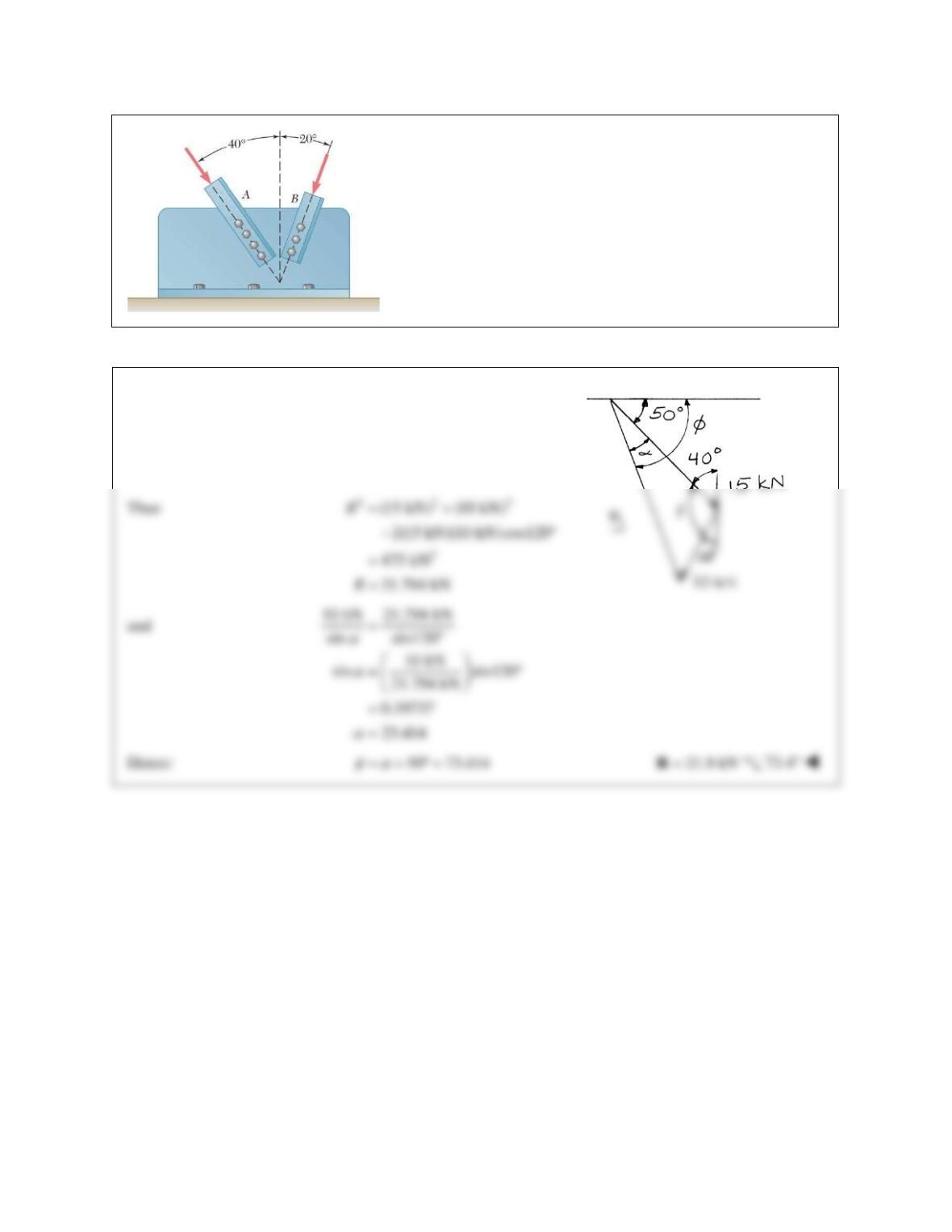
PROBLEM 2.127
Two structural members A and B are bolted to a bracket as
shown. Knowing that both members are in compression and
that the force is 15 kN in member A and 10 kN in member B,
determine by trigonometry the magnitude and direction of the
resultant of the forces applied to the bracket by members A and
B.
SOLUTION
Using the force triangle and the laws of cosines and sines,
we have
180 (40 20 )
120
γ
= °− °+ °
= °
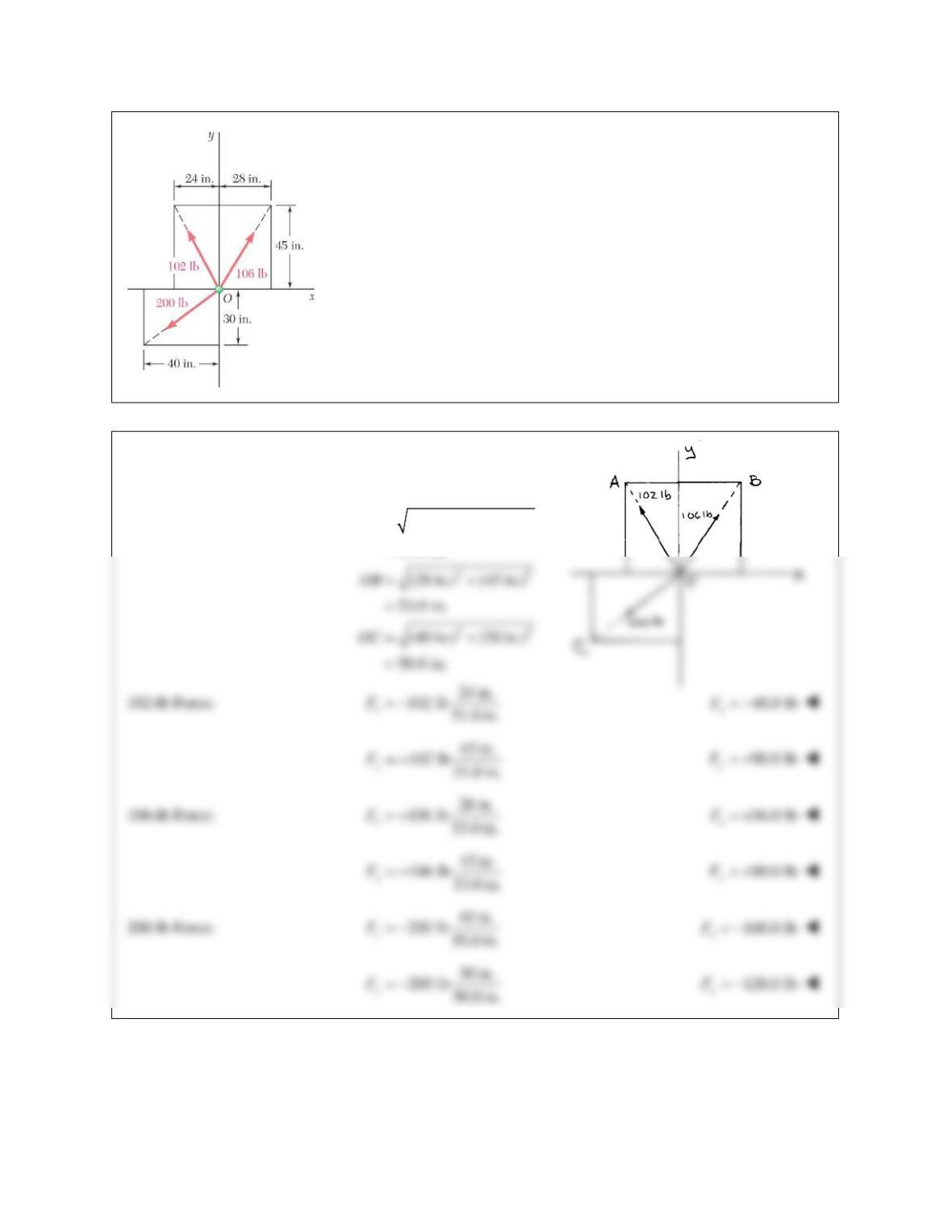
PROBLEM 2.128
Determine the x and y components of each of the forces shown.
SOLUTION
Compute the following distances:
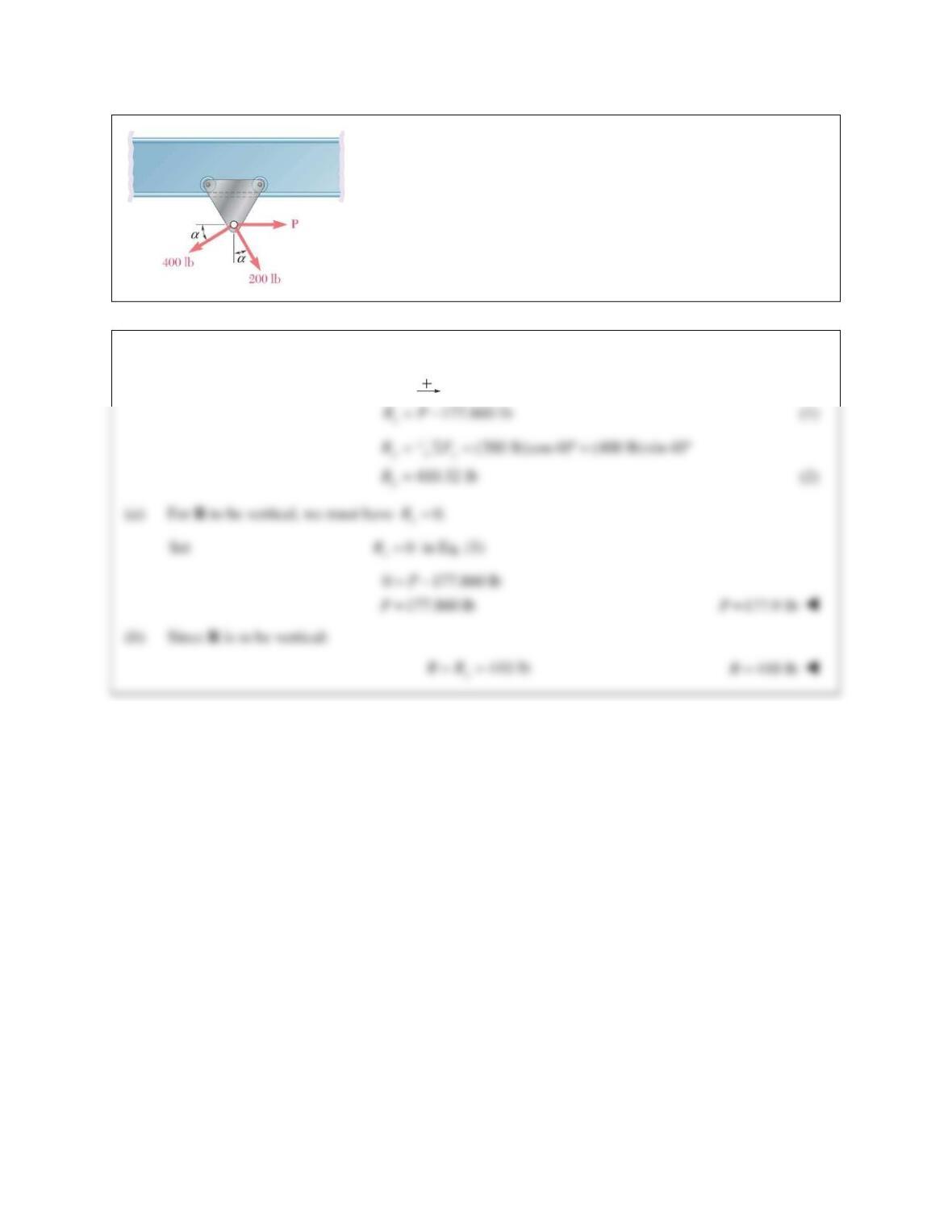
PROBLEM 2.129
A hoist trolley is subjected to the three forces shown. Knowing that
α = 40°, determine (a) the required magnitude of the force P if the
resultant of the three forces is to be vertical, (b) the corresponding
magnitude of the resultant.
SOLUTION
x
R=
(200 lb)sin 40 (400 lb) cos 40
x
FPΣ = + °− °
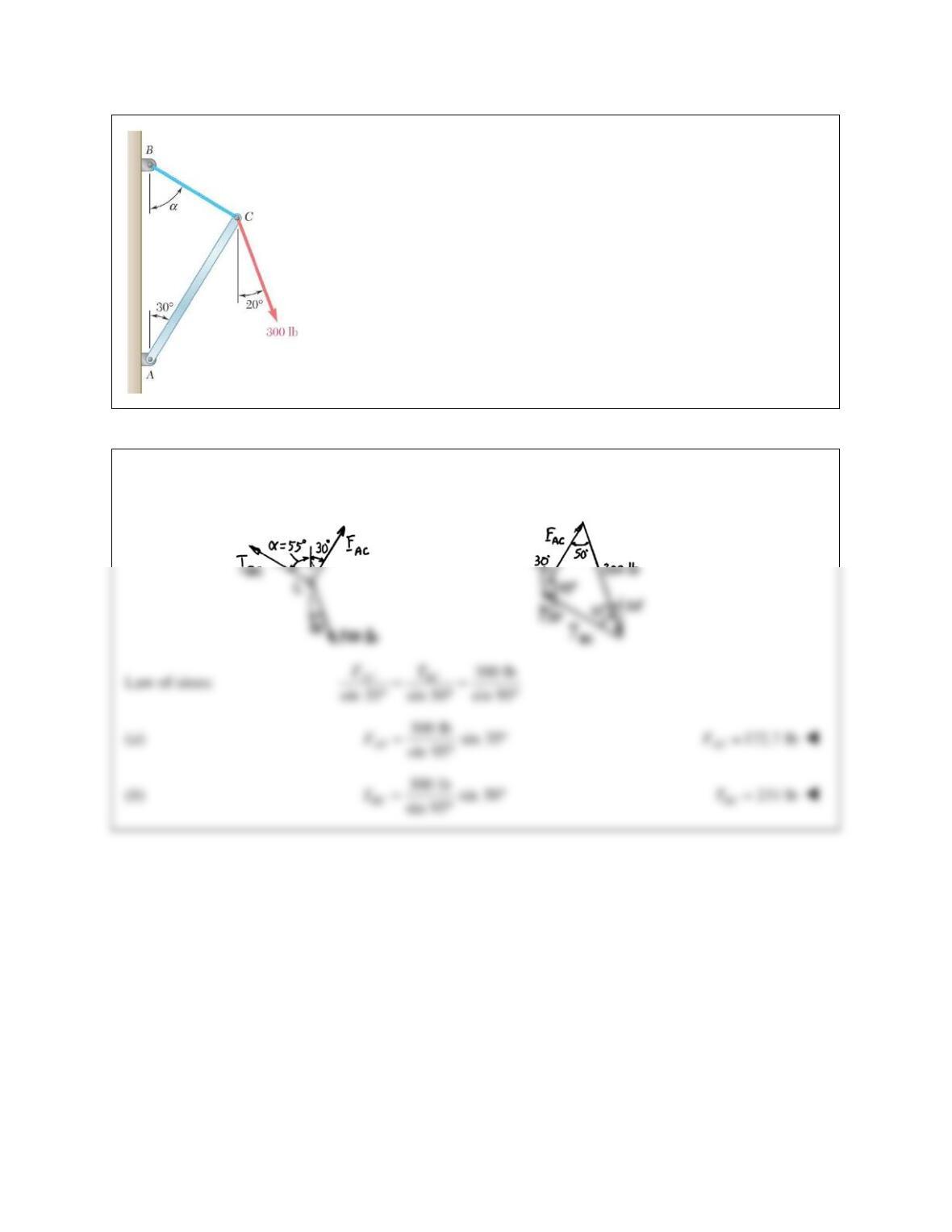
PROBLEM 2.130
Knowing that
55
α
= °
and that boom AC exerts on pin C a force directed
along line AC, determine (a) the magnitude of that force, (b) the tension in
cable BC.
SOLUTION
Free–Body Diagram Force Triangle
PROBLEM 2.131
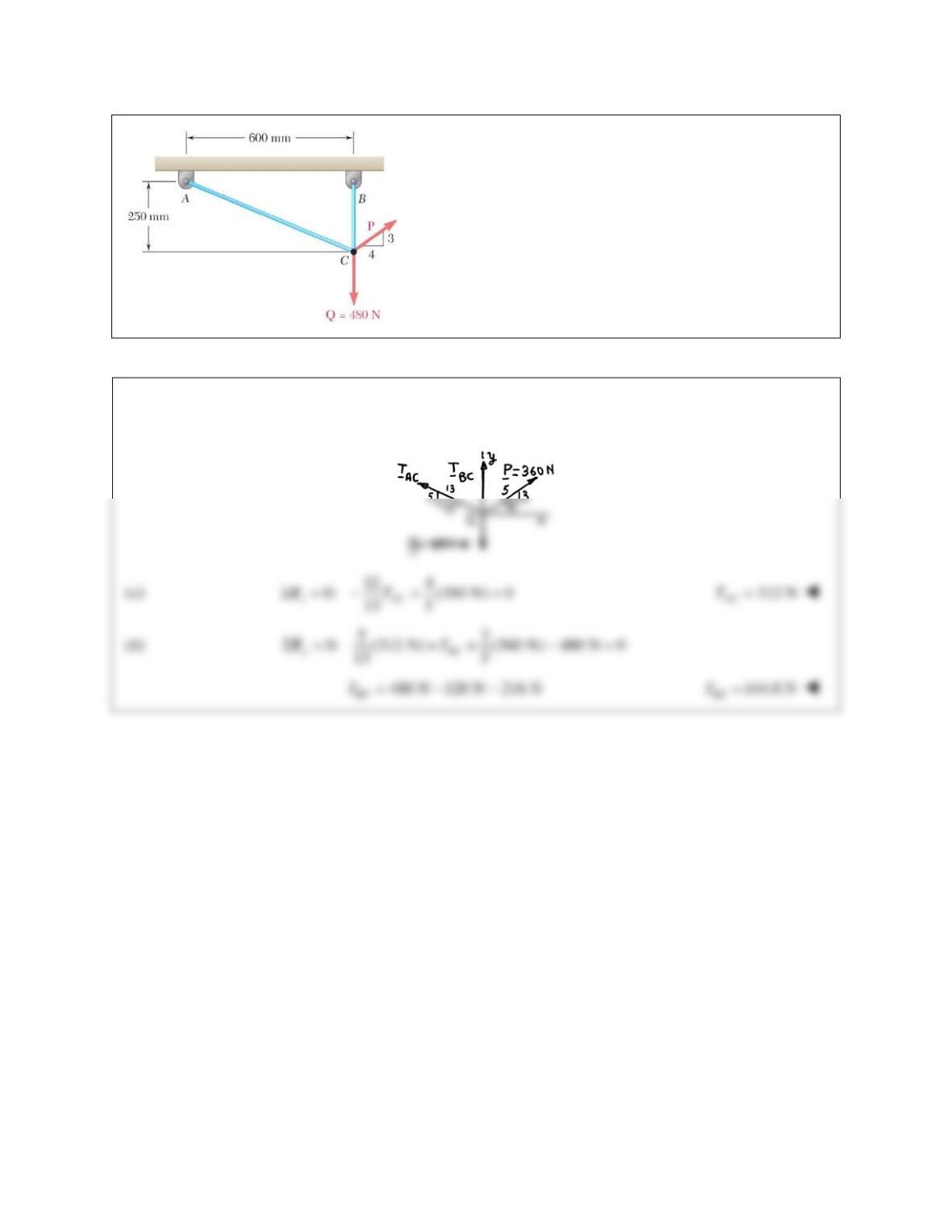
Two cables are tied together at C and loaded as shown.
Knowing that
360 N,P=
determine the tension (a) in cable
AC, (b) in cable BC.
SOLUTION
Free Body: C
PROBLEM 2.132
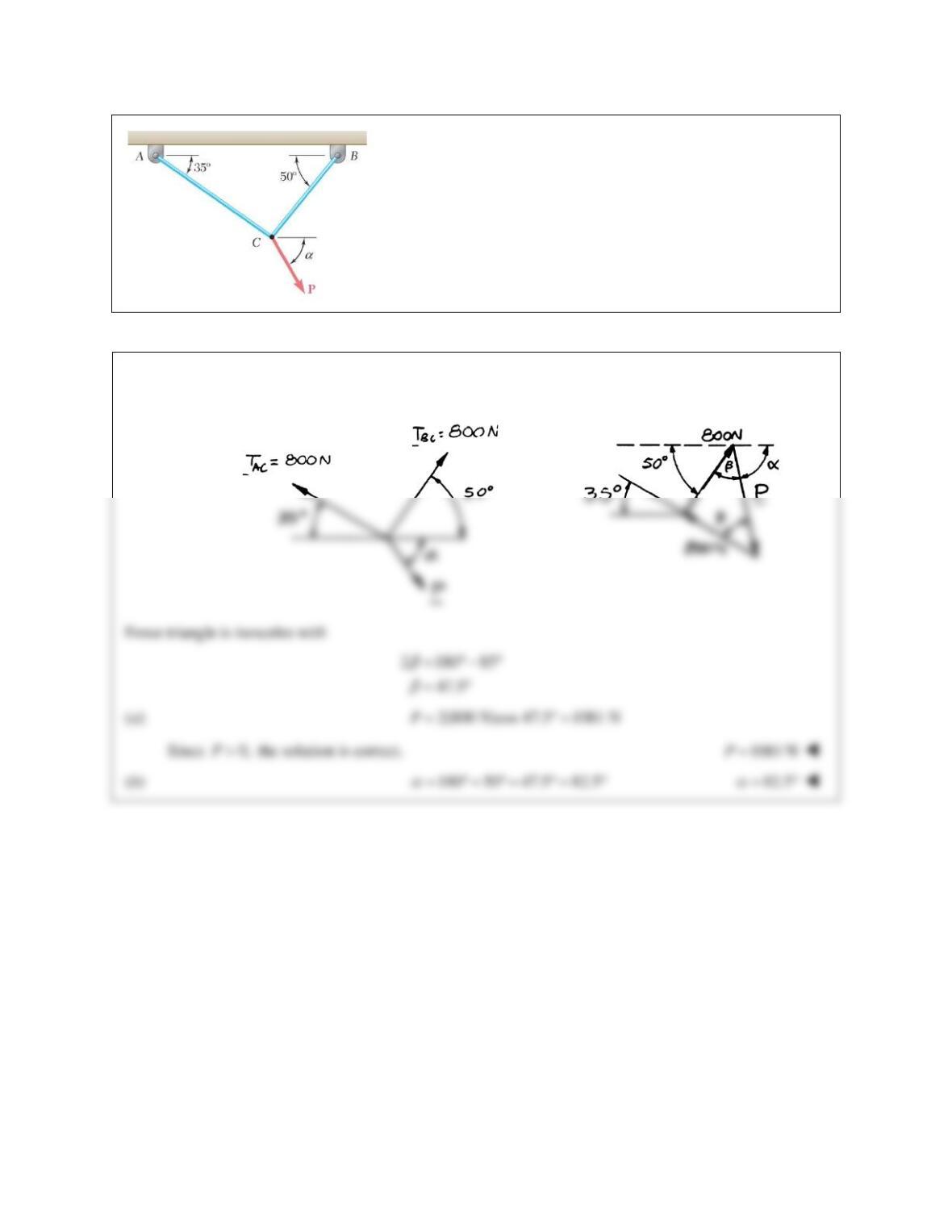
Two cables tied together at C are loaded as shown. Knowing that
the maximum allowable tension in each cable is 800 N,
determine (a) the magnitude of the largest force P that can be
applied at C, (b) the corresponding value of
α
.
SOLUTION
Free–Body Diagram: C Force Triangle
PROBLEM 2.133
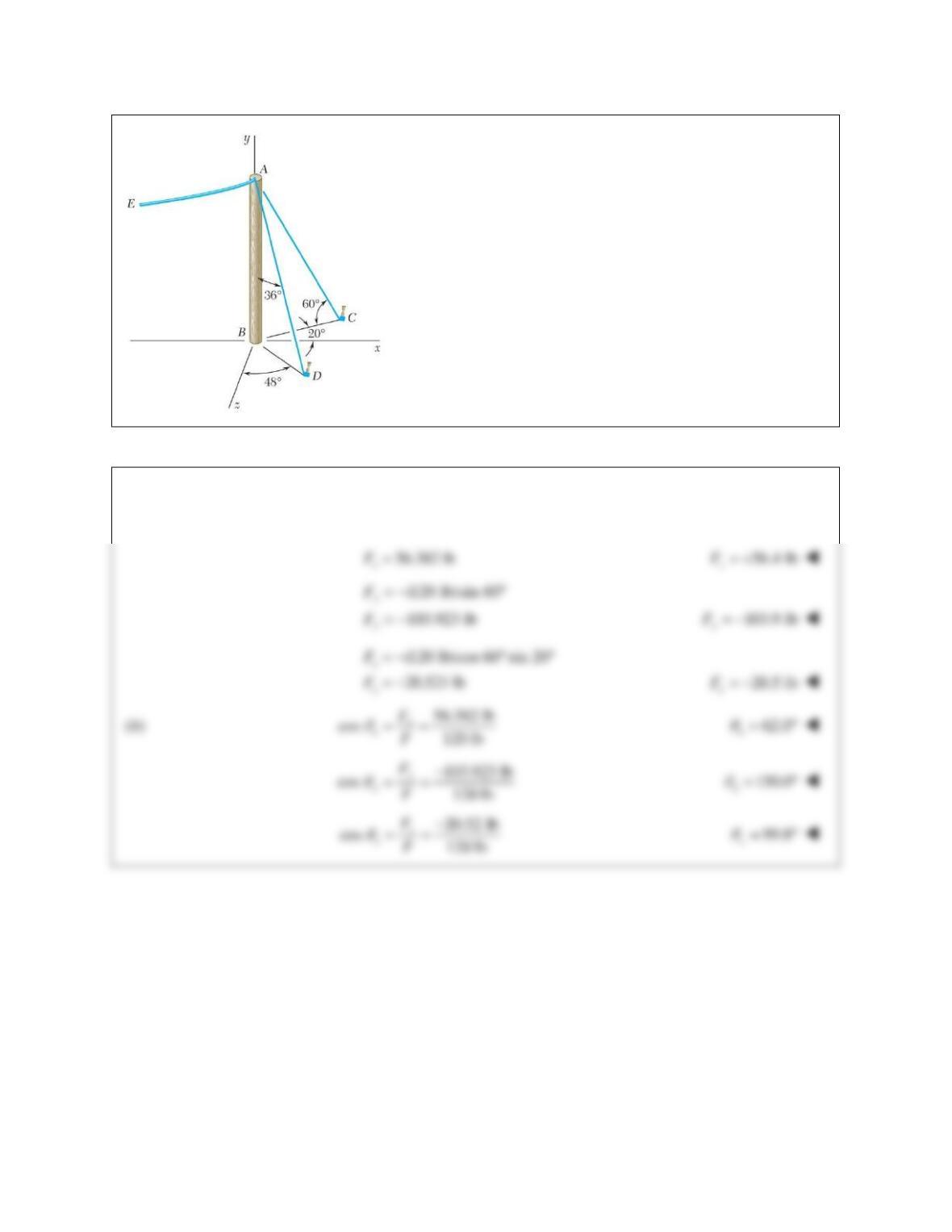
The end of the coaxial cable AE is attached to the pole AB,
which is strengthened by the guy wires AC and AD. Knowing
that the tension in wire AC is 120 lb, determine (a) the
components of the force exerted by this wire on the pole, (b)
the angles
θ
x,
θ
y, and
θ
z that the force forms with the
coordinate axes.
SOLUTION
(a)
(120 lb)cos 60 cos 20
x
F= °°
PROBLEM 2.134
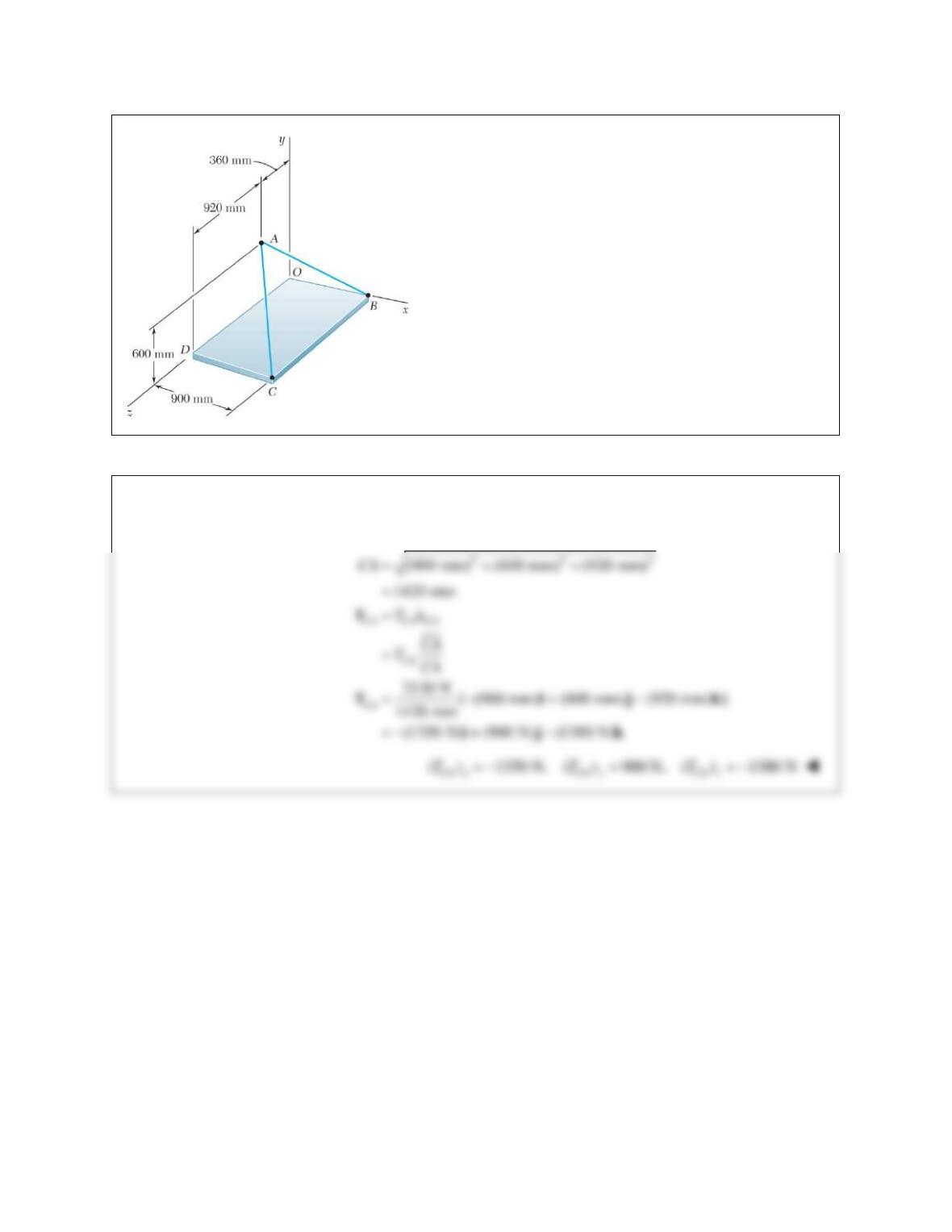
Knowing that the tension in cable AC is 2130 N, determine
the components of the force exerted on the plate at C.
SOLUTION
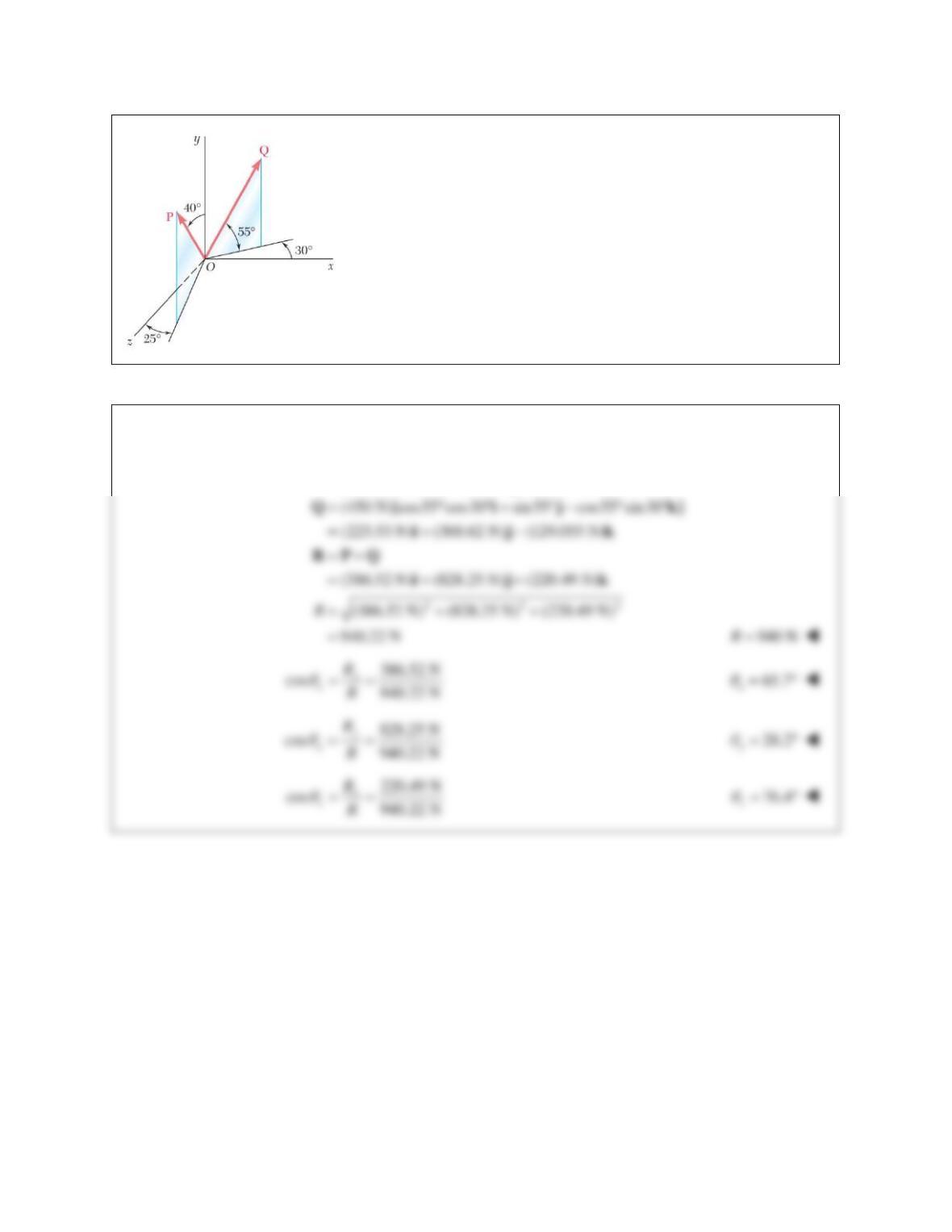
PROBLEM 2.135
Find the magnitude and direction of the resultant of the two forces
shown knowing that P = 600 N and Q = 450 N.
SOLUTION