Chapter 2: Human Resources Strategy and Planning
Chapter 2
Human Resources Strategy and Planning
Learning Objectives
After students have read this chapter, they should be able to:
• Summarize the organization’s strategic planning process.
• Explain the key differences between good and bad strategy and suggest a way to force
strategic asset reallocation.
Chapter Overview
Strategic human resource management refers to the use of employees to gain or maintain a
competitive advantage. There should be a close linkage between organizational and HR
strategies. This chapter starts with a discussion of organizational strategic planning including
strategy formulation, the strategic planning process, strategic competencies for HR professionals,
and operationalizing HR management strategies.
Chapter Outline
Chapter 2: Human Resources Strategy and Planning
The strategy an organization follows is its plan for how to compete successfully, survive and
grow. Many organizations have a relatively formal process for developing a written strategy
encompassing a three- to five-year period with objectives and goals for each unit.
Organizations seek to achieve and maintain a competitive advantage in the marketplace by
delivering high-quality products and services to their customers in a way that competitors cannot
duplicate. Strategies to do so might include revising existing products, acquiring new businesses,
or developing new products or services using existing capabilities.
I. Organizational Strategic Planning
Strategic planning is the process of defining a strategy, or direction, and making decisions on
how to allocate the resources of the organization (capital and people) to pursue this strategy. The
strategic plan serves as the roadmap that gives the organization direction and aligns resources.
HR Headline: Best Buy Cuts 2400 Jobs in Turnaround Strategy
Best Buy needed a strategy to combat the “showrooming” of its stores. Showrooming
occurs when customers go to Best Buy’s well stocked stores to see, compare, and
demonstrate its products, but then leave and purchase the products at a discount or on-
line store. The big retailer laid off 600 employees in its technical support division called
the “Geek Squad” and 1,800 others as it seeks to improve results. That is about 1.4% of
its 167,000 employees.
yoffs are a part of the company’s ongoing
Chapter 2: Human Resources Strategy and Planning
A. Strategy Formulation
The strategic planning cycle typically covers a three- to five-year time frame, and
management considers both internal and external forces when formulating the strategic plan.
The guiding force behind the strategic planning process is the organizational mission, which
is the core reason for the existence of the organization and what makes it unique.
B. Good versus Bad Strategy
Many companies are generating strategies that by their own admission are substandard. Bad
strategy abounds perhaps because it ignores the difficult path to focusing and making choices
among alternatives. Instead of making a choice, a strategy may try to accommodate many
Chapter 2: Human Resources Strategy and Planning
II. Human Resources and Strategy
Regardless of which specific strategies are adopted for guiding an organization, having the right
people will be necessary to make the overall strategies work. Strategic HR management entails
providing input for organizational strategic planning and developing specific HR initiatives to
help achieve the organizational goals.
Strategic HR management refers to the use of human resource management practices to gain or
keep a competitive advantage. Talent acquisition, deployment, development, and reward are all
strategic HRM approaches that can impact the organizational ability to achieve its strategic
objectives.
advance the strategic goals.
A. Requirements for Human Resource Contribution to Strategy
HR Perspective: Forcing Strategic Asset Reallocation
Different units in the organization can be classified into different categories based on
their market opportunity and performance. A unit might be labeled “grow”, “maintain”,
or “dispose.” Each category comes with clearly differentiated resource investment
guidelines. This removes as much politics as possible and focuses on contribution to the
strategic goals of each unit.
Chapter 2: Human Resources Strategy and Planning
Specific HR management strategies obviously depend on the strategies and plans of the
organization. Figure 2-2 highlights some common areas where HR should develop and
implement appropriate strategies. To contribute in the strategic planning process, HR
professionals provide their perspective and expertise to managers by performing the following
functions:
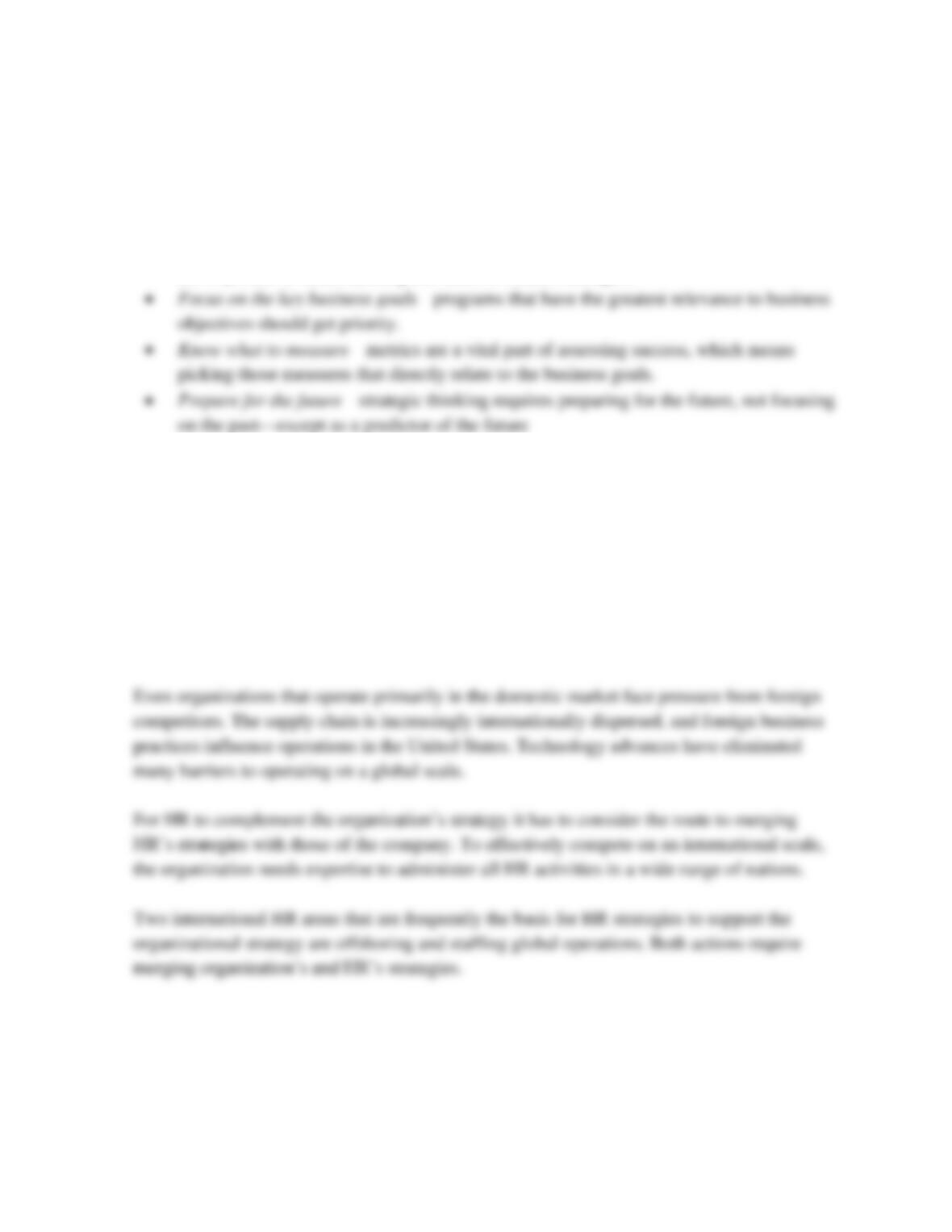
• Understand the business—knowing the financials and key drivers of business success
are important to understanding the need for certain strategies.
B. Human Resources Strategies for Global Competitiveness
The globalization of business has meant that more organizations now operate across borders
with ties to foreign operations, international suppliers, vendors, employees, and other business
partners. A global presence can range from importing and exporting to operating as a
multinational corporation (MNC). An MNC, sometimes called a “transnational
corporation,” is an organization that has facilities and other assets in at least one country other
than its home country.
Offshoring Strategy
Competitive pressure to lower costs has resulted in many jobs being moved overseas in
recent years. Offshoring is the relocation of a business process or operation by a company
from one country to another. Product- and software-development projects are increasingly
Chapter 2: Human Resources Strategy and Planning
being offshored because of the lack of science and engineering talent in the United States.
Global Staffing Strategy
Staffing for global operations includes a wide variety of alternatives. The optimal solution
is to combine the expertise of local employees with the organization-specific knowledge of
employees from the home country. Some countries require that the organization employ a
certain percentage of workers from the host country. Each organization will use a staffing
model that best fits its culture and strategic goals.
III. Human Resource Planning
Human resource planning is the process of analyzing and identifying the need for and
availability of people so that the organization can meet its strategic objectives. The focus of HR
planning is to ensure the organization has the right number of human resources, with the right
capabilities, at the right times, and in the right places.
Chapter 2: Human Resources Strategy and Planning
and discharges.
A. Human Resources Planning Process
The steps in the HR planning process are shown in Figure 2-4. The process begins with
considering the organizational plans and the environmental analysis that went into them. This
includes an environmental analysis to identify the situation in which HR is operating.
Strengths, weaknesses, opportunities, and threats are considered. Then the possible available
workforce is evaluated by identifying both the external and internal workforce.
B. Environmental Analysis
Before the managers in an organization begin strategic planning, they study and assess the
dynamics of the environment in which they operate to better understand how these conditions
might affect their plans. The process of environmental scanning helps to pinpoint strengths,
weaknesses, opportunities, and threats that the organization will face during the planning
horizon.
Chapter 2: Human Resources Strategy and Planning
The strengths and weaknesses of the organization represent internal factors that either create
or destroy value. When assessing the internal environment, managers evaluate the quantity
and quality of human resources, HR practices, and the organizational culture.
process of identifying a plan for the orderly replacement of key employees.
IV. Planning for External Workforce Availability
When an organization plans to expand its services, it must also identify how many and what
types of new employees will be needed to staff the expanded services, locations, and facilities.
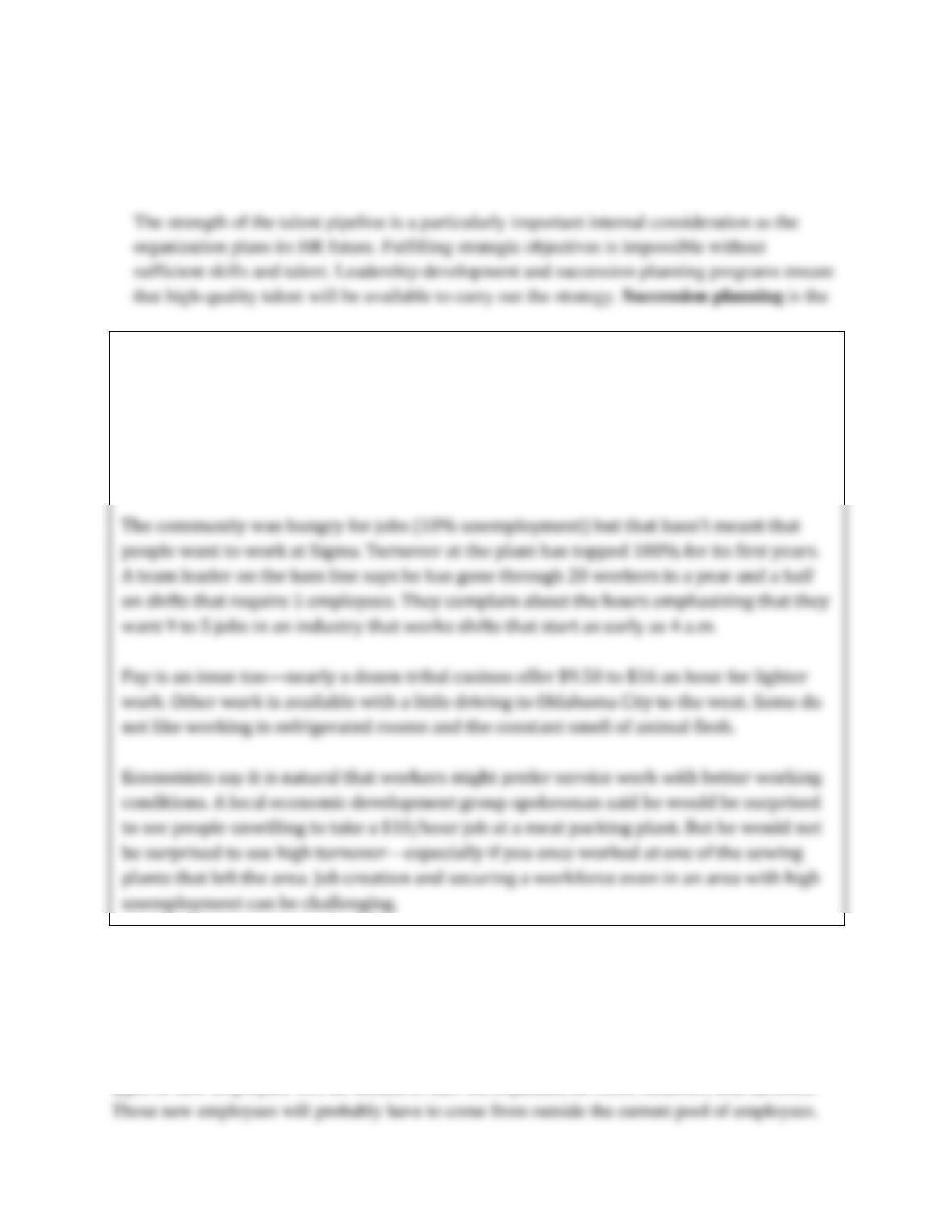
HR Perspective: Where Is the Workforce?
Mexico’s SIGMA Alimentos made a $63 million investment in Oklahoma to make hot dogs
and hams but cannot find the workforce it needs even with high unemployment. The
company got millions of dollars in tax incentives to build a factory near downtown
Seminole, a small town with many boarded up and abandoned buildings.
Chapter 2: Human Resources Strategy and Planning
Several specific factors affect that external pool of potential employees.
A. Economic and Governmental Factors
The general cycles of economic recession and economic boom in different businesses affect
HR planning. Factors such as interest rates, inflation, and economic decline or growth affect
B. Geographic/Competitive Evaluations
When making HR plans, employers must consider a number of geographic and competitive
concerns. The net migration into a particular region is important. Direct competitors are
C. Changing Workforce Considerations
Significant changes in the workforce, both in the United States and globally, must be
considered when examining the outside workforce for HR planning. When scanning the
potential and future workforce, it is important to consider a number of variables, including:
• Aging of the workforce
• Growing diversity of workers
V. Planning For Internal Workforce Availability
Chapter 2: Human Resources Strategy and Planning
Analyzing the jobs that will need to be done and the capabilities of people who are currently
available in the organization to do them is the next part of HR planning. The needs of the
A. Current and Future Jobs Audit
The starting point for evaluating internal workforce strengths and weaknesses is an audit of
the jobs that need to be done in the organization. The following are key questions that are
addressed during the internal jobs assessment:
• What jobs exist now and how essential is each job?
B. Employee and Organizational Capabilities Inventory
As HR planners gain an understanding of the current and future jobs that will be necessary to
carry out organizational plans, they can conduct a detailed audit of current employees and
their capabilities. An inventory of organizational skills and capabilities may consider a
number of elements. The following ones are important:
• Individual employee demographics (age, length of service in the organization, etc.)
C. Forecasting HR Supply and Demand
Forecasting uses information from the past and the present to identify expected future
conditions. However, projections for the future are subject to error.
Chapter 2: Human Resources Strategy and Planning
D. Forecasting Methods and Periods
Forecasting methods may be either judgmental or mathematical (Figure 2-6). Despite the
availability of sophisticated judgmental and mathematical models and techniques, forecasting
is still a combination of quantitative methods and subjective judgment.
E. Forecasting the Demand/(Need) for Human Resources
The demand for employees can be calculated for an entire organization and/or for individual
units in the organization. The unit breakdown allows HR planners to better pinpoint the
specific skills needed than does the aggregate method.
F. Forecasting the Supply (Availability) of Human Resources
Forecasting availability considers both external and internal supplies. Although the internal
supply may be somewhat easier to calculate, it is important to calculate the external supply as
accurately as possible.
External Supply
The external supply of potential employees available to the organization can be identified.
Government estimates of labor force populations, trends in the industry, and many more
complex and interrelated factors must be considered. Such information is often available
from state or regional economic development offices. The following items may be
included:
Chapter 2: Human Resources Strategy and Planning
• Net migration into and out of the area
• Individuals entering and leaving the workforce
Internal Supply
Figure 2-7 shows in general terms how the internal supply can be calculated for a specific
employer. Estimating internal supply considers the number of external hires and the
employees who move from their current jobs into others through promotions, lateral
moves, and terminations. It also considers that the internal supply, among other factors, is
influenced by:
• Training and development programs
VI. WORKFORCE SUPPLY ≠ DEMAND
Because the objective of strategic planning is to anticipate future events and conditions,
managers should evaluate and revise the strategic plan on a periodic basis. Attracting and
A. Managing a Talent Surplus
A talent surplus can be managed within a strategic HR plan in a number of ways. The reasons
Chapter 2: Human Resources Strategy and Planning
for the surplus will guide the ultimate steps taken by the organization. If the workforce has the
Reduction in Work Hours or Compensation
In order to retain qualified employees, managers may institute reduced work hours on a
temporary basis. Selected groups of employees may have their workweek reduced or all
Attrition and Hiring Freezes
Attrition occurs when individuals quit, die, or retire and are not replaced. Unless turnover
is high, attrition will eliminate only a relatively small number of employees in the short
run, but it can be a viable alternative over a longer period of time. Therefore, employers
may combine attrition with a freeze on hiring.
Voluntary Separation Programs
Organizations can reduce the workforce while also minimizing legal risks if employees
volunteer to leave. Often firms entice employees to volunteer by offering them additional
severance, training, and benefits payments. Early retirement buyouts are widely used to
Chapter 2: Human Resources Strategy and Planning
Workforce Downsizing
It has been given many names, including downsizing, rightsizing, and reduction in force
(RIF), but it almost always means cutting employees. Trimming underperforming units or
employees as part of a plan that is on the basis of sound organizational strategies may
make sense. However, it does not increase revenues; it is a short-term cost-cutting measure
that can result in a long-term lack of talent. Best practices for companies to successfully
carry out layoffs include the following:
• Identify the work that is core to sustaining a profitable business.
B. Legal Considerations for Workforce Reductions
HR must be involved during workforce adjustments to ensure that the organization does not
violate any of the nondiscrimination or other laws governing workforce reductions. Selection
criteria for determining which employees will be laid off must comply with Title VII of the