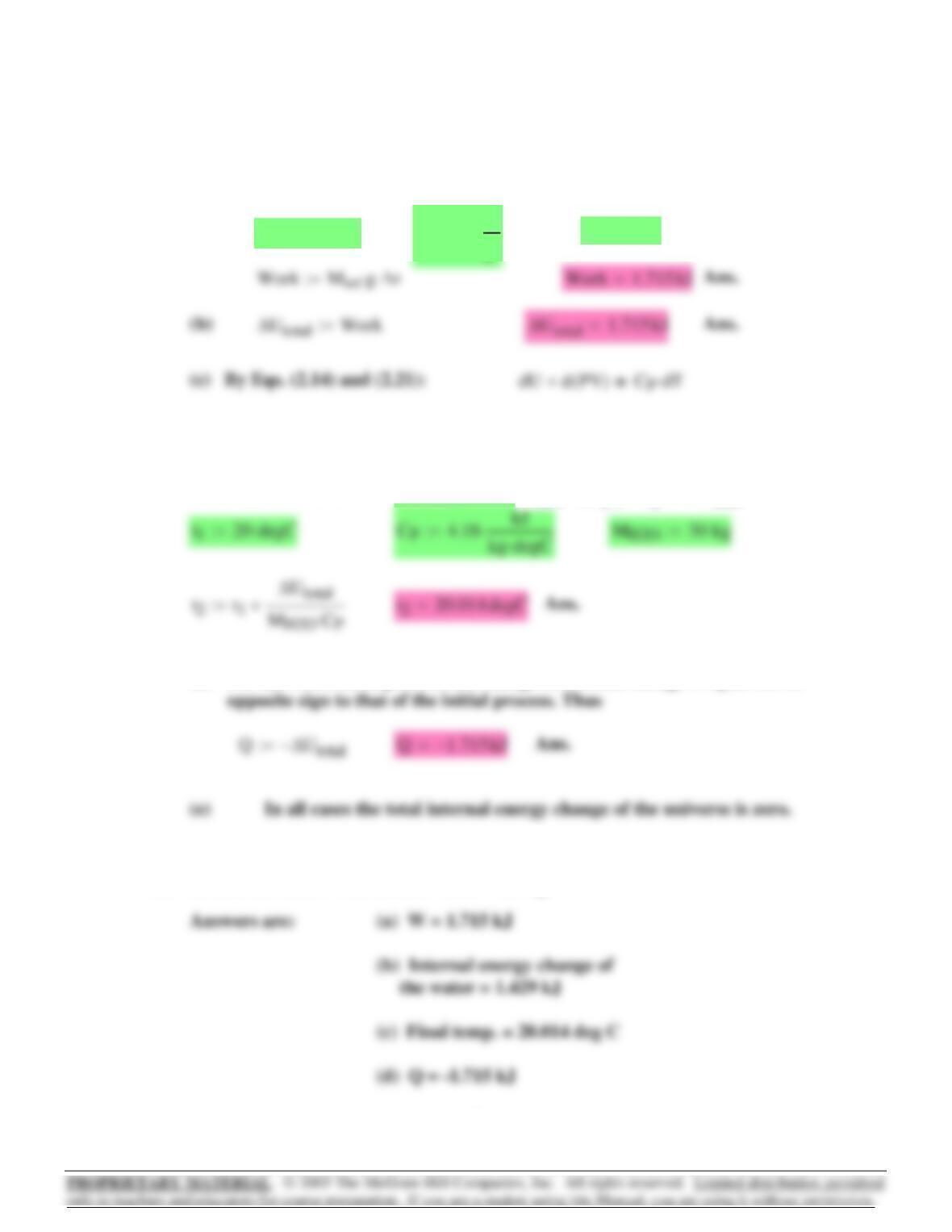
(d) For the restoration process, the change in internal energy is equal but of
2.2 Similar to Pb. 2.1 with mass of water = 30 kg.
Chapter 2 – Section A – Mathcad Solutions
2.1 (a) Mwt 35 kg⋅:= g 9.8 m
s2
⋅:= ∆z5m⋅:=
Since P is constant, this can be written:
MH2O CP
⋅dT⋅MH2O dU⋅MH2O P⋅dV⋅+=
Take Cp and V constant and integrate: MH2O CP
⋅t2t1
−
()
⋅∆Utotal
=
9

Q34 800−J:= W34 300J:=
Step 1 to 2 to 3 to 4 to 1: Since ∆Ut is a state function, ∆Ut for a series of steps
that leads back to the initial state must be zero. Therefore, the sum of the
∆Ut values for all of the steps must sum to zero.
∆Ut41 4700J:= ∆Ut23 ∆Ut12
−∆Ut34
−∆Ut41
−:=
Step 2 to 3: ∆Ut23 4−103
×J=Q23 3800−J:=
For a series of steps, the total work done is the sum of the work done for each
step.
W12341 1400−J:=
2.4 The electric power supplied to the motor must equal the work done by the
motor plus the heat generated by the motor.
i 9.7amp:= E 110V:= Wdotmech 1.25hp:=
Wdotelect iE⋅:= Wdotelect 1.067 103
×W=
2.5 Eq. (2.3): ∆UtQW+=
Step 1 to 2: ∆Ut12 200−J:= W12 6000−J:=
Step 3 to 4:
10

2.13 Subscripts: c, casting; w, water; t, tank. Then
mc∆Uc
⋅mw∆Uw
⋅+ mt∆Ut
⋅+ 0=
Let C represent specific heat, CC
P
=CV
=
Then by Eq. (2.18)
mcCc
⋅∆tc
⋅mwCw
⋅∆tw
⋅+ mtCt
⋅∆tt
⋅+ 0=
mc2kg⋅:= mw40 kg⋅:= mt5kg⋅:=
Cc0.50 kJ
kg degC⋅
⋅:= Ct0.5 kJ
kg degC⋅
⋅:= Cw4.18 kJ
kg degC⋅
⋅:=
tc500 degC⋅:= t125 degC⋅:= t230 degC⋅:= (guess)
Step 4 to 1: ∆Ut41 4700J:= W41 4.5 103
×J=
2.11 The enthalpy change of the water = work done.
M20kg⋅:= CP4.18 kJ
kg degC⋅
⋅:= ∆t 10 degC⋅:=
2.12 Q 7.5 kJ⋅:= ∆U12−kJ⋅:= W∆UQ−:=
11

A 3.142m2
=
2.18 (a) U1762.0 kJ
kg
⋅:= P11002.7 kPa⋅:= V11.128 cm3
gm
⋅:=
(b) U22784.4 kJ
kg
⋅:= P21500 kPa⋅:= V2169.7 cm3
gm
⋅:=
2.15 mass 1 kg⋅:= CV4.18 kJ
kg K⋅
:=
(b) g 9.8 m
s2
:= ∆EP∆Ut:=
(c) ∆EK∆Ut:= u∆EK
1
2mass⋅
:= u 91.433 m
s
=Ans.
2.17 ∆z 50m:= ρ 1000 kg
m3
:= u5
m
s
:=
D2m:= Aπ
4D2
:=
12
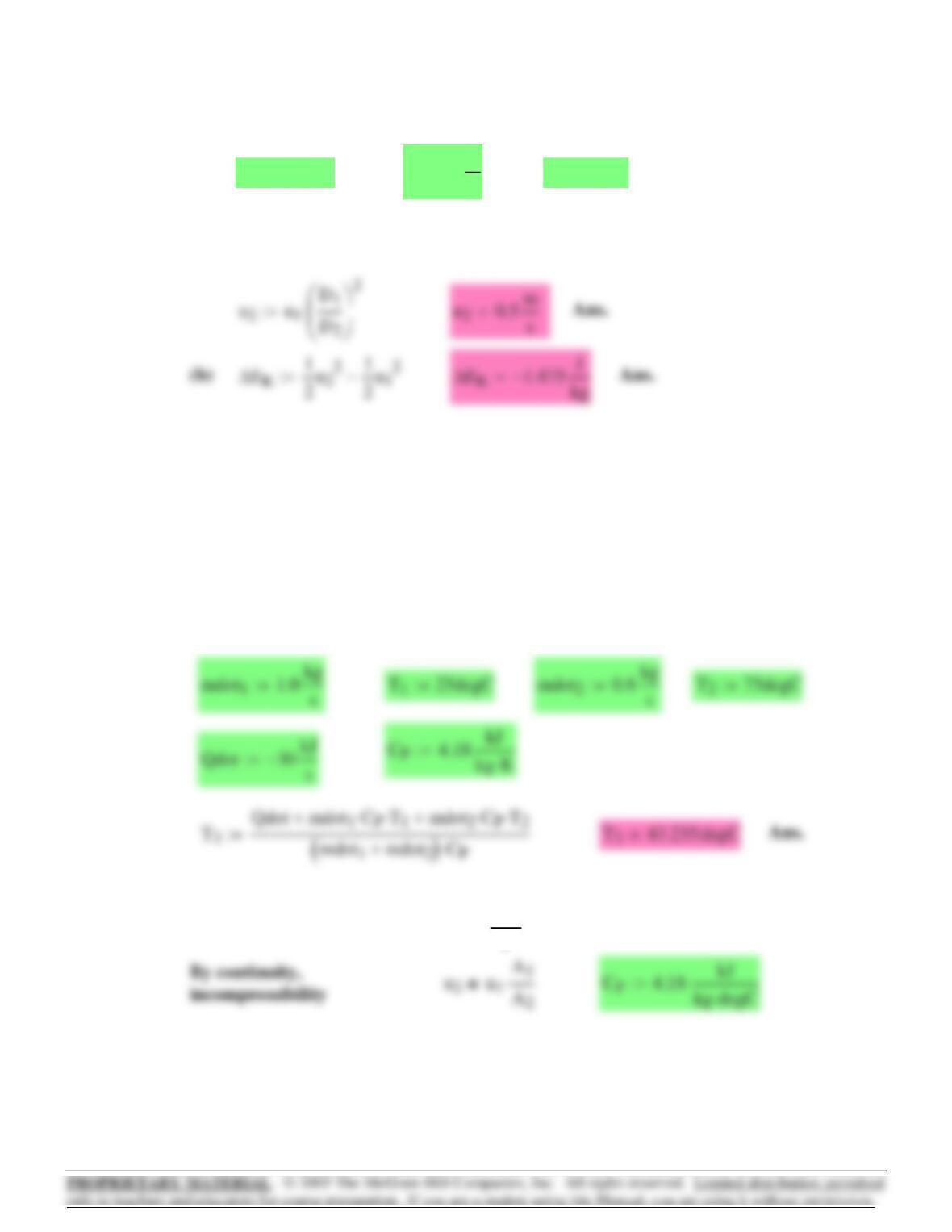
mdot Cp
⋅T3T1
−
()
⋅mdot2CP
⋅T3T2
−
()
⋅+ Qdot=
T3CP
⋅mdot1mdot2
+
()
⋅Qdot mdot1CP
⋅T1
⋅+ mdot2CP
⋅T2
⋅+=
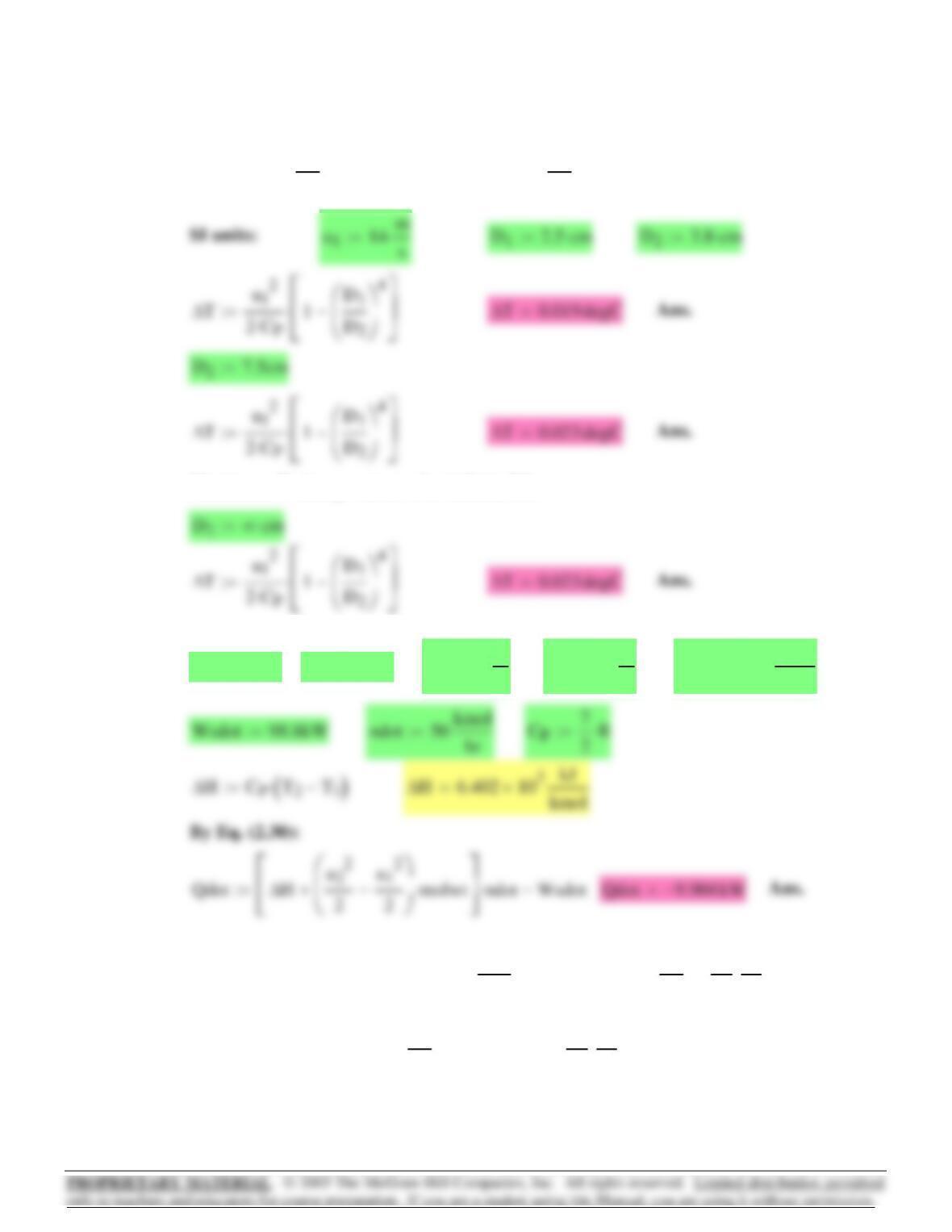
2.25 By Eq. (2.32a): ∆H∆u2
2
+0=∆HC
P∆T⋅=
2.22 D12.5cm:= u12m
s
:= D25cm:=
(a) For an incompressible fluid, ρ=constant. By a mass balance,
mdot = constant = u1A1ρ = u2A2ρ.
2.23 Energy balance: mdot3H3
⋅mdot1H1
⋅mdot2H2
⋅+
()
−Qdot=
Mass balance: mdot3mdot1
−mdot2
−0=
Therefore: mdot1H3H1
−
()
⋅mdot2H3H2
−
()
⋅+ Qdot=
or
13
u23.5 m
s
:= molwt 29 kg
kmol
:=
2.27 By Eq. (2.32b): ∆H∆u2
2g
c
⋅
−=also V2
V1
T2
T1
P1
P2
⋅=
By continunity,
constant area u2u1V2
V1
⋅=u2u1T2
T1
⋅P1
P2
⋅=∆u2u22u12
−=
∆u2u12A1
A2
⎛
⎜
⎝
⎞
⎠
2
1−
⎡
⎢
⎢
⎣
⎤
⎥
⎥
⎦
⋅=∆u2u12D1
D2
⎛
⎜
⎝
⎞
⎠
4
1−
⎡
⎢
⎢
⎣
⎤
⎥
⎥
⎦
⋅=
⎜
⎢
⎢
⎥
⎥
⎜
⎢
⎢
⎥
⎥
Maximum T change occurrs for infinite D2:
⎜
⎢
⎢
⎥
⎥
2.26 T1300K:= T2520K:= u110 m
s
:=
14
H22726.5 kJ
kg
⋅:=
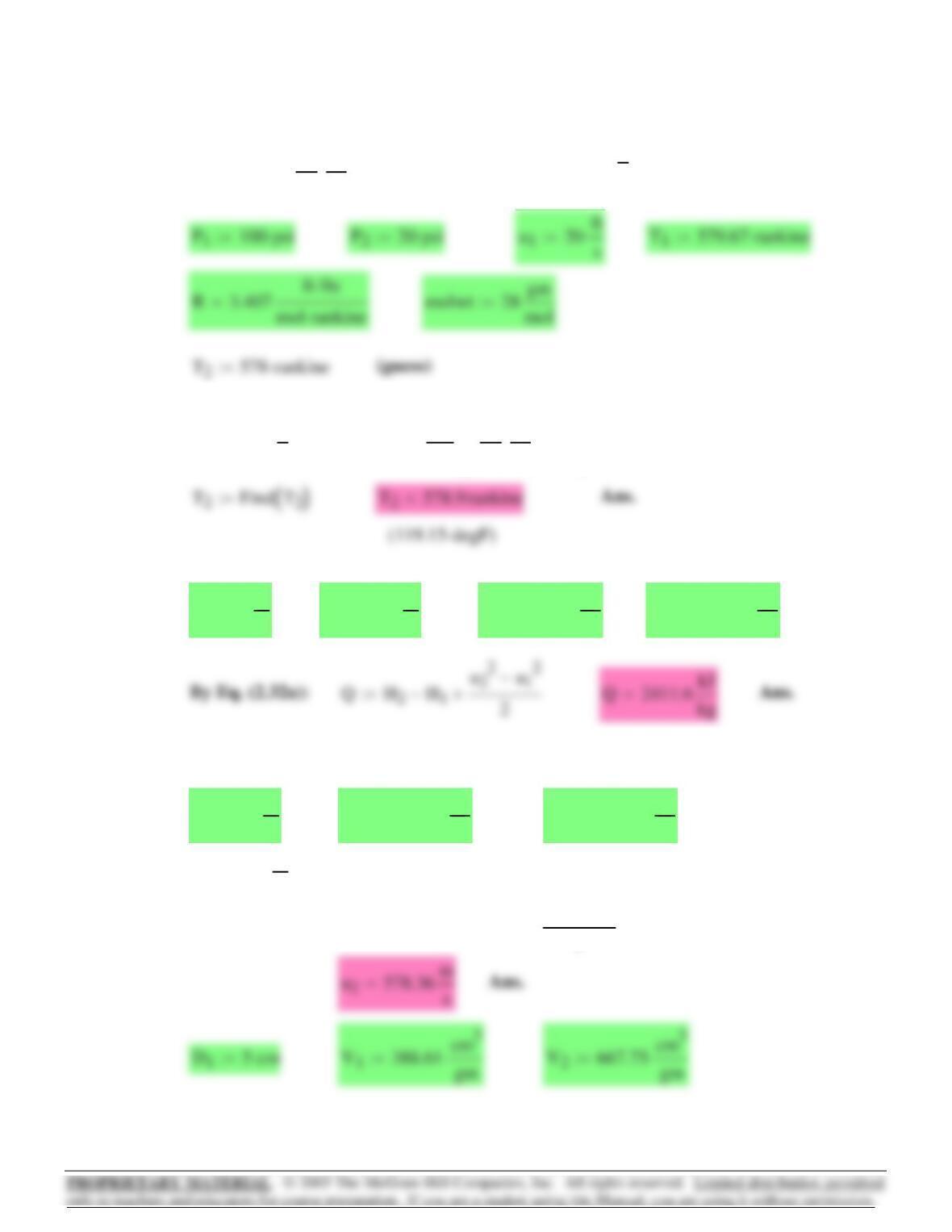
2.29 u130 m
s
⋅:= H13112.5 kJ
kg
⋅:= H22945.7 kJ
kg
⋅:=
u2500 m
s
⋅:= (guess)
By Eq. (2.32a): Given H2H1
−u12u22
−
2
=u2Find u2
()
:=
∆HC
P∆T⋅=7
2R⋅T2T1
−
()
⋅=
∆u2u12T2
T1
P1
P2
⋅
⎛
⎜
⎝
⎞
⎠
2
1−
⎡
⎢
⎢
⎣
⎤
⎥
⎥
⎦
⋅=
Given 7
2R⋅T2T1
−
()
⋅u12
2
−T2
T1
P1
P2
⋅
⎛
⎜
⎝
⎞
⎠
2
1−
⎡
⎢
⎢
⎣
⎤
⎥
⎥
⎦
⋅molwt⋅=
2.28 u13m
s
⋅:= u2200 m
s
⋅:= H1334.9 kJ
kg
⋅:=
15

2.31 (a) t170 degF⋅:= t2350 degF⋅:= n 3 mol⋅:=
CV5BTU
mol degF⋅
⋅:= By Eq. (2.19):
Take account of the heat capacity of the vessel:
mv200 lbm
⋅:= cv0.12 BTU
lbmdegF⋅
⋅:=
(b) t1400 degF⋅:= t2150 degF⋅:= n 4 mol⋅:=
2.30 (a) t130 degC⋅:= t2250 degC⋅:= n 3 mol⋅:=
CV20.8 J
mol degC⋅
⋅:=
Take into account the heat capacity of the vessel; then
mv100 kg⋅:= cv0.5 kJ
kg degC⋅
⋅:=
(b) t1200 degC⋅:= t240 degC⋅:= n 4 mol⋅:=
16
2.34 H1307 BTU
lbm
⋅:= H2330 BTU
lbm
⋅:= u120 ft
s
⋅:= molwt 44 gm
mol
⋅:=
V19.25 ft3
lbm
⋅:= V20.28 ft3
lbm
⋅:= D14in⋅:= D21in⋅:=
CP7BTU
mol degF⋅
⋅:= By Eq. (2.23):
2.33 H11322.6 BTU
lbm
⋅:= H21148.6 BTU
lbm
⋅:= u110 ft
s
⋅:=
V13.058 ft3
lbm
⋅:= V278.14 ft3
lbm
⋅:= D13in⋅:= D210 in⋅:=
17
2.37 Work exactly like Ex. 2.10: 2 steps, (a) & (b). A value is required for PV/T,
namely R.
T1293.15 K⋅:= T2333.15 K⋅:=
R 8.314 J
mol K⋅
=P11000 kPa⋅:= P2100 kPa⋅:=
(a) Cool at const V1 to P2
(b) Heat at const P2 to T2 CP7
2R⋅:= CV5
2R⋅:=
Ta2 T1P2
P1
⋅:= Ta2 29.315K=
2.36 T1300 K⋅:= P 1 bar⋅:= n1kg⋅
28.9 gm
mol
⋅
:= n 34.602mol=
V183.14 bar cm3
⋅
mol K⋅
⋅T1
P
⋅:= V124942 cm3
mol
=
Wn−
V1
V2
VP
⌠
⎮
⌡d⋅=nP⋅V1V2
−
()
⋅=nP⋅V13V
1
⋅−
()
⋅=
18

Re
22133
55333
110667
276667
⎛
⎜
⎜
⎜
⎜
⎝
⎞
⎟
⎟
⎠
=Re Dρ⋅ u⋅
µ
→
⎯
⎯
:=
u
1
1
5
5
⎛
⎜
⎜
⎜
⎜
⎝
⎞
⎟
⎟
⎠
m
s
:=D
2
5
2
5
⎛
⎜
⎜
⎜
⎜
⎝
⎞
⎟
⎟
⎠
cm:=
Note: εD = ε/D
in this solution
εD 0.0001:=µ 9.0 10 4−
⋅kg
ms⋅
:=ρ 996 kg
m3
:=
2.39
∆Ub6.315 103
×J
mol
=∆Ub∆HbP2V2V1
−
()
⋅−:=
∆Ha7.677−103
×J
mol
=∆Ha∆UaV1P2P1
−
()
⋅+:=
V20.028 m3
mol
=V2RT
2
⋅
P2
:=V12.437 10 3−
×m3
mol
=V1RT
1
⋅
P1
:=
∆Ua5.484−103
×J
mol
=∆UaCV∆Ta
⋅:=
∆Hb8.841 103
×J
mol
=∆HbCP∆Tb
⋅:=
∆Ta263.835−K=∆TaTa2 T1
−:=∆Tb303.835K=∆TbT2Ta2
−:=
19
Assume that the compressor is adiabatic (Qdot = 0). Neglect changes in
KE and PE.
H2536.9 kJ
kg
⋅:=H1761.1 kJ
kg
:=mdot 4.5 kg
s
:=
2.42
⎜
⎜
⎜
⎯
⎯
⎜
⎜
⎜
⎯
⎯
fF
0.00635
0.00517
0.00452
0.0039
⎛
⎜
⎜
⎜
⎜
⎝
⎞
⎟
⎟
⎠
=fF0.3305 ln 0.27 εD⋅7
Re
⎛
⎜
⎝
⎞
⎠
0.9
+
⎡
⎢
⎣
⎤
⎥
⎦
⎡
⎢
⎣
⎤
⎥
⎦
2−
⋅
⎡
⎢
⎢
⎣
⎤
⎥
⎥
⎦
→
⎯
⎯⎯⎯⎯⎯⎯⎯⎯⎯⎯⎯⎯⎯⎯
⎯
:=
20