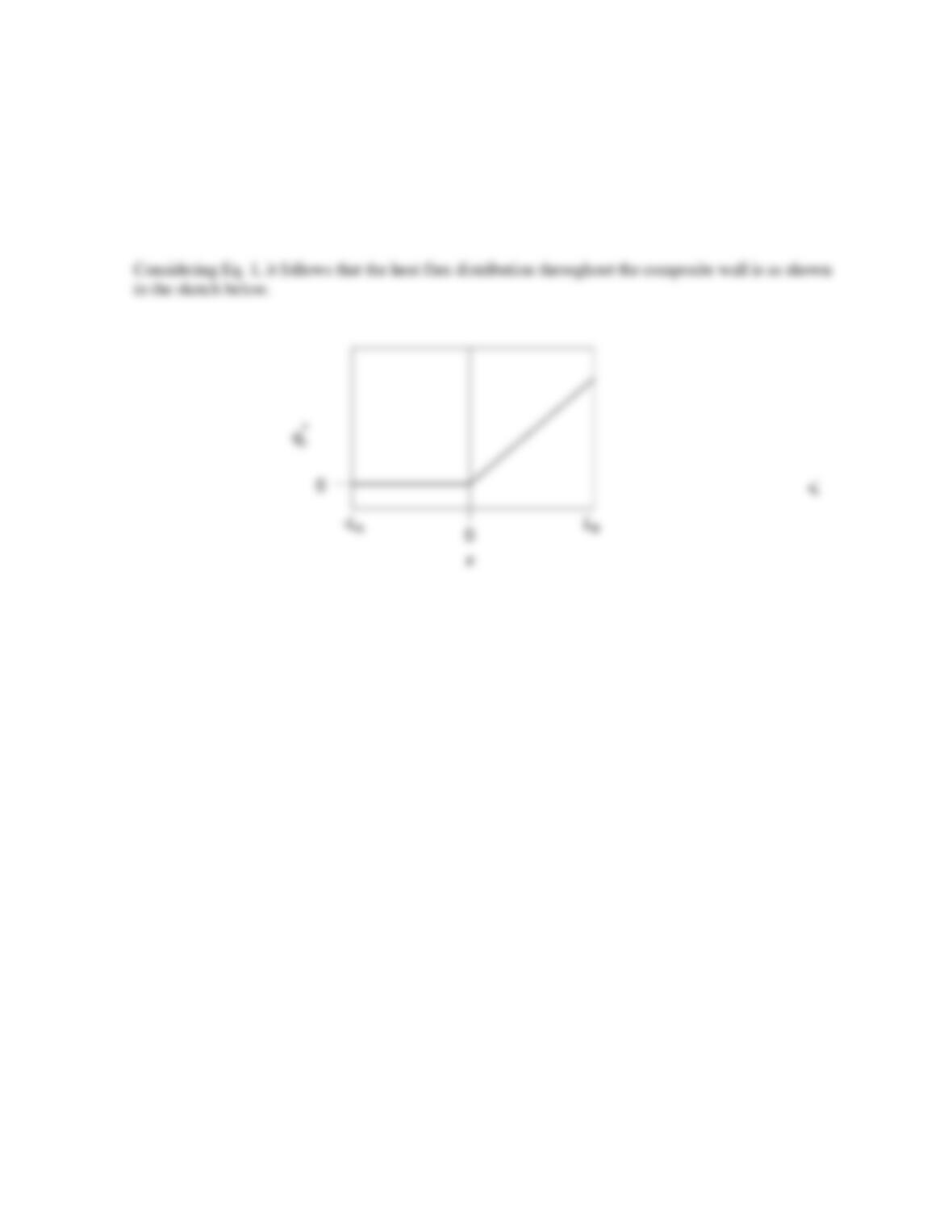
PROBLEM 2.47 (Cont.)
If the volumetric energy generation rate,
q
, is unchanged, Equation (1) requires that the temperature
gradient everywhere in Material B will be reduced by half if the thermal conductivity of Material B is
doubled. Hence, the difference between the minimum and maximum temperatures in the composite
wall would be reduced by half. <
COMMENTS: If you were given information regarding which material experiences internal energy
generation, the boundary condition at x = –LA, and the thermal conductivities of both materials, you
should be able to sketch the temperature and heat flux distributions.
PROBLEM 2.48
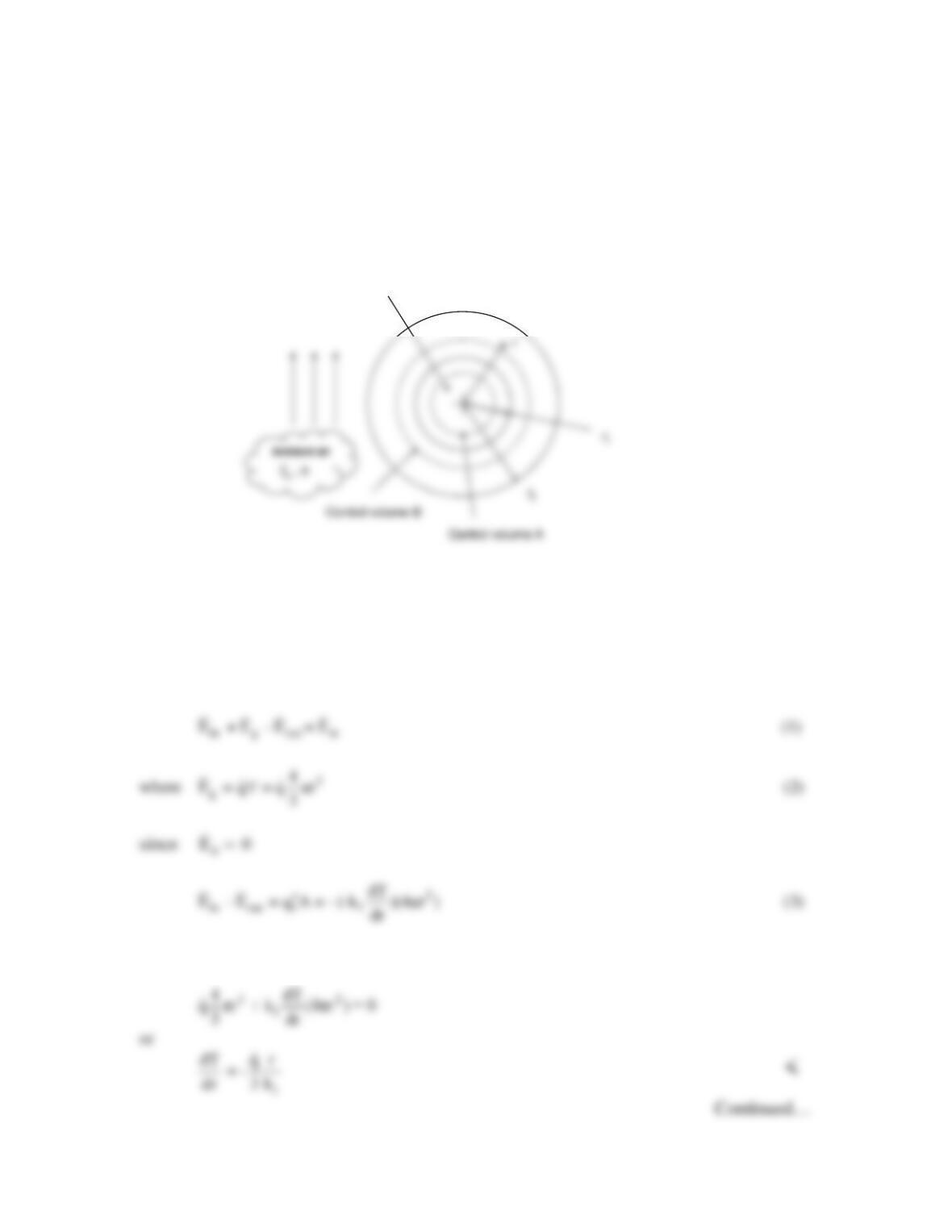
KNOWN: Size and thermal conductivities of a spherical particle encased by a spherical shell.
FIND: (a) Relationship between dT/dr and r for 0 ≤ r ≤ r1, (b) Relationship between dT/dr and r
for r1 ≤ r ≤ r2, (c) Sketch of T(r) over the range 0 ≤ r ≤ r2.
SCHEMATIC:
ASSUMPTIONS: (1) Steady-state conditions, (2) Constant properties, (3) One-dimensional heat
transfer.
ANALYSIS:
(a) The conservation of energy principle, applied to control volume A, results in
Substituting Eqs. (2) and (3) in Eq. (1) yields
Chemical reaction
q
.
Chemical reaction
q
.
PROBLEM 2.48 (Cont.)
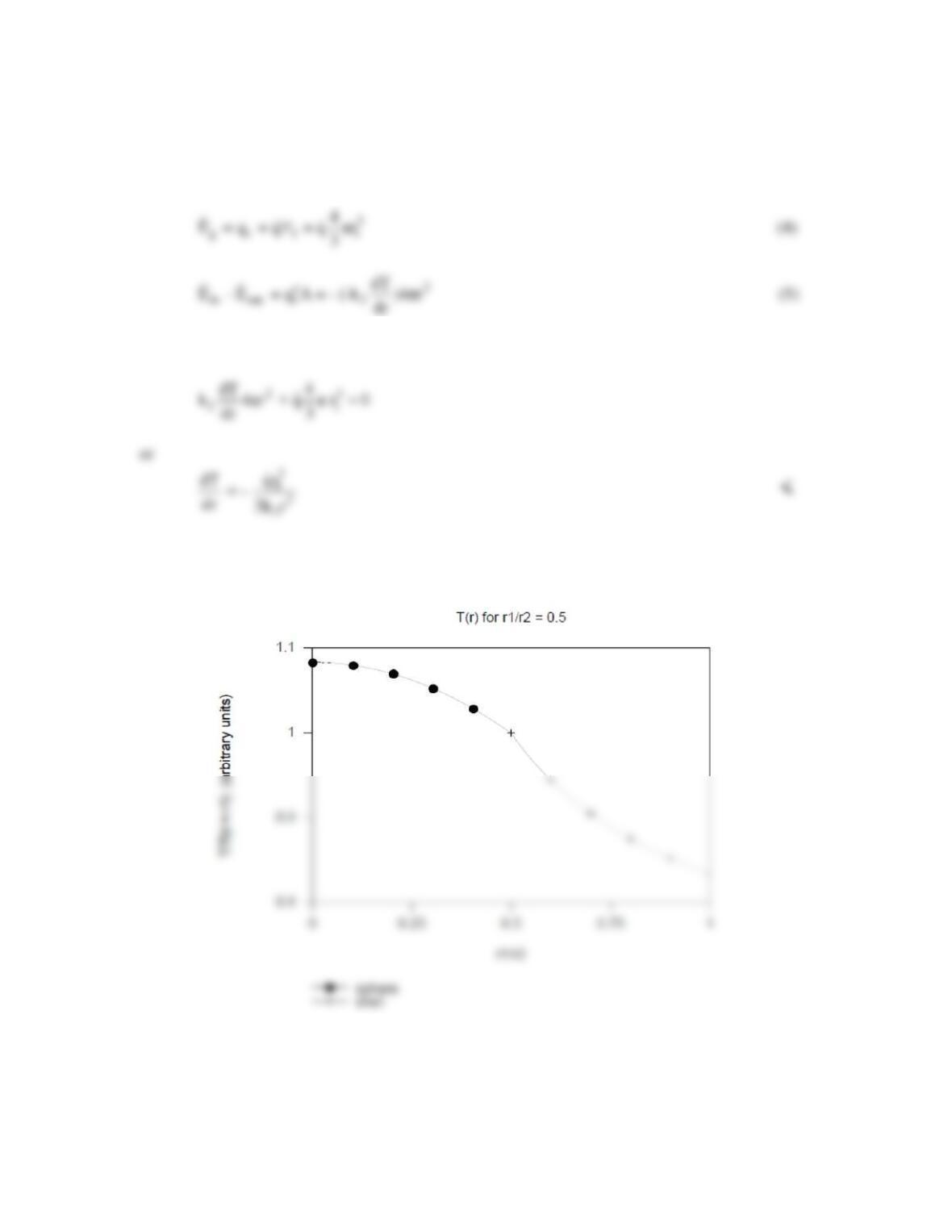
(b) For r > r1, the radial heat rate is constant and is
Substituting Eqs. (4) and (5) into Eq. (1) yields
(c) The temperature distribution on T-r coordinates is
COMMENTS: (1) Note the non-linear temperature distributions in both the particle and the
shell. (2) The temperature gradient at r = 0 is zero. (3) The discontinuous slope of T(r) at r1/r2 =
0.5 is a result of k1 = 2k2.
PROBLEM 2.49
KNOWN: Long cylindrical rod with uniform initial temperature immersed in liquid at a lower
temperature.
FIND: Sketch temperature distribution at initial time, steady state, and two intermediate times for two
rods with different thermal conductivities. State boundary conditions at centerline and surface.
ASSUMPTIONS: (1) One–dimensional conduction in radial direction, (2) Constant properties, (3)
Fluid temperature remains constant, (4) Convection heat transfer coefficient is constant.
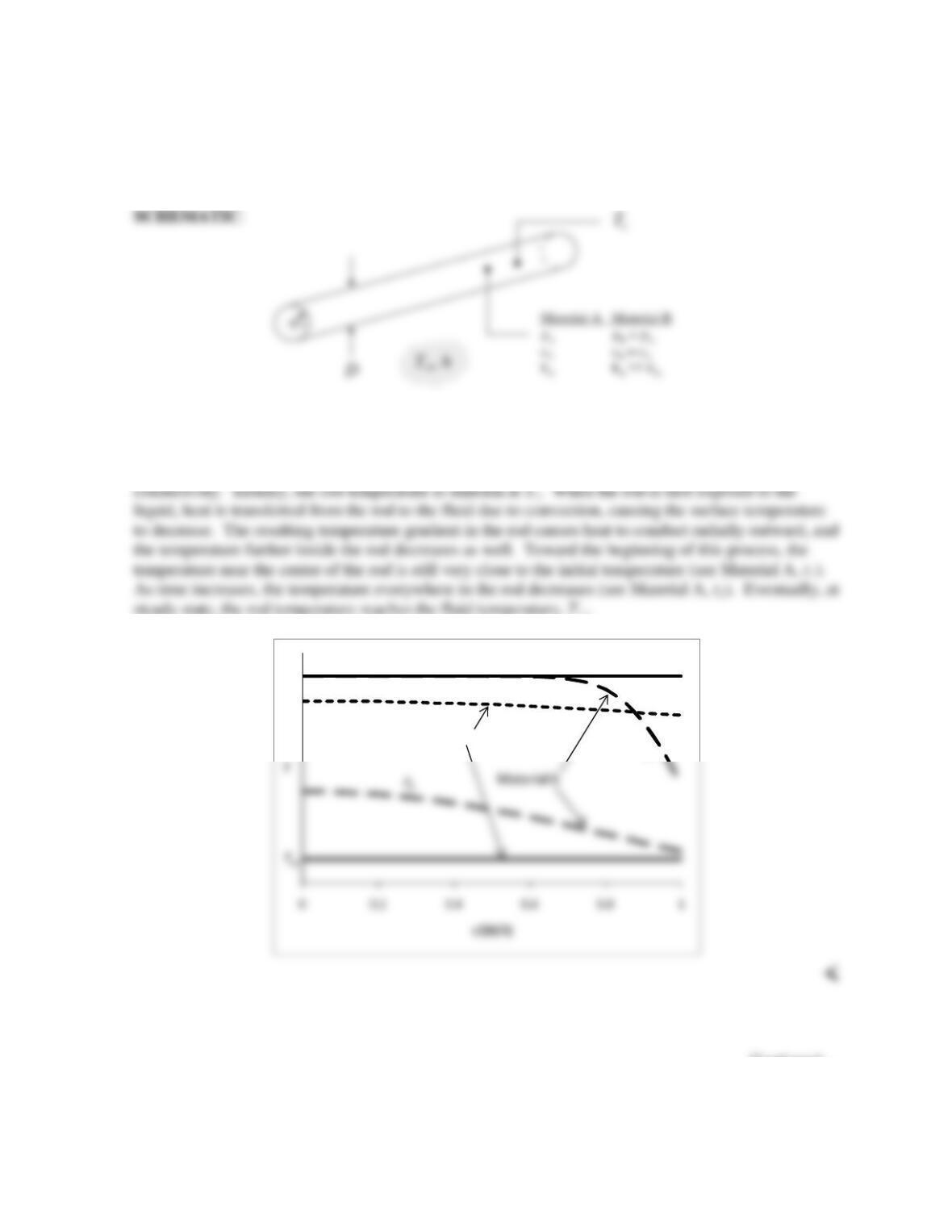
ANALYSIS: Referring to the figure below, first consider Material A of moderate thermal
t
1
T
i
Material B
t
1
Continued…
PROBLEM 2.49 (Cont.)
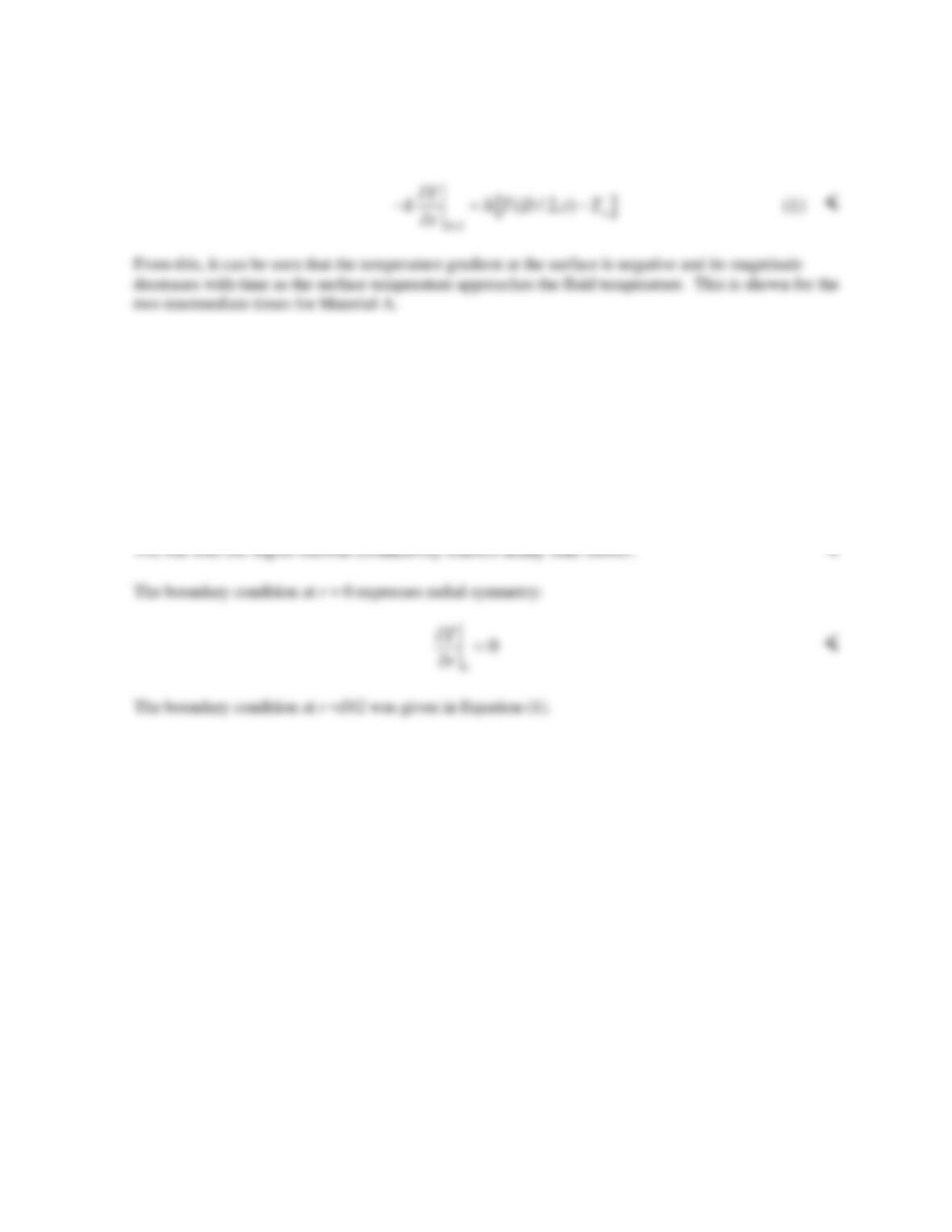
The boundary condition at the rod surface expresses a balance between heat reaching the surface by
conduction and heat leaving the surface by convection:
Next compare Material A to Material B having a very large thermal conductivity. At time t = 0 when
both rods have the same temperature Ti, it can be seen from the right hand side of Equation (1) that the
heat flux is the same for both materials. Energy is being removed from both rods at the same rate.
However, because of the large thermal conductivity of material B, its temperature gradient is smaller
and its temperature tends to be nearly uniform, as shown in the figure for Material B, t1. Its
temperature is higher at the surface and lower in the center as compared to Material A. Because its
surface temperature stays higher for longer, the heat flux leaving the rod is larger, and overall it cools
faster. At time t2, when Material A’s surface temperature is close to T∞, but it is still warm in the
center, Material B has already reached steady state.
COMMENTS: The problem of transient conduction in a cylinder will be solved in Chapter 5.
PROBLEM 2.50
KNOWN: Temperature distribution in a plane wall of thickness L experiencing uniform volumetric
heating
q
having one surface (x = 0) insulated and the other exposed to a convection process
characterized by T∞ and h. Suddenly the volumetric heat generation is deactivated while convection
continues to occur.
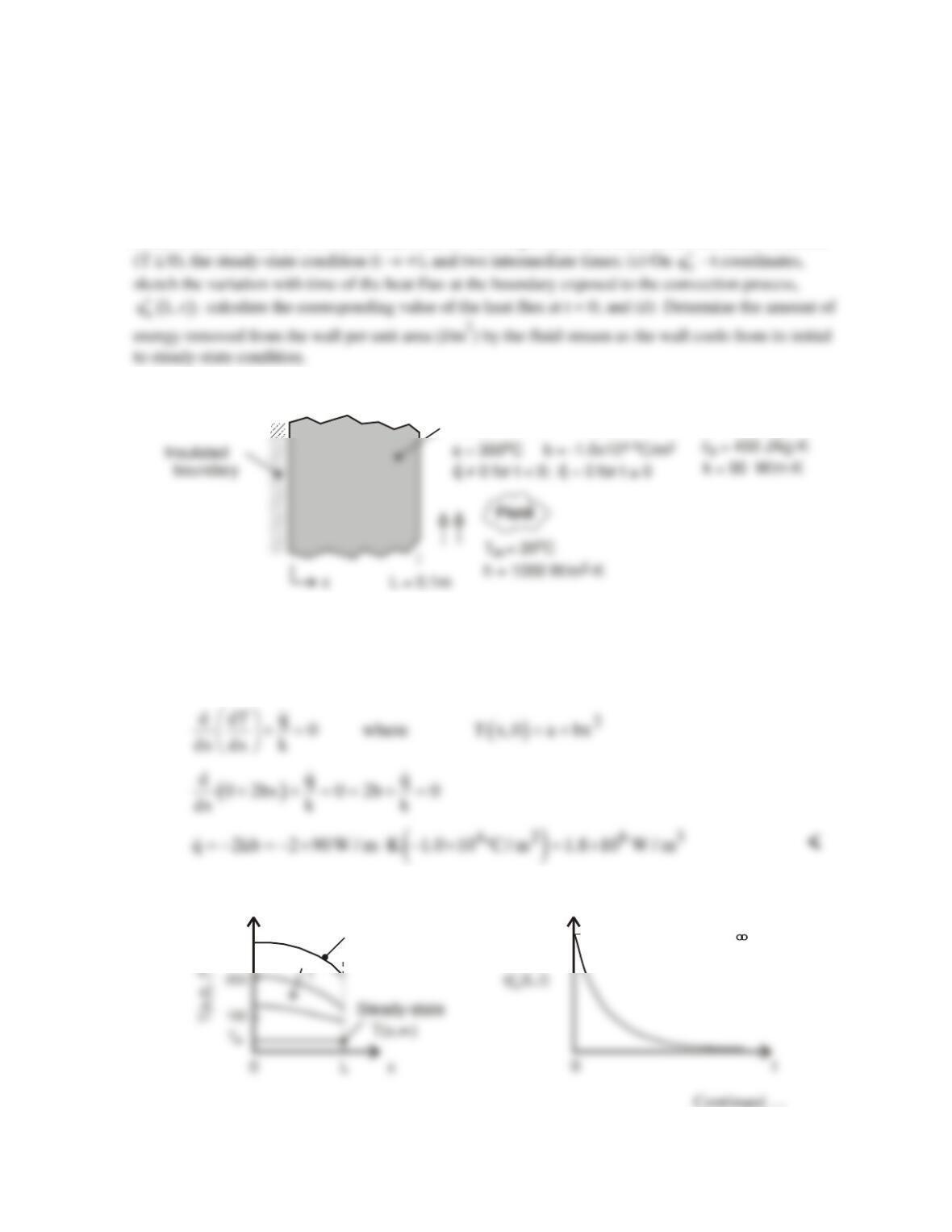
FIND: (a) Determine the magnitude of the volumetric energy generation rate associated with the
initial condition, (b) On T-x coordinates, sketch the temperature distributions for the initial condition
SCHEMATIC:
T(x,0) = a + b x(m)x
2
r
= 7000 kg/m
3
ASSUMPTIONS: (1) One–dimensional conduction, (2) Constant properties, and (3) Uniform internal
volumetric heat generation for t < 0.
ANALYSIS: (a) The volumetric heating rate can be determined by substituting the temperature
distribution for the initial condition into the appropriate form of the heat diffusion equation.
(b) The temperature distributions are shown in the sketch below.
q”(L,0) = h[T(L,0) – T ]
x
Initial
T(x,0) = a + bx
2
300
PROBLEM 2.50 (Cont.)
(c) The heat flux at the exposed surface x = L,
( )
x
q L, 0 ,
′′
is initially a maximum value and decreases
with increasing time as shown in the sketch above. The heat flux at t = 0 is equal to the convection
heat flux with the surface temperature T(L,0). See the surface energy balance represented in the
schematic.
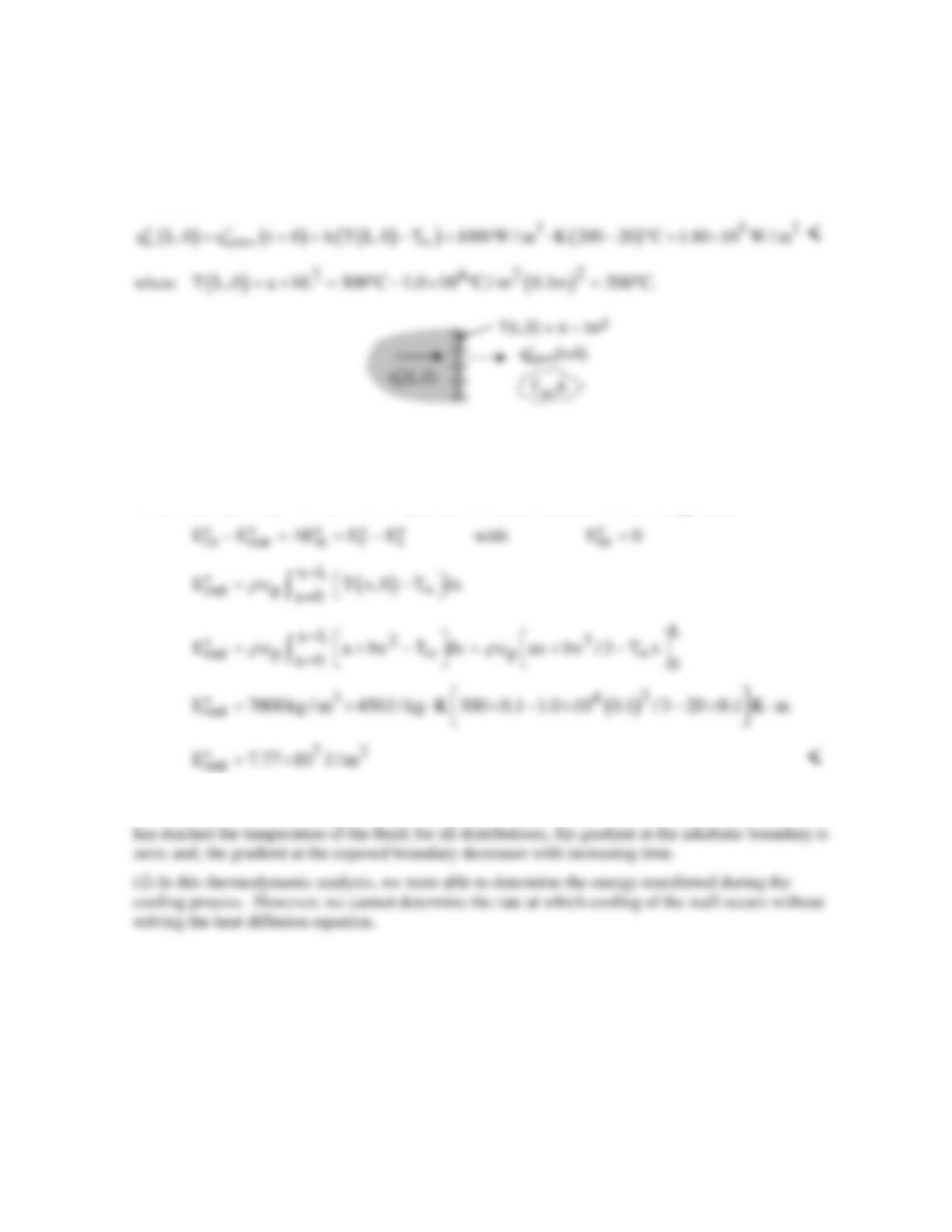
(d) The energy removed from the wall to the fluid as it cools from its initial to steady–state condition
can be determined from an energy balance on a time interval basis, Eq. 1.12b. For the initial state, the
wall has the temperature distribution T(x,0) = a + bx2; for the final state, the wall is at the temperature
of the fluid, Tf = T∞. We have used T∞ as the reference condition for the energy terms.
COMMENTS: (1) In the temperature distributions of part (a), note these features: initial condition
has quadratic form with zero gradient at the adiabatic boundary; for the steady-state condition, the wall
PROBLEM 2.51
KNOWN: Thickness of composite plane wall consisting of material A in left half and material B in
right half. Exothermic reaction in material A and endothermic reaction in material B, with equal and
opposite heat generation rates. External surfaces are insulated.
FIND: Sketch temperature and heat flux distributions for three thermal conductivity ratios, kA/kB.
SCHEMATIC:
ASSUMPTIONS: (1) Steady–state conditions, (2) One–dimensional conduction, (3) Constant
properties.
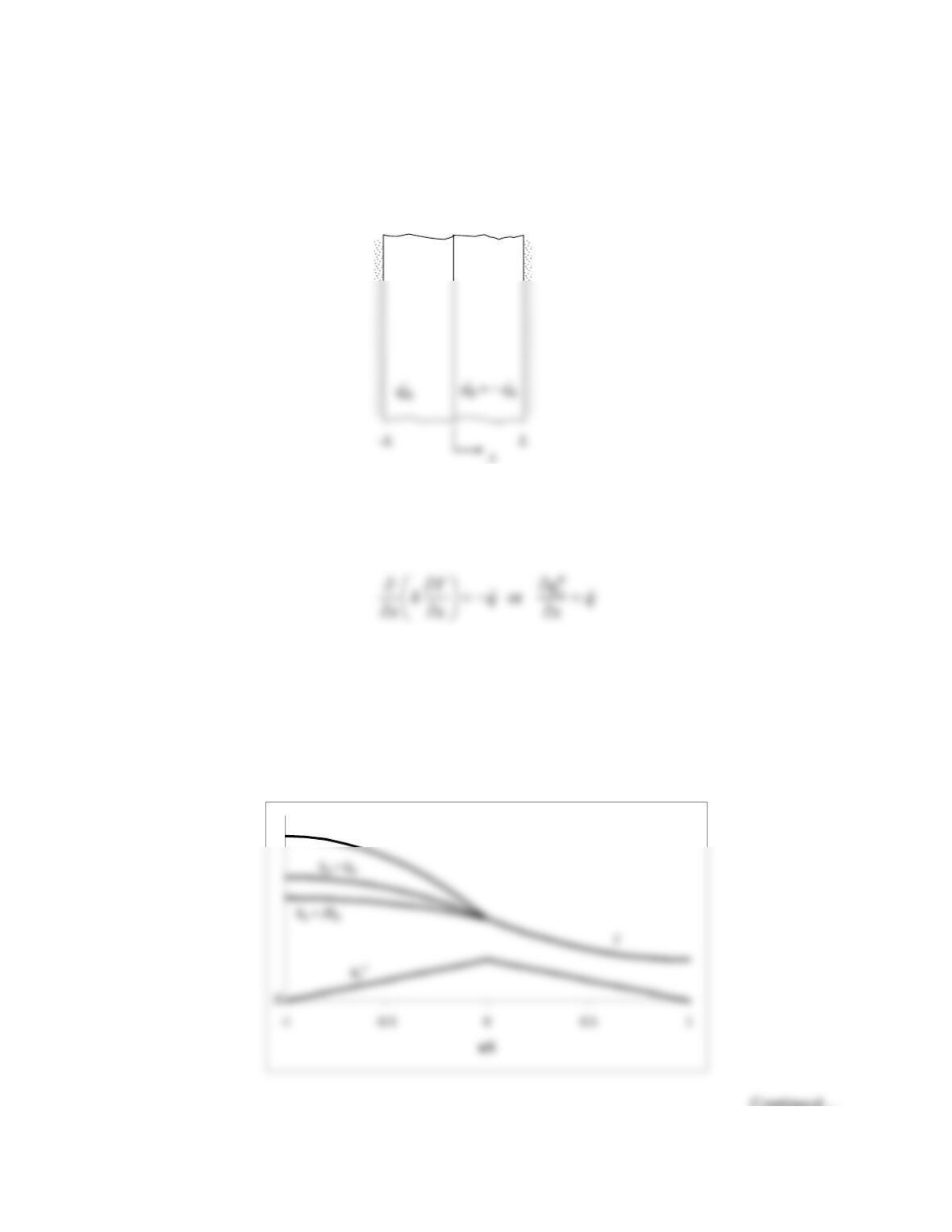
ANALYSIS: From Equation 2.19 for steady–state, one–dimensional conduction, we find
From the second equation, with uniform heat generation rate, we see that
′′
x
q
varies linearly with x,
and its slope is +
A
q
in material A and –
A
q
in material B. Furthermore, since the wall is insulated on
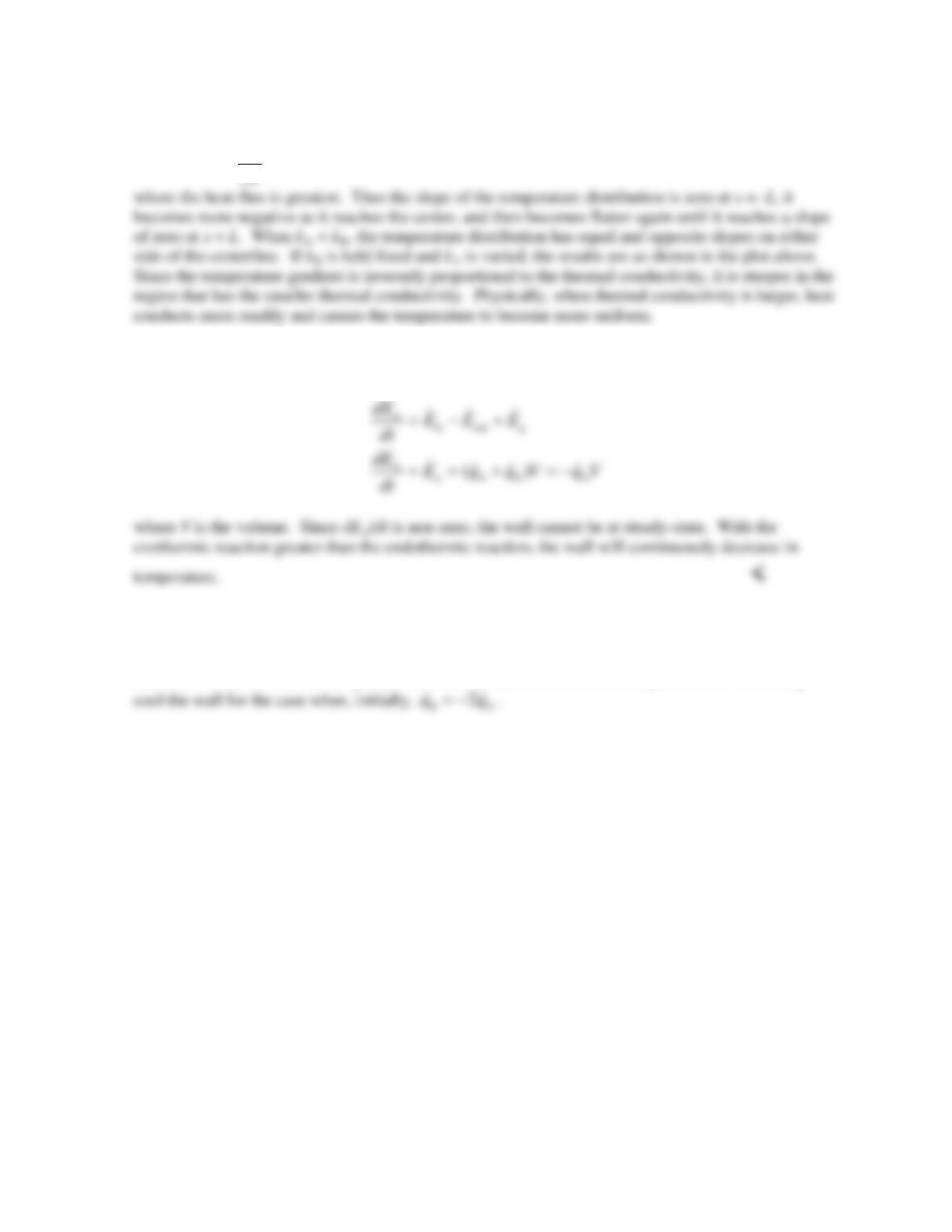
both exterior surfaces, the heat flux must be zero at x = ±L. Thus, the heat flux is as shown in the
graph below and does not depend on the thermal conductivities. The heat generated in the left half is
conducting to the right and accumulating as it goes. Once it reaches the centerline, it begins to be
consumed by the exothermic reaction and drops to zero at x = L.
k
A
= 0.5k
B
Continued…
Material A Material B
PROBLEM 2.51 (Cont.)
Since
∂
′′ = − ∂
x
T
qk
, the temperature gradient is negative everywhere, and its magnitude is greatest
If
BA
2= −
qq
, an energy balance on the wall gives:
COMMENTS: (1) Given the information in the problem statement, it is not possible to calculate
actual temperatures. There are an infinite number of correct solutions regarding temperature values,
but only one correct solution regarding the shape of the temperature distribution. (2) Chemical
reactions would cease if the temperature became too small. It would not be possible to continually
BA
2= −
qq
PROBLEM 2.52
KNOWN: Radius and length of coiled wire in hair dryer. Electric power dissipation in the wire, and
temperature and convection coefficient associated with air flow over the wire.
SCHEMATIC:
r = 1 mm
o
q (r )
o
L = 0.5 m
p
c
1 T q T 1T
r
rr r k k t t
∂∂ ∂ ∂
+= =
∂∂ ∂ ∂
r
α
<
Under steady–state conditions, all of the thermal energy generated within the wire is transferred to the
air by convection. Performing an energy balance for a control surface about the wire,
out g
E E 0,− +=
it follows that
( )
o o elec
2 r L q r , t P 0.
π
′′
− →∞ + =
Hence,
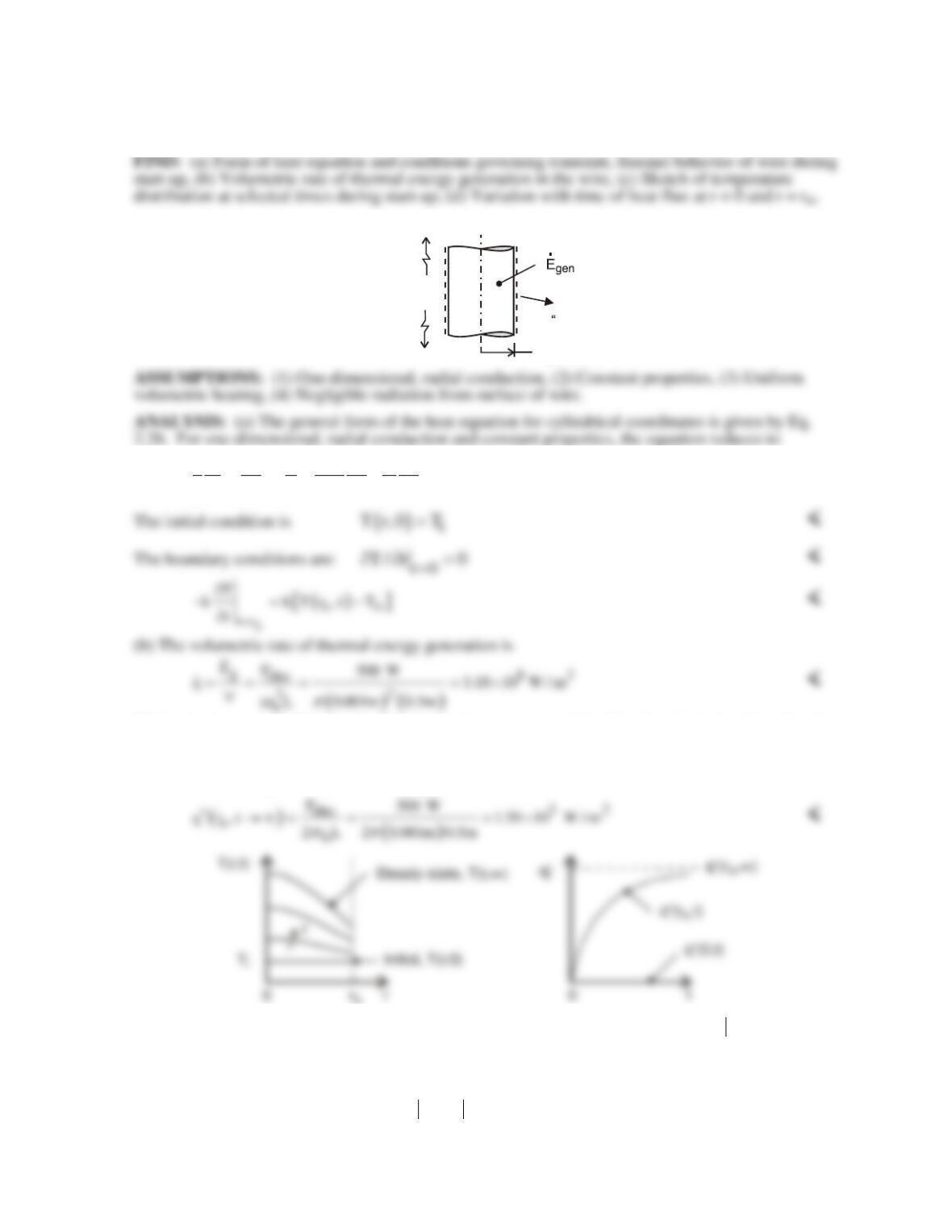
COMMENTS: The symmetry condition at r = 0 imposes the requirement that
r0
T / r 0,
=
∂∂ =
and
hence
( )
q 0, t 0
′′ =
throughout the process. The temperature at ro, and hence the convection heat flux,
increases steadily during the start–up, and since conduction to the surface must be balanced by
convection from the surface at all times,
o
rr
T/ r =
∂∂
also increases during the start–up.
PROBLEM 2.53
KNOWN: Temperature distribution in a composite wall.
FIND: (a) Relative magnitudes of interfacial heat fluxes, (b) Relative magnitudes of thermal
conductivities, and (c) Heat flux as a function of distance x.
SCHEMATIC:
ASSUMPTIONS: (1) Steady-state conditions, (2) One-dimensional conduction, (3) Constant
properties.
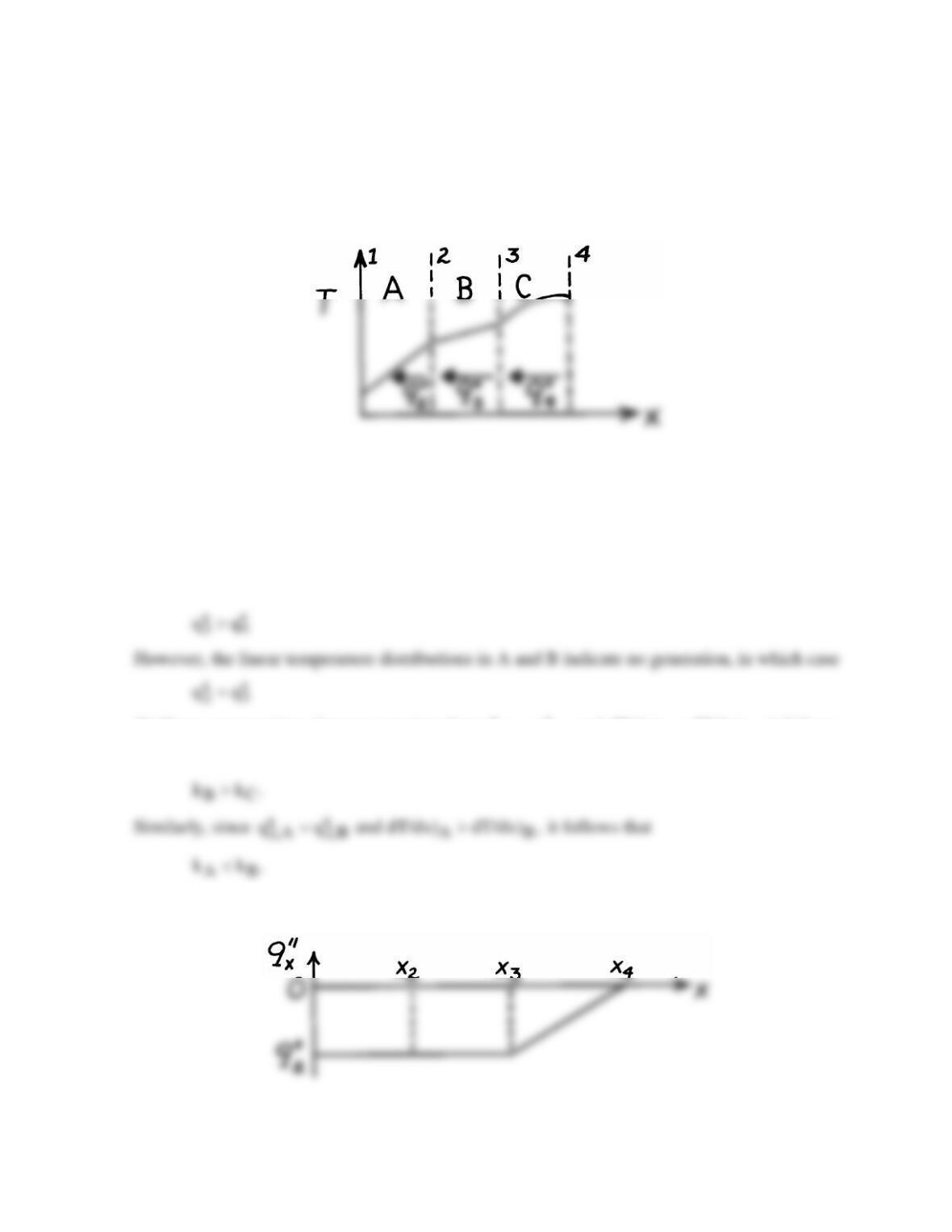
ANALYSIS: (a) For the prescribed conditions (one-dimensional, steady-state, constant k),
the parabolic temperature distribution in C implies the existence of heat generation. Hence,
since dT/dx increases with decreasing x, the heat flux in C increases with decreasing x.
Hence,
(b) Since conservation of energy requires that
3,B 3,C B C
q q and dT/dx) dT/dx) ,
′′ ′′
= <
it follows
from Fourier’s law that
(c) It follows that the flux distribution appears as shown below.
COMMENTS: Note that, with dT/dx)4,C = 0, the interface at 4 is adiabatic.