COMPARATIVE ANALYSIS CASE (Continued)
Because PepsiCo uses LIFO for part of its inventory, if material, it
would be necessary to adjust as best as possible to FIFO. An additional
problem is that both use the average cost for some of their inventory,
but information related to its percentage use is not provided.
Coca-Cola
Recent Accounting Standards and Pronouncements
In June 2009, the Financial Accounting Standards Board (‘‘FASB’’)
amended its guidance on accounting for VIEs. The new accounting
guidance resulted in a change in our accounting policy effective
January 1, 2010. Among other things, the new guidance requires more
qualitative than quantitative analyses to determine the primary
beneficiary of a VIE, requires continuous assessments of whether an
enterprise is the primary beneficiary of a VIE, enhances disclosures
about an enterprise’s involvement with a VIE, and amends certain
guidance for determining whether an entity is a VIE. Under the new
guidance, a VIE must be consolidated if the enterprise has both (a) the
relationship between our voting interests in these entities and our
exposure to the economic risks and potential rewards of the entities.
As a result, we determined that we held a majority of the variable
interests in these entities and, therefore, were deemed to be the
primary beneficiary. The loan guarantees and/or other financial support
given by the Company to these entities are included in the calculation
2-38
COMPARATIVE ANALYSIS CASE (Continued)
In December 2007, the FASB amended its guidance on accounting for
business combinations. The new accounting guidance resulted in a
change in our accounting policy effective January 1, 2009, and is being
applied prospectively to all business combinations subsequent to the
effective date. Among other things, the new guidance amends the
In December 2007, the FASB issued new accounting and disclosure
guidance related to noncontrolling interests in subsidiaries (previously
referred to as ‘‘minority interests’’), which resulted in a change in our
accounting policy effective January 1, 2009. Among other things, the
new guidance requires that a noncontrolling interest in a subsidiary
COMPARATIVE ANALYSIS CASE (Continued)
In December 2007, the FASB issued new accounting guidance that
defines collaborative arrangements and establishes reporting require–
ments for transactions between participants in a collaborative arrange-
ment and between participants in the arrangement and third parties. It
In February 2007, the FASB issued new accounting guidance that
permits entities to choose to measure many financial instruments and
certain other items at fair value. Unrealized gains and losses on items
for which the fair value option has been elected will be recognized in
earnings at each subsequent reporting date. This new accounting
guidance was effective for our Company on January 1, 2008. The
Company did not elect the fair value option for any financial
instruments or other items permitted under this guidance; therefore, its
adoption had no impact on our consolidated financial statements.
2-40
COMPARATIVE ANALYSIS CASE (Continued)
PepsiCo
Recent Accounting Pronouncements
expensed rather than capitalized. Future adjustments made to valuation
allowances on deferred taxes and acquired tax contingencies associ–
ated with acquisitions that closed prior to the beginning of our 2009
fiscal year apply the new provisions and will be evaluated based on
the outcome of these matters.
and (2) the loss of control of subsidiaries. We adopted the accounting
provisions of the new guidance on a prospective basis as of the
beginning of our 2009 fiscal year, and the adoption did not have a
material impact on our financial statements. In addition, we adopted

COMPARATIVE ANALYSIS CASE (Continued)
VIE. In addition, the amended guidance requires an ongoing reconsid–
2-42
FINANCIAL STATEMENT ANALYSIS CASE—WAL-MART
(a) (1) In the year of the change, Wal-Mart will reverse the revenue recog-
nized in prior periods for layaway sales that are not complete.
This will reduce income in the year of the change.
(b) By recognizing the revenue before delivery, Wal-Mart was recognizing
revenue before the earnings process was complete. In addition, if cus-
tomers did not pay the remaining balance owed, the realizability criterion
is not met either. While Wal-Mart likely could estimate expected deliv-
eries and payments, it is not apparent that this was done.
ACCOUNTING, ANALYSIS, AND PRINCIPLES
Accounting
Caddie Shack Company
Statement of Financial Position
May 31, 2010
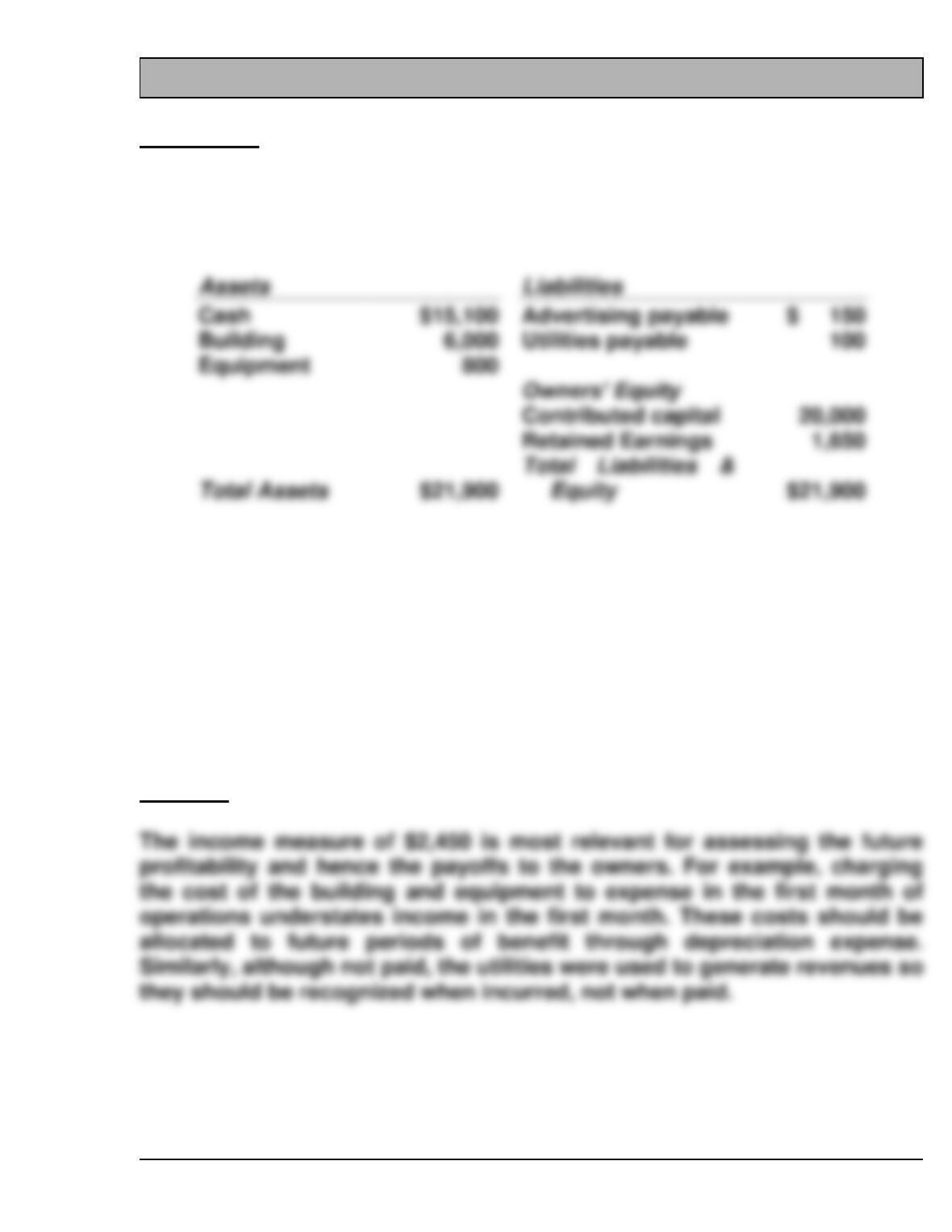
Accrual income = $4,700 – $1,000 – $750 – $400 – $100 = $2,450
Earned capital balance = $0 + $2,450 – $800 = $1,650
Murray might conclude that his business earned a profit of $1,650 because
that is his earned capital at the end of the month. The conclusion that his
business lost $4,900 might come from the change in the business’s cash
balance, which started at $20,000 and ended the month at $15,100.
Analysis
2-44
ACCOUNTING, ANALYSIS, AND PRINCIPLES (Continued)
Principles
GAAP income is the accrual income computed above as $2,450. The key
PROFESSIONAL RESEARCH
Search Strings: concept statement, “materiality”, “articulation”
(a) According to Concepts Statement 2 (CON 2): Qualitative Characteristics
of Accounting Information, “Glossary”:
(b) CON 2, Appendix C—See Table 1—refers to several SEC cases which
apply materiality. Students might also research SEC literature (e.g. Staff
Accounting Bulletin No. 99), although SEC literature is not in the FARS
database.
SFAC No. 2, 128. provides the following examples of screens that might
be used to determine materiality:
2-46
PROFESSIONAL RESEARCH (Continued)
However, according to CON 2, Pars. 129, 131 the FASB notes that
more than magnitude must be considered in evaluating materiality:
SFAC No. 2, Par. 131. Some hold the view that the Board should
promulgate a set of quantitative materiality guides or criteria covering
a wide variety of situations that preparers could look to for authoritative
support. That appears to be a minority view, however, on the basis of
representations made to the Board in response to the Discussion
Memorandum, Criteria for Determining Materiality. The predominant
view is that materiality judgments can properly be made only by those
who have all the facts. The Board’s present position is that no general
standards of materiality could be formulated to take into account all
the considerations that enter into an experienced human judgment.
PROFESSIONAL SIMULATION
Explanation
1. Most accounting methods are based on the assumption that the business
enterprise will have a long life. Acceptance of this assumption
provides credibility to the historical cost principle, which would be of
2. The company is too conservative in its accounting for this transaction.
The expense recognition principle indicates that expenses should be
allocated to the appropriate periods involved. In this case, there appears
to be a high uncertainty that the company will have to pay. FASB
Codification, Section 450-20, requires that a loss should be accrued
only (1) when it is probable that the company would lose the suit and
Research
According to Concepts Statement 8 (CON 8) par. QCII:
Information is material if omitting it or misstating it could influence decisions
that users make on the basis of the financial information of a specific
reporting entity. In other words, materiality is an entity-specific aspect of
relevance based on the nature or magnitude or both of the items to which
the information relates in the context of an individual entity’s financial report.
Consequently, the Board cannot specify a uniform quantitative threshold for
materiality or predetermine what could be material in a particular situation.
2-48
IFRS CONCEPTS AND APPLICATION
IFRS2-1
The IASB framework makes two assumptions. One assumption is that
IFRS2-2
IFRS2-3
The FASB differentiates gains and losses from revenue and expenses where
gains and losses are incidental transactions of the entity. Further, the FASB
includes changes in equity as elements: investment by owners, distributions
to owners, and comprehensive income.
IFRS2-4
As indicated, the measurement project relates to both initial measurement
and subsequent measurement. Thus, the continuing controversy related to
IFRS2-5
The IASB and FASB frameworks are strikingly similar. This is not surprising,
given that the IASB framework was adopted after the FASB developed its
framework (the IASB framework was approved in April 1989). In addition, the
Note to Instructors—These differences may be resolved as the FASB and
IASB work on their performance reporting projects.
IFRS2-6
Search Strings: “materiality”, “completeness”
(a) According to the Framework (para. 30): Information is defined to be
material if its omission or misstatement could influence the economic
decisions of users taken on the basis of the financial statements.
2-50
IFRS2-6 (Continued)
30 Information is material if its omission or misstatement could
influence the economic decisions of users taken on the basis of the
financial statements. Materiality depends on the size of the item or
(c) According to the Framework (para. 22):
Accrual basis
In order to meet their objectives, financial statements are prepared on
the accrual basis of accounting. Under this basis, the effects of
transactions and other events are recognized when they occur (and
IFRS2-7
(a) According to Note 1—Accounting Policies, “Revenue comprises sales
of goods to customers outside the Group less an appropriate
deduction for actual and expected returns, discounts and loyalty
(c) Examination of the auditor’s report. Also, M&S discusses a number of
new accounting pronouncements issued or effective during the fiscal
year (e.g., IFRS 7, IFRIC 11, IFRIC 14). M&S indicates that they have
had or are expected to have a material impact on the financial
statements.