2.2 The Method of False Position
1. Each of the following equations has a root on the interval (0,1). Perform the
method of false position to determine p3, the third approximation to the location
of the root, and to determine (a4, b4), the next enclosing interval.
(a) ln(1 + x)−cos x= 0 (b) x5+ 2x−1 = 0
(c) e−x−x= 0 (d) cos x−x= 0
(a) Let f(x) = ln(1 + x)−cos x. For the first iteration, we have (a1, b1) = (0,1)
To determine whether the root is contained on (a1, p1)or on (p1, b1), we
Note that f(p2)≈ −3.270 ×10⁻⁴<0, which is of the same sign as f(a2).
2Section 2.2
Note that f(p2)≈ −0.131 <0, which is of the same sign as f(a2). Hence, the
(c) Let f(x) = e−x−x. For the first iteration, we have (a1, b1) = (0,1) and we
To determine whether the root is contained on (a1, p1)or on (p1, b1), we
Note that f(p2)≈ −0.00789 <0, which is of opposite sign from f(a2).
The Method of False Position 3
(d) Let f(x) = cos x−x. For the first iteration, we have (a1, b1) = (0,1) and we
know that f(a1) = 1 >0and that f(b1) = cos 1 −1≈ −0.460 <0. Our first
approximation to the location of the root is
2. Construct an algorithm for the method of false position. Remember to save
function values which will be needed for later iterations and to implement a
stopping condition based on equations (6) and (7).
Here is an algorithm for the method of false position:
GIVEN: function whose zero is to be located, f
3. Confirm that |λ|<1 for the remaining configurations in Figure 2-5.
Start with the configuration depicted in the upper right panel of Figure 2.5. Because
In the lower left panel of Figure 2.5, bnis fixed, so l=bn−p. Now, bn−p > 0and
Finally, in the lower right panel of Figure 2.5, bnis fixed, so l=bn−p. Now,
In Exercises 4 – 7, an equation, an interval on which the equation has a root,
and the exact value of the root are specified.
The Method of False Position 5
(a) Perform the first five (5) iterations of the method of false position.
(b) Verify that the absolute error in the third, fourth and fifth approximations
satisfies the error estimate
|pn−p| ≈
λ
λ−1
|pn−pn−1|.
(c) How does the error in the fifth false position approximation compare to the
maximum error which would result from six iterations of the bisection method?
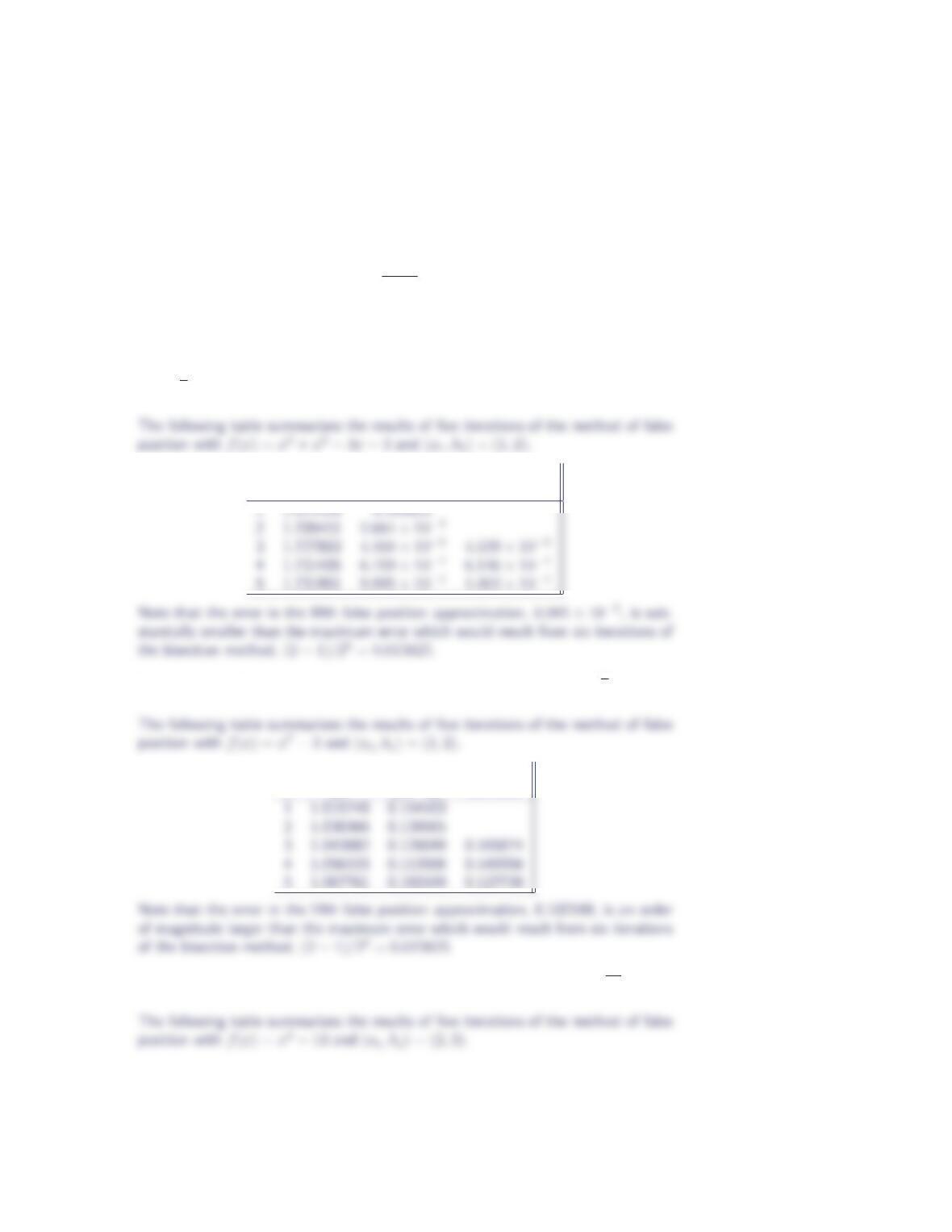
4. The equation x3+x2−3x−3 = 0 has a root on the interval (1,2), namely
x=√3.
error
npn|pn−p|estimate
5. The equation x7= 3 has a root on the interval (1,2), namely x=7
√3.
error
npn|pn−p|estimate
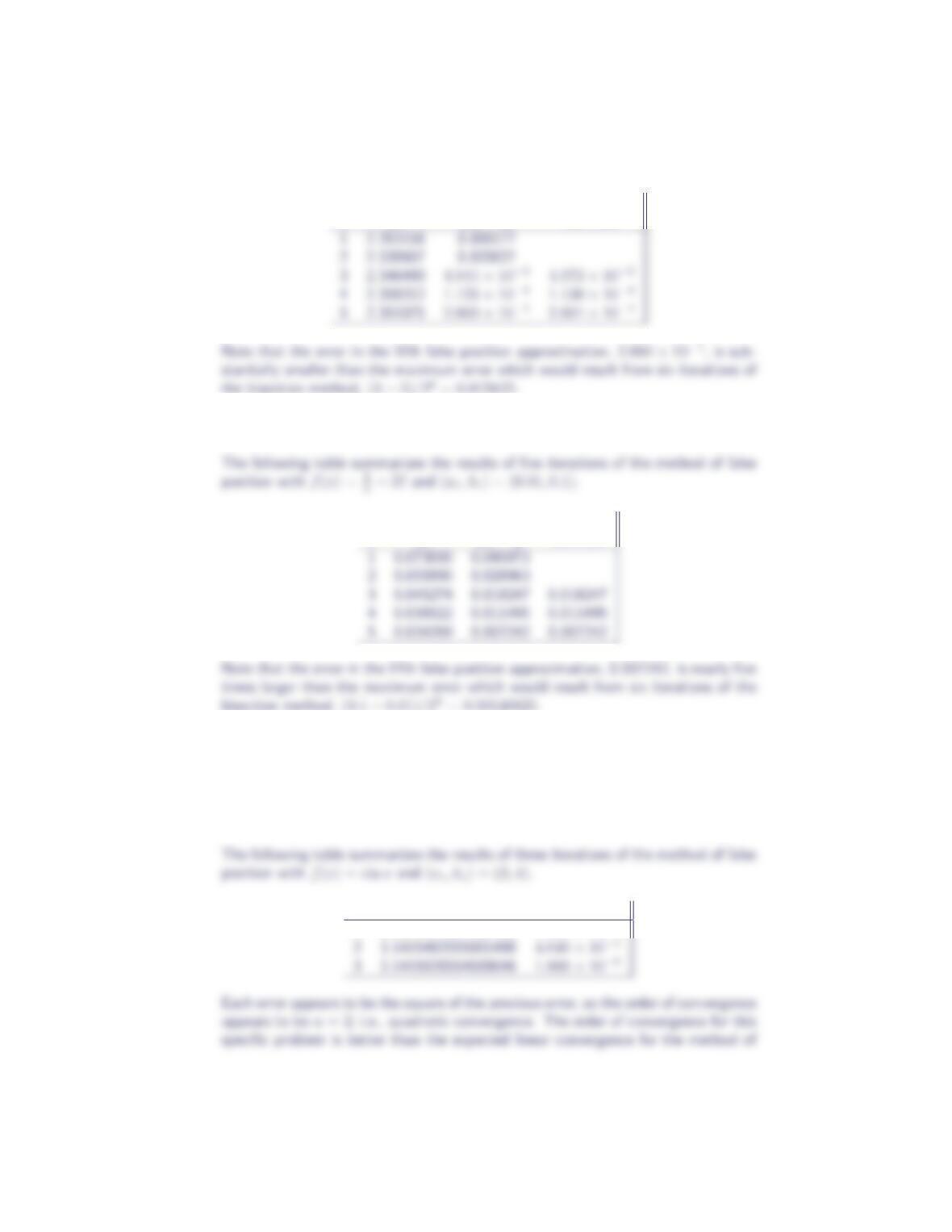
6. The equation x3−13 = 0 has a root on the interval (2,3), namely 3
√13.
6Section 2.2
error
npn|pn−p|estimate
7. The equation 1/x−37 = 0 has a zero on the interval (0.01,0.1), namely x= 1/37.
error
npn|pn−p|estimate
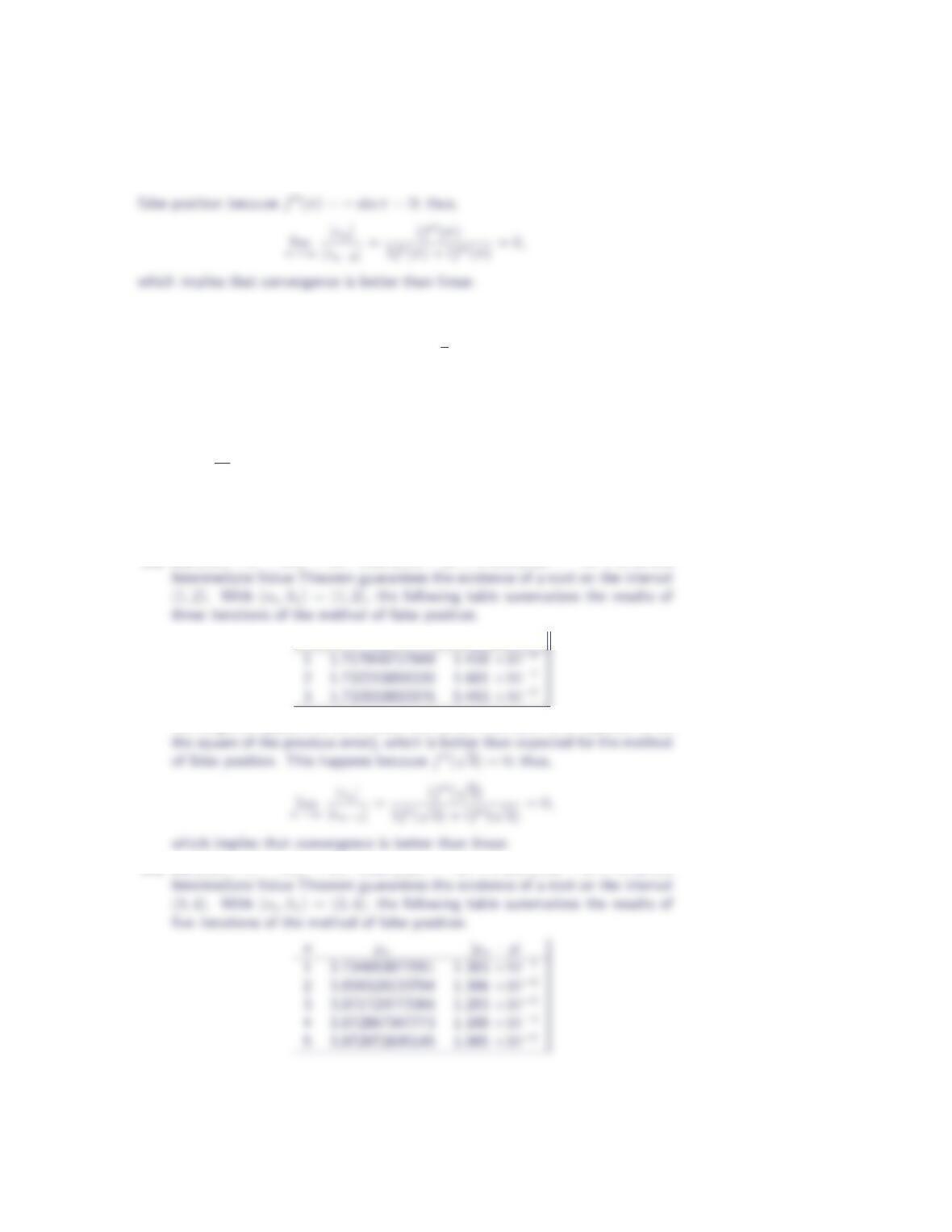
8. The function f(x) = sin xhas a zero on the interval (3,4), namely x=π.
Perform three iterations of the method of false position to approximate this zero.
Determine the absolute error in each of the three computed approximations.
What is the apparent order of convergence? What explanation can you provide
for this behavior?
npn|pn−p|
1 3.1571627924799466 1.557 ×10⁻²
The Method of False Position 7
9. (a) Verify that the equation x4−18x2+45 = 0 has a root on the interval (1,2).
Next, perform three iterations of the method of false position. Given that
the exact value of the root is x=√3, compute the absolute error in
the three approximations just obtained. What is the apparent order of
convergence? What explanation can you provide for this behavior?
(b) Verify that the equation x4−18x2+ 45 = 0 also has a root on the interval
(3,4). Perform five iterations of the method of false position, and compute
the absolute error in each approximation. The exact value of the root is
x=√15. What is the apparent order of convergence in this case?
(c) What explanation can you provide for the different convergence behavior
between parts (a) and (b)?
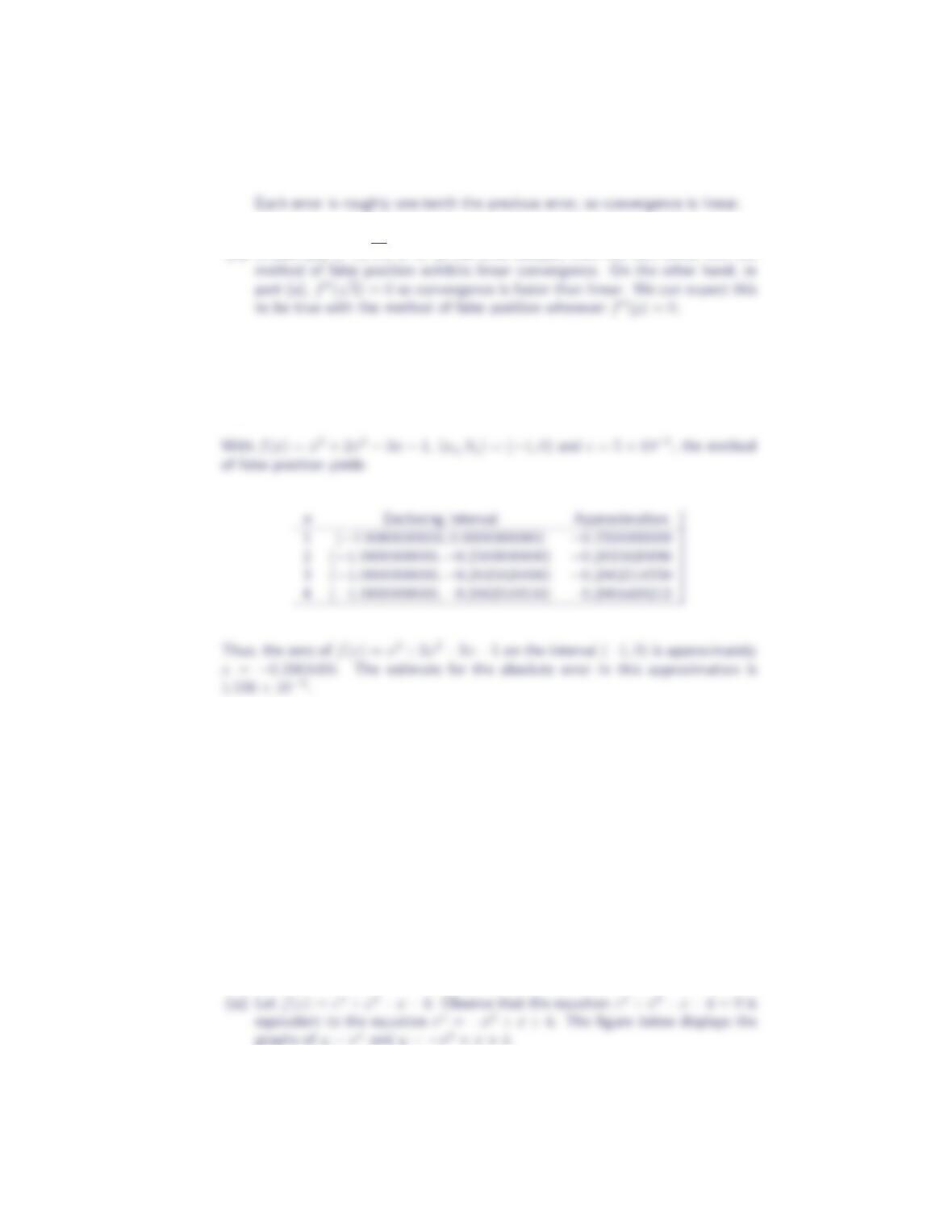
(a) Let f(x) = x4−18x2+ 45. Then f(1) = 28 >0and f(2) = −11 <0, so the
npn|pn−p|
Convergence appears to be of order two (note that each error appears to be
(b) Let f(x) = x4−18x2+ 45. Then f(3) = −36 <0and f(4) = 13 >0, so the
8Section 2.2
(c) In part (b), f′′ (√15) 6= 0, so the error analysis from the text holds, and the
10. The function f(x) = x3+ 2x2−3x−1 has a zero on the interval (−1,0).
Approximate this zero to within an absolute tolerance of 5 ×10⁻⁵.
11. For each of the functions given below, use the method of false position to approx-
imate all real roots. Use an absolute tolerance of 10−6as a stopping condition.
(a) f(x) = ex+x2−x−4
(b) f(x) = x3−x2−10x+ 7
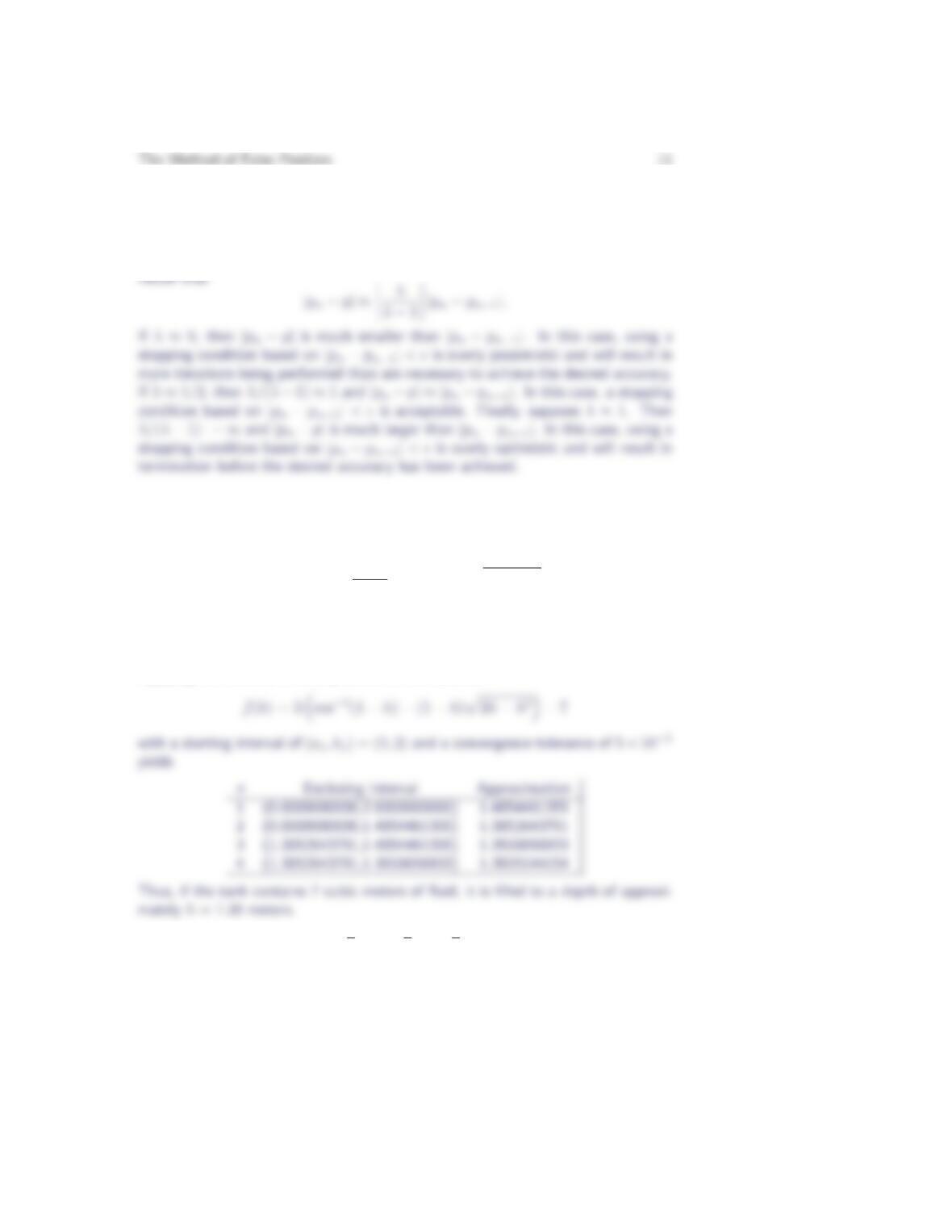
(c) f(x) = 1.05 −1.04x+ ln x
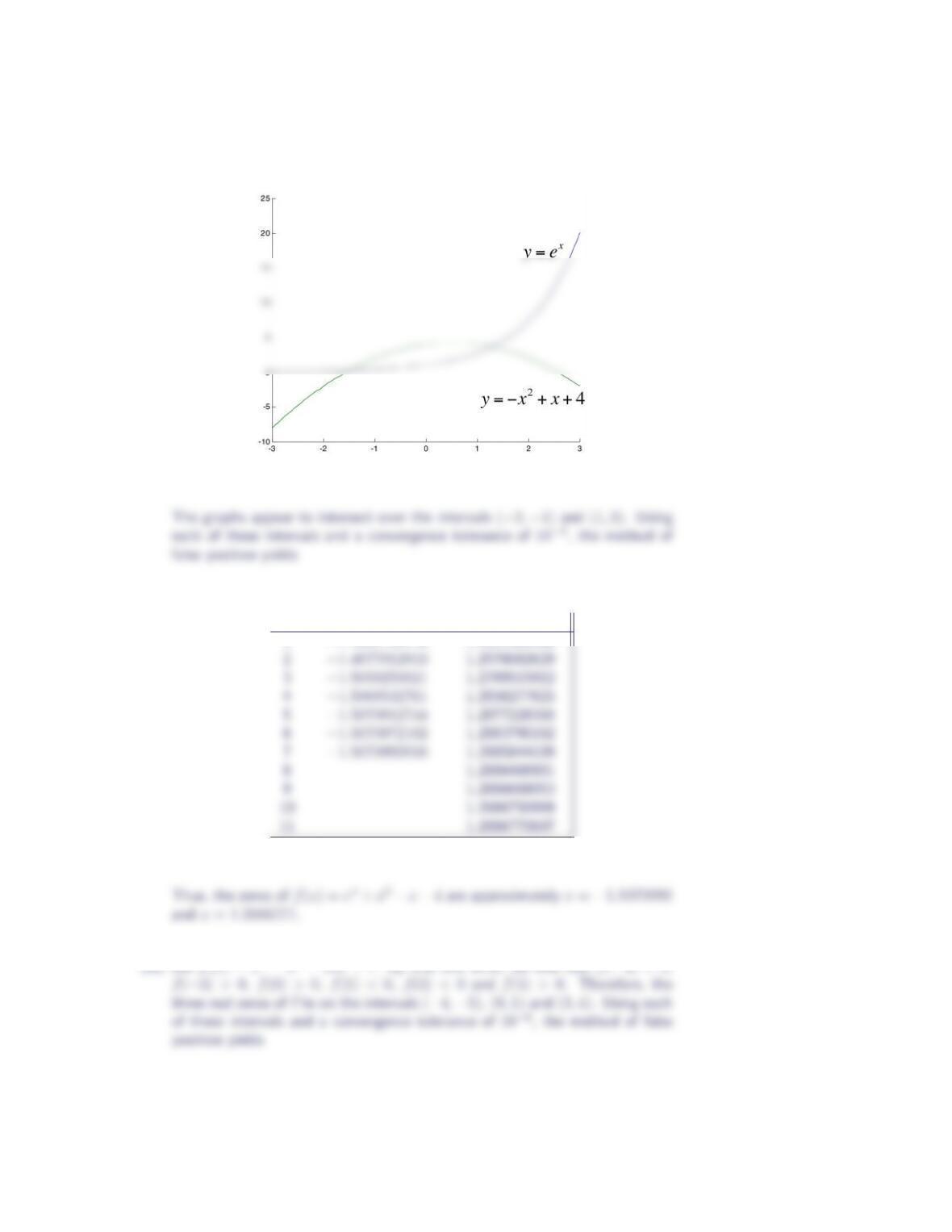
The Method of False Position 9
n(a1, b1) = (−2,−1) (a1, b1) = (1,2)
1−1.4332155776 1.1921393409
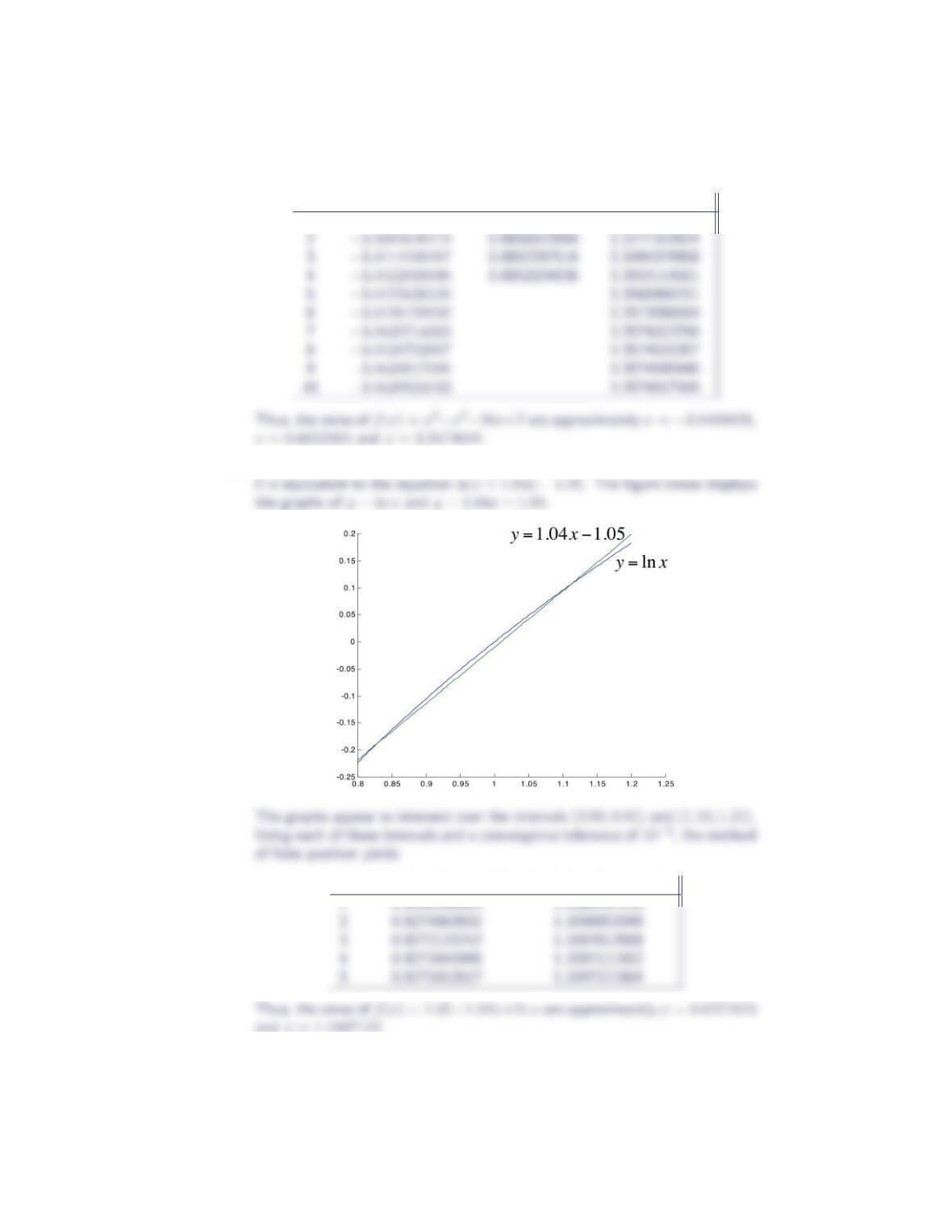
10 Section 2.2
n(a1, b1) = (−4,−3) (a1, b1) = (0,1) (a1, b1) = (3,4)
1−3.0294117647 0.7000000000 3.2500000000
(c) Let f(x) = 1.05−1.04x+ln x. Observe that the equation 1.05−1.04x+ln x=
n(a1, b1) = (0.80,0.85) (a1, b1) = (1.10,1.15)
12. In the literature, it is not uncommon to find the method of false position ter-
minated when |pn−pn−1|< ǫ. Comment on the accuracy of this stopping
condition. Consider the cases λ≈0, λ≈1/2 and λ≈1.
13. A storage tank is in the shape of a horizontal cylinder with length Land radius
r. The volume Vof fluid in the tank is related to the depth hof the fluid by
the equation
V=r2cos−1r−h
r−(r−h)p2rh −h2L.
If r= 1 meter, L= 3 meters and V= 7 cubic meters, determine h.
Because the radius of the tank is one meter, we are guaranteed that 0≤h≤2.
Applying the method of false position to the function
14. The equation x2= 1 −cos(√2x) + √2 sin(√2x) has two real roots. One of
them is at x= 0. Determine an interval which contains the other root, and
then approximate this root to three decimal places. This problem arises in the
calculation of the amplitude of the solution to a nonlinear third-order differ-
ential equation. See Gottlieb (“Simple nonlinear jerk functions with periodic
solutions,” American Journal of Physics, 66 (10), 903 – 906, 1998) for details.
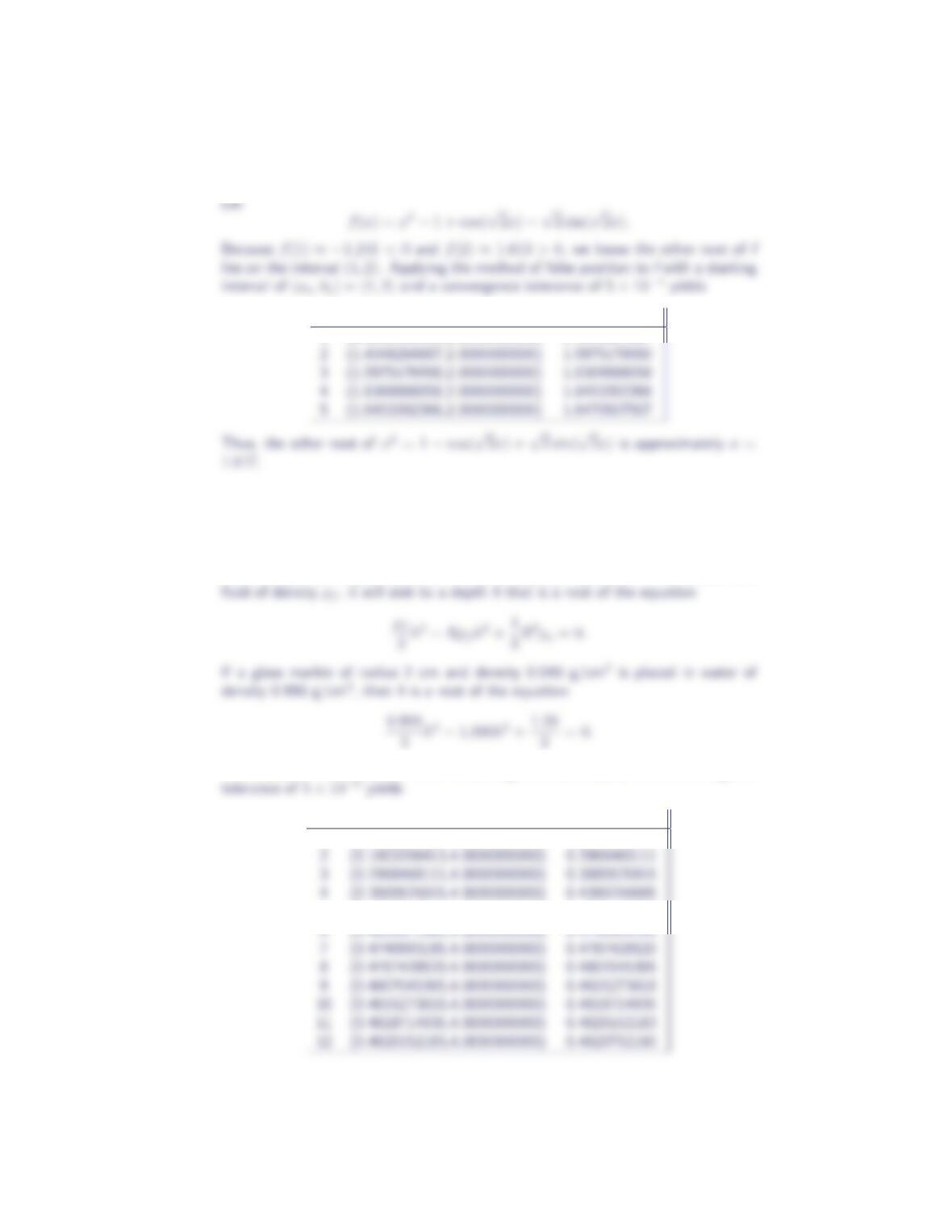
12 Section 2.2
nEnclosing Interval Approximation
1 (1.0000000000,2.0000000000) 1.4348284887
15. Rework the “Depth of Submersion” problem to determine the depth to which a
glass marble of radius 2 cm and density 0.040 g/cm3sinks in water of density
0.998 g/cm3.
When a spherical object of radius Rand density ρois placed on the surface of a
The method of false position with a starting interval of (0,4) and a convergence
nEnclosing Interval Approximation
1 (0.0000000000,4.0000000000) 0.1603206413
5 (0.4390256685,4.0000000000) 0.4632877062

The Method of False Position 13