CHAPTER 2
WORKING WITH FINANCIAL
STATEMENTS
Answers to Concepts Review and Critical Thinking Questions
1. Liquidity measures how quickly and easily an asset can be converted to cash without significant loss
in value. It’s desirable for firms to have high liquidity so that they can more safely meet short-term
creditor demands. However, liquidity also has an opportunity cost. Firms generally reap higher returns
by investing in illiquid, productive assets. It’s up to the firm’s financial management staff to find a
reasonable compromise between these opposing needs.
3. Historical costs can be objectively and precisely measured, whereas market values can be difficult to
estimate, and different analysts would come up with different numbers. Thus, there is a tradeoff
between relevance (market values) and objectivity (book values).
6. For a successful company that is rapidly expanding, capital outlays would typically be large, possibly
leading to negative cash flow from assets. In general, what matters is whether the money is spent
wisely, not whether cash flow from assets is positive or negative.
7. It’s probably not a good sign for an established company, but it would be fairly ordinary for a start–
up, so it depends.
9. If a company raises more money from selling stock than it pays in dividends in a particular period, its
cash flow to stockholders will be negative. If a company borrows more than it pays in interest, its cash
flow to creditors will be negative.
Solutions to Questions and Problems
NOTE: All end-of-chapter problems were solved using a spreadsheet. Many problems require multiple
steps. Due to space and readability constraints, when these intermediate steps are included in this solutions
manual, rounding may appear to have occurred. However, the final answer for each problem is found
without rounding during any step in the problem.
Basic
1. The balance sheet for the company will look like this:
Balance sheet
Current assets
$2,030
Current liabilities
$1,640
Net fixed assets
Long-term debt
Total assets
$11,810
Net working capital is current assets minus current liabilities, so:
NWC = Current assets – Current liabilities
NWC = $2,030 – 1,640
NWC = $390
2. The income statement starts with revenues and subtracts costs to arrive at EBIT. We then subtract out
interest to get taxable income, and then subtract taxes to arrive at net income. Doing so, we get:
Income Statement
Sales $634,000
3. The dividends paid plus the addition to retained earnings must equal net income, so:
Net income = Dividends + Addition to retained earnings
Addition to retained earnings = $126,750 – 43,000
Addition to retained earnings = $83,750
4. Earnings per share is the net income divided by the shares outstanding, so:
5. Using Table 2.3, we can see the marginal tax schedule. The first $50,000 of income is taxed at 15
percent, the next $25,000 is taxed at 25 percent, the next $25,000 is taxed at 34 percent, and the next
$143,000 is taxed at 39 percent. So, the total taxes for the company will be:
Taxes = .15($50,000) + .25($25,000) + .34($25,000) + .39($243,000 – 100,000)
Taxes = $78,020
6. The average tax rate is the total taxes paid divided by taxable income, so:
7. To calculate the OCF, we first need to construct an income statement. The income statement starts
with revenues and subtracts costs to arrive at EBIT. We then subtract out interest to get taxable income,
and then subtract taxes to arrive at net income. Doing so, we get:
Income Statement
Sales $38,530
Costs 12,750
8. Net capital spending is the increase in fixed assets, plus depreciation. Using this relationship, we find:
Net capital spending = NFAend – NFAbeg + Depreciation
Net capital spending = $2,134,000 – 1,975,000 + 325,000
Net capital spending = $484,000
9. The change in net working capital is the end of period net working capital minus the beginning of
period net working capital, so:
10. The cash flow to creditors is the interest paid, minus any net new borrowing, so:
Cash flow to creditors = Interest paid – Net new borrowing
Cash flow to creditors = Interest paid – (LTDend – LTDbeg)
Cash flow to creditors = $102,800 – ($1,551,000 – 1,410,000)
Cash flow to creditors = –$38,200
11. The cash flow to stockholders is the dividends paid minus any new equity raised. So, the cash flow to
stockholders is: (Note that APIS is the additional paid-in surplus.)
Cash flow to stockholders = Dividends paid – Net new equity
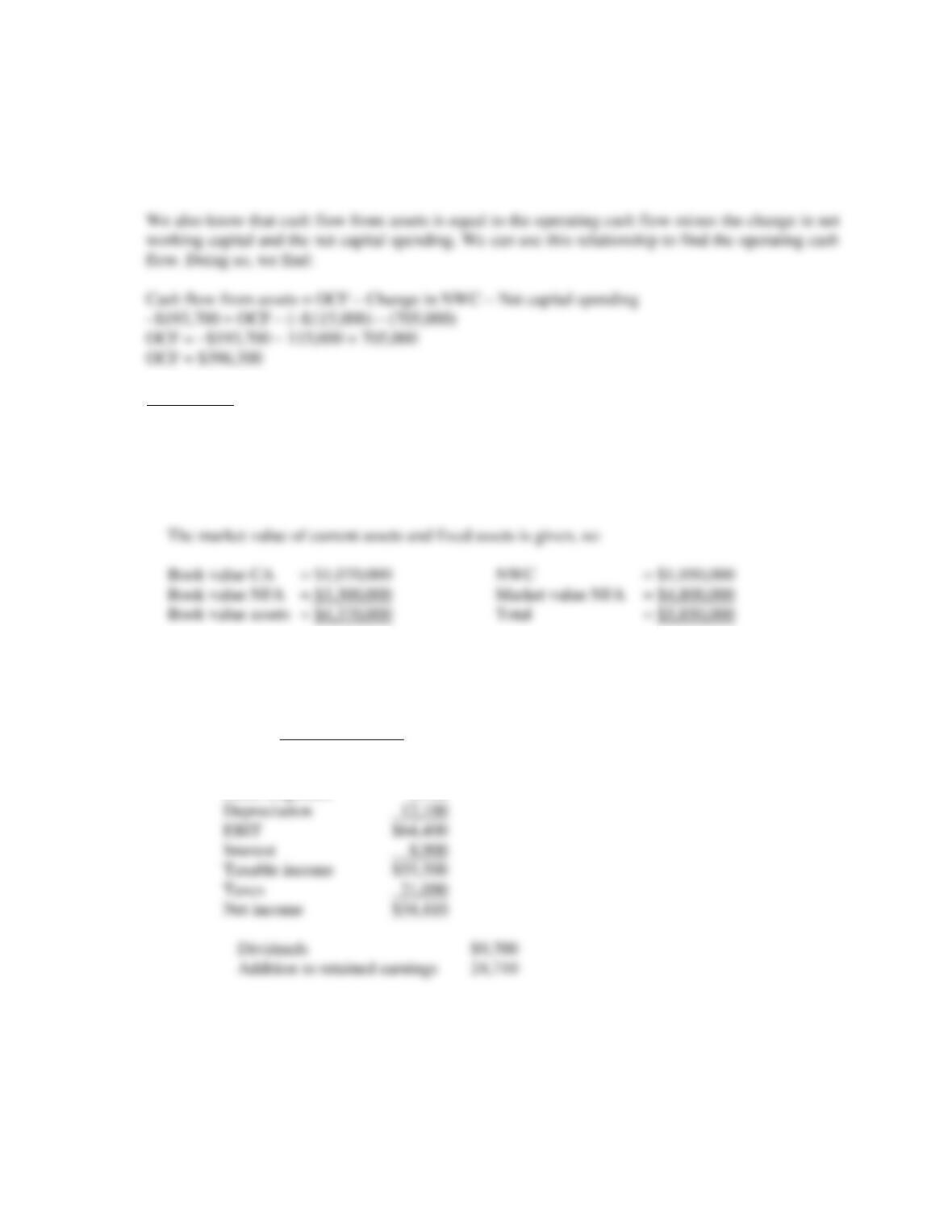
Cash flow from assets = Cash flow to creditors + Cash flow to stockholders
Cash flow from assets = –$38,200 – 155,500
Cash flow from assets = –$193,700
Intermediate
13. To find the book value of current assets, we use: NWC = CA – CL. Rearranging to solve for current
assets, we get:
CA = NWC + CL = $220,000 + 850,000 = $1,070,000
14. a. To calculate the OCF, we first need to construct an income statement. The income statement starts
with revenues and subtracts costs to arrive at EBIT. We then subtract out interest to get taxable
income, and then subtract taxes to arrive at net income. Doing so, we get:
Income Statement
Sales $173,000
Costs 91,400
Other Expenses 5,100
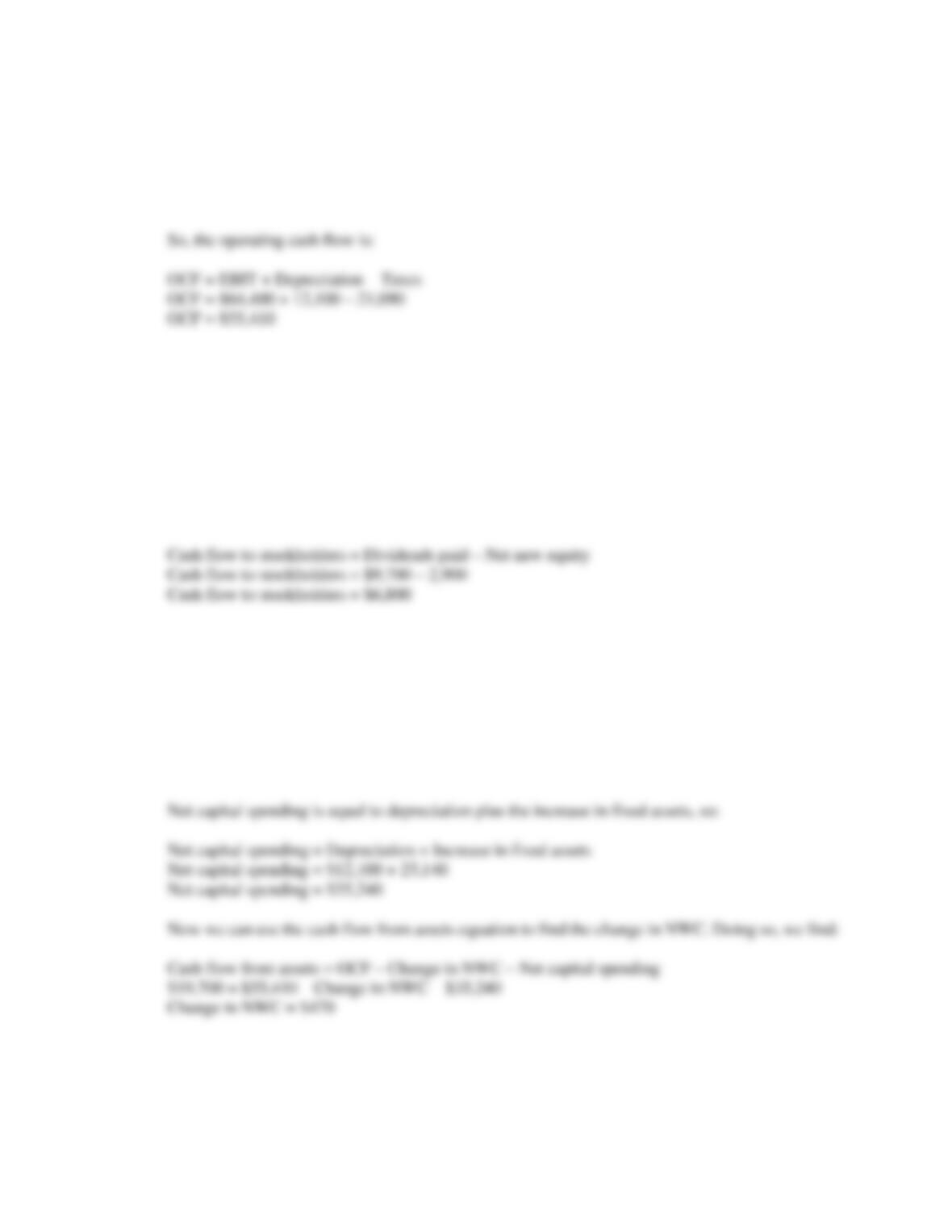
Dividends paid plus addition to retained earnings must equal net income, so:
Net income = Dividends + Addition to retained earnings
Addition to retained earnings = $34,410 – 9,700
Addition to retained earnings = $24,710
b. The cash flow to creditors is the interest paid, minus any new borrowing. Since the company
redeemed long-term debt, the net new borrowing is negative. So, the cash flow to creditors is:
Cash flow to creditors = Interest paid – Net new borrowing
Cash flow to creditors = $8,900 – (–$4,000)
Cash flow to creditors = $12,900
c. The cash flow to stockholders is the dividends paid minus any new equity. So, the cash flow to
stockholders is:
d. In this case, to find the addition to NWC, we need to find the cash flow from assets. We can then
use the cash flow from assets equation to find the change in NWC. We know that cash flow from
assets is equal to cash flow to creditors plus cash flow to stockholders. So, cash flow from assets
is:
Cash flow from assets = Cash flow to creditors + Cash flow to stockholders
Cash flow from assets = $12,900 + 6,800
Cash flow from assets = $19,700
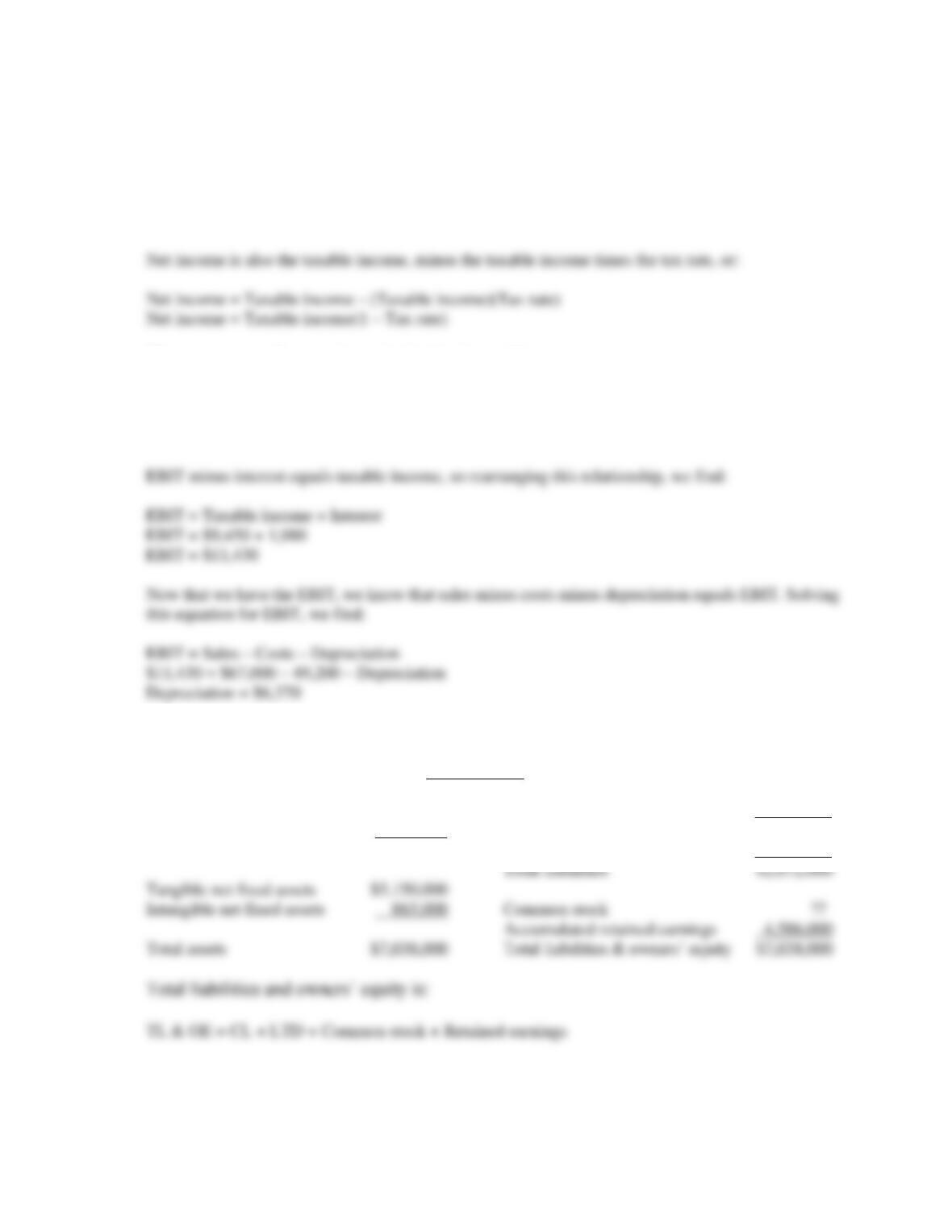
15. Here we need to work the income statement backward. Starting with net income, we know that net
income is:
Net income = Dividends + Addition to retained earnings
Net income = $2,170 + 3,500
Net income = $5,670
Taxable income = Net income / (1 – Tax rate)
Taxable income = $5,670 / (1 – .40)
Taxable income = $9,450
16. We can fill in the balance sheet with the numbers we are given. The balance sheet will be:
Balance Sheet
Cash $197,000 Accounts payable $288,000
Accounts receivable 265,000 Notes payable 194,000
Inventory 563,000 Current liabilities $482,000
Current assets $1,025,000 Long-term debt 1,490,000
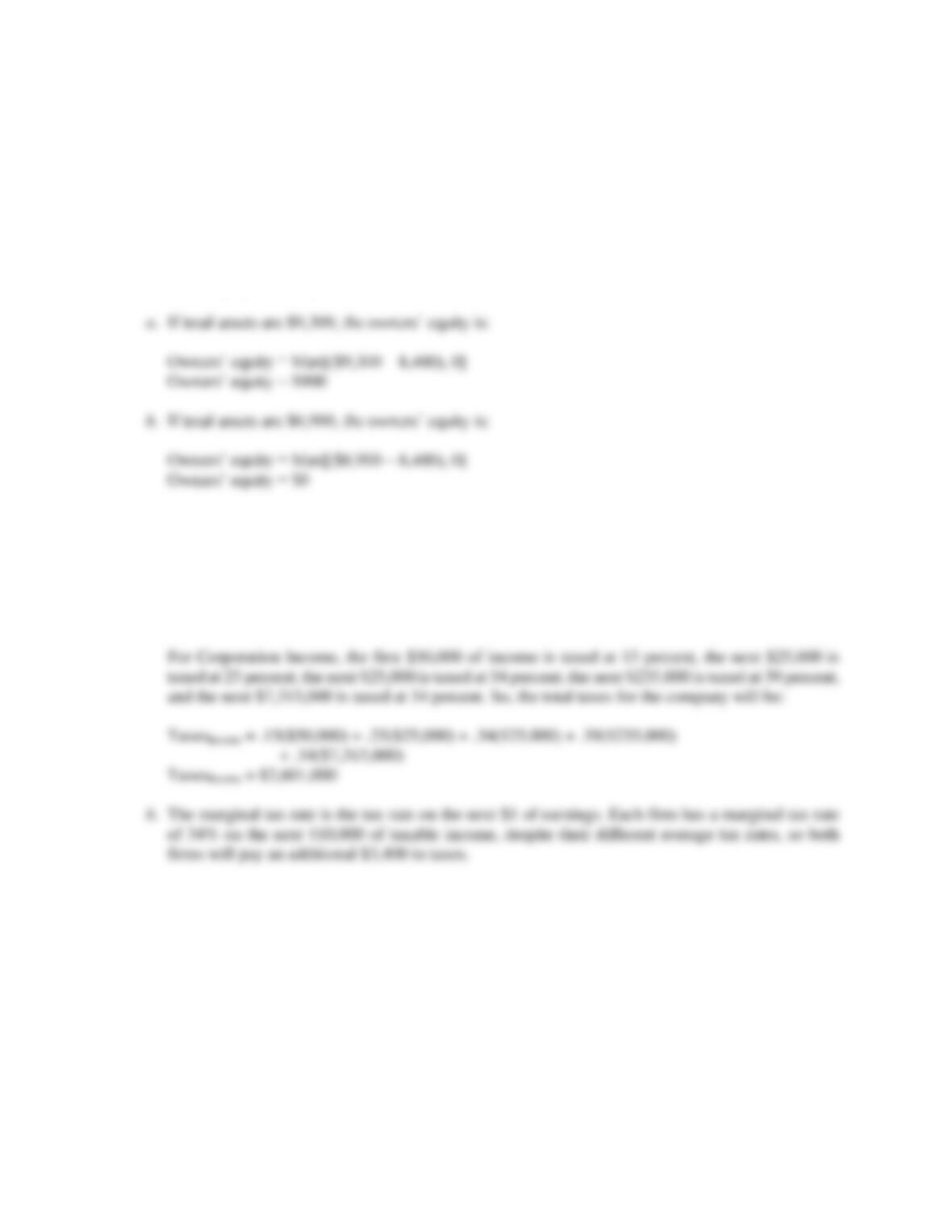
Solving for this equation for common stock gives us:
Common stock = $7,038,000 – 4,586,000 – 2,072,000
Common stock = $380,000
17. Owners’ equity is the maximum of total assets minus total liabilities, or zero. Although the book value
of owners’ equity can be negative, the market value of owners’ equity cannot be negative, so:
Owners’ equity = Max [(TA – TL), 0]
18. a. Using Table 2.3, we can see the marginal tax schedule. For Corporation Growth, the first $50,000
of income is taxed at 15 percent, the next $25,000 is taxed at 25 percent, and the next $1,500 is
taxed at 34 percent. So, the total taxes for the company will be:
TaxesGrowth = .15($50,000) + .25($25,000) + .34($1,500)
TaxesGrowth = $14,260
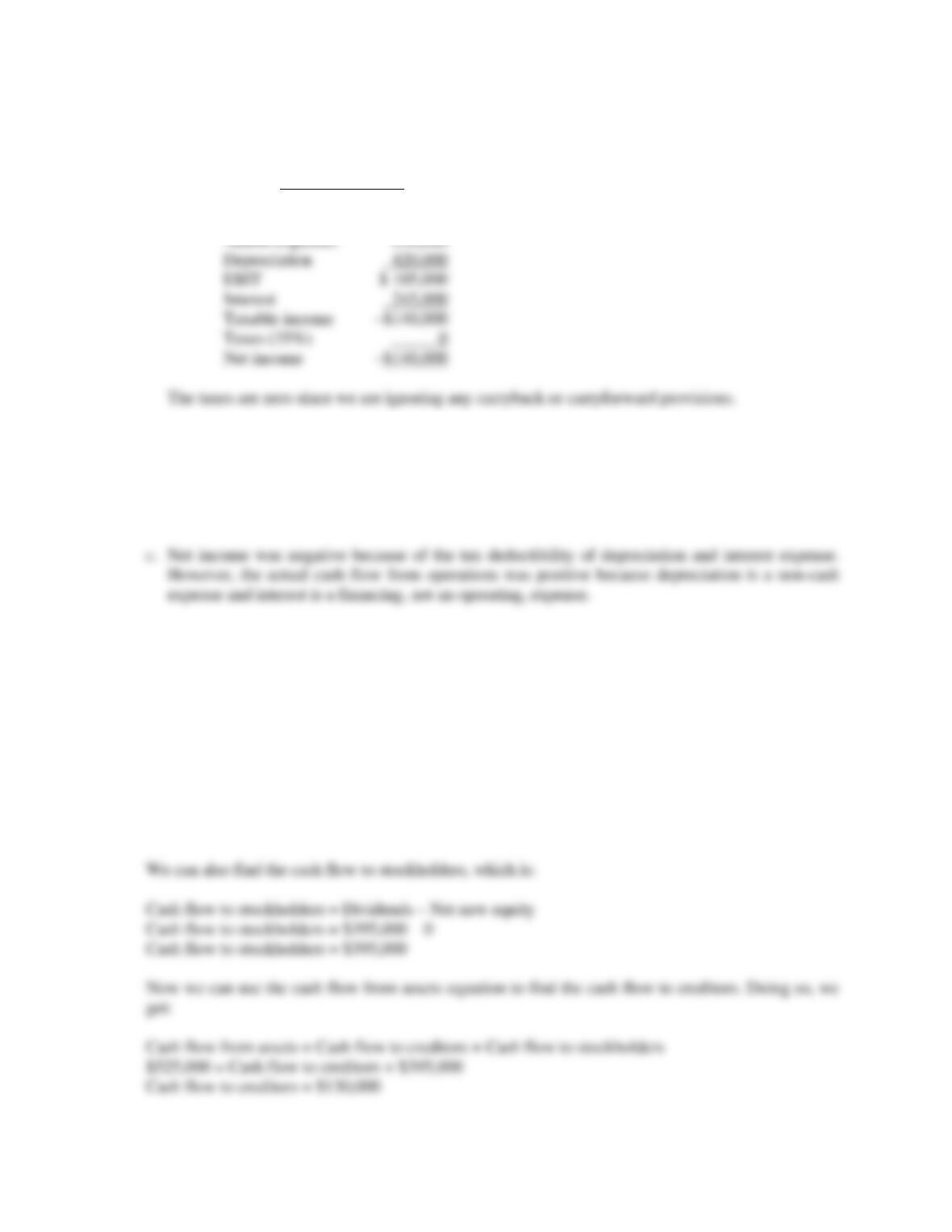
19. a. The income statement starts with revenues and subtracts costs to arrive at EBIT. We then subtract
interest to get taxable income, and then subtract taxes to arrive at net income. Doing so, we get:
Income Statement
Sales $2,350,000
Cost of goods sold 1,925,000
b. The operating cash flow for the year was:
OCF = EBIT + Depreciation – Taxes
OCF = $105,000 + 420,000 – 0
OCF = $525,000
20. A firm can still pay out dividends if net income is negative; it just has to be sure there is sufficient
cash flow to make the dividend payments. The assumptions made in the question are:
Change in NWC = Net capital spending = Net new equity = 0
To find the new long-term debt, we first need to find the cash flow from assets. The cash flow from
assets is:
Cash flow from assets = OCF – Change in NWC – Net capital spending
Cash flow from assets = $525,000 – 0 – 0
Cash flow from assets = $525,000
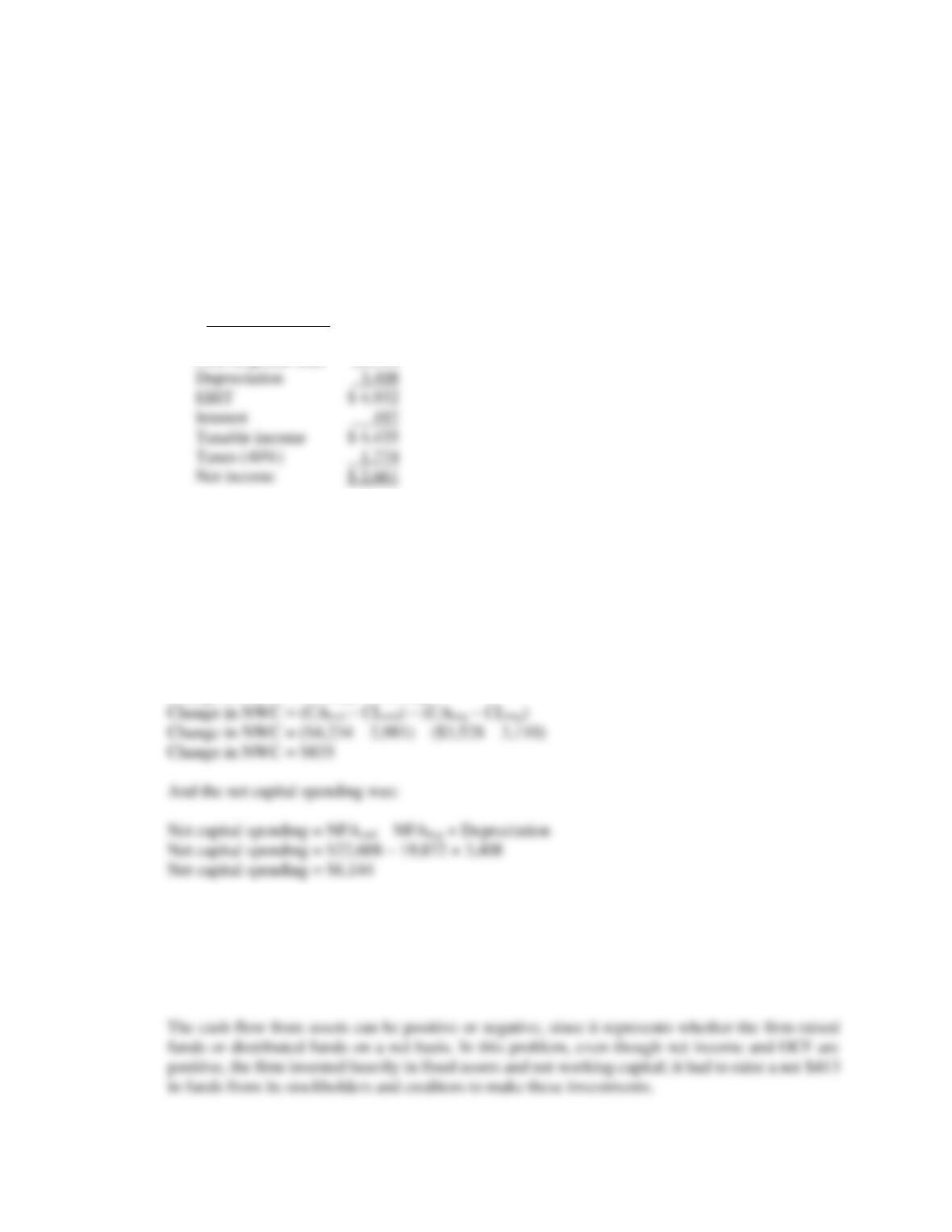
Now we can use the cash flow to creditors equation to find:
Cash flow to creditors = Interest – Net new long-term debt
$130,000 = $245,000 – Net new long-term debt
Net new long-term debt = $115,000
21. a. To calculate the OCF, we first need to construct an income statement. The income statement starts
with revenues and subtracts costs to arrive at EBIT. We then subtract out interest to get taxable
income, and then subtract taxes to arrive at net income. Doing so, we get:
Income Statement
Sales $28,476
Cost of goods sold 20,136
b. The operating cash flow for the year was:
OCF = EBIT + Depreciation – Taxes
OCF = $4,932 + 3,408 – 1,774
OCF = $6,566
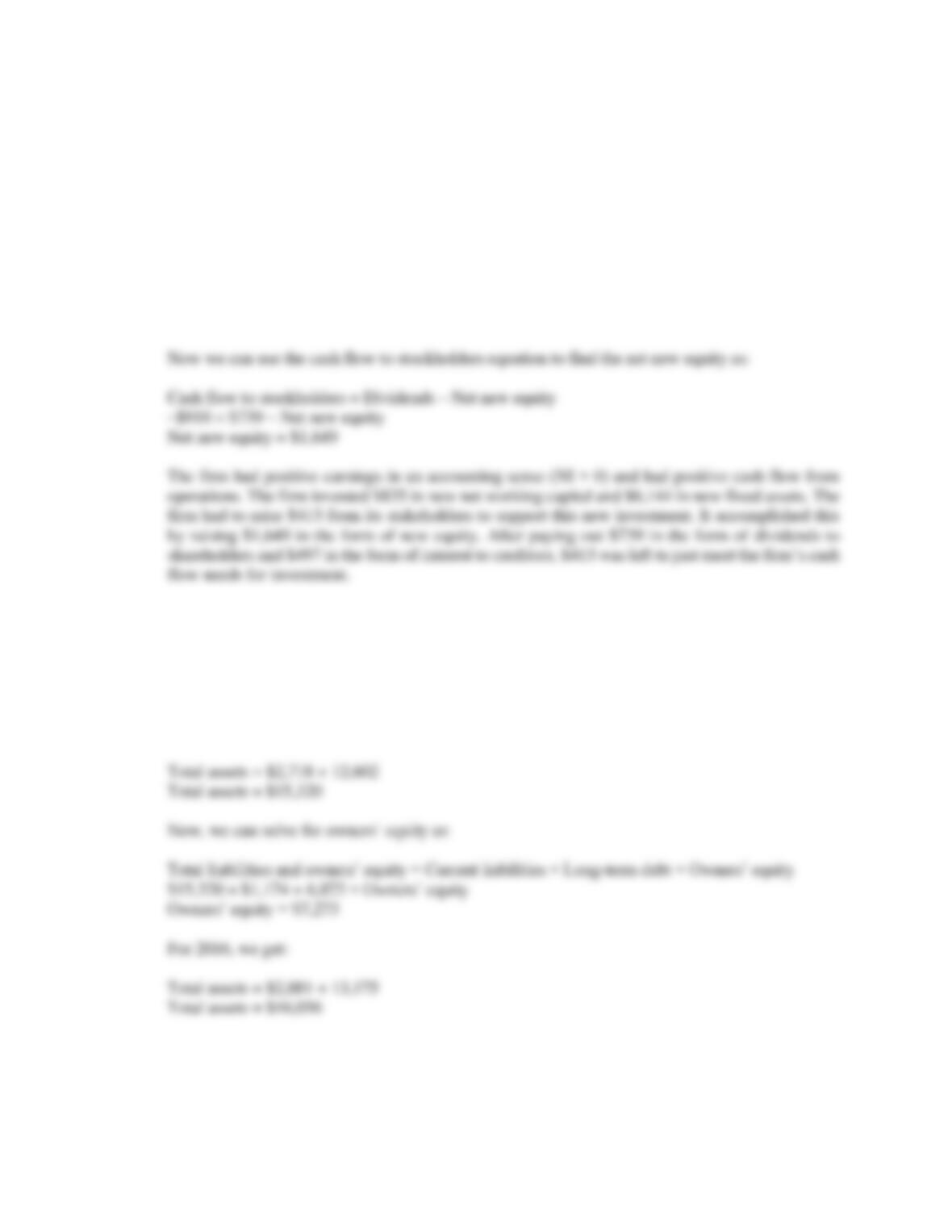
c. To calculate the cash flow from assets, we also need the change in net working capital and net
capital spending. The change in net working capital was:
Change in NWC = NWCend – NWCbeg
So, the cash flow from assets was:
Cash flow from assets = OCF – Change in NWC – Net capital spending
Cash flow from assets = $6,566 – 835 – 6,144
Cash flow from assets = –$413
d. The cash flow to creditors was:
Cash flow to creditors = Interest – Net new LTD
Cash flow to creditors = $497 – 0
Cash flow to creditors = $497
Rearranging the cash flow from assets equation, we can calculate the cash flow to stockholders as:
Cash flow from assets = Cash flow to stockholders + Cash flow to creditors
–$413 = Cash flow to stockholders + $497
Cash flow to stockholders = –$910
22. a. To calculate owners’ equity, we first need total liabilities and owners’ equity. From the balance
sheet relationship we know that this is equal to total assets. We are given the necessary information
to calculate total assets. Total assets are current assets plus fixed assets, so:
Total assets = Current assets + Fixed assets = Total liabilities and owners’ equity
For 2015, we get:
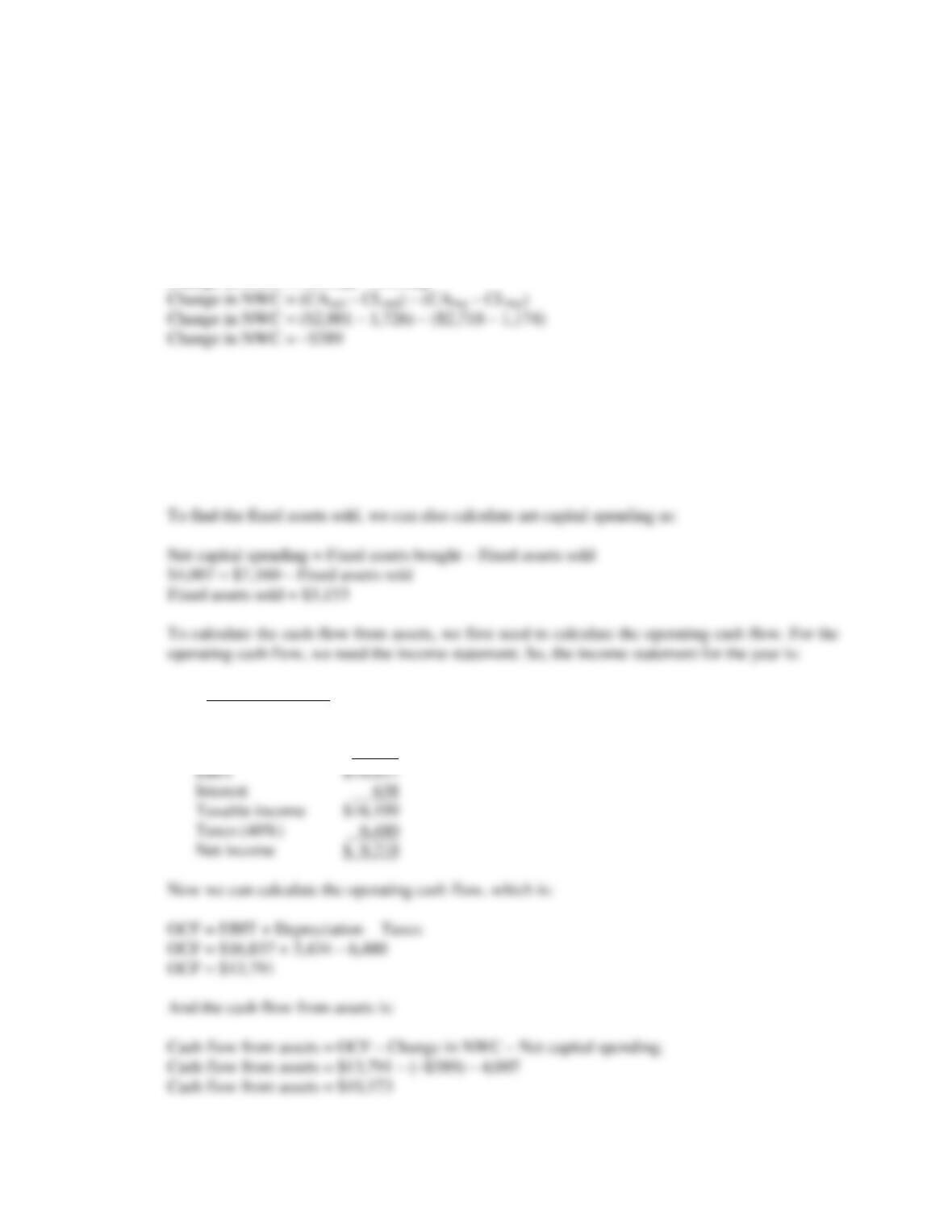
Now we can solve for owners’ equity as:
Total liabilities and owners’ equity = Current liabilities + Long-term debt + Owners’ equity
$16,056 = $1,726 + 8,019 + Owners’ equity
Owners’ equity = $6,311
b. The change in net working capital was:
Change in NWC = NWCend – NWCbeg
c. To find the amount of fixed assets the company sold, we need to find the net capital spending. The
net capital spending was:
Net capital spending = NFAend – NFAbeg + Depreciation
Net capital spending = $13,175 – 12,602 + 3,434
Net capital spending = $4,007
Income Statement
Sales $40,664
Costs 20,393
Depreciation 3,434
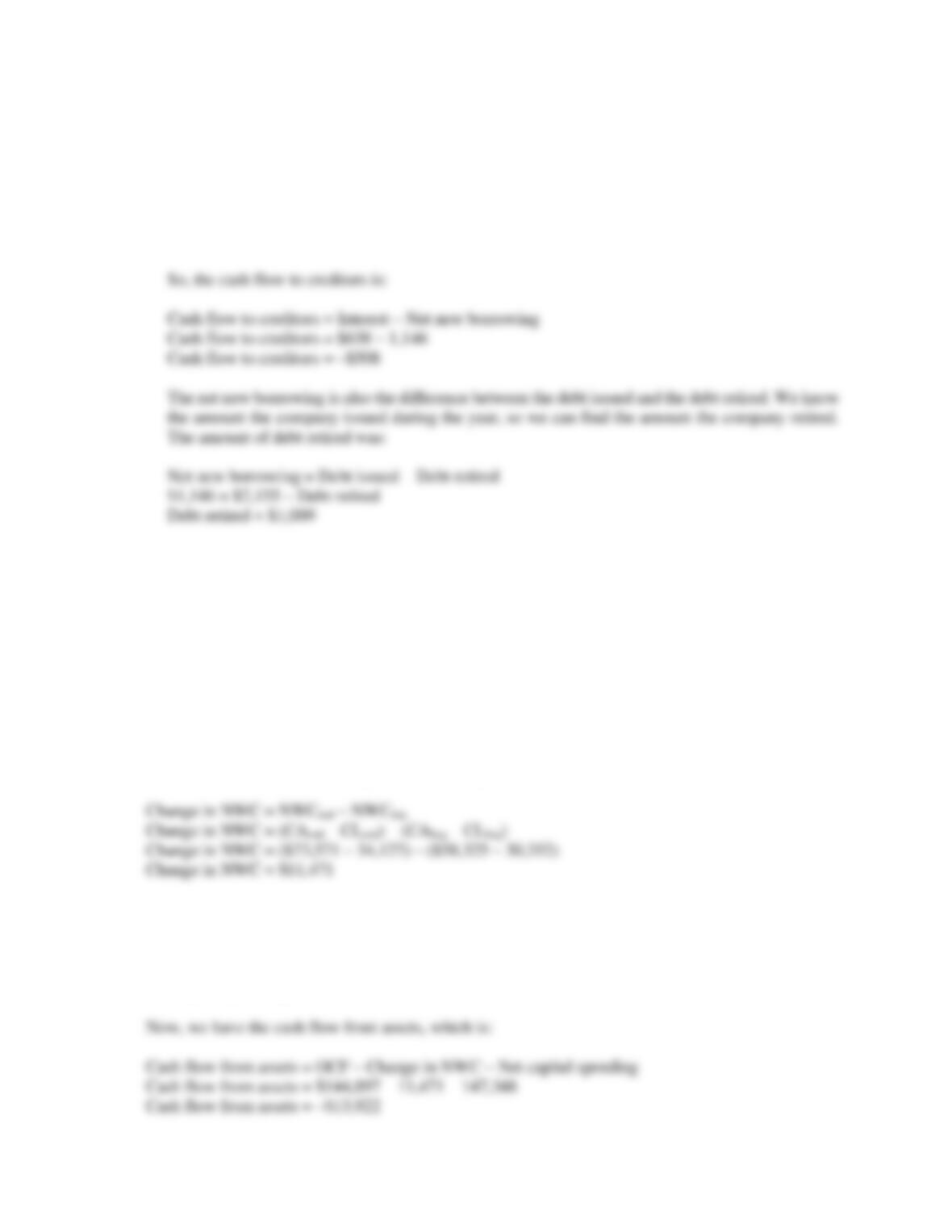
d. To find the cash flow to creditors, we first need to find the net new borrowing. The net new
borrowing is the difference between the ending long-term debt and the beginning long-term debt,
so:
Net new borrowing = LTDEnding – LTDBeginnning
Net new borrowing = $8,019 – 6,873
Net new borrowing = $1,146
23. To construct the cash flow identity, we will begin with cash flow from assets. Cash flow from assets
is:
Cash flow from assets = OCF – Change in NWC – Net capital spending
So, the operating cash flow is:
OCF = EBIT + Depreciation – Taxes
OCF = $103,562 + 69,038 – 27,703
OCF = $144,897
Next, we will calculate the change in net working capital, which is:
Now, we can calculate the capital spending. The capital spending is:
Net capital spending = NFAend – NFAbeg + Depreciation
Net capital spending = $513,980 – 435,670 + 69,038
Net capital spending = $147,348
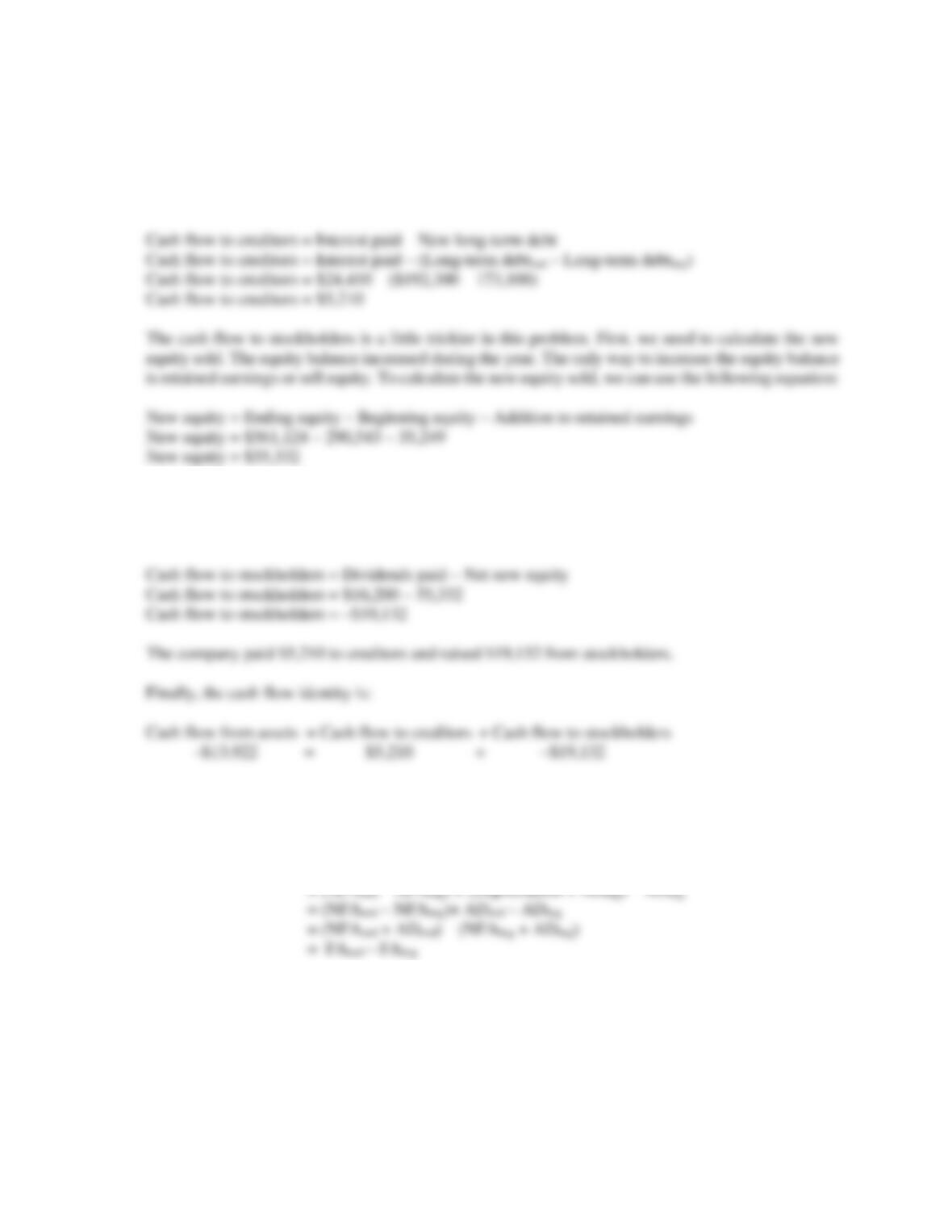
The company’s assets generated an outflow of $13,922. The cash flow from operations was $144,897,
and the company spent $11,471 on net working capital and $147,348 on fixed assets.
The cash flow to creditors is:
What happened was the equity account increased by $70,581. Of this increase, $35,249 came from
addition to retained earnings, so the remainder must have been the sale of new equity. Now we can
calculate the cash flow to stockholders as:
The cash flow identity balances, which is what we expect.
Challenge
24. Net capital spending = NFAend – NFAbeg + Depreciation
25. a. The tax bubble causes average tax rates to catch up to marginal tax rates, thus eliminating the tax
advantage of low marginal rates for high-income corporations.
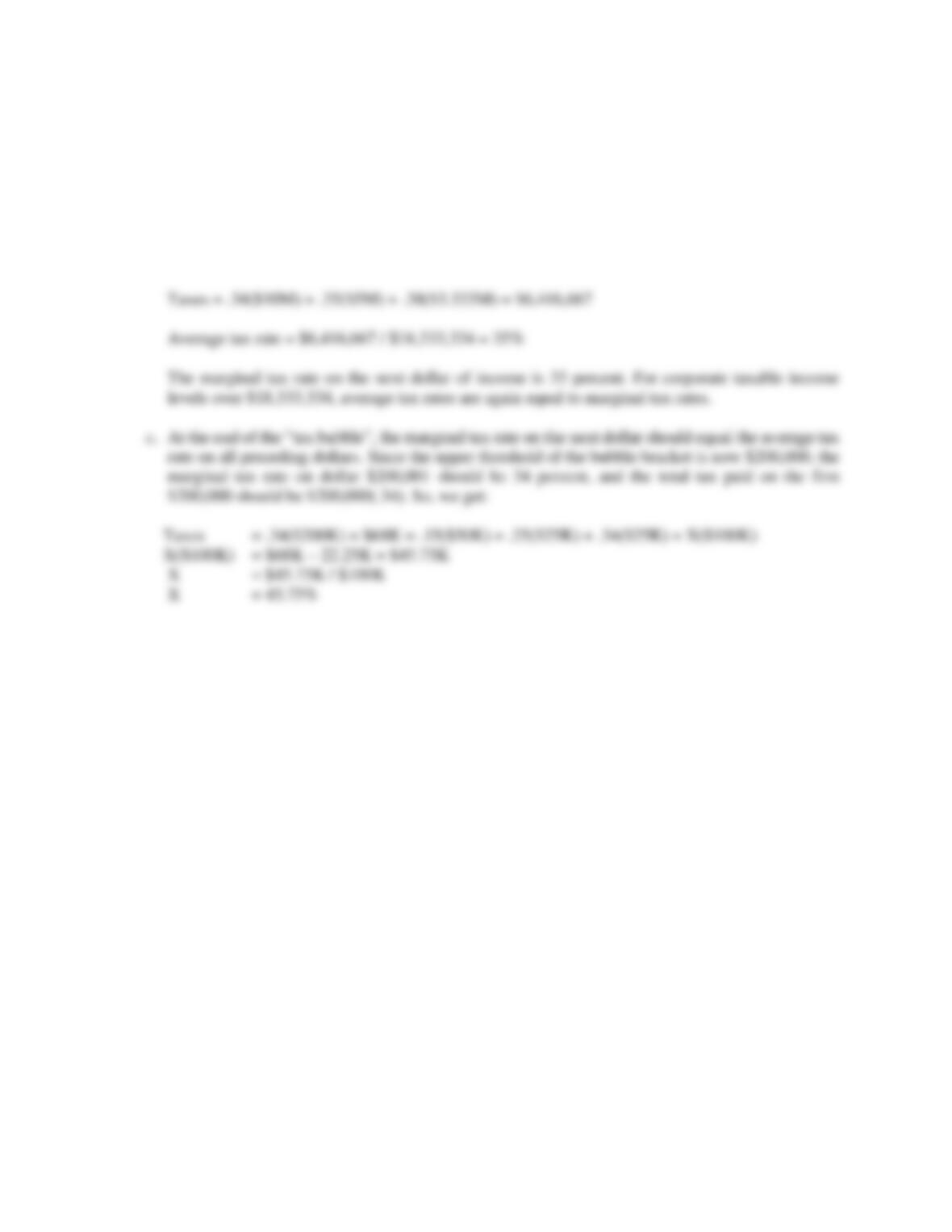
b. Taxes = .15($50K) + .25($25K) + .34($25K) + .39($235K) = $113.9K
Average tax rate = $113.9K / $335K = 34%
The marginal tax rate on the next dollar of income is 34 percent.
For corporate taxable income levels of $335K to $10M, average tax rates are equal to marginal tax
rates.