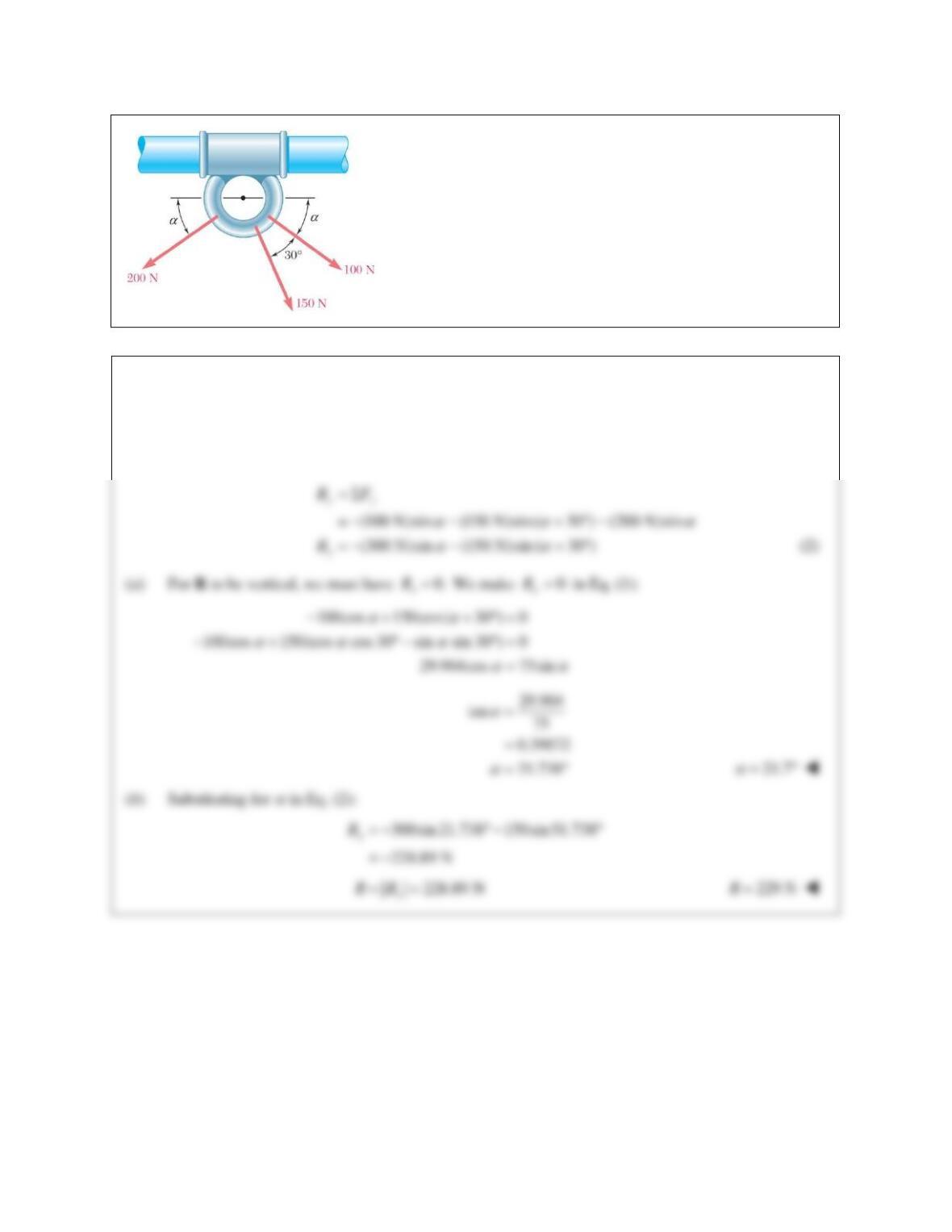
PROBLEM 2.39
For the collar of Problem 2.35, determine (a) the required value
of
α
if the resultant of the three forces shown is to be vertical,
(b) the corresponding magnitude of the resultant.
SOLUTION
(100 N)cos (150 N)cos( 30 ) (200 N)cos
(100 N)cos (150 N)cos( 30 )
xx
x
RF
R
αα α
αα
= Σ
= + + °−
=− + +°
(1)
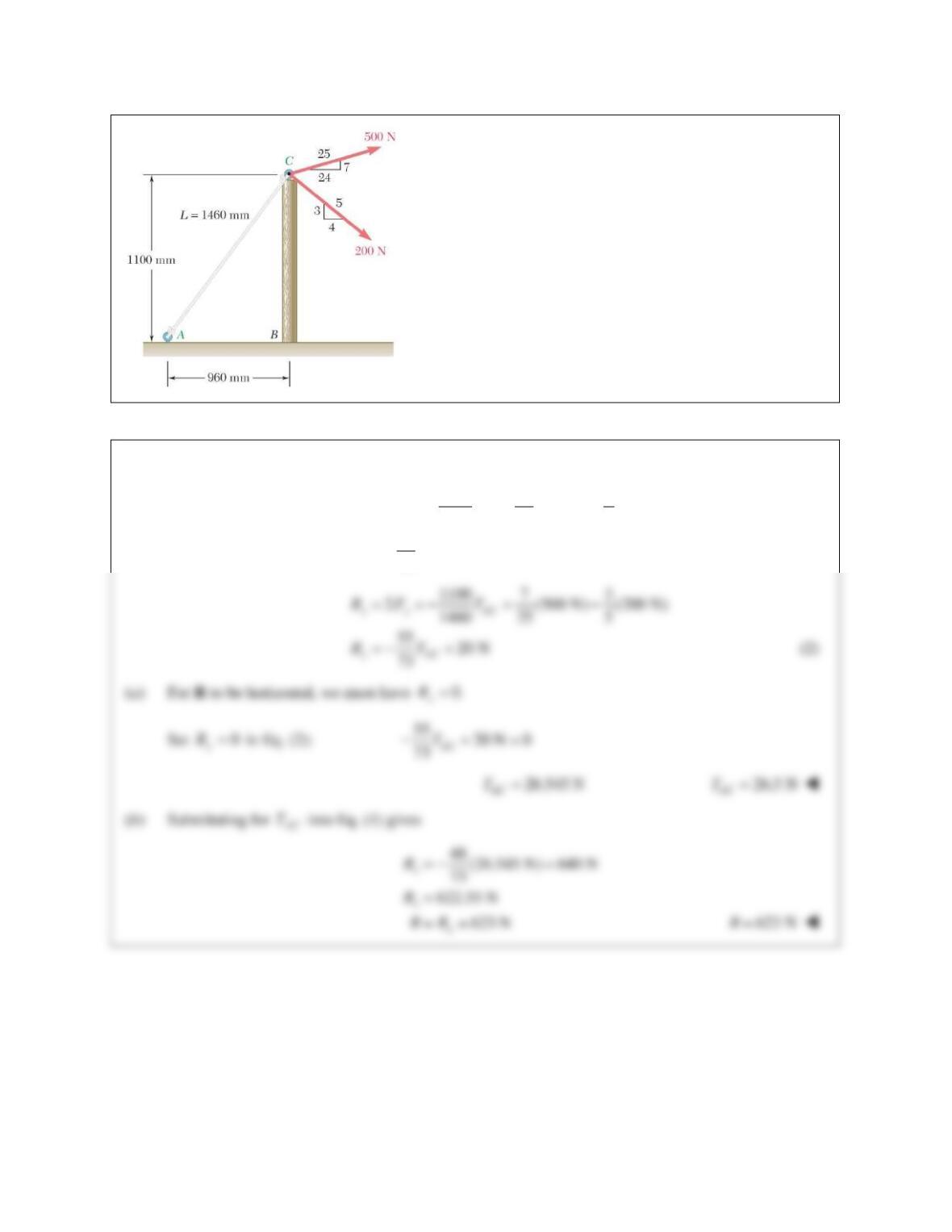
PROBLEM 2.40
For the post of Prob. 2.36, determine (a) the required
tension in rope AC if the resultant of the three forces
exerted at point C is to be horizontal, (b) the corresponding
magnitude of the resultant.
SOLUTION
960 24 4
(500 N) (200 N)
1460 25 5
48 640 N
73
x x AC
x AC
RF T
RT
=Σ=− + +
=−+
(1)
73
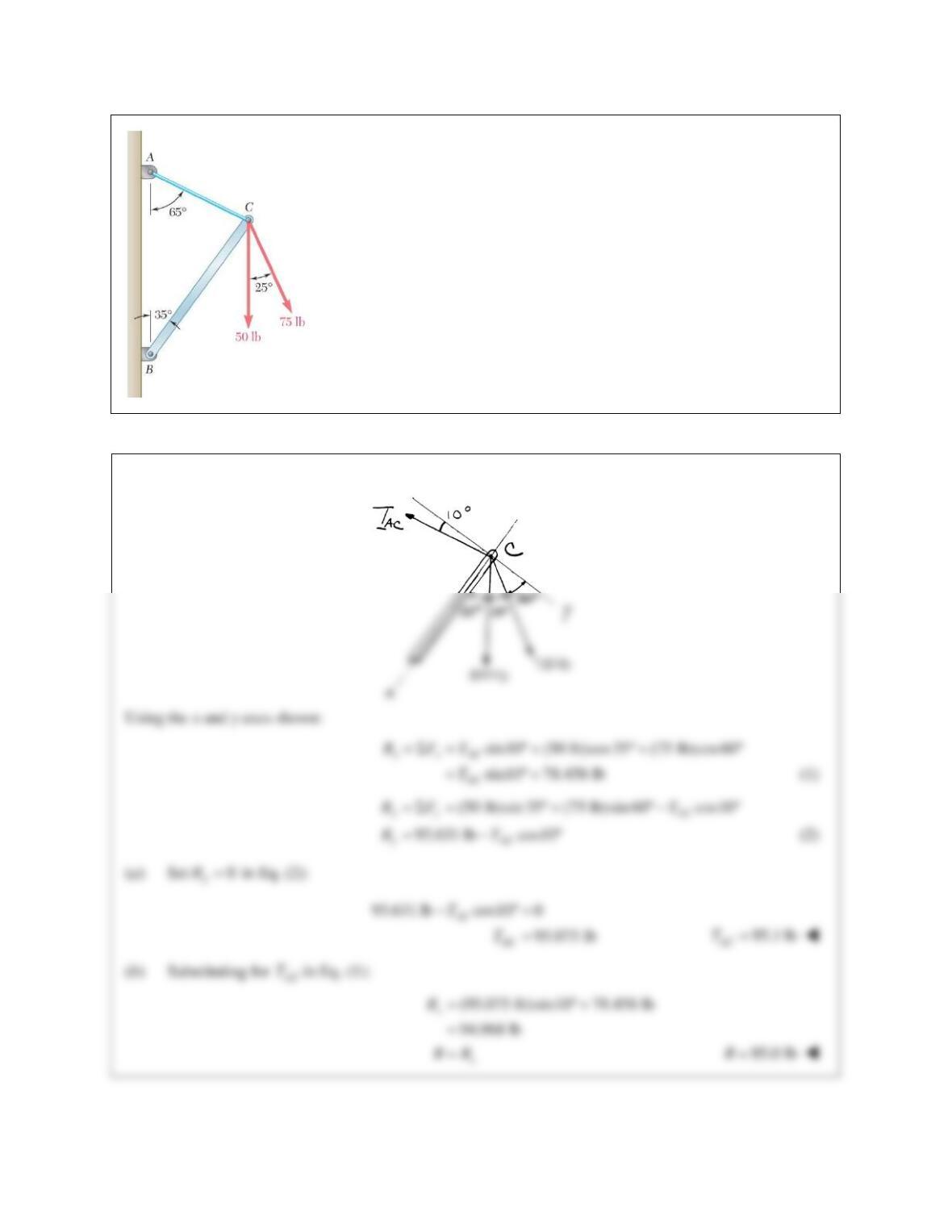
PROBLEM 2.41
Determine (a) the required tension in cable AC, knowing that the resultant
of the three forces exerted at Point C of boom BC must be directed along
BC, (b) the corresponding magnitude of the resultant.
SOLUTION
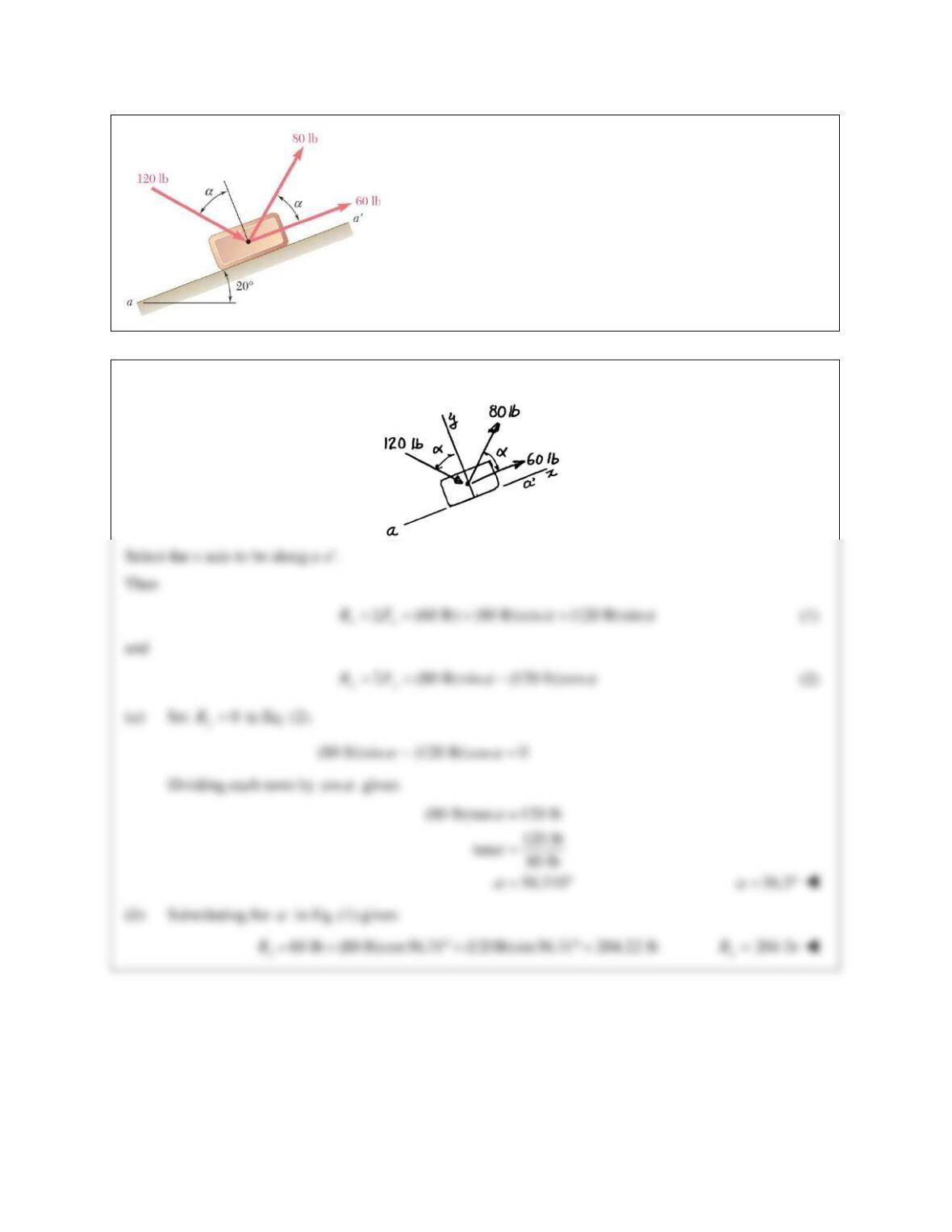
PROBLEM 2.42
For the block of Problems 2.37 and 2.38, determine (a) the
required value of
α
if the resultant of the three forces shown is
to be parallel to the incline, (b) the corresponding magnitude of
the resultant.
SOLUTION
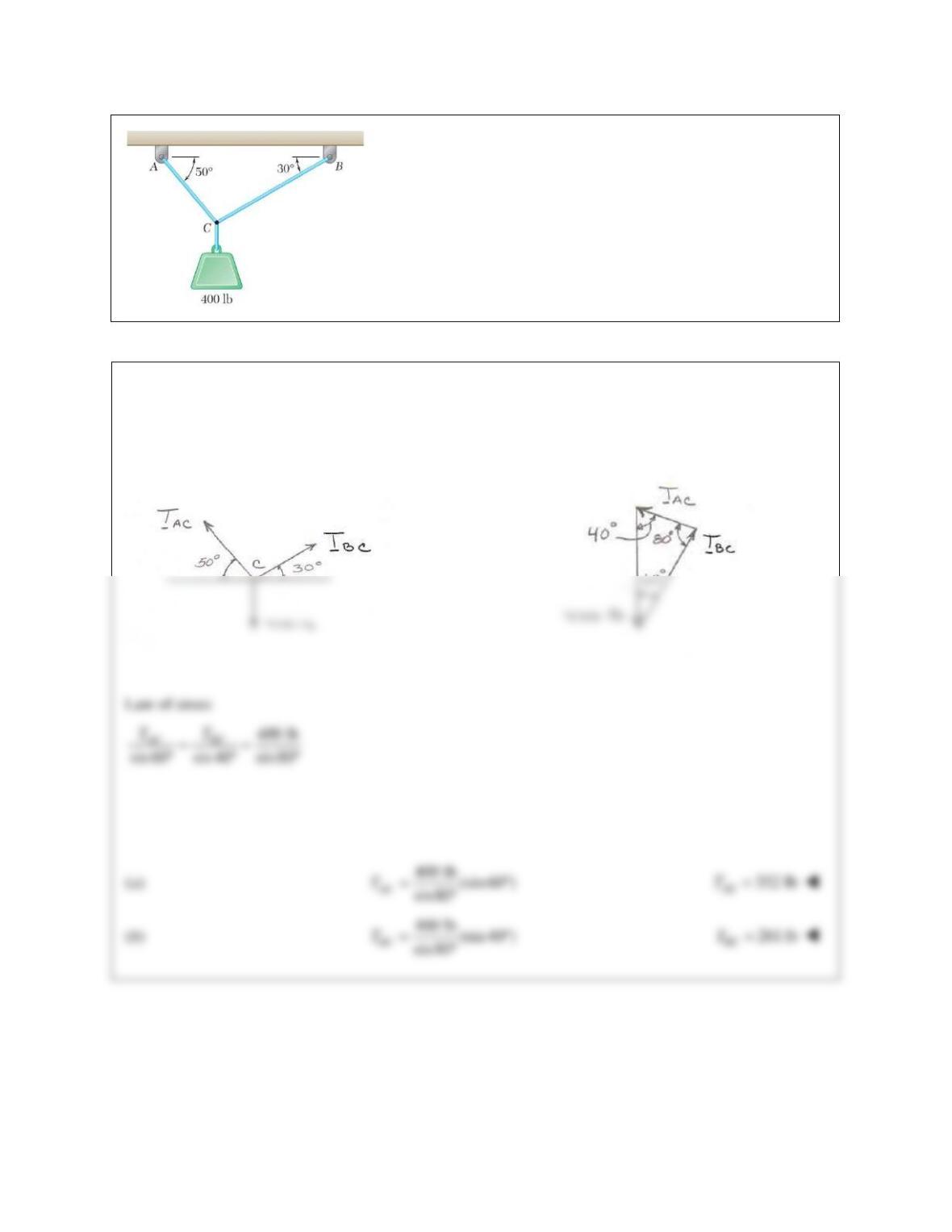
PROBLEM 2.43
Two cables are tied together at C and are loaded as shown.
Determine the tension (a) in cable AC, (b) in cable BC.
SOLUTION
Free–Body Diagram Force Triangle
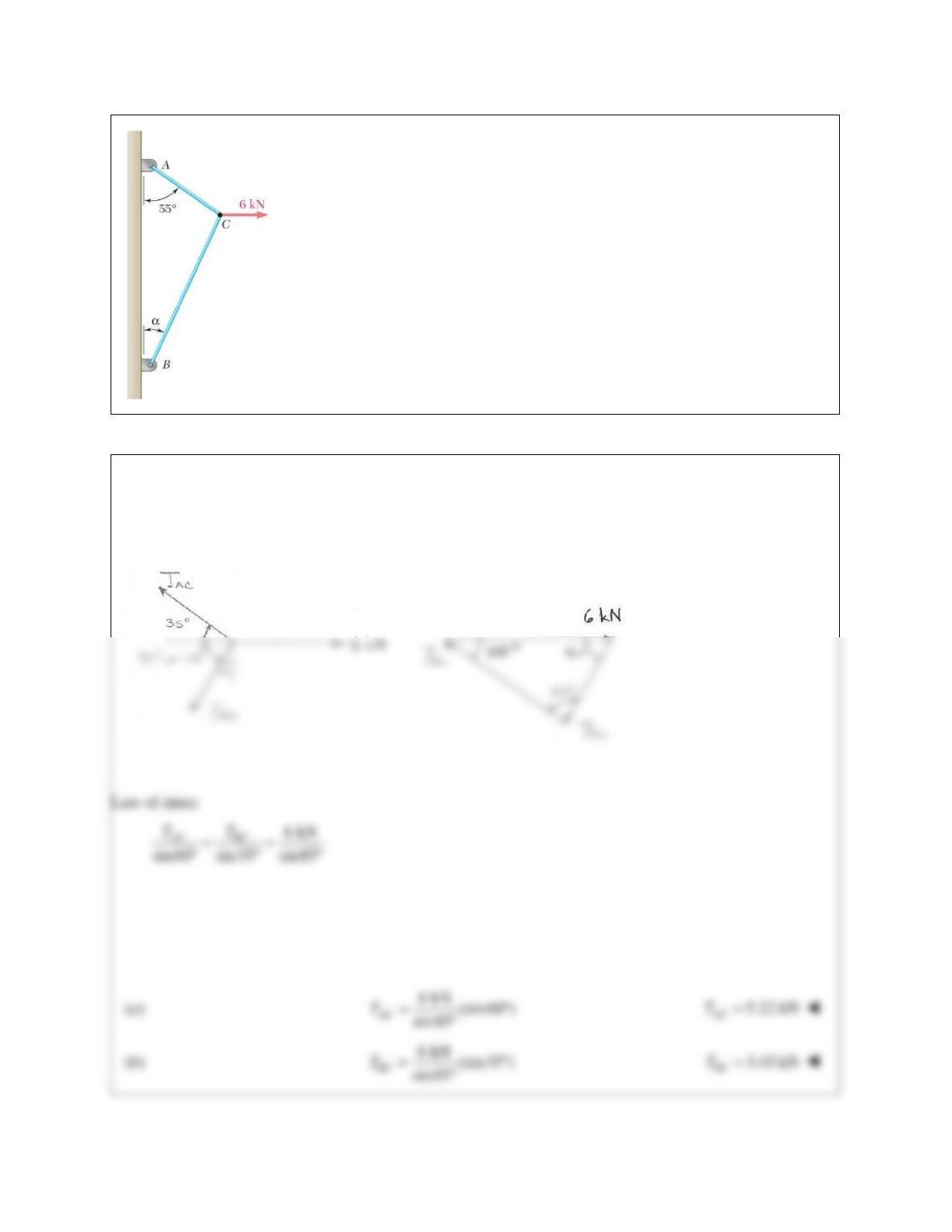
PROBLEM 2.44
Two cables are tied together at C and are loaded as shown. Knowing
that α = 30°, determine the tension (a) in cable AC, (b) in cable BC.
SOLUTION
Free–Body Diagram Force Triangle
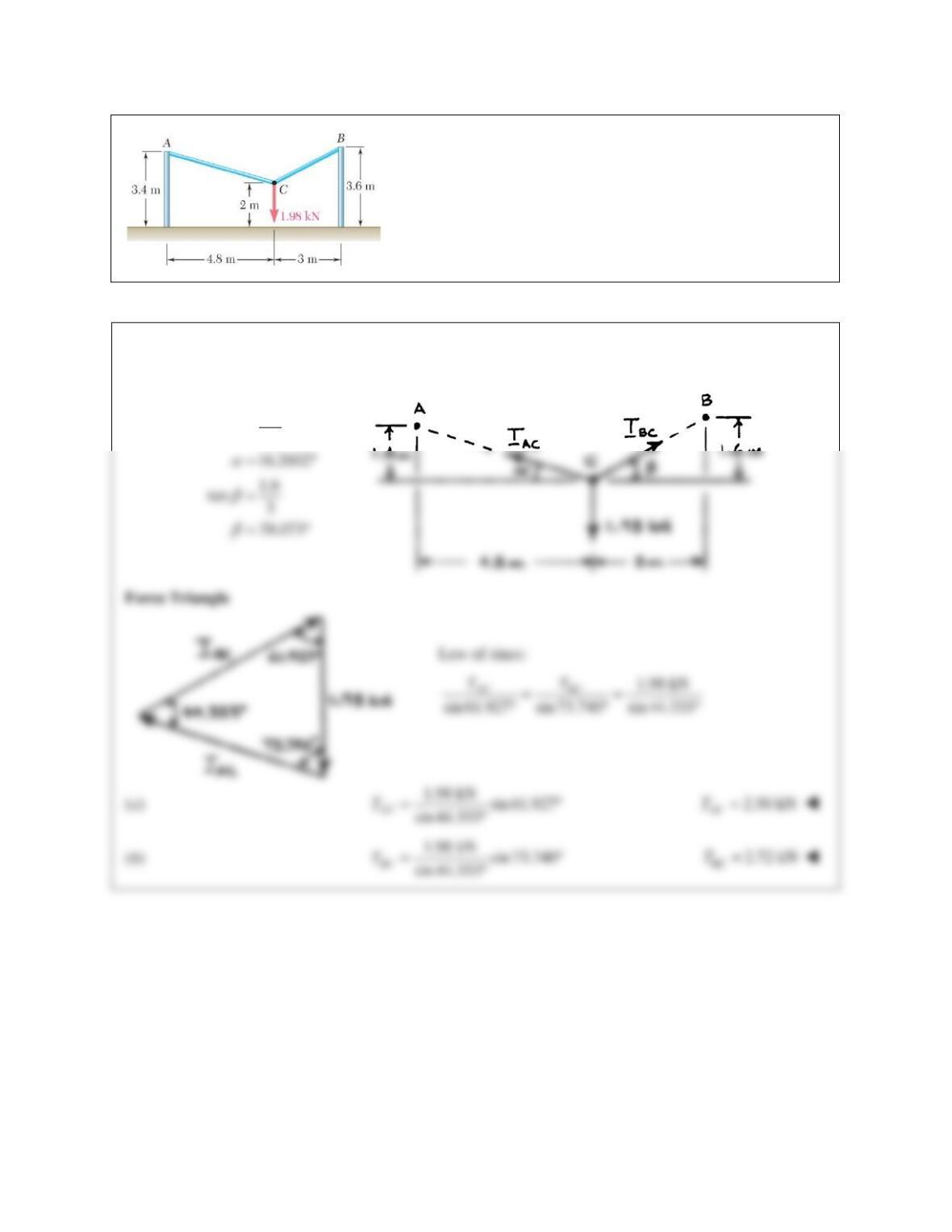
PROBLEM 2.45
Two cables are tied together at C and loaded as shown.
Determine the tension (a) in cable AC, (b) in cable BC.
SOLUTION
Free–Body Diagram
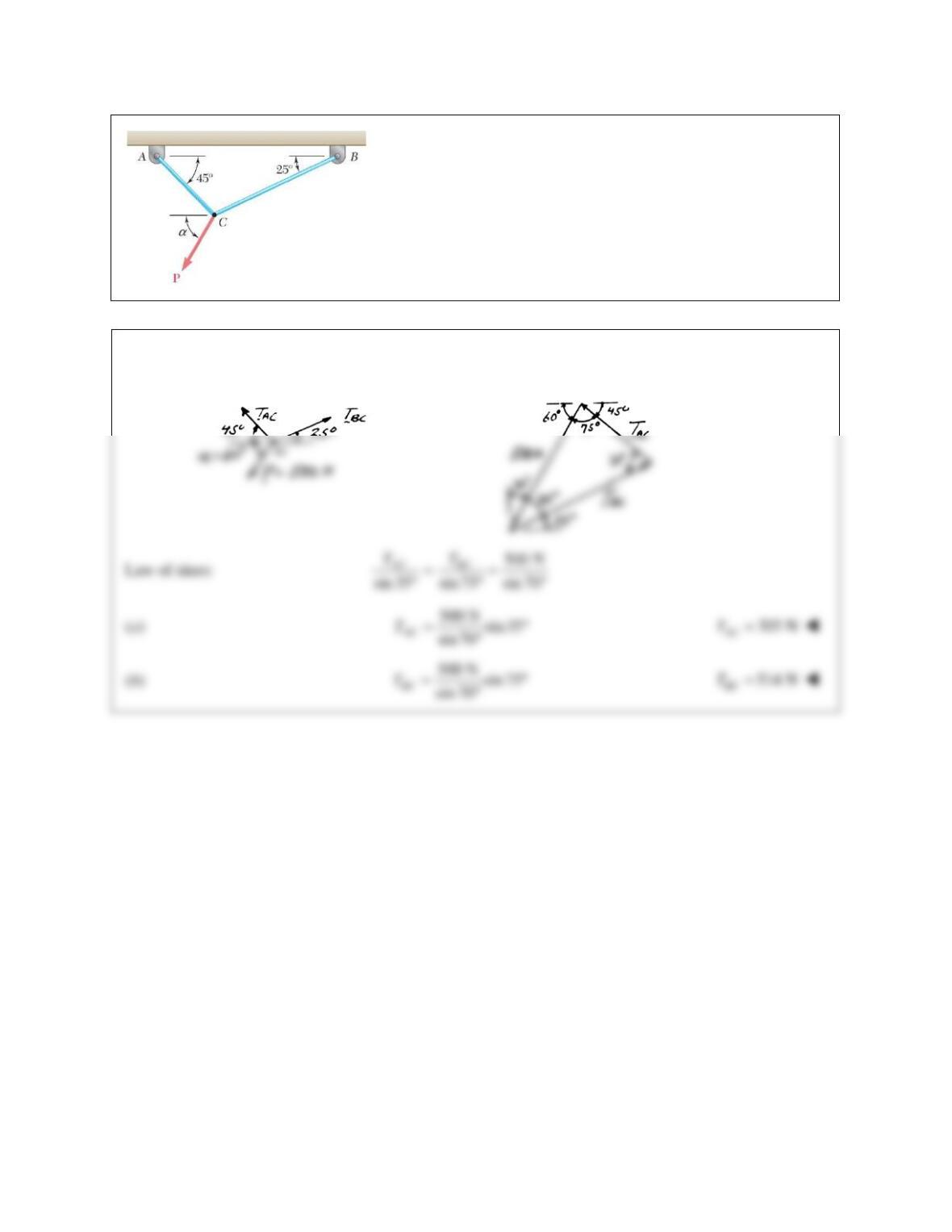
PROBLEM 2.46
Two cables are tied together at C and are loaded as shown.
Knowing that P = 500 N and
α
= 60°, determine the tension in
(a) in cable AC, (b) in cable BC.
SOLUTION
Free–Body Diagram Force Triangle
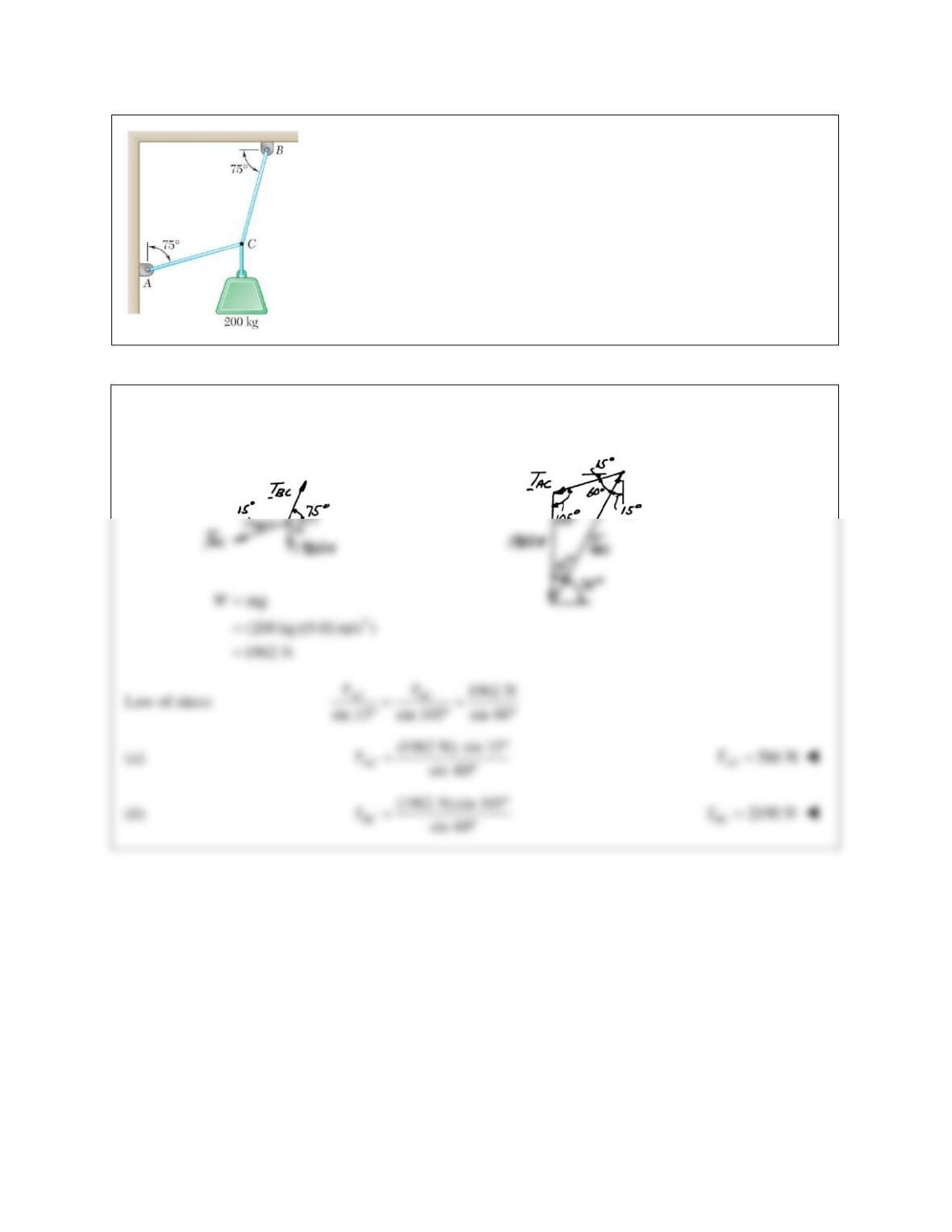
PROBLEM 2.47
Two cables are tied together at C and are loaded as shown. Determine the
tension (a) in cable AC, (b) in cable BC.
SOLUTION
Free–Body Diagram Force Triangle
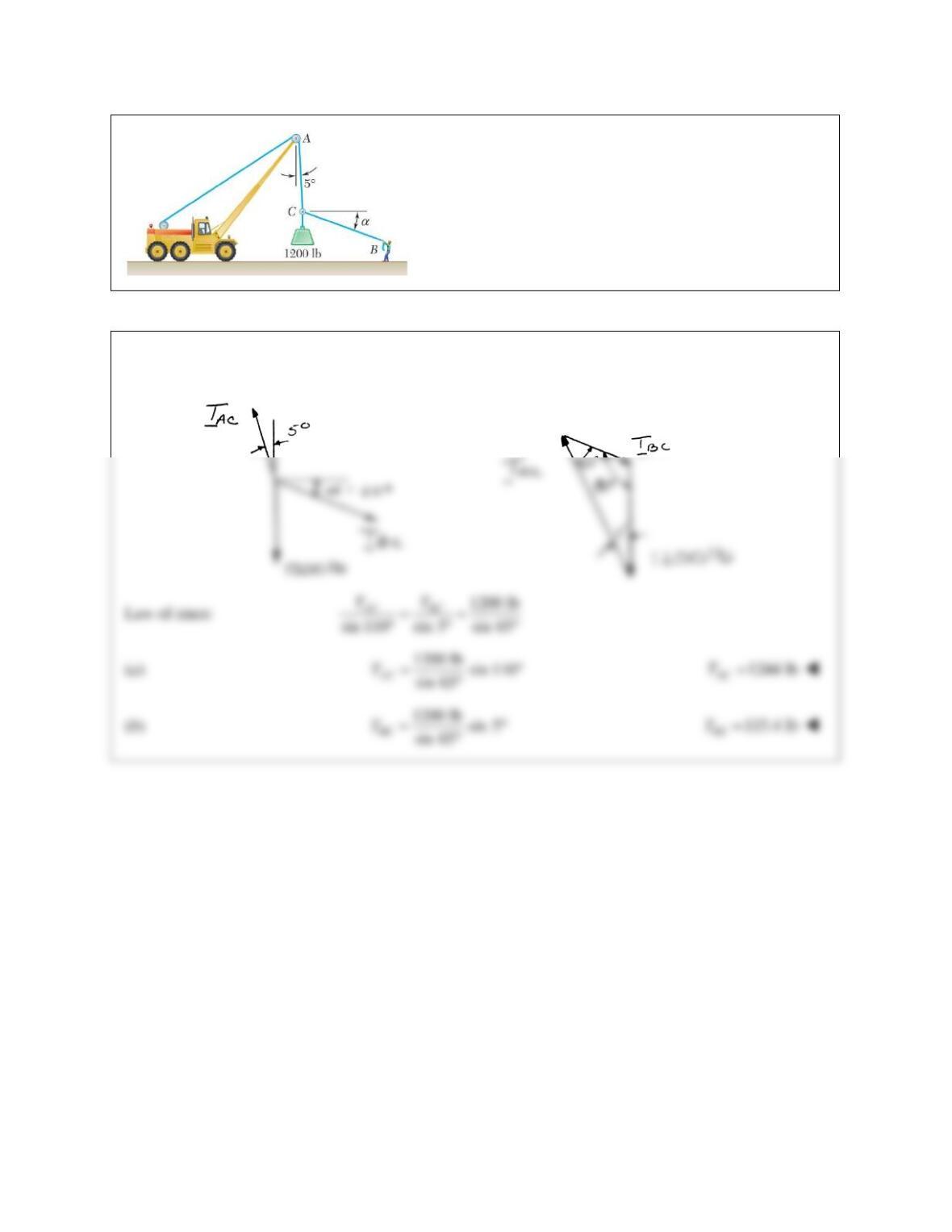
PROBLEM 2.48
Knowing that
20 ,
α
= °
determine the tension (a) in cable
AC, (b) in rope BC.
SOLUTION
Free-Body Diagram Force Triangle
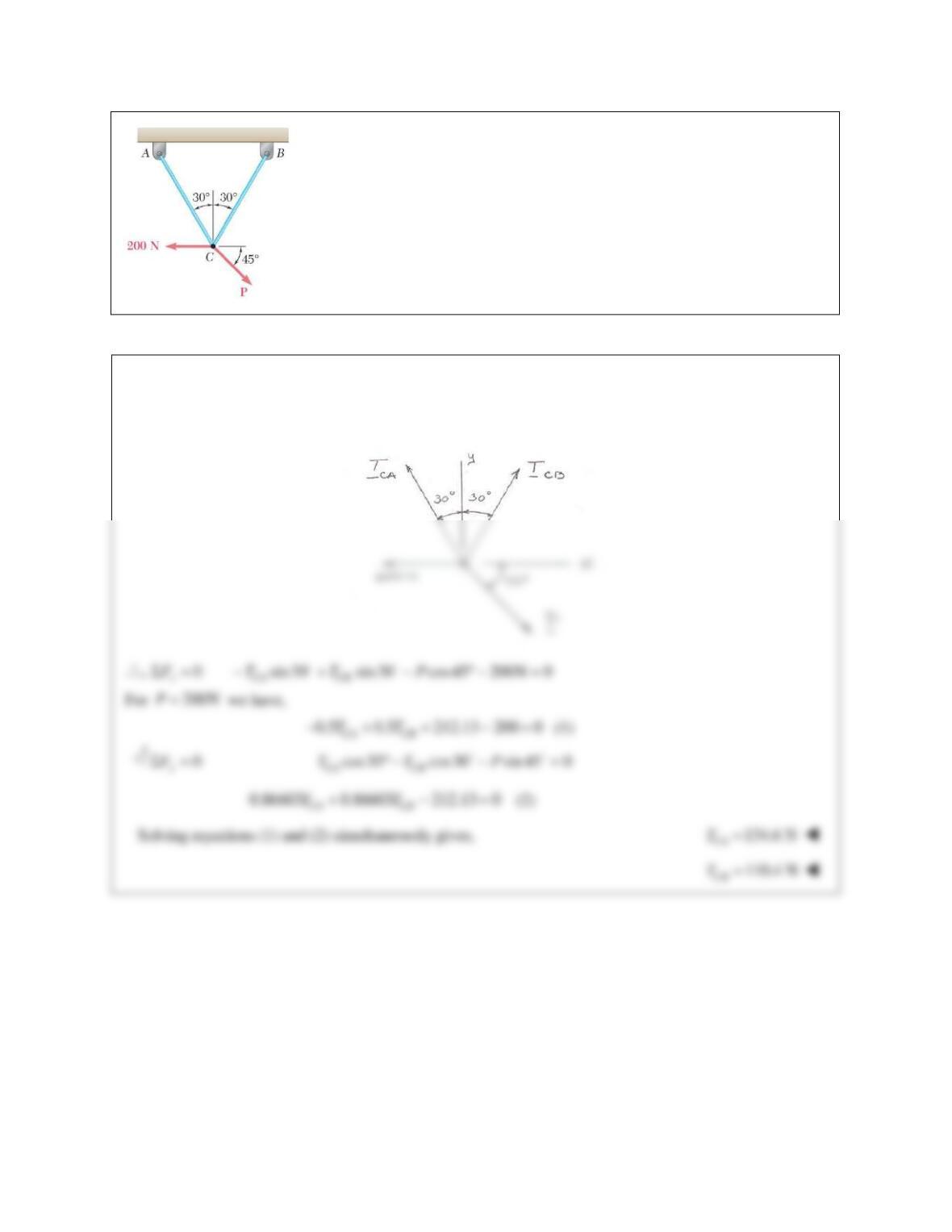
PROBLEM 2.49
Two cables are tied together at C and are loaded as shown.
Knowing that P = 300 N, determine the tension in cables AC and
BC.
SOLUTION
Free–Body Diagram
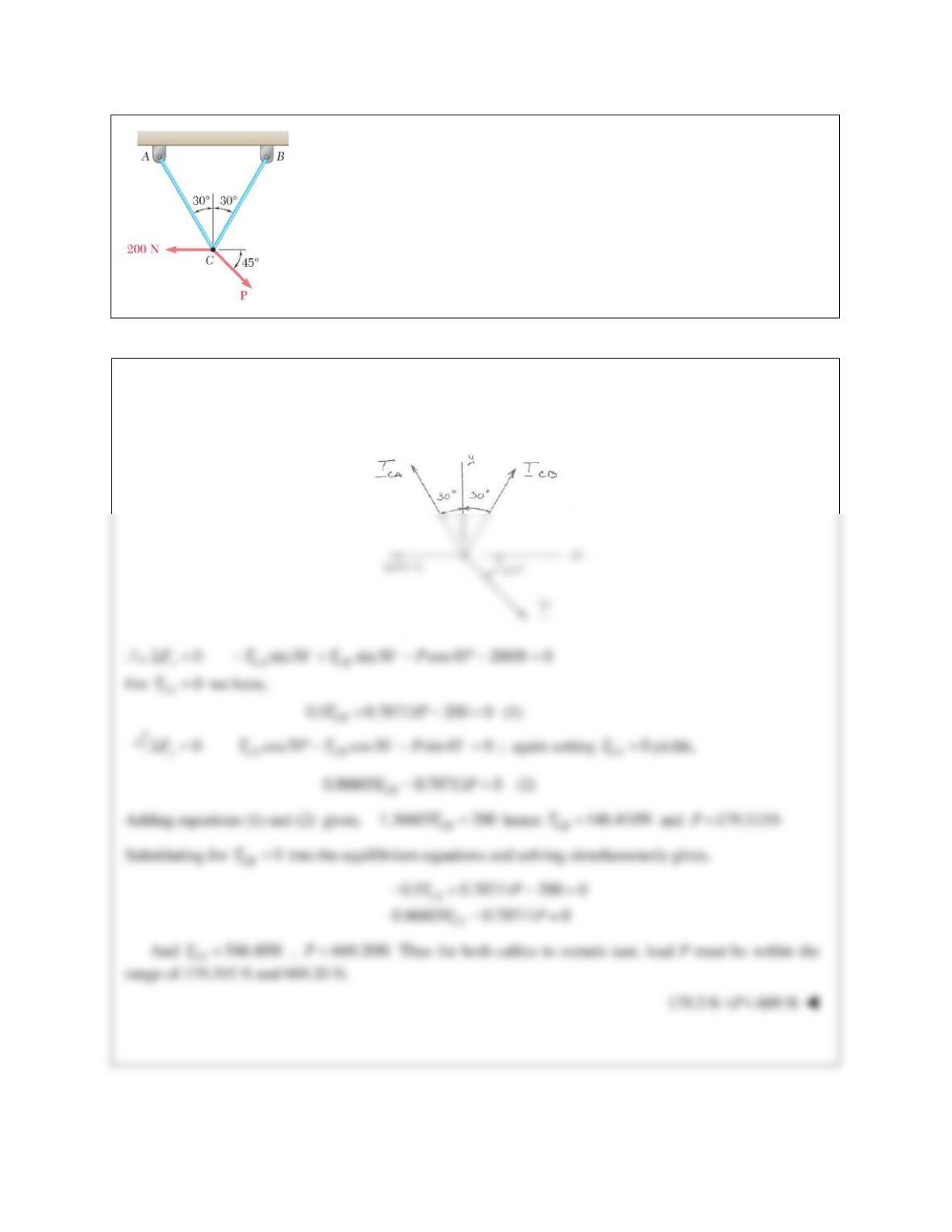
PROBLEM 2.50
Two cables are tied together at C and are loaded as shown.
Determine the range of values of P for which both cables remain
taut.
SOLUTION
Free–Body Diagram
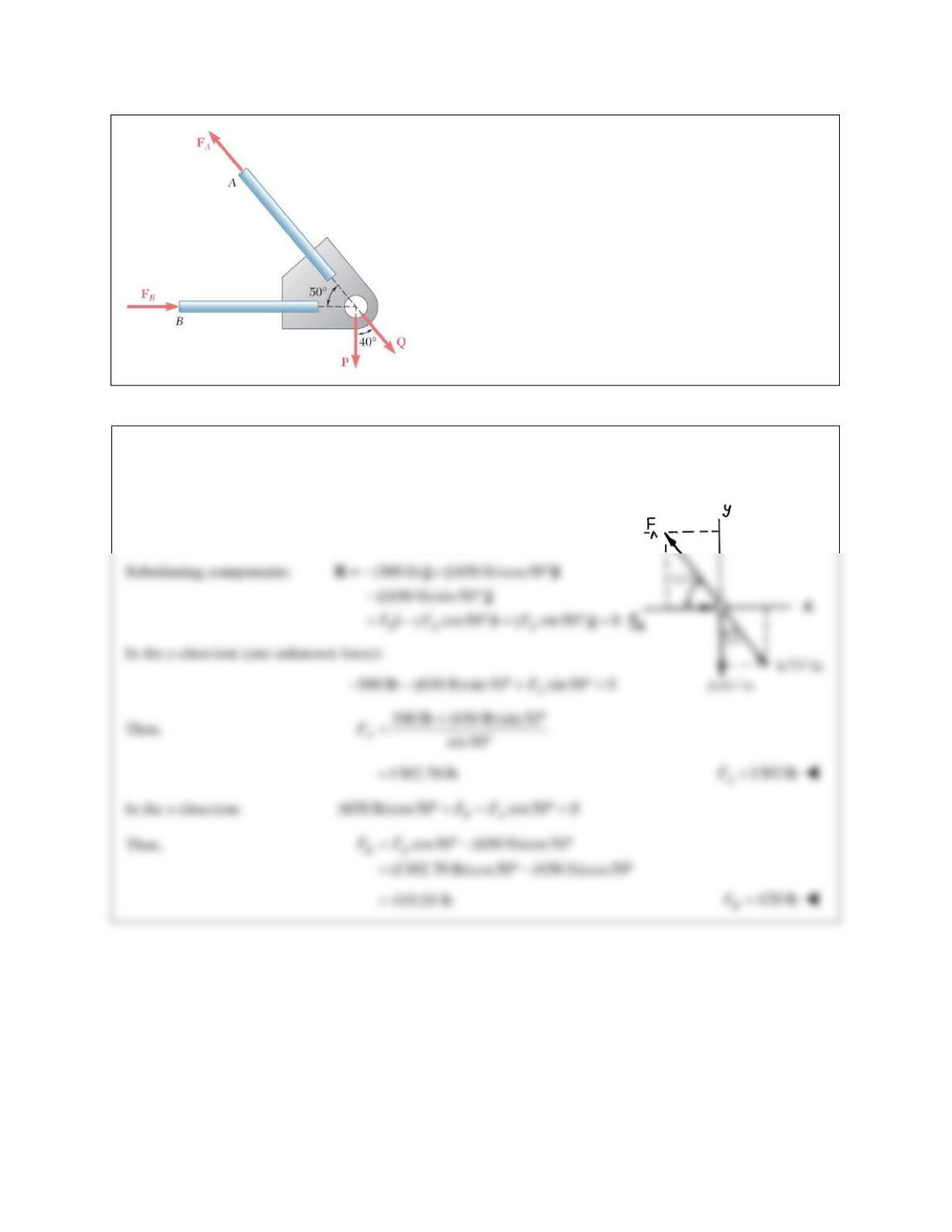
PROBLEM 2.51
Two forces P and Q are applied as shown to an aircraft
connection. Knowing that the connection is in equilibrium
and that
500P=
lb and
650Q=
lb, determine the
magnitudes of the forces exerted on the rods A and B.
SOLUTION
Free–Body Diagram
Resolving the forces into x– and y–directions:
0
AB
=++ + =RPQF F
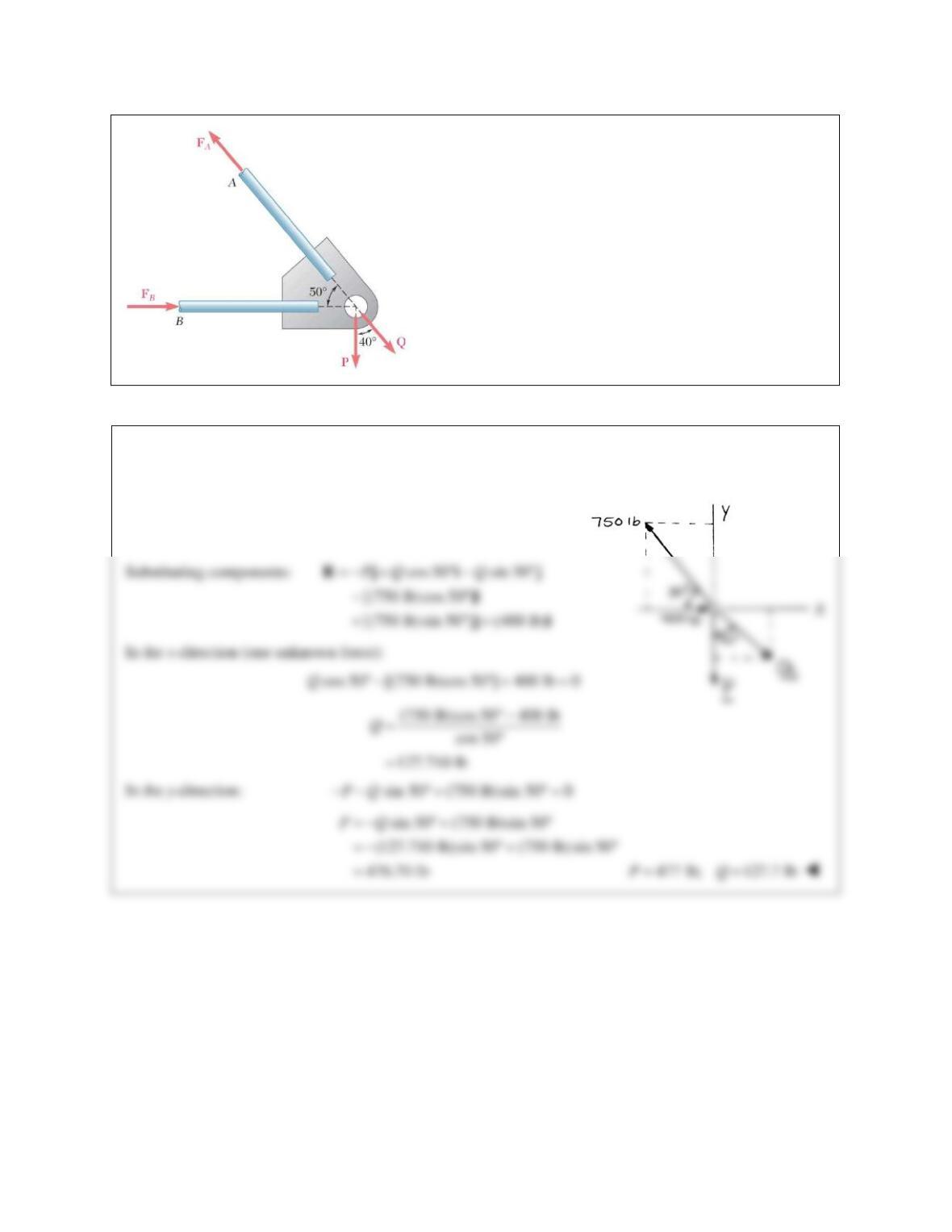
PROBLEM 2.52
Two forces P and Q are applied as shown to an aircraft
connection. Knowing that the connection is in
equilibrium and that the magnitudes of the forces exerted
on rods A and B are
750
A
F=
lb and
400
B
F=
lb,
determine the magnitudes of P and Q.
SOLUTION
Free–Body Diagram
Resolving the forces into x– and y–directions:
0
AB
=++ + =RPQF F
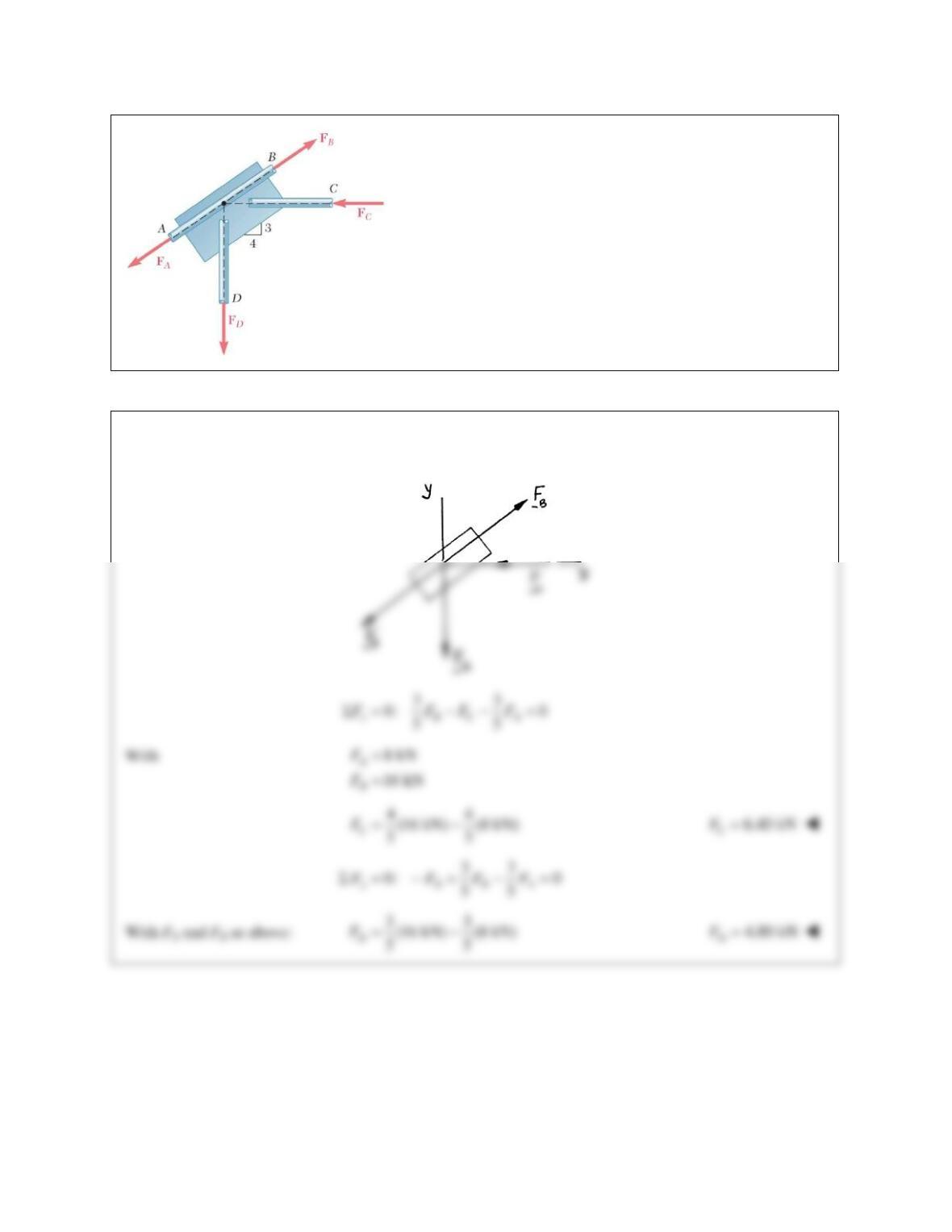
PROBLEM 2.53
A welded connection is in equilibrium under the action of
the four forces shown. Knowing that
8
A
F=
kN and
16
B
F=
kN, determine the magnitudes of the other two
forces.
SOLUTION
Free–Body Diagram of Connection
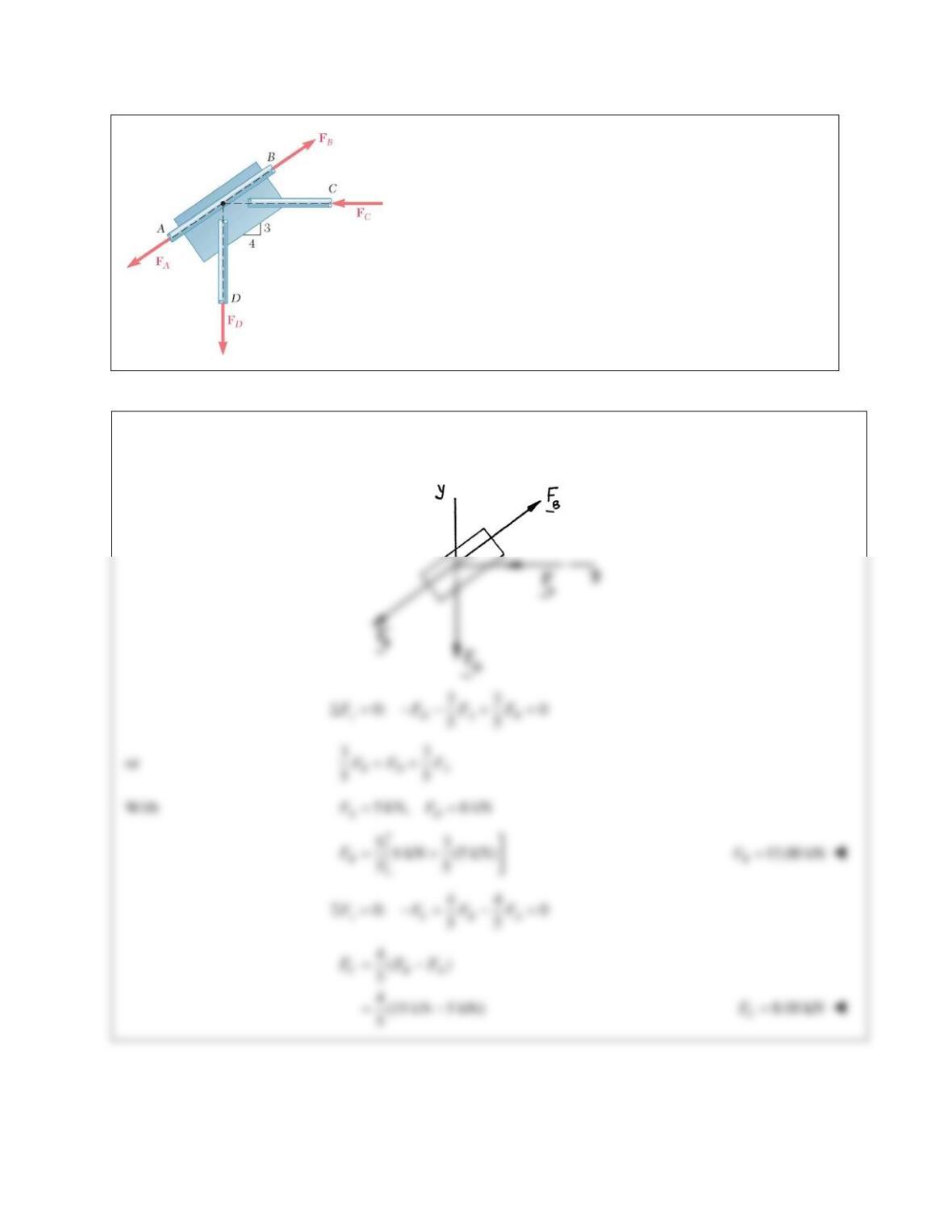
PROBLEM 2.54
A welded connection is in equilibrium under the action of the
four forces shown. Knowing that
5
A
F=
kN and
6
D
F=
kN,
determine the magnitudes of the other two forces.
SOLUTION
Free–Body Diagram of Connection
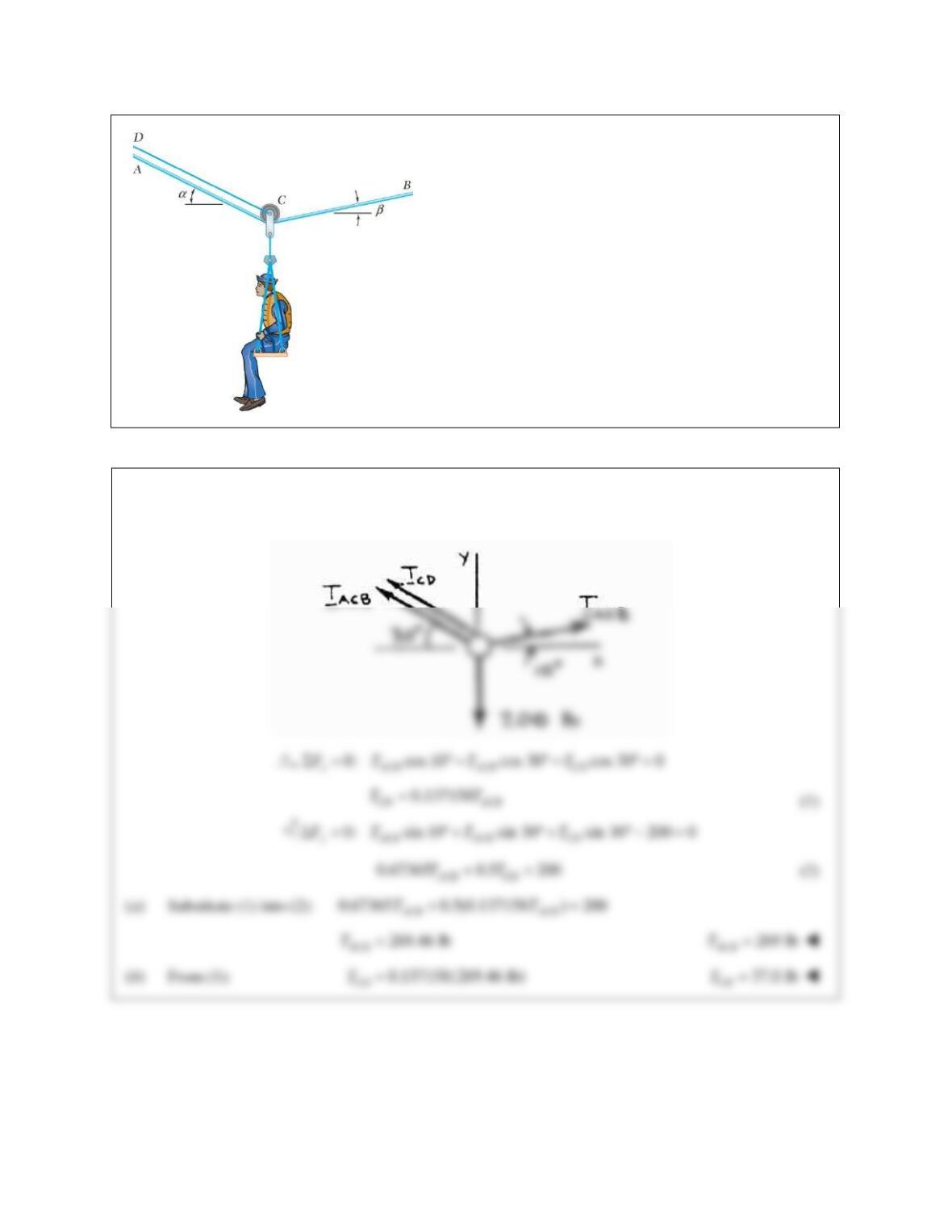
PROBLEM 2.55
A sailor is being rescued using a boatswain’s chair
that is suspended from a pulley that can roll freely
on the support cable ACB and is pulled at a
constant speed by cable CD. Knowing that
α
= 30°
and
β
= 10° and that the combined weight of the
boatswain’s chair and the sailor is 200 lb,
determine the tension (a) in the support cable ACB,
(b) in the traction cable CD.
SOLUTION
Free–Body Diagram
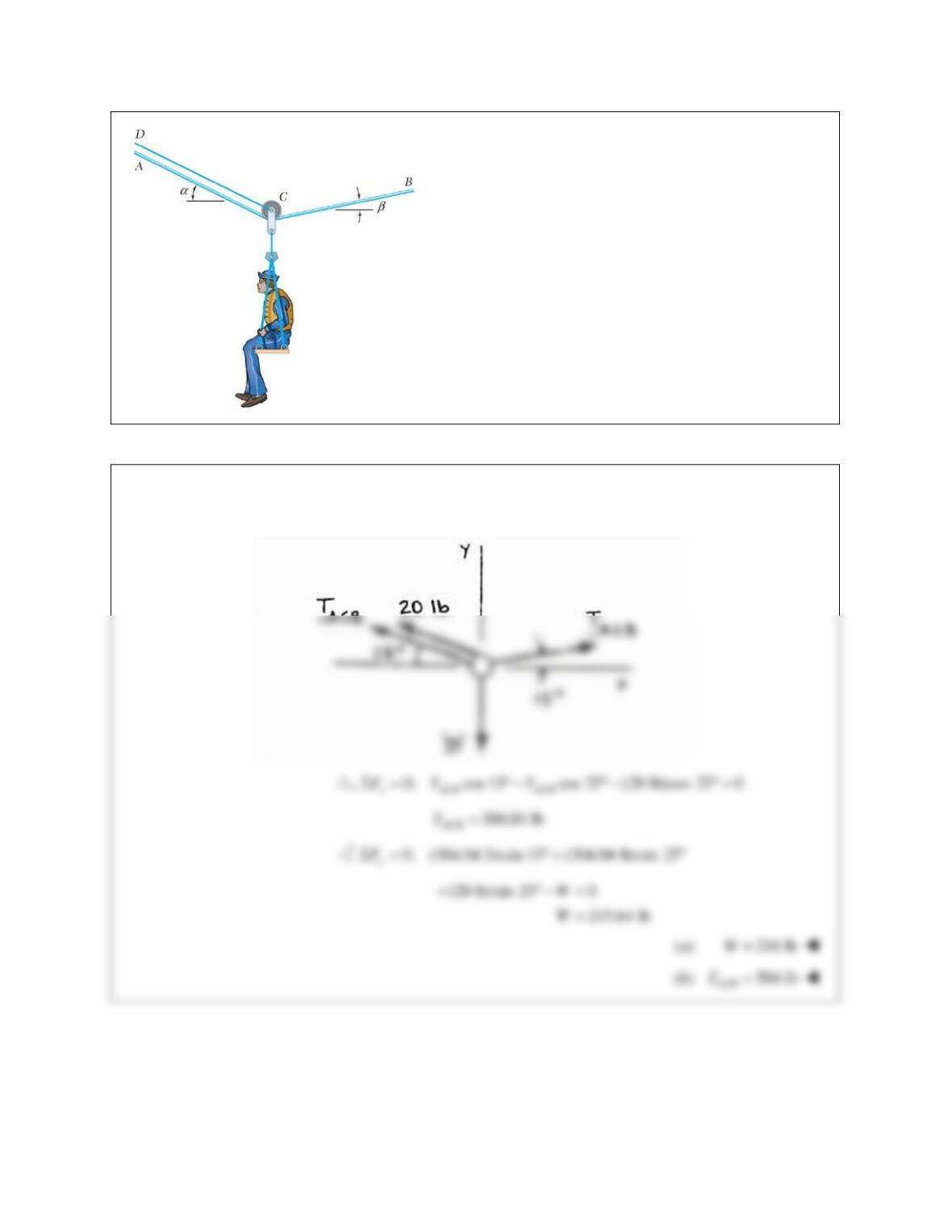
PROBLEM 2.56
A sailor is being rescued using a boatswain’s chair that is
suspended from a pulley that can roll freely on the support
cable ACB and is pulled at a constant speed by cable CD.
Knowing that α = 25° and
β
= 15° and that the tension in
cable CD is 20 lb, determine (a) the combined weight of
the boatswain’s chair and the sailor, (b) the tension in the
support cable ACB.
SOLUTION
Free–Body Diagram
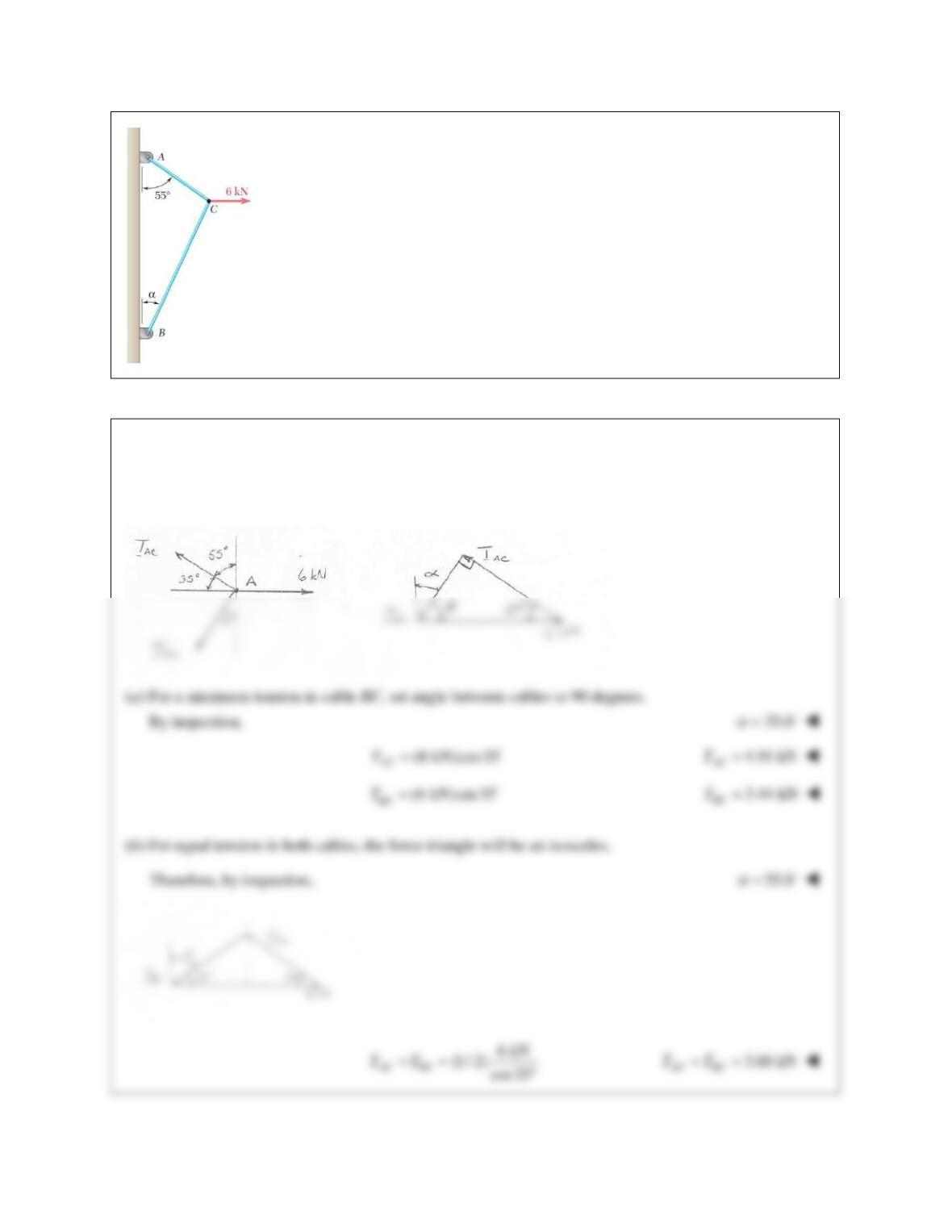
PROBLEM 2.57
For the cables of prob. 2.44, find the value of α for which the tension
is as small as possible (a) in cable bc, (b) in both cables
simultaneously. In each case determine the tension in each cable.
SOLUTION
Free-Body Diagram Force Triangle
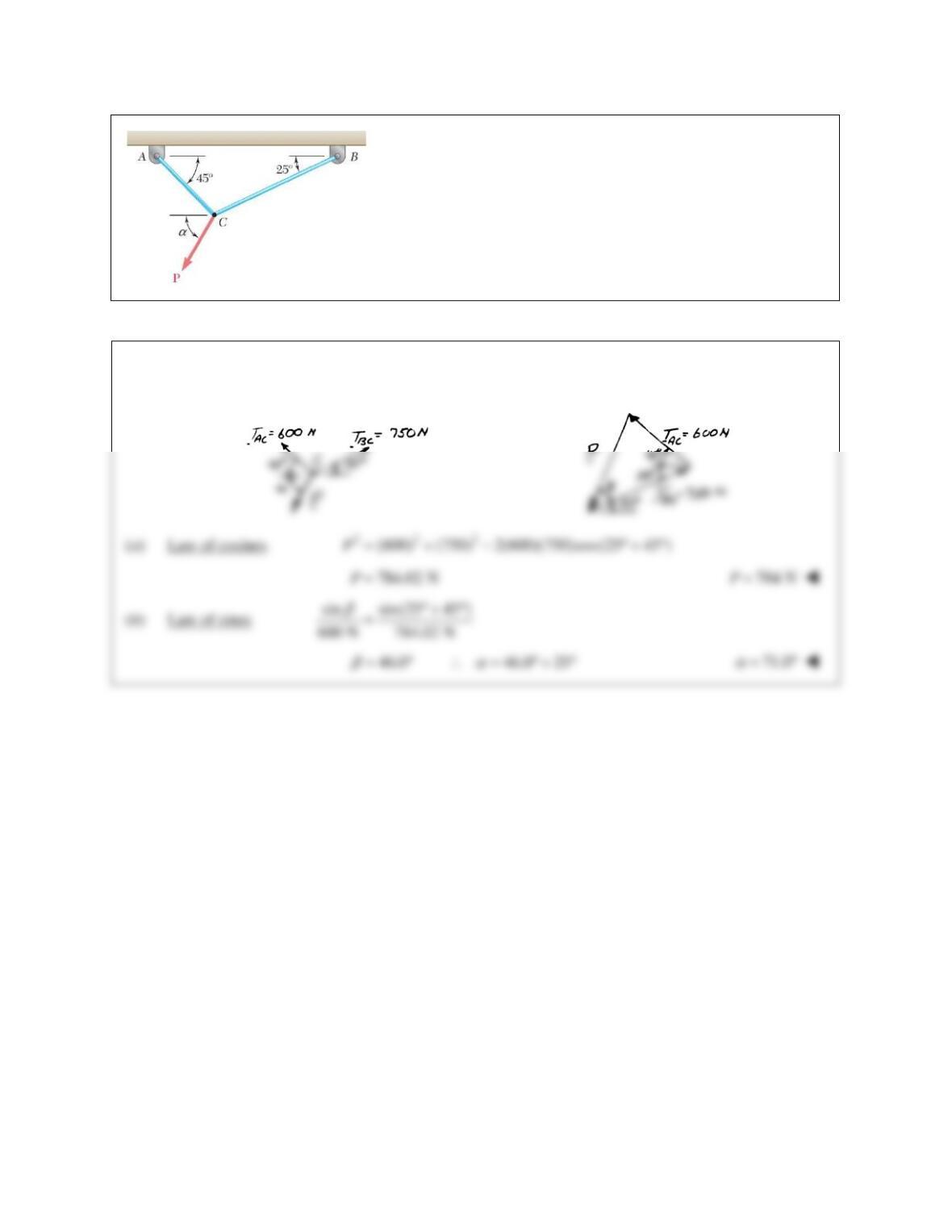
PROBLEM 2.58
For the cables of Problem 2.46, it is known that the maximum
allowable tension is 600 N in cable AC and 750 N in cable BC.
Determine (a) the maximum force P that can be applied at C,
(b) the corresponding value of
α
.
SOLUTION
Free–Body Diagram Force Triangle