2.1 Shearing stress is the force required to slide one unit area layer of a substance over another.
2.3 Dynamic viscosity = shearing stress/velocity gradient.
2.5 N s/m2 or Pa s
2.13 It does not conform to the standard SI system. It uses obsolete basic unit of cm.
2.19 1.5 10 3 Pa s
CHAPTER TWO
VISCOSITY OF FLUIDS
Viscosity of Fluids
15
2.21 1.1 10 5 Pa s
2.23 1.90 Pa s
2.31 2.8 10 5 lb s/ft2
2.37 High viscosity index (VI).
2.39 The fluid occupies the small radial space between the stationary cup and the rotating drum.
2.40 A meter measures the torque required to drive the rotating drum. The torque is a function of
2.41 The inside diameter of the capillary tube; the velocity of fluid flow; the length between
Chapter 2
16
2.42 Terminal velocity is that velocity achieved by the sphere when falling through the fluid
2.43 The diameter of the ball; the terminal velocity (usually by noting distance traveled in a
given time); the specific weight of the fluid; the specific weight of the ball.
2.44 The Saybolt viscometer employs a container in which the fluid can be brought to a known,
2.47 Standard calibrated glass capillary viscometer.
For questions 2.48 to 2.53, Refer to Section 2.8 and to Internet resource 19 for Tribology-abc. Tables for
SAE viscosity grades for engine oils and automotive gear lubricants are listed on the Internet site, from
standards SAE J300 and SAE J306 that can be used to determine appropriate values for viscosities and
information on the testing procedures used. NOTE: It is essential that the latest version of the standards
be used for critical applications. See References 14 and 15.
2.48 The kinematic viscosity of SAE 20 oil must be between 5.6 and 9.3 cSt at 100 C using
ASTM D 445. Its dynamic viscosity must be over 2.6 cP at 150 C using ASTM D 4683,
2.50 SAE 70W through SAE 250 for gear-type transmissions, depending on operating conditions.
2.53 From Internet resource 19: The kinematic viscosity of SAE 5W-40 oil must be between
Viscosity of Fluids
17
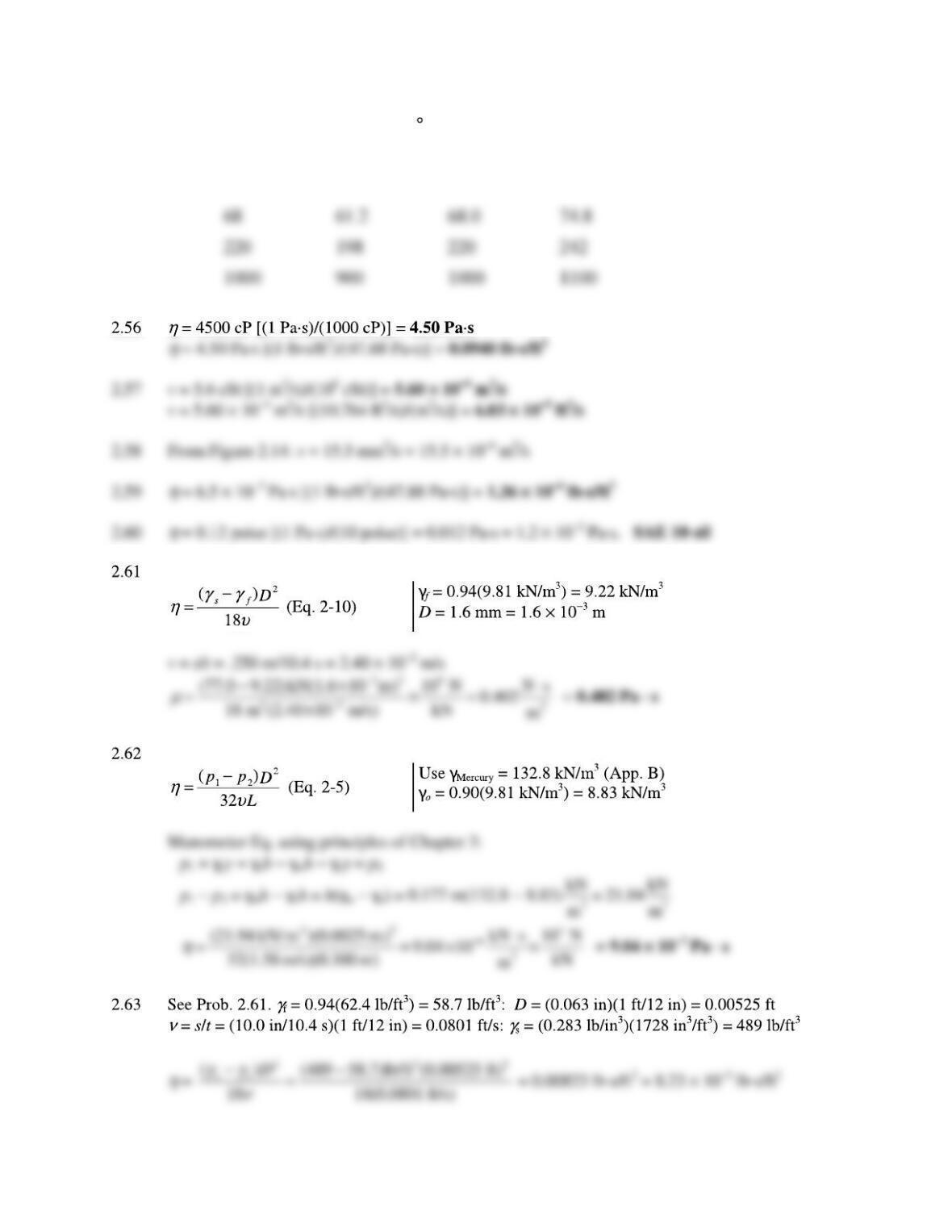
2.55 From Table 2.5: Viscosities at 40 C in mm2/s of cSt
ISO Viscosity grade Minimum Nominal Maximum
10 9.0 10.0 11.0
Viscosity of Fluids
19
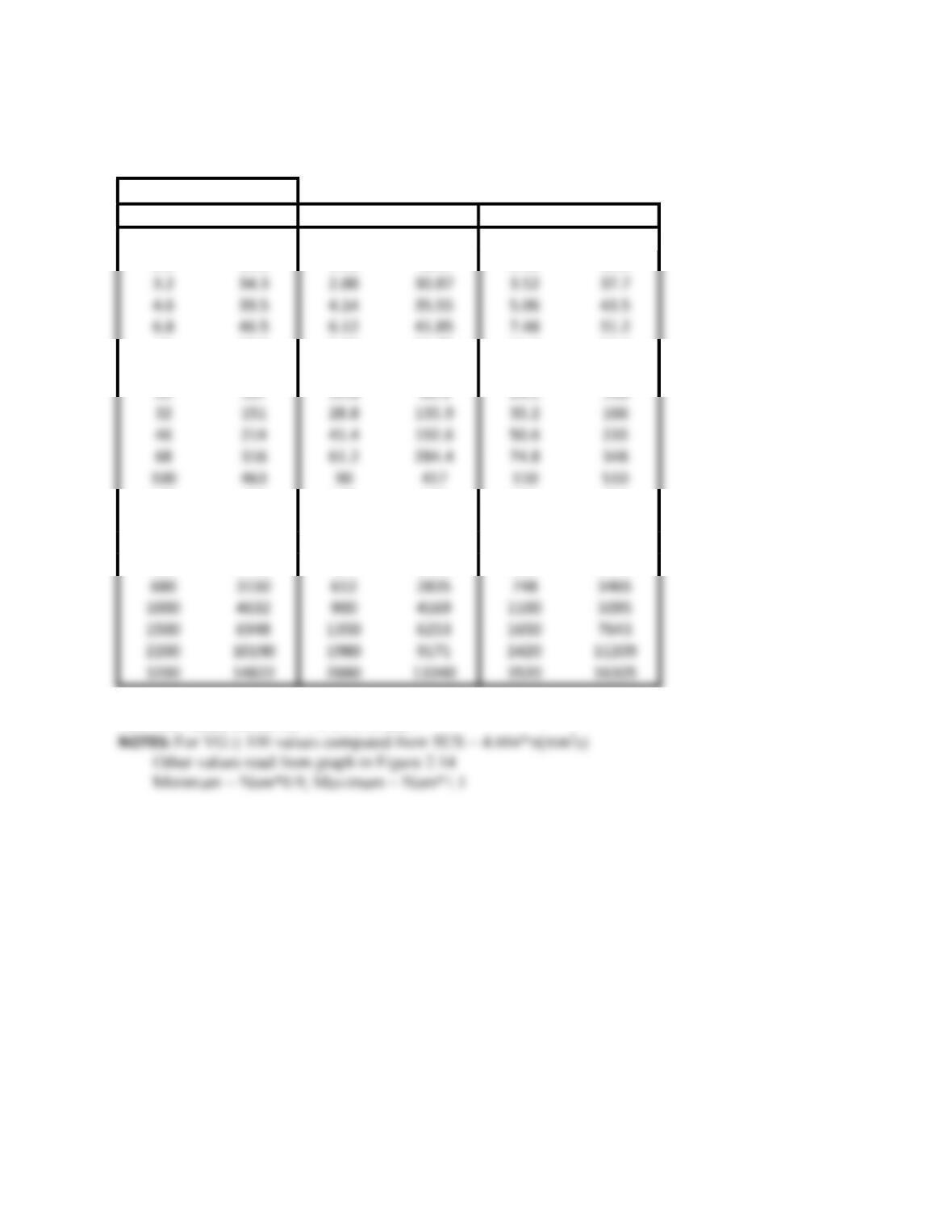
Problem 2.77
Convert kinematic viscosity for ISO grades from mm2/s to SUS
ISO VG*
No
m
inal
Minimum
Maximum
(mm2/s) (SUS) (mm2/s) (SUS) (mm2/s) (SUS)
2
.2
32
.0
1
.
98
28
.8
2
.
42
35
.2
10
57
.5
9
.
00
51
.
75
11
.0
63
.3
15
76
.5
13
.5
68
.9
16
.5
84
.2
22
107
19
.8
96
.3
24
.2
118
32
151
28
.8
135
.9
35
.2
166
46
214
41
.4
192
.6
50
.6
235
68
316
61
.2
284
.4
74
.8
348
100
463
90
417
110
510
150
695
135
625
165
764
220
1019
198
917
242
1121
320
1482
288
1334
352
1630
460
2131
414
1918
506
2344
680
3150
612
2835
748
3465
1000
4632
900
4169
1100
5095
1500
6948
1350
6253
1650
7643
*First four values are called VG 2, 3, 5, and 7
3
.2
34
.3
2
.
88
30
.
87
3
.
52
37
.7
4
.6
39
.5
4
.
14
35
.
55
5
.
06
43
.5
6
.8
46
.5
6
.
12
41
.
85
7
.
48
51
.2