
Chapter 2: Building Professional Development Relationships with Adults
Summary
Exploring effective ways that mentors initially join and plan for professional learning
relationships with early-childhood teachers is the focus of this chapter. Increasing responsiveness
to and awareness of the whole teacher (as mentee, or protégé) through an examination of
Outline
The chapter supports your growing capacity to
• partner with others for learning;
Building PD
Relationships
with Adults
partner for
learning
join
& plan
evaluate
progress

Learner outcomes
• Students will develop an understanding of how to partner with others to support their
learning.
• Students will explore the many ways to plan for an adult’s professional development,
Suggested teaching activities
1. Partner for Learning
To set the tone for this topic, open your session by reading this famous quote by Jere Pawl and
Maria St. John (1998), “How you are is as important as what you do.”
Then ask participants to reflect on what that statement means to them in the context of working
with children and families. Write down their ideas and ask the group again what might be added
to the list if they considered what’s needed to work with the teachers of young children. Possible
responses include:
• a positive climate based on trust and respect.
Conclude by stating that when this is developed over time, it is referred to as having an
effective, consultative stance (Johnson & Brinamen, 2006) with adults (teachers or parents).
Extension: A follow up small group activity to go deeper into these ideas might be to direct
building a friendship with a colleague.
After giving the group some time to complete this work, direct them to turn to their book and
compare their list with strategies in Table 2.1 that either weaken or promote learning
partnerships. Conclude by asking each group to share a few of their most important comments
with the large group.

2. Partner to Meet Learning Needs
Ask the participants to get into three groups and tell them that they are mentors or coaches from
a local child care support agency. Give each group a different scenario in which they need to
identify the teacher learning needs.
A) A new toddler teacher needs help with child guidance and other routine daily tasks.
Several other toddler teachers in the program are very effective in guiding children and
have been working at this program for over ten years. The mentor assigned to this teacher
is from another part of the state and does not speak the language of many of the families
in the program. All the teachers speak the dominant languages of the enrolled families.
After they have had some time to discuss, then ask the groups to consider what support their
teachers in the scenarios need for their learning needs. Tell them they may use the following
questions to spark conversation.
___________________________________________________________________________
1. Ask: What teacher on-site or in a similar role or program might act as a peer mentor? Does the
mentor understand the cultural context of the program?
_____________________________________________________________________________
Conclude: After each group briefly shares what they discussed, conclude with the statement:
You have helped to work on the question that mentors wrestle with when forming a learning
relationship, “Why is fitting the learning need to the learning response so important?”
Alternative Activity: For the scenarios above, ask participants to role-play the teacher and the
• Would a one-on-one mentoring relationship be helpful to you?
• Do you currently have anyone whom you see as a professional mentor to you?
• Can you describe a current challenge?
• How would you like to get support for your role here?
Purpose: Often, the same mentor is asked to fill all of the different professional needs identified
Other Options to Extend Learning: Look at Table 2.3 – Matching the Learning Need to the
Strategy for Learning and explore the scenarios with your participants. Using these different
scenarios will allow you to examine the various roles of the mentor, coach, and consultant.
3. Join and Plan Together for Building a Learning Relationship
Ask the participants the question. “What does not work to support the building of learning
Notice and consider the consequences of a mentoring process that is:
…trying to quickly solve problems and offer help without first understanding the issues
or contexts.
the current issues.
thinks, feels, and acts in a situation.
…ignoring the influences of culture and community or speaking of them only when
Then ask, “What should a mentor do instead of the less effective approaches?” Collect ideas
from the group and then share ideas from this list from the same Table 2.4 that have not been
mentioned by the participants.
…having a planned first meeting and conveying interest in what is shared.
…avoiding the role of the expert at first and doing a lot of listening and questioning.
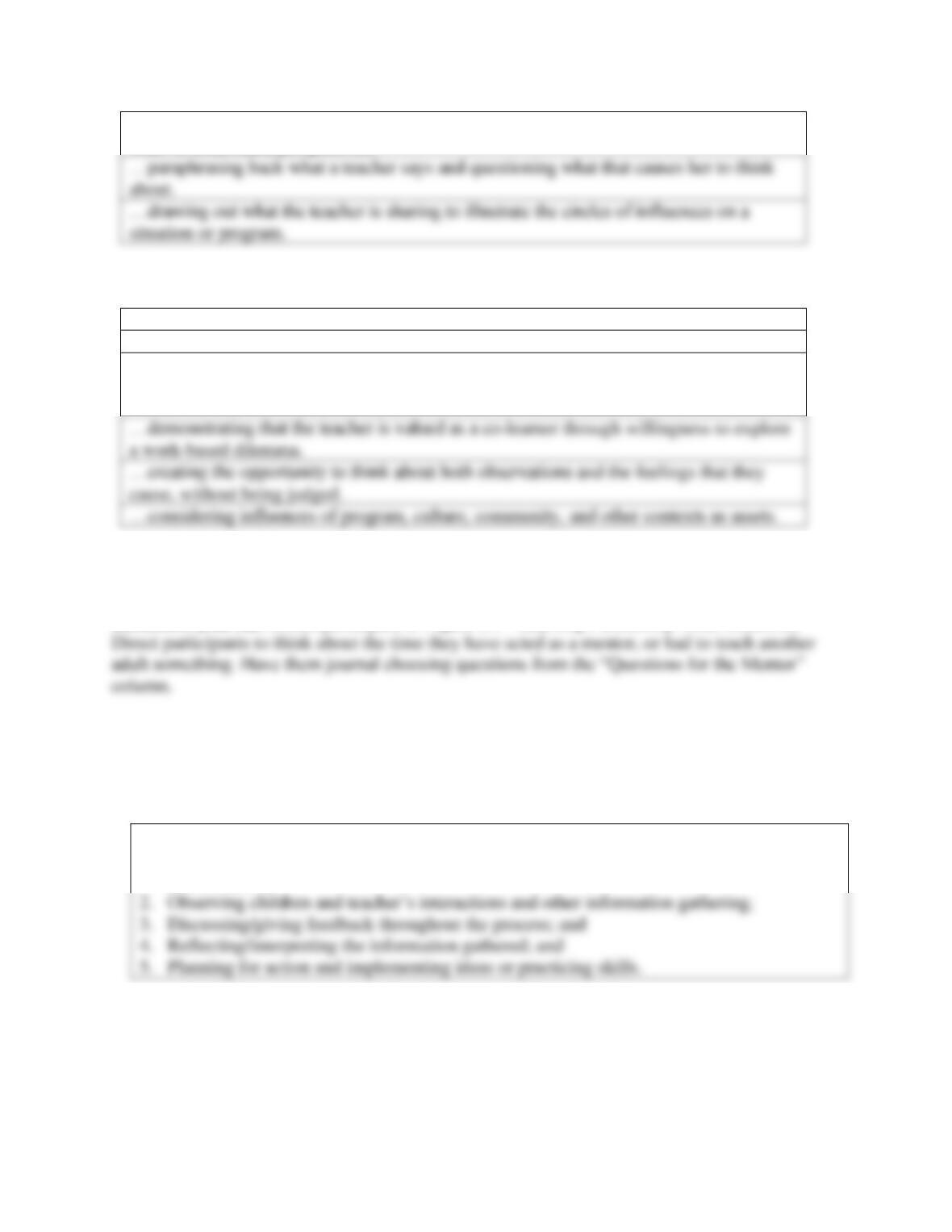
…wondering, brainstorming, listening to different points of view, and questioning in
Conclude by reiterating what building a learning relationship requires.
…taking time to build trust, comfort, and a positive climate.
…acting as a safe haven for the teacher to share frustrations and successes.
…establishing a clear purpose or negotiating to be able to answer the simple question,
Why are we doing this?
…considering influences of program, culture, community, and other contexts as assets.
Purpose: Connecting relationship building values with actual mentoring practices is the focus of
this activity.
Reflection Journal: Direct participant to Figure 2.1 – Learning Partnership Asset Checklist.
4. Establish Expectations
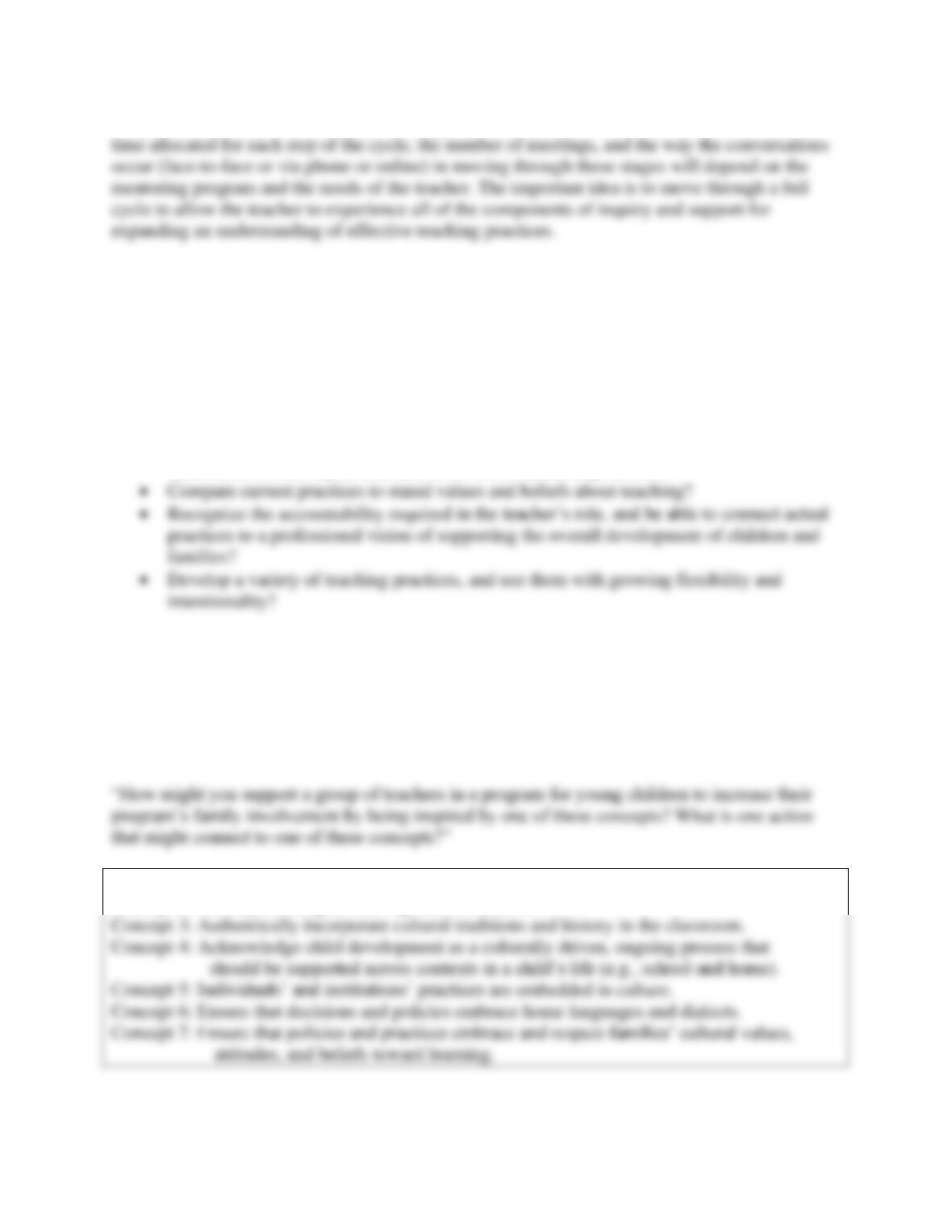
Share with participants a five-step process for a mentor to work with a teacher to establish what a
teacher may expect from them.
1. Joining together and creating a clear plan with the understanding of what the teacher and
mentor, or coach, will each do (e.g., teacher observes children, mentor observes teacher
and children);
Ask participants the advantages and disadvantages of going through all the steps in order to gain
more professional knowledge and skills. Ask participants how this process is similar to and
different from the way children construct knowledge.
Purpose: Mentors need to be flexible to support teachers in achieving their goals. The amount of
5. Evaluate Progress
Ask participants to discuss how they know when a mentor-teacher learning relationship has
resulted in progress for the teacher in meeting their goals.
Conclude by sharing these broad indicators of progress in a learning relationship and ask:
Do I see specific evidence that the mentoring process has supported a teacher’s ability to:
• Work with mentors, peers, and colleagues to commit to participating together to discuss
ideas about effective practices and to reflect on actual experiences?
6. Understand Cultural Competence
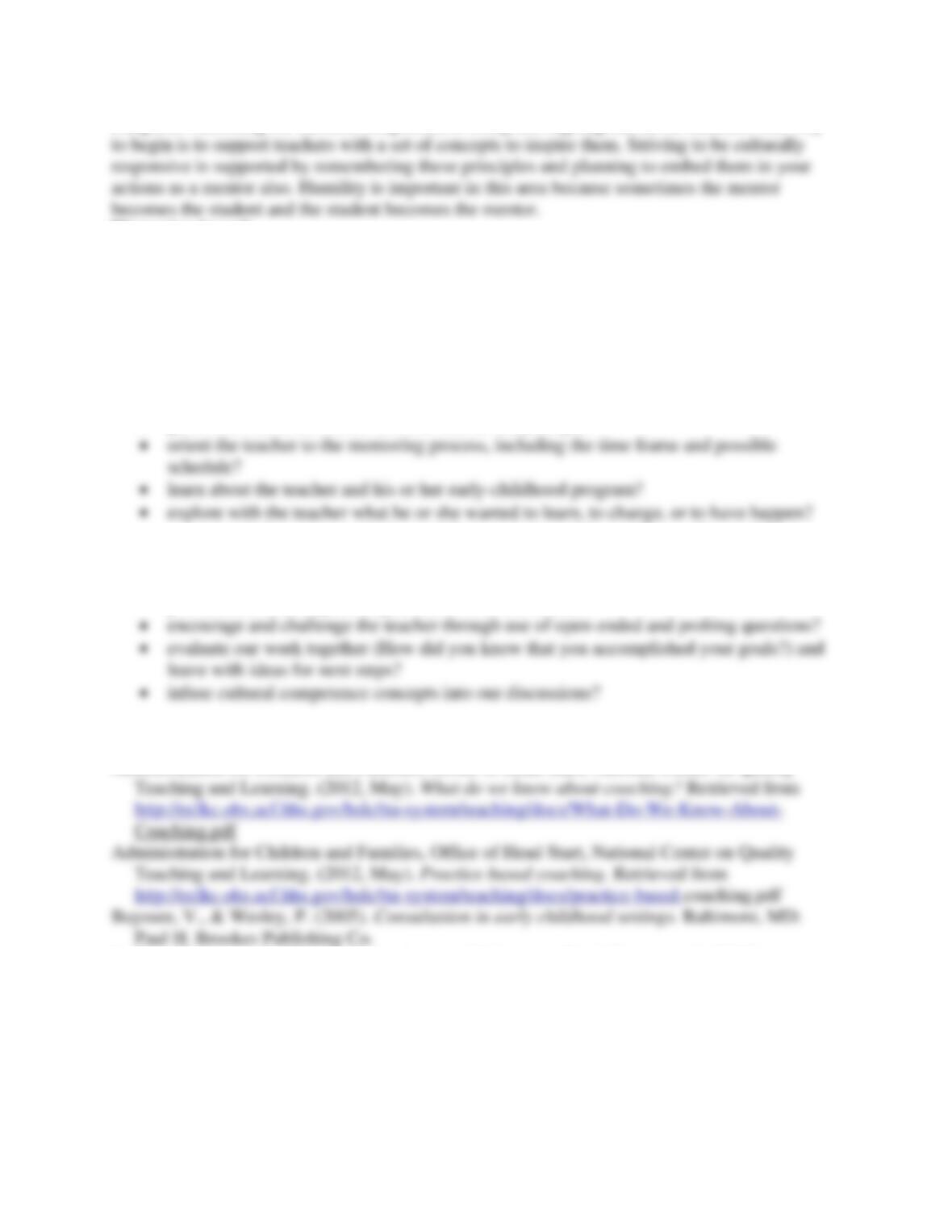
Put participants into seven groups. Ask each group to consider one of the concepts summarized
and simplified here from the National Association for the Education of Young Children
(NAEYC) Pathways to Cultural Competence Project (QBCCP). Then ask each group to
brainstorm possible responses to the following question:
Concept 1: Children are nested in families.
Concept 2: Identify shared goals among families and staff.
Purpose: Mentoring for cultural competence is complex, ongoing and never finished. One way
Discussion board
If the participants have experience as a mentor, coach or consultant, ask them to think of a time
they worked successfully with an early childhood teacher and respond to these questions. If they
do not have experience in early childhood mentoring, as them to reflect on the skills, knowledge
and abilities needed by a mentor in a learning partnership by thinking of a time they had to teach
an adult something. Another adaptation is to bring in a mentor and have the group interview
them with these questions:
In what ways did you work to:
• get to know and build trust with the teacher (as protégé)?
• encourage information gathering and documentation of the problem or focus of the
teacher’s inquiry?
• be flexible during implementation?
• problem-solve through dialogue and reflective feedback?
More suggested reading and resources
Darling-Hammond, L., Wei, R. C., Andree, A., Richardson, N., & Orphanos, S. (2009).
Professional learning in the learning profession: A status report on teacher development in
the United States and abroad. Dallas, TX: National Staff Development Council.
Elliott, K., Farris, M., Alvarado, C., Peters, C., Surr, W., Genser, A., & Chin, E. (2000). The
power of mentoring. Taking the lead: Investing in early childhood leadership for the 21st
century. Report of the Center for Development in Early Care and Education, Report,
Wheelock College, Boston.
Garet, M., Porter, S., Andrew, C., & Desimone, L. (2001). What makes professional

Children.
Michigan Association for Infant Mental Health. (2002). Michigan Association for Infant Mental
Health training guidelines. East Lansing, MI: Author.
Nabobo-Baba, U., & Tiko, L. (2009). Indigenous Fijian cultural conceptions of mentoring and
related capacity building: Implications for teacher education. In A. Gibbons & C. Gibbs
(Eds.), Conversations on early childhood teacher education: Voices from the working forum
for teacher education (pp. 73–81). Redmond, WA: World Forum Foundation and New
Pianta, R. C., Mashburn, A. J., Downer, J. T., Hamre, B. K., & Justice, L. (2008). Effects of
web-mediated professional development resources on teacher–child interaction in pre-
kindergarten classrooms. Early Childhood Research Quarterly, 23(4), 431–451.
Stremmel, A. (2007). Teacher research: Nurturing professional and personal growth through
inquiry. Voices of practitioners. National Association for the Education of Young Children.