2.4 Newton’s Method
1. Each of the following equations has a root on the interval (0,1). Perform New-
ton’s method to determine p4, the fourth approximation to the location of the
root.
(a) ln(1 + x)−cos x= 0 (b) x5+ 2x−1 = 0
(c) e−x−x= 0 (d) cos x−x= 0
(a) Let f(x) = ln(1 + x)−cos x. Then f′(x) = 1
1+x+ sin x. With p0= 0, four
iterations of Newton’s method yield
(b) Let f(x) = x5+ 2x−1. Then f′(x) = 5x4+ 2. With p0= 0, four iterations
of Newton’s method yield
−e−p0−1= 0.5000000000;
2Section 2.4
2. Construct an algorithm for Newton’s method. Is it necessary to save all calcu-
lated terms in the sequence {pn}?
Because convergence is quadratic, iteration is terminated when |pn−pn−1|falls
In Exercises 3 – 6, an equation, an interval on which the equation has a root,
and the exact value of the root are specified.
(a) Perform five (5) iterations of Newton’s method.
(b) For n≥1, compare |pn−pn−1|with |pn−1−p|and |pn−p|.
(c) For n≥1, compute the ratio |pn−p|/|pn−1−p|2and show that this value
approaches |f′′ (p)/2f′(p)|.
Newton’s Method 3
3. The equation x3+x2−3x−3 = 0 has a root on the interval (1,2), namely
x=√3.
npn|pn−pn−1| |pn−p| |pn−1−p| |pn−p|/|pn−1−p|2
1 3.00000000 2.00000000 1.26794919 0.73205081 2.366
3 1.83015075 0.36984925 0.09809995 0.46794919 0.448
Note that for n≥3,|pn−pn−1|provides an excellent estimate for |pn−1−p|and is
4. The equation x7= 3 has a root on the interval (1,2), namely x=7
√3.
npn|pn−pn−1| |pn−p| |pn−1−p| |pn−p|/|pn−1−p|2
0 1.00000000
2 1.19691682 0.08879746 0.02698601 0.11578347 2.013
Note that for all n,|pn−pn−1|provides a reasonable estimate for |pn−1−p|and is
5. The equation x3−13 = 0 has a root on the interval (2,3), namely 3
npn|pn−pn−1| |pn−p| |pn−1−p| |pn−p|/|pn−1−p|2
0 3.00000000
2 2.35804119 0.12344029 6.707 ×10−30.13014679 0.396
Note that for all n,|pn−pn−1|provides a reasonable estimate for |pn−1−p|and is
6. The equation 1/x−37 = 0 has a zero on the interval (0.01,0.1), namely x= 1/37.
npn|pn−pn−1| |pn−p| |pn−1−p| |pn−p|/|pn−1−p|2
1 0.01630000 0.00630000 0.010727027 0.017027027 37.000
3 0.02635634 0.00358687 0.000670691 0.004257557 37.000
Note that for all n,|pn−pn−1|provides a reasonable estimate for |pn−1−p|and
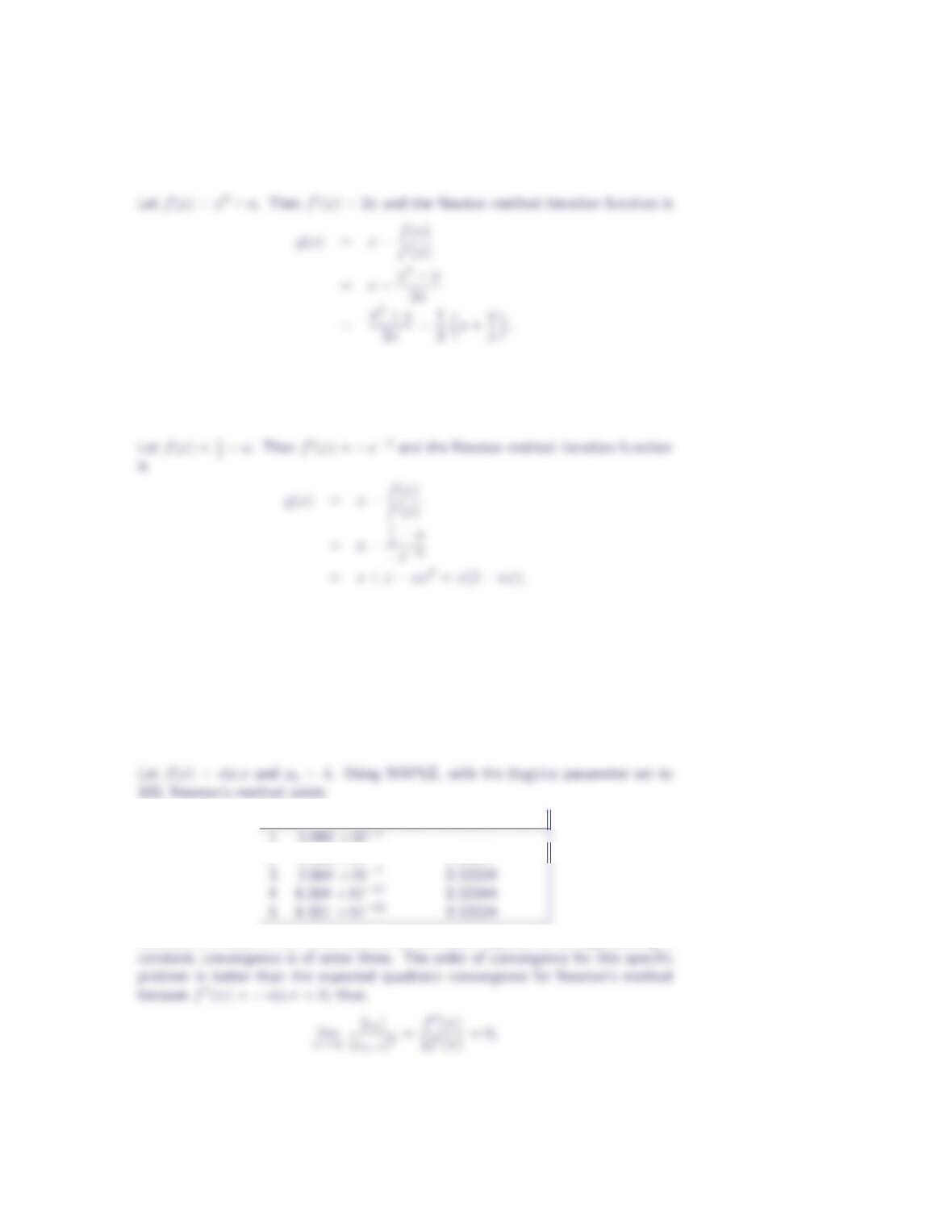
7. Show that when Newton’s method is applied to the equation x2−a= 0, the
resulting iteration function is g(x) = 1
2x+a
x.
Newton’s Method 5
8. Show that when Newton’s method is applied to the equation 1/x −a= 0, the
resulting iteration function is g(x) = x(2 −ax).
9. The function f(x) = sin xhas a zero on the interval (3,4), namely x=π.
Perform three iterations of Newton’s method to approximate this zero, using
p0= 4. Determine the absolute error in each of the computed approximations.
What is the apparent order of convergence? What explanation can you provide
for this behavior? (NOTE: If you have access to MAPLE, perform five iterations
with the Digits parameter set to at least 100.)
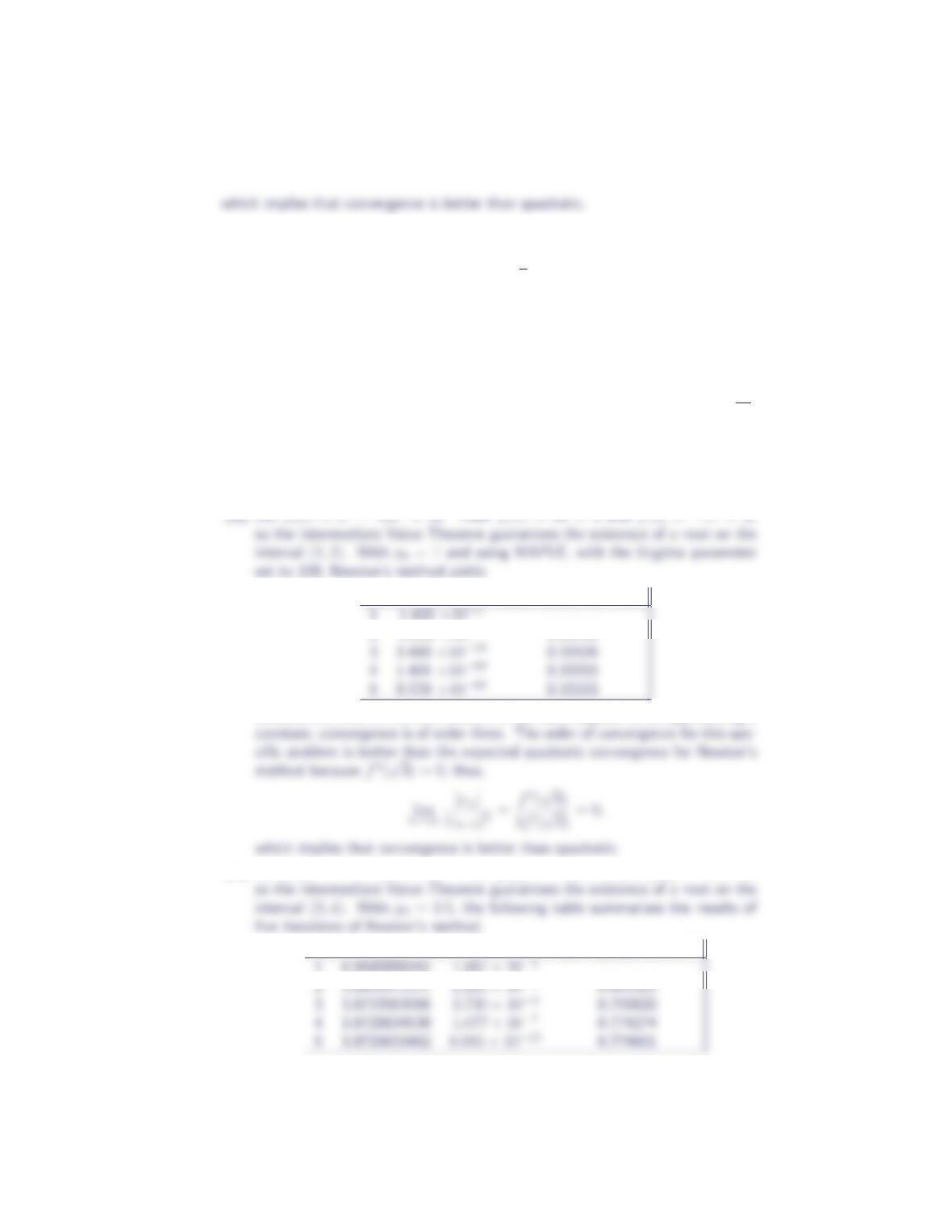
n|pn−p| |pn−p|/|pn−1−p|3
2 9.280 ×10−30.34577
Because the ratio in the third column of the table appears to be approaching a
6Section 2.4
10. (a) Verify that the equation x4−18x2+45 = 0 has a root on the interval (1,2).
Next, perform three iterations of Newton’s method, with p0= 1. Given
that the exact value of the root is x=√3, compute the absolute error in the
approximations just obtained. What is the apparent order of convergence?
What explanation can you provide for this behavior? (NOTE: If you have
access to MAPLE, perform five iterations with the Digits parameter set
to at least 100.)
(b) Verify that the equation x4−18x2+ 45 = 0 also has a root on the interval
(3,4). Perform five iterations of Newton’s method, and compute the abso-
lute error in each approximation. The exact value of the root is x=√15.
What is the apparent order of convergence in this case?
(c) What explanation can you provide for the different convergence behavior
between parts (a) and (b)?
n|pn−p| |pn−p|/|pn−1−p|3
2 1.014 ×10−30.34730
Because the ratio in the third column of the table appears to be approaching a
(b) Let f(x) = x4−18x2+ 45. Then f(3) = −36 <0and f(4) = 13 >0,
npn|pn−p| |pn−p|/|pn−1−p|2

Newton’s Method 7
11. The function f(x) = 27x4+ 162x3−180x2+ 62x−7 has a zero at x= 1/3.
Perform ten iterations of Newton’s method on this function, starting with p0=
0. What is the apparent order of convergence of the sequence of approximations?
What is the multiplicity of the zero at x= 1/3? Would the sequence generated
by the bisection method converge faster?
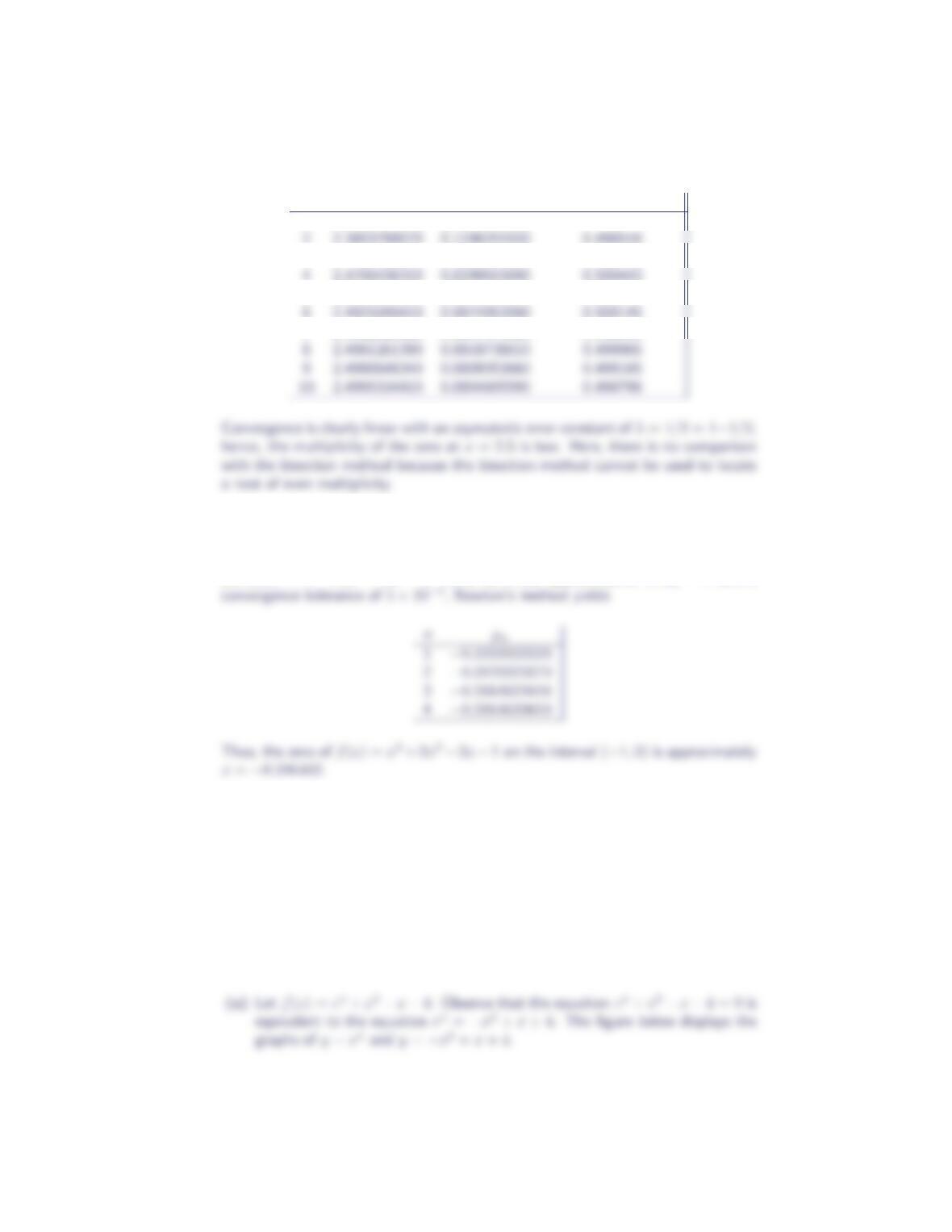
npn|pn−p| |pn−p|/|pn−1−p|
2 0.1871468695 0.1461864638 0.663187
4 0.2687288261 0.0646045072 0.665169
6 0.3046911326 0.0286422007 0.666010
8 0.3206173081 0.0127160252 0.666378
Convergence is clearly linear with an asymptotic error constant of λ= 2/3 = 1−1/3;
12. Repeat Exercise 11 for the function
f(x) = x
1 + x2−500
841 1−21x
125 ,
which has a zero at x= 2.5. Start Newton’s method with p0= 2.
Let
8Section 2.4
npn|pn−p| |pn−p|/|pn−1−p|
1 2.2600472810 0.2399527190
3 2.4401402930 0.0598597070 0.500415
5 2.4850136160 0.0149863840 0.500274
7 2.4962520120 0.0037479880 0.500041
13. The function f(x) = x3+ 2x2−3x−1 has a zero on the interval (−1,0).
Approximate this zero to within an absolute tolerance of 5 ×10⁻⁵.
Let f(x) = x3+ 2x2−3x−1. With an initial approximation of p0= 0 and a
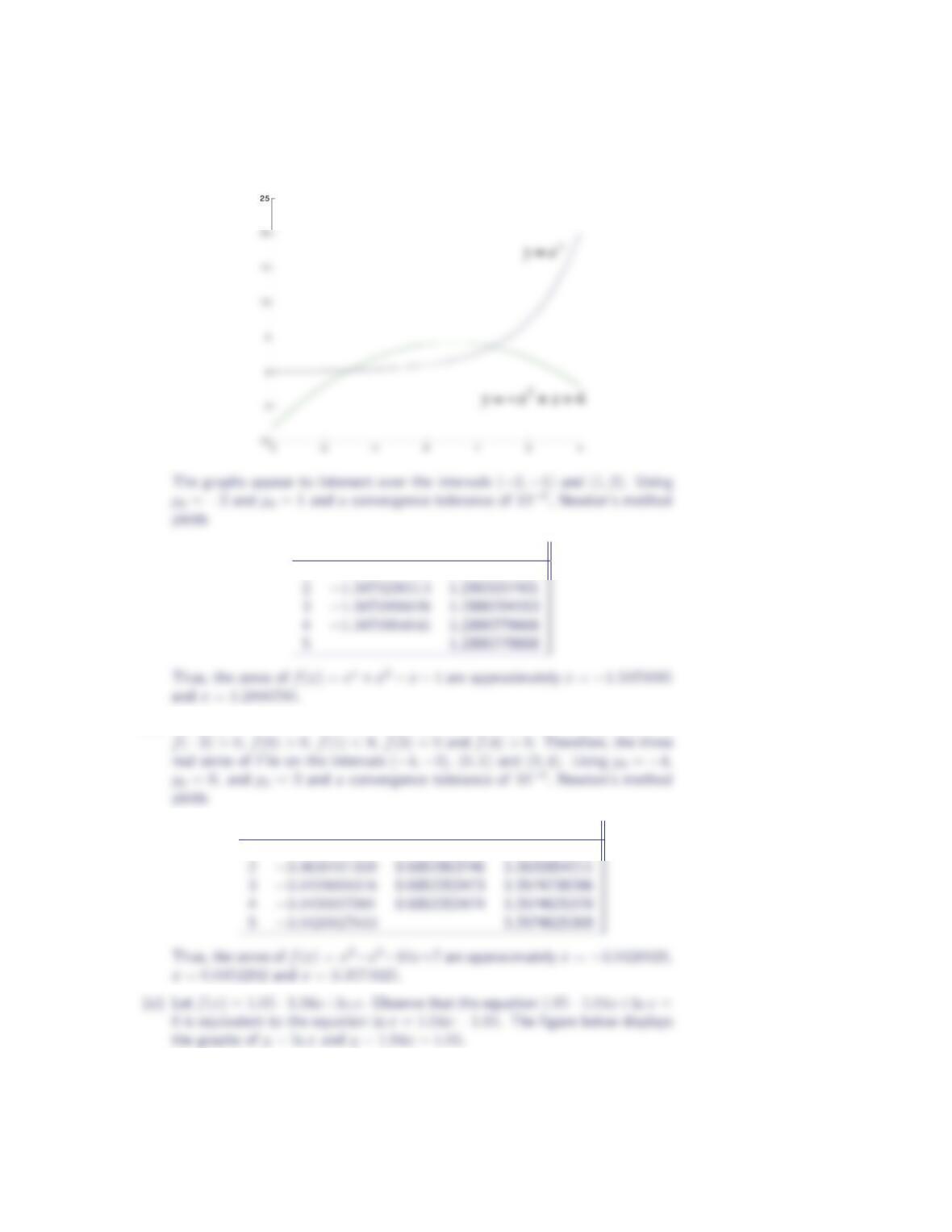
14. For each of the functions given below, use Newton’s method to approximate all
real roots. Use an absolute tolerance of 10−6as a stopping condition.
(a) f(x) = ex+x2−x−4
(b) f(x) = x3−x2−10x+ 7
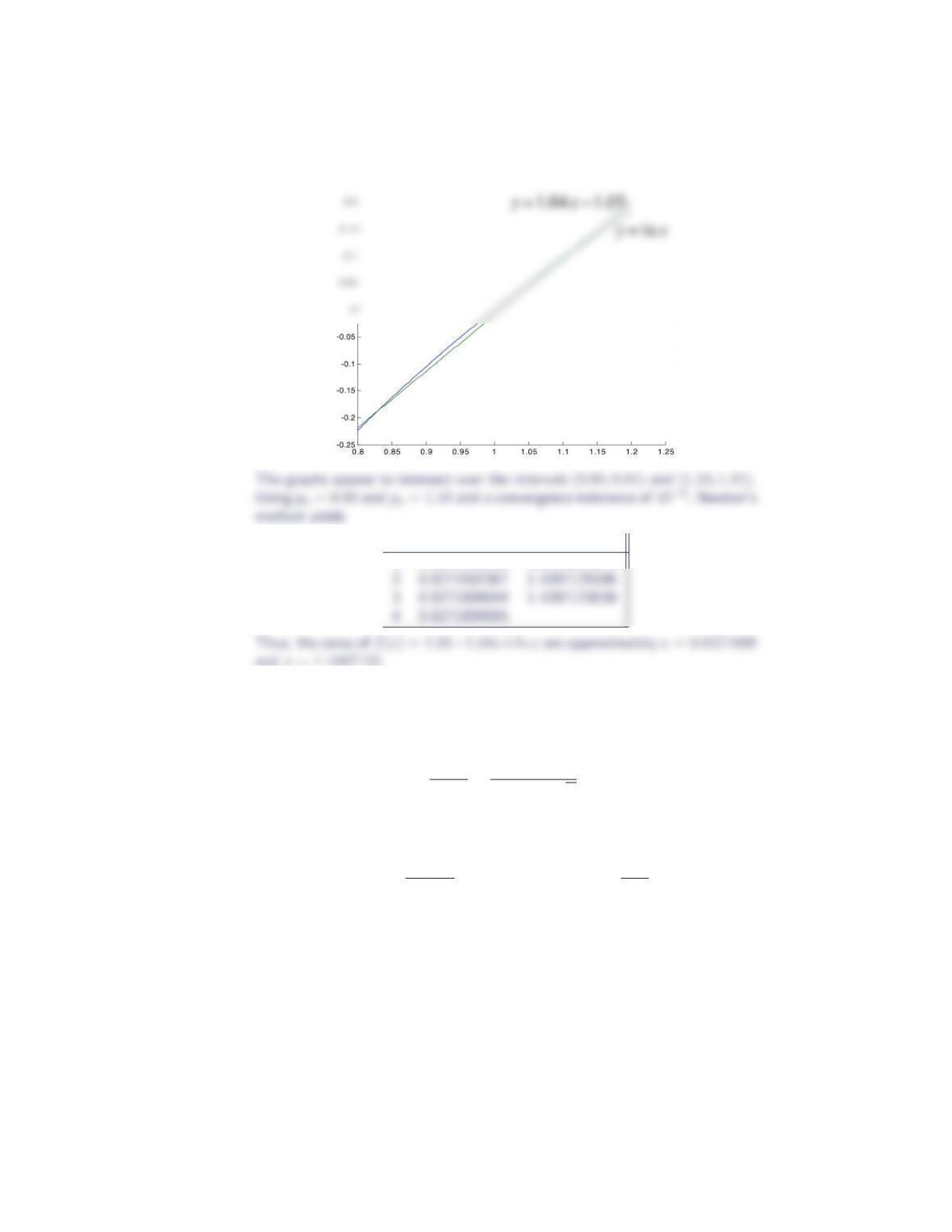
(c) f(x) = 1.05 −1.04x+ ln x
Newton’s Method 9
np0=−2p0= 1
1−1.5610519106 1.3447071068
(b) Let f(x) = x3−x2−10x+ 7. By trial and error, we find that f(−4) <0,
np0=−4p0= 0 p0= 3
1−3.2826086957 0.7000000000 3.4545454545
10 Section 2.4
np0= 0.80 p0= 1.10
1 0.8244931015 1.1100083179
15. An equation of state relates the volume Voccupied by one mole of a gas to
the instantaneous pressure Pand the Kelvin absolute temperature Tof the gas.
The Redlich-Kwong equation of state is given by
P=RT
V−b−a
V(V+b)√T,
where aand bare related to the critical temperature Tcand the critical pressure
Pcby the equations
a= 0.42747 R2T5/2
c
Pc!and b= 0.08664 RTc
Pc.
The coefficient Ris a universal constant equal to 0.08206.
(a) Determine the volume of one mole of carbon dioxide at a temperature of
T= 323.15K and a pressure of one atmosphere. For carbon dioxide, Tc=
304.2K and Pc= 72.9 atmospheres.
(b) Determine the volume of one mole of ammonia at a temperature of T=
450K and a pressure of 56 atmospheres. For ammonia, Tc= 405.5K and
Pc= 111.3 atmospheres.
Newton’s Method 11
(a) For carbon dioxide, Tc= 304.2K and Pc= 72.9atmospheres, so
With a convergence tolerance of 5×10⁻⁷, Newton’s method yields
(b) For ammonia, Tc= 405.5K and Pc= 111.3atmospheres, so
With a convergence tolerance of 5×10⁻⁷, Newton’s method yields
nVn
16. In determining the minimum cushion pressure needed to break a given thickness
of ice using an air cushion vehicle, Muller (“Ice Breaking with an Air Cushion
Vehicle,” in Mathematical Modeling: Classroom Notes in Applied Mathematics,
M.S. Klamkin, editor, SIAM, 1987) derived the equation
p3(1 −β2) + 0.4hβ2−σh2
r2p2+σ2h4
3r4p−σh2
3r23
= 0,
where pdenotes the cushion pressure, hthe thickness of the ice field, rthe size
of the air cushion, σthe tensile strength of the ice, and βis related to the width
of the ice wedge. Take β= 0.5, r= 40 feet and σ= 150 pounds per square inch
(psi). Determine pfor h= 0.6, 1.2, 1.8, 2.4, 3.0, 3.6 and 4.2 feet.
Let
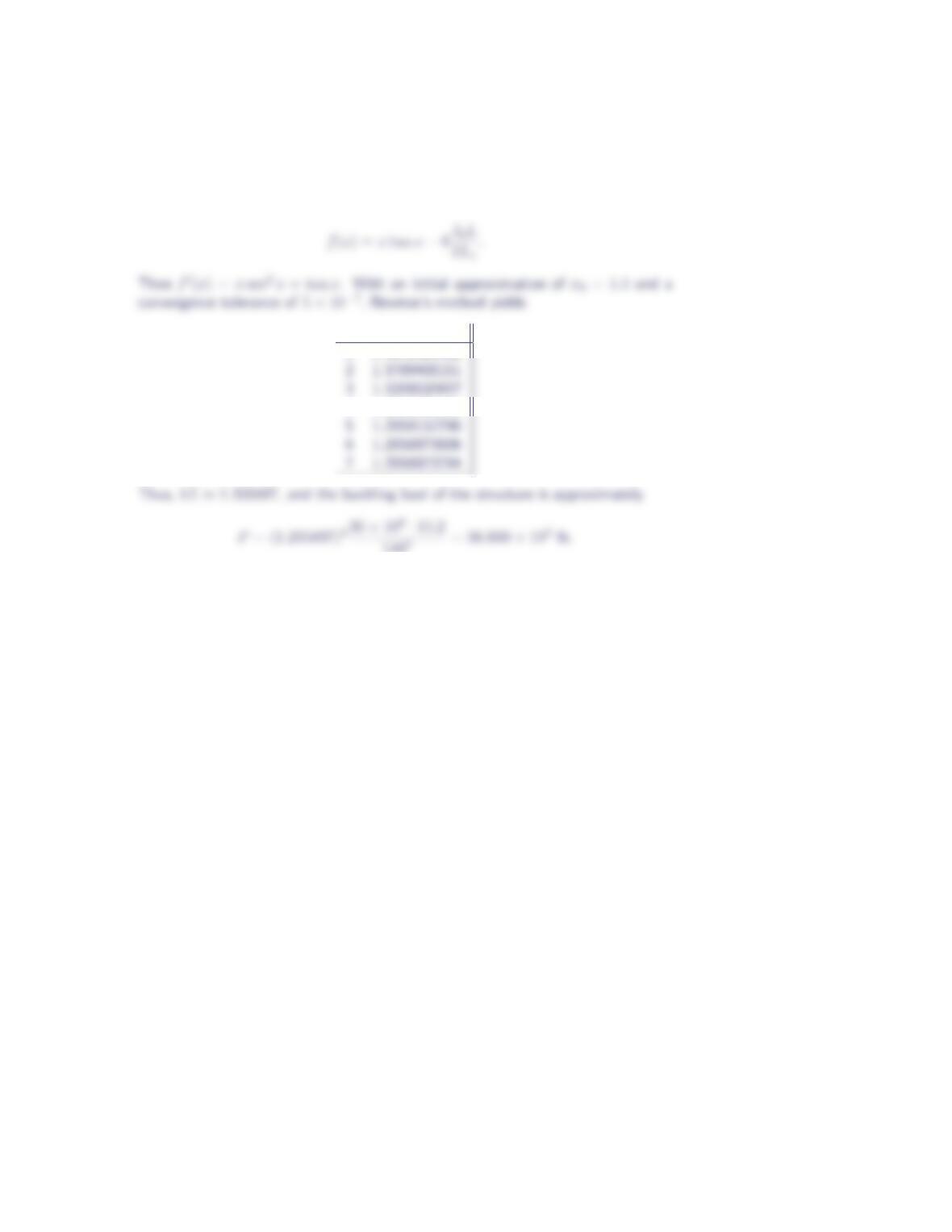
17. A frame structure is composed of two vertical columns and one horizontal beam,
as shown below. The vertical columns are of length Land have modulus of elas-
ticity Eand moment of inertia I. The horizontal beam connecting the tops of
the columns is of length L1with modulus of elasticity Eand moment of inertia
I1. The structure is pinned at the bottom and free to displace laterally at the
top. The buckling load, P, for the structure is given by
P
P
P= (kL)2EI
L2,
where kL is the smallest positive solution of
kL tan kL = 6 I1L
IL1
.
Suppose E= 30 ×106lb/in2,I= 15.2 in4,
L= 144 in, I1= 9.7 in4and L1= 120 in.
Determine the buckling load of the structure.
Newton’s Method 13
Let x=kL and define the function
nxn
1 1.4472486988
4 1.2981292481