CHAPTER 2
Conceptual Framework for
Financial Reporting
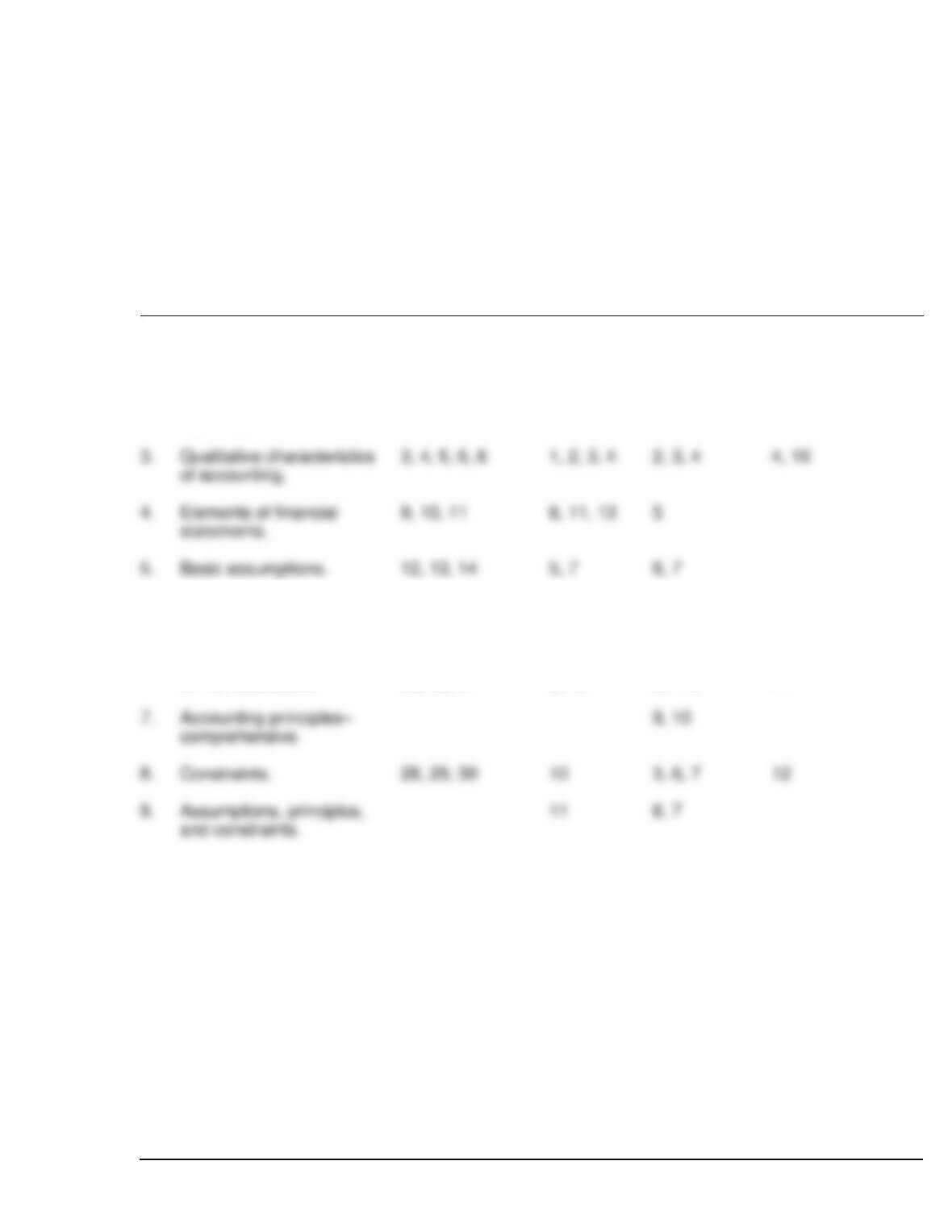
ASSIGNMENT CLASSIFICATION TABLE (BY TOPIC)
Topics
Questions
Brief
Exercises
Exercises
Concepts
for Analysis
1.
Conceptual framework–
general.
1, 7
1, 2
2.
Objectives of financial
reporting.
2
1, 2
3
6.
Basic principles:
a. Measurement.
b. Revenue recognition.
c. Expense recognition.
d. Full disclosure.
15, 16, 17, 18
19, 20, 21, 22, 23
24
25, 26, 27
8, 9, 12
8
8, 12,
8, 12
6, 7
7
6, 7
6, 7, 8
5, 6
5, 6
5, 6, 7, 8, 9, 11
11
7.
Accounting principles–
comprehensive.
9, 10
Constraints.
28, 29, 30
3, 6, 7
9.
Assumptions, principles,
and constraints.
6, 7
3.
Qualitative characteristics
of accounting.
3, 4, 5, 6, 8
1, 2, 3, 4
2, 3, 4
4, 10
4.
Elements of financial
statements.
9, 10, 11
6, 11, 13
5
Basic assumptions.
12, 13, 14
5, 7
6, 7
2-2
ASSIGNMENT CLASSIFICATION TABLE (BY LEARNING OBJECTIVE)
Learning Objectives
Brief Exercises
Exercises
1. Describe the usefulness of a conceptual framework.
1, 2
2. Describe the FASB’s efforts to construct a conceptual
framework.
3. Understand the objectives of financial reporting.
1, 2
4. Identify the qualitative characteristics of accounting
information.
1, 2, 3, 4, 5
2, 3, 4
5. Define the basic elements of financial statements.
6, 13
5
6. Describe the basic assumptions of accounting.
7, 11, 12
6, 7
7. Explain the application of the basic principles of
accounting.
8, 9, 11, 12
6, 7, 8, 9, 10
8. Describe the impact that constraints have on reporting
accounting information.
10, 12
3, 6, 7

ASSIGNMENT CHARACTERISTICS TABLE
Item
Description
Level of
Difficulty
Time
(minutes)
E2-1
Usefulness, objectives of financial reporting.
Simple
15–20
E2-2
Usefulness, objectives of financial reporting, qualitative
characteristics.
Simple
15–20
CA2-1
Conceptual framework–general.
Simple
20–25
CA2-2
Conceptual framework–general.
Simple
25–35
CA2-3
Objective of financial reporting.
Moderate
25–35
CA2-4
Qualitative characteristics.
Moderate
30–35
CA2-5
Revenue and expense recognition principles.
Complex
25–30
CA2-6
Revenue and expense recognition principles.
Moderate
30–35
CA2-7
Expense recognition principle.
Complex
20–25
CA2-8
Expense recognition principle.
Moderate
20–25
CA2-9
Expense recognition principle.
Moderate
20–30
CA2–10
Qualitative characteristics.
Moderate
20–30
CA2–11
Expense recognition principle.
Moderate
20–25
CA2–12
Cost Constraint.
Moderate
30–35
E2-3
Qualitative characteristics.
Moderate
25–30
E2-4
Qualitative characteristics.
Simple
15–20
E2-5
Elements of financial statements.
Simple
15–20
E2-6
Assumptions, principles, and constraints.
Simple
15–20
E2-7
Assumptions, principles, and constraints.
Moderate
20–25
E2-8
Full disclosure principle.
Complex
20–25
E2-9
Accounting principles–comprehensive.
Moderate
20–25
E2–10
Accounting principles–comprehensive.
Moderate
20–25
2-4
SOLUTION TO CODIFICATION EXERCISES
CE2-1
(a) The master glossary provides three definitions of fair value that are found in GAAP:
Fair Value—The amount at which an asset (or Liability) could be bought (or incurred) or settled in
a current transaction between willing parties, that is, other than in a forced or liquidation sale.
(b) Revenue—Revenue earned by an entity from its direct distribution, exploitation, or licensing of a
film, before deduction for any of the entity’s direct costs of distribution. For markets and territories
in which an entity’s fully or jointly–owned films are distributed by third parties, revenue is the net
amounts payable to the entity by third party distributors. Revenue is reduced by appropriate
allowances, estimated returns, price concessions, or similar adjustments, as applicable.
The glossary references a revenue definition for the SEC: (Revenue (SEC))—See paragraph
942–235-S599-1, Regulation S-X Rule 9-05(c)(2), for the definition of revenue for purposes of
Regulation S-X Rule 9-05.
CE2-2
The FASB Codification’s organization is closely aligned with the elements of financial statements, as

CE2-3
The Importance of Industry Practices is reflected in the designation of several industries as top level
links in the Codification organization. There are separate links to sections for the following industries
(section numbers precede each name):
905 Agriculture
908 Airlines
950 Financial Services—Title Plant
952 Franchisors
954 Health Care Entities
956 Limited Liability Entities
958 Not-for-Profit Entities
960 Plan Accounting—Defined Benefit Pension Plans
2-6
ANSWERS TO QUESTIONS
1. A conceptual framework is a coherent system of interrelated objectives and fundamentals that can
lead to consistent standards and that prescribes the nature, function, and limits of financial account-
ing and financial statements. A conceptual framework is necessary in financial accounting for the
following reasons:
2. The basic objective is to provide financial information about the reporting entity that is useful to
present and potential equity investors, lenders, and other creditors in making decisions about
providing resources to the entity.
5. The concept of materiality refers to the relative significance of an amount, activity, or item to
informative disclosure and a proper presentation of financial position and the results of operations.
Materiality has qualitative and quantitative aspects; both the nature of the item and its relative size
enter into its evaluation.
An accounting misstatement is said to be material if knowledge of the misstatement will affect the
decisions of the average informed reader of the financial statements. Financial statements are
misleading if they omit a material fact or include so many immaterial matters as to be confusing. In
the examination, the auditor concentrates efforts in proportion to degrees of materiality and relative
risk and disregards immaterial items.
Questions Chapter 2 (Continued)
6. Enhancing qualities are qualitative characteristics that are complementary to the fundamental
qualitative characteristics. These characteristics distinguish more-useful information from less-
useful information. Enhancing characteristics are comparability, verifiability, timeliness, and
understandability.
7. In providing information to users of financial statements, the Board relies on general-purpose
financial statements. The intent of such statements is to provide the most useful information
8. Comparability facilitates comparisons between information about two different enterprises at a
particular point in time. Consistency, a type of comparability, facilitates comparisons between
information about the same enterprise at two different points in time.
9. At present, the accounting literature contains many terms that have peculiar and specific meanings.
10. Distributions to owners differ from expenses and losses in that they represent transfers to owners,
11. Investments by owners differ from revenues and gains in that they represent transfers by owners
12. The four basic assumptions that underlie the financial accounting structure are:
(1) An economic entity assumption.
(2) A going concern assumption.
(3) A monetary unit assumption.
(4) A periodicity assumption.
2-8
Questions Chapter 2 (Continued)
(b) The practice of periodic measurement has led to many of the most difficult accounting prob–
lems such as inventory pricing, depreciation of long-term assets, and the necessity for
revenue recognition tests. The accrual system calls for associating related revenues and
14. The monetary unit assumption assumes that the unit of measure (the dollar) remains reasonably
stable so that dollars of different years can be added without any adjustment. When the value of
the dollar fluctuates greatly over time, the monetary unit assumption loses its validity.
The FASB in Concept No. 5 indicated that it expects the dollar unadjusted for inflation or deflation
to be used to measure items recognized in financial statements. Only if circumstances change
dramatically will the Board consider a more stable measurement unit.
16. Fair value is defined as “the price that would be received to sell an asset or paid to transfer a
liability in an orderly transaction between market participants at the measurement date.” Fair value
is therefore a market-based measure.
18. The fair value hierarchy provides insight into the priority of valuation techniques that are used to
determine fair value. The fair value hierarchy is divided into three broad levels.
Fair Value Hierarchy
Level 1: Observable inputs that reflect quoted prices for
Least Subjective
identical assets or liabilities in active markets.
Questions Chapter 2 (Continued)
19. Revenue is generally recognized when (1) realized or realizable, and (2) earned.
The adoption of the sale basis is the accountant’s practical solution to the extremely difficult
problem of measuring revenue under conditions of uncertainty as to the future. The revenue is
equal to the amount of cash that will be received due to the operations of the current accounting
20. Revenues should be recognized when they are realized or realizable and earned. The most
common time at which these two conditions are met is when the product or merchandise is
delivered or services are rendered to customers. Therefore, revenue for Selane Eatery should be
recognized at the time the luncheon is served.
21. Revenues are realized when products (goods or services), merchandise, or other assets are ex–
changed for cash or claims to cash. Revenues are realizable when related assets received or held
22. Each deviation depends on either the existence of earlier objective evidence other than the sale or
insufficient evidence of sale. Objective evidence is the key.
(a) In the case of installment sales the probability of uncollectibility may be great due to the nature
of the collection terms. The sale itself, therefore, does not give an accurate basis on which to
estimate the amount of cash that will be collected. It is necessary to adopt a basis which will
Questions Chapter 2 (Continued)
(b) The opposite is true in the case of certain agricultural products. Since there is a ready buyer
and a quoted price, a sale is not necessary to establish the amount of revenue to be received.
In fact, the sale is an insignificant part of the whole operation. As soon as it is harvested, the
crop can be valued at its selling price less the cost of transportation to the market and this
23. The president means that the “gain” should be recorded in the books. This item should not be
entered in the accounts, however, because it has not been realized.
24. The cause and effect relationship can seldom be conclusively demonstrated, but many costs
appear to be related to particular revenues and recognizing them as expenses accompanies
recognition of the revenue. Examples of expenses that are recognized by associating cause and
effect are sales commissions and cost of products sold or services provided.
25. The four characteristics are:
(1) Definitions—The item meets the definition of an element of financial statements.
(2) Measurability—It has a relevant attribute measurable with sufficient reliability.
(3) Relevance—The information is capable of making a difference in user decisions.
(4) Reliability—The information is representationally faithful, verifiable, and neutral.
26. (a) To be recognized in the main body of financial statements, an item must meet the definition of
an element. In addition the item must have been measured, recorded in the books, and passed
through the double-entry system of accounting.
Questions Chapter 2 (Continued)
27. The general guide followed with regard to the full disclosure principle is to disclose in the financial
statements any facts of sufficient importance to influence the judgment of an informed reader.
The fact that the amount of outstanding common stock doubled in January of the subsequent
28. Accounting information is subject to the cost constraint. Information is not worth providing unless
the benefits exceed the costs of preparing it.
29. The costs of providing accounting information are paid primarily to highly trained accountants who
design and implement information systems, retrieve and analyze large amounts of data, prepare
financial statements in accordance with authoritative pronouncements, and audit the information
30. (a) Acceptable if reasonably accurate estimation is possible. To the extent that warranty costs can
be estimated accurately, they should be matched against the related sales revenue.
(b) Not acceptable. Most accounts are collectible or the company will be out of business very soon.
Hence sales can be recorded when made. Also, other companies record sales when made
2-12
BRIEF EXERCISE 2-1
(a) 5. Comparability
BRIEF EXERCISE 2-2
(a) 5. Faithful representation
BRIEF EXERCISE 2-3
(a) If the company changed its method for inventory valuation, the consis-
tency, and therefore the comparability, of the financial statements have
been affected by a change in the method of applying the accounting
BRIEF EXERCISE 2-3 (continued)
(c) If the company reduced the estimated remaining useful life of plant
property because of obsolescence, the comparability of the financial
BRIEF EXERCISE 2-4
(a) Verifiability
BRIEF EXERCISE 2-5
Companies and their auditors for the most part have adopted the general
rule of thumb that anything under 5% of net income is considered not material.
Recently, the SEC has indicated that it is okay to use this percentage for
the initial assessment of materiality, but other factors must be considered.
BRIEF EXERCISE 2-5 (Continued)
(b) Each item must be considered separately and not netted. Therefore
BRIEF EXERCISE 2-6
(a) Equity
(b) Revenues
BRIEF EXERCISE 2-7
(a) Periodicity
BRIEF EXERCISE 2-8
(a) Revenue recognition
BRIEF EXERCISE 2-9
Investment 1—Level 3
BRIEF EXERCISE 2-10
(a) Industry practices
BRIEF EXERCISE 2-11
(a) Net realizable value.
BRIEF EXERCISE 2-12
2-16
BRIEF EXERCISE 2-13
(a) Should be debited to the Land account, as it is a cost incurred in acquir-
ing land.
SOLUTIONS TO EXERCISES
EXERCISE 2-1 (15–20 minutes)
(a) True.
(b) False – General-purpose financial reports helps users who lack the
ability to demand all the financial information they need from an entity
EXERCISE 2-2 (15–20 minutes)
(a) False – The fundamental qualitative characteristics that make account-
ing information useful are relevance and faithful representation.
EXERCISE 2-3 (20–30 minutes)
(a)
Confirmatory Value.
(f)
Relevance and Faithful
EXERCISE 2-4 (15–20 minutes)
(a)
Comparability.
(g)
Comparability, Verifiability,
Timeliness, and Understability.
EXERCISE 2-5 (15–20 minutes)
(a) Gains, losses.
(b) Liabilities.
(c) Investments by owners, comprehensive income.
EXERCISE 2-6 (15–20 minutes)
(a)
7.
Expense recognition principle.
EXERCISE 2-7 (20–25 minutes)
(a)
Historical cost principle.
(j)
Revenue and expense recogni-
EXERCISE 2-8
(a) It is well established in accounting that revenues, cost of goods sold
and expenses must be disclosed in an income statement. It might be
2-20
EXERCISE 2-8 (Continued)
(c) According to GAAP, the basis upon which inventory amounts are stated
(lower of cost or market) and the method used in determining cost (LIFO,
EXERCISE 2-9
(a) This entry violates the economic entity assumption. This assumption
in accounting indicates that economic activity can be identified with a
particular unit of accountability. In this situation, the company erred
by charging this cost to the wrong economic entity.