1
______________________________________________________________________________
(2.1) Apply the intermediate value theorem to show that the polynomial 24x10x)x(f 2−+−=
has a root in the interval [3,5].
Solution
The intermediate value theorem (see Section 2.2) guarantees that there exists at least one
2.2 Apply the intermediate value theory to show that the function has a root in the
interval .
Solution
The intermediate value theorem (see Section 2.2) guarantees that there exists at least one value x0 such that
fx() xcos x2
–=
0π2⁄,[]
2.3 Apply the intermediate value theorem to show that the polynomial has a
root in the interval .
Solution
fx() x32.5x2
–x–2.5+=
1.5–0.5–,[]
1
2.4 Use the formal definition of the derivative (Eq. (2.2)) and associated terminology to show that the
derivative of is .
Solution
xtan
xsec2
1
2.5 Use the formal definition of the derivative (Eq. (2.2)) and associated terminology to show that the
derivative of is .
Solution
ex2
2xex2
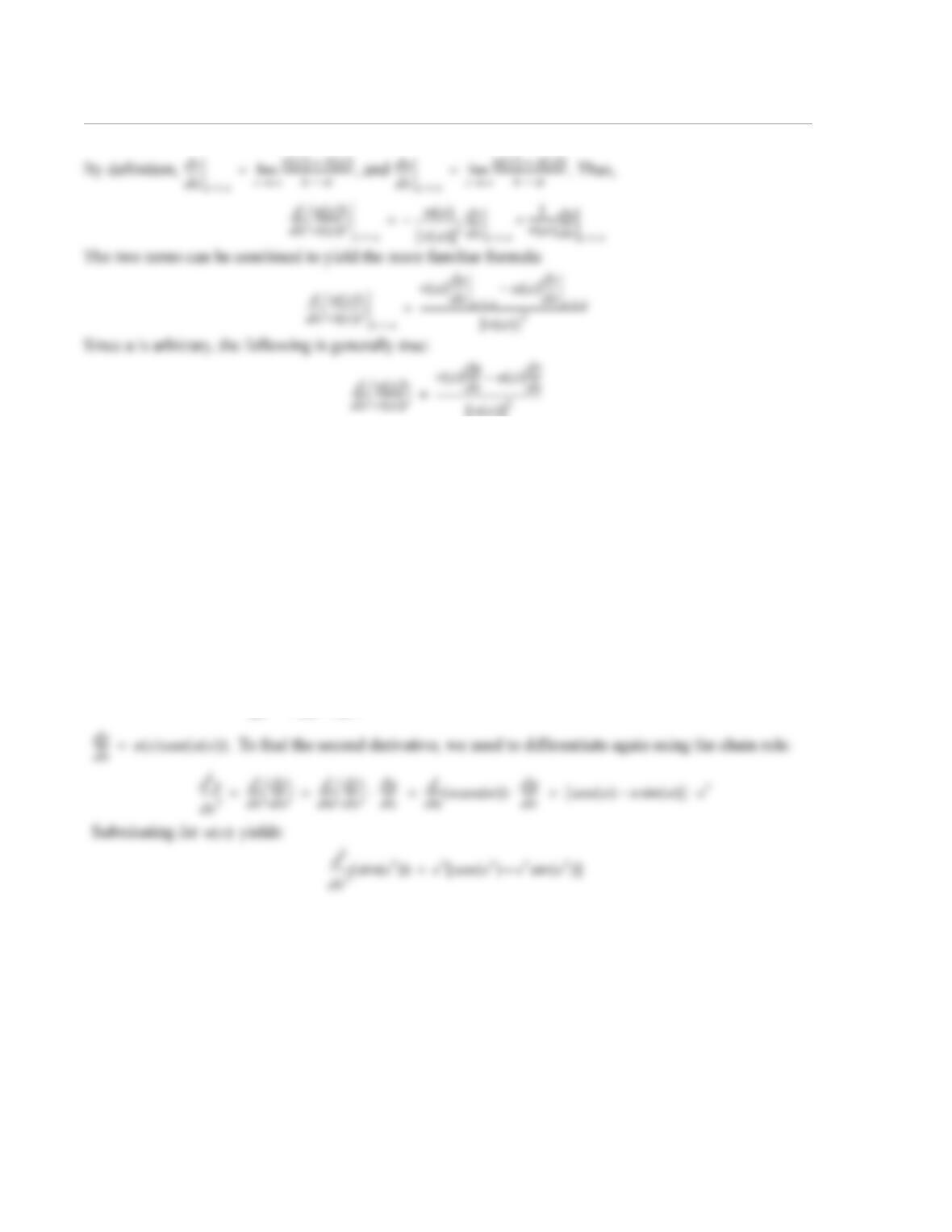
2.6 Use the definition of the derivative (Eq. (2.2)) to show that:
(a) . (b) .
Solution
(a) Using the definition of the derivative (Eq.(2.2)),
d
dx
—––ux()vx()()udv
dx
—––vdu
dx
—––
+=
d
dx
—––ux()
vx()
———–
⎝⎠
⎛⎞
vdu
dx
—––udv
dx
—––
–
v2
————————–=
d
dx
—––ux()vx()()
xa=
ux()vx() ua()va()–
xa–
————————————-————–
xa→
lim ux()vx() ux()va() ux()va()–ua()va()–+
xa–
——————-——————-——————-———————–——————-——–
xa→
lim==
d
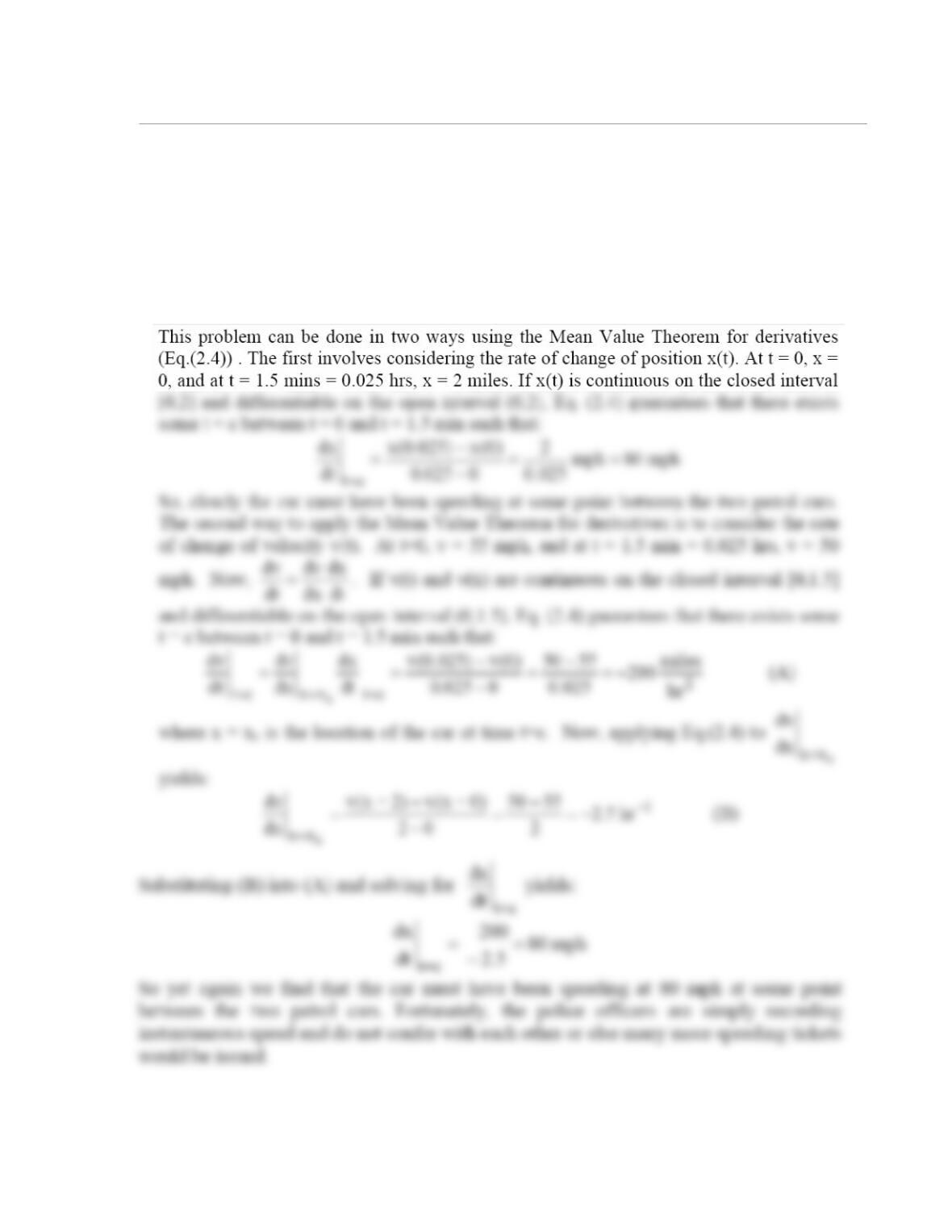
2.7 Use the chain rule (Eq. (2.3)) to find the second derivative of . (Hint: define
and then apply the chain rule.)
Solution
Defining , the given function becomes . Using the chain rule with
, . In terms of the first derivative is
fx() ex
()sin=
ux() ex
=
ux() ex
=
fux()() u()sin=
yfu() u()sin==
dy
dx
—––dy
du
—––
⎝⎠
⎛⎞
du
dx
—––
⎝⎠
⎛⎞ u()cos ex
⋅==
ux()
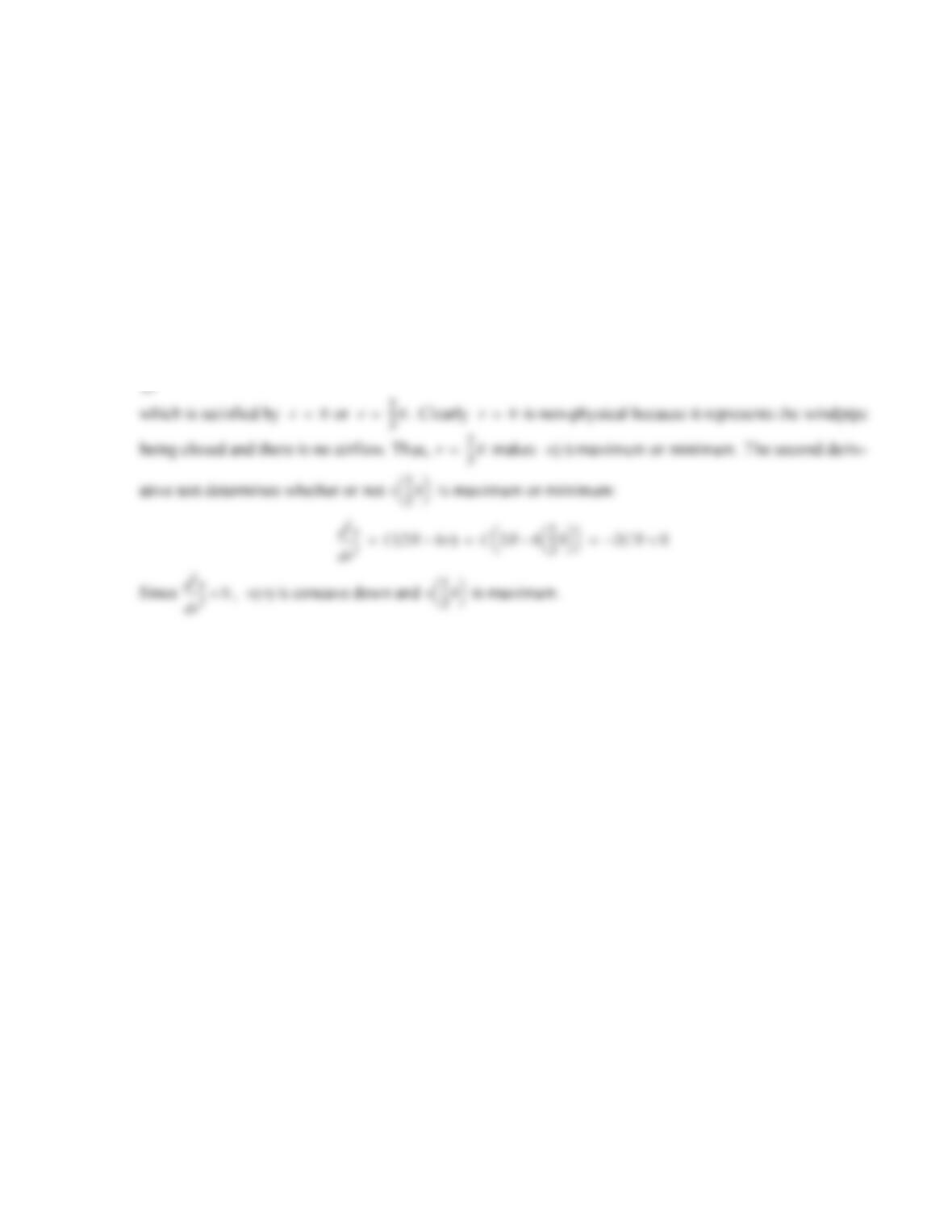
2.8 As a highway patrol officer, you are participating in a speed trap. A car passes your patrol car which
you clock at 55 mph. One and a half minutes later, your partner in another patrol car situated two miles
away from you, clocks the same car at 50 mph. Using the mean value theorem for derivatives (Eq. (2.4)),
show that the car must have exceeded the speed limit of 55 mph at some point during the one and a half
minutes it traveled between the two patrol cars.
Solution
2.9 Coughing causes the windpipe in the throat to contract, forcing the flowing air to pass with increased
velocity. Suppose the velocity, v, of the flowing air during the cough is given by:
where C is a constant, and R is the normal radius of the windpipe (i.e., when not coughing) which is also a
constant, and r is the variable radius of the windpipe during the cough. Find the radius of the windpipe that
produces the largest velocity of airflow during the cough.
Solution
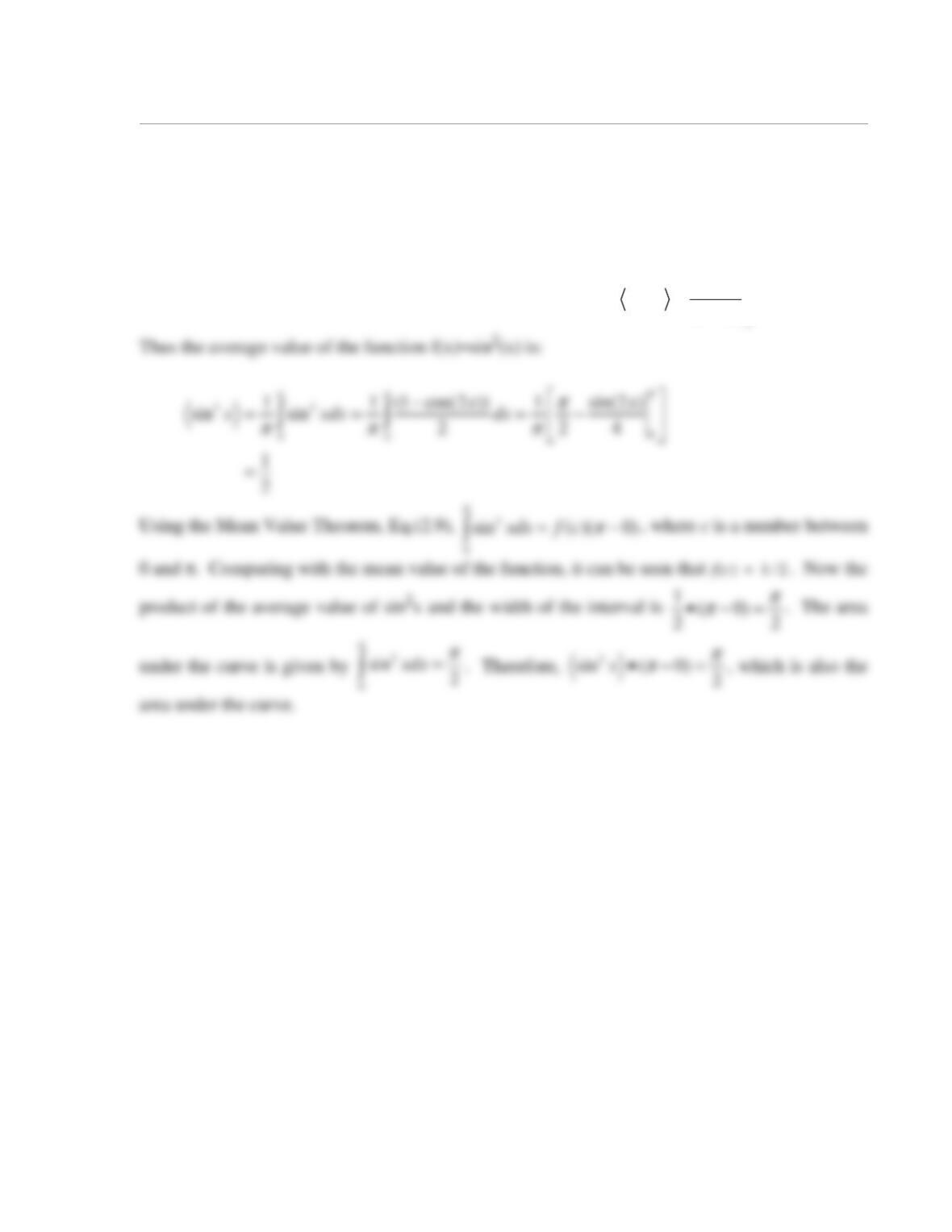
Given , the maximum (largest) or minimum value of v is found by setting . Thus,
vCRr–()r2
=
vr()
dv
dr
—–-0=
dv
—––C2Rr 3r2
–()0==
vr()
2.10 Using the mean value theorem for integrals, find the average value of the function in
the interval . Show that the product of this average value times the width of the interval is equal to
the area under the curve.
Solution
The average value of a function is defined by Eq. (2.10), .
fx() xsin2
=
0π,[]
fx()
1
() ()
()
b
a
fx fxdx
ba
=−
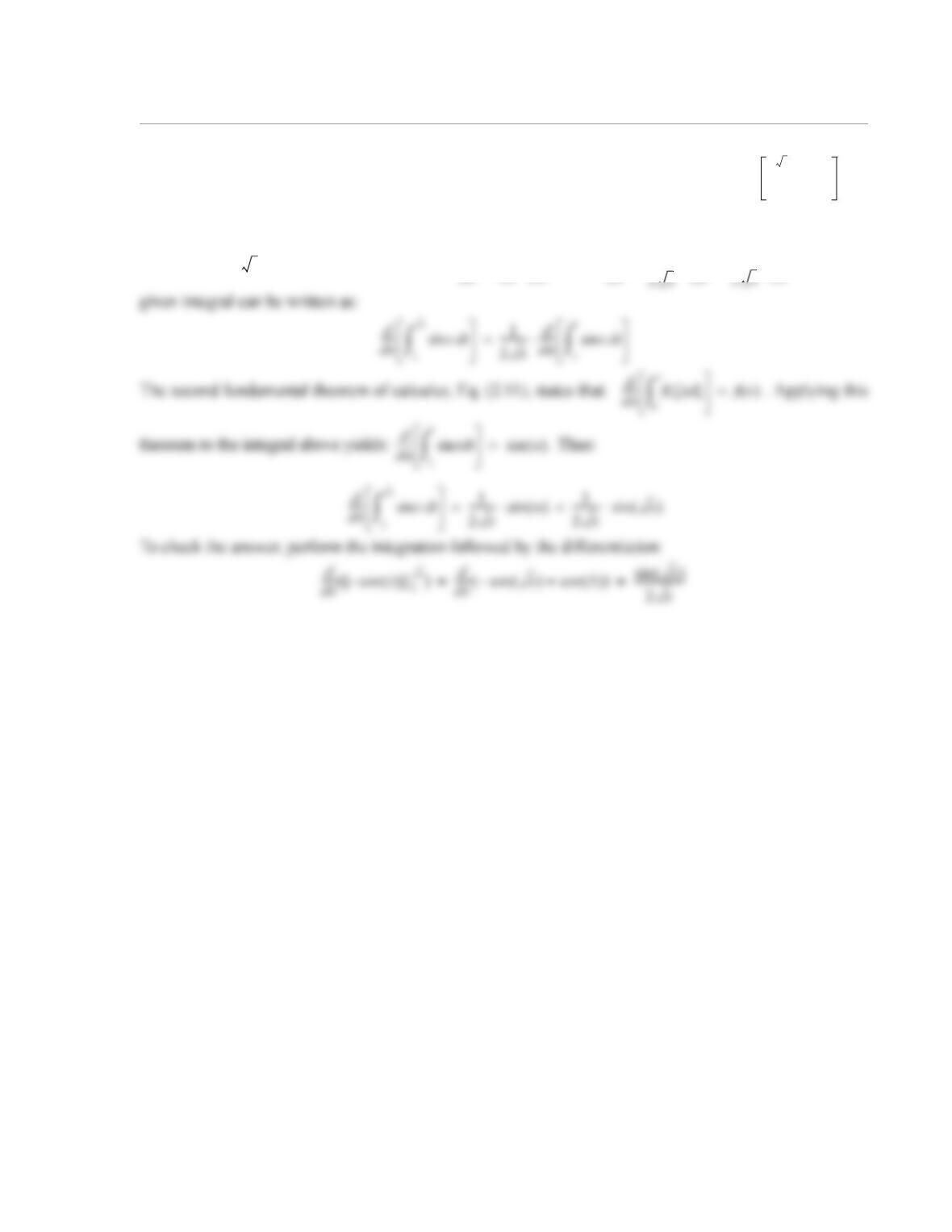
2.11 Use the second fundamental theorem of calculus along with the chain rule to find .
Solution
Defining , and using the chain rule, . Since , . Thus, the
d
dx
—––tsin td
1
x
∫
ux=
d
dx
—––du
dx
—––d
du
—––
⋅=
du
dx
—––1
———–=
d
dx
—––1
———–d
du
—––
⋅=
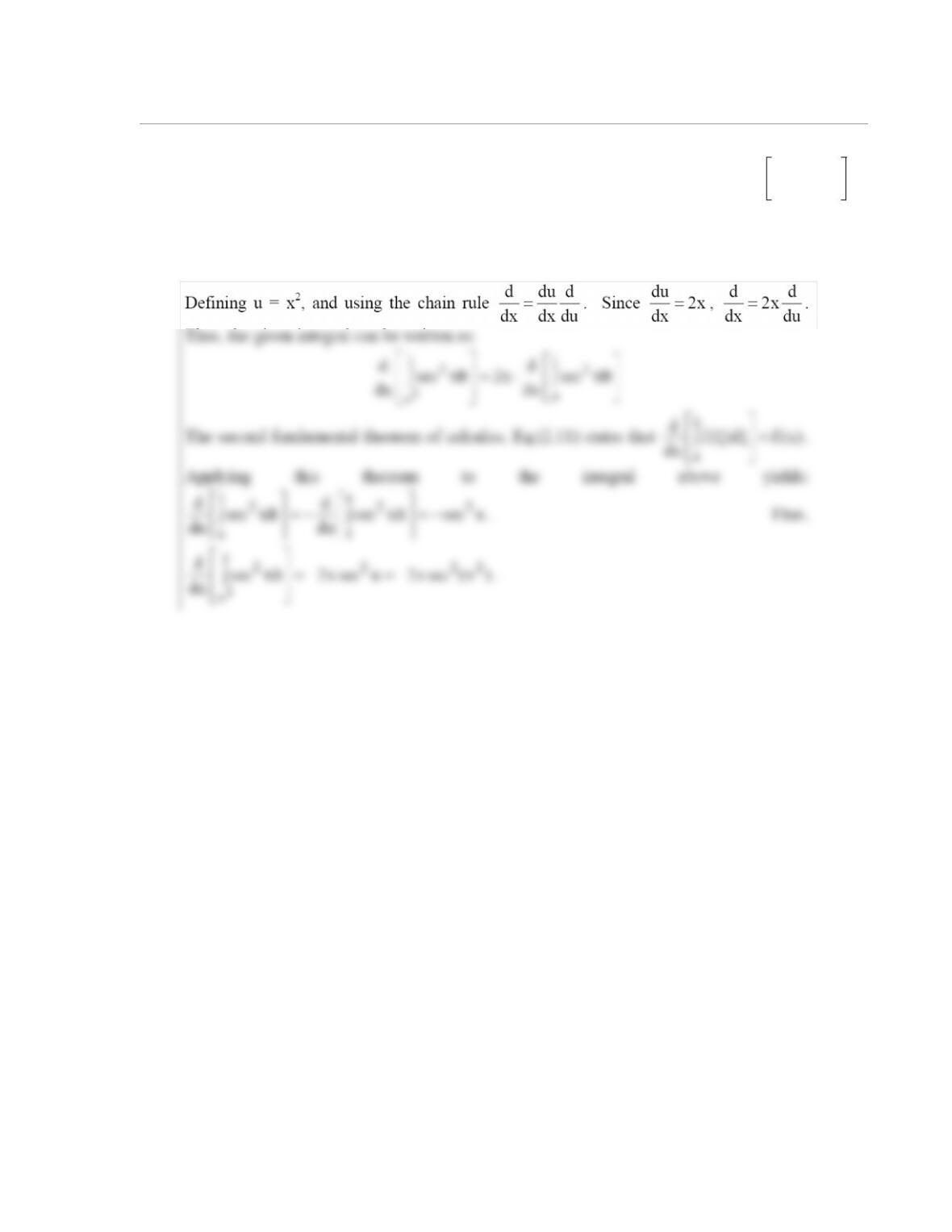
2.12 Use the second fundamental theorem of calculus along with the chain rule to find .
Solution
d
dx
—––tsec2td
x2
1
∫
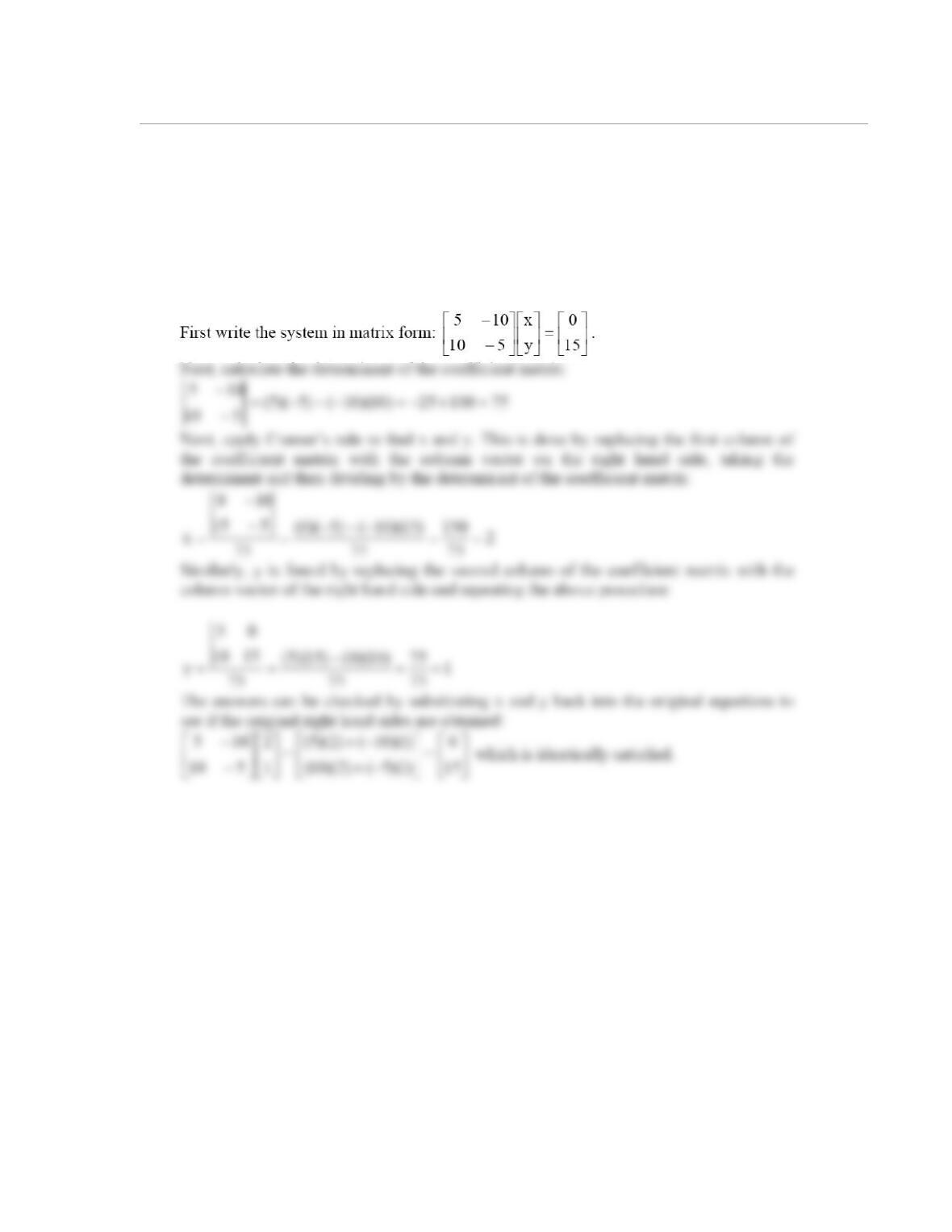
2.13 Given the following system of equations,
determine the unknowns x and y using Cramer’s rule.
Solution
5x10y–0=
10x5y–15=
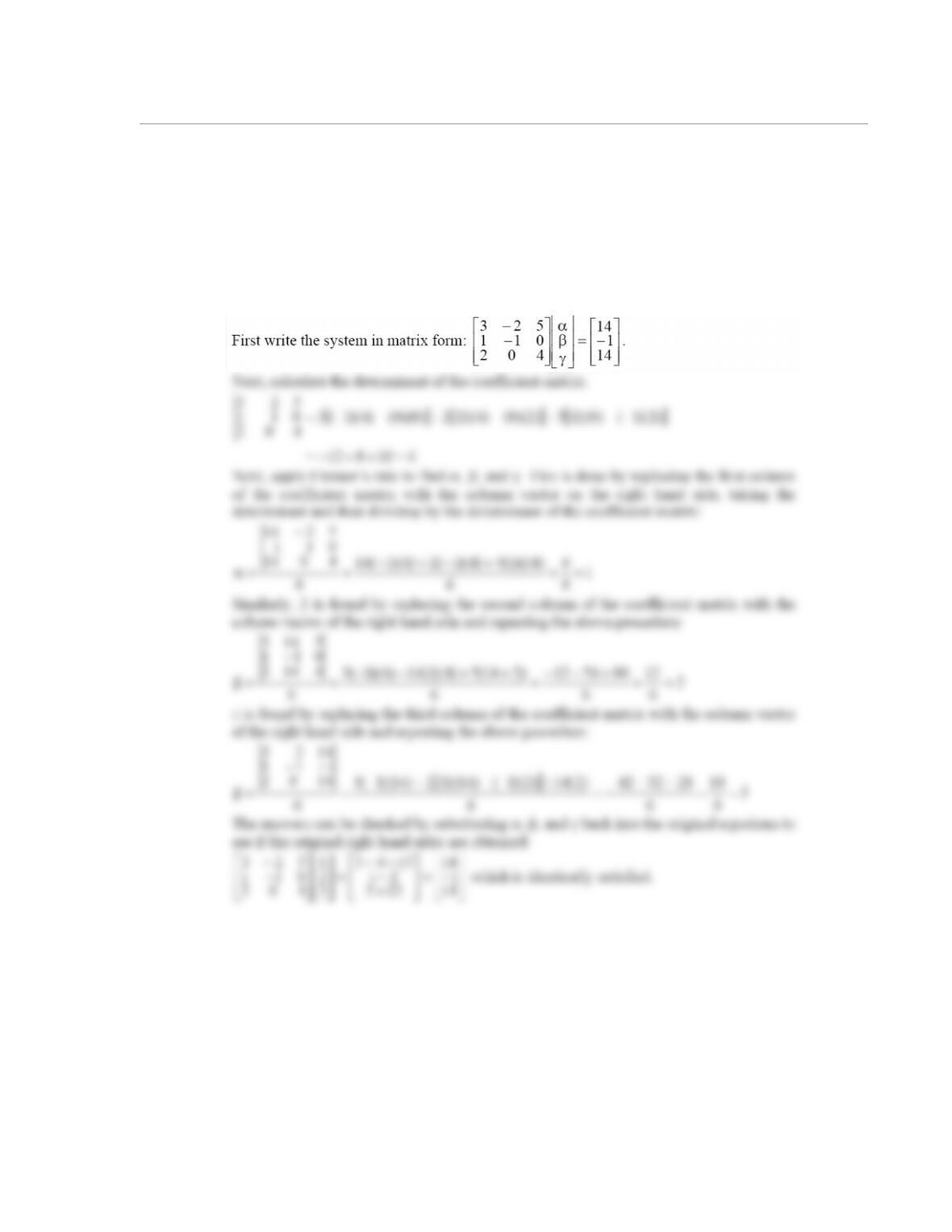
2.14 Given the following system of equations,
determine the unknowns , , and using Cramer’s rule.
Solution
3α2β–5γ+14=
αβ–1–=
2α4γ+14=
α
β
γ
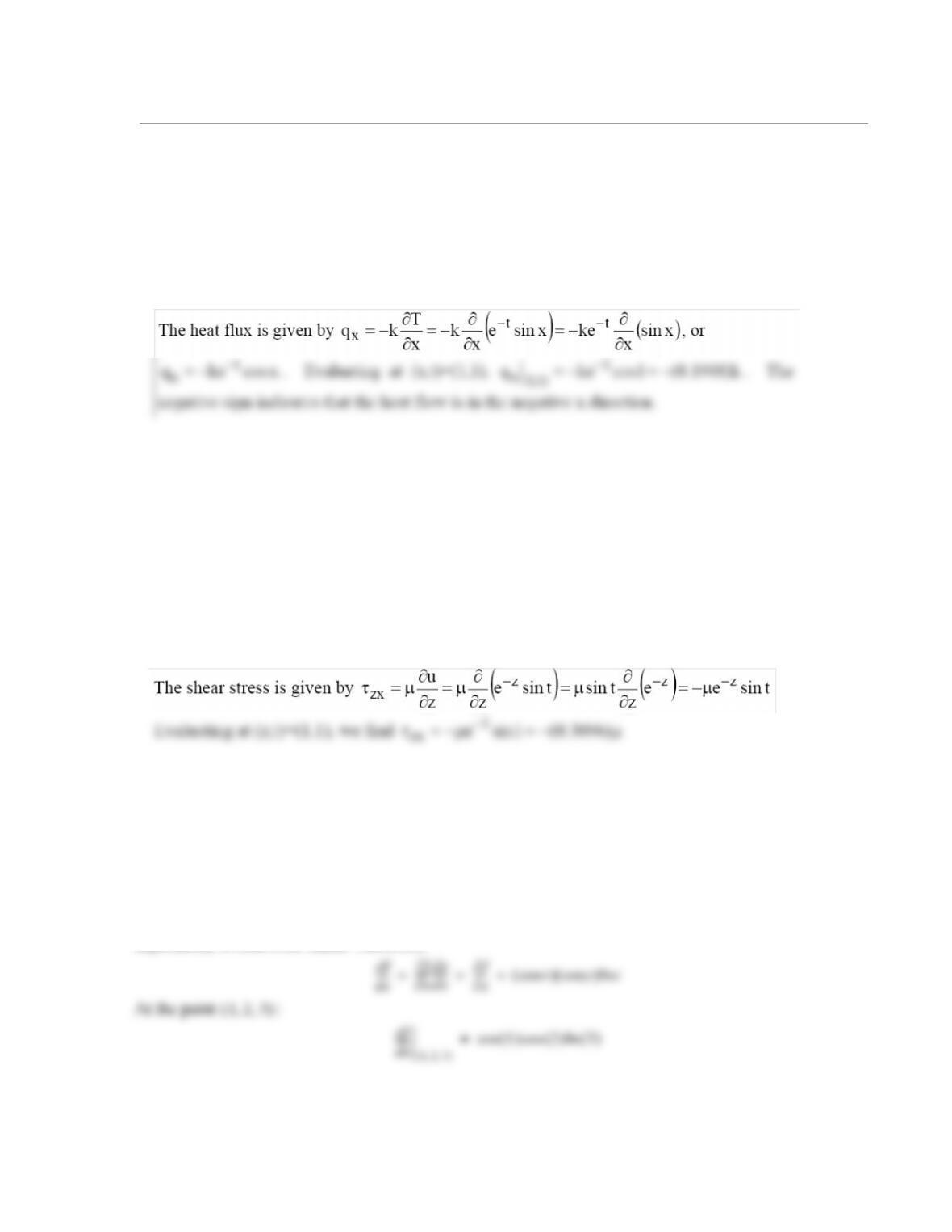
2.15 The temperature distribution in a solid is given by . The heat flux in the x direction
is given by . Using the definition of the partial derivative (Eq. (2.62)), find the heat flux at
the point and the instant .
Solution
Txt,() et–xsin=
qxk∂T
∂x
—––
–=
qx
x1=
t1=
2.16 The velocity distribution in a flow is given by , where u is the x-component of the
velocity, z is the coordinate perpendicular to x, and t is time. The shear stress is given by ,
where is the coefficient of dynamic viscosity. Using the definition of the partial derivative (Eq. (2.62)),
find the shear stress at the point and the instant .
Solution
uzt,() ez–tsin=
τzx
τzx μ∂u
∂z
—––
=
μ
τzx
z1=
t1=
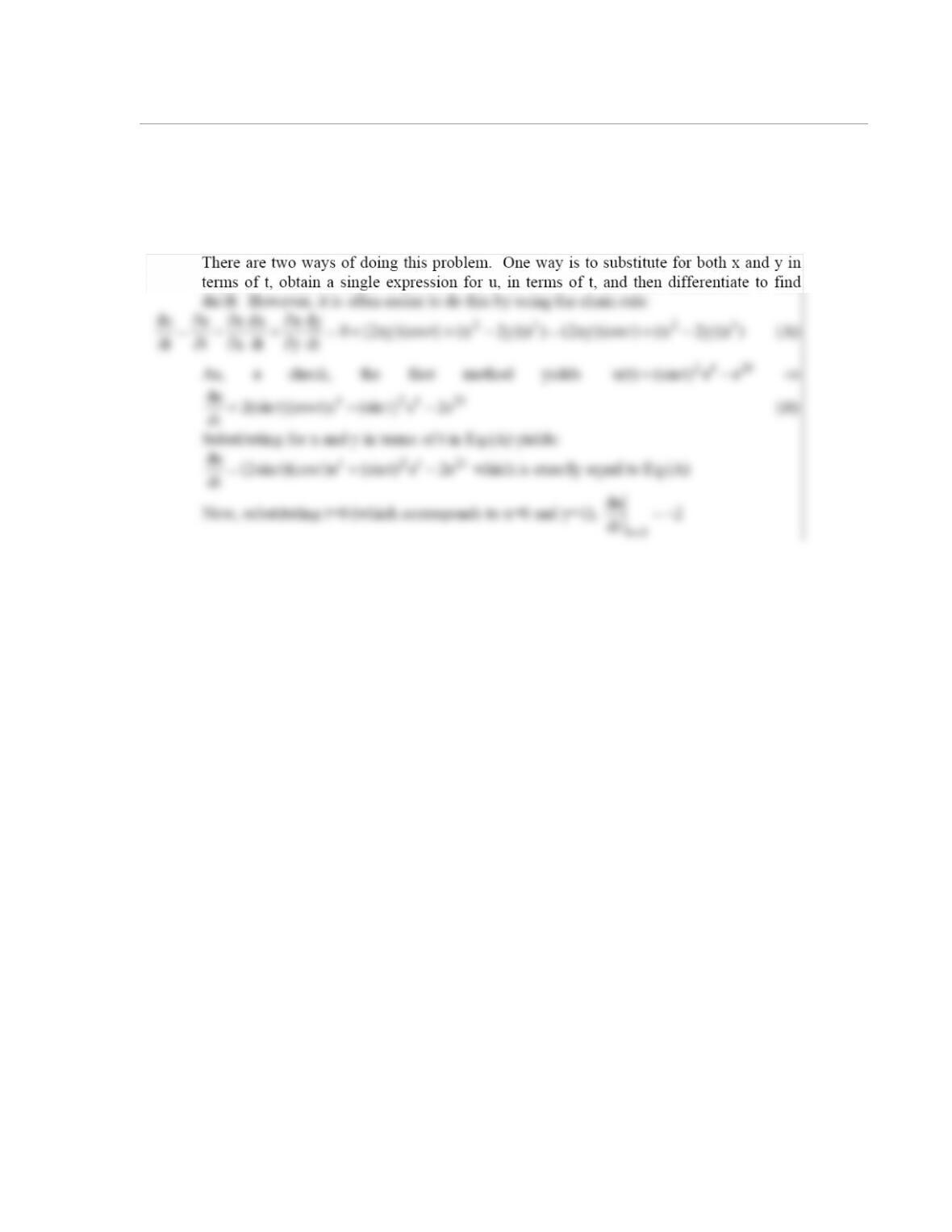
2.17 Given the function , find the total derivative with respect to x, at the point
.
Solution
From the problem statement, it may be assumed that x, y, and z are independent of each other since no
dependency is otherwise stated. Therefore,
fx() xsin()ycos()zln=
df
dx
—––
123,,()
123,,()
2.18 Given the function , where and , find when .
Solution
uxy,()x2yy
2
–=
xtsin=
ye
t
=
du
dt
—––
t0=
2.19 Find the determinant of the following matrix:
Solution
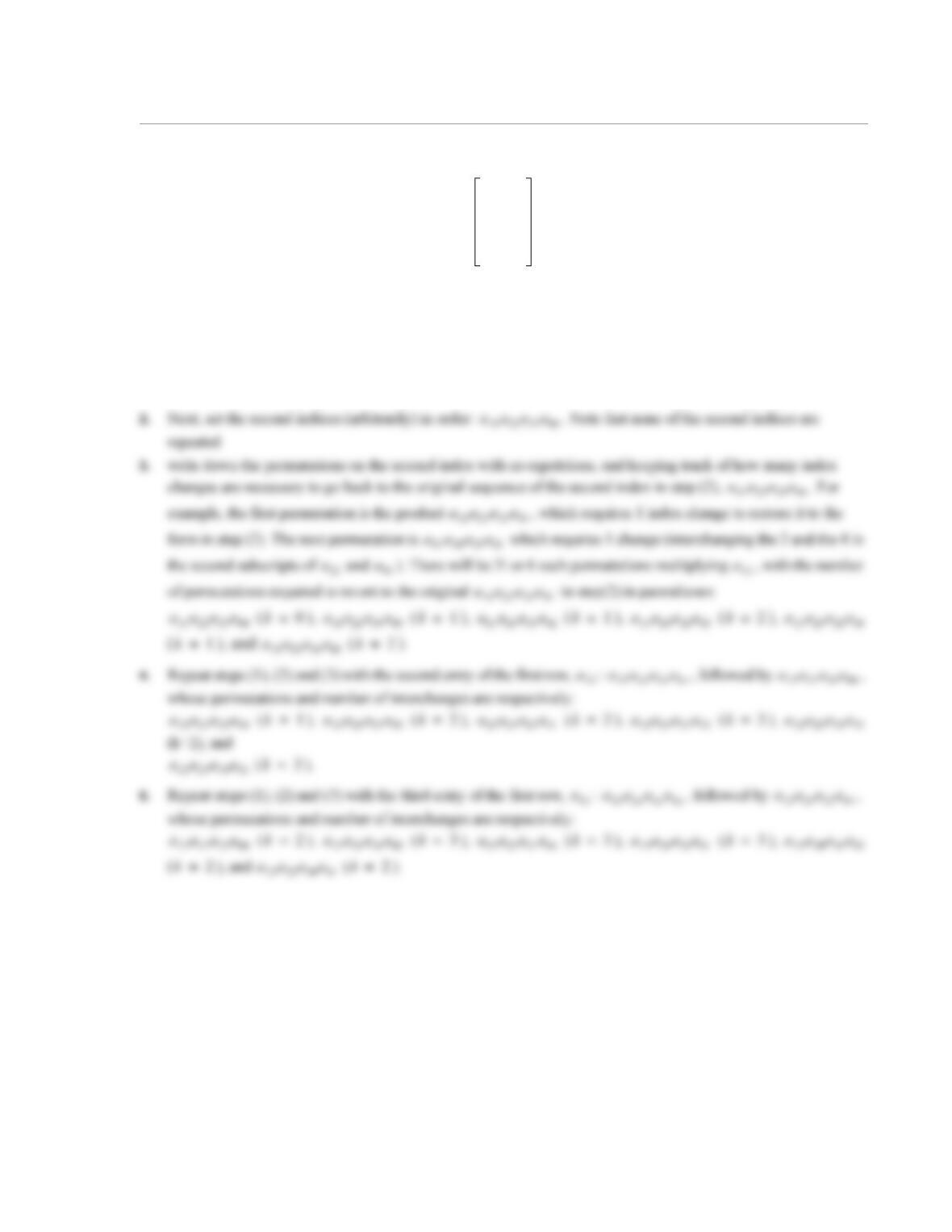
The long way to find the determinant of this matrix is to use the definition, Eq. (2.40). This is done in the
following steps:
1. start with the first element in the first row multiplied by other elements whose first indices are successive:
.
2003
1110
5119
1100
a11a2xa3xa4x
a22
a11a22a33a44
a11a24a32 a43
a12a21a33a44
a12a24a31 a43
a12a23a34a41
a13a2xa3xa4x
a13a21a32a44
a13a24a32 a41
2
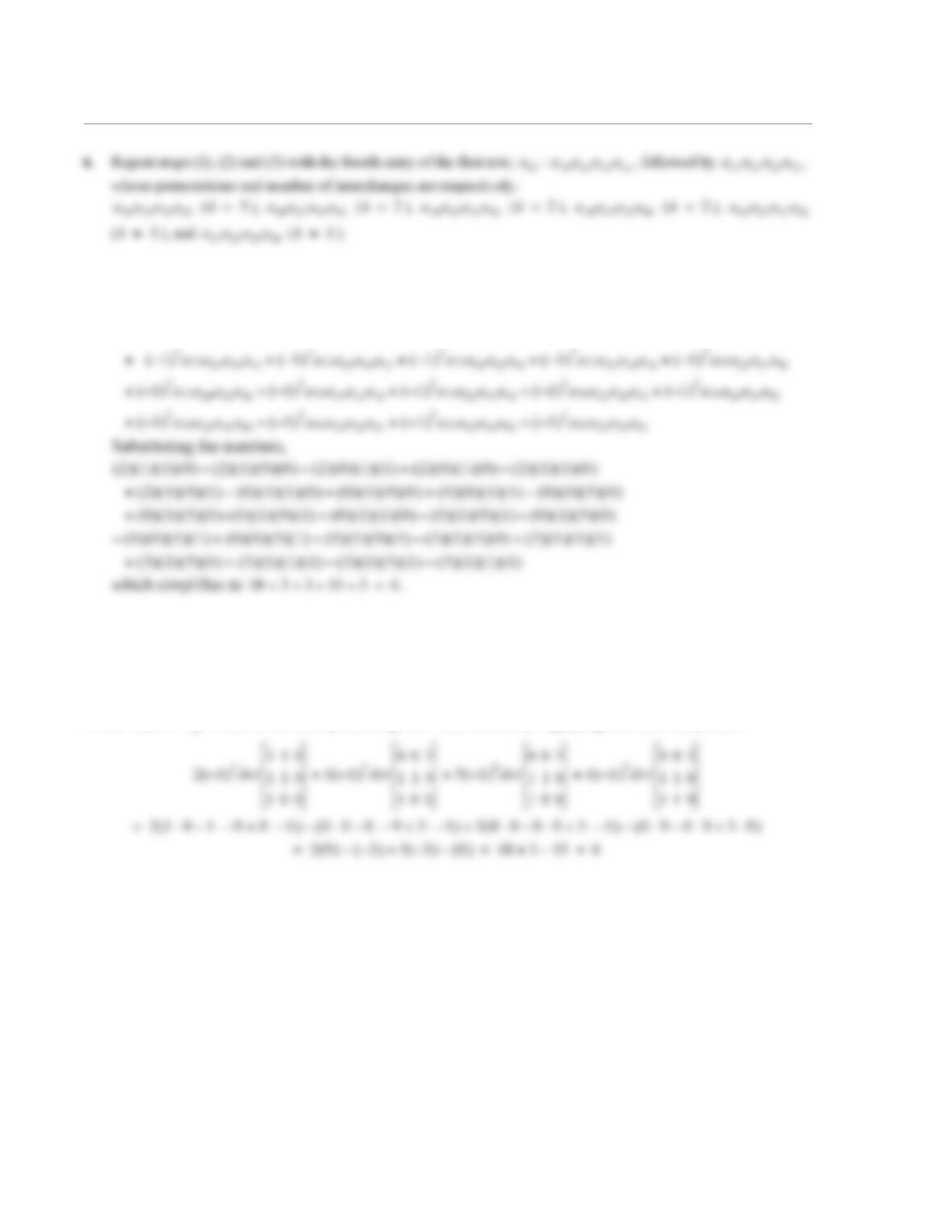
7. Add the terms from steps (3), (4), (5), and (6) each multiplied by their respective coefficient :
Thus, the determinant of the given matrix is 6.
There exists a simpler way of calculating the determinant. It can be shown that
, where is called the cofactor of the
minor matrix which is formed by deleting row i and column j. Applying this formula yields:
1–()
k
1–()
0a11a22a33a44 1–()
1a11a22a34a43 1–()
1a11a24a33a42 1–()
2a11a24a32a43 1–()
1a11a23a32a44
++++
+1–()
2a11a23a34a42 1–()
1a12a21a33a44 1–()
2a12a21a34a43 1–()
2a12a24a33a41 1–()
3a12a24a31a43
++++
det A() a1jC1ja2jC2ja3jC3j…anjCnj
++++=
Cij 1–()
ij+det Mij
()=
Mij
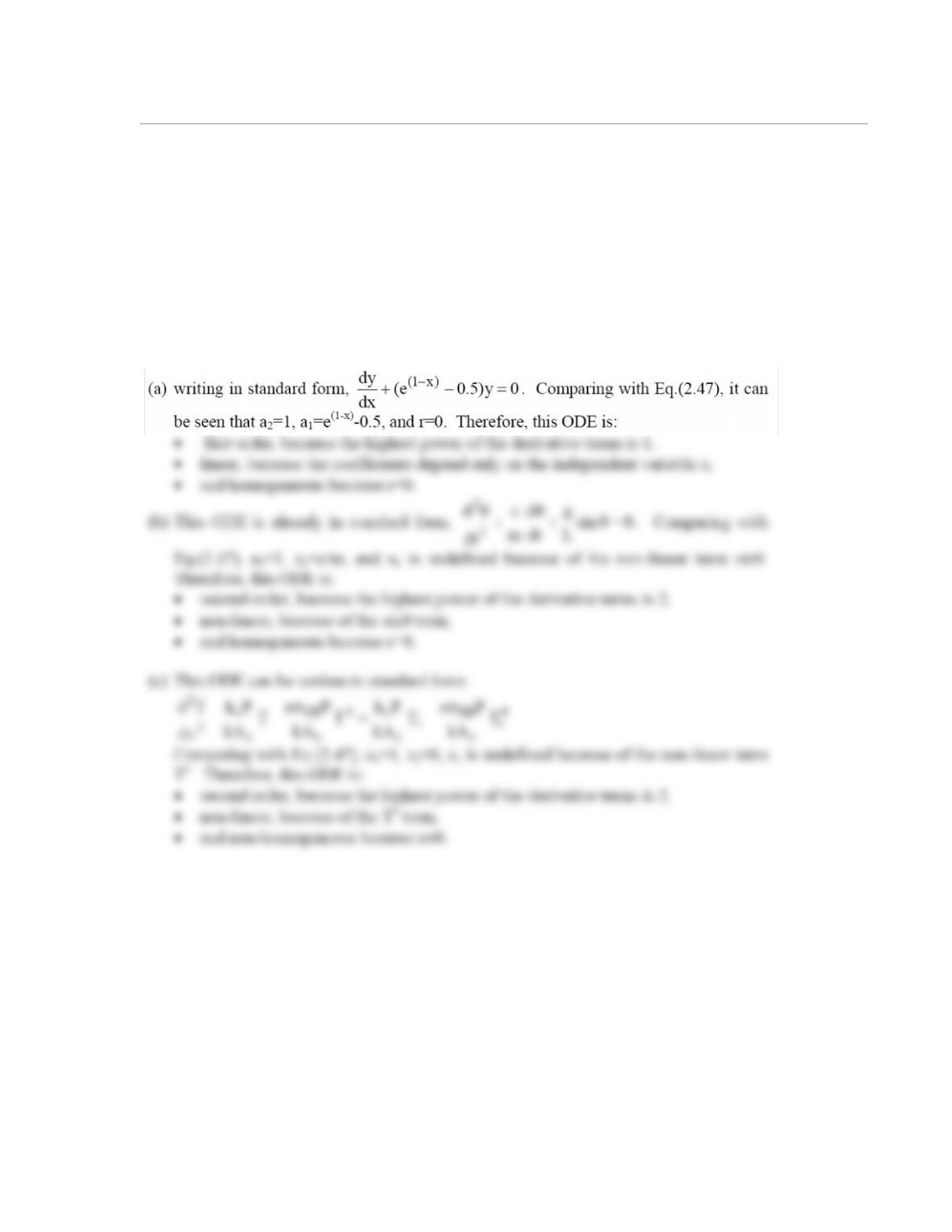
2.20 Determine the order of the following ODEs and whether they are linear or nonlinear, and homoge-
neous or non homogeneous:
(a).
(b), where c, m, g, and L are constants.
(c), where , P, k, , , , and are constants.
Solution
dy
dx
—––ye 1x–()
–0.5y+=
d2θ
dt2
——–– c
m
—–dθ
dt
—–– g
L
—–θsin++ 0=
d2T
dx2
——–– hcP
kAc
——––TT
S
–()–εσSBP
kAc
————–– T4TS
4
–()–0=
hc
Ac
ε
σSB
TS
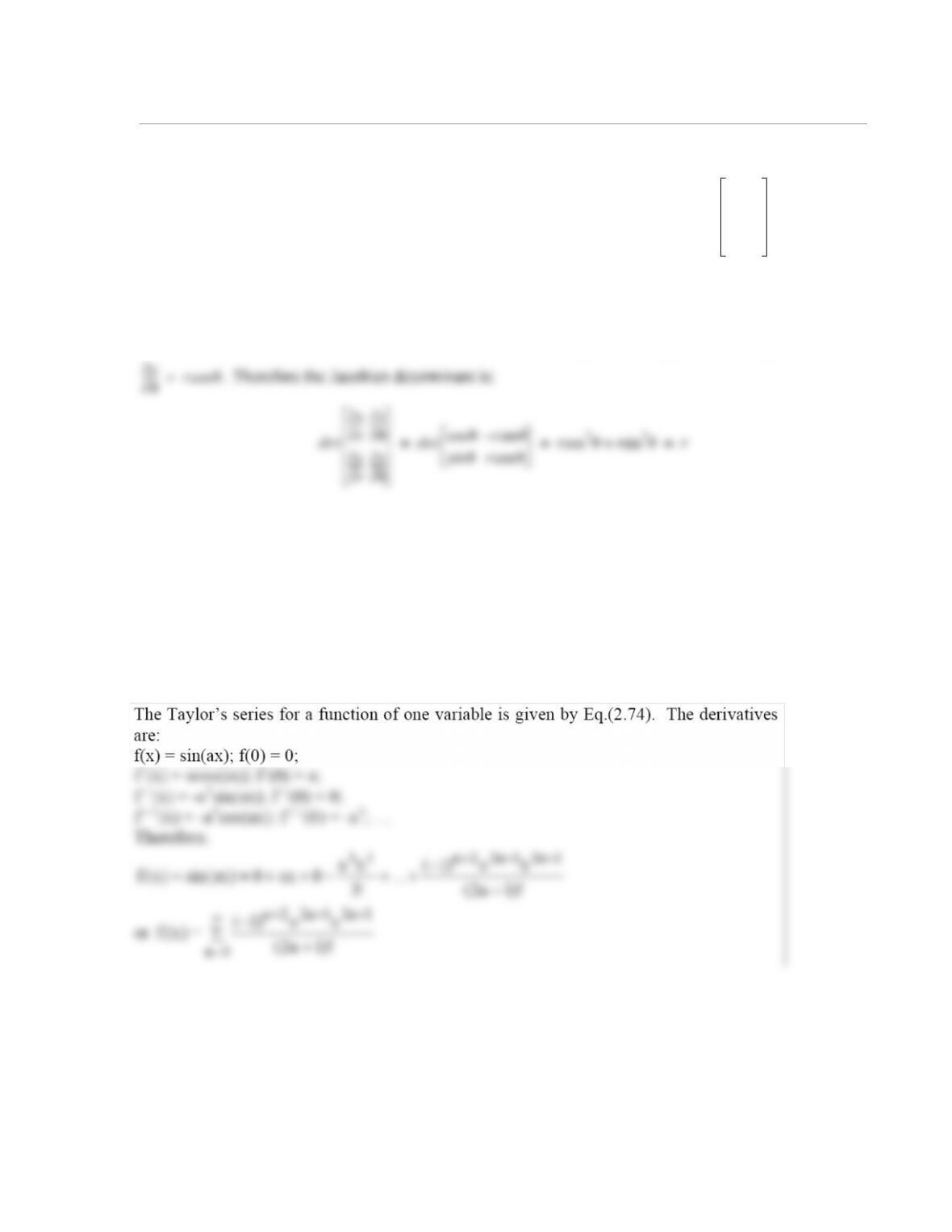
2.21When transforming from Cartesian coordinates to polar coordinates , the following rela-
tions hold: and . Find the Jacobian matrix . What is the
Jacobian determinant?
Solution
Evaluating the partial derivatives in the Jacobian matrix yields , , , and
xy,()
rθ,()
xrθ,()rθcos=
yrθ,()rθsin=
J[]
∂x
∂r
—– ∂x
∂θ
—––
∂y
∂r
—– ∂y
∂θ
—––
=
∂x
∂r
—– θcos=
∂x
∂θ
—––rθsin–=
∂y
∂r
—– θsin=
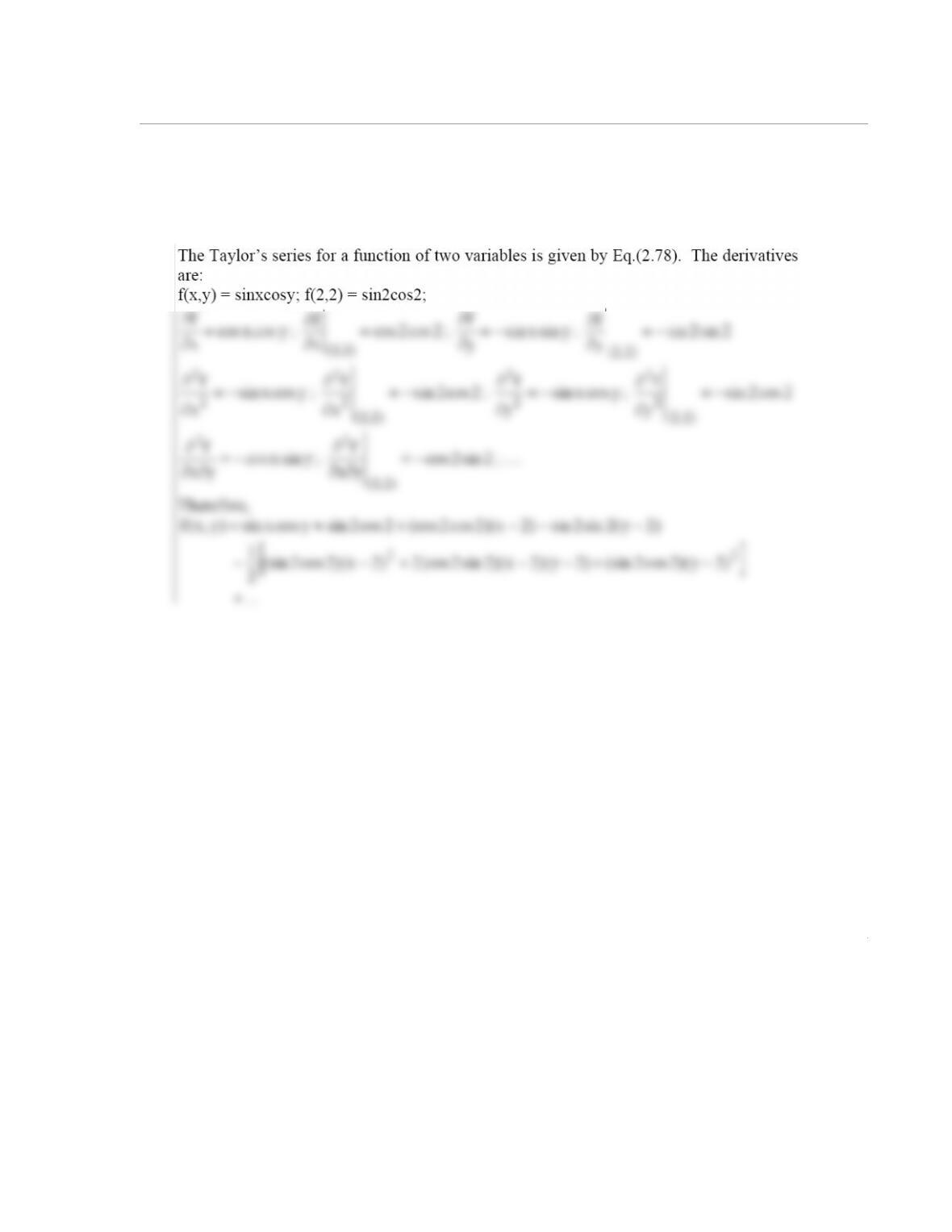
2.22 Write the Taylor’s series expansion of the function about , where is a
known constant.
Solution
fx() ax()sin=
x0=
a0≠
1
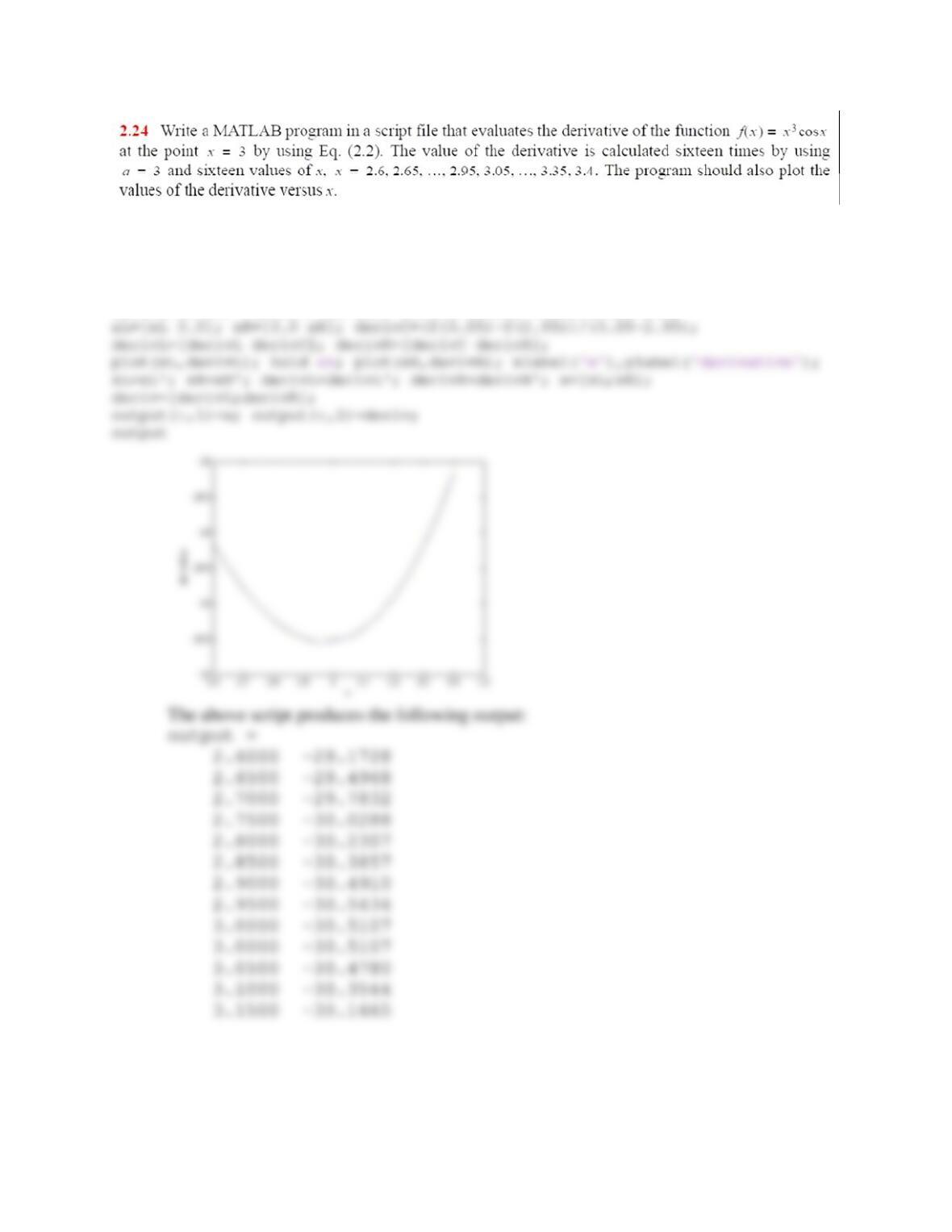
2.23 Write the Taylor’s series expansion of the function about the point
Solution
fxy,() xycossin=
22,()
1
______________________________________________________________________________
Solution
The following MATLAB script solves this problem:
% Problem (2.24), second edition
clear all; close all; clc; format compact;
f=inline(‘(x.^3).*cos(x)’,‘x’); x0=3; xL=2.6:0.05:2.95; xR=3.05:0.05:3.4;
derivL=(f(xL)-f(x0))./(xL-x0); derivR=(f(xR)-f(x0))./(xR-x0);