Bisection Method 1
Solutions
Chapter 2 Rootfinding
2.1 Bisection Method
1. Verify that each of the following equations has a root on the interval (0,1).
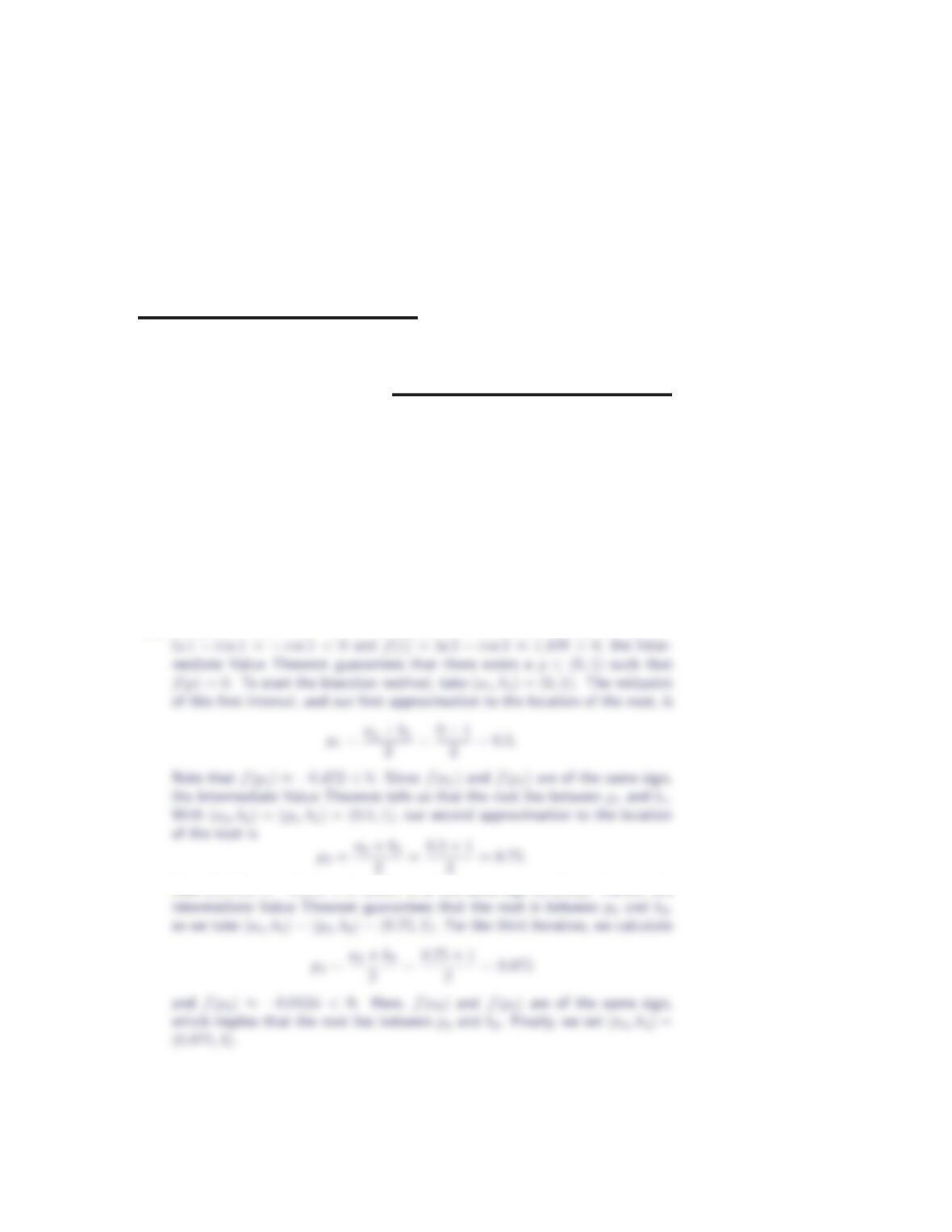
Next, perform the bisection method to determine p3, the third approximation
to the location of the root, and to determine (a4, b4), the next enclosing interval.
(a) ln(1 + x)−cos x= 0 (b) x5+ 2x−1 = 0
(c) e−x−x= 0 (d) cos x−x= 0
(a) Let f(x) = ln(1 + x)−cos x. Because fis continuous on [0,1] with f(0) =
Now f(0.75) ≈ −0.172 <0, which is of the same sign as f(a2). Hence, the
2Section 2.1
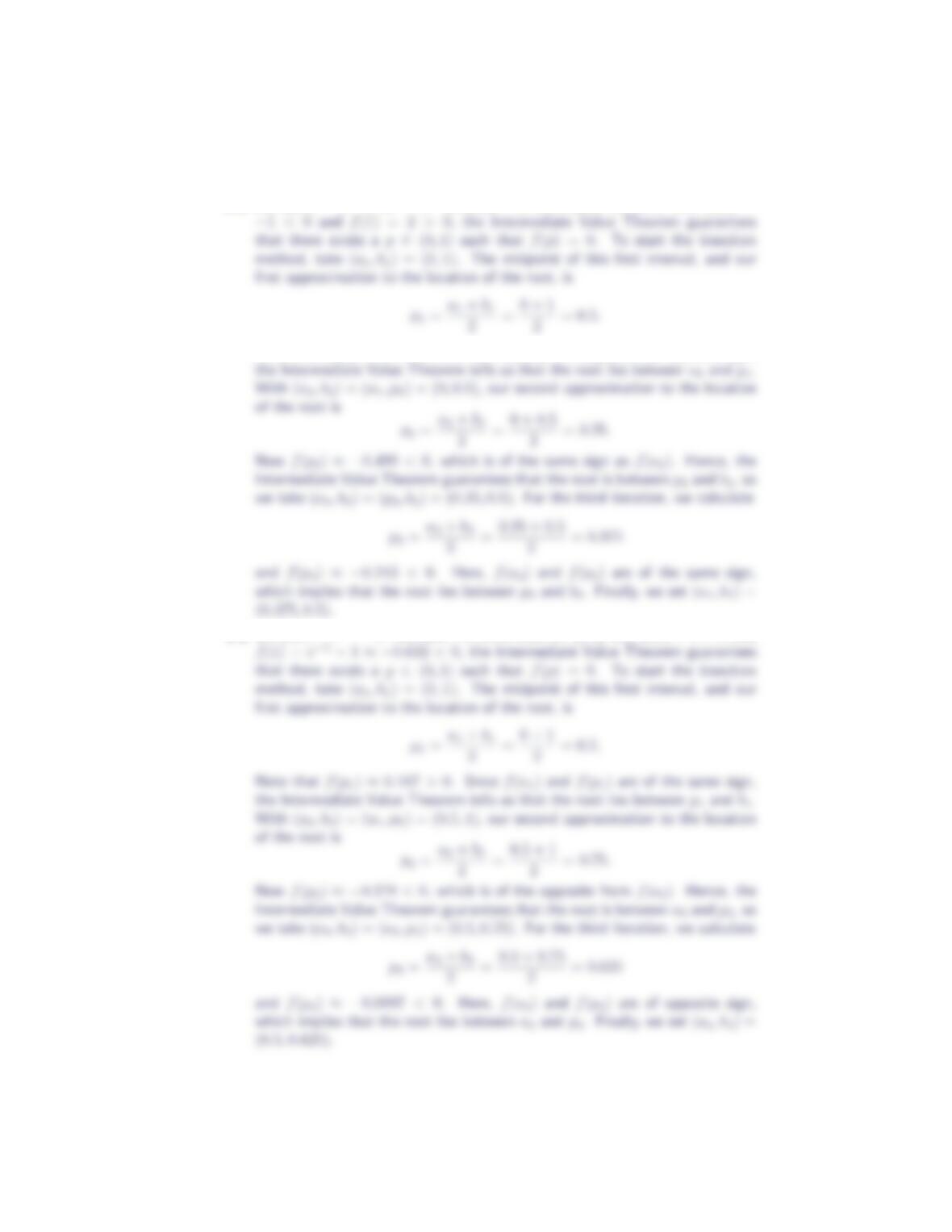
(b) Let f(x) = x5+ 2x−1. Because fis continuous on [0,1] with f(0) =
Note that f(p1) = 0.03125 >0. Since f(a1)and f(p1)are of opposite sign,
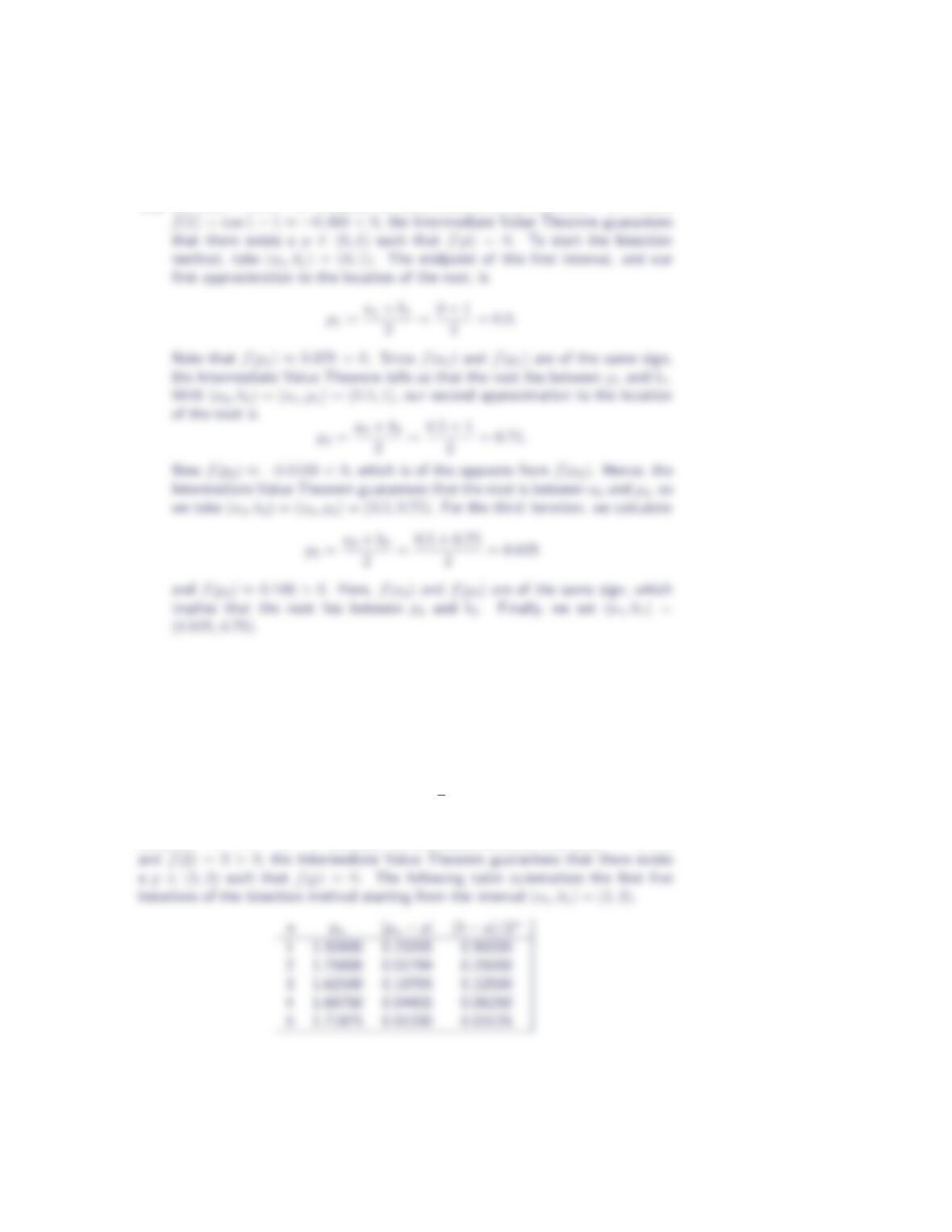
(c) Let f(x) = e−x−x. Because fis continuous on [0,1] with f(0) = 1 >0and
Bisection Method 3
(d) Let f(x) = cos x−x. Because fis continuous on [0,1] with f(0) = 1 >0and
In Exercises 2 – 5, verify that the given function has a zero on the indicated
interval. Next, perform the first five (5) iterations of the bisection method
and verify that each approximation satisfies the theoretical error bound of the
bisection method, but that the actual errors do not steadily decrease. The exact
location of the zero is indicated by the value of p.
2. f(x) = x3+x2−3x−3,(1,2), p =√3
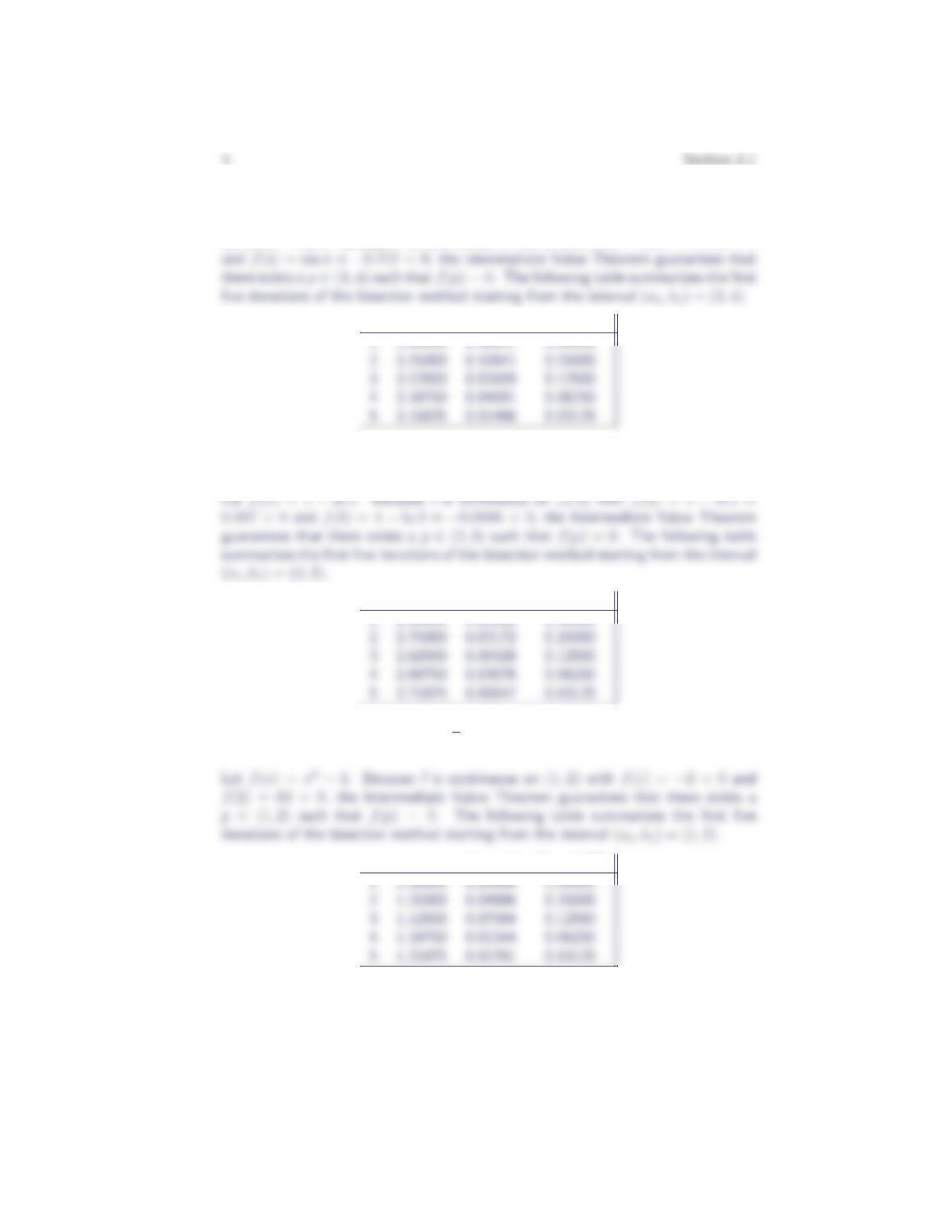
Let f(x) = x3+x2−3x−3. Because fis continuous on (1,2) with f(1) = −4<0
3. f(x) = sin x, (3,4), p =π
Let f(x) = sin x. Because fis continuous on (3,4) with f(3) = sin 3 ≈0.141 >0
npn|pn−p|(b−a)/2n
4. f(x) = 1 −ln x, (2,3), p =e
npn|pn−p|(b−a)/2n
5. f(x) = x6−3,(1,2), p =6
√3
npn|pn−p|(b−a)/2n
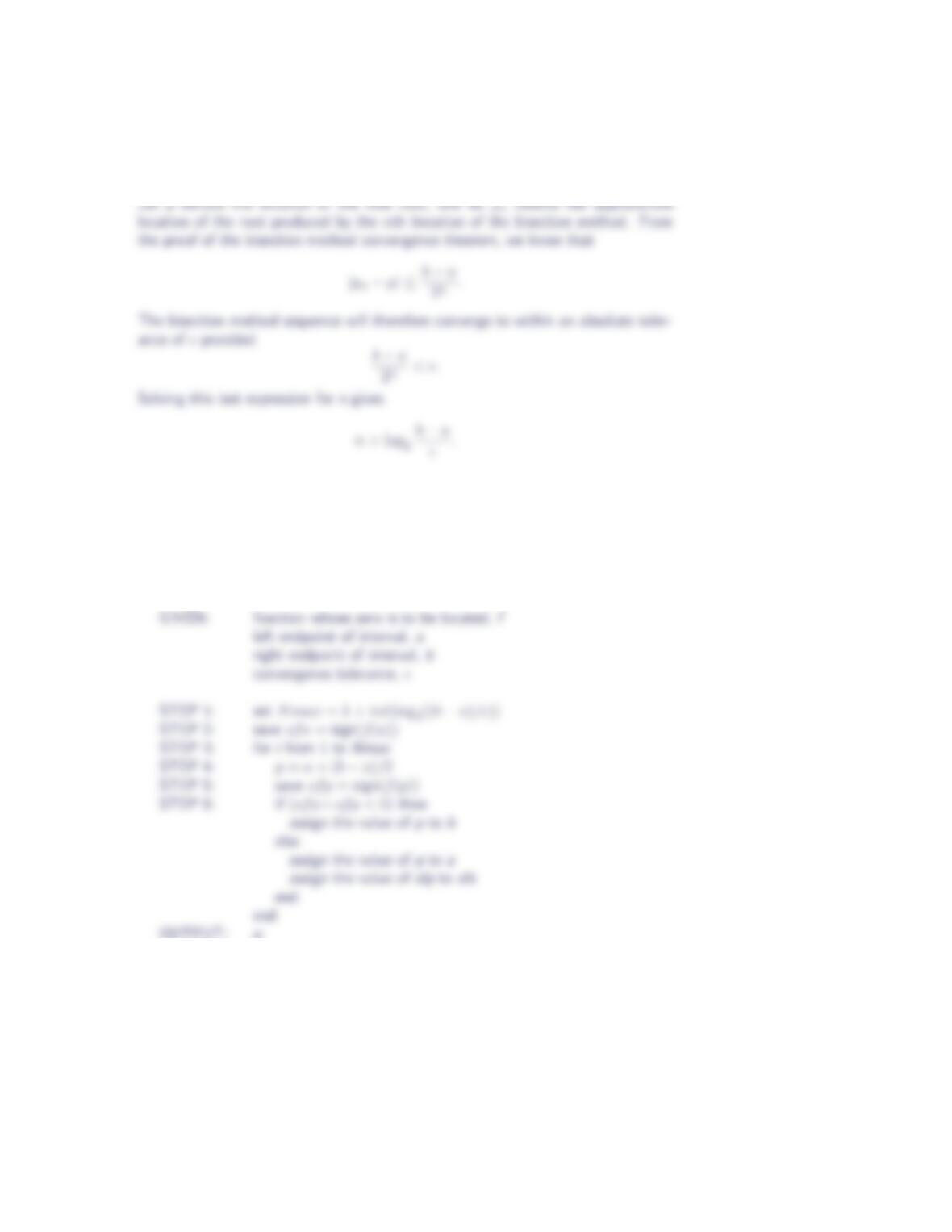
6. Determine a formula which relates the number of iterations, n, required by the
bisection method to converge to within an absolute error tolerance of ǫ, starting
from the initial interval (a, b).
Bisection Method 5
7. Modify the algorithm for the bisection method as follows. Remove the input
Nmax, and calculate the number of iterations needed to achieve the specified
convergence tolerance using the results of Exercise 6.
Here is the modified bisection method algorithm:
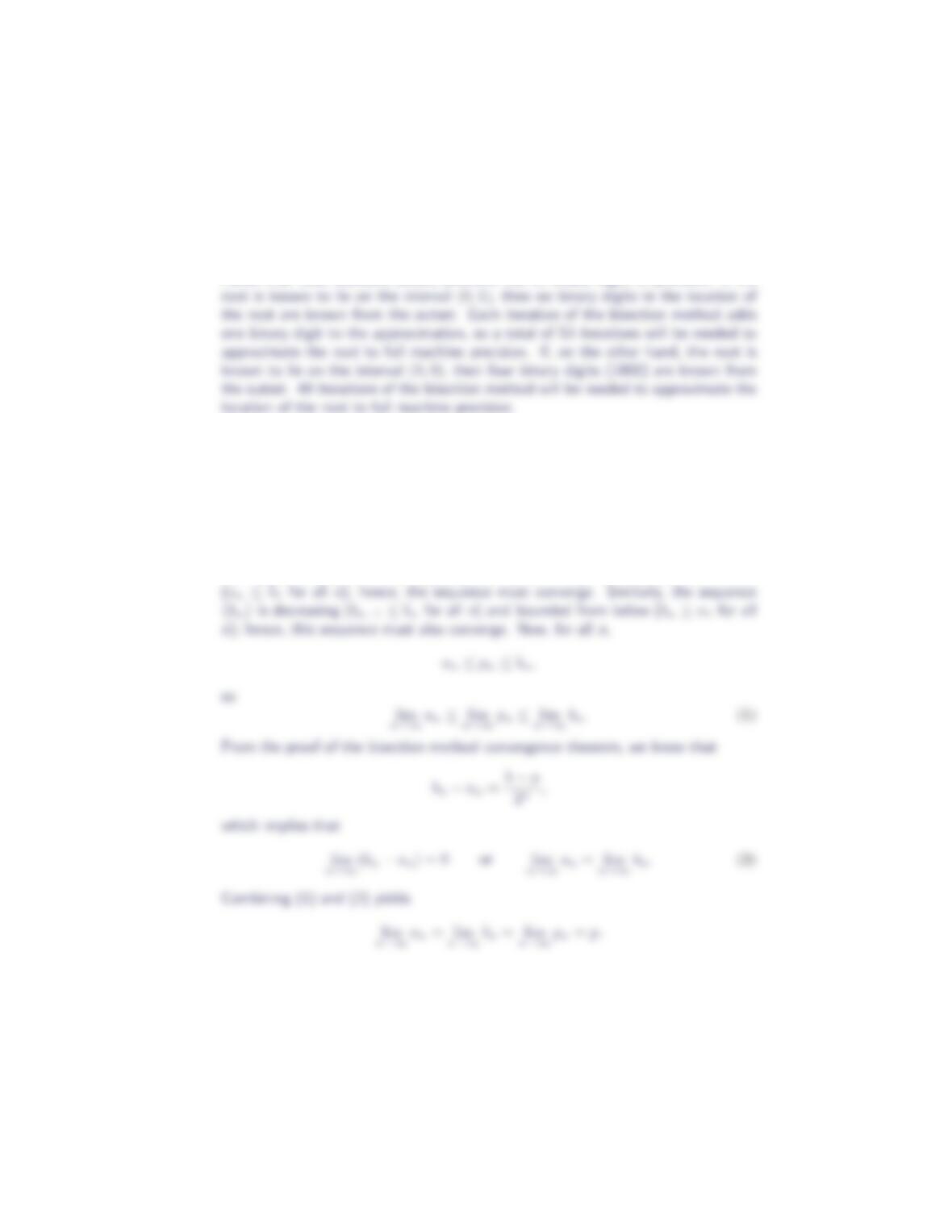
8. Suppose that an equation is known to have a root on the interval (0,1). How
many iterations of the bisection method are needed to achieve full machine
precision in the approximation to the location of the root assuming calculations
are performed in IEEE standard double precision? What if the root were known
6Section 2.1
to be contained in the interval (8,9)? (Hint: Consider the number of base 2
digits already known in the location of the root and how many base 2 digits are
available in the indicated floating point system.)
Recall that IEEE standard double precision has 53 binary digits of precision. If the
9. By construction, the endpoints of the enclosing intervals produced by the bi-
section method satisfy a1≤a2≤a3≤ ··· ≤ b3≤b2≤b1. Prove that the
sequences {an}and {bn}converge and that
lim
n→∞
an= lim
n→∞
bn= lim
n→∞
pn=p.
The sequence {an}is increasing (an+1 ≥anfor all n) and bounded from above
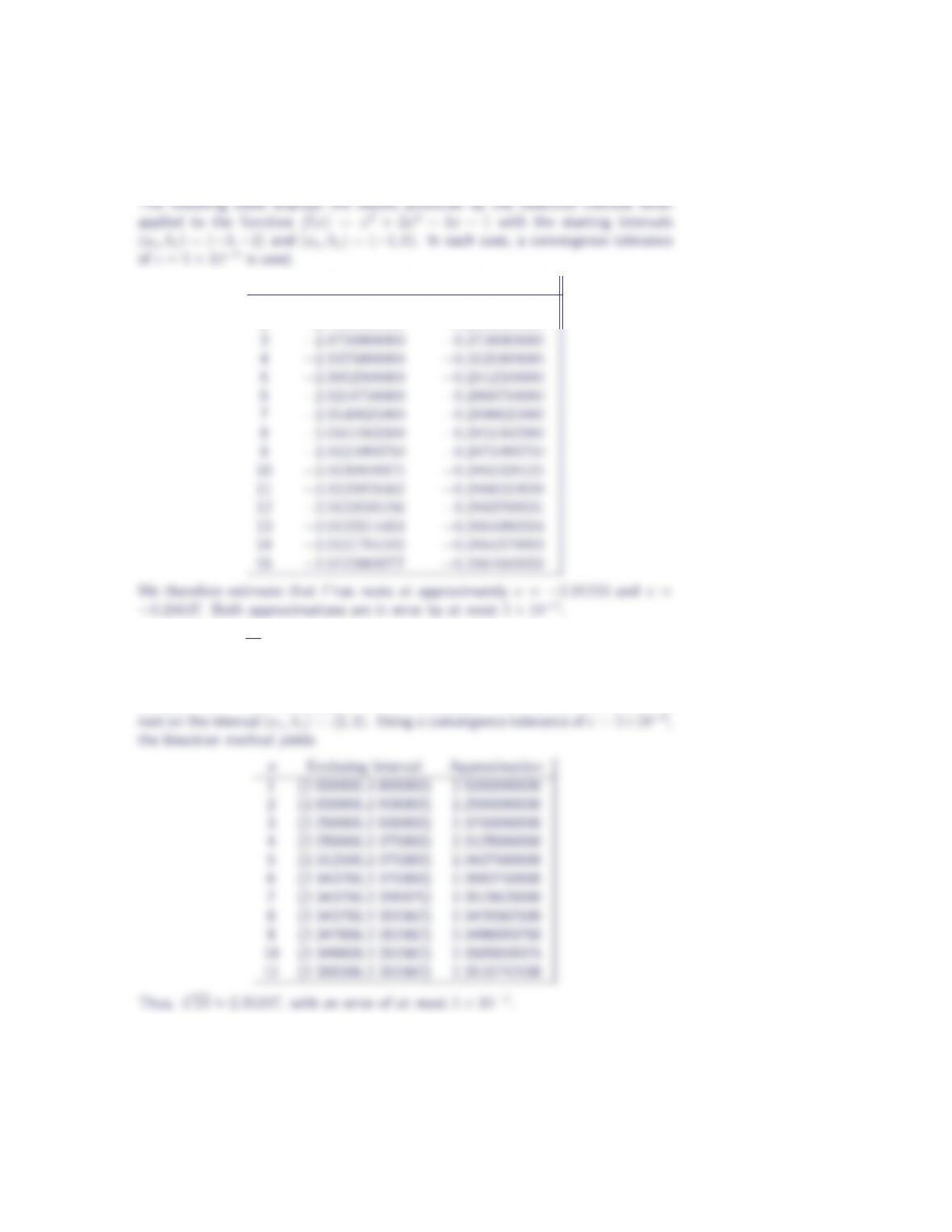
10. It was noted that the function f(x) = x3+2x2−3x−1 has a zero on the interval
(−3,−2) and another on the interval (−1,0). Approximate both of these zeroes
to within an absolute tolerance of 5 ×10⁻⁵.
Bisection Method 7
n(a1, b1) = (−3,−2) (a1, b1) = (−1,0)
1−2.5000000000 −0.5000000000
2−2.7500000000 −0.2500000000
11. Approximate 3
√13 to three decimal places by applying the bisection method to
the equation x3−13 = 0.
Let f(x) = x3−13. Since f(2) = −5<0and f(3) = 14 >0, we know there is a
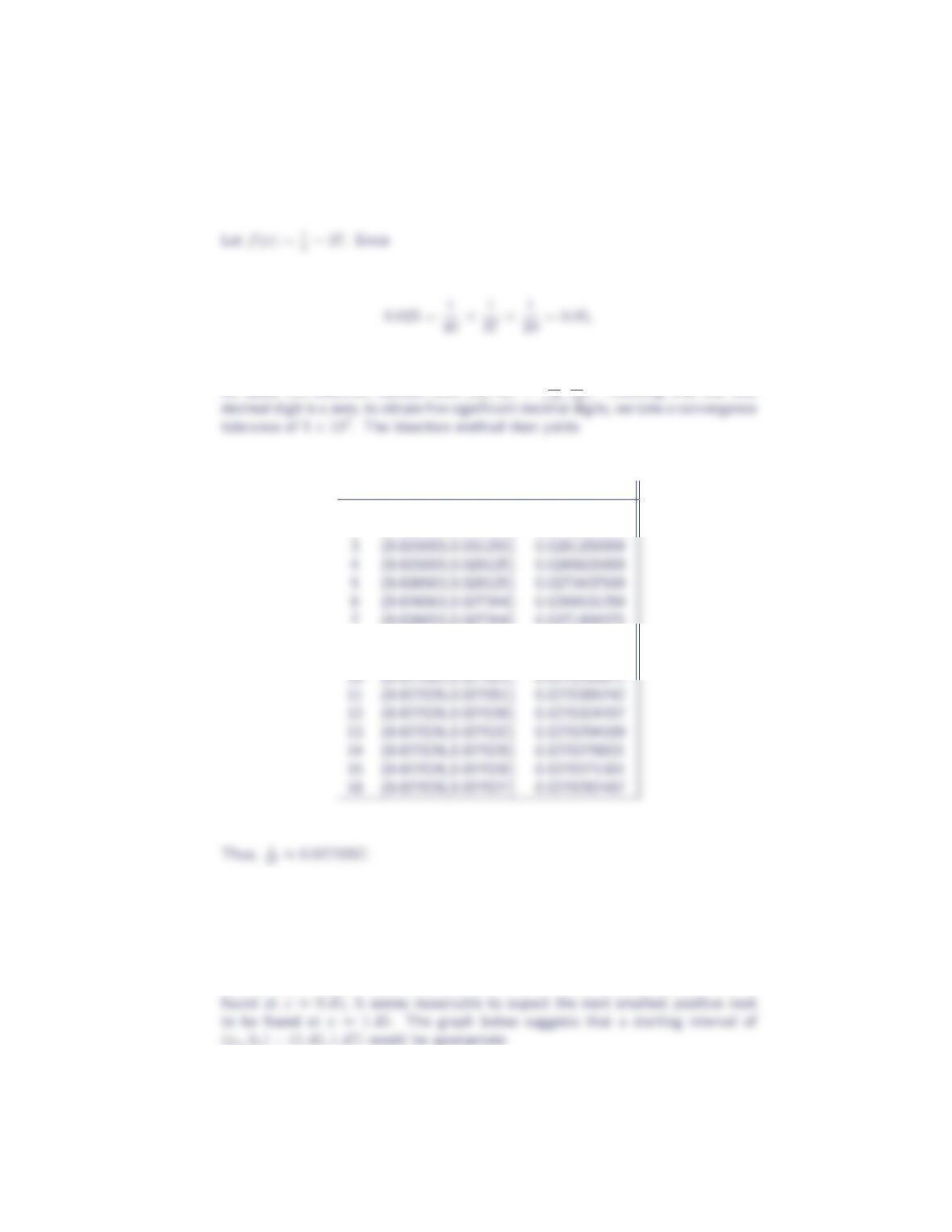
12. Approximate 1/37 to five decimal places by applying the bisection method to
8Section 2.1
the equation 1/x −37 = 0.
we apply the bisection method with (a1, b1) = ( 1
nEnclosing Interval Approximation
1 (0.025000,0.050000) 0.0375000000
2 (0.025000,0.037500) 0.0312500000
7 (0.026953,0.027344) 0.0271484375
8 (0.026953,0.027148) 0.0270507813
9 (0.026953,0.027051) 0.0270019531
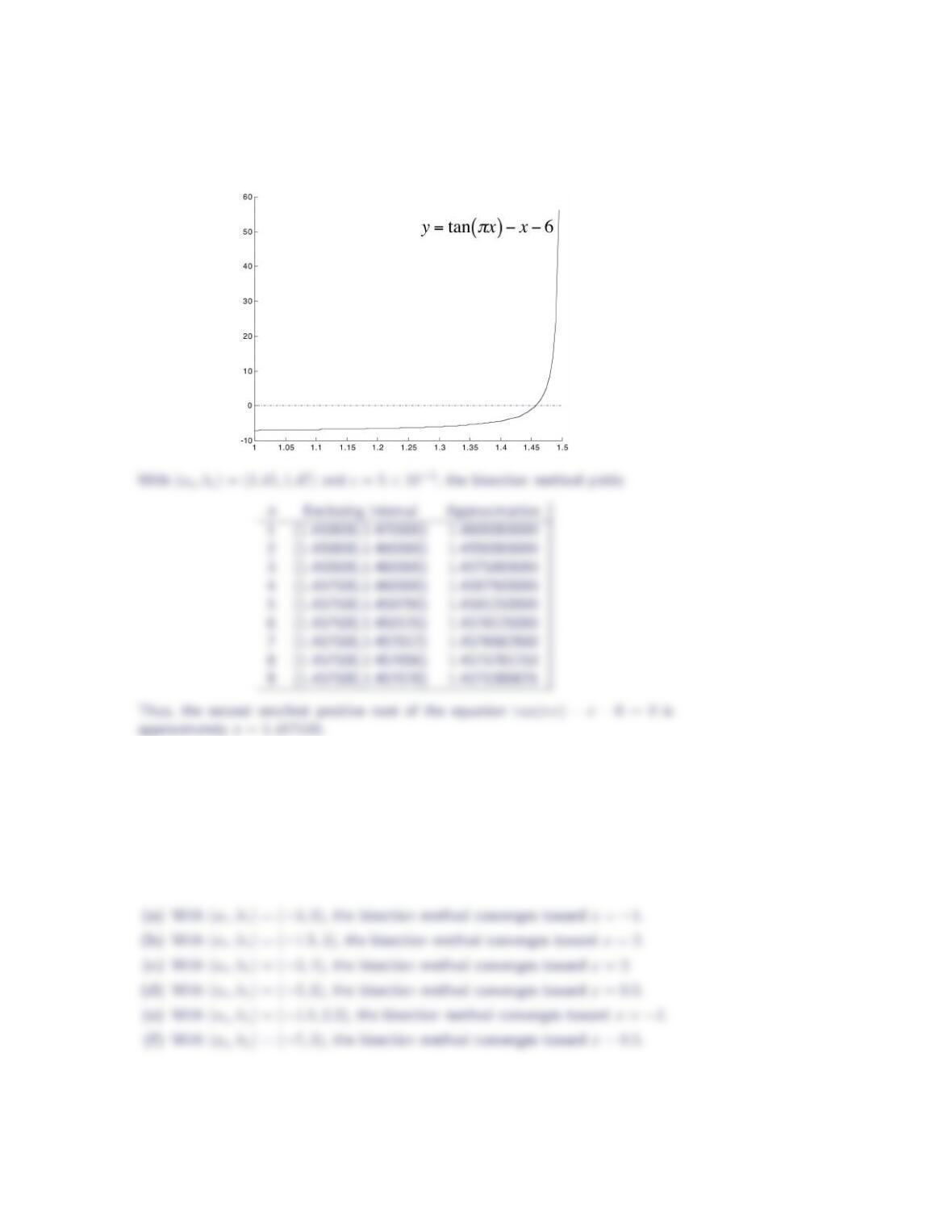
13. In one of the worked examples of this section, the smallest positive root of the
equation tan(πx)−x−6 = 0 was approximated. Graphically determine an
interval which contains the next smallest positive root of this equation, and
then approximate the root to within an absolute tolerance of 5 ×10⁻⁵.
The function tan(πx)is periodic with period 1. Since the smallest positive root is
Bisection Method 9
14. The equation (x−0.5)(x+ 1)3(x−2) = 0 clearly has roots at x=−1, x=
0.5, and x= 2. Each of the intervals listed below encompasses all of these
roots. Determine to which root the bisection method converges when each of
the intervals below is used as the starting interval.
(a) (−3,3) (b) (−1.5,3) (c) (−2,4)
(d) (−2,3) (e) (−1.5,2.2) (f) (−7,3)
15. It can be shown that the equation
3
2x−6−1
2sin(2x) = 0
has a unique real root.
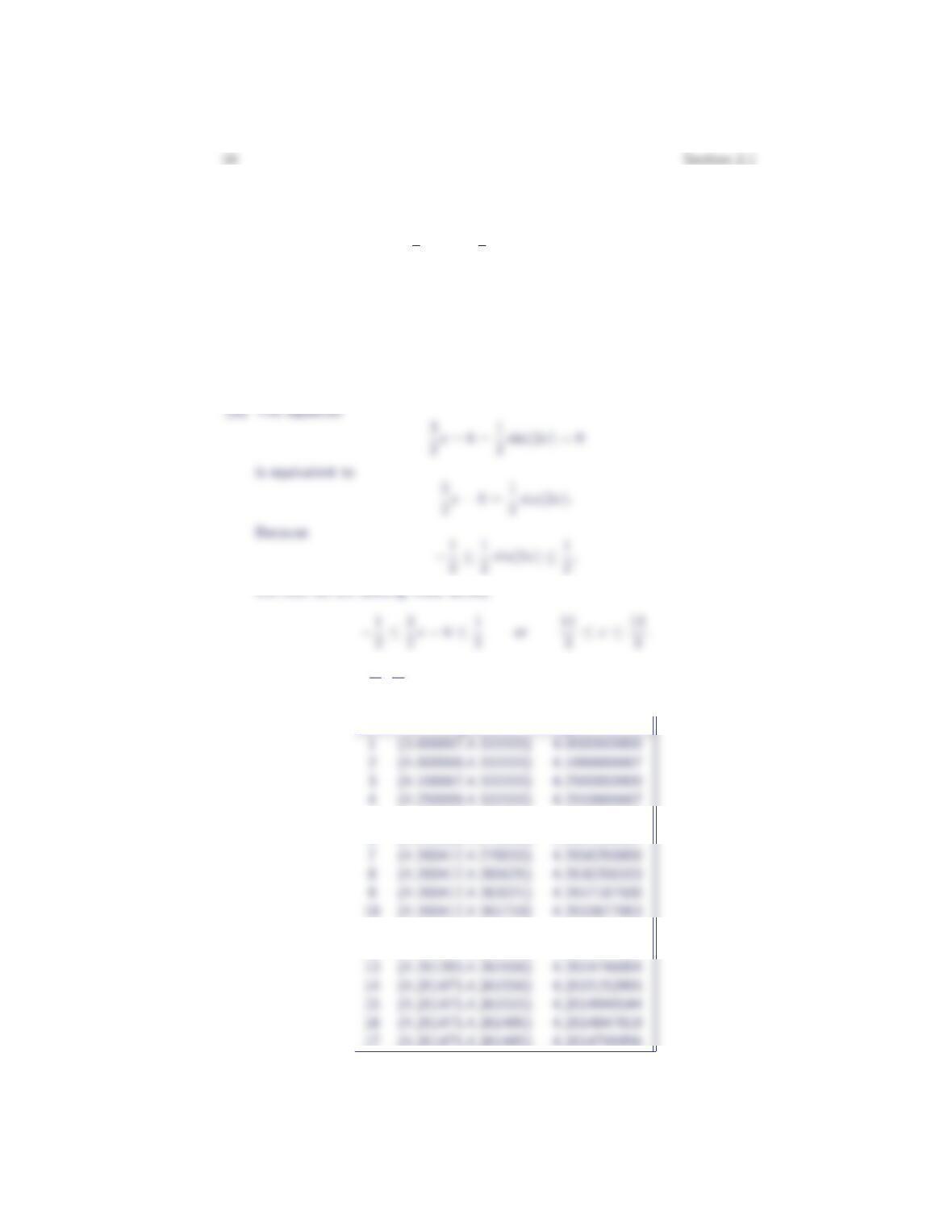
(a) Find an interval on which this unique real root is guaranteed to exist.
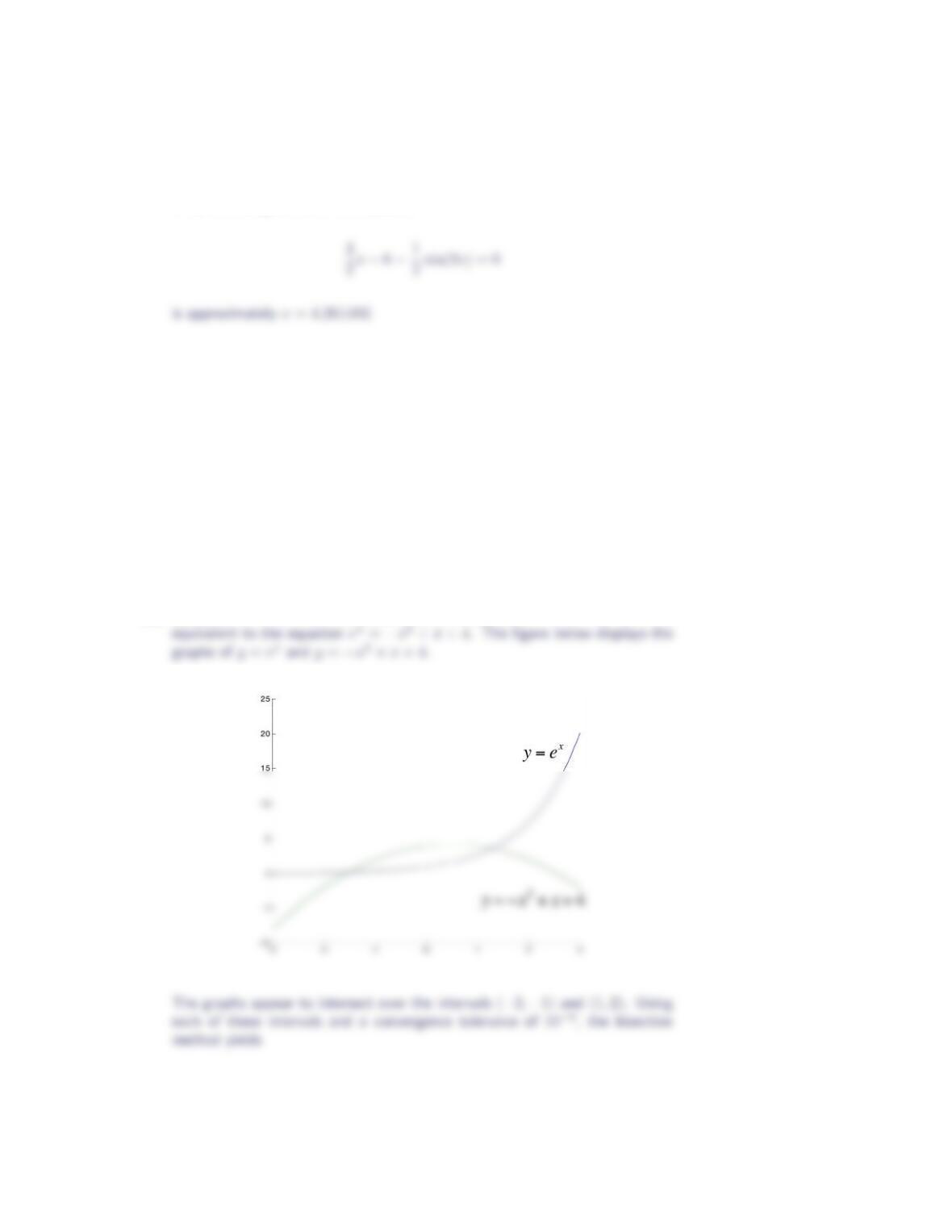
(b) Using the interval found in part (a) and the bisection method, approximate
the root to within an absolute tolerance of 10−5.
(b) With (a1, b1) = (11
3,13
3)and a convergence tolerance of ǫ= 10−5, the bisec-
tion method yields
nEnclosing Interval Approximation
5 (4.250000,4.291667) 4.2708333333
6 (4.250000,4.270833) 4.2604166667
11 (4.261068,4.261719) 4.2613932292
12 (4.261393,4.261719) 4.2615559896
Bisection Method 11
Thus, the unique root of the equation
16. For each of the functions given below, use the bisection method to approximate
all real zeros. Use an absolute tolerance of 10−6as a stopping criterion.
(a) f(x) = ex+x2−x−4
(b) f(x) = x3−x2−10x+ 7
(c) f(x) = 1.05 −1.04x+ ln x
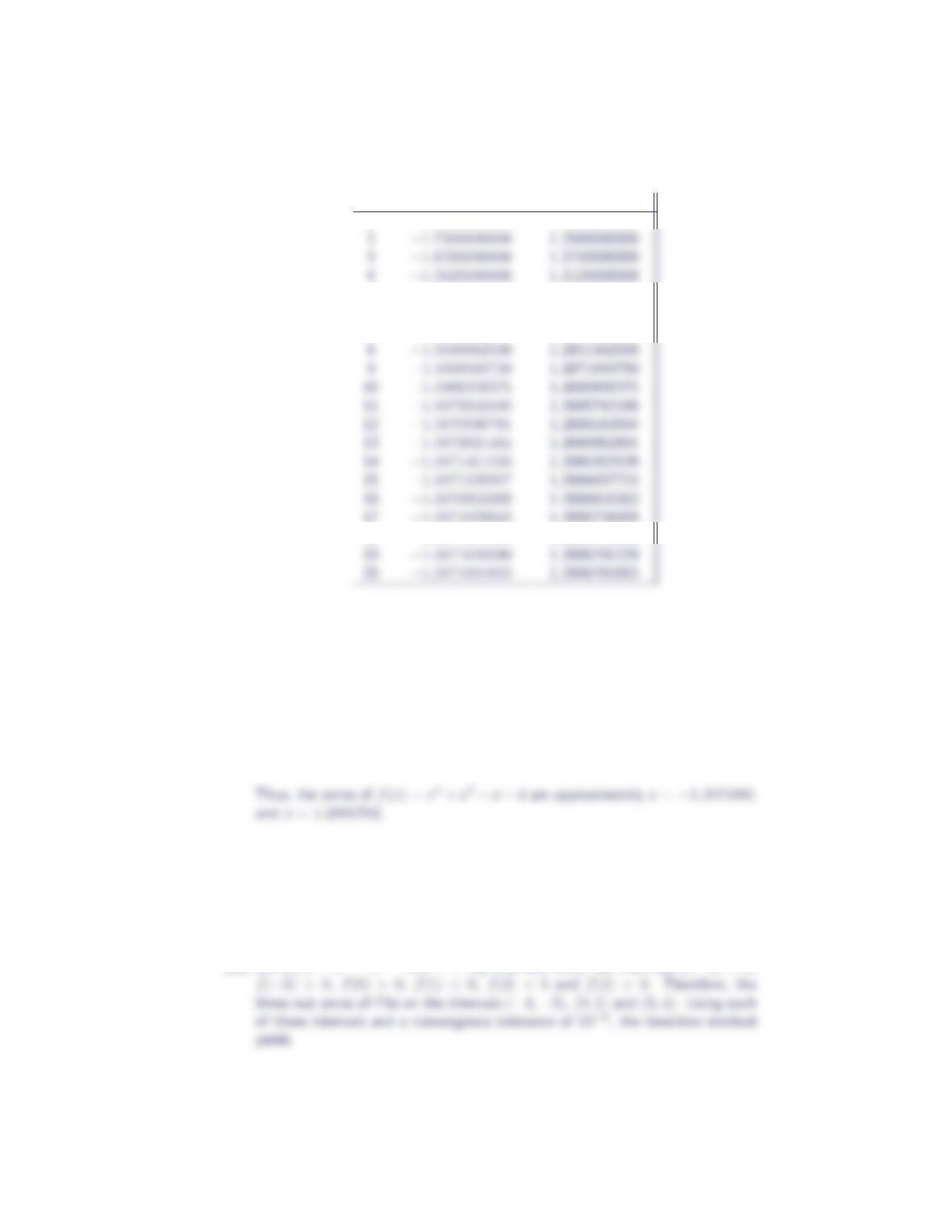
(a) Let f(x) = ex+x2−x−4. Observe that the equation ex+x2−x−4 = 0 is
12 Section 2.1
n(a1, b1) = (−2,−1) (a1, b1) = (1,2)
1−1.5000000000 1.5000000000
5−1.5312500000 1.2812500000
6−1.5156250000 1.2968750000
7−1.5078125000 1.2890625000
18 −1.5070991516 1.2886772156
(b) Let f(x) = x3−x2−10x+ 7. By trial and error, we find that f(−4) <0,
Bisection Method 13
n(a1, b1) = (−4,−3) (a1, b1) = (0,1) (a1, b1) = (3,4)
1−3.5000000000 0.5000000000 3.5000000000
6−3.0468750000 0.6718750000 3.3593750000
7−3.0390625000 0.6796875000 3.3515625000
8−3.0429687500 0.6835937500 3.3554687500
14 −3.0426635742 0.6852416992 3.3574829102
15 −3.0426940918 0.6852111816 3.3574523926
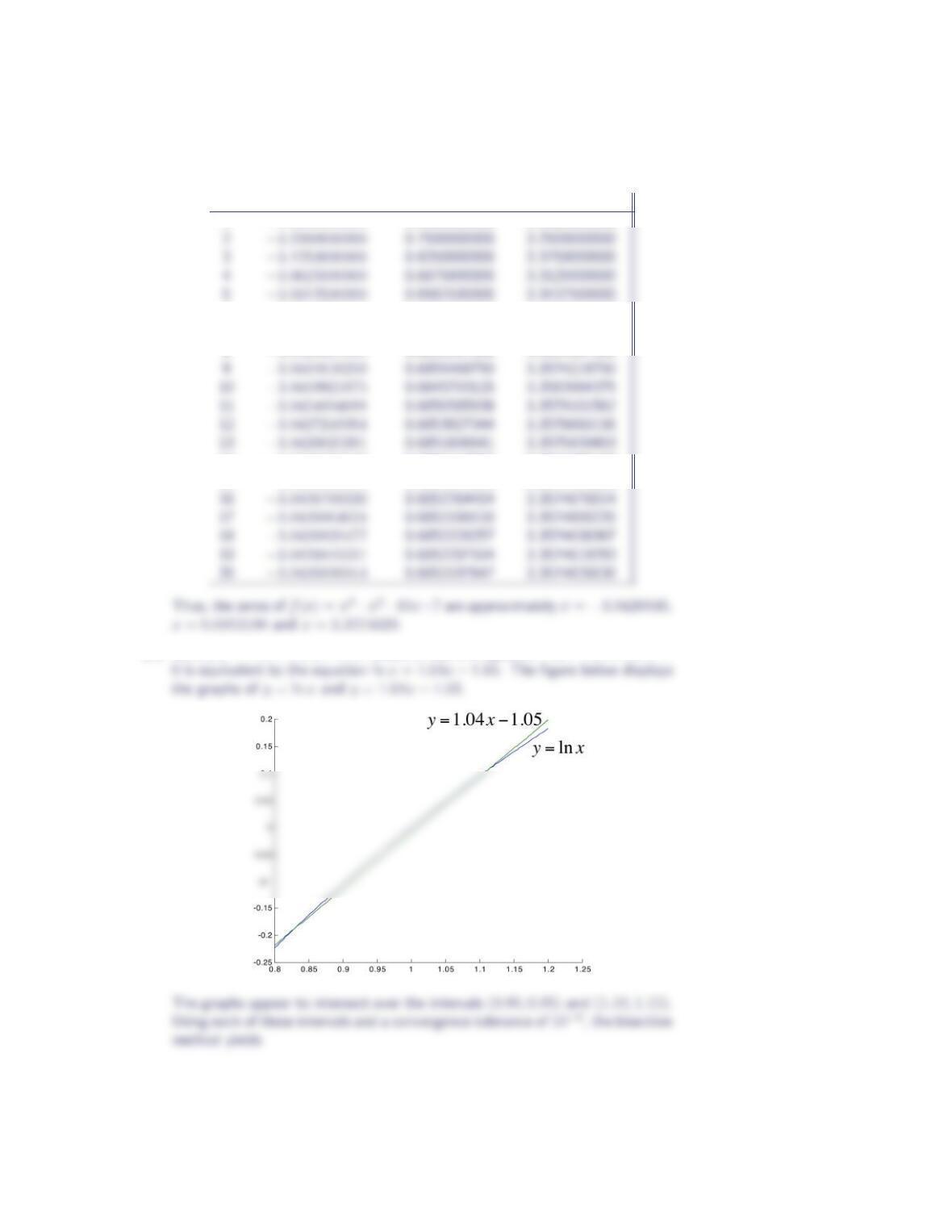
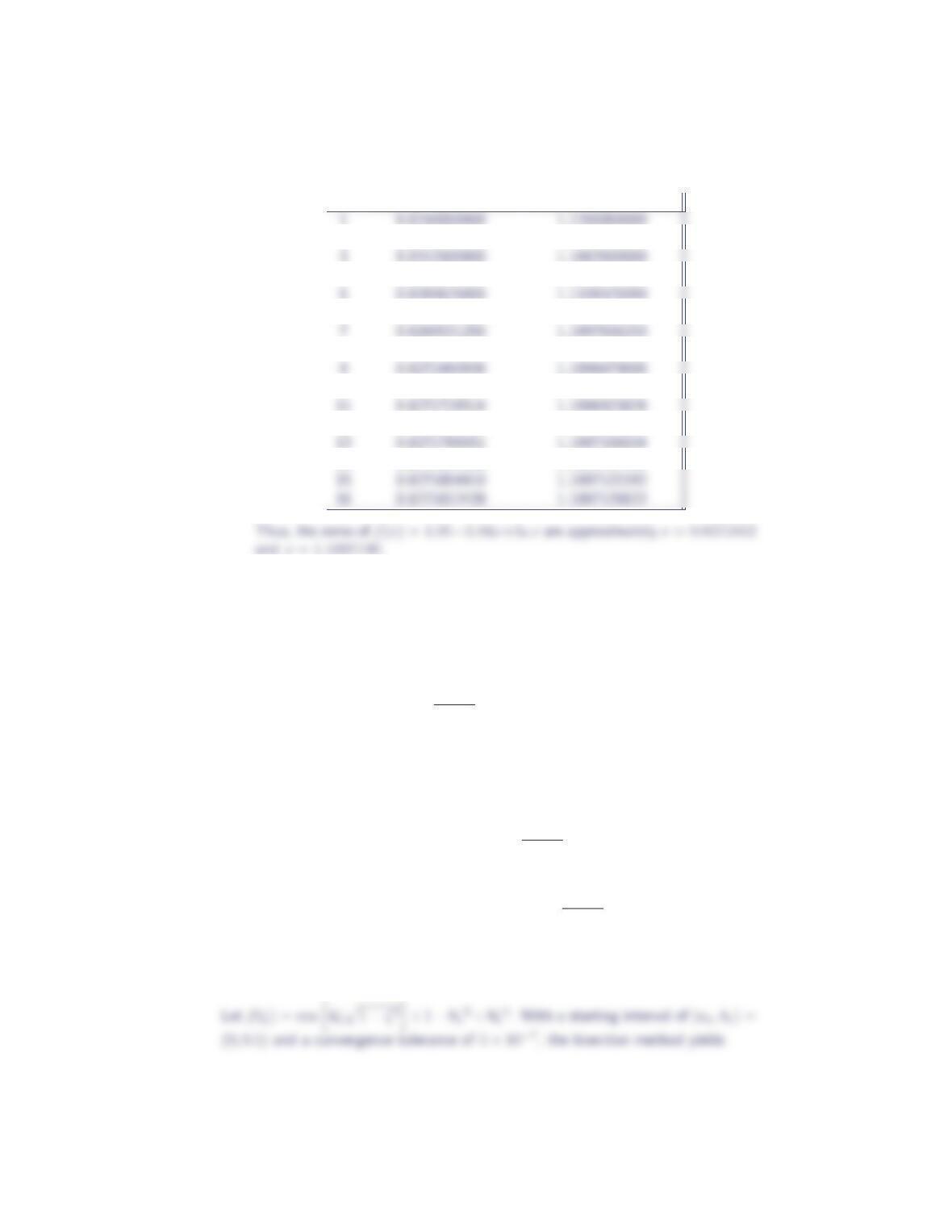
(c) Let f(x) = 1.05−1.04x+ln x. Observe that the equation 1.05−1.04x+ln x=
14 Section 2.1
n(a1, b1) = (0.80,0.85) (a1, b1) = (1.10,1.15)
2 0.8375000000 1.1125000000
4 0.8281250000 1.1093750000
6 0.8273437500 1.1101562500
8 0.8271484375 1.1095703125
10 0.8271972656 1.1097167969
12 0.8271850586 1.1097045898
14 0.8271820068 1.1097137451
17. Peters (“Optimum Spring-Damper Design for Mass Impact,” SIAM Review, 39
(1), pp. 118 – 122, 1997) models the impact of an object on a spring-damper
system. If the displacement of the object following impact is limited, then the
maximum force exerted on the object is minimized when the nondimensional
damping coefficient, ζ, is the solution of the equation
cos h4ζp1−ζ2i=−1 + 8ζ2−8ζ4
on the interval 0 < ζ < 1/2. The maximum (nondimensional) force is then
given by
Fm= exp [−ζ(τf+τm)] ,
where
τf= cos−1ζ/p1−ζ2
is the time of the end of the stroke and
τm= cos−1ζ(3 −4ζ2)/p1−ζ2
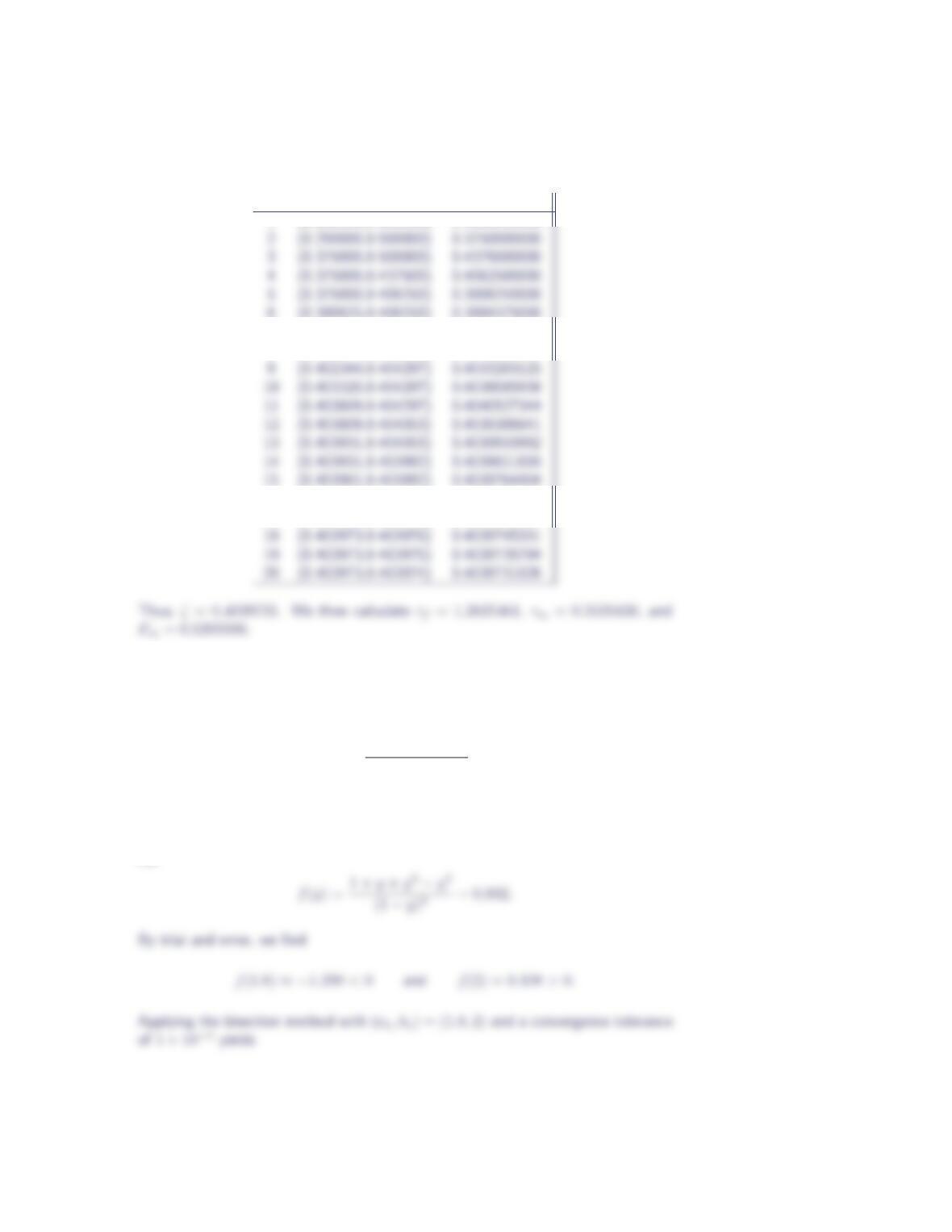
is the time when the maximum force occurs. Determine ζto within an absolute
tolerance of 5 ×10⁻⁷, and then calculate τf,τmand Fm.
Bisection Method 15
nEnclosing Interval Approximation
1 (0.000000,0.500000) 0.2500000000
6 (0.390625,0.406250) 0.3984375000
7 (0.398438,0.406250) 0.4023437500
8 (0.402344,0.406250) 0.4042968750
16 (0.403961,0.403976) 0.4039688110
17 (0.403969,0.403976) 0.4039726257
18. DeSantis, Gironi and Marelli (“Vector-liquid equilibrium from a hard-sphere
equation of state,” Industrial and Engineering Chemistry Fundamentals, 15,
182-189, 1976) derive a relationship for the compressibility factor of real gases
of the form
z=1 + y+y2−y3
(1 −y)3,
where yis related to the van der Waals volume correction factor. If z= 0.892,
what is the value of y?
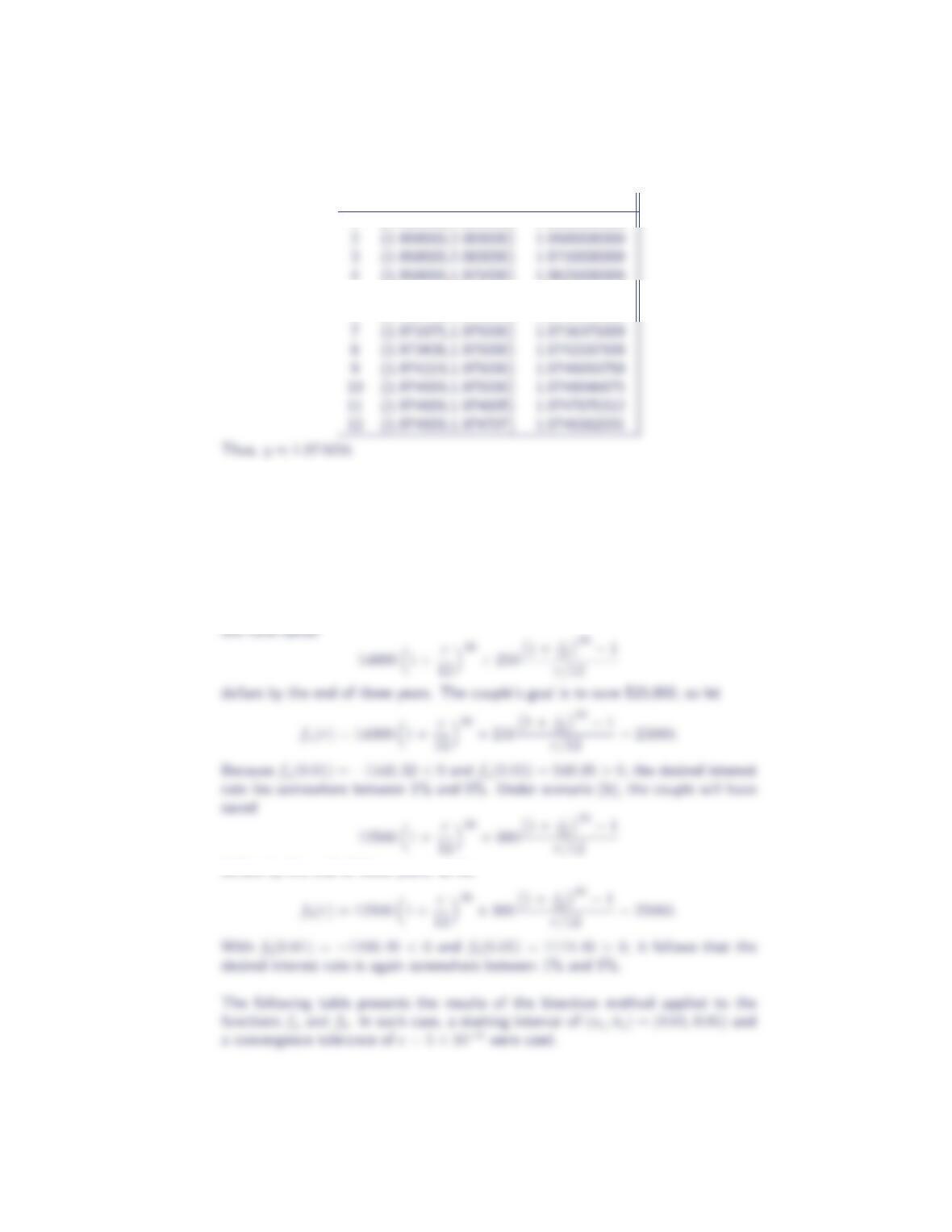
Let
16 Section 2.1
nEnclosing Interval Approximation
1 (1.800000,2.000000) 1.9000000000
4 (1.950000,1.975000) 1.9625000000
5 (1.962500,1.975000) 1.9687500000
6 (1.968750,1.975000) 1.9718750000
19. Reconsider the “Saving for a Down Payment” application problem. Which of
the following scenarios requires a smaller compounded monthly interest rate to
achieve a goal of $25,000 after three years:
(a) a $14,000 initial investment with $250 per month thereafter; or
(b) a $12,500 initial investment with $300 per month thereafter?
Let rdenote the compounded monthly interest rate. Under scenario (a), the couple
dollars by the end of three years, so let

Bisection Method 17
nScenario (a) Scenario (b)
2 0.0400000000 0.0400000000
4 0.0325000000 0.0325000000
6 0.0343750000 0.0306250000
8 0.0345312500 0.0307812500
10 0.0346484375 0.0306640625
12 0.0346191406 0.0306542969