Chapter 2: Human Resources Strategy and Planning
discrimination must meet certain requirements. The worker must be given something of value
(“considerations”) in exchange for the waiver of right to sue, typically severance benefits.
C. Managing a Talent Shortage
There can be mismatches between the qualifications needed by the employers and the skills
possessed by available workers. Companies can use a number of alternative tactics to manage
a talent shortage (Figure 2-9).
Alternate work arrangements are nontraditional schedules that provide flexibility to
employees, include job sharing and telecommuting. These are creative solutions to attract and
retain skilled employees who want flexibility. Retirees may be rehired on a part-time or
temporary basis to fill talent gaps. The advantage is that these individuals are already trained
and can be productive immediately. Care must be taken not to interfere with pension
payments or other benefits tied to retirement.
VII. Human Resources Planning in Mergers and Acquisitions
Chapter 2: Human Resources Strategy and Planning
The purpose of a merger or acquisition is to generate growth by combining two existing
companies and creating a more competitive company. Most executives feel merger and
acquisition (M&A) is an important strategy for growth through acquiring products, intellectual
To determine whether or not the two organizations should combine, a rigorous process of due
diligence is conducted. Due diligence is a comprehensive assessment of all aspects of the
business being acquired. Financial, sales and marketing, operations, and human resource staffs
can all be involved before the final decision is made to merge or acquire the company. HR
professionals review issues related to legal compliance, compensation and benefits programs,
quality of talent, and labor contract obligations. Due diligence is even more complex when the
M&A involves companies in different countries. A thorough, objective analysis of the HR-
related issues is critical to make good business decisions.
A. During Integration
After the deal has been closed, the focus of HR activity switches to the orderly transition of
basic HR processes such as payroll and benefits migration. During the first 60 days after the
acquisition, HR must deliver high-quality administrative and operational support to
employees and managers. The immediate concerns are often about basic services needed to
run the operations. Frequent communication, employee hotlines, and guidance for managers
all contribute to employee retention and loyalty during the chaotic early days of the transition.
Chapter 2: Human Resources Strategy and Planning
their behavior and to signal the rest of the organization.
• Provide clear and consistent messages—Align what you say with what you do and
reward.
B. Post Integration
To realize the expected benefits of a merger, the months following the initial integration are
important. Culture changes started in the early days must be maintained. Practical issues
VIII. Measuring Effectiveness of Human Resources and Human Capital
Effectiveness for organizations is a measure of the ability of a program, project, or task to
produce a specific desired effect or result that can be measured. Efficiency is the degree to which
operations are done in an economical manner.
There are many ways of measuring the financial contributions of the HR function in an
organization, and many challenges associated with doing so. Return on investment (ROI) is a
common measure used by financial professionals to assess the value of an investment.
competitive pressure.
It is important that HR managers understand financial and operational measures that drive the
business and relate decisions to key performance indicators (KPIs). Metrics, benchmarking,
Chapter 2: Human Resources Strategy and Planning
balanced scorecards, and audits can help the organization track HR performance and measure the
value of HR practices.
A. HR Metrics and Analytics
HR and line managers collect and share the data needed to track performance. Data to track
these measures come from several sources within the organization. Financial data are required
to determine costs for various HR activities and performance and turnover data can be found
in HR and operations records.
Metrics and software have been combined to make analysis easier, but it is still an evolving
area. Analytics can simply be a way to report certain metrics or a sophisticated predictive
modeling designed to answer “what if” questions about HR variables. A definition of HR
analytics that takes in both extremes is—HR analytics is an evidence-based approach to
making HR decisions based on the basis of quantitative tools and models. The following
characteristics should be considered when developing HR metrics and analytics:
Chapter 2: Human Resources Strategy and Planning
B. Human Resources and Benchmarking
Benchmarking is the process of comparing the business processes and outcomes to an
industry standard or best practice. Benchmarking is focused on external practices that the
organization can use to improve its own processes and practices. When implementing
C. Human Resources and the Balanced Scorecard
The balanced scorecard is a framework organizations use to report on a diverse set of
performance measures. It balances financial and nonfinancial measures so that managers
HR Perspective: Using the Right Analytics
The capability for providing operating managers with the information they want about
human capital in the organization is beginning to emerge. HR can provide actionable
information like—your turnover rate is X% and here is what it is costing you and here
are some things you can do about it. For example at Superior Energy Services in New
Orleans the HR VP calculated revenue lost for each job type when someone quit. Nearly
Chapter 2: Human Resources Strategy and Planning
• Internal business processes—Product and service quality, efficiency and productivity,
conformance with standards, and cycle times can be measured to ensure that the
operation runs smoothly and efficiently.
• Customer relations—Customer satisfaction, loyalty, and retention are important to
ensure that the organization is meeting customer expectations and can depend on repeat
business from its customers.
D. Human Capital Effectiveness Measures
Measuring the benefits of human capital is very challenging but equally important. Assessing
the value of human capital demonstrates the importance of implementing effective HR
practices to maintain a high-quality, workforce.
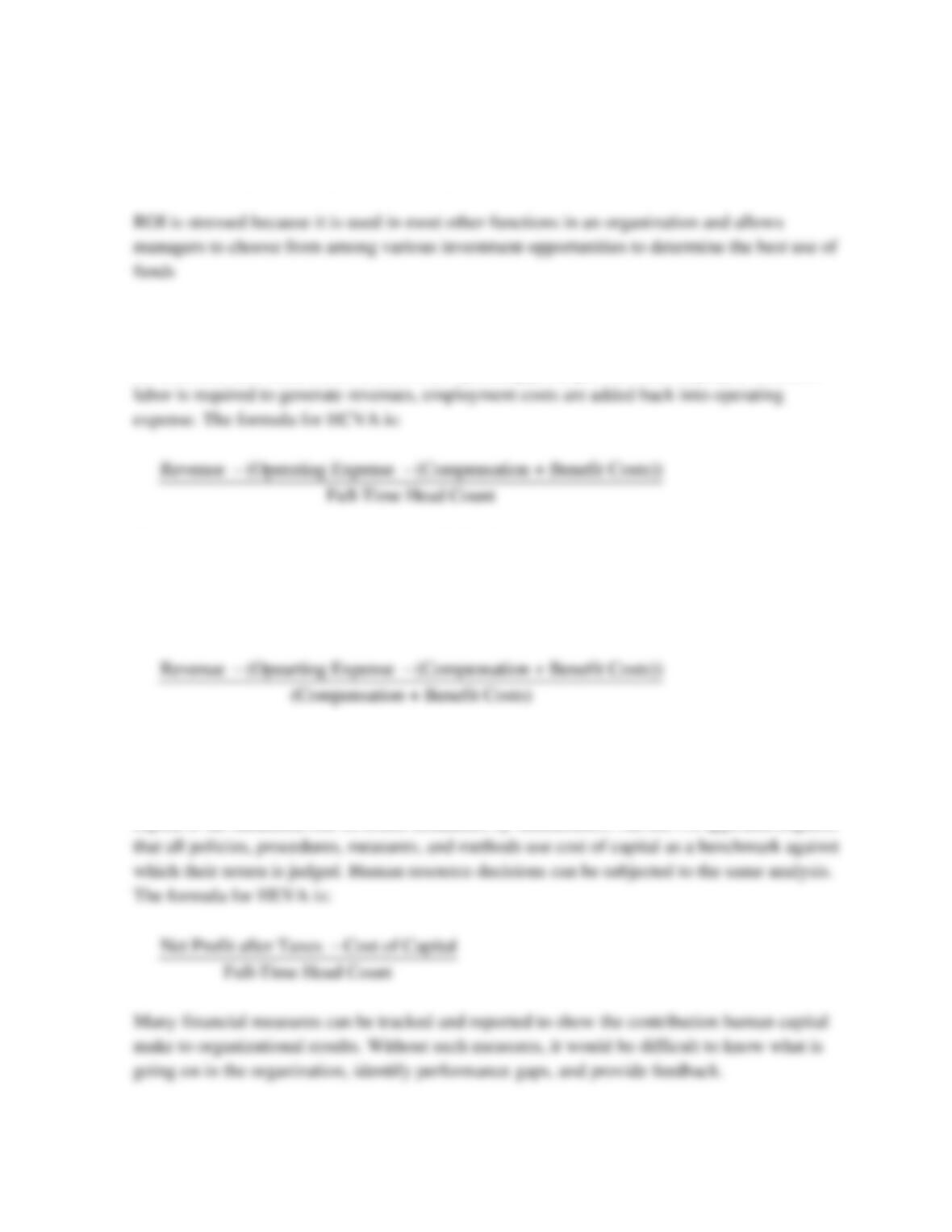
A widely used financial measure that can be applied to measure the contribution and cost of
HR activities is return on investment (ROI), which is a calculation showing the value of
investments in human capital. It can also be used to show how long it will take for the
activities to show results. The following formula can be used to calculate the potential ROI
for a new HR activity:
Chapter 2: Human Resources Strategy and Planning
A = Operating costs for a new or enhanced system for the time period
B = One-time cost of acquisition and implementation
C = Value of gains from productivity improvements for the time period
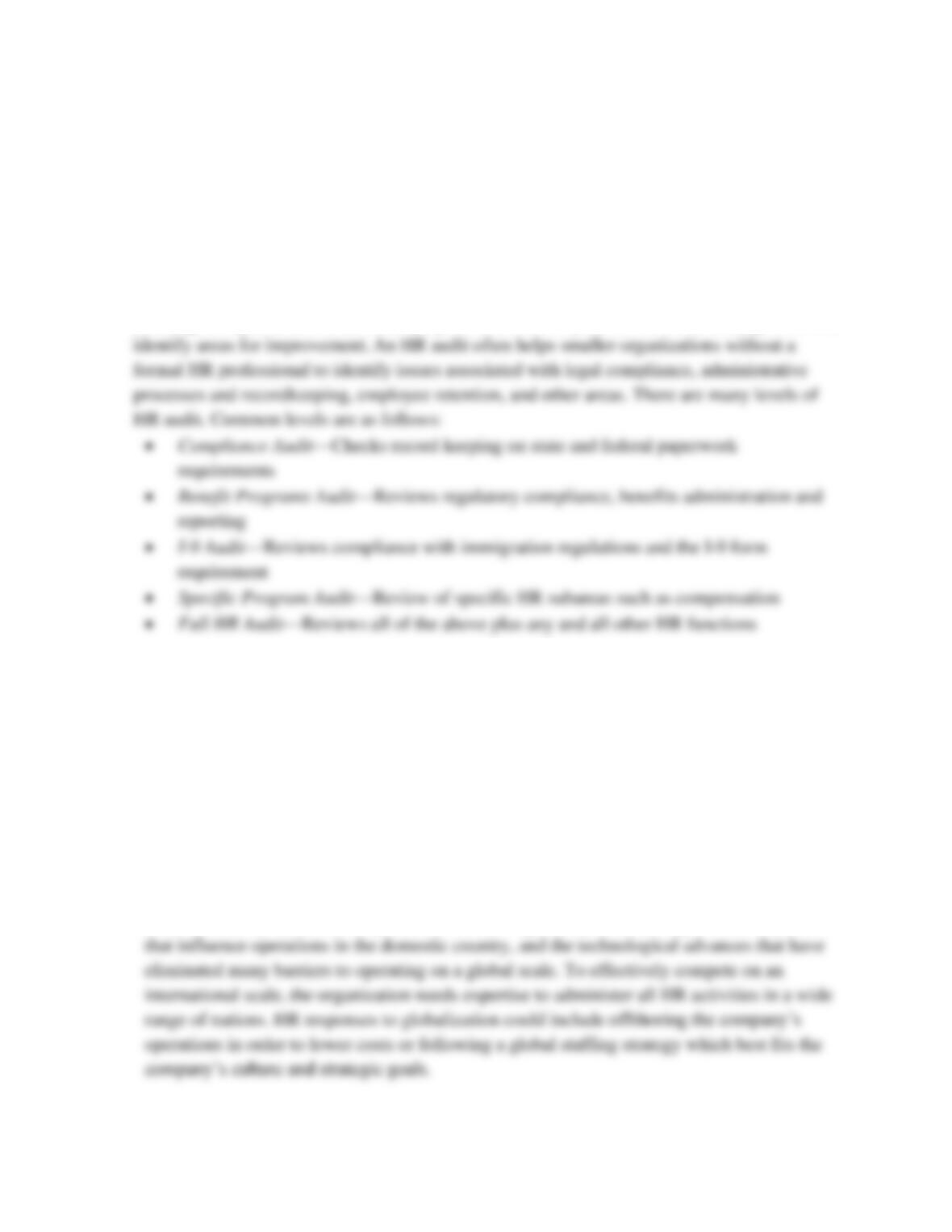
Human capital value added (HCVA) is an adjusted operating profitability figure calculated
by subtracting all operating expenses except for labor expenses from revenue and dividing by
the total full-time head count. It shows the operating profit per full-time employee. Because
Human capital return on investment (HCROI) directly shows the amount of profit derived
from investments in labor, the leverage on labor cost. The formula for HCROI uses the same
adjusted operating profitability figure as for HCVA, but it is divided by the human capital
cost:
Human economic value added (HEVA) shows the wealth created per employee. It shows
how much more valuable the organization has become because of the investment in human
capital. Wealth is the net operating profit of a firm after the cost of capital is deducted. Cost of
capital is the minimum rate of return demanded by shareholders. An HEVA approach requires
Chapter 2: Human Resources Strategy and Planning
Regardless of the time and effort placed on HR measurement and HR metrics, the most
important consideration is that HR effectiveness and efficiency must be measured regularly
for managers to know how HR is contributing to organizational success.
E. Human Resources Audit
An HR audit is a formal research effort to assess the current state of HR practices in an
organization. This audit is used to evaluate how well activities in each of the HR areas
(staffing, compensation, health and safety, etc.) have been performed, so that management can
Audits frequently use a questionnaire and interviews performed to collect information and are
done by outside entities for more objective data. They can provide assessment on how well
HR is doing its job.
Critical Thinking Challenges
1. Discuss how globalization has changed jobs in an organization where you have worked.
What are some HR responses to those changes?
Students responses will vary based on their individual experiences. Most jobs have certainly
been affected by the increased pressures from foreign competitors, foreign business practices
Chapter 2: Human Resources Strategy and Planning
2. What steps can HR professionals take to ensure that mergers and acquisitions are
successful? How can HR help during the integration process?
Students can refer to Figure 2-10 that lists the HR activities during mergers and
acquisitions to help identify what steps HR professionals can take to ensure that M&As
3. How can an organization maintain its image while dealing with a talent surplus? If
layoffs are necessary, what would you recommend managers do to ensure that
survivors remain committed and productive?
Best practices for companies carrying out layoffs include:
• Identify the work that is core to sustaining a profitable business.
4. As the HR manager for a multinational corporation, you want to identify HR competencies
that are critical for global companies. Visit the website for the World Federation of People
Management Association (www.wfpma.com) to research the topic and to identify
differences in the body of knowledge in different parts of the world.
At this website students can get information about the competency project that was done by
this organization. The following is from the Executive Summary of the project report: “The
aim of this World Federation of Personnel Management Associations’ project was to
Chapter 2: Human Resources Strategy and Planning
5. As the HR Director of a U.S.-based company that is looking at global opportunities in
China, you have been asked by the company president to prepare an outline for an HR
strategic plan as part of the company’s expansion process. You need to develop an HR
A. What is the process to use for identifying the components of the HR strategic planning
process?
Most students will probably refer to the Strategic Planning Process shown in Figure 2-
B. What other company strategic objectives must the HR strategic plan integrate and
support?
Organizational productivity, customer service and quality, and financial contributions
Case
Analytics at PricewaterhouseCoopers
1. Why do more companies not use analytics to solve such problems? How would you argue to
make the case for analytics in an old-line HR department?
Chapter 2: Human Resources Strategy and Planning
Students could identify different reasons, but some possible answers might be that:
2. What resources could an HR professional consult to begin building expertise in this area of
analytics?
There are HR metrics classes through professional associations such as Society for Human
Supplemental Cases
Where Do You Find the Bodies?
Questions
1. How does this case illustrate the lack of HR planning?
Student answers may vary. The corporate headquarters did not consider the gap in the wage
2. What approaches could be used to recruit mechanics?
Student answers may vary. Because the objective of strategic planning is to anticipate
future events and conditions, managers should evaluate and revise the strategic plan
Chapter 2: Human Resources Strategy and Planning
Comments
The situation described in Boomtown is very typical in several parts of the western United
States. Unfortunately there are no easy solutions that Milt can adopt. He might try
recruiting mechanics from economically depressed areas elsewhere and Milt might design
an incentive system for use with shop personnel. Another alternative is to start renting
space in the center for individuals to work on their own vehicles. Also, Milt and his boss
must convince headquarters that there must be greater flexibility available to the managers
in Boomtown. In summary, the case emphasizes the need for planning, flexibility, and
creativity in dealing with personnel problems, and the fact that organizations are truly
affected by environmental forces.
Xerox
This case highlights the challenges of employee retention during stressful and unpredictable
1. Discuss the challenges faced by HR management when significant staff cutbacks occur
and how they should be addressed.
When companies cannibalize the human resources needed to grow and innovate,
disruption follows for some time. Downsizing can hurt productivity by leaving
Chapter 2: Human Resources Strategy and Planning
2. Use of technology, employee retention, and HR development have been at the core of
HR becoming more strategic at Xerox. Why have those areas been so key?
These areas have been key because they illustrate to employees that Xerox is
committed to professional development and continuous learning for its employees.
Pioneers in HR Analytics
HR analytics at four different organizations helped solve several problems and shows how
1. What are some reasons that more organizations do not implement HR analytics? How would
you make the case for adopting HR analytics?
Students could identify different reasons, but some possible answers might be:
2. How can HR professionals develop the needed skills to analyze and interpret metrics? What
resources could an HR professional consult to begin building expertise in this area?
There are HR metrics classes through professional associations such as SHRM and there are