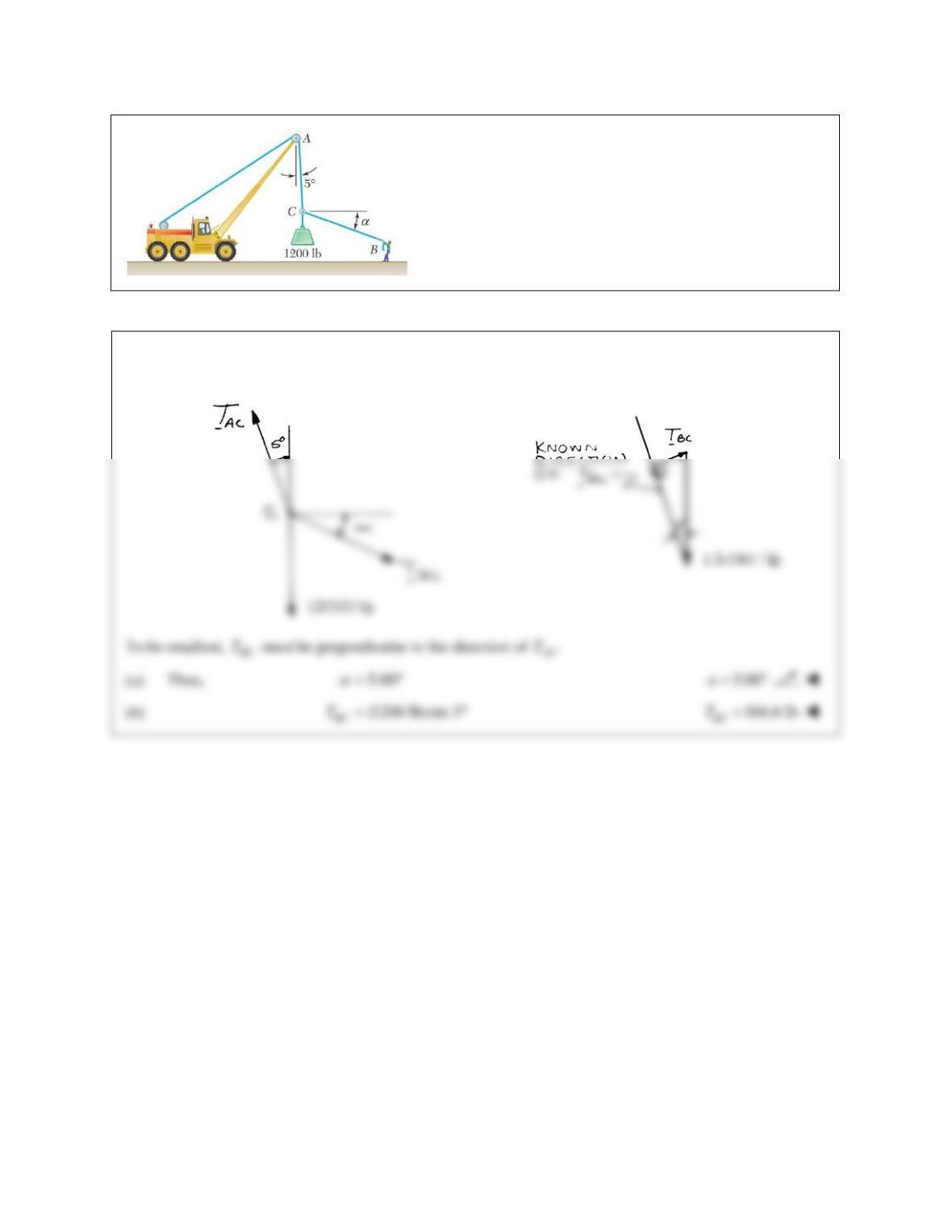
PROBLEM 2.59
For the situation described in Figure P2.48, determine (a)
the value of
α
for which the tension in rope BC is as small
as possible, (b) the corresponding value of the tension.
SOLUTION
Free–Body Diagram Force Triangle
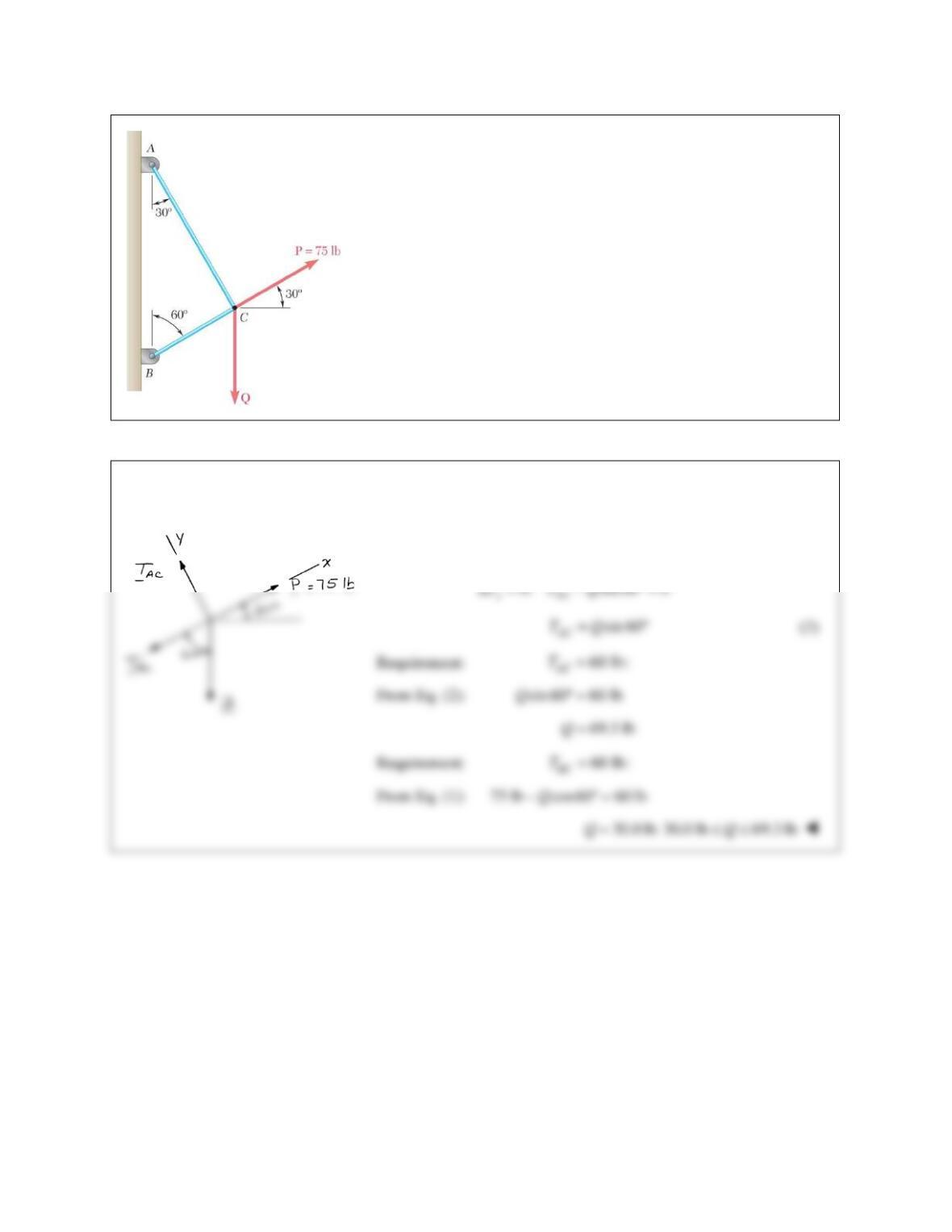
PROBLEM 2.60
Two cables tied together at C are loaded as shown. Determine the
range of values of Q for which the tension will not exceed 60 lb in
either cable.
SOLUTION
Free–Body Diagram
0: cos60 75 lb 0
x BC
F TQΣ = − − °+ =
75 lb cos60
BC
TQ=−°
(1)
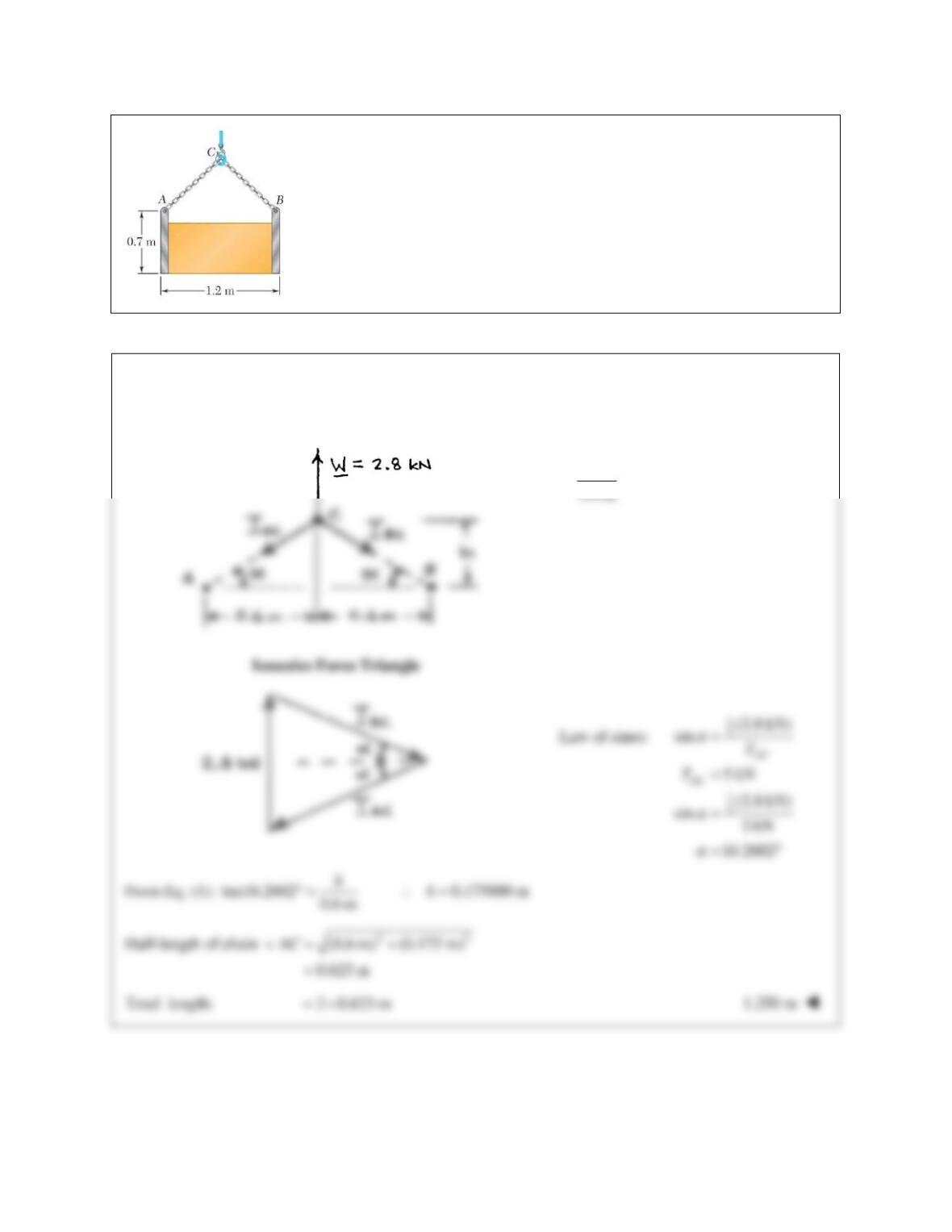
PROBLEM 2.61
A movable bin and its contents have a combined weight of 2.8 kN. Determine
the shortest chain sling ACB that can be used to lift the loaded bin if the
tension in the chain is not to exceed 5 kN.
SOLUTION
Free–Body Diagram
tan 0.6 m
α
=h
(1)
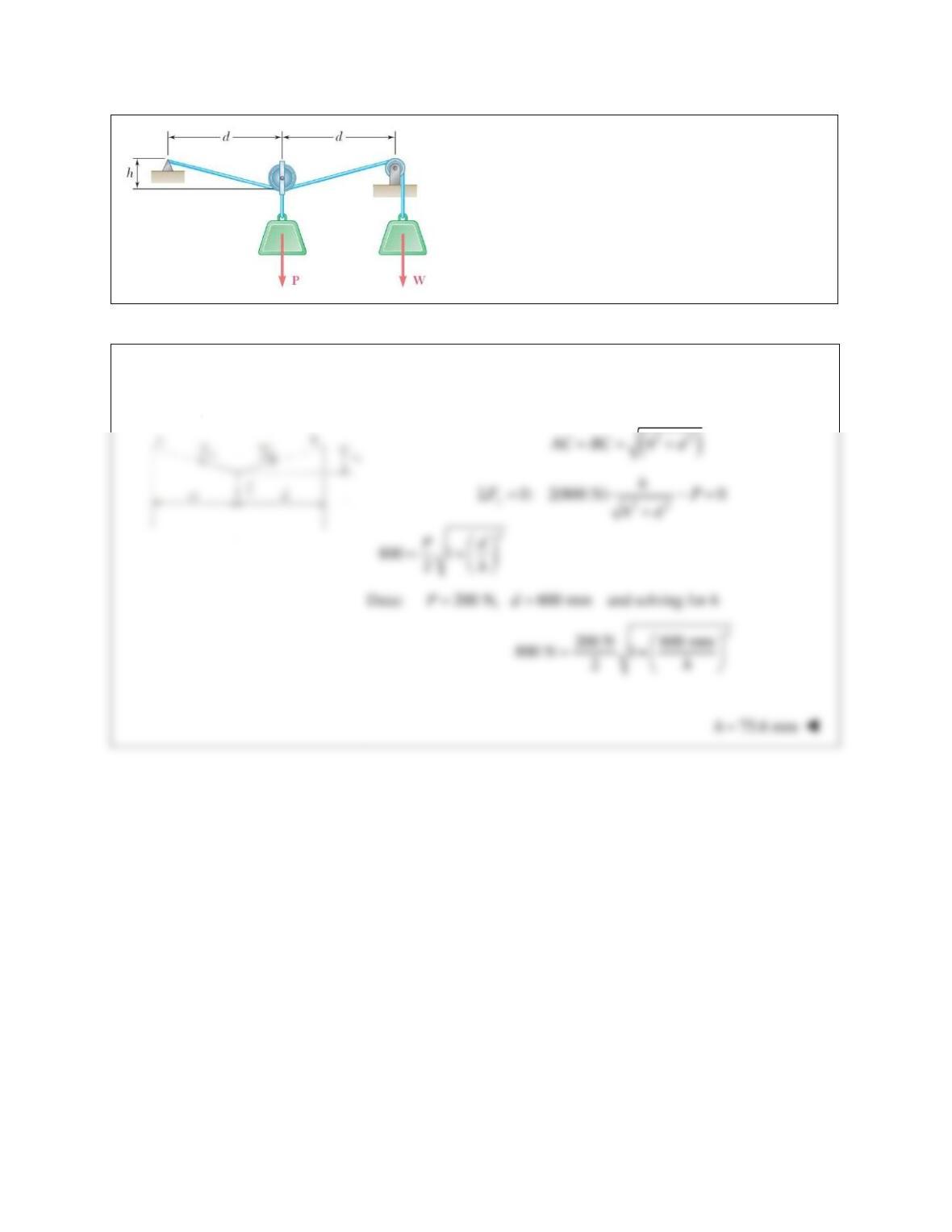
PROBLEM 2.62
For W = 800 N, P = 200 N, and d = 600 mm,
determine the value of h consistent with
equilibrium.
SOLUTION
Free–Body Diagram
800 N
AC BC
TT= =
PROBLEM 2.63
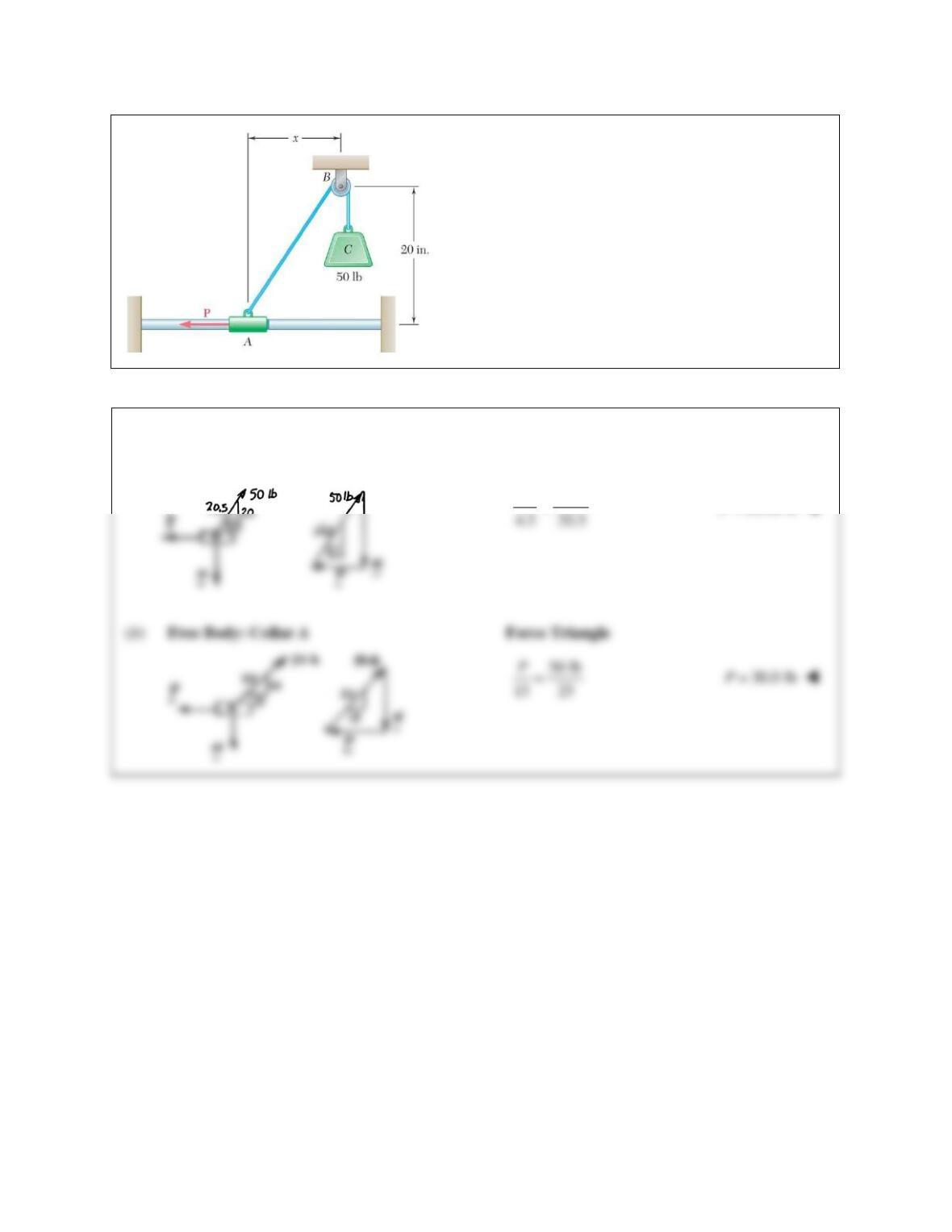
Collar A is connected as shown to a 50–lb load and can
slide on a frictionless horizontal rod. Determine the
magnitude of the force P required to maintain the
equilibrium of the collar when (a)
4.5 in.,x=
(b)
15 in.x=
SOLUTION
(a) Free Body: Collar A Force Triangle
10.98 lbP=
PROBLEM 2.64
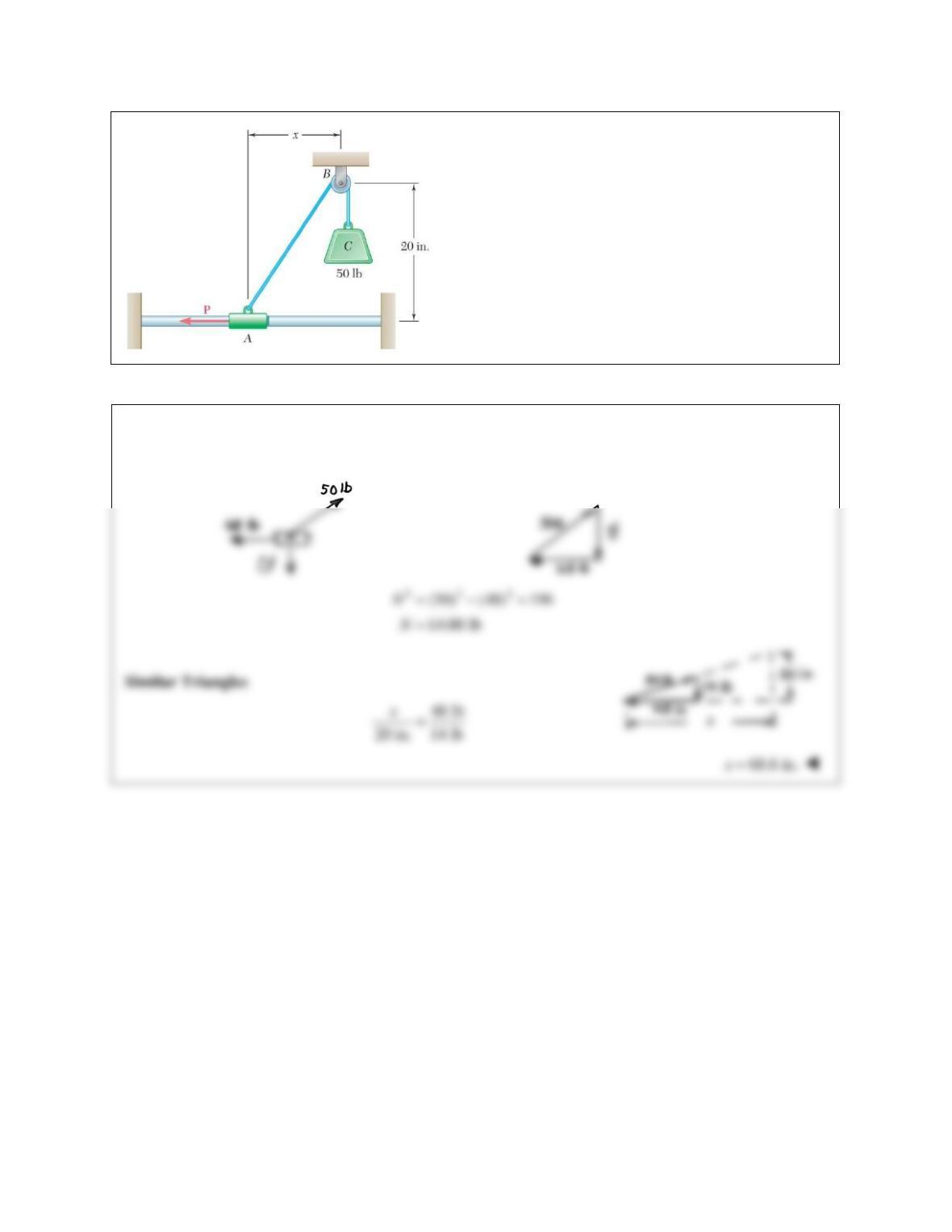
Collar A is connected as shown to a 50-lb load and can
slide on a frictionless horizontal rod. Determine the
distance x for which the collar is in equilibrium when
P = 48 lb.
SOLUTION
Free Body: Collar A Force Triangle
PROBLEM 2.65
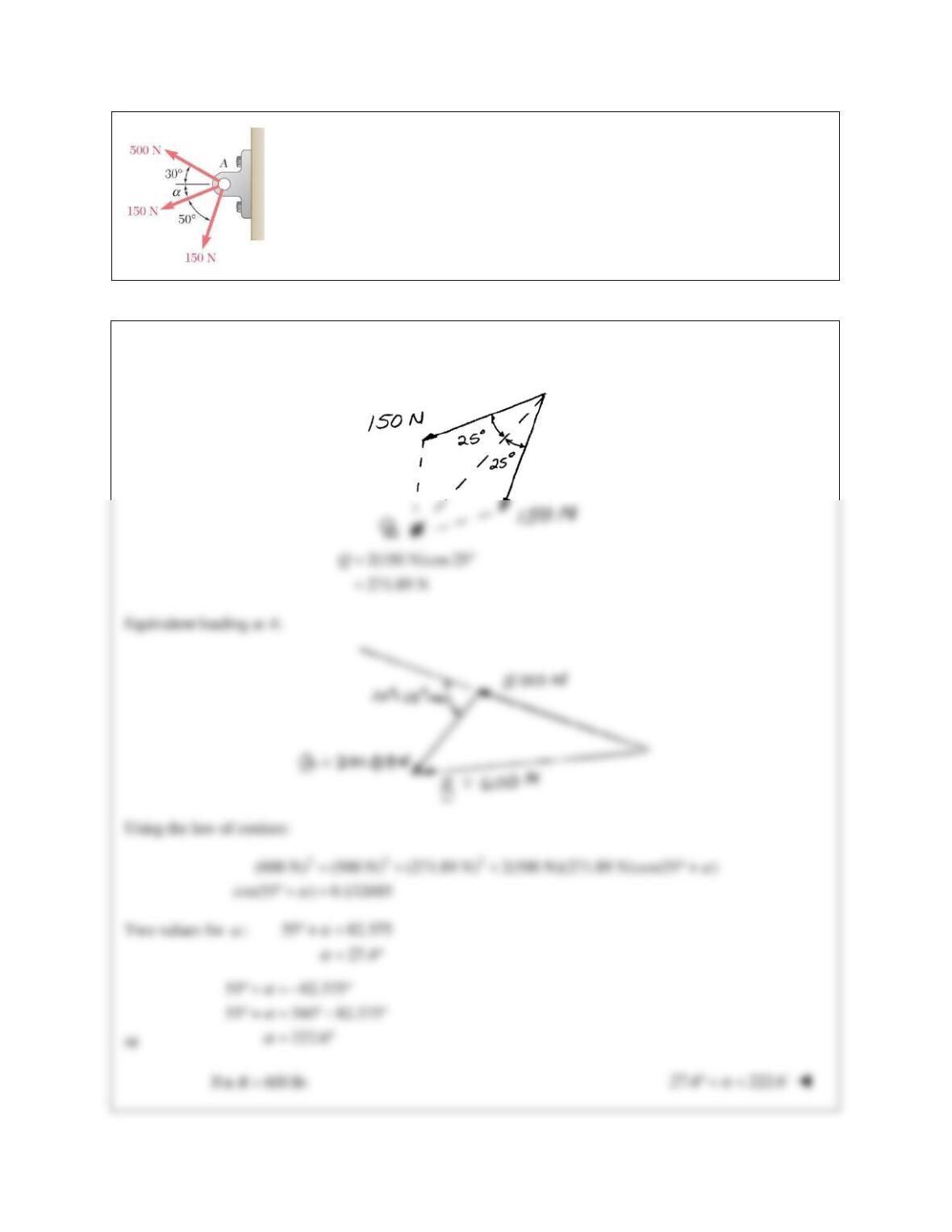
Three forces are applied to a bracket as shown. The directions of the two 150-N
forces may vary, but the angle between these forces is always 50°. Determine
the range of values of α for which the magnitude of the resultant of the forces
acting at A is less than 600 N.
SOLUTION
Combine the two 150-N forces into a resultant force Q:
PROBLEM 2.66
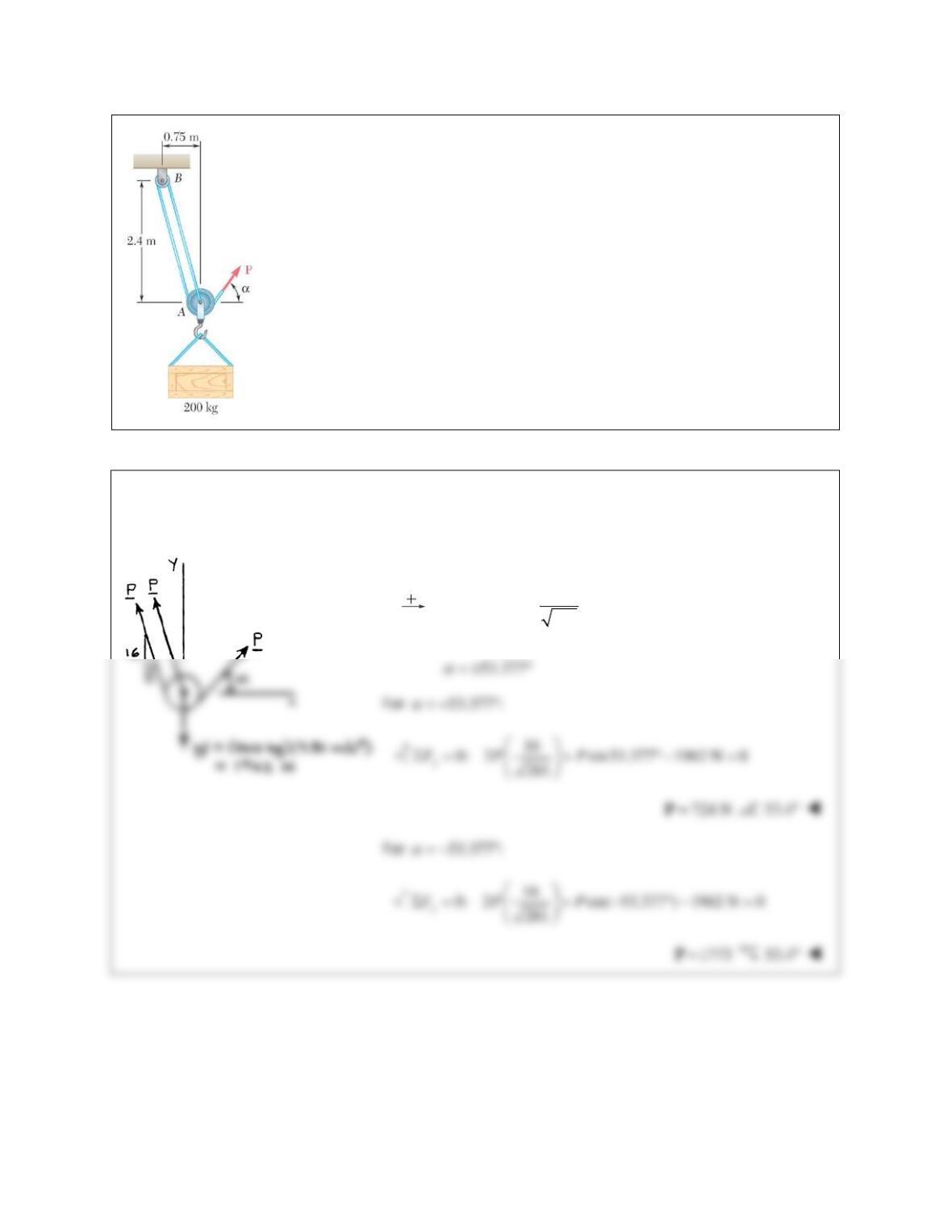
A 200-kg crate is to be supported by the rope-and-pulley arrangement shown.
Determine the magnitude and direction of the force P that must be exerted on
the free end of the rope to maintain equilibrium. (Hint: The tension in the rope is
the same on each side of a simple pulley. This can be proved by the methods of
Ch. 4.)
SOLUTION
Free–Body Diagram: Pulley A
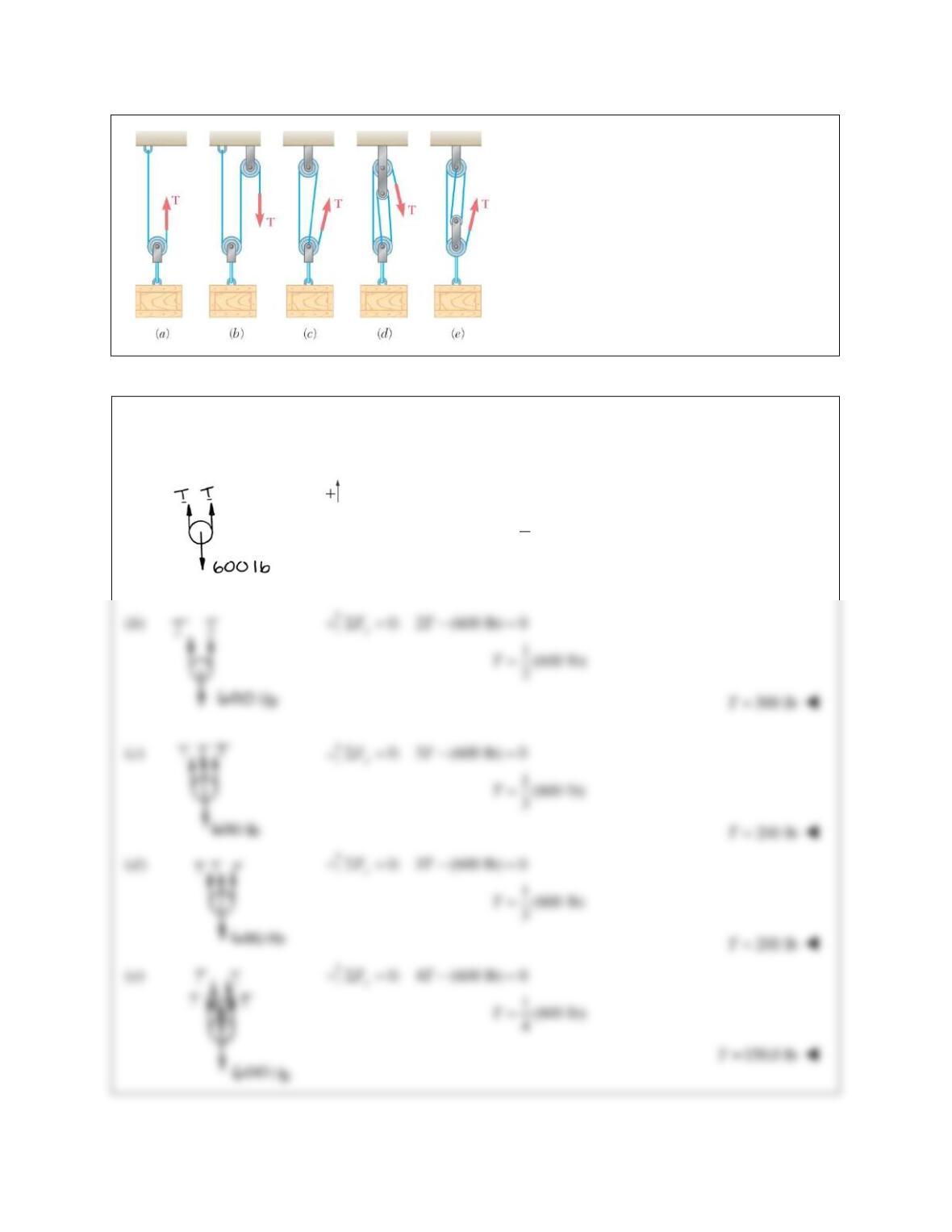
PROBLEM 2.67
A 600–lb crate is supported by several rope-
and–pulley arrangements as shown. Determine
for each arrangement the tension in the rope.
(See the hint for Problem 2.66.)
SOLUTION
Free–Body Diagram of Pulley
(a)
0: 2 (600 lb) 0
1(600 lb)
2
y
FT
T
Σ= − =
=
300 lbT=
0: 2 (600 lb) 0
2
y
FT
T
Σ= − =
=
0: 4 (600 lb) 0
1(600 lb)
4
y
FT
T
Σ= − =
=
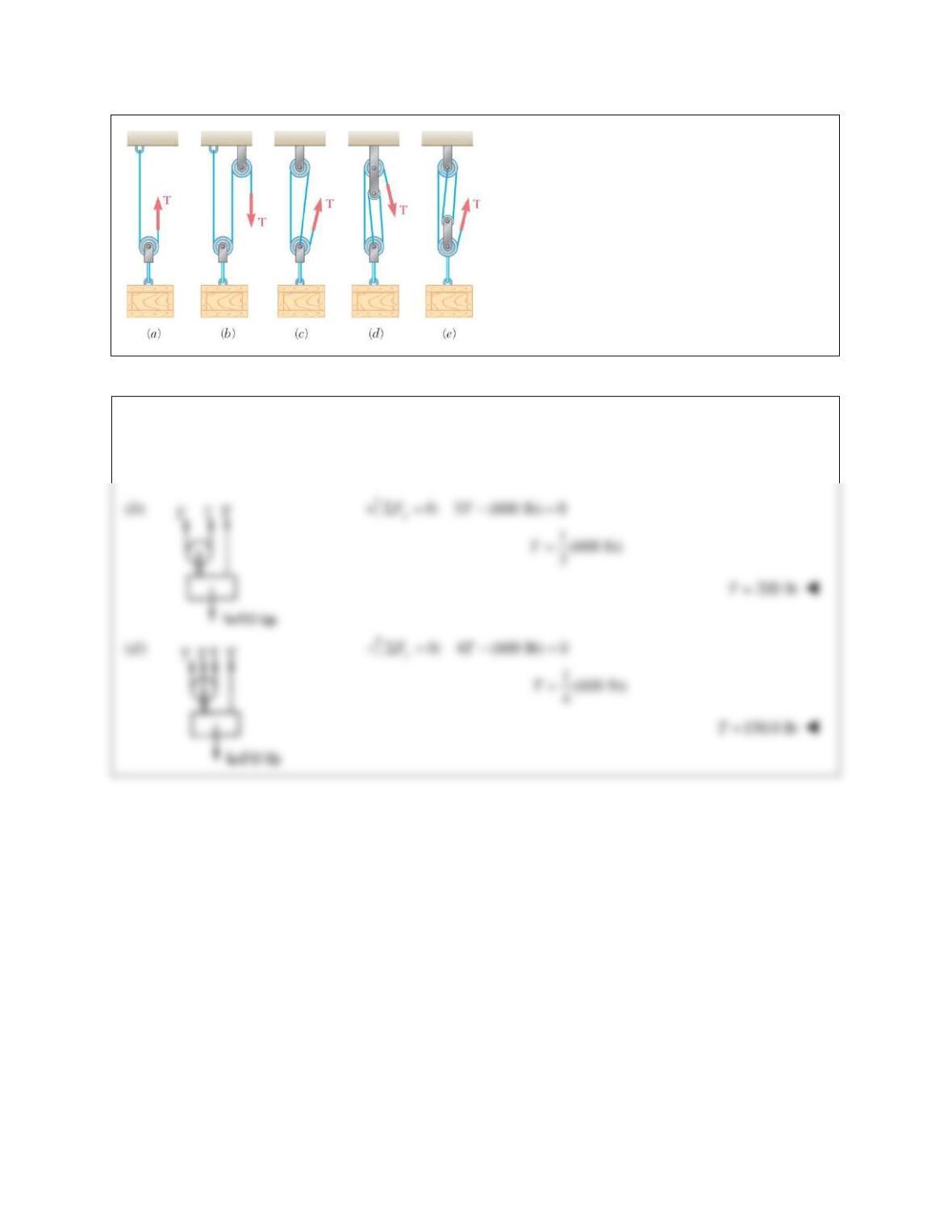
PROBLEM 2.68
Solve Parts b and d of Problem 2.67, assuming
that the free end of the rope is attached to the
crate.
PROBLEM 2.67 A 600-lb crate is supported
by several rope–and–pulley arrangements as
shown. Determine for each arrangement the
tension in the rope. (See the hint for Problem
2.66.)
SOLUTION
Free-Body Diagram of Pulley and Crate
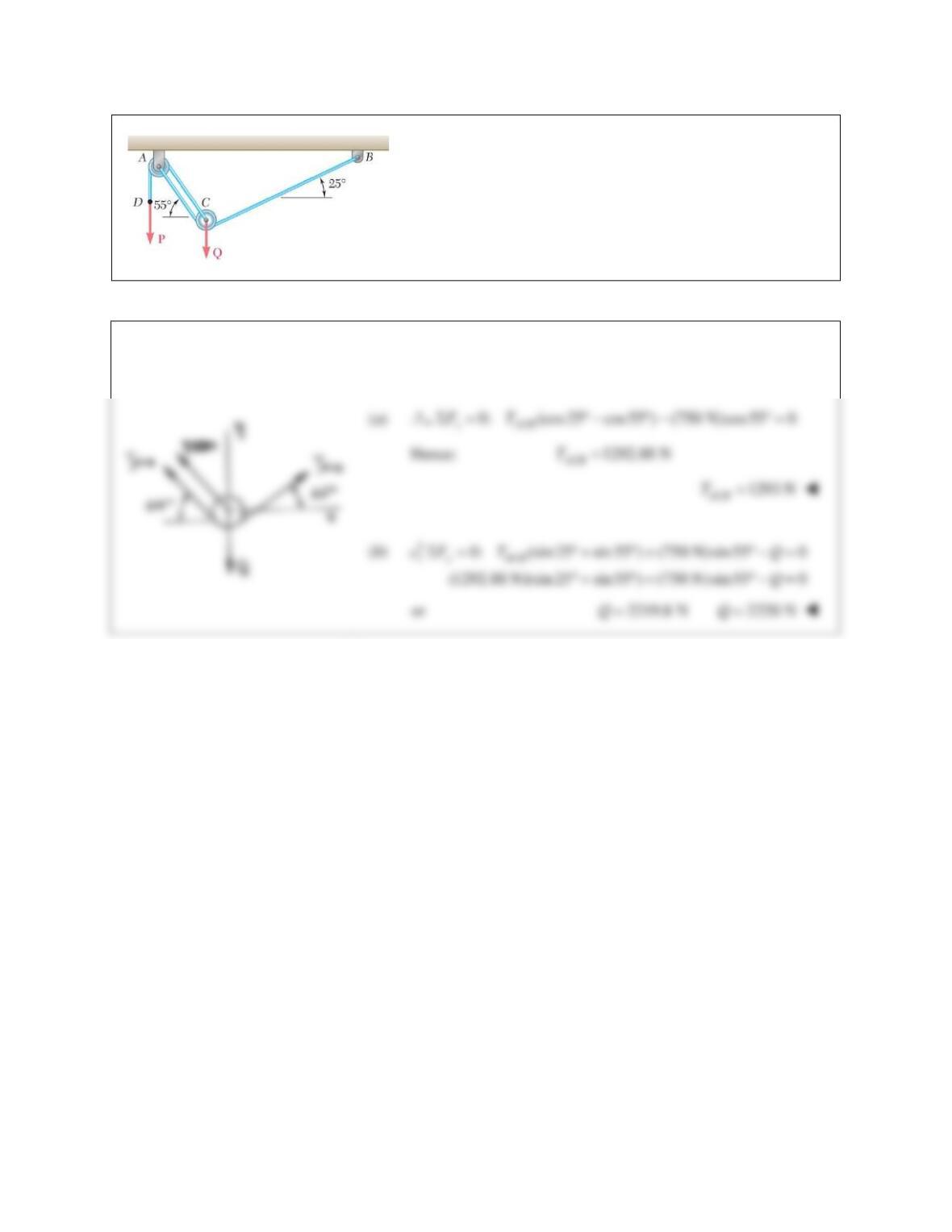
PROBLEM 2.69
A load Q is applied to the pulley C, which can roll on the
cable ACB. The pulley is held in the position shown by a
second cable CAD, which passes over the pulley A and
supports a load P. Knowing that
750 N,P=
determine
(a) the tension in cable ACB, (b) the magnitude of load Q.
SOLUTION
Free–Body Diagram: Pulley C
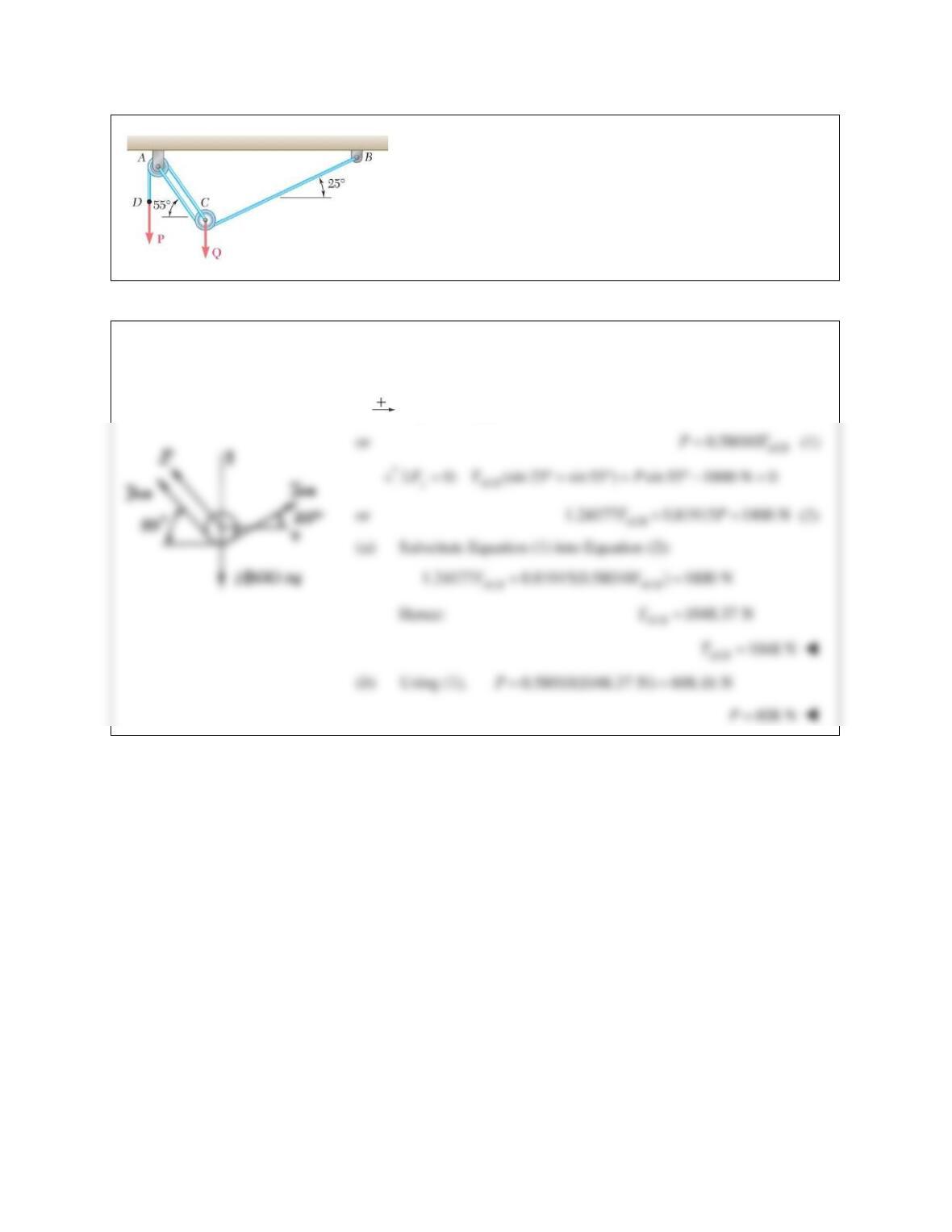
PROBLEM 2.70
An 1800-N load Q is applied to the pulley C, which can roll
on the cable ACB. The pulley is held in the position shown by
a second cable CAD, which passes over the pulley A and
supports a load P. Determine (a) the tension in cable ACB,
(b) the magnitude of load P.
SOLUTION
Free–Body Diagram: Pulley C
0: (cos 25 cos55 ) cos55 0
x ACB
FT PΣ = °− ° − °=
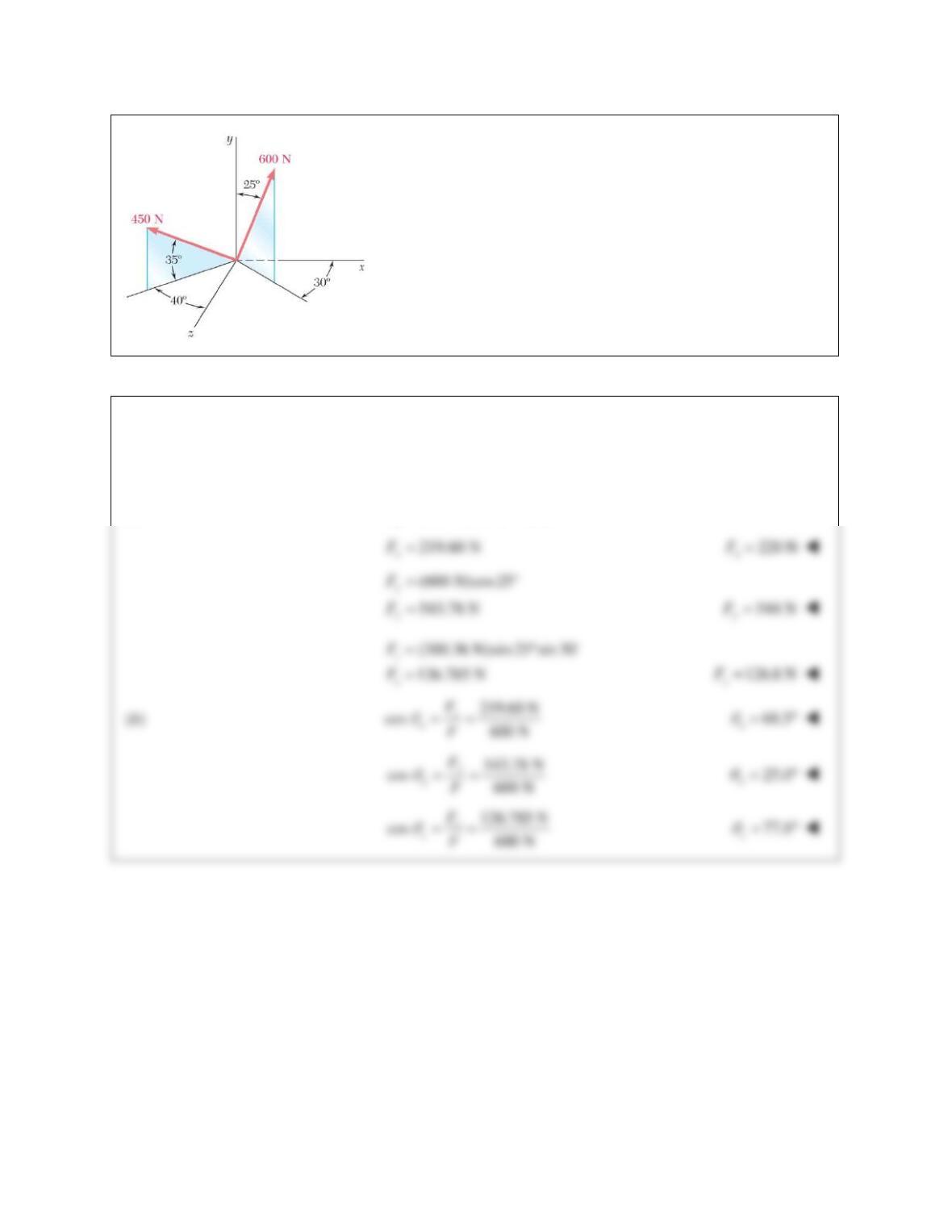
PROBLEM 2.71
Determine (a) the x, y, and z components of the 600-N force,
(b) the angles
θ
x,
θ
y, and
θ
z that the force forms with the
coordinate axes.
SOLUTION
(a)
(600 N)sin 25 cos30
x
F= °
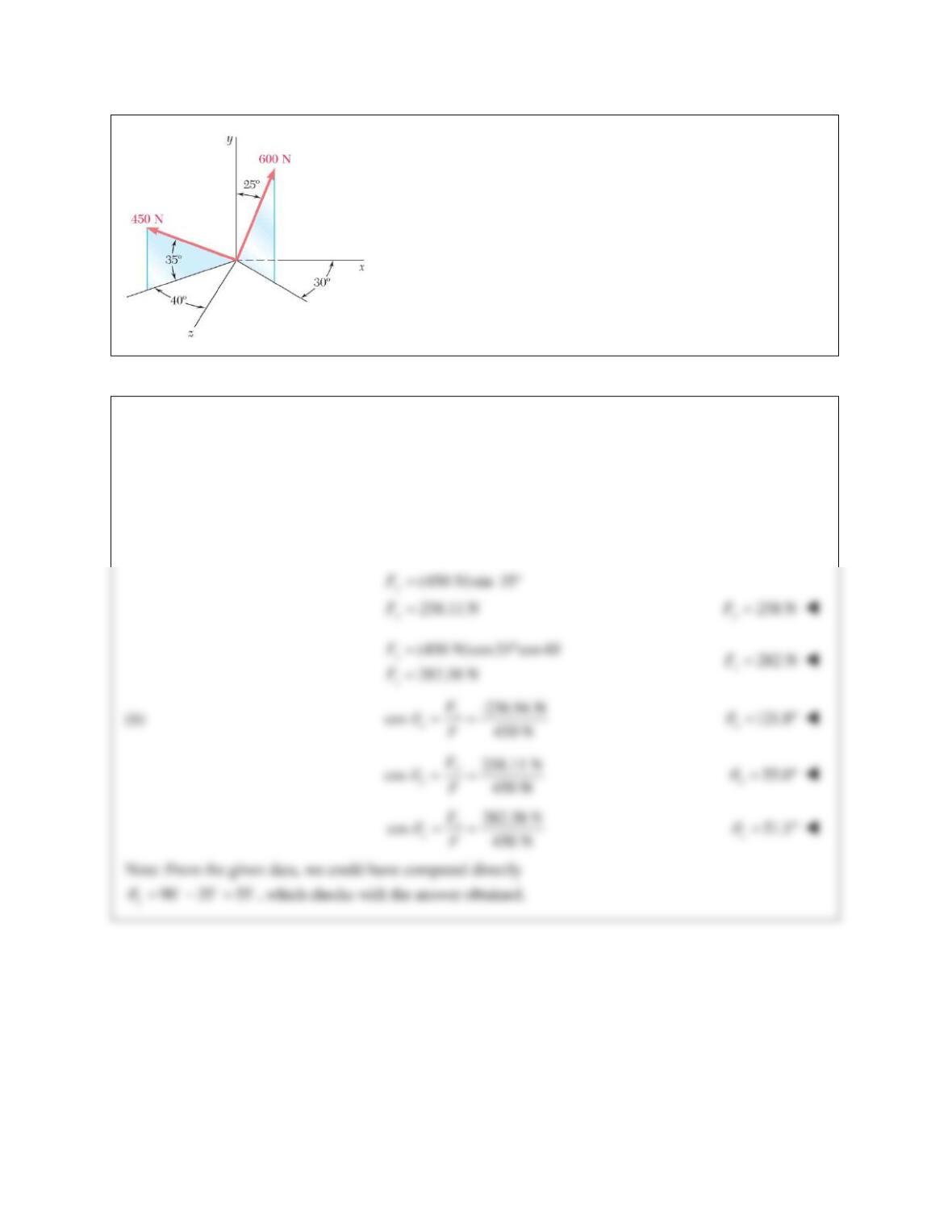
PROBLEM 2.72
Determine (a) the x, y, and z components of the 450-N force,
(b) the angles
θ
x,
θ
y, and
θ
z that the force forms with the
coordinate axes.
SOLUTION
(a)
(450 N)cos 35 sin 40
x
F=−°
236.94 N
x
F= −
237 N
x
F= −
z
PROBLEM 2.73
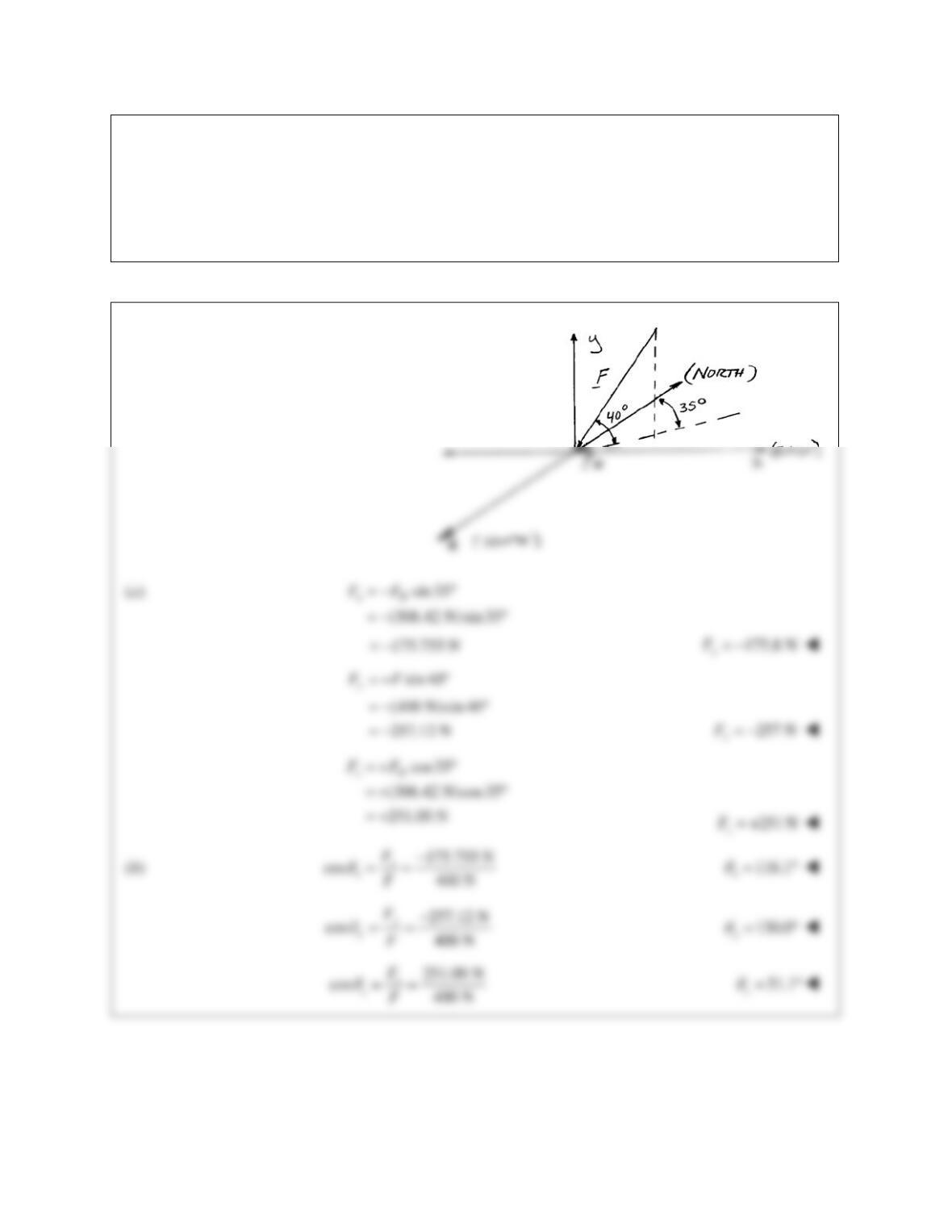
A gun is aimed at a point A located 35° east of north. Knowing that the barrel of the gun forms an angle
of 40° with the horizontal and that the maximum recoil force is 400 N, determine (a) the x, y, and z
components of that force, (b) the values of the angles θx, θy, and θz defining the direction of the recoil
force. (Assume that the x, y, and z axes are directed, respectively, east, up, and south.)
SOLUTION
Recoil force
400 NF=
(400 N) cos 40
306.42 N
H
F∴= °
=
PROBLEM 2.74
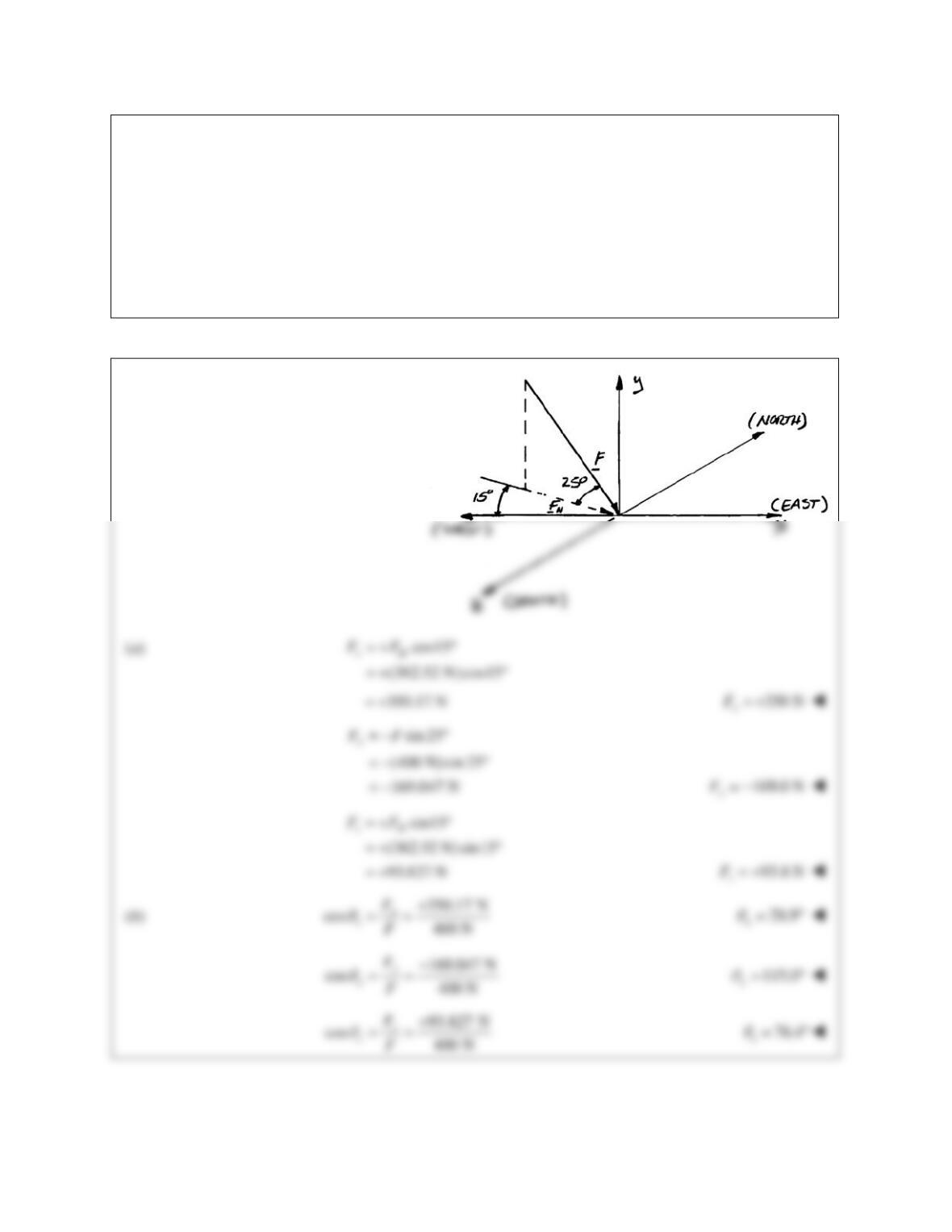
Solve Problem 2.73, assuming that point A is located 15° north of west and that the barrel of the gun
forms an angle of 25° with the horizontal.
PROBLEM 2.73 A gun is aimed at a point A located 35° east of north. Knowing that the barrel of the
gun forms an angle of 40° with the horizontal and that the maximum recoil force is 400 N, determine
(a) the x, y, and z components of that force, (b) the values of the angles θx, θy, and θz defining the direction
of the recoil force. (Assume that the x, y, and z axes are directed, respectively, east, up, and south.)
SOLUTION
Recoil force
400 NF=
(400 N) cos 25
362.52 N
H
F∴= °
=
PROBLEM 2.75
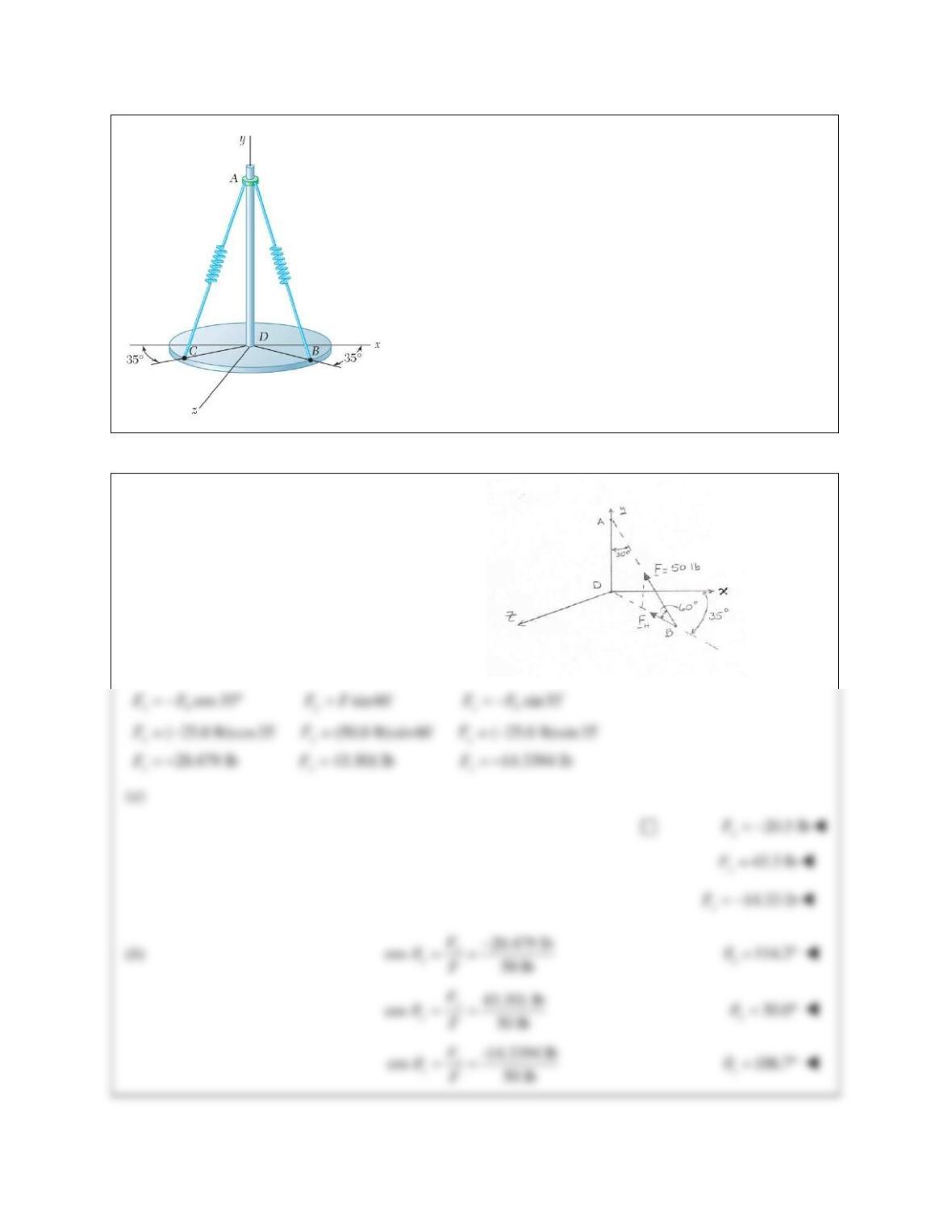
The angle between spring AB and the post DA is 30°. Knowing
that the tension in the spring is 50 lb, determine (a) the x, y,
and z components of the force exerted on the circular plate at
B, (b) the angles
θ
x,
θ
y, and
θ
z defining the direction of the
force at B.
SOLUTION
cos 60
(50 lb)cos 60
25.0 lb
h
h
FF
F
= °
= °
=
PROBLEM 2.76
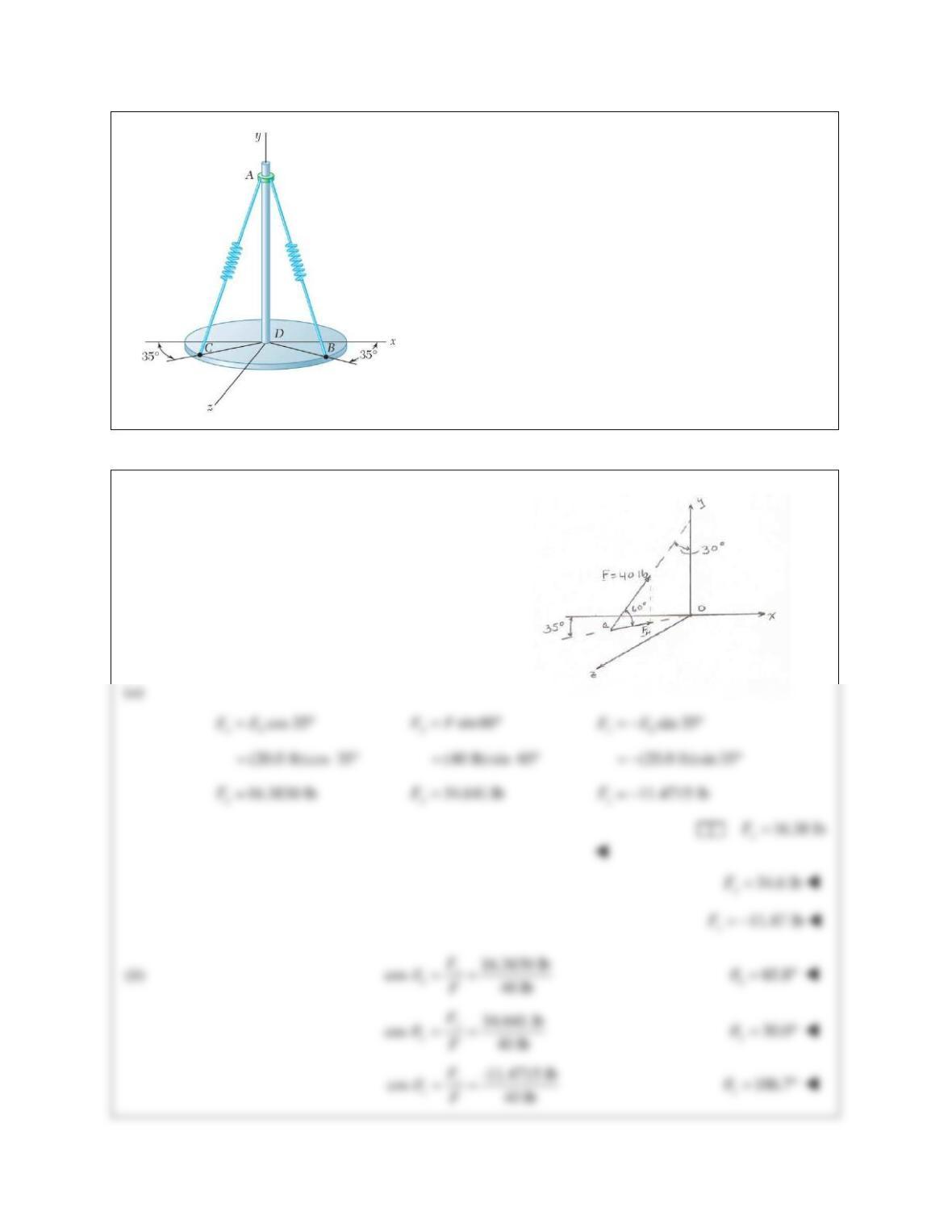
The angle between spring AC and the post DA is
30°. Knowing that the tension in the spring is 40 lb,
determine (a) the x, y, and z components of the force
exerted on the circular plate at C, (b) the angles
θ
x,
θ
y, and
θ
z defining the direction of the force at C.
SOLUTION
cos 60
(40 lb)cos 60
20.0 lb
h
h
FF
F
= °
= °
=
PROBLEM 2.77
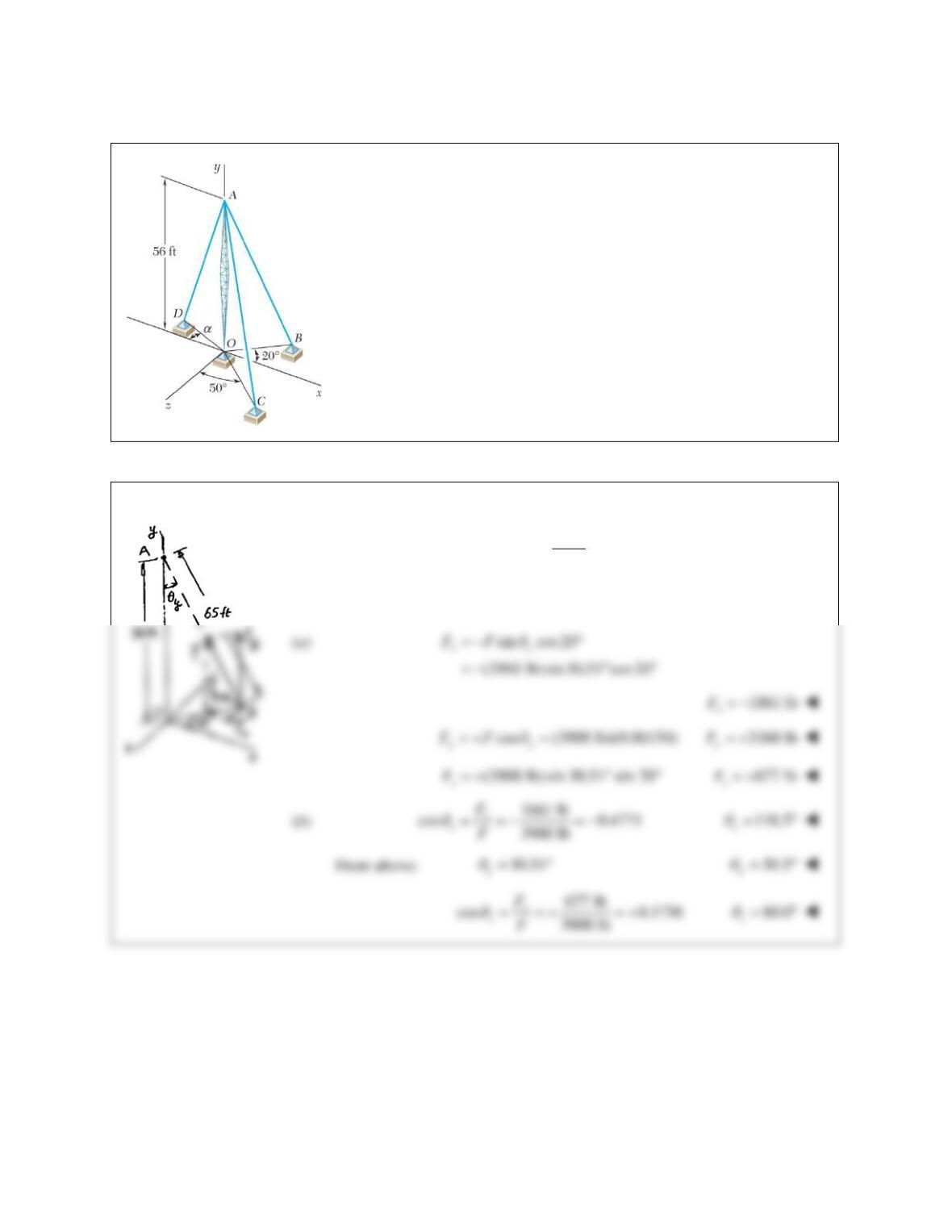
Cable AB is 65 ft long, and the tension in that cable is 3900 lb.
Determine (a) the x, y, and z components of the force exerted by the
cable on the anchor B, (b) the angles
,
x
θ
,
y
θ
and
z
θ
defining the
direction of that force.
SOLUTION
From triangle AOB:
56 ft
cos 65 ft
0.86154
30.51
y
y
θ
θ
=
=
= °
PROBLEM 2.78
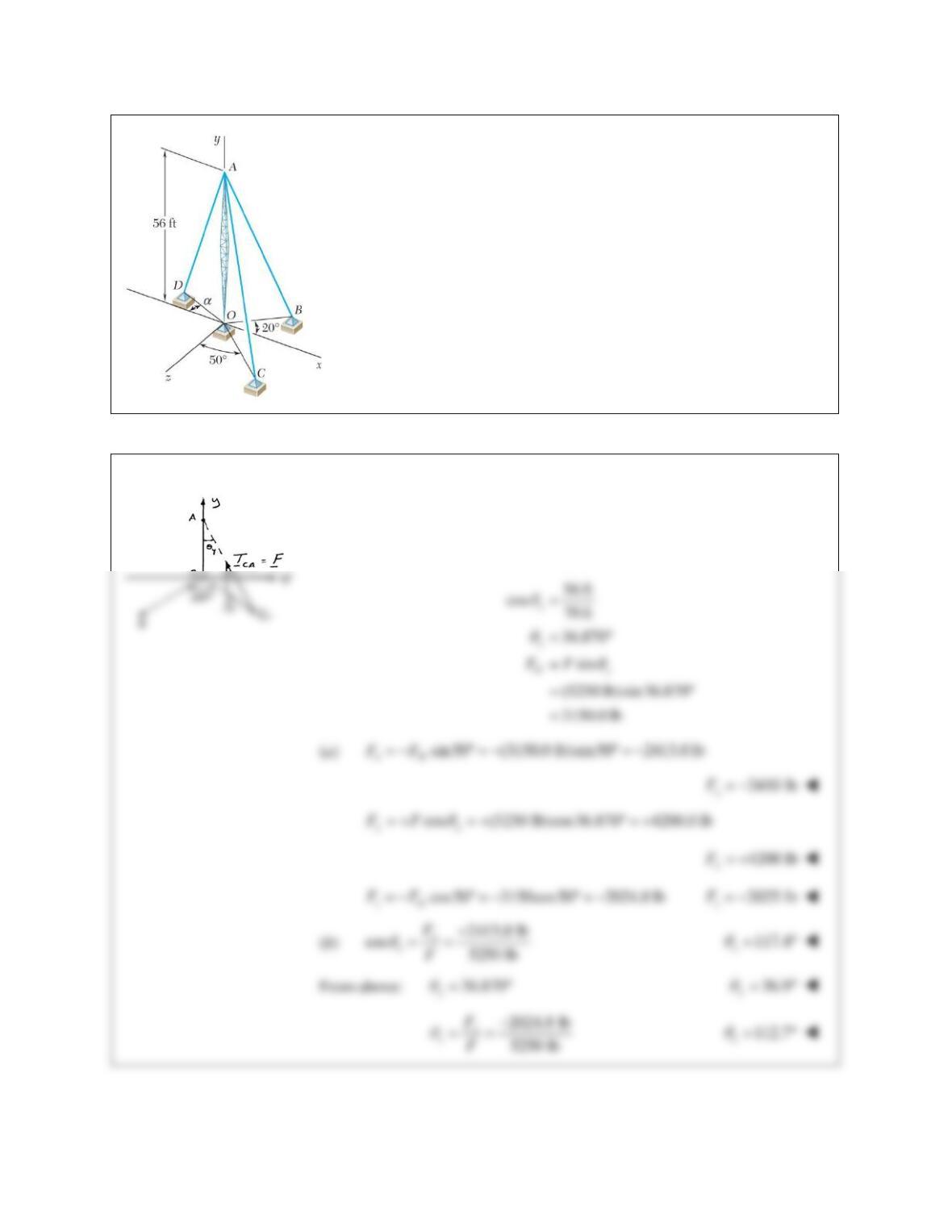
Cable AC is 70 ft long, and the tension in that cable is 5250 lb.
Determine (a) the x, y, and z components of the force exerted by the
cable on the anchor C, (b) the angles
θ
x,
θ
y, and
θ
z defining the
direction of that force.
SOLUTION
In triangle AOB:
70 ft
56 ft
5250 lb
AC
OA
F
=
=
=