Chapter 2
can let ~v =~e1and ~w =~e2instead.)
2.2.19 T(~e1) = ~e1,T(~e2) = ~e2, and T(~e3) = ~
0, so that the matrix is
1 0 0
0 1 0
0 0 0
.
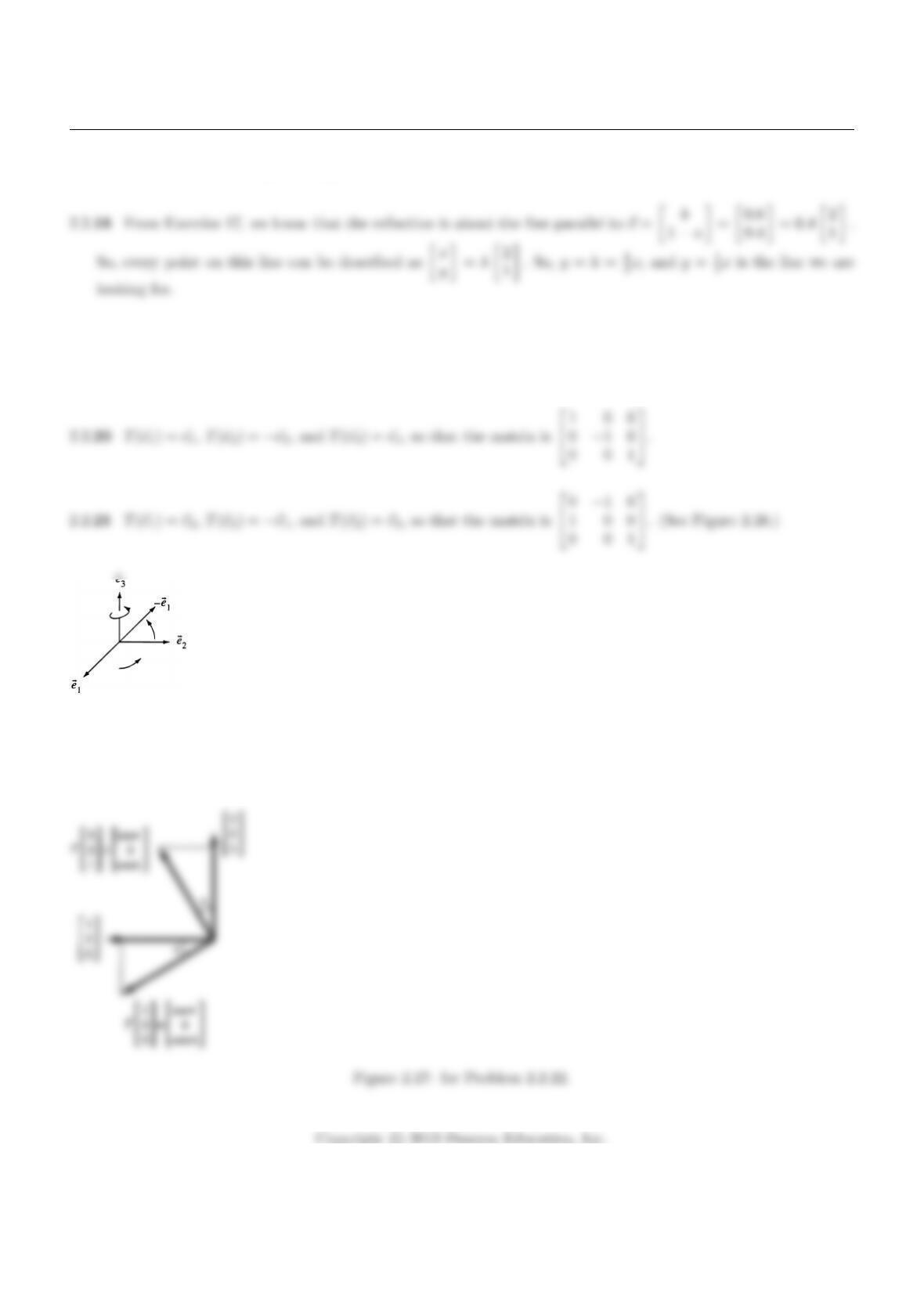
Figure 2.26: for Problem 2.2.21.
2.2.22 Sketch the ~e1−~e3plane, as viewed from the positive ~e2axis.
70
Section 2.2
Since T(~e2) = ~e2, the matrix is
cos θ0 sin θ
0 1 0
−sin θ0 cos θ
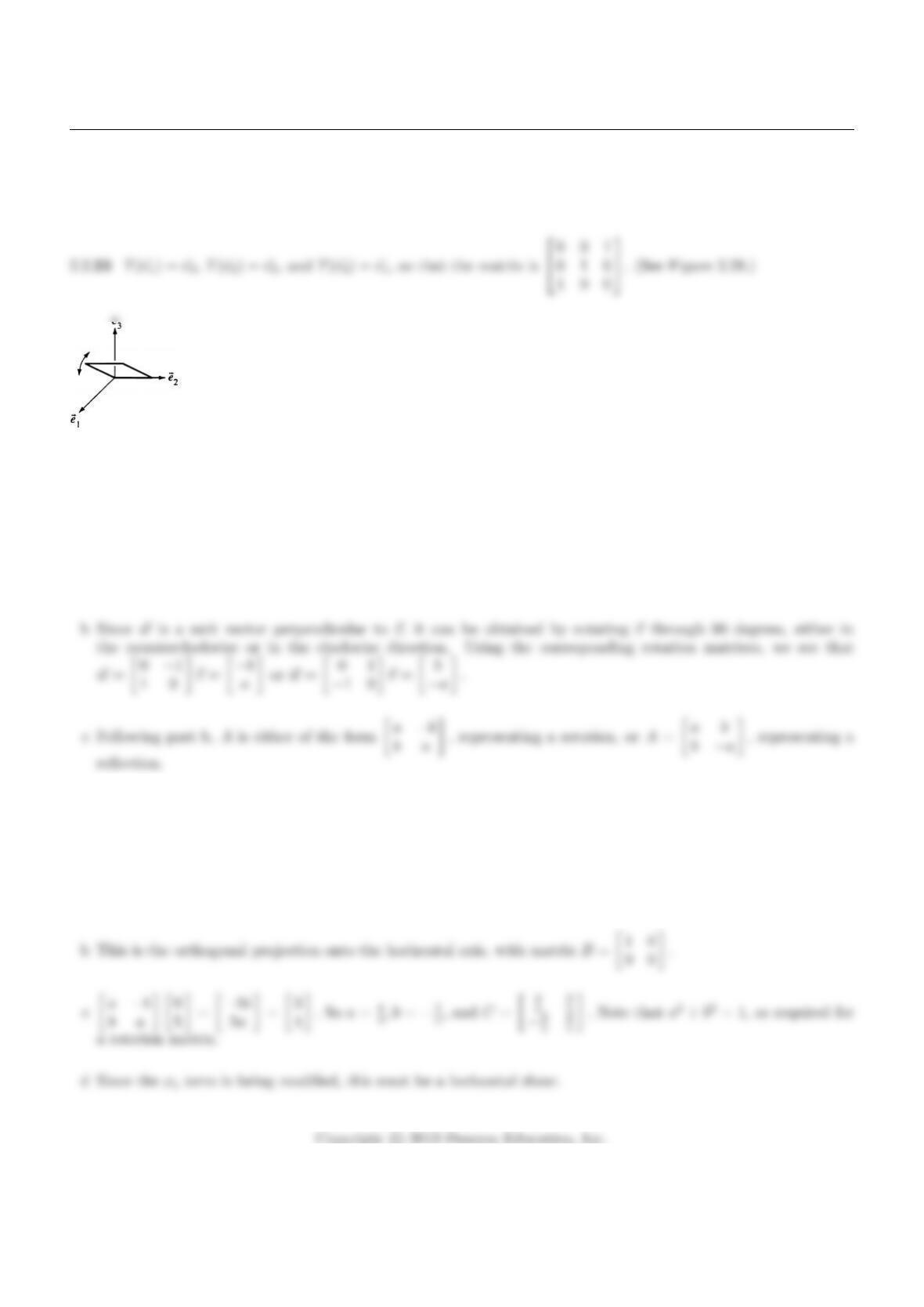
. (See Figure 2.27.)
Figure 2.28: for Problem 2.2.23.
2.2.24 aA= [ ~v ~w ],so A1
0=~v and A0
1=~w. Since Apreserves length, both ~v and ~w must be unit
vectors. Furthermore, since Apreserves angles and 1
0and 0
1are clearly perpendicular, ~v and ~w must also
be perpendicular.
2.2.25 The matrix A=1k
0 1 represents a horizontal shear, and its inverse A−1=1−k
0 1 represents such a
shear as well, but “the other way.”
2.2.26 ak0
0k 2
−1=2k
−k=8
−4. So k= 4 and A=4 0
0 4 .
71
2.2.27 Matrix Bclearly represents a scaling.
Matrix Crepresents a projection, by Definition 2.2.1, with u1= 0.6 and u2= 0.8.
2.2.28 aDis a scaling, being of the form k0
0k.
2.2.29 To check that Lis linear, we verify the two parts of Theorem 2.1.3:
a) Use the hint and apply Lto both sides of the equation ~x +~y =T(L(~x) + L(~y)):
2.2.30 Write A= [ ~v1~v2]; then A~x = [~v1~v2]x1
x2=x1~v1+x2~v2. We must choose ~v1and ~v2in such a way that
x1~v1+x2~v2is a scalar multiple of the vector 1
72
Section 2.2
2.2.31 Write A= [~v1~v2~v3]; then A~x = [~v1~v2~v3]
x1
x2
x3
=x1~v1+x2~v2+x3~v3.
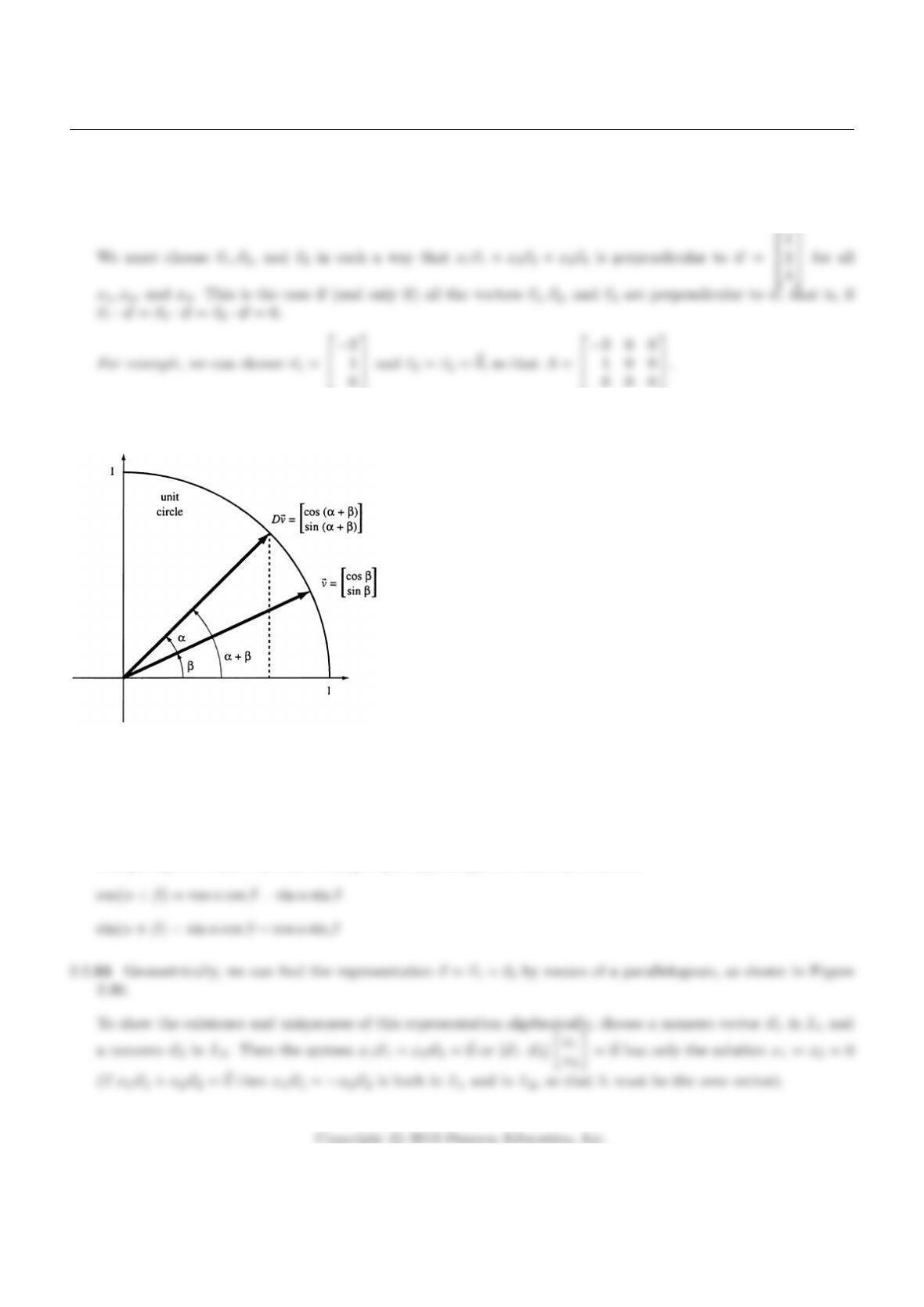
2.2.32 a See Figure 2.29.
Figure 2.29: for Problem 2.2.32a.
b Compute D~v =cos α−sin α
sin αcos αcos β
sin β=cos αcos β−sin αsin β
sin αcos β+ cos αsin β.
Comparing this result with our finding in part (a), we get the addition theorems
73
Chapter 2
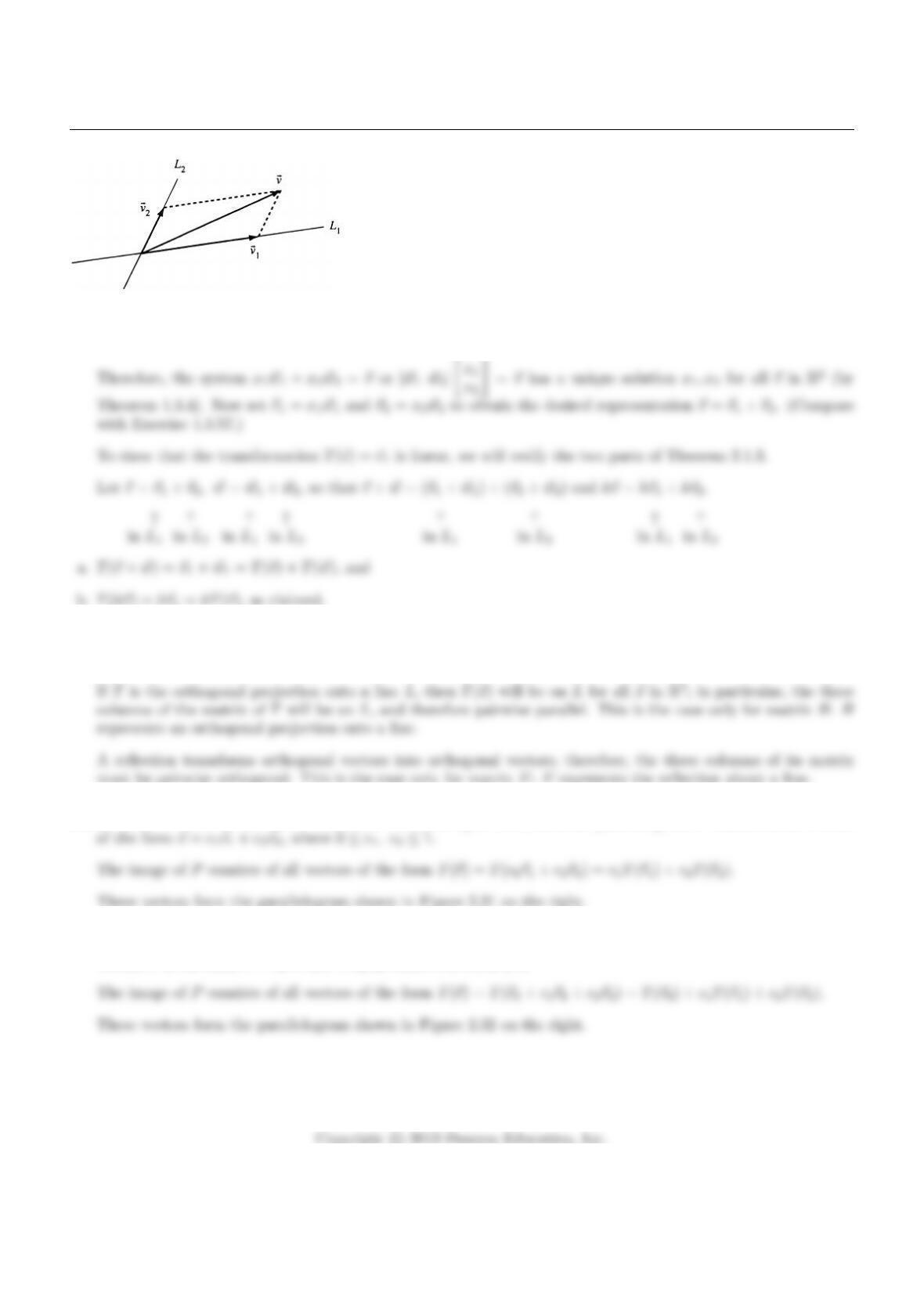
Figure 2.30: for Problem 2.2.33.
2.2.34 Keep in mind that the columns of the matrix of a linear transformation Tfrom R3to R3are T(~e1), T (~e2),
and T(~e3).
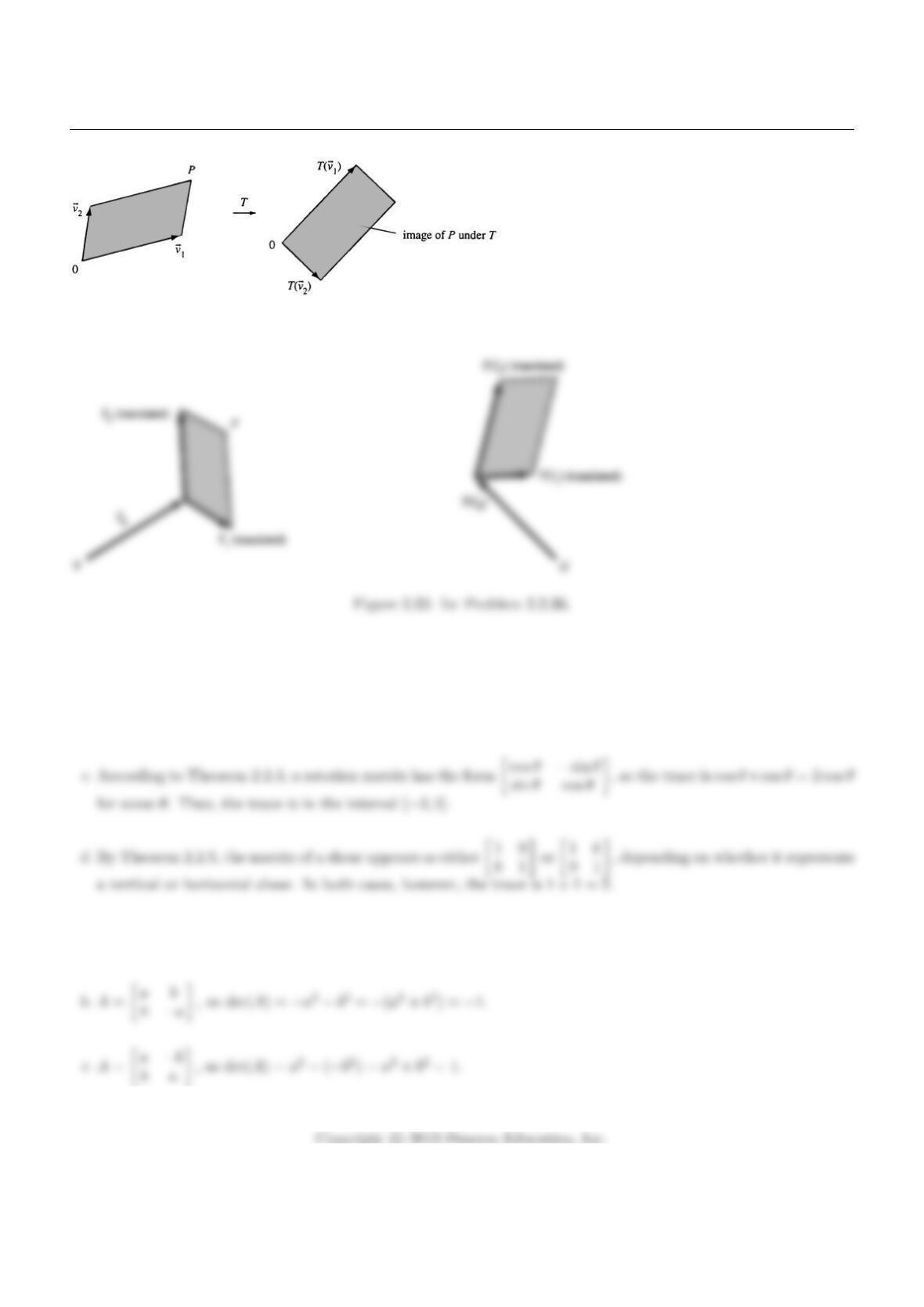
2.2.35 If the vectors ~v1and ~v2are defined as shown in Figure 2.27, then the parallelogram Pconsists of all vectors
2.2.36 If the vectors ~v0, ~v1, and ~v2are defined as shown in Figure 2.28, then the parallelogram Pconsists of all
vectors ~v of the form ~v =~v0+c1~v1+c2~v2, where 0 ≤c1, c2≤1.
2.2.37 a By Definition 2.2.1, a projection has a matrix of the form u2
1u1u2
u1u2u2
2, where u1
u2is a unit vector.
74
Section 2.2
Figure 2.31: for Problem 2.2.35.
So the trace is u2
1+u2
2= 1.
b By Definition 2.2.2, reflection matrices look like a b
b−a, so the trace is a−a= 0.
2.2.38 aA=u2
1u1u2
u1u2u2
2,so det(A) = u2
1u2
2−u1u2u1u2= 0.
75
Chapter 2
c We are asked to write 3 4
4−3=k“3
k
4
k
4
k−3
k#, with our scaling factor kyet to be determined. This matrix,
“3
k
4
k
4
k−3
k#has the form of a reflection matrix a b
b−a. This form further requires that 1 = a2+b2=
(3
k)2+ ( 4
k)2, or k= 5. Thus, the matrix represents a reflection combined with a scaling by a factor of 5.
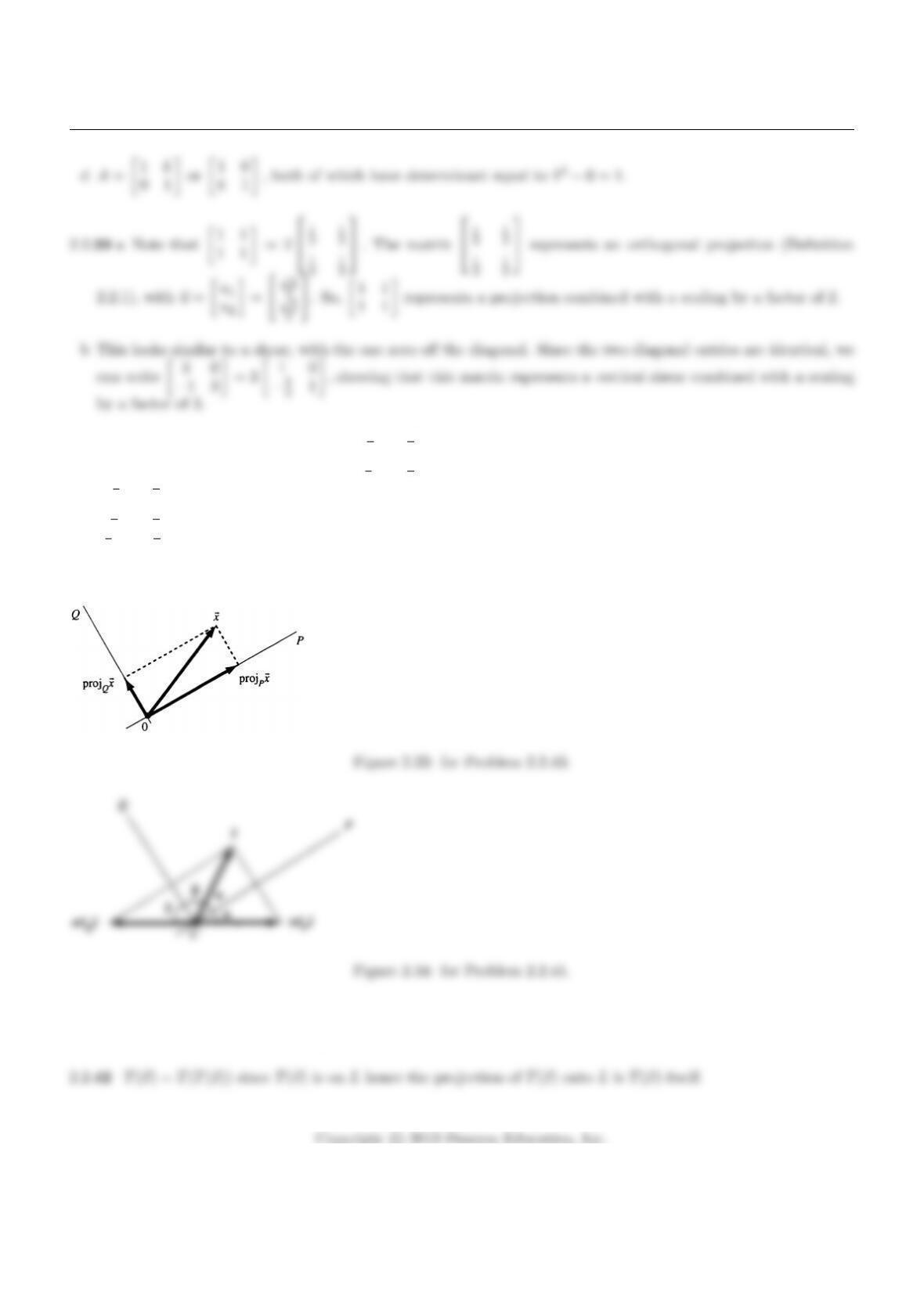
2.2.40 ~x = projP~x + projQ~x, as illustrated in Figure 2.33.
2.2.41 refQ~x =−refP~x since refQ~x, refP~x, and ~x all have the same length, and refQ~x and refP~x enclose an angle of
2α+ 2β= 2(α+β) = π. (See Figure 2.34.)
76
Section 2.2
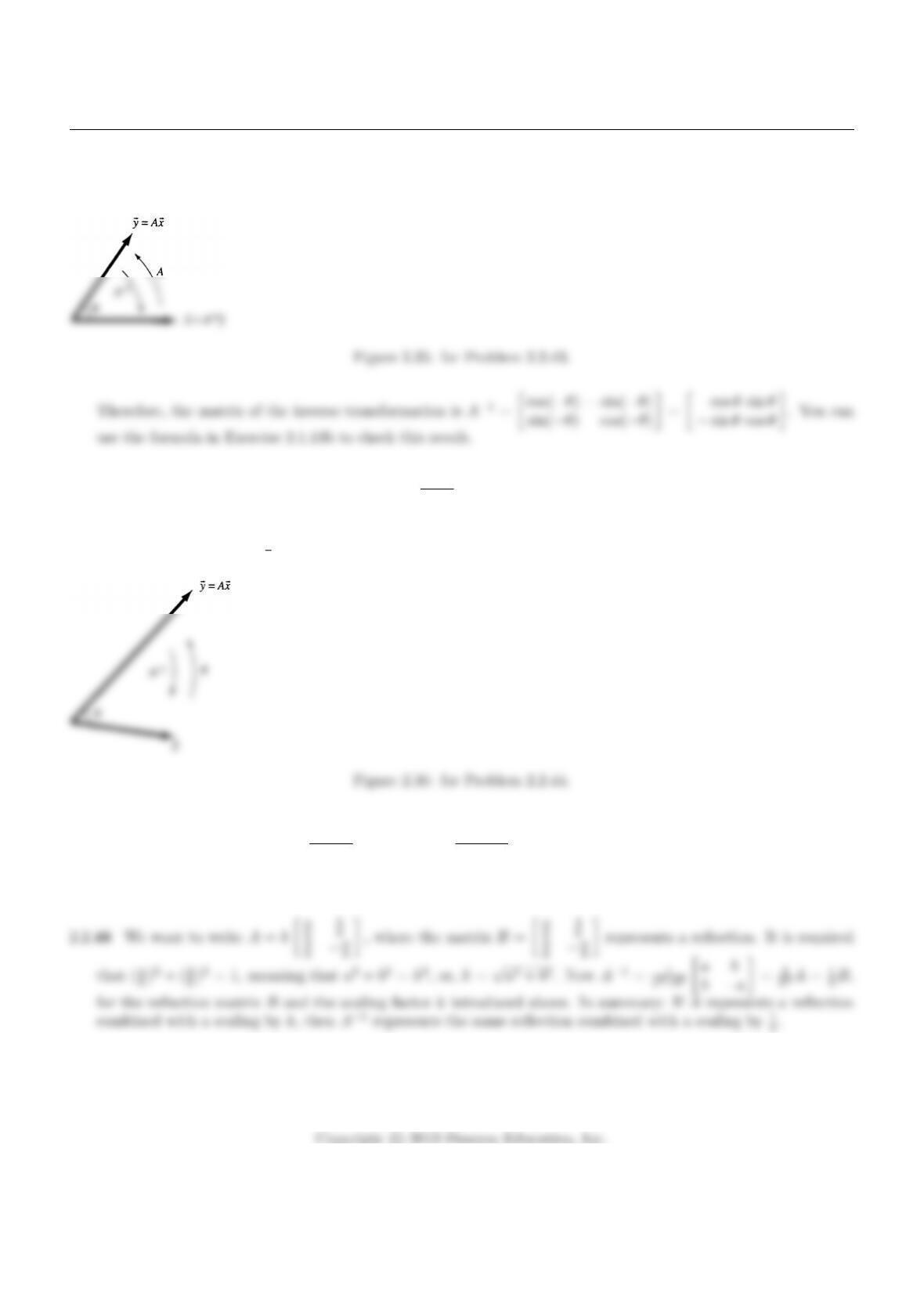
2.2.43 Since ~y =A~x is obtained from ~x by a rotation through θin the counterclockwise direction, ~x is obtained
from ~y by a rotation through θin the clockwise direction, that is, a rotation through −θ. (See Figure 2.35.)
2.2.44 By Exercise 1.1.13b, A−1=a−b
b a −1
=1
a2+b2a b
−b a .
If Arepresents a rotation through θfollowed by a scaling by r, then A−1represents a rotation through −θ
followed by a scaling by 1
r. (See Figure 2.36.)
2.2.45 By Exercise 2.1.13, A−1=1
−a2−b2−a−b
−b a =1
−(a2+b2)−a−b
−b a =−1−a−b
−b a =a b
b−a.
So A−1=A, which makes sense. Reflecting a vector twice about the same line will return it to its original state.
2.2.47 a. Let A=a b
c d . Then
77
Chapter 2
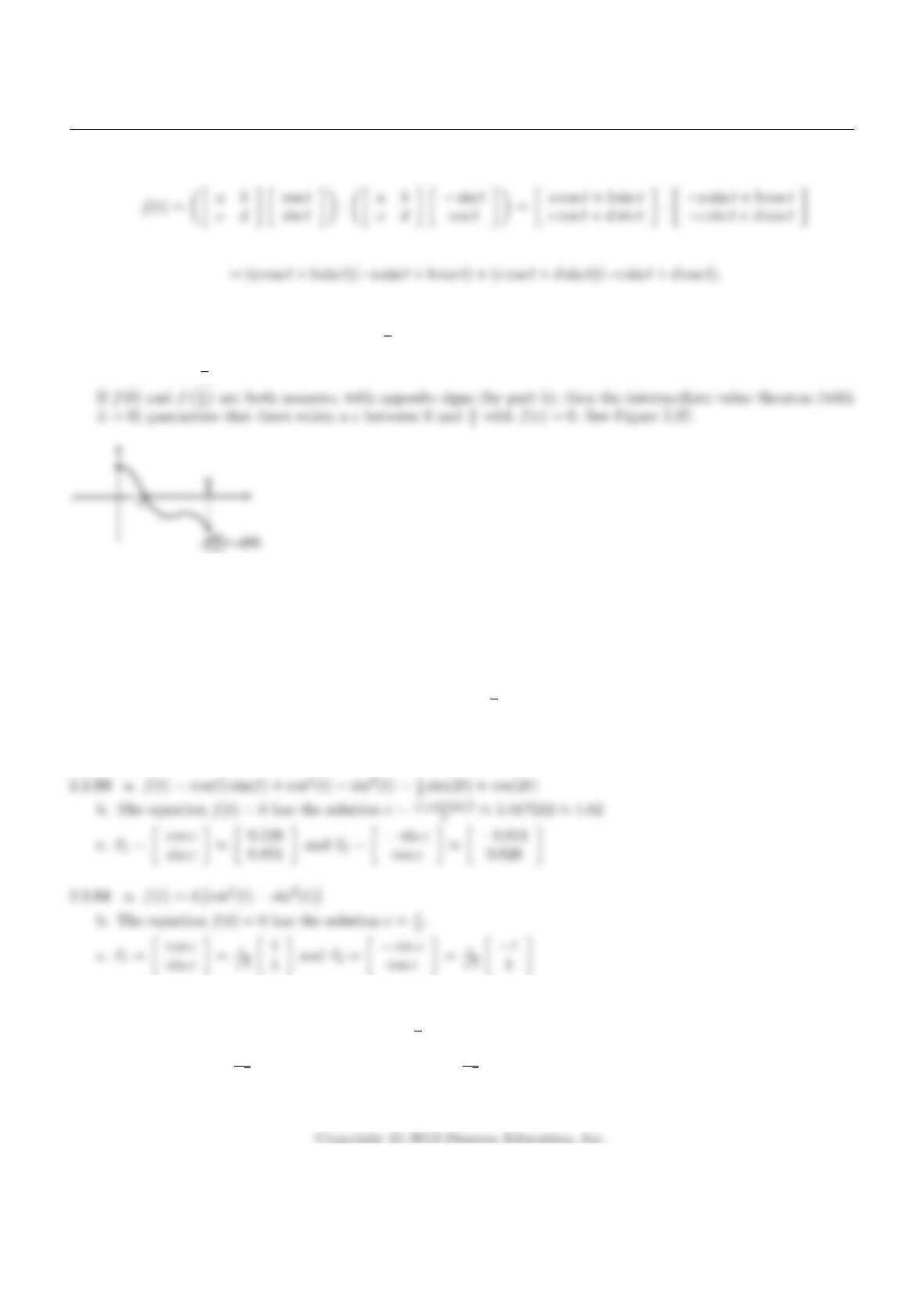
a continuous function.
b. f(0) = T1
0·T0
1and fπ
2=T0
1·T−1
0=−T1
0·T0
1=−f(0)
c. If f(0) = fπ
2= 0, then we can let c= 0.
Figure 2.37: for Problem 2.2.47c.
2.2.48 Since rotations preserve angles, any two perpendicular unit vectors ~v1and ~v2will do the job.
2.2.49 a. A straightforward computation gives f(t) = 15 cos(t) sin(t).
b. The equation f(t) = 0 has the solutions c= 0 and c=π
2.
c. Using c= 0 we find ~v1=cos c
sin c=1
0and ~v2=−sin c
cos c=0
1.
2.2.52 a. f(t) = 15 sin2(t)−cos2(t)
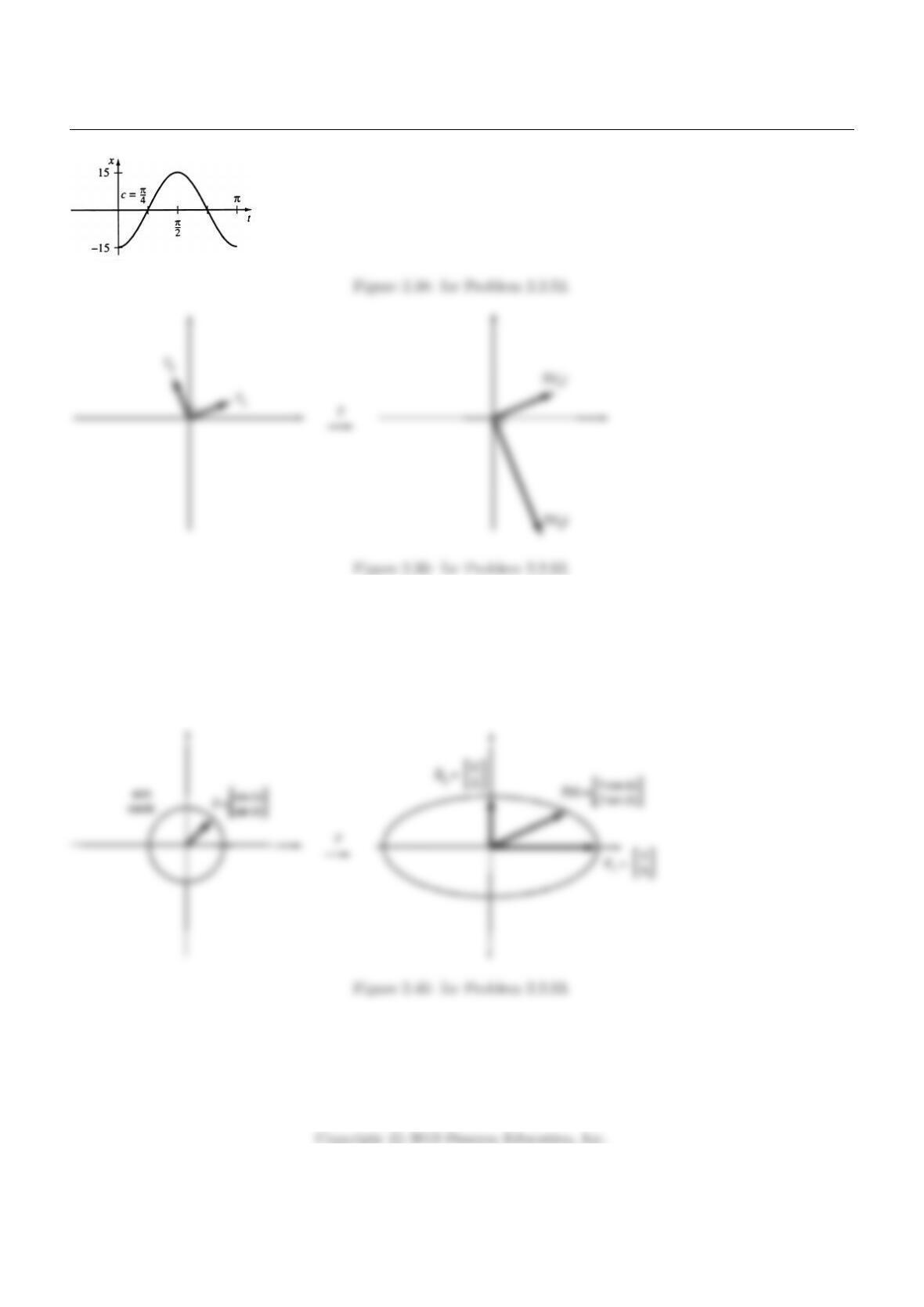
b. The equation f(t) = 0 has the solution c=π
4. See Figure 2.38.
c. ~v1=cos c
sin c=1
√21
1and ~v2=−sin c
cos c=1
√2−1
1See Figure 2.39.
78
Section 2.2
2.2.53 If ~x =cos(t)
sin(t)then T(~x) = 5 0
0 2 cos(t)
sin(t)=5 cos(t)
2 sin(t)= cos(t)5
0+ sin(t)0
2.
These vectors form an ellipse; consider the characterization of an ellipse given in the footnote on Page 75, with
~w1=5
0and ~w2=0
2. (See Figure 2.40.)
2.2.54 Use the hint: Since the vectors on the unit circle are of the form ~v = cos(t)~v1+ sin(t)~v2, the image of the
unit circle consists of the vectors of the form T(~v) = T(cos(t)~v1+ sin(t)~v2) = cos(t)T(~v1) + sin(t)T(~v2).
79
Chapter 2
2.2.55 Consider the linear transformation Twith matrix A= [ ~w1~w2], that is,
Tx1
x2=Ax1
x2= [ ~w1~w2]x1
x2=x1~w1+x2~w2.
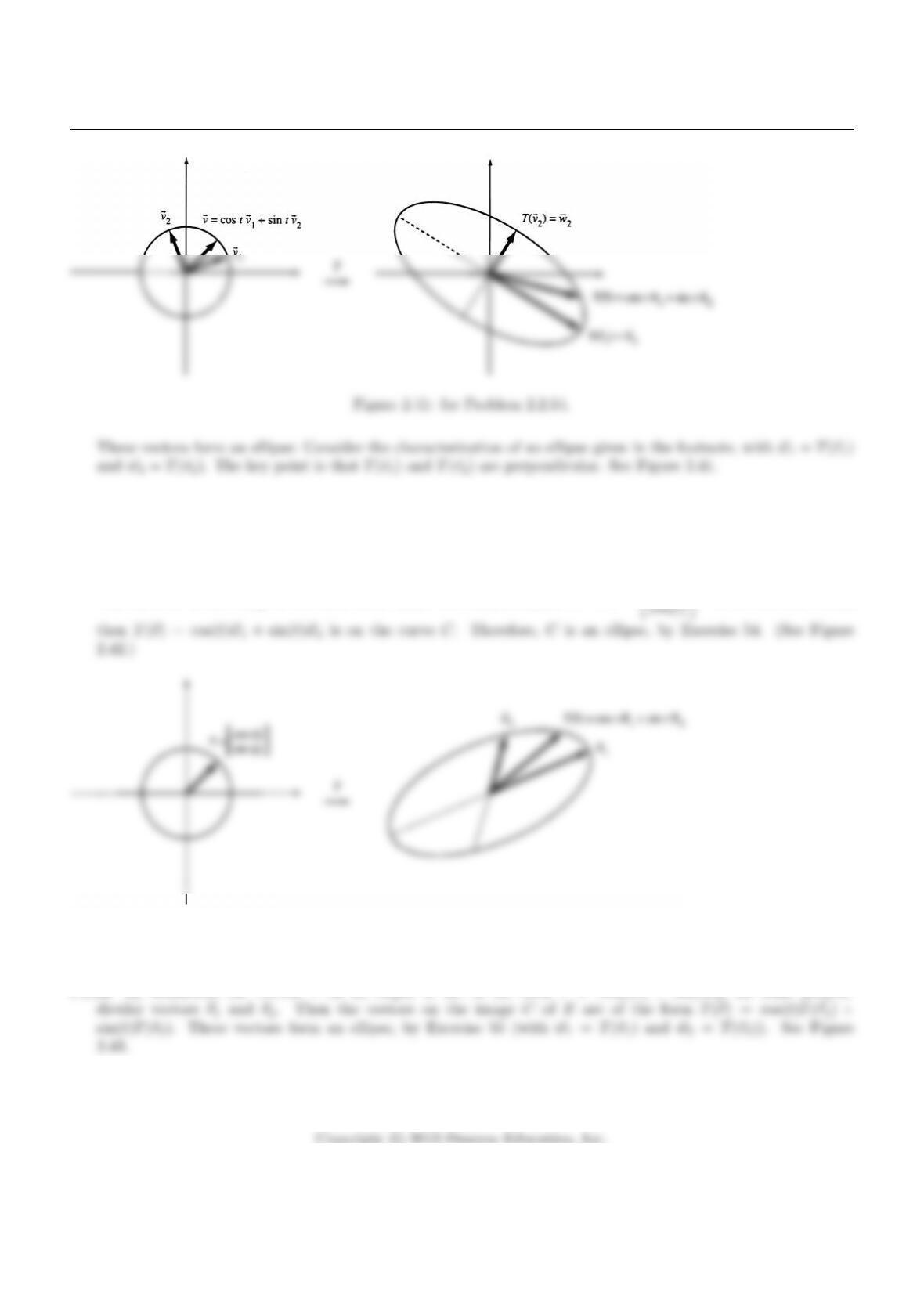
The curve Cis the image of the unit circle under the transformation T: if ~v =cos(t)
Figure 2.42: for Problem 2.2.55.
2.2.56 By definition, the vectors ~v on an ellipse Eare of the form ~v = cos(t)~v1+ sin(t)~v2, for some perpen-
80
Section 2.3
Section 2.3
2.3.14 6
3 4
2.3.7
−1 1 0
5 3 4
−6−2−4
81
Chapter 2
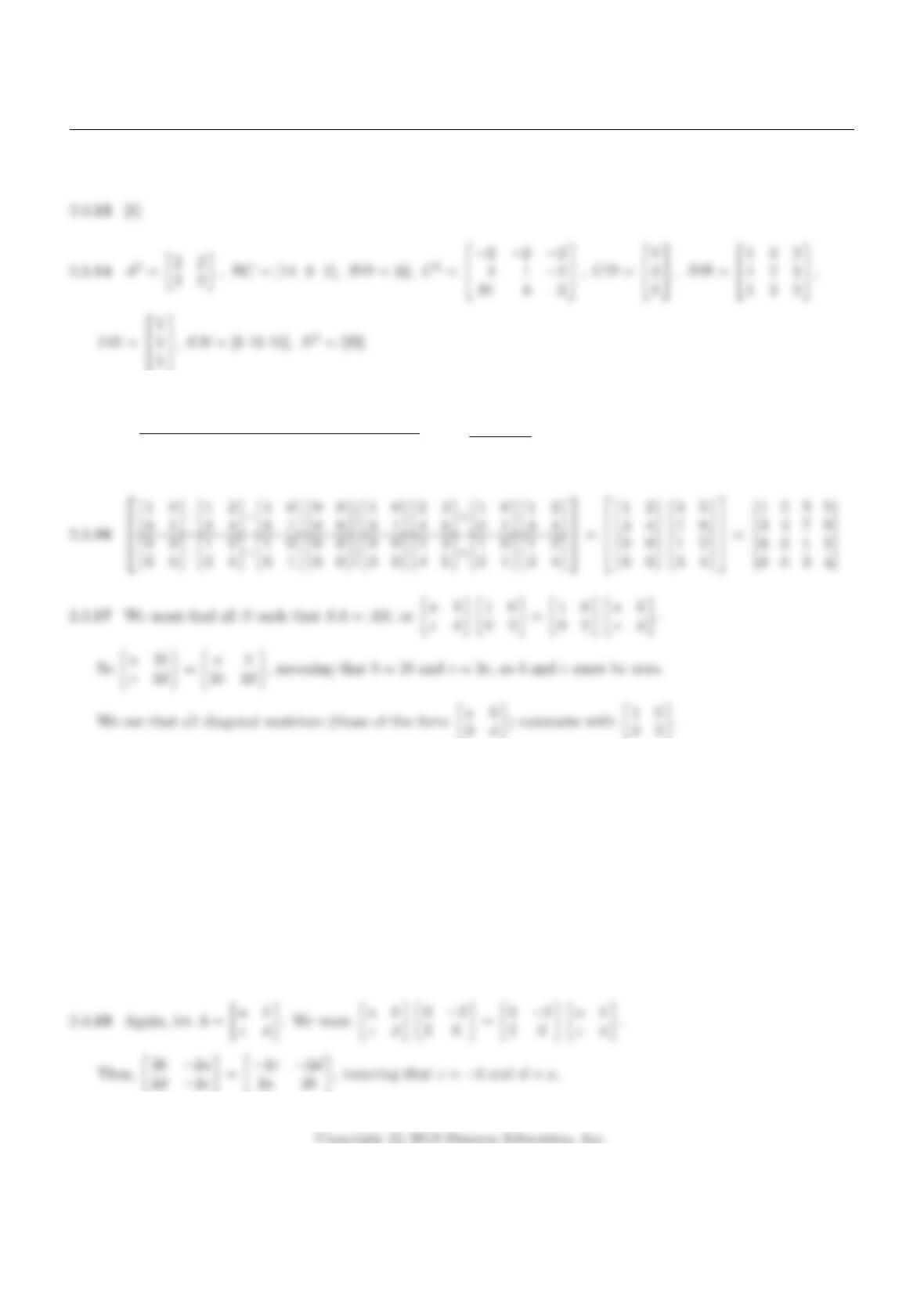
2.3.12 [0 1]
2.3.15
“1 0
0 1 # “1
2#+“0
0#[ 3 ]“1 0
0 1 #”0
0#+“0
0#[ 4 ]
[ 1 3 ]“1
2#+[ 4 ][ 3 ][ 1 3 ]“0
0#+[ 4 ][ 4 ]
=
“1
2#“0
0#
[ 19 ][ 16 ]
=
1 0
2 0
19 16
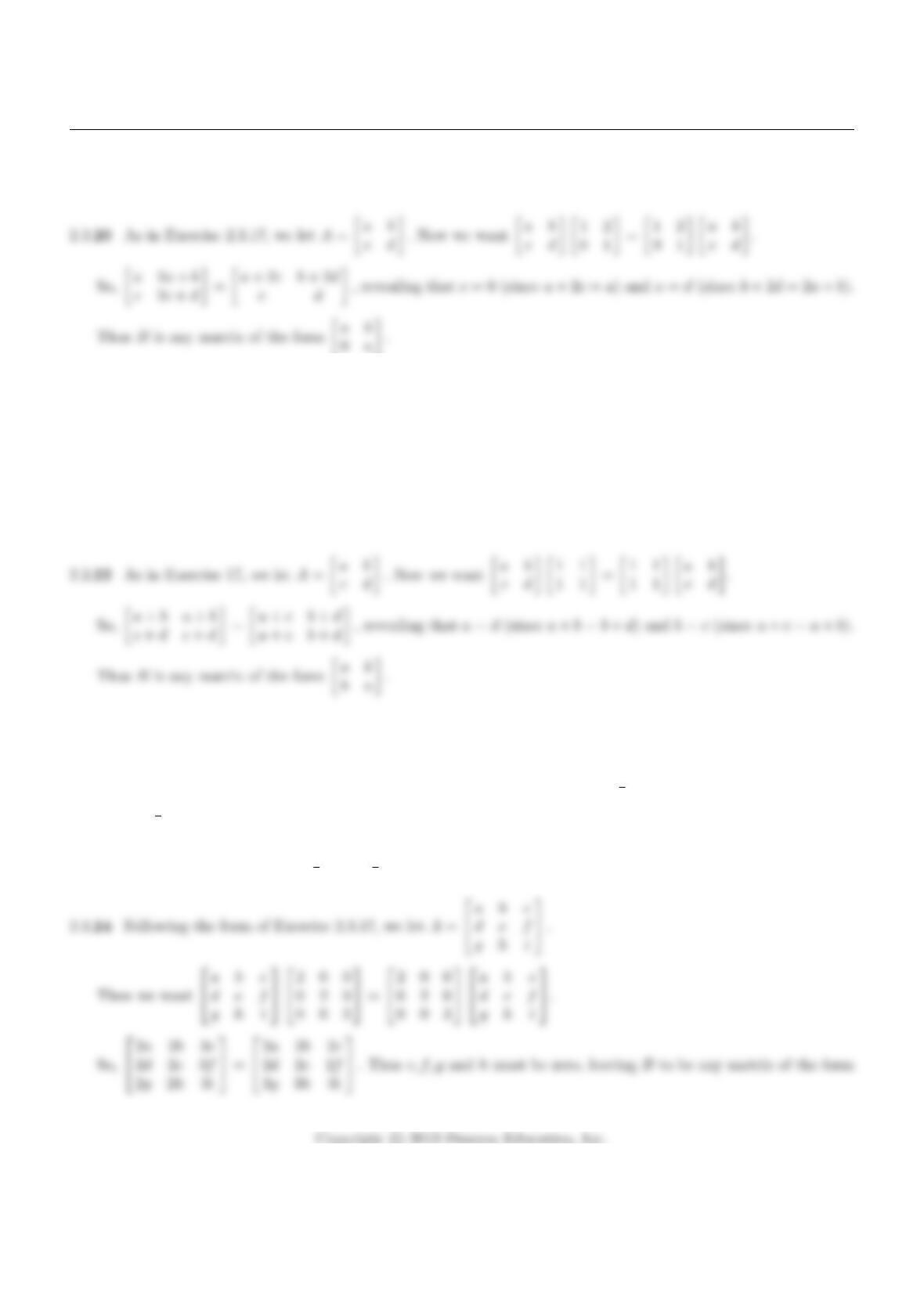
2.3.18 Following the form of Exercise 17, we let A=a b
c d .
Now we want a b
c d 2 3
−3 2 =2 3
−3 2 a b
c d .
So, 2a−3b3a+ 2b
2c−3d3c+ 2d=2a+ 3c2b+ 3d
−3a+ 2c−3b+ 2d,revealing that a=d(since 3a+ 2b= 2b+ 3d) and −b=
c(since 2a+ 3c= 2a−3b).
Thus Bis any matrix of the form a b
−b a .
82
Section 2.3
We see that all matrices of the form a b
−b a commute with 0−2
2 0 .
2.3.21 Now we want a b
c d 1 2
2−1=1 2
2−1a b
c d .
Thus, a+ 2b2a−b
c+ 2d2c−d=a+ 2c b + 2d
2a−c2b−d. So a+ 2b=a+ 2c, or c=b, and 2a−b=b+ 2d, revealing
d=a−b. (The other two equations are redundant.)
All matrices of the form a b
b a −bcommute with 1 2
2−1.
2.3.23 We want a b
c d 1 3
2 6 =1 3
2 6 a b
c d .
Then, a+ 2b3a+ 6b
c+ 2d3c+ 6d=a+ 3c b + 3d
2a+ 6c2b+ 6d. So a+ 2b=a+ 3c, or c=2
3b, and 3a+ 6b=b+ 3d, revealing
d=a+5
3b. The other two equations are redundant.
Thus all matrices of the form a b
2
3b a +5
3bcommute with 1 3
2 6 .
83
Chapter 2
a b 0
d e 0
0 0 i
.
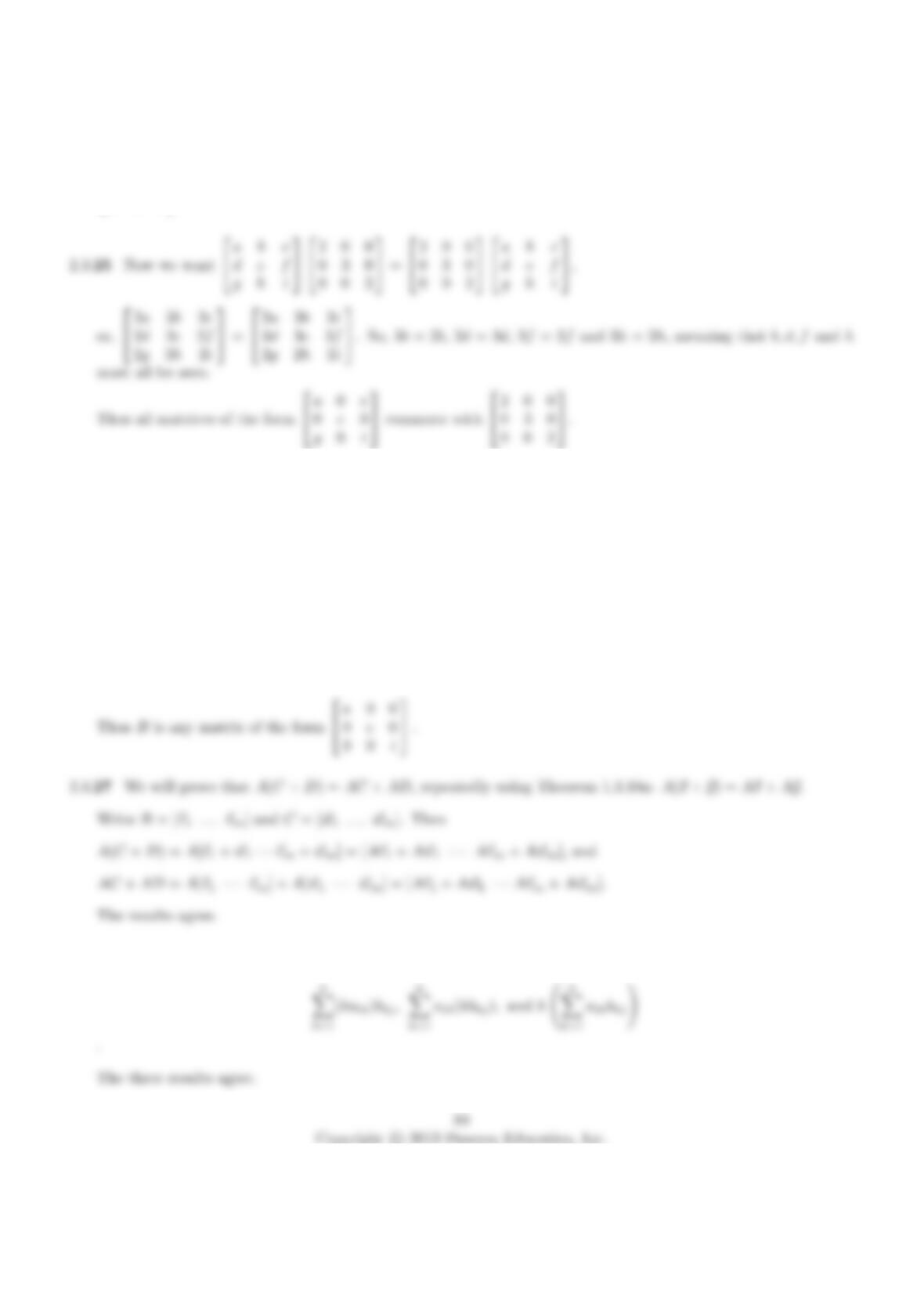
2.3.26 Following the form of Exercise 2.3.17, we let A=
a b c
d e f
g h i
.
Now we want
a b c
d e f
g h i
2 0 0
0 3 0
0 0 4
=
2 0 0
0 3 0
0 0 4
a b c
d e f
g h i
.
So,
2a3b4c
2d3e4f
2g3h4i
=
2a2b2c
3d3e3f
4g4h4i
,which forces b, c, d, f, g and hto be zero. a, e and i, however, can be
chosen freely.
2.3.28 The ijth entries of the three matrices are
Section 2.3
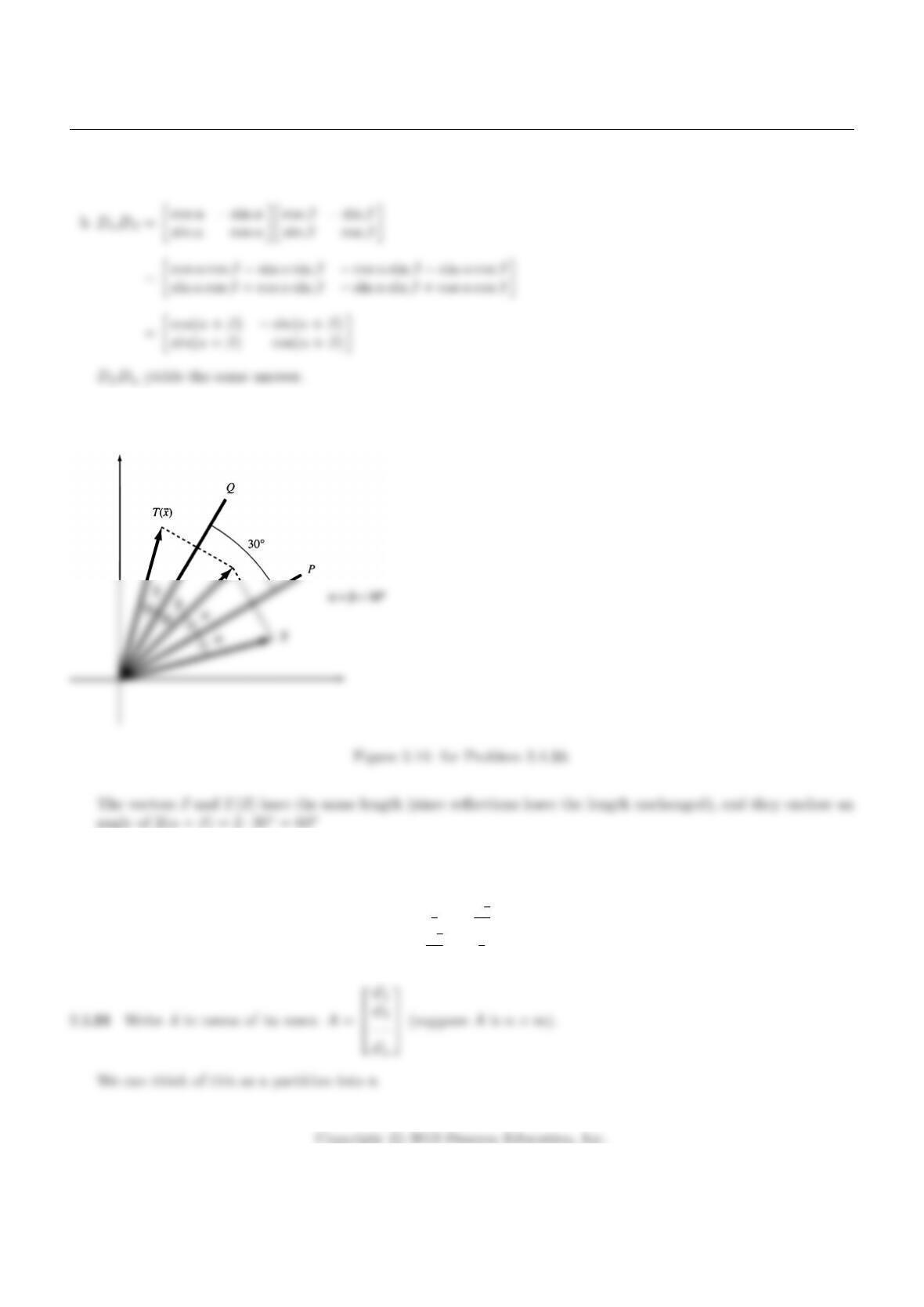
2.3.29 aDαDβand DβDαare the same transformation, namely, a rotation through α+β.
2.3.30 a See Figure 2.44.
b Based on the answer in part (a), we conclude that Tis a rotation through 60◦.
c The matrix of Tis cos(60◦)−sin(60◦)
sin(60◦) cos(60◦)=
1
2−√3
2
√3
2
1
2
.
85
Chapter 2
1×mmatrices. Now AB =
~w1
~w2
···
~wn
B=
~w1B
~w2B
···
~wnB
(a product of partitioned matrices).
We see that the ith row of AB is the product of the ith row of Aand the matrix B.
2.3.33 A2=I2,A3=A, A4=I2. The power Analternates between A=−I2and I2. The matrix Adescribes
a reflection about the origin. Alternatively one can say Arepresents a rotation by 180◦=π. Since A2is the
identity, A1000 is the identity and A1001 =A=−1 0
0−1.
2.3.36 A2=1 2
0 1 ,A3=1 3
0 1 and A4=1 4
0 1 . The power Anrepresents a horizontal shear along the
x-axis. The shear strength increases linearly in n. We have A1001 =1 1001
0 1 .
2.3.38 A2=−1 0
0−1,A3=−A,A4=I2. The matrix Arepresents the rotation through π/2 in the
86
Section 2.3
2.3.40 A2=1
2−1√3
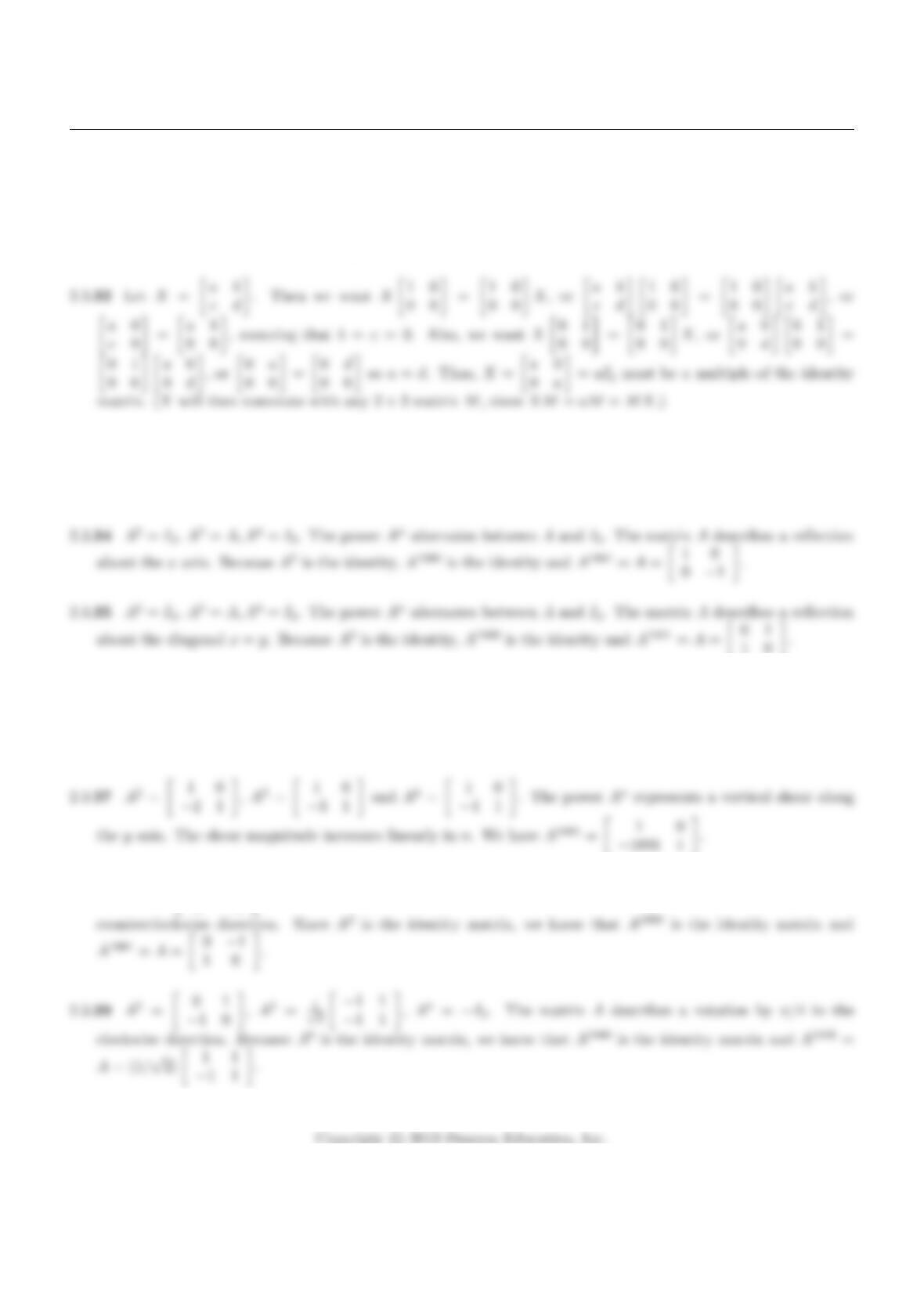
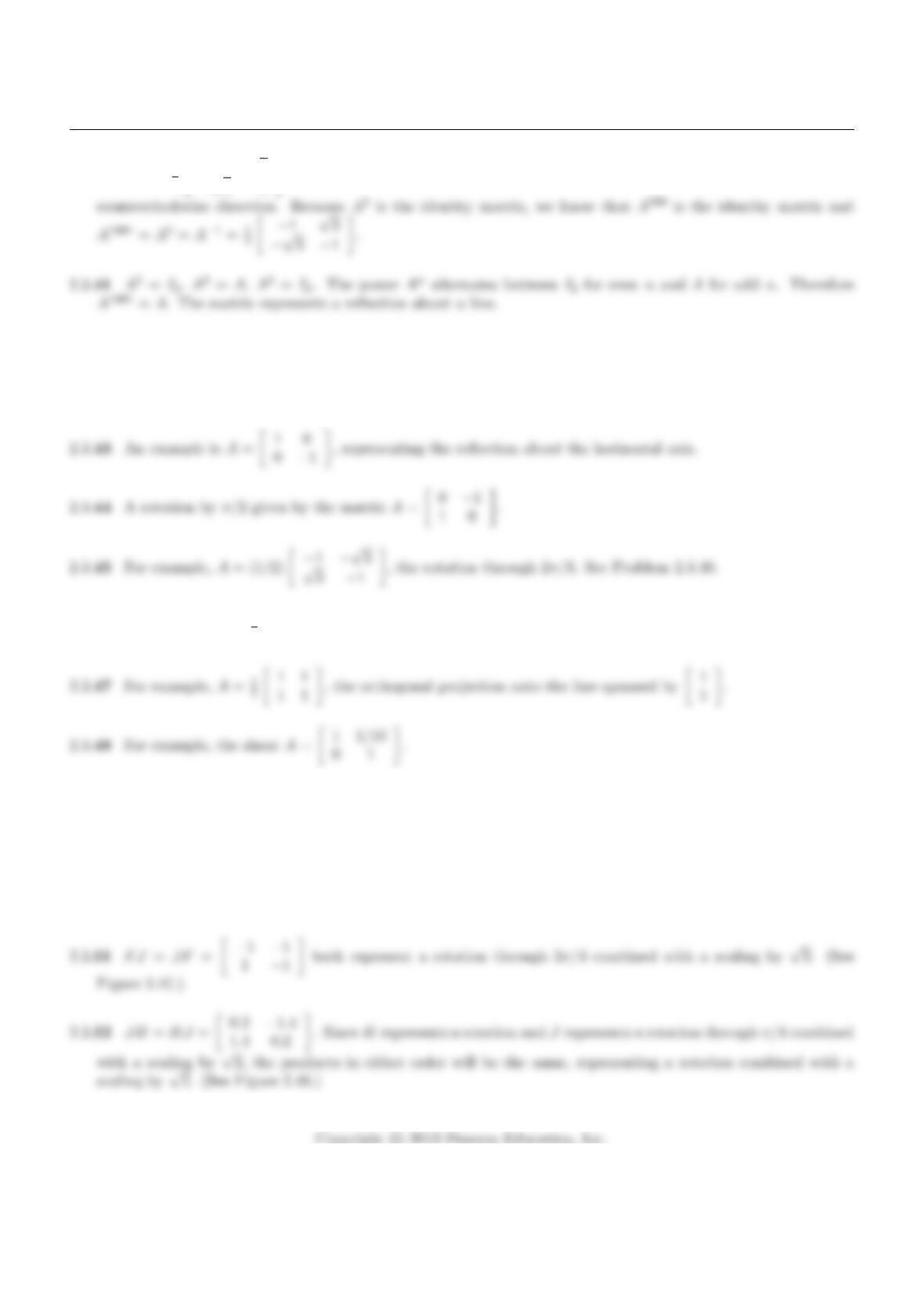
−√3−1,A3=I2,A4=A. The matrix Adescribes a rotation by 120◦= 2π/3 in the
2.3.42 An=A. The matrix Arepresents a projection on the line x=yspanned by the vector 1
1. We have
A1001 =A= (1/2) 1 1
1 1 .
2.3.46 For example, A=1
21 1
1 1 , the orthogonal projection onto the line spanned by 1
1.
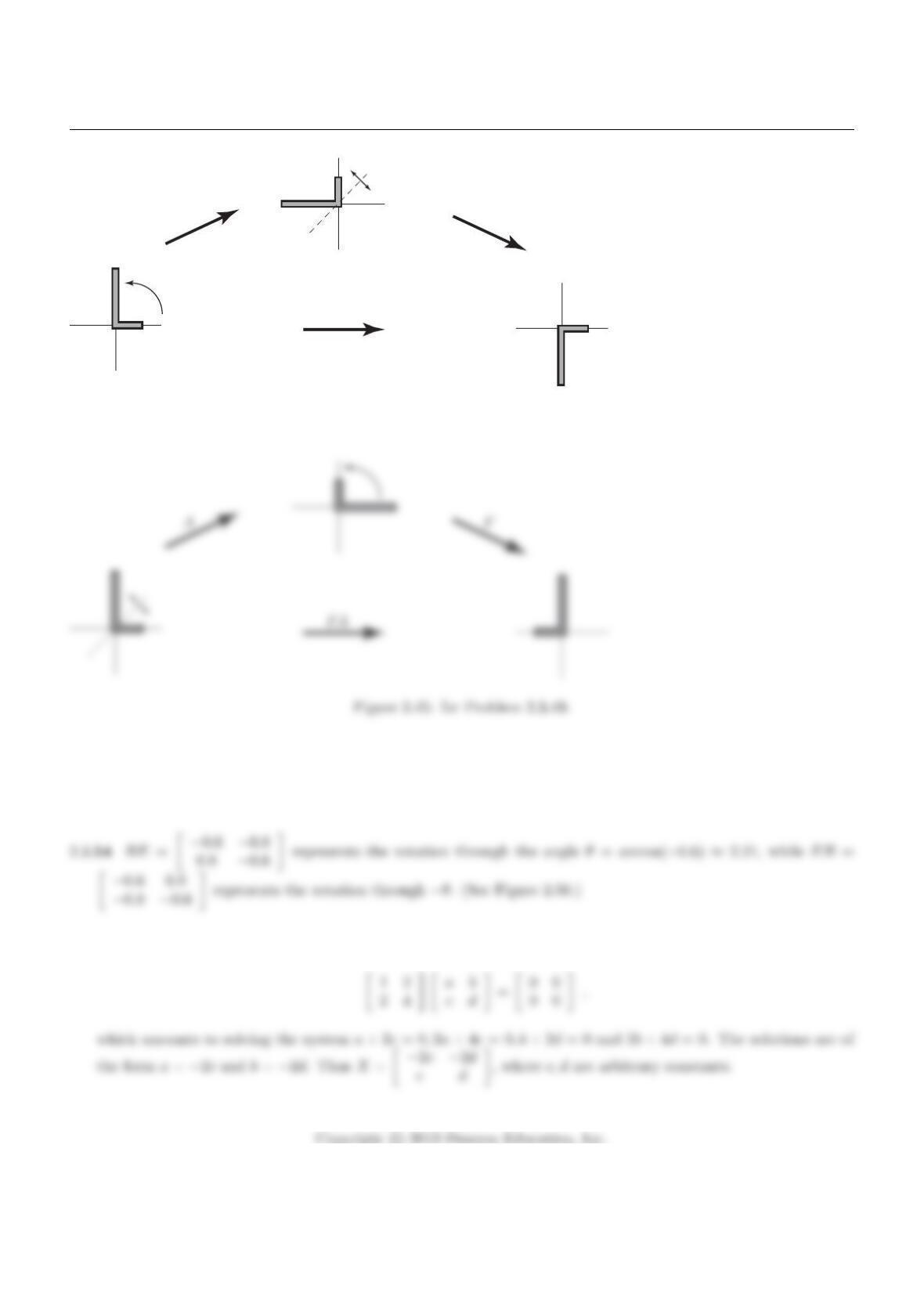
2.3.49 AF =1 0
0−1represents the reflection about the x-axis, while F A =−1 0
0 1 represents the reflection
about the y-axis. (See Figure 2.45.)
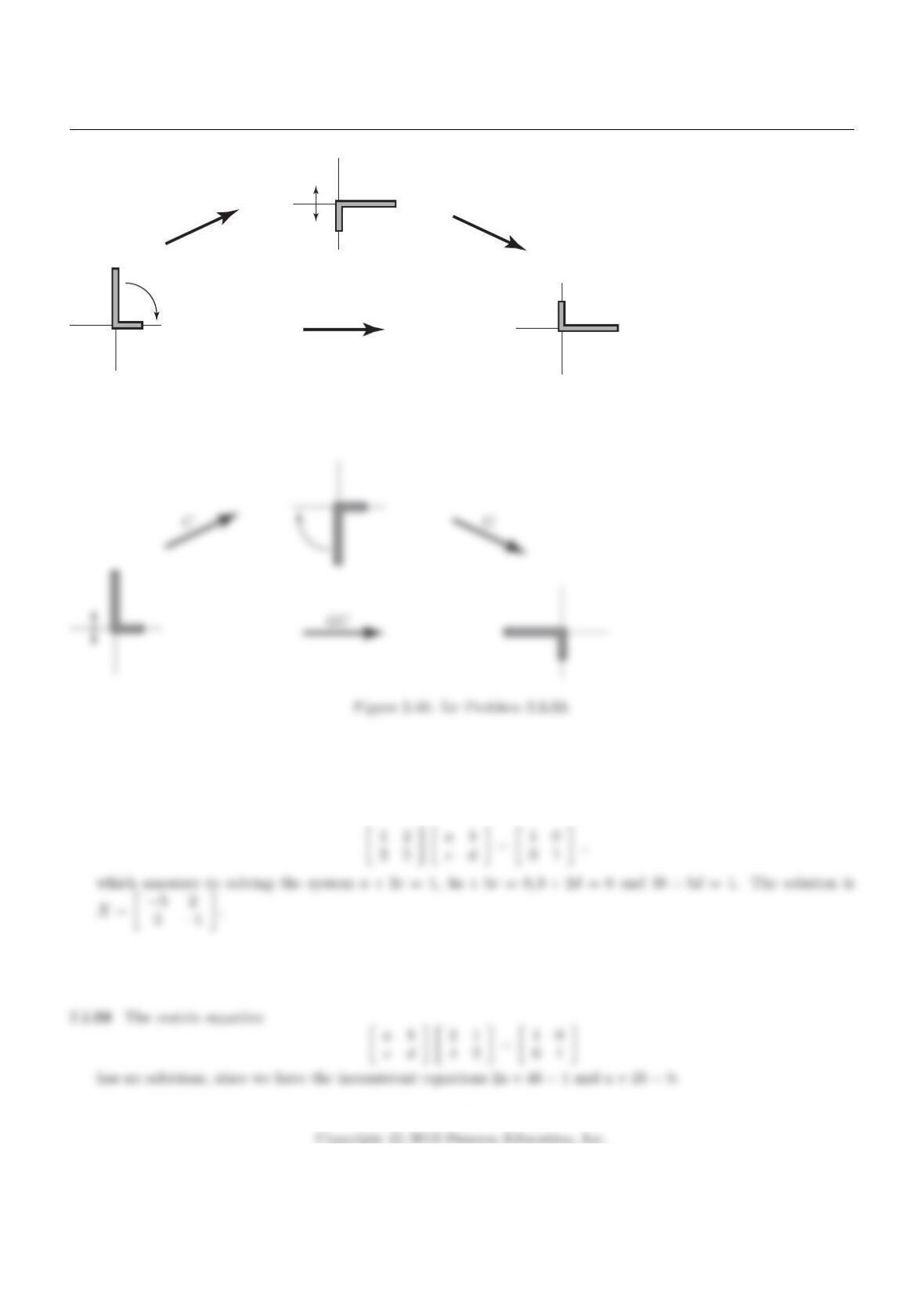
2.3.50 CG =0 1
1 0 represents a reflection about the line x=y, while GC =0−1
−1 0 represents a reflection
about the line x=−y. (See Figure 2.46.)
87
Chapter 2
AF
FA
2.3.53 CD =0−1
1 0 represents the rotation through π/2, while DC =0 1
−1 0 represents the rotation
through −π/2. (See Figure 2.49.)
2.3.55 We need to solve the matrix equation
88
Section 2.3
CG
GC
2.3.56 Proceeding as in Exercise 55, we find X=−5 2
3−1.
2.3.57 We need to solve the matrix equation
2.3.58 Proceeding as in Exercise 55, we find X=−2b b
−2d d , where band dare arbitrary.
89