Chapter 2
Water: The Solvent for Biochemical Reactions
SUMMARY
Section 2.1
Water is a polar molecule, with a partial negative charge on the oxygen and
partial positive charges on the hydrogens.
There are forces of attraction between the unlike charges.
Section 2.2
A hydrogen bond is a special example of a dipole-dipole bond.
Water molecules are extensively hydrogen bonded.
Section 2.3
Acids are proton donors, and bases are proton acceptors.
Water can accept or donate protons.
The strength of an acid is measured by its acid dissociation constant, Ka. The
Section 2.4
In aqueous solution, the relative concentrations of a weak acid and its conjugate
base can be related to the titration curve of the acid.
2 Chapter 2
Section 2.5
Buffer solutions are characterized by their tendency to resist pH change when
small amounts of strong acid or strong base are added.
LECTURE NOTES
The material in this chapter is often overlooked nowadays to make room for more
exciting and timely topics, like molecular biology. However, many of the concepts here
LECTURE OUTLINE
I. Polarity of water
A. Electronegativity
B. Polar bonds vs. polar molecules — dipoles
C. Solvent properties of water
1. Hydrophilic molecules
II. Hydrogen Bonds
A. Donors and acceptors
B. Geometric arrangements
E. Other biologically important hydrogen bonds
III. Acids and bases
A. Definitions
B. Acid strength, dissociation constants
IV. Dissociation of water and pH
A. Derivation of Kw
Water: The Solvent for Biochemical Reactions 3
V. Titrations and equivalence points
VI. Buffers
A. What a buffer is
B. Relationship between buffering and Henderson-Hasselbalch equation
ANSWERS TO PROBLEMS
2.1 Water and Polarity
1. The unique fitness of water for forming hydrogen bonds determines the
properties of many important biomolecules. Water can also act as an acid and as
a base, giving it great versatility in biochemical reactions.
5. A salt bridge refers to electrostatic attractions of parts of molecules with others.
An example would be a negatively charged side–chain from an aspartate residue
in a protein with a positively charged lysine residue.
6. If the dipole is cancelled out by another of equal and opposite orientation. The
classic example is CO2. Each carbon-oxygen bond is a dipole, but the two cancel
2.2 Hydrogen Bonds
9. Dipole –dipole bond.
10. A hydrogen bond is a type of dipole-dipole bond, and a dipole-dipole bond is a
type of Van der Waals force. However, hydrogen bonds are particularly strong
11. Proteins and nucleic acids have hydrogen bonds as an important part of their
structures.
13. The C-H bond is not sufficiently polar for greatly unequal distribution of electrons
4 Chapter 2
14. Many molecules can form hydrogen bonds. Examples might be H2O, CH3OH, or
17. Glucose = 17 and sorbitol = 18, ribitol = 15; each alcohol group can bond to three
water molecules and the ring oxygen binds to two. The sugar alcohols bind more
than the corresponding sugars.
18. Positively charged ions will bind to nucleic acids as a result of electrostatic
attraction to the negatively charged phosphate groups.
2.3 Acids, Bases, and pH
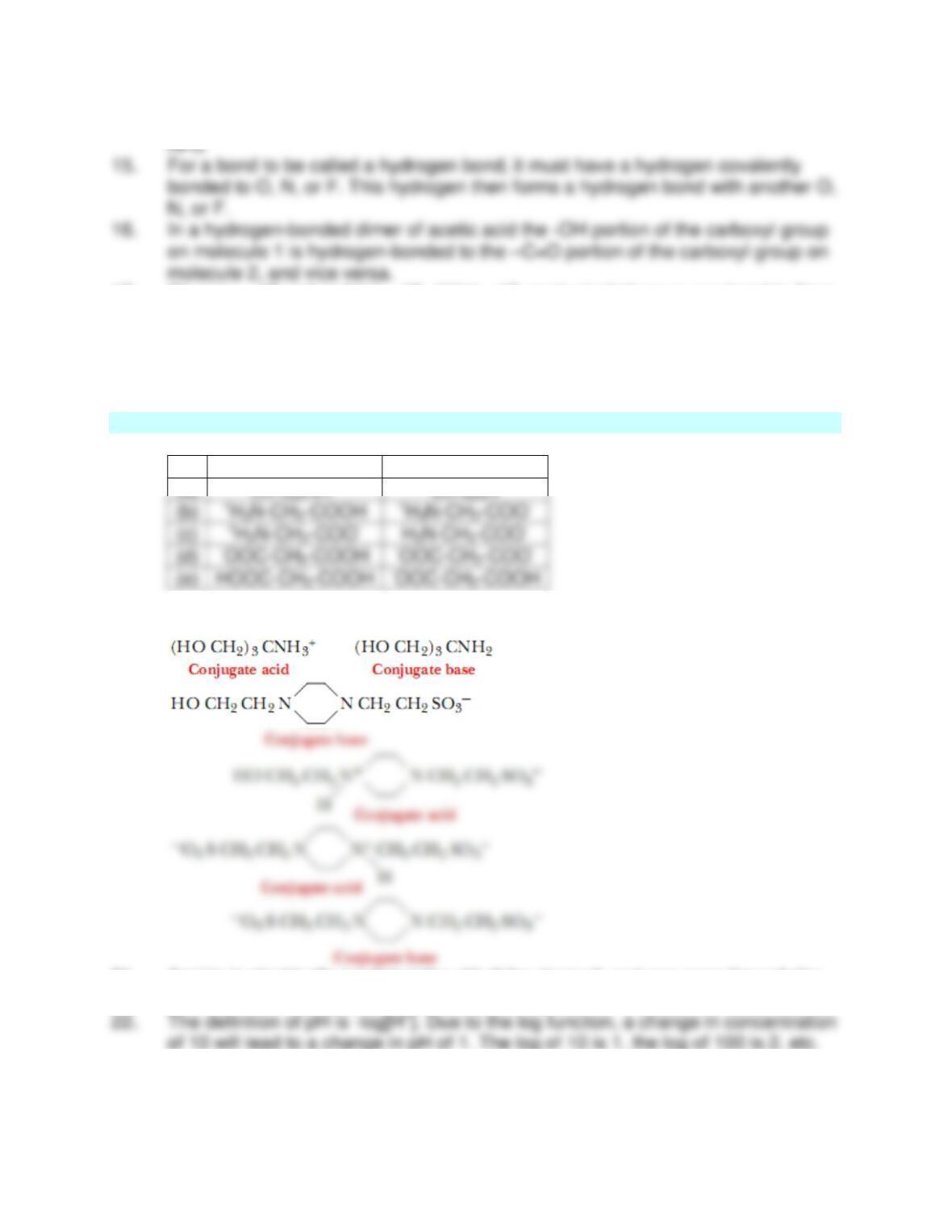
19.
Conjugate Acid
Conjugate Base
(a)
(CH3)3NH+
(CH3)3N
(b)
(c)
(d)
(e)
20.
21. Aspirin is electrically neutral at the pH of the stomach and can pass through the
membrane more easily than in the small intestine.
Water: The Solvent for Biochemical Reactions 5
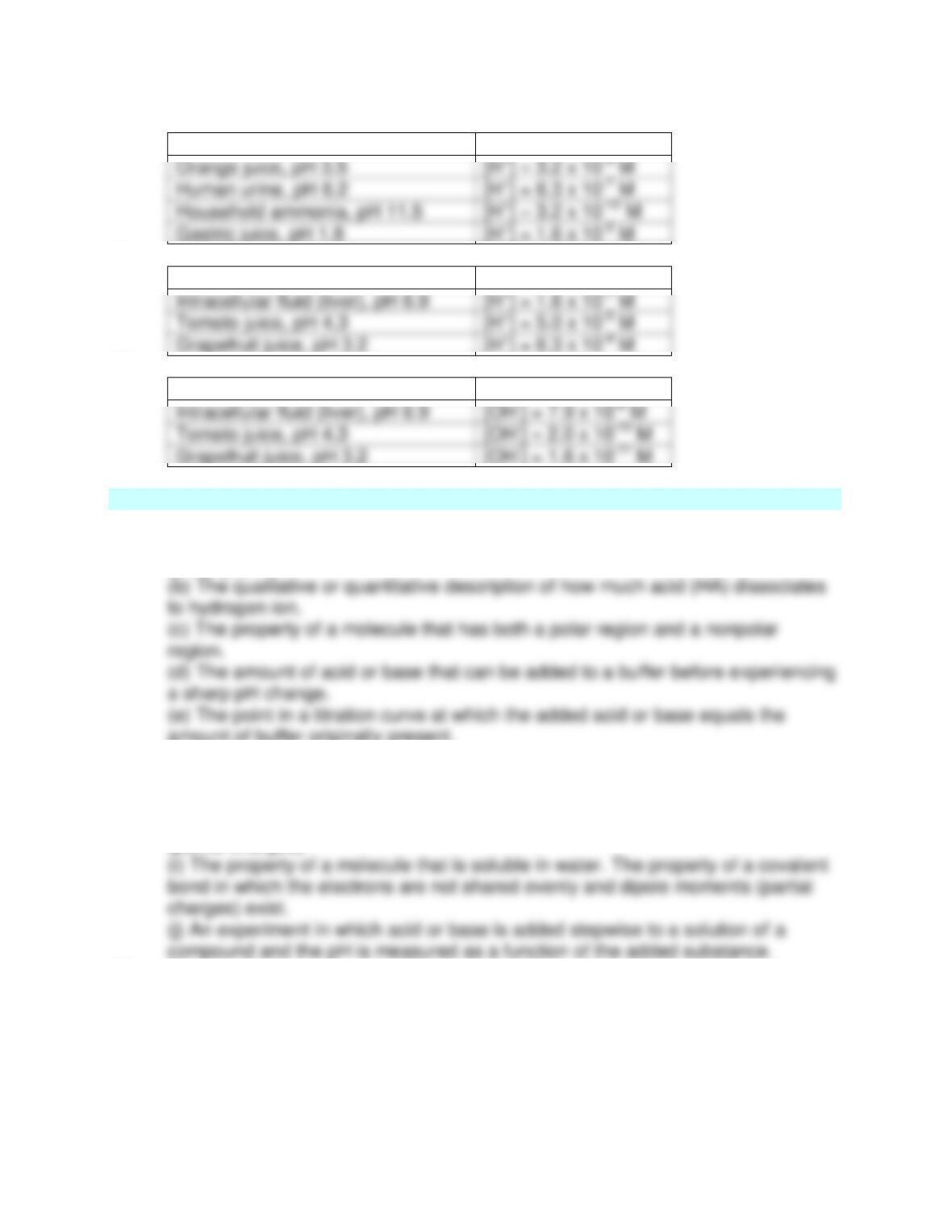
23.
Blood plasma, pH 7.4
[H+] = 4.0 x 10⁻⁸ M
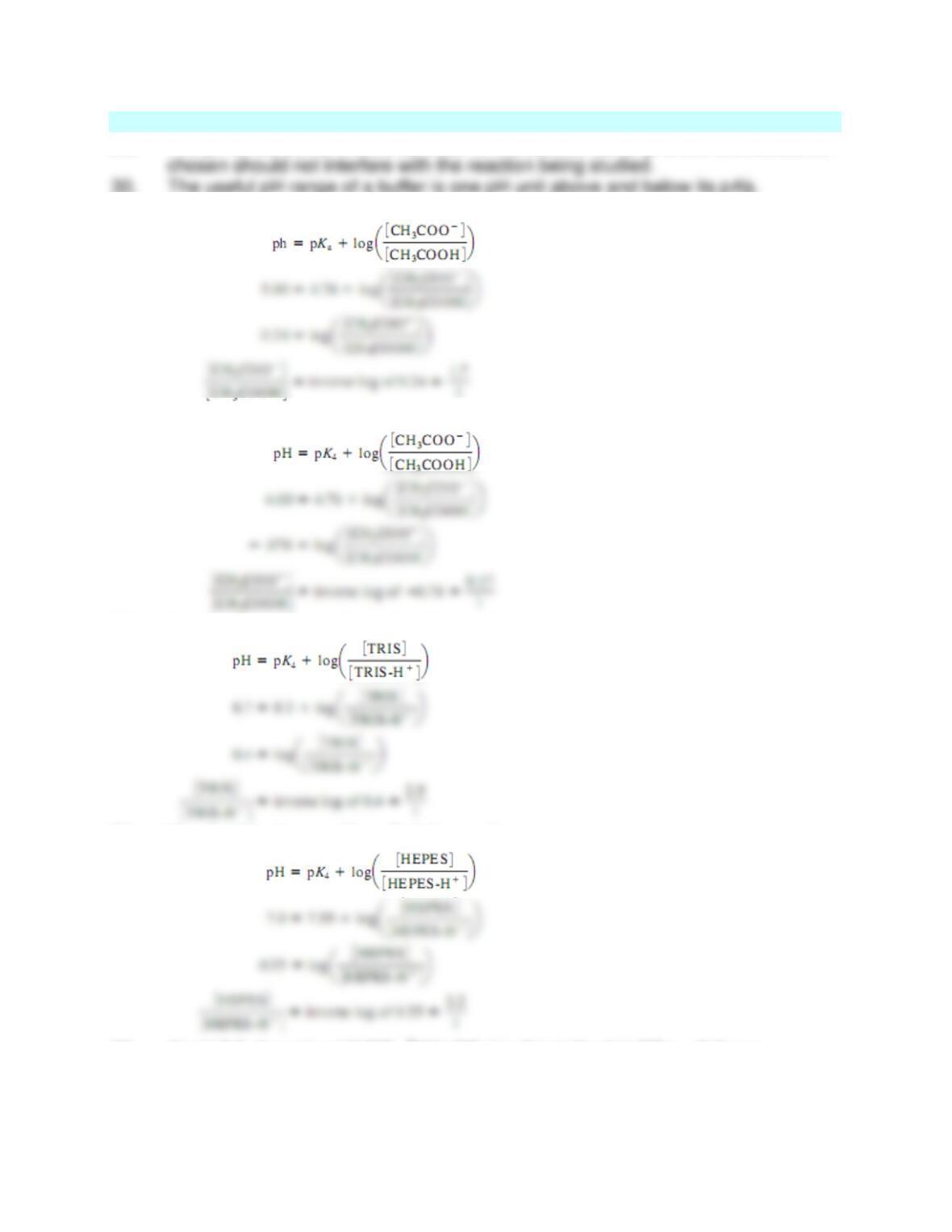
24.
Saliva, pH 6.5
[H+] = 3.2 x 10⁻⁷ M
Intracellular fluid (liver), pH 6.9
[H+] = 1.6 x 10⁻⁷ M
Tomato juice, pH 4.3
[H+] = 5.0 x 10⁻⁵ M
Grapefruit juice, pH 3.2
[H+] = 6.3 x 10⁻⁴ M
25.
Saliva, pH 6.5
[OH–] = 3.2 x 10⁻⁸ M
Intracellular fluid (liver), pH 6.9
Tomato juice, pH 4.3
[OH–] = 2.0 x 10⁻¹⁰ M
Grapefruit juice, pH 3.2
[OH–] = 1.6 x 10⁻¹¹ M
2.4 Titration Curves
26. (a) The numerical constant equal to the concentration of the products of the
dissociation divided by the concentration of the undissociated acid form:
([H+][A])/[HA].
amount of buffer originally present.
(f) The property of a molecule that is readily soluble in water (i.e., water loving).
(g) The property of a molecule that is insoluble in water (i.e., water hating).
(h) The property of a molecule that is not soluble in water. The property of a
covalent bond in which there is even sharing of electrons and no dipole moments
(partial charges).
27. To get a titration curve most like the one in Figure 2.15, we have to titrate a
compound with a pKa as close as possible to that of H2PO4–. According to Table
2.8, MOPS has a pKa of 7.2, which is the closest value.
28. The titration curve for TRIS would be shifted to the right compared to that of
phosphate. The crossover point would be at pH 8.3, rather than pH 7.2.
Human urine, pH 6.2
[H+] = 6.3 x 10⁻⁷ M
Household ammonia, pH 11.5
[H+] = 3.2 x 10⁻¹² M
Gastric juice, pH 1.8
[H+] = 1.6 x 10⁻² M
6 Chapter 2
2.5 Buffers
29. The pK of the buffer should be close to the desired buffer pH, and the substance
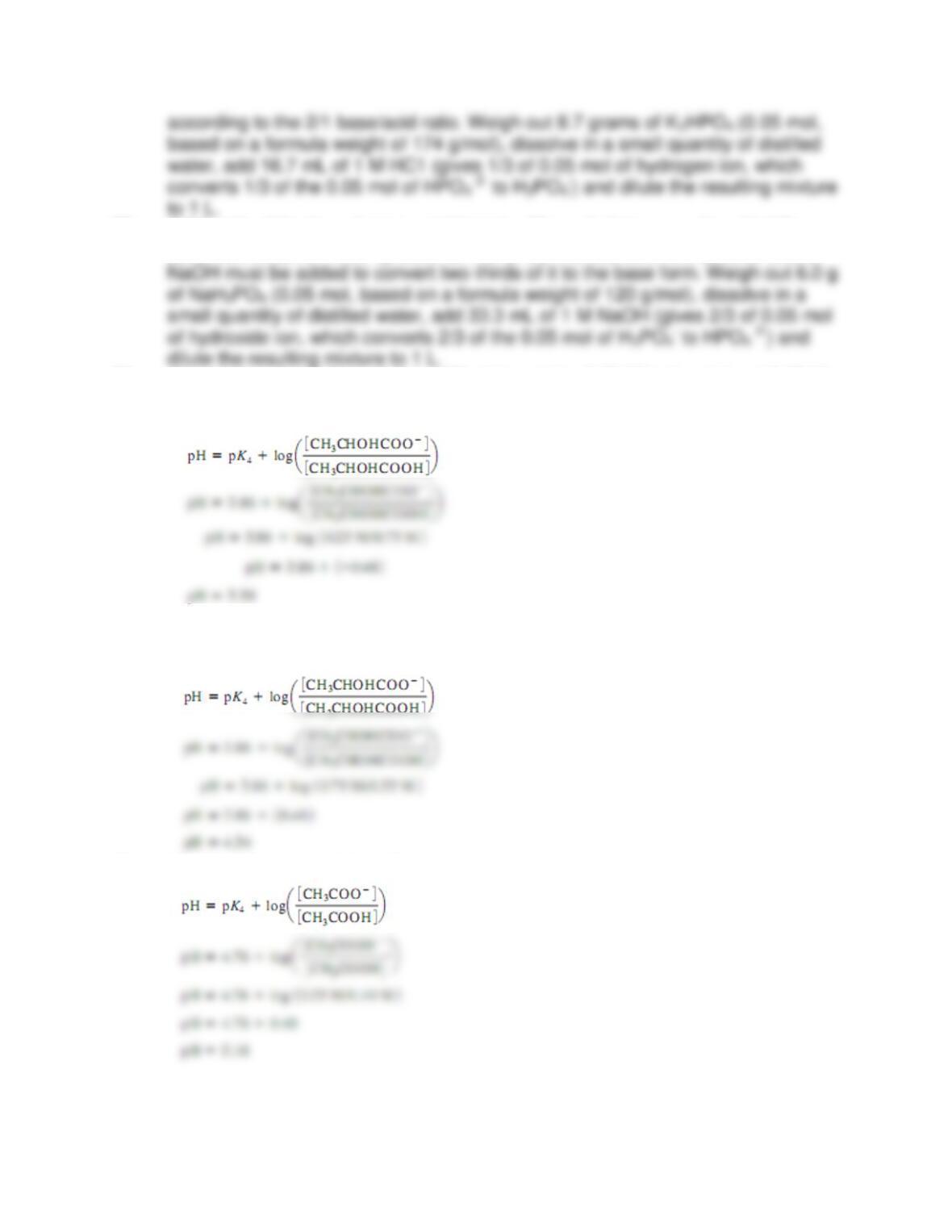
30. The useful pH range of a buffer is one pH unit above and below its pKa.
31. Use the Henderson–Hasselbalch equation:
32. Use the Henderson–Hasselbalch equation:
33. Use the Henderson–Hasselbalch equation:
34. Use the Henderson–Hasselbalch equation:
35. At pH 7.5, the ratio of [HPO4 2-]/[H2PO4–] is 2/1 (pKa of H2PO4– = 7.2), as
calculated using the Henderson–Hasselbalch equation. K2HPO4 is a source of
the base form, and HCl must be added to convert one-third of it to the acid form,
Water: The Solvent for Biochemical Reactions 7
36. A 2/1 ratio of the base form to acid form is still needed, because the pH of the
buffer is the same in both problems. NaH2PO4 is a source of the acid form, and
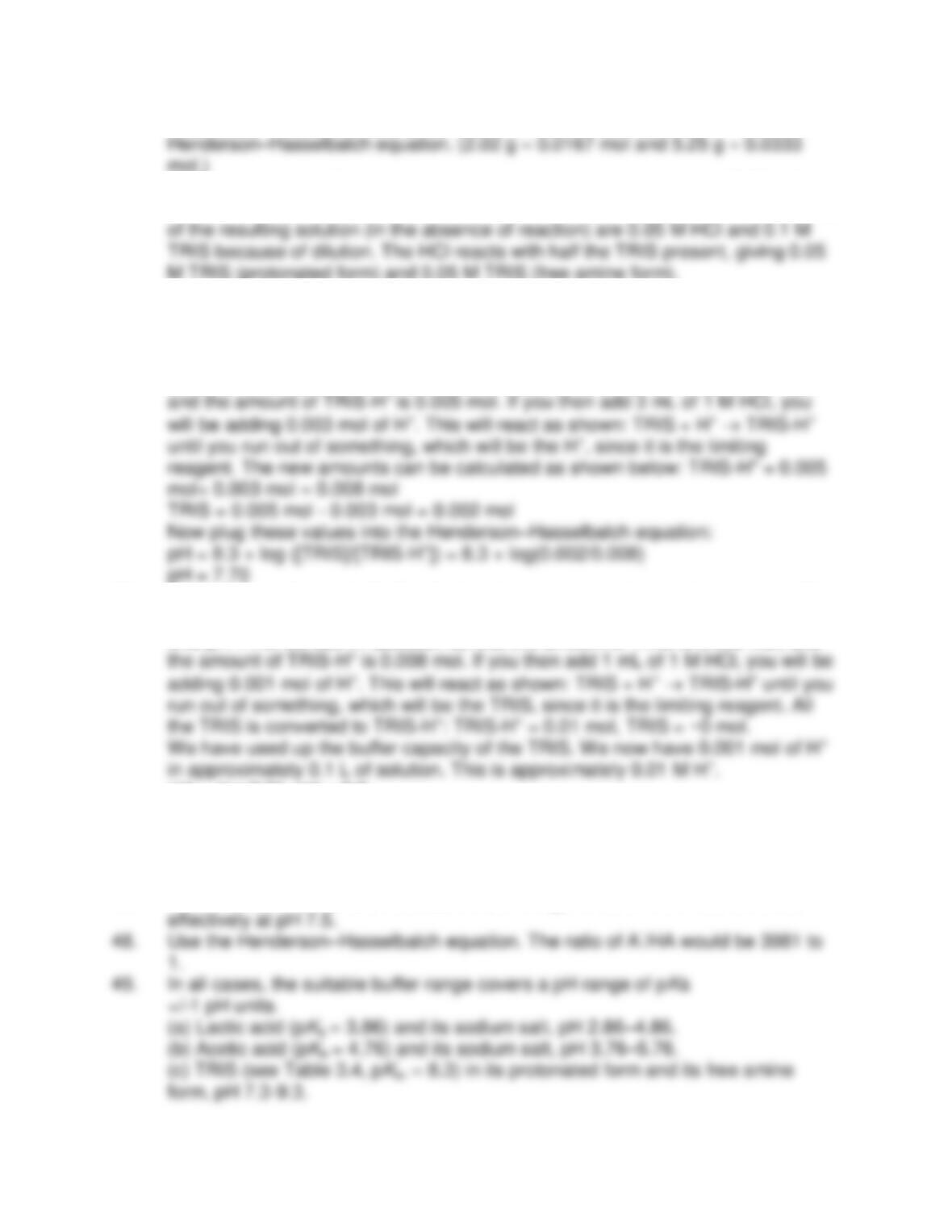
37. After mixing, the buffer solution (100 mL) contains 0.75 M lactic acid and 0.25 M
sodium lactate. The pKa of lactic acid is 3.86. Use the Henderson–Hasselbalch
equation
38. After mixing, the buffer solution (100 mL) contains 0.25 M lactic acid and 0.75 M
sodium lactate. The pKa of lactic acid is 3.86. Use the Henderson–Hasselbalch
equation:
39. Use the Henderson–Hasselbalch equation:
8 Chapter 2
40. Yes, it is correct, calculate the molar amounts of the two forms and insert into the
41. The solution is a buffer because it contains equal concentrations of TRIS in the
acid and free amine forms. When the two solutions are mixed, the concentrations
42. Any buffer that has equal concentrations of the acid and basic forms will have a
pH equal to its pKa. Therefore, the buffer from Question 33 will have a pH of 8.3.
43. First calculate the moles of buffer that you have: 100 mL = 0.1 L, and 0.1 L of 0.1
M TRIS buffer is 0.01 mol. Since the buffer is at its pKa, there are equal
concentrations of the acid and basic form, so the amount of TRIS is 0.005 mol,
44. First calculate the mol of buffer that you have (we are going to do some rounding
off): 100 mL = 0.1 L, and 0.1 L of 0.1 M TRIS buffer is 0.01 mol. Since the buffer
is at pH 7.70, we saw in Question 25 that the amount of TRIS is 0.002 mol, and
pH = -log 0.01, pH = 2.0.
45. [H+] = [A–] for pure acid, thus Ka = [H+]2/[HA]
[H+]2 = Ka X [HA], -2 log [H+] = pKa – log [HA]
pH = 1/2 {pKa – log [HA]}
46. Use the Henderson–Hasselbalch equation. [Acetate ion]/ [acetic acid] = 2.3/1
47. A substance with a pKa of 3.9 has a buffer range of 2.9 to 4.9. It will not buffer
Water: The Solvent for Biochemical Reactions 9
(d) HEPES (see Table 3.4, pKa, = 7.55) in its zwitterionic and its anionic form, pH
6.55–8.55.
50. Several of the buffers would be suitable, namely TES, HEPES, MOPS, and
PIPES; but the best buffer would be MOPS, because its pKa of 7.2 is closest to
the desired pH of 7.3.
51. The solution is called 0.0500 M, even though the concentration of neither the free
sum of the two ionic forms.)
52. At the equivalence point of the titration, a small amount of acetic acid remains
because of the equilibrium CH3COOH H+ + CH3COO–. There is a small, but
nonzero, amount of acetic acid left.
53. Buffering capacity is based upon the amounts of the acid and base forms present
in the buffer solution. A solution with a high buffering capacity can react with a
54. It would be more effective to start with the HEPES base. You want a buffer at a
55. In a buffer with the pH above the pKa, the base form predominates. This would
be useful as a buffer for a reaction that produces H+ because there will be plenty
of the base form to react with the hydrogen ion produced.
56. Zwitterions tend not to interfere with biochemical reactions.