2.37
Situation:
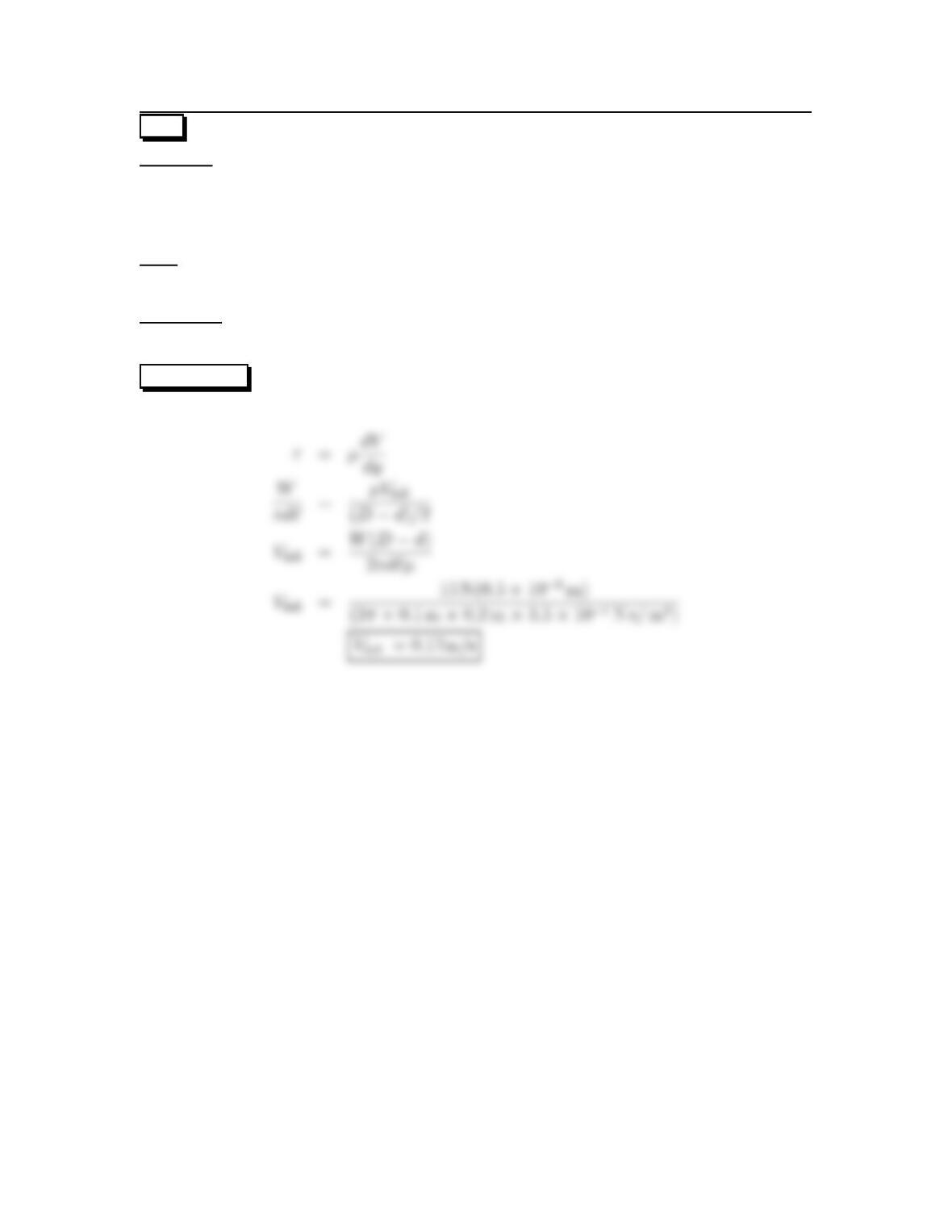
A cylinder falls inside a pipe filled with oil.
d=100mm,D=100.5mm.
=200mm,W=15N.
Find:
Speed at which the cylinder slides down the pipe.
Properties:
SAE 20W oil (10oC) from Figure A.2: μ=0.35N·s/m2.
SOLUTION
41
2.38
Situation:
A disk is rotated very close to a solid boundary with oil in between.
ωa=1rad/s,r2=2cm,r3=3cm.
ωb=2rad/s,rb=3cm.
H=2mm,μc=0.01 N s/m2.
Find:
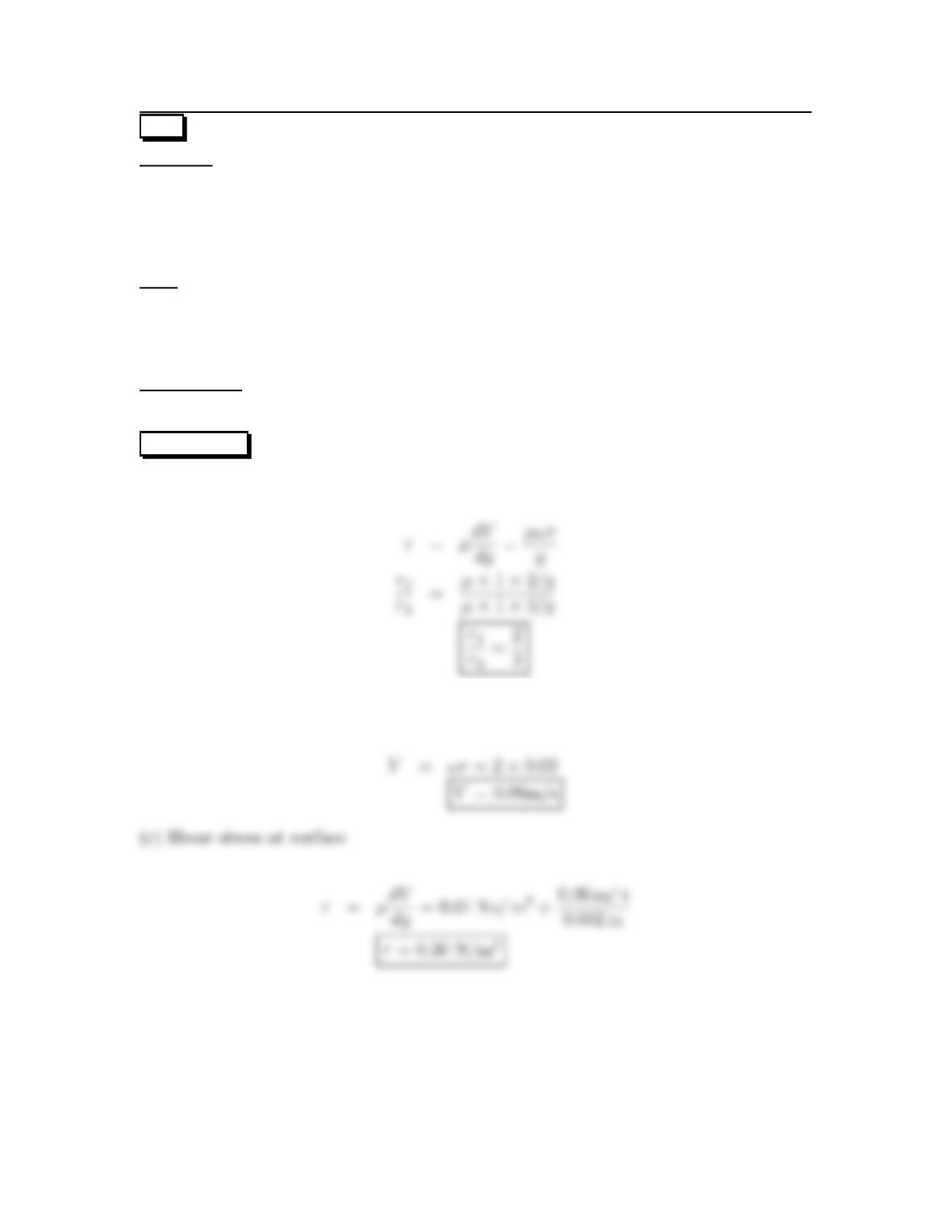
(a) Ratio of shear stress at 2cm to shear stress at 3cm.
(b) Speed of oil at contact with disk surface.
(c) Shear stress at disk surface.
Assumptions:
Linear velocity distribution: dV/dy =V/y =ωr/y.
SOLUTION
(a) Ratio of shear stresses
(b) Speed of oil
42
2.39
Situation:
A disk is rotated in a container of oil to damp the motion of an instrument.
Find:
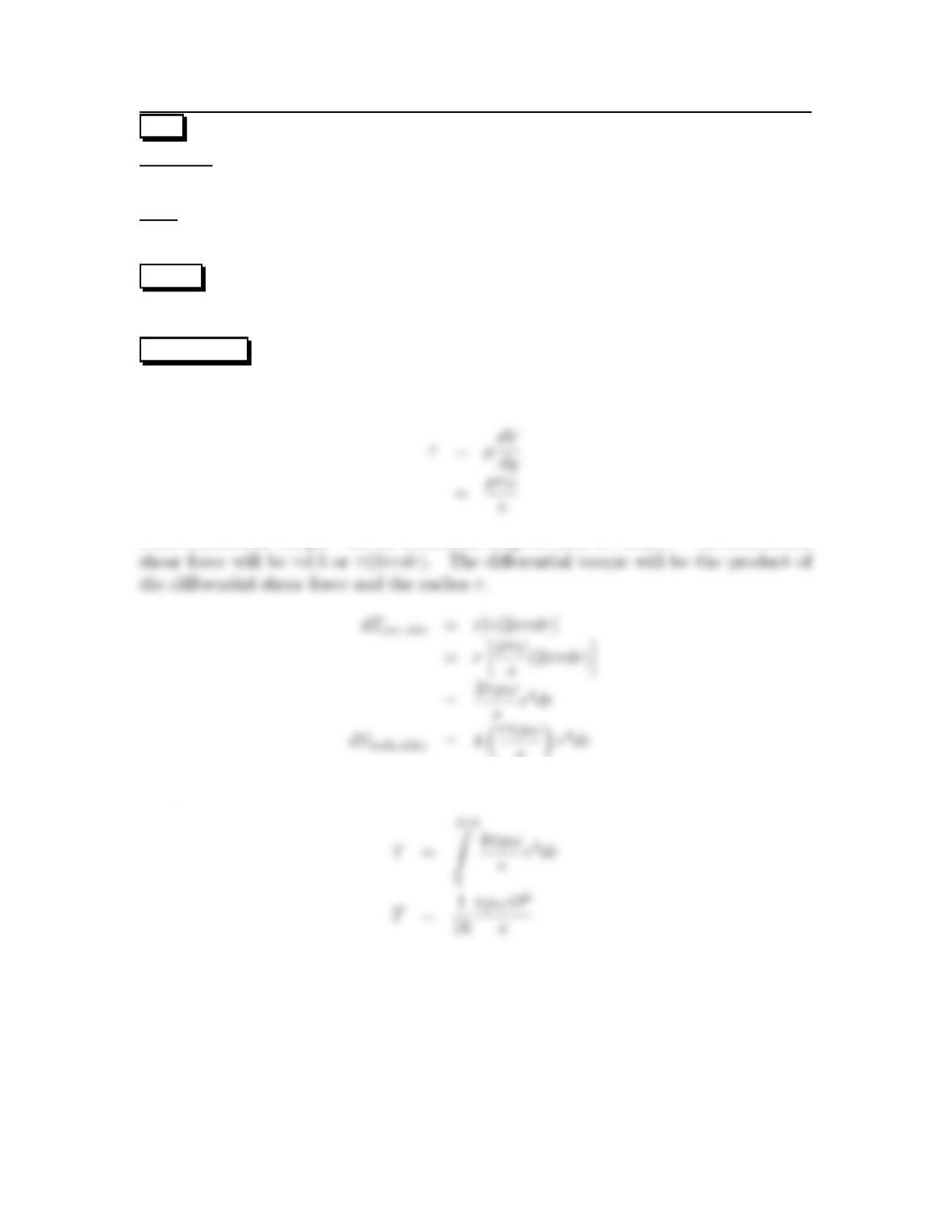
Derive an equation for damping torque as a function of D, S, ω and μ.
PLAN
Apply the Newton’s law of viscosity.
SOLUTION
Shear stress
Find differential torque–on an elemental strip of area of radius rthe differential
s´r3dr
Integrate
43
2.40
Situation:
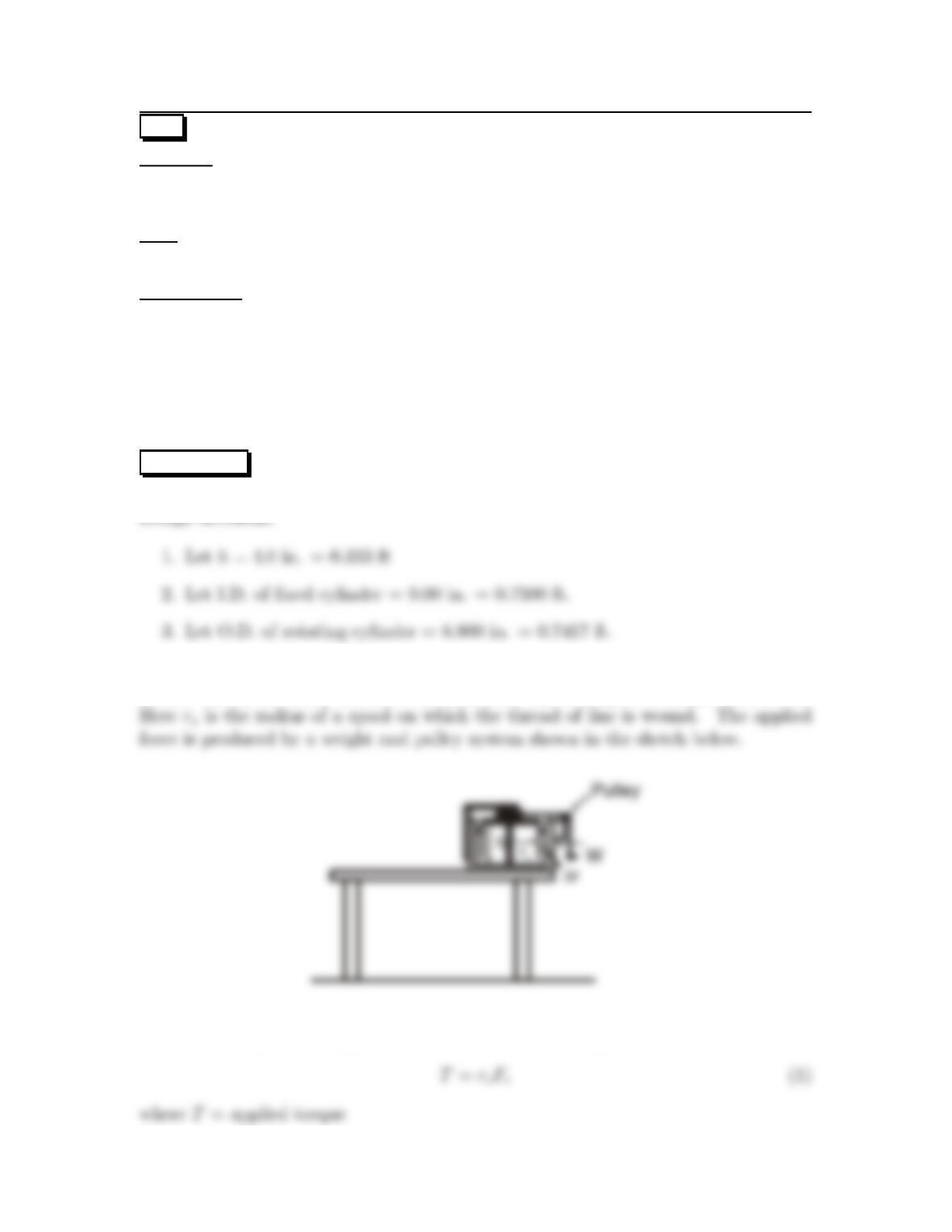
Onetypeofviscometerinvolvestheuseofarotatingcylinderinsideafixed cylinder.
Tmin =50◦F,Tmax =200◦F.
Find:
(a) Design a viscometer that can be used to measure the viscosity of motor oil.
Assumptions:
Motor oil is SAE 10W-30. Data from Fig A-2: μwill vary from about 2×10⁻⁴lbf-
s/ft2to 8×10⁻³lbf-s/ft2.
Assume the only significant shear stress develops between the rotating cylinder and
the fixed cylinder.
Assume we want the maximum rate of rotation (ω)to be 3 rad/s.
Maximum spacing is 0.05 in.
SOLUTION
One possible design solution is given below.
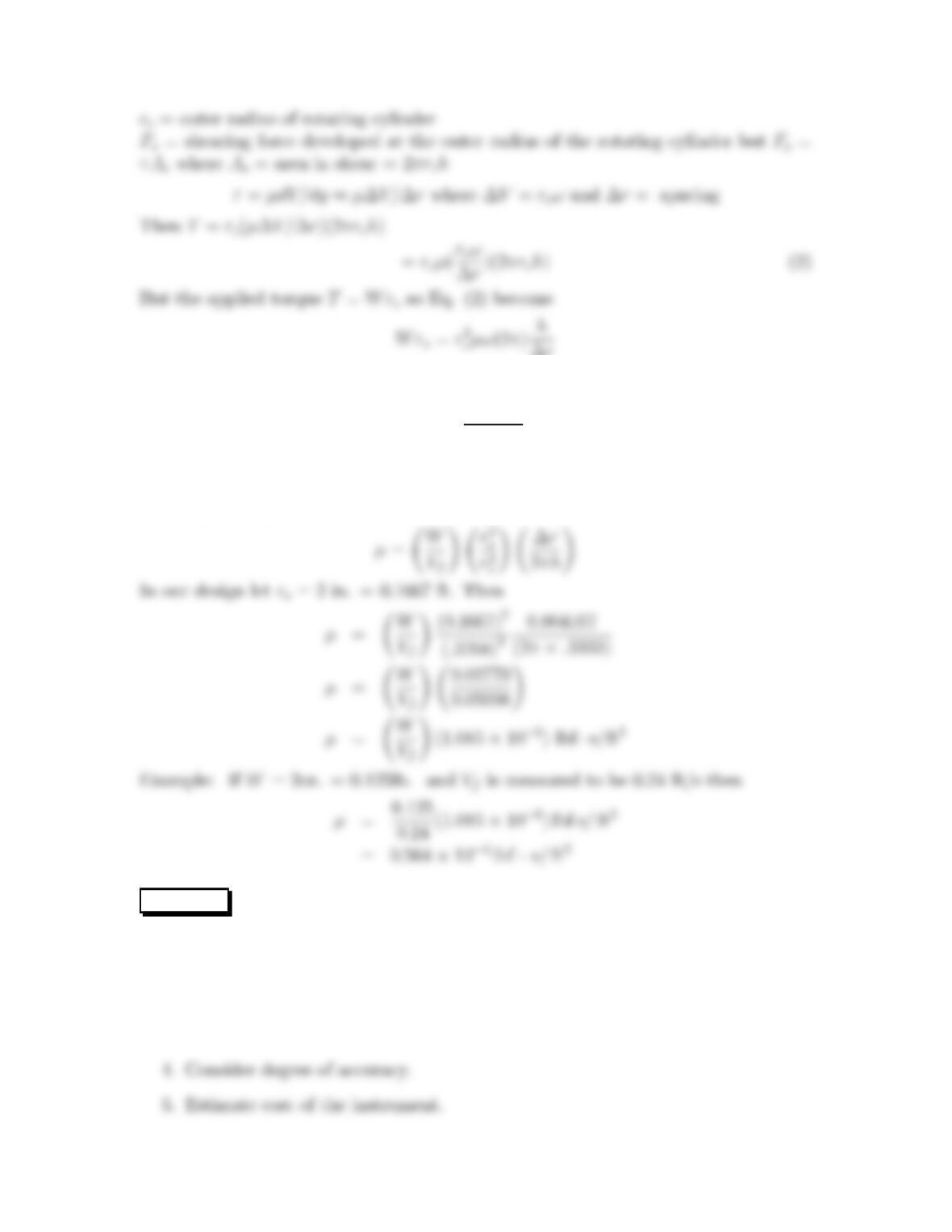
Let the applied torque, which drives the rotating cylinder, be produced by a force
from a thread or small diameter monofilament line acting at a radial distance rs.
The relationship between μ, rs,ω,h, and Wis now developed.
44
∆r
Or
μ=Wr
s∆r
2πωhr3
c
(3)
The weight Wwill be arbitrarily chosen (say 2 or 3 oz.) and ωwill be determined by
measuring the time it takes the weight to travel a given distance. So rsω=Vfall or
ω=Vfall/rs.Equation (3) then becomes
REVIEW
Other things that could be noted or considered in the design:
1. Specify dimensions of all parts of the instrument.
2. Neglect friction in bearings of pulley and on shaft of cylinder.
3. Neglect weight of thread or monofilament line.
45
2.41
Situation:
Questions on the effect of temperature upon different types of fluids.
Find:
(a) If temperature increases, does the viscosity of water increase or decrease? Why?
(b) If temperature increases, does the viscosity of air increase or decrease? Why?
SOLUTION
(c) The viscosity of water decreases with increasing temperature .Thisistruefor
all liquids, and is because the loose molecular lattice within liquids, which provides a
46
2.42
Situation:
Sutherland’s equation (select all that apply):
a. relates temperature and viscosity
b. must be calculated using Kelvin
c. requires use of a single universal constant for all gases
d. requires use of a different constant for each gas
SOLUTION
47
2.43
Situation:
When looking up values for density, absolute viscosity, and kinematic viscosity, which
statement is true for BOTH liquids
and gases?
a. all 3 of these properties vary with temperature
b. all 3 of these properties vary with pressure
c. all 3 of these properties vary with temperature and pressure
SOLUTION
48
2.44
Situation:
Common Newtonian fluids are:
a. toothpaste, catsup, and paint
b. water, oil and mercury
c. all of the above
SOLUTION
49
2.45
Situation:
Which of these flows (deforms) with even a small shear stress applied?
a. a Bingham plastic
b. a Newtonian fluid
SOLUTION
50
2.46
Situation:
Sutherland’s equation and the ideal gas law describe behaviors of common gases.
Find:
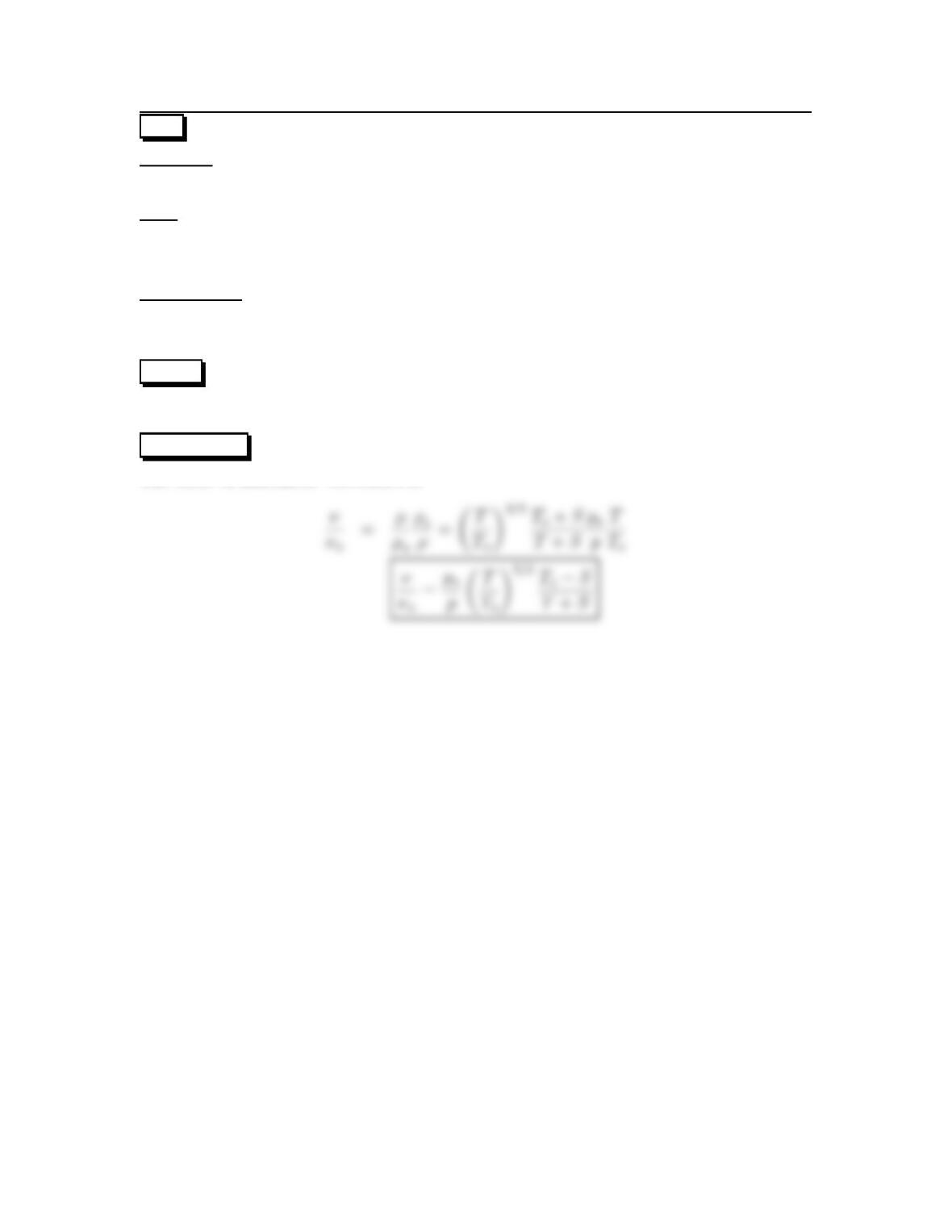
Develop an expression for the kinematic viscosity ratio ν/νo,whereνis at temper-
ature Tand pressure p.
Assumptions:
Assume a gas is at temperature Toand pressure po, where the subscript ”o” defines
the reference state.
PLAN
Combine the ideal gas law and Sutherland’s equation.
SOLUTION
The ratio of kinematic viscosities is
51
2.47
Situation:
The dynamic viscosity of air.
μo=1.78 ×10⁻⁵N·s/m2.
To=15◦C,T=100◦C.
Find:
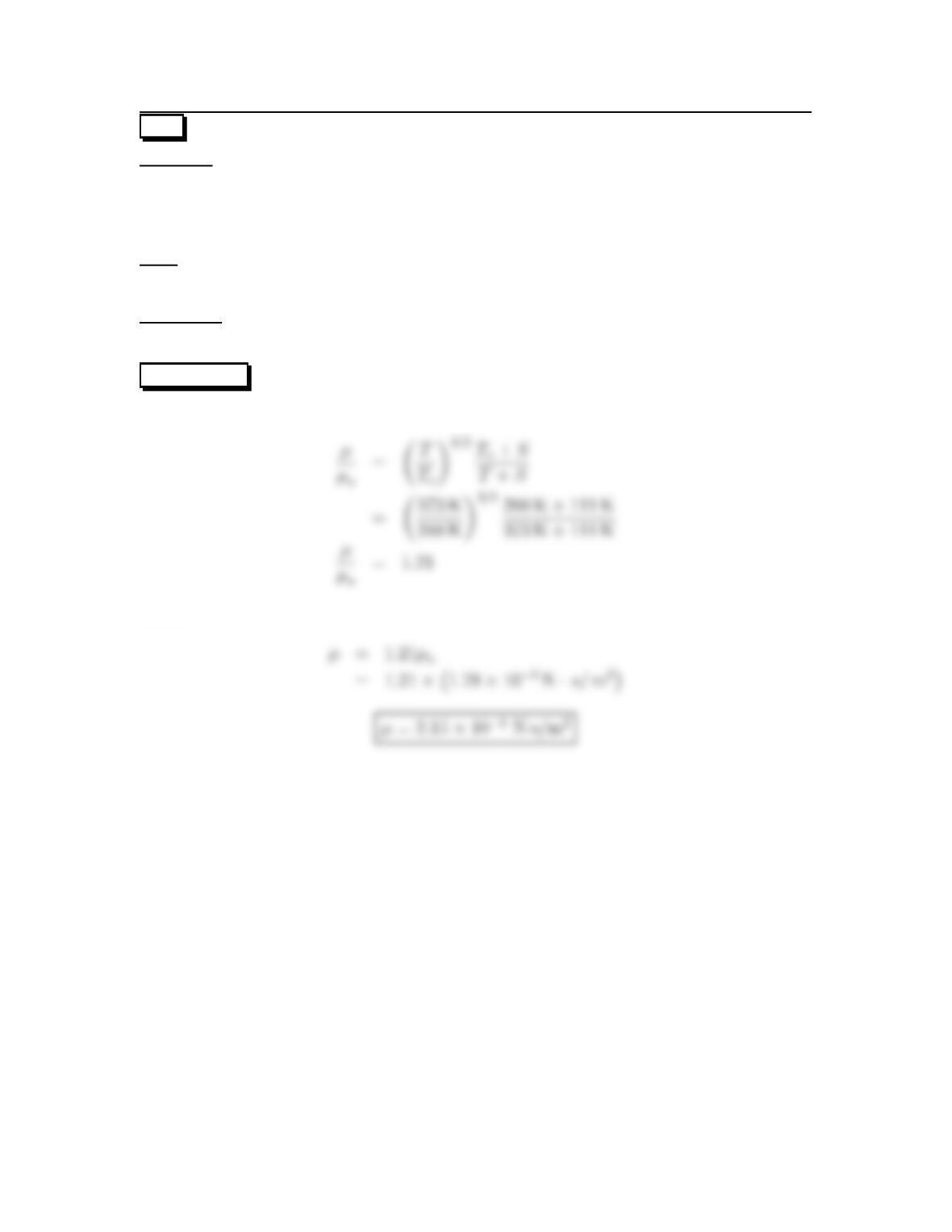
Dynamic viscosity μ.
Properties:
From Table A.2, S=111K.
SOLUTION
Sutherland’s equation
Thus
52
2.48
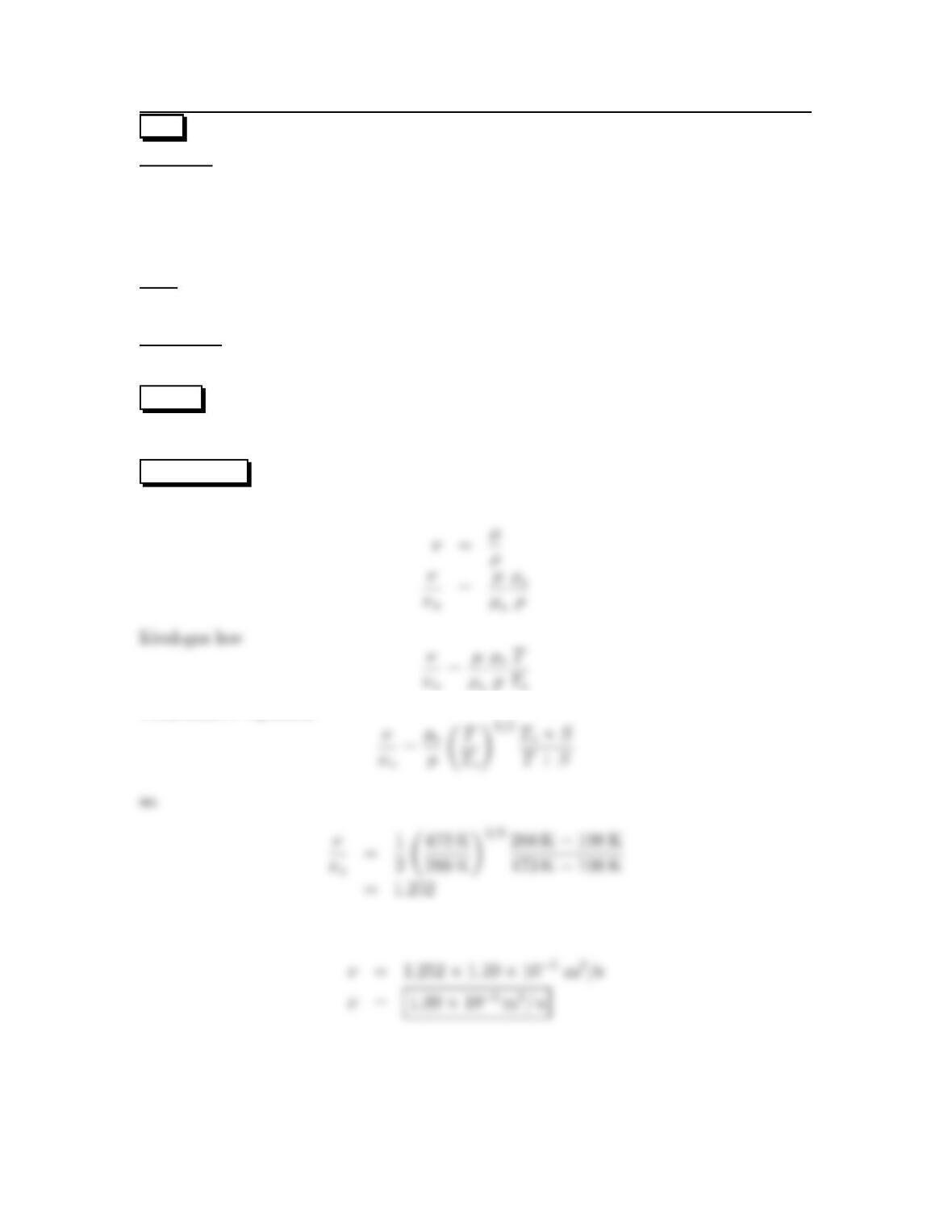
Situation:
Methane gas.
vo=1.59 ×10⁻⁵m2/s.
To=15◦C,T=200◦C.
po=1atm,p=2atm.
Find:
Kinematic viscosity ( m2/s).
Properties:
From Table A.2, S=198K.
PLAN
Apply the ideal gas law and Sutherland’s equation.
SOLUTION
Sutherland’s equation
and
53
2.49
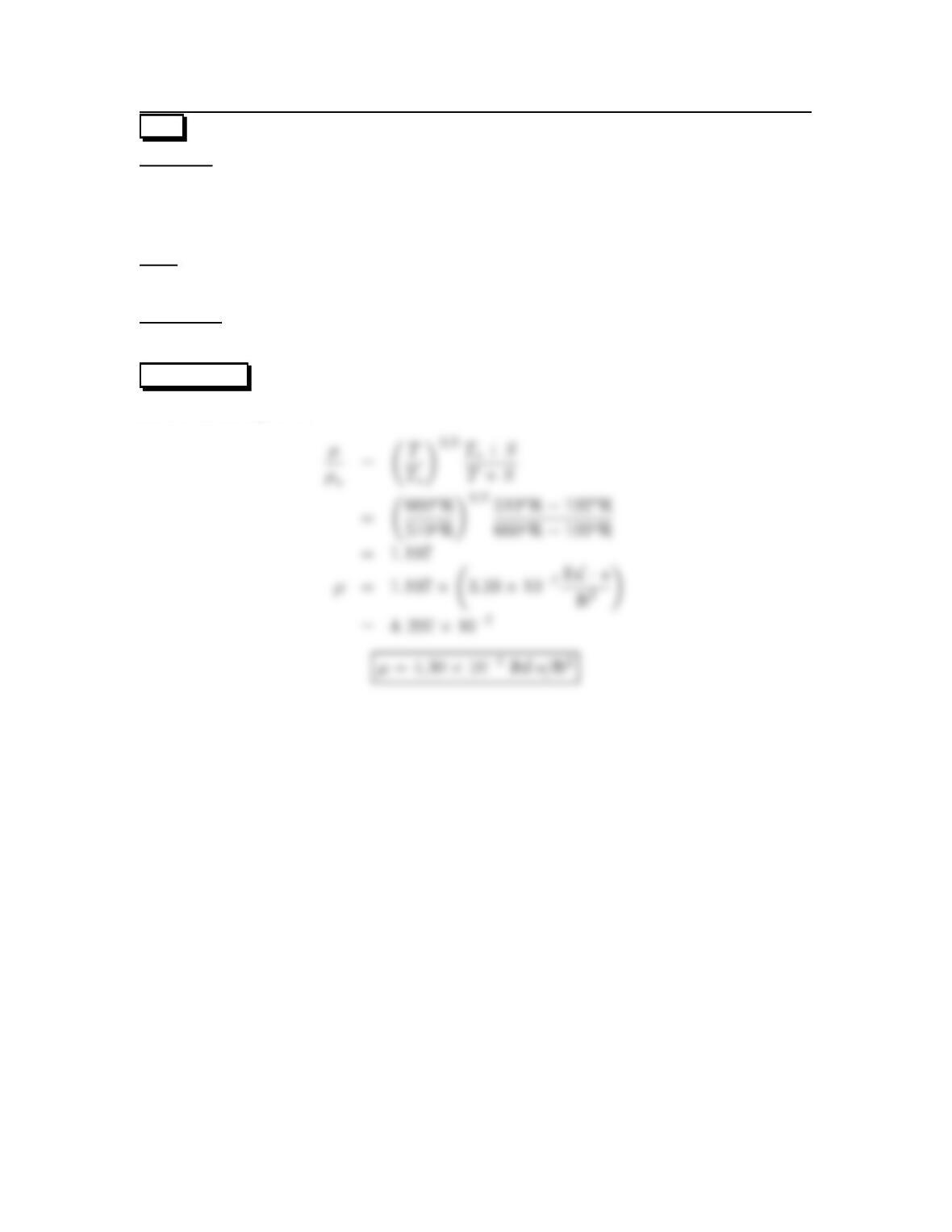
Situation:
Nitrogen gas.
μo=3.59 ×10⁻⁷lbf ·s/ft2.
To=59◦F,T=200◦F.
Find:
μusing Sutherland’s equation.
Properties:
From Table A.2, S=192oR.
SOLUTION
Sutherland’s equation
54
2.50
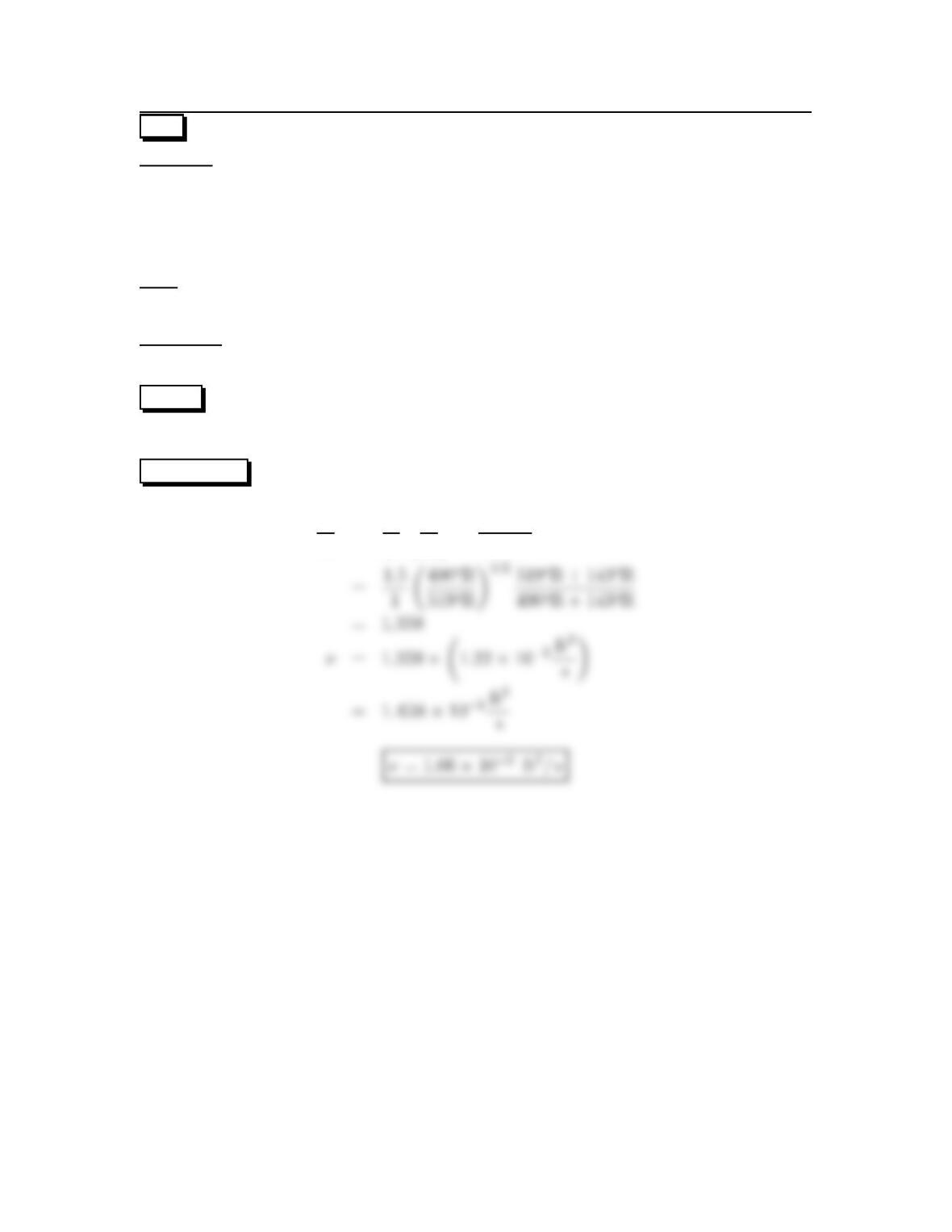
Situation:
Helium gas.
vo=1.22 ×10⁻³ft2/s.
To=59◦F,T=30◦F.
po=1atm,p=1.5atm.
Find:
Kinematic viscosity using Sutherland’s equation.
Properties:
From Table A.2, S=143oR.
PLAN
Combine the ideal gas law and Sutherland’s equation.
SOLUTION
ν
νo
=po
pµT
To¶5/2To+S
T+S
55
2.51
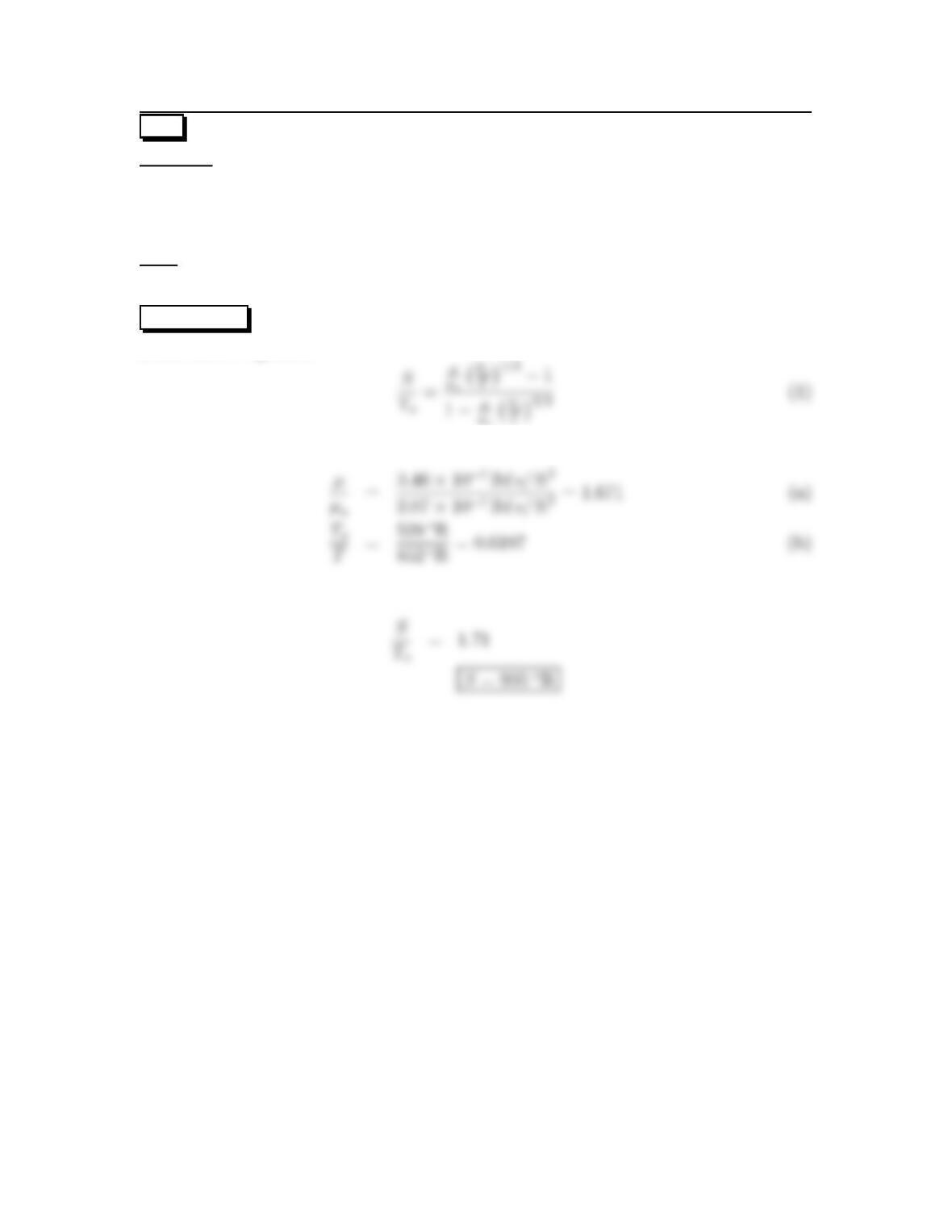
Situation:
Ammonia at room temperature.
To=68◦F,μo=2.07 ×10⁻⁷lbf s/ft2.
T=392◦F,μ=3.46 ×10⁻⁷lbf s/ft2.
Find:
Sutherland’s constant.
SOLUTION
Sutherland’s equation
Calculations
Substitute (a) and (b) into Eq. (1)
56
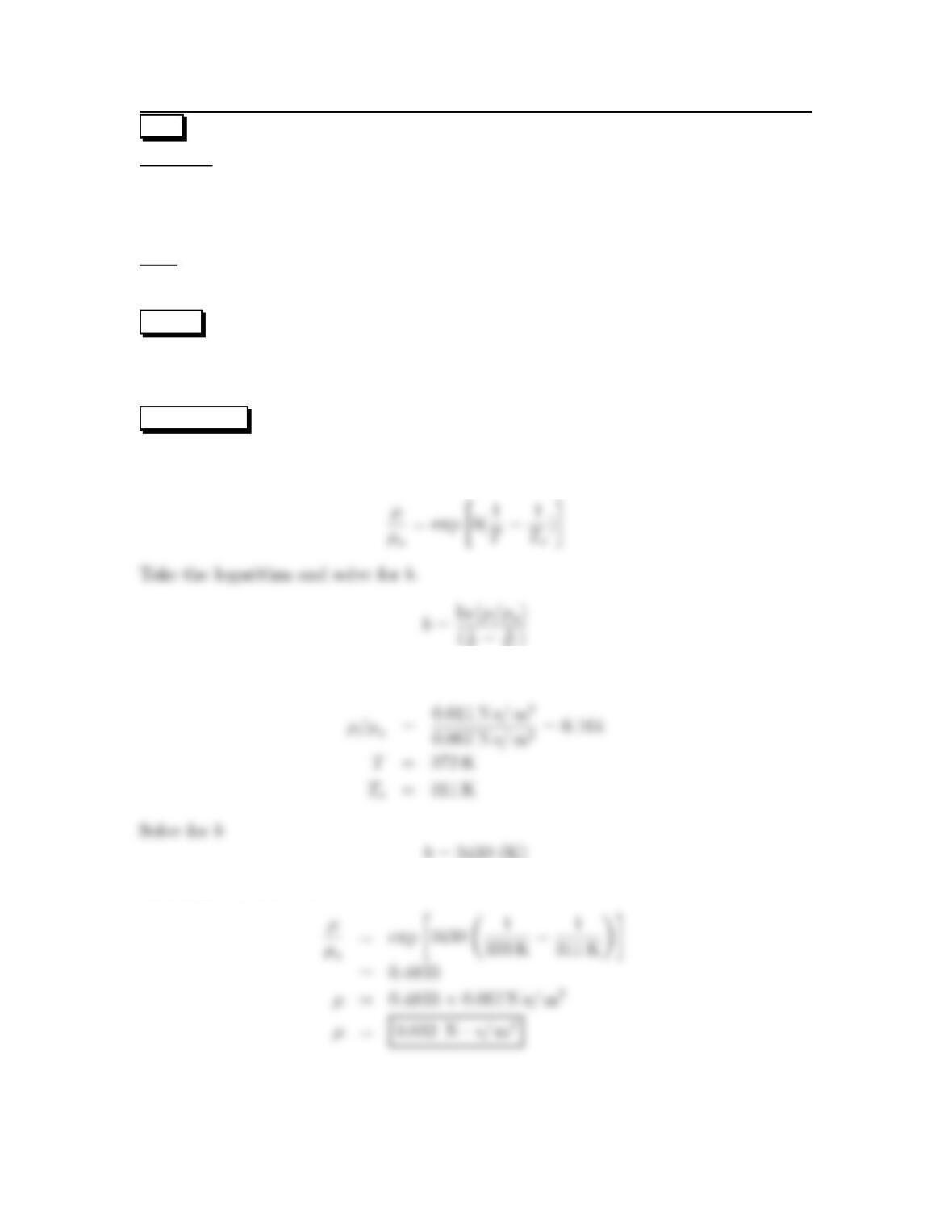
2.52
Situation:
SAE 10W30 motor oil.
To=38◦C,μo=0.067 N s/m2.
T=99◦C,μ=0.011 N s/m2.
Find:
The viscosity of motor oil,μ(60oC), using the equation μ=Ceb/T .
PLAN
Use algebra and known values of viscosity (μ)to solve for the constant b. Then,
solvefortheunknownvalueofviscosity.
SOLUTION
Viscosity variation of a liquid can be expressed as μ=Ceb/T .Thus, evaluate μat
temperatures Tand Toand take the ratio:
T−1
To)
Data
b= 3430 (K)
Viscosity ratio at 60oC
57
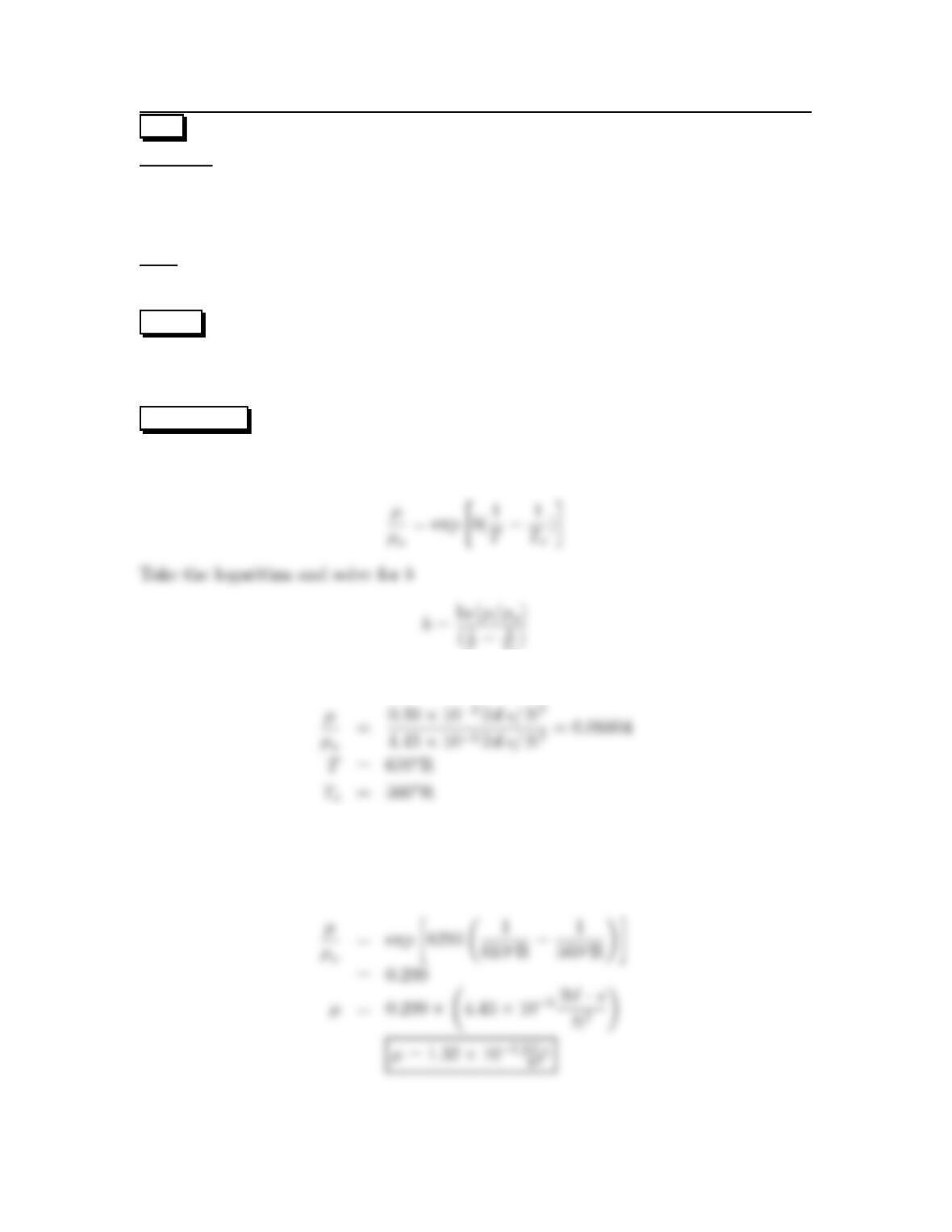
2.53
Situation:
Viscosity of grade 100 aviation oil.
To=100◦F,μo=4.43 ×10⁻³lbf s/ft2.
T=210◦F,μ=3.9×10⁻⁴lbf s/ft2.
Find:
μ(150oF), using the equation μ=Ceb/T .
PLAN
Use algebra and known values of viscosity (μ)to solve for the constant b. Then,
solvefortheunknownvalueofviscosity.
SOLUTION
Viscosity variation of a liquid can be expressed as μ=Ceb/T .Thus, evaluate μat
temperatures Tand Toand take the ratio:
Data
Solve for b
b=8293(oR)
Viscosity ratio at 150oF
58
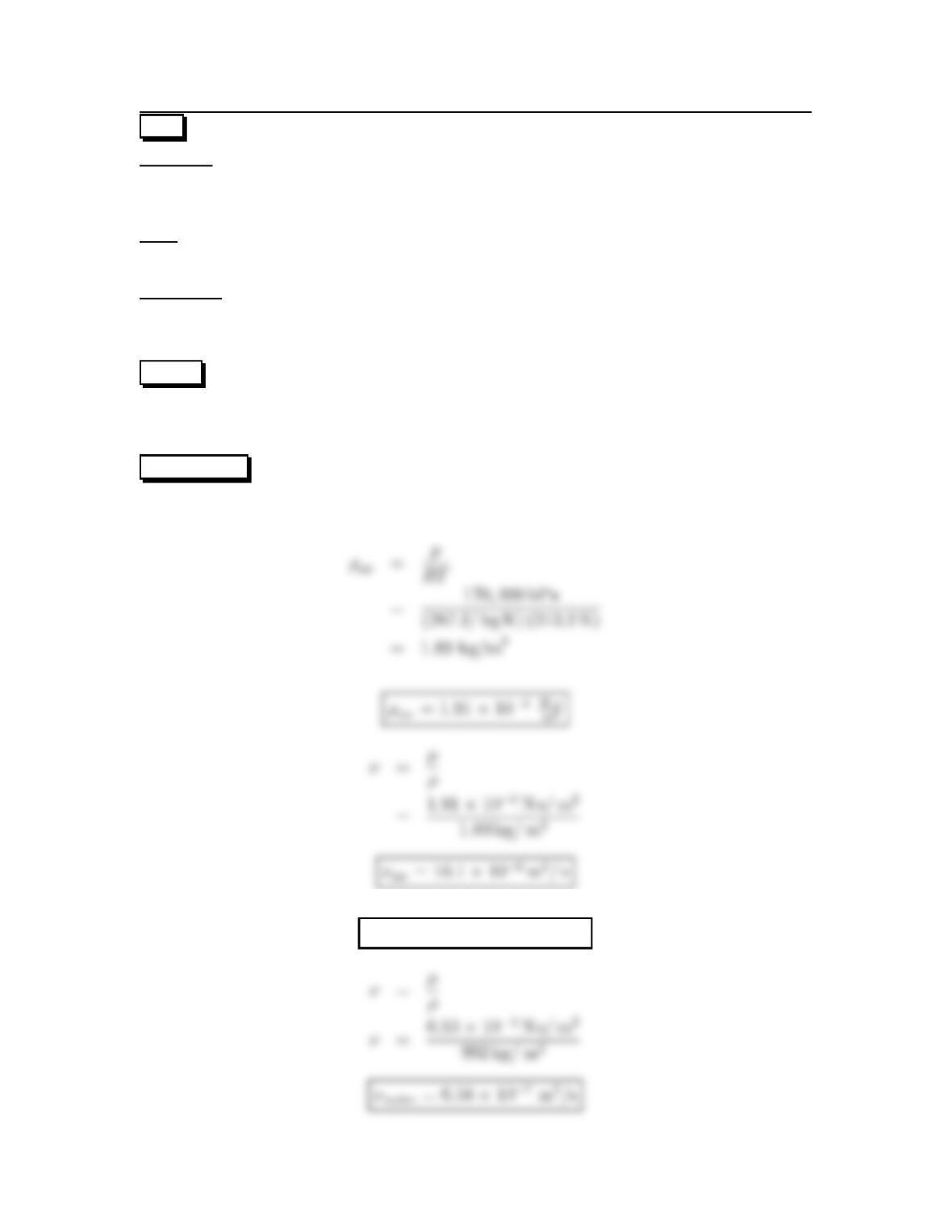
2.54
Situation:
Properties of air and water.
T=40◦C,p=170kPa.
Find:
Kinematic and dynamic viscosities of air and water.
Properties:
Air data from Table A.3, μair =1.91 ×10⁻⁵N·s/m2
Water data from Table A.5, μwater =6.53 ×10⁻⁴N·s/m2,ρwater =992kg/m3.
PLAN
Apply the ideal gas law to find density. Find kinematic viscosity as the ratio of
dynamic and absolute viscosity.
SOLUTION
A.) Air
Ideal gas law
B.) water
μwater =6.53 ×10⁻⁵N·s/m2
59