2.55
Situation:
Oxygen at 50 ◦Fand 100 ◦F.
Find:
Ratio of viscosities: μ100
μ50 .
SOLUTION
60

2.56
Situation:
Surface tension: (select all that apply)
a. only occurs at an interface, or surface
b. has dimensions of energy/area
c. has dimensions of force/area
d. has dimensions of force/length
e. depends on adhesion and cohesion
f. varies as a function of temperature
SOLUTION
61
2.57
Situation:
Very small spherical droplet of water.
Find:
Pressure inside.
SOLUTION
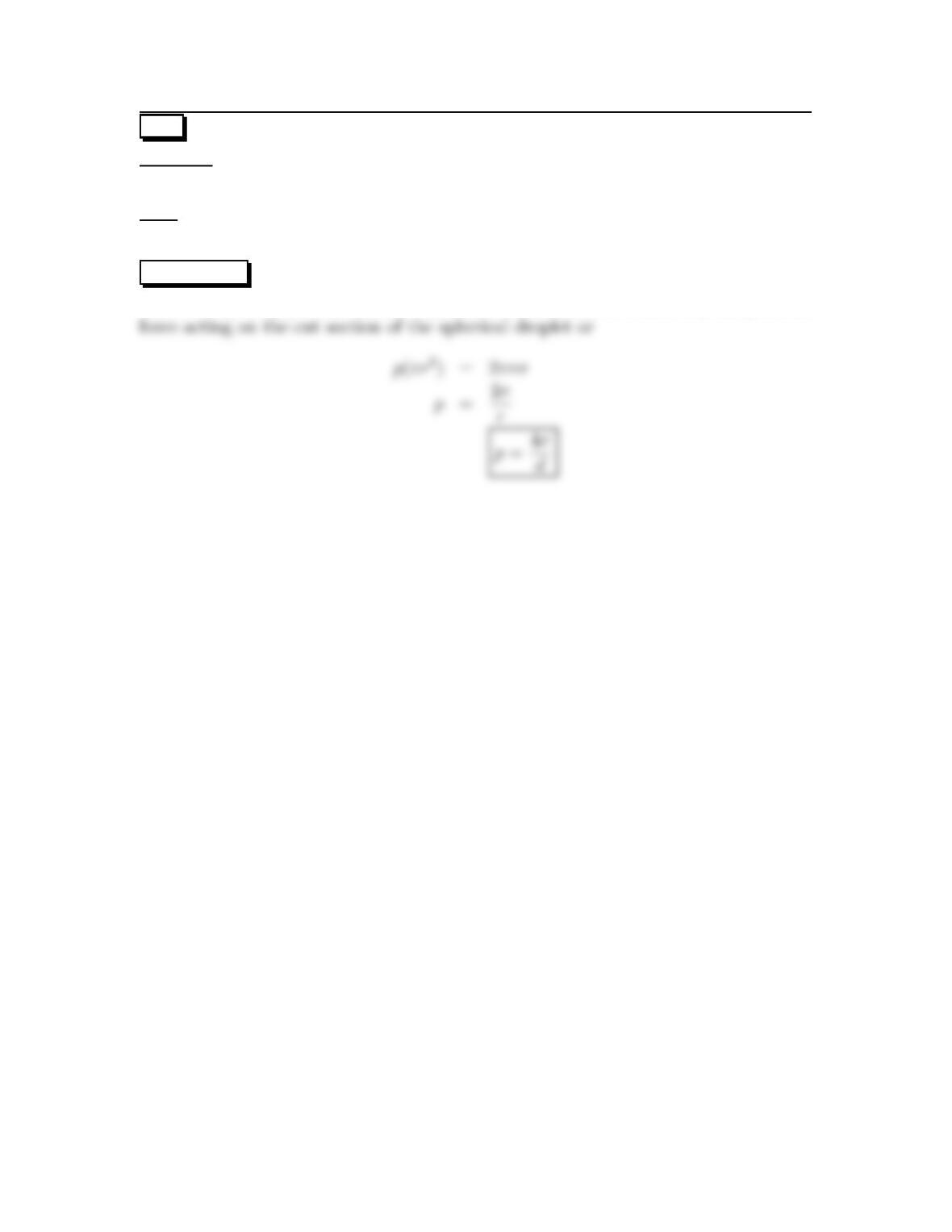
Refer to Fig. 2-6(a). The surface tension force, 2πrσ, will be resisted by the pressure
62
2.58
Situation:
A spherical soap bubble.
Inside radius R, wall-thickness t, surface tension σ.
Special case: R=4mm.
Find:
Derive a formula for the pressure difference across the bubble
Pressure difference for bubble with R=4mm.
Assumptions:
The effect of thickness is negligible, and the surface tension is that of pure water.
PLAN
Apply equilibrium, then the surface tension force equation.
SOLUTION
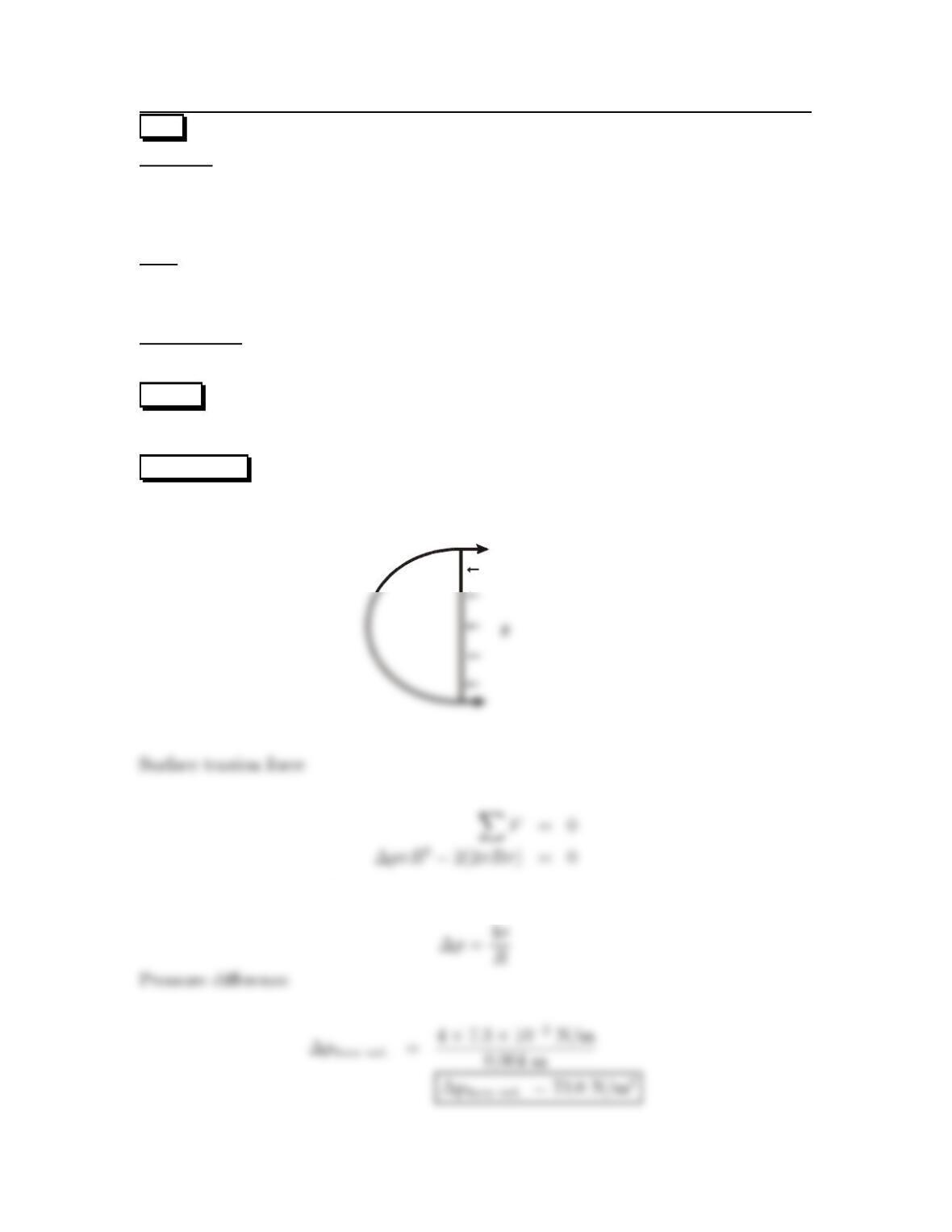
Force balance
2 x 2 R
π
σ
Formula for pressure difference
63
2.59
Situation:
A water bug is balanced on the surface of a water pond.
n=6legs, =5mm/leg.
Find:
Maximum mass of bug to avoid sinking.
Properties:
Surface tension of water, from Table A.4, σ=0.073 N/m.
PLAN
Apply equilibrium, then the surface tension force equation.
SOLUTION
Force equilibrium
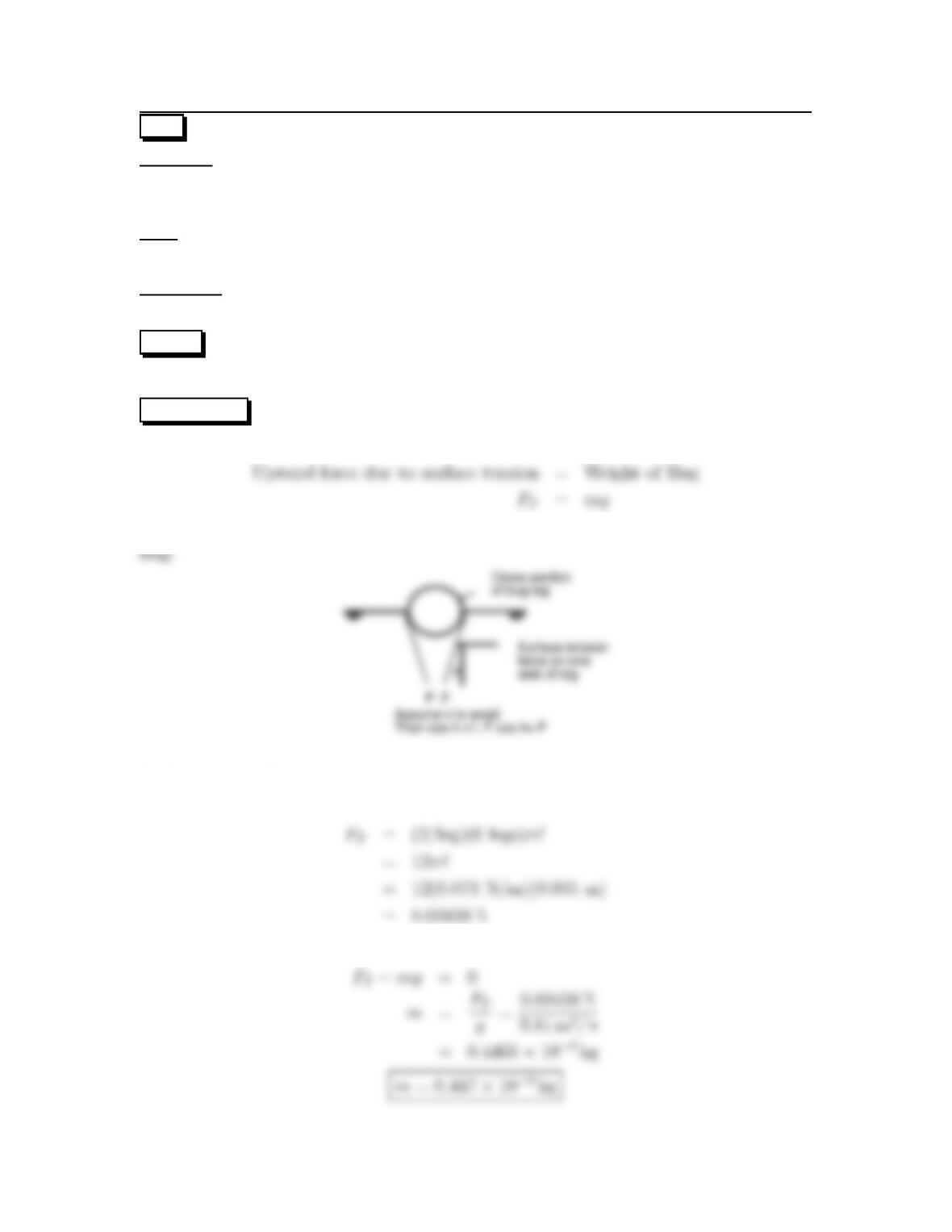
To find the force of surface tension (FT), consider the cross section of one leg of the
Surface tension force
Apply equilibrium
64
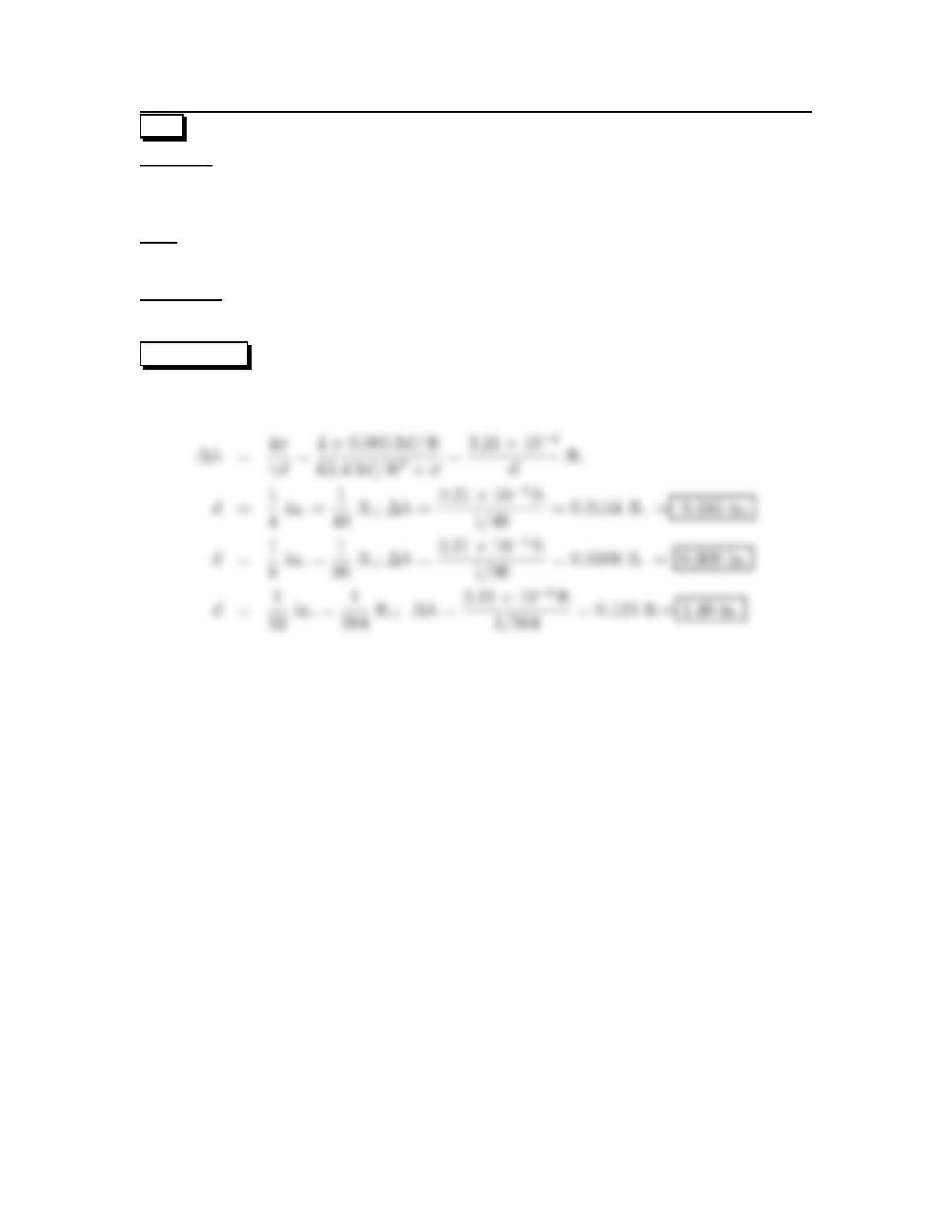
2.60
Situation:
A water column in a glass tube is used to measure pressure.
d1=0.25 in,d2=1/8in,d3=1/32 in.
Find:
Height of water column due to surface tension effects for all diameters.
Properties:
From Table A.4: surface tension of water is 0.005 lbf/ft.
SOLUTION
Surface tension force
65
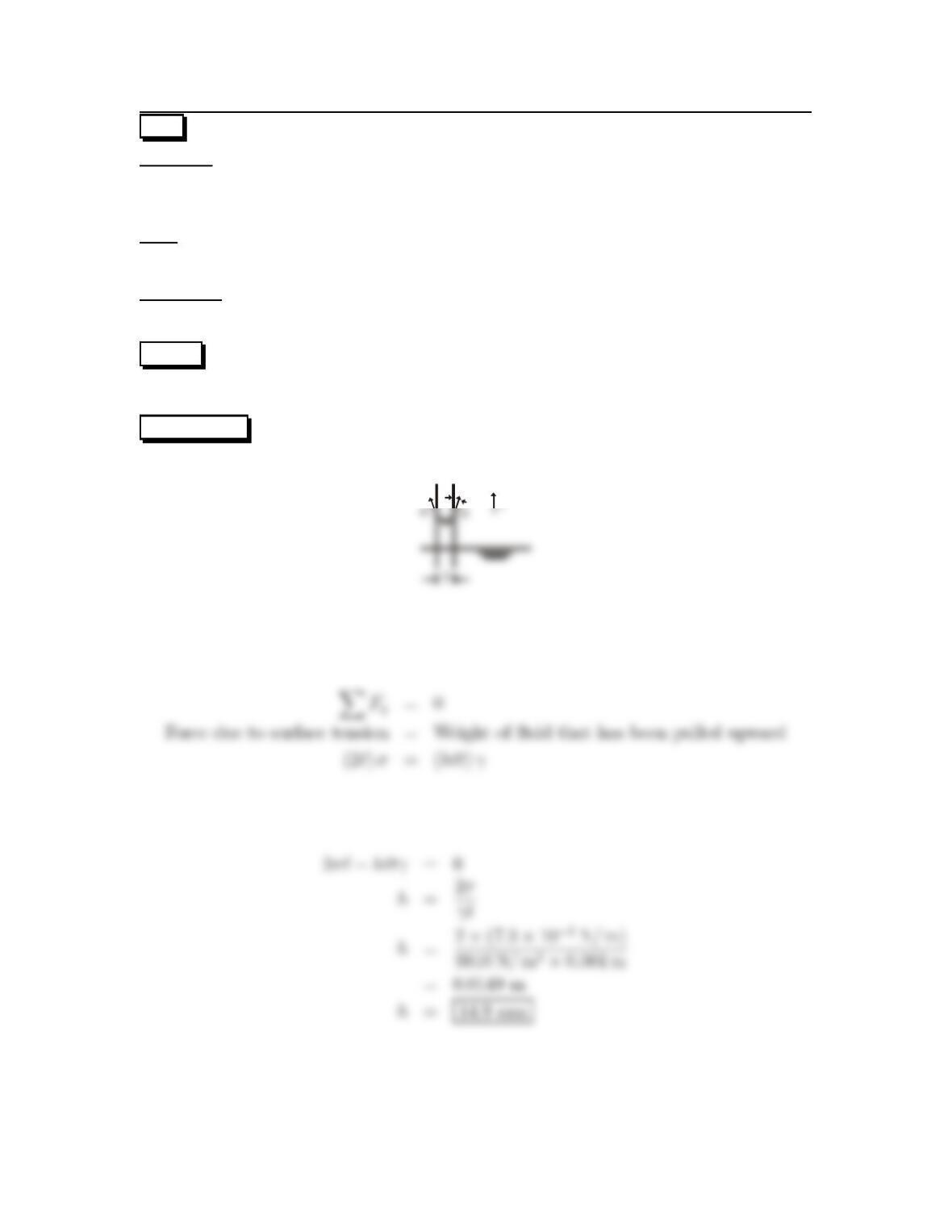
2.61
Situation:
Two vertical glass plates
y=1mm
Find:
Capillary rise (h)between the plates.
Properties:
From Table A.4, surface tension of water is 7.3×10⁻²N/m.
PLAN
Apply equilibrium, then the surface tension force equation.
SOLUTION
θ
y
Equilibrium
Solve for capillary rise (h)
66
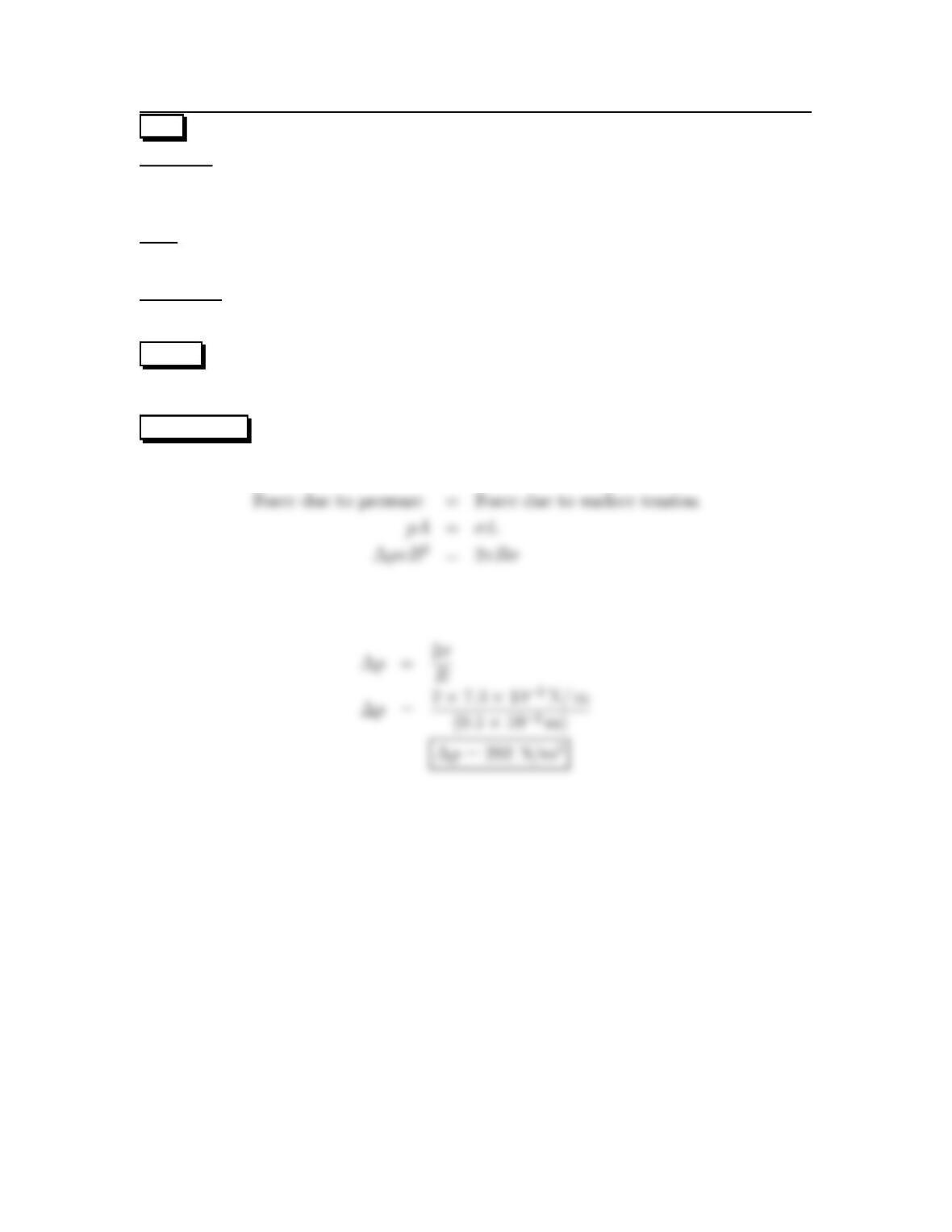
2.62
Situation:
A spherical water drop.
d=1mm
Find:
Pressure inside the droplet (N/m2)
Properties:
From Table A.4, surface tension of water is 7.3×10⁻²N/m
PLAN
Apply equilibrium, then the surface tension force equation.
SOLUTION
Equilibrium (half the water droplet)
Solve for pressure
67
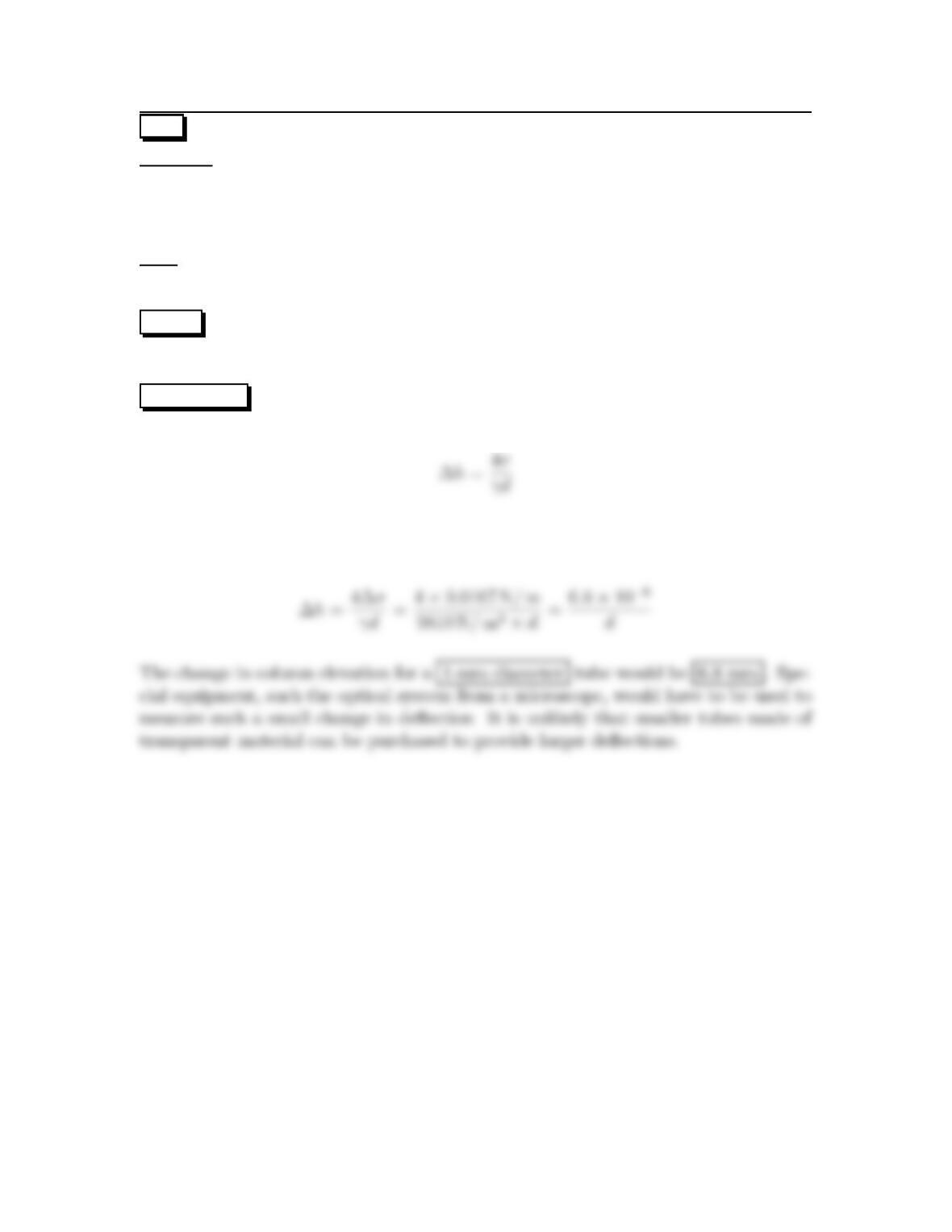
2.63
Situation:
A tube employing capillary rise is used to measure temperature of water
T0=0◦C,T100 =100◦C
σ0=0.0756 N/m,σ100 =0.0589 N/m
Find:
Size the tube (this means specify diameter and length).
PLAN
Apply equilibrium and the surface tension force equation.
SOLUTION
The elevation in a column due to surface tension is
where γis the specificweightanddis the tube diameter. For the change in surface
tension due to temperature, the change in column elevation would be
68
2.64
Situation:
Capillary rise is the distance water will rise above a water table, because the intercon-
nected pores in the soil act like capillary tubes. This means that deep-rooted plants
in the desert need only grow to the top of the “capillary fringe” in order to get water;
they do not have to extend all the way down to the water table.
a. Assuming that interconnected pores can be represented as a continuous capillary
tube, how high is the capillary rise in a soil consisting of a silty soil, with pore diameter
of 10 μm?
b. Is the capillary rise higher in a soil with fine sand (pore dapprox. 0.1 mm), or
in fine gravel (pore dapprox. 3 mm)?
c. Root cells extract water from soil using capillarity. For root cells to extract
water from the capillary zone, do the pores in a root need to be smaller than, or
greater than, the pores in the soil?
SOLUTION
a. Apply principals of surface tension, using Eq. 2.26 from EFM10e:
b. By inspection of Eq. 2.26 of EFM10e, the pore diameter, d, is in the denomina-
tor, so as dgets smaller, ∆hincreases. Therefore, capillary rise is higher in a clay
69
2.65
Situation:
A soap bubble and a droplet of water of equal diameter falling in air
d=2mm,σbubble =σdroplet
Find:
Which has the greater pressure inside.
SOLUTION
70
2.66
Situation:
A hemispherical drop of water is suspended under a surface
Find:
Diameter of droplet just before separation
Properties:
Table A.5 (20 ◦C): γ=9790N/m3,σ =0.073 N/m.
SOLUTION
Equilibrium
Solve for D
71
2.67
Situation:
Surface tension is being measured by suspending liquid from a ring
Di=10cm,Do=9.5cm
W=10g,F=16g
Find:
Surface tension (N/m)
PLAN
1. Force equilibrium on the fluid suspended in the ring. For force due to surface
tension, use the form of the equation provided in the text for the special case of a
ring being pulled out of a liquid.
2. Solve for surface tension – all the other forces are known.
SOLUTION
1. Force equilibrium
2. Solve for surface tension
72
2.68
Situation:
If liquid water at 30◦Cisflowing in a pipe and the pressure drops to the vapor
pressure, what happens in the water?
a. the water begins condensing on the walls of the pipe
b. the water boils
c. the water flashes to vapor
SOLUTION
73
2.69
Find:
How does vapor pressure change with increasing temperature?
a. it increases
b. it decreases
c. it stays the same
SOLUTION
Theansweris(a).
REVIEW Vapor pressure increases with increasing temperature. To get an every-
74

2.70
Situation:
T=20◦C,fluid is water.
Find:
The pressure that must be imposed to cause boiling
Properties:
Water (60 ◦F), Table A.5: Pv= 2340 Pa abs
SOLUTION
75
2.71
Situation:
Water in a closed tank
T=20◦C,p= 10400 Pa
Find:
Whether water will bubble into the vapor phase (boil).
Properties:
From Table A.5, at T=20◦C,Pv=2340Pa abs
SOLUTION
REVIEW
Thewatercanbemadetoboilatthistemperatureonly if the pressure is reduced
76
2.72
Situation:
The boiling temperature of water decreases with increasing elevation
∆p
∆T=−3.1kPa
oC.
Find:
Boiling temperature at an altitude of 3000 m
PLAN
Develop a linear equation for boiling temperature as a function of elevation.
SOLUTION
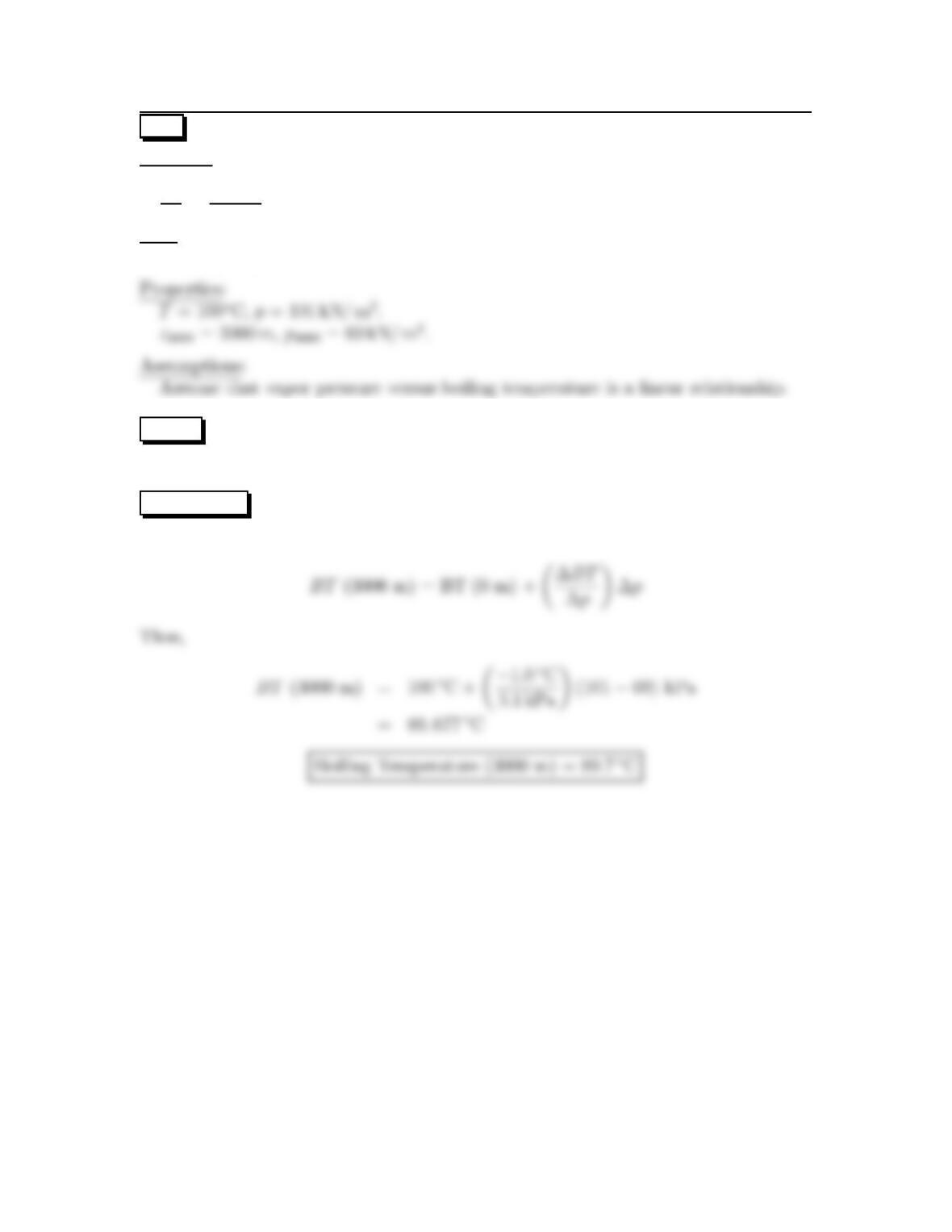
Let BT = “Boiling Temperature.” Then, BT as a function of elevation is
77