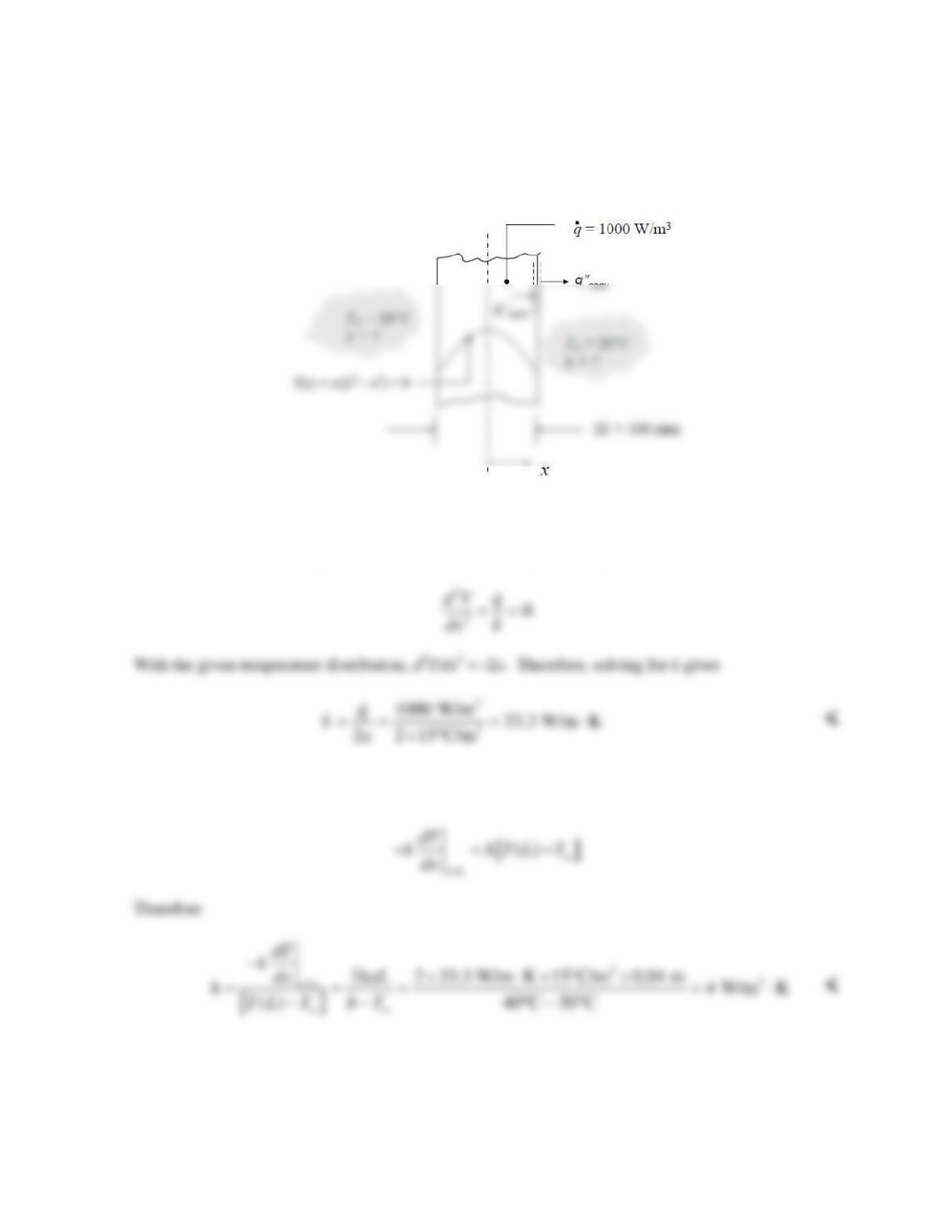
PROBLEM 2.26
KNOWN: Wall thickness. Thermal energy generation rate. Temperature distribution. Ambient fluid
temperature.
FIND: Thermal conductivity. Convection heat transfer coefficient.
SCHEMATIC:
ASSUMPTIONS: (1) Steady state, (2) One–dimensional conduction, (3) Constant properties, (4)
Negligible radiation.
ANALYSIS: Under the specified conditions, the heat equation, Equation 2.21, reduces to
The convection heat transfer coefficient can be found by applying the boundary condition at x = L (or
at x = –L),
COMMENTS: (1) In Chapter 3, you will learn how to determine the temperature distribution. (2)
The heat transfer coefficient could also have been found from an energy balance on the wall. With
in out 0
g
EE E− +=
, we find –2hA[T(L) – T∞] + 2
q
LA = 0. This yields the same result for h.
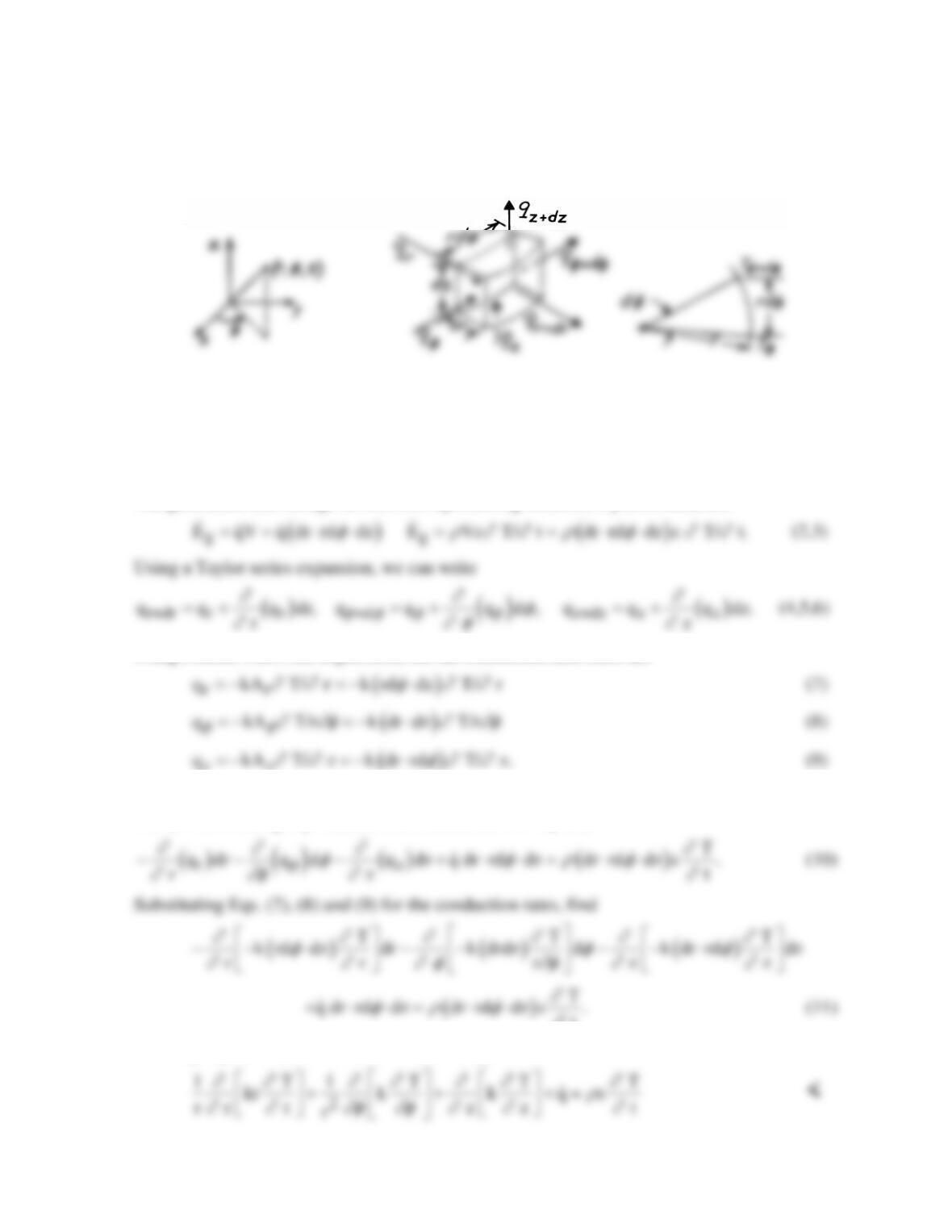
PROBLEM 2.27
KNOWN: Three–dimensional system – described by cylindrical coordinates (r,φ,z) –
experiences transient conduction and internal heat generation.
FIND: Heat diffusion equation.
SCHEMATIC: See also Fig. 2.12.
ASSUMPTIONS: (1) Homogeneous medium.
ANALYSIS: Consider the differential control volume identified above having a volume
given as V = dr⋅rdφ⋅dz. From the conservation of energy requirement,
q q q q q q E E
r r +dr +d z z+dz g st
− + − + − + =
φ φ φ
.
(1)
The generation and storage terms, both representing volumetric phenomena, are
Using Fourier’s law, the expressions for the conduction heat rates are
zz
Note from the above, right schematic that the gradient in the φ–direction is ∂T/r∂φ and not
∂T/∂φ. Substituting Eqs. (2), (3) and (4), (5), (6) into Eq. (1),
t
Dividing Eq. (11) by the volume of the CV, Eq. 2.26 is obtained.
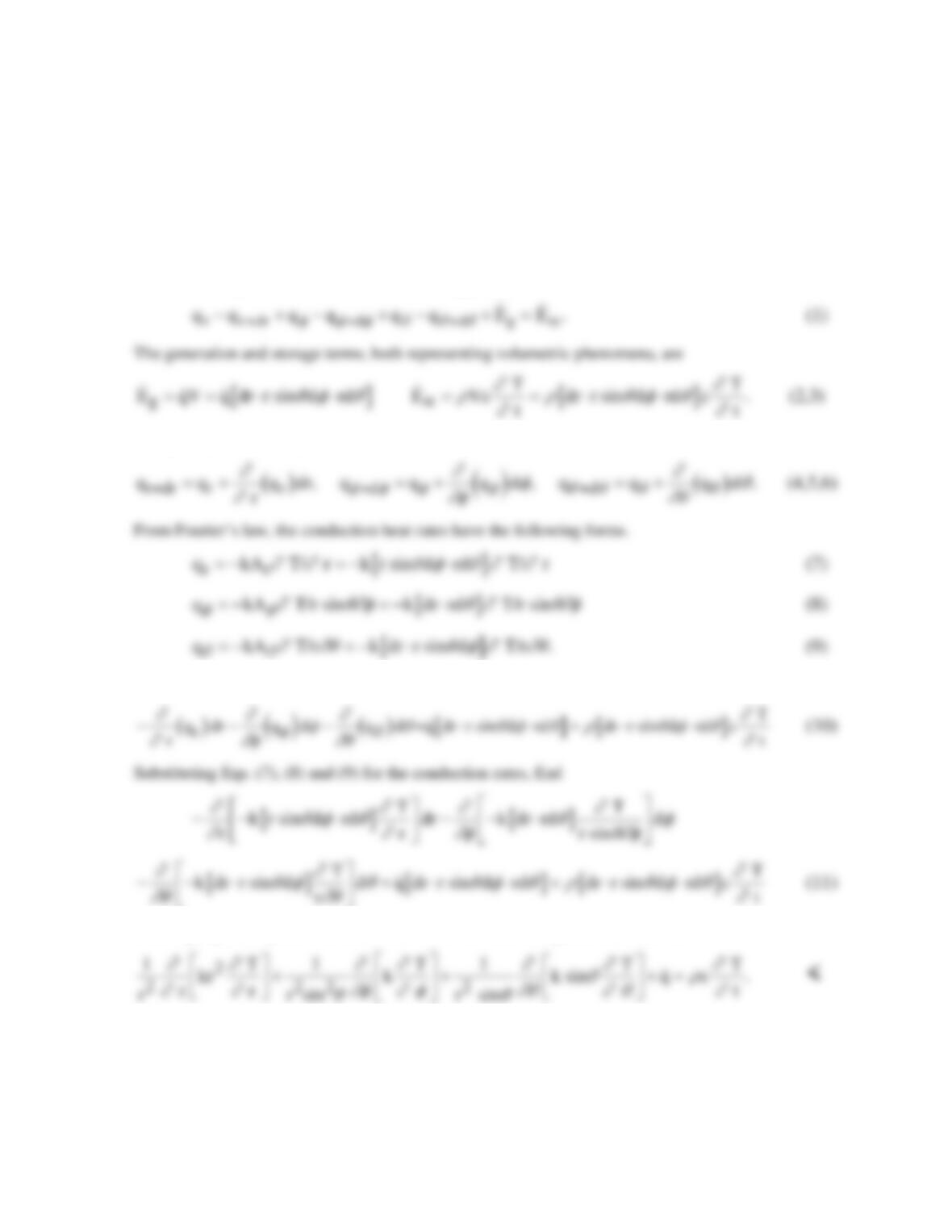
PROBLEM 2.28
KNOWN: Three-dimensional system – described by spherical coordinates (r,φ,θ) – experiences
transient conduction and internal heat generation.
FIND: Heat diffusion equation.
SCHEMATIC: See Figure 2.13.
ASSUMPTIONS: (1) Homogeneous medium.
ANALYSIS: The differential control volume is V = dr⋅rsinθdφ⋅rdθ, and the conduction terms are
identified in Figure 2.13. Conservation of energy requires
Using a Taylor series expansion, we can write
Substituting Eqs. (2), (3) and (4), (5), (6) into Eq. (1), the energy balance becomes
Dividing Eq. (11) by the volume of the control volume, V, Eq. 2.29 is obtained.
COMMENTS: Note how the temperature gradients in Eqs. (7) – (9) are formulated. The numerator
is always ∂T while the denominator is the dimension of the control volume in the specified coordinate
direction.
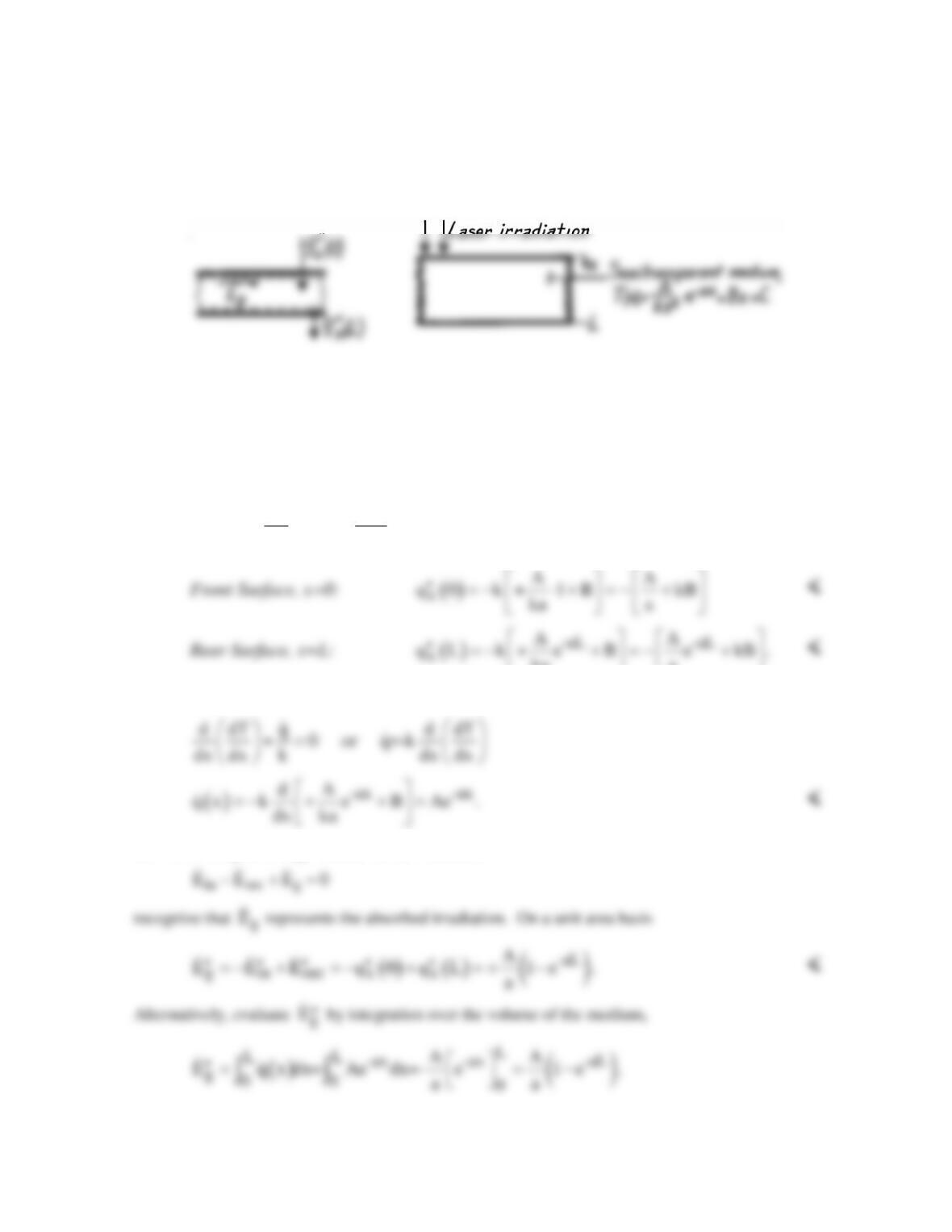
PROBLEM 2.29
KNOWN: Temperature distribution in a semi-transparent medium subjected to radiative flux.
FIND: (a) Expressions for the heat flux at the front and rear surfaces, (b) Heat generation rate
( )
qx,
(c) Expression for absorbed radiation per unit surface area in terms of A, a, B, C, L, and k.
SCHEMATIC:
ASSUMPTIONS: (1) Steady-state conditions, (2) One-dimensional conduction in medium, (3)
Constant properties, (4) All laser irradiation is absorbed and can be characterized by an internal
volumetric heat generation term
( )
qx.
ANALYSIS: (a) Knowing the temperature distribution, the surface heat fluxes are found using
Fourier’s law,
( )
-ax
x2
dT A
q k k– ae B
dx ka
′′ =− =− −+
ka a
(b) The heat diffusion equation for the medium is
(c) Performing an energy balance on the medium,
PROBLEM 2.30
KNOWN: Spherical shell under steady–state conditions with no energy generation.
FIND: Under what conditions is a linear temperature distribution possible.
SCHEMATIC:
ASSUMPTIONS: (1) Steady state, (2) One-dimensional, (3) No heat generation.
ANALYSIS: Under the stated conditions, the heat equation in spherical coordinates, Equation 2.29,
reduces to
COMMENTS: It is unlikely to encounter or even create a material for which k varies inversely with
the spherical radial coordinate r in the manner necessary to develop a linear temperature distribution.
Assuming linear temperature distributions in radial systems is nearly always both fundamentally
incorrect and physically implausible.
T(r)
PROBLEM 2.31
KNOWN: Steady–state temperature distribution in a one–dimensional wall is T(x) = Ax2 +
Bx + C, thermal conductivity, thickness.
FIND: Expressions for the heat fluxes at the two wall faces (x = 0,L) and the heat generation
rate in the wall per unit area.
ASSUMPTIONS: (1) Steady-state conditions, (2) One-dimensional heat flow, (3)
Homogeneous medium.
ANALYSIS: The appropriate form of the heat diffusion equation for these conditions is
COMMENTS: (1) From an overall energy balance on the wall, find
From integration of the volumetric heat rate, we can also find
′′
Eg
as
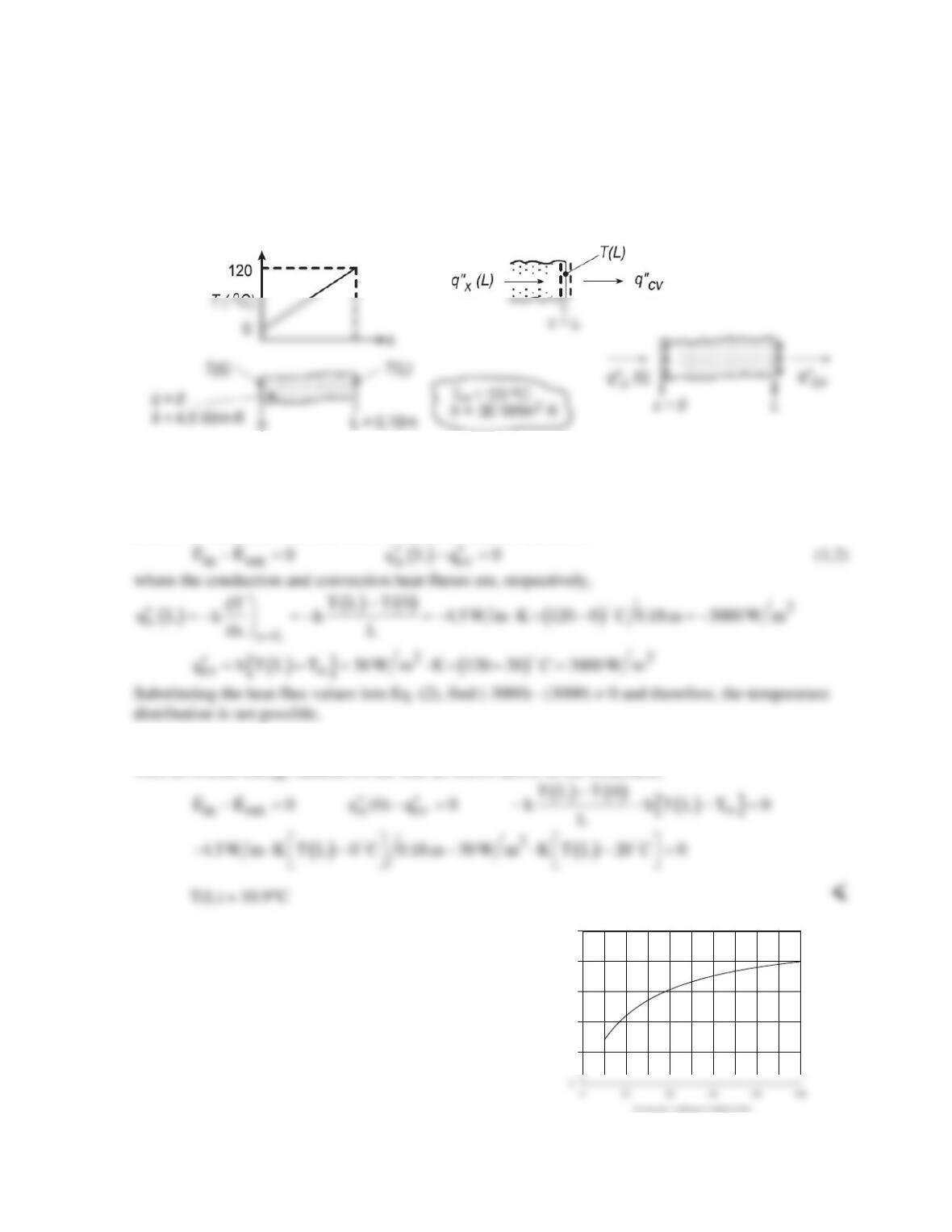
PROBLEM 2.32
KNOWN: Plane wall with no internal energy generation.
FIND: Determine whether the prescribed temperature distribution is possible; explain your
reasoning. With the temperatures T(0) = 0°C and
T
∞
= 20°C fixed, compute and plot the
temperature T(L) as a function of the convection coefficient for the range 10 ≤ h ≤ 100 W/m2⋅K.
SCHEMATIC:
ASSUMPTIONS: (1) One-dimensional conduction, (2) No internal energy generation, (3) Constant
properties, (4) No radiation exchange at the surface x = L, and (5) Steady-state conditions.
ANALYSIS: (a) Is the prescribed temperature distribution possible? If so, the energy balance at the
surface x = L as shown above in the Schematic, must be satisfied.
(b) With T(0) = 0°C and
T
∞
= 20°C, the temperature at the surface x = L, T(L), can be determined
from an overall energy balance on the wall as shown above in the schematic,
Using this same analysis, T(L) as a function of
the convection coefficient can be determined
and plotted. We don’t expect T(L) to be
linearly dependent upon h. Note that as h
increases to larger values, T(L) approaches
T
∞
. To what value will T(L) approach as h
decreases?
4
8
12
16
20
Surface temperature, T(L) (C)
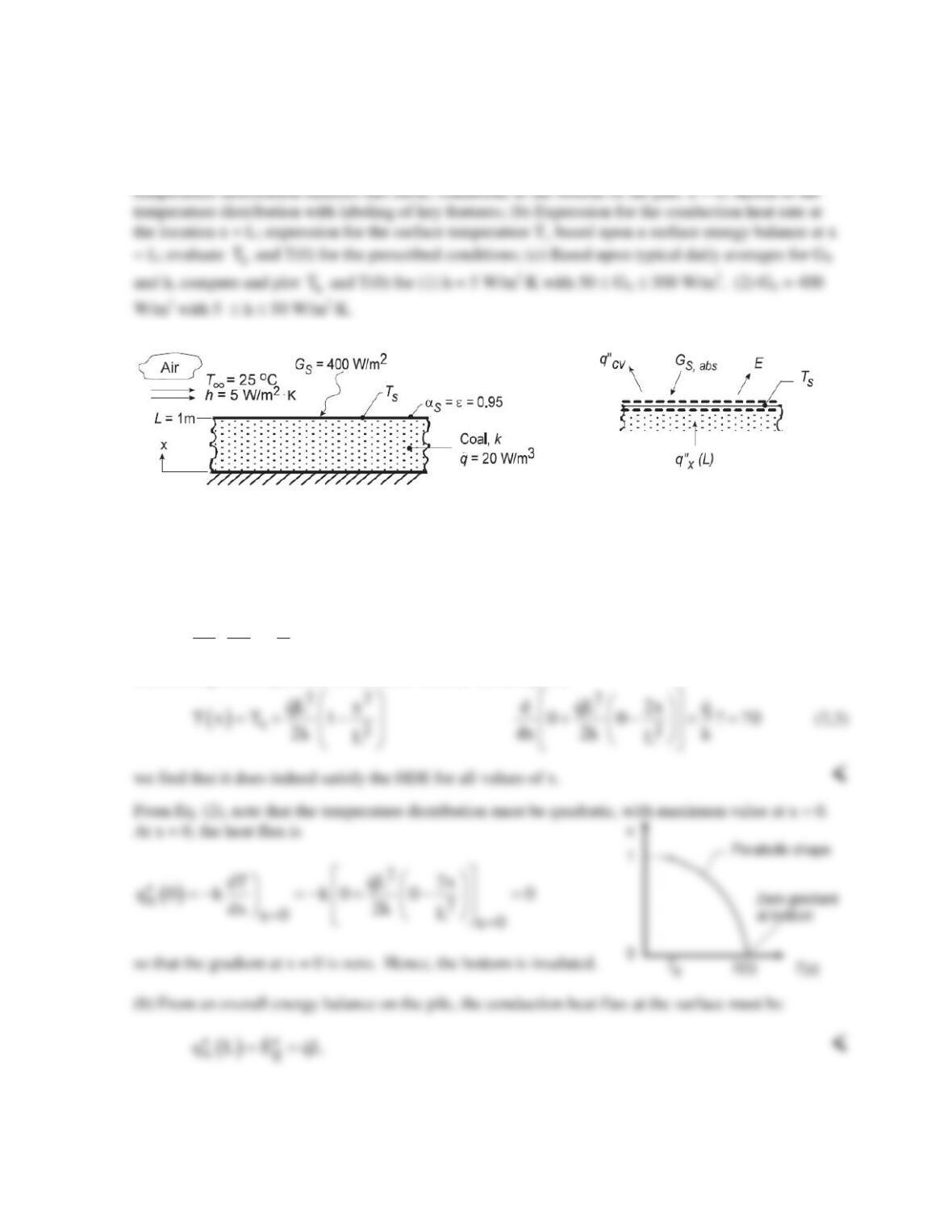
PROBLEM 2.33
KNOWN: Coal pile of prescribed depth experiencing uniform volumetric generation with
convection, absorbed irradiation and emission on its upper surface.
FIND: (a) The appropriate form of the heat diffusion equation (HDE) and whether the prescribed
SCHEMATIC:
ASSUMPTIONS: (1) One-dimensional conduction, (2) Uniform volumetric heat generation, (3)
Constant properties, (4) Negligible irradiation from the surroundings, and (5) Steady-state conditions.
PROPERTIES: Table A.3, Coal (300K): k = 0.26 W/m∙K
ANALYSIS: (a) For one-dimensional, steady-state conduction with uniform volumetric heat
generation and constant properties the heat diffusion equation (HDE) follows from Eq. 2.22,
d dT q 0
dx dx k
+=
(1) <
Substituting the temperature distribution into the HDE, Eq. (1),
Continued…
PROBLEM 2.33 (Cont.)
From a surface energy balance per unit area shown in the schematic above,
(
)
ss
s
T
= 305.6 K = 32.6°C <
From Eq. (2) with x = 0, find
Solar Irradi ation, Gs = 400 W/m^2
80
100
120
Convecti on coefficient, h = 5 W/m^2.K
80
100
120
PROBLEM 2.33 (Cont.)
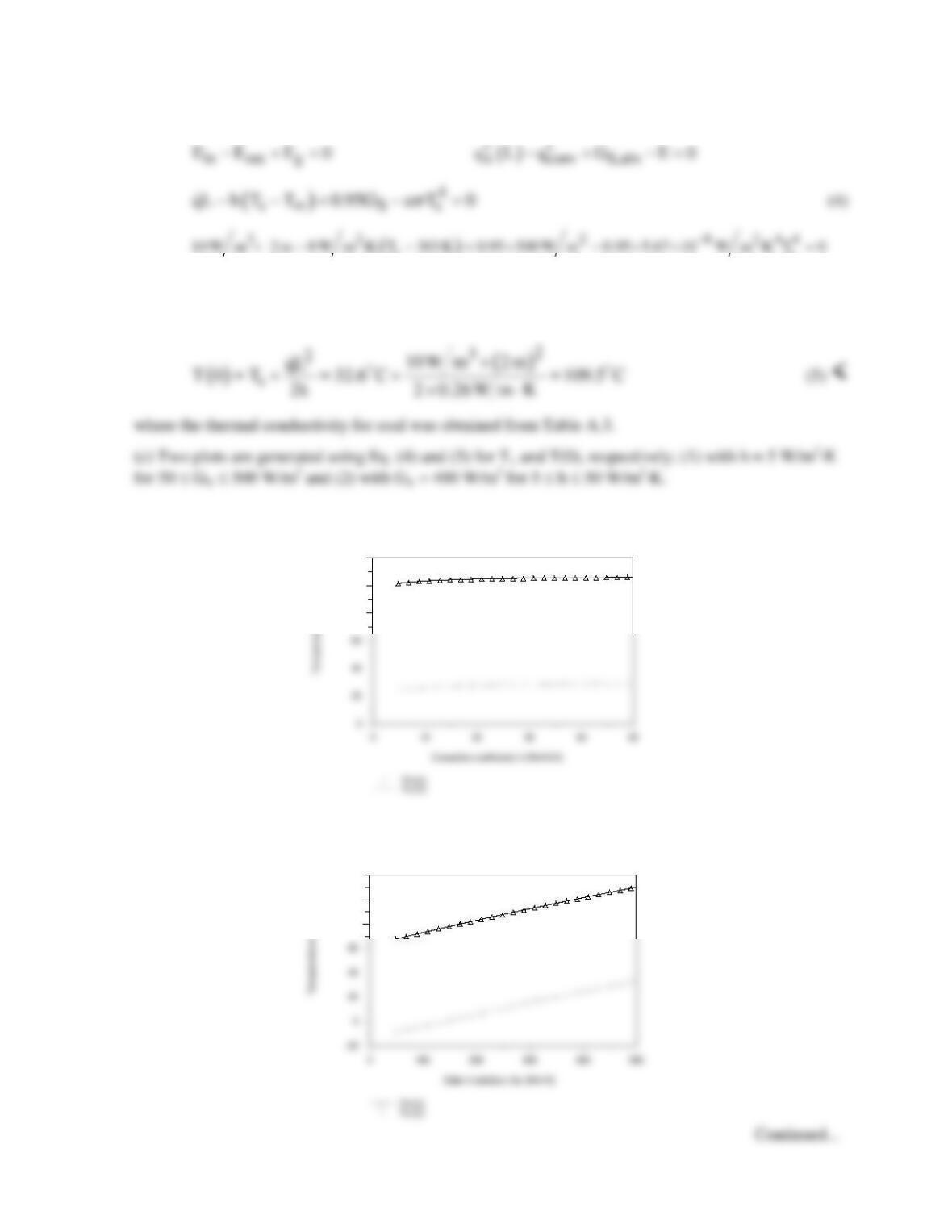
From the T vs. h plot with GS = 400 W/m2, note that the convection coefficient does not have a major
influence on the surface or bottom coal pile temperatures. From the T vs. GS plot with h = 5 W/m2⋅K,
note that the solar irradiation has a very significant effect on the temperatures. The fact that
T
s
is less
than the ambient air temperature,
T
∞
, and, in the case of very low values of GS, below freezing, is a
consequence of the large magnitude of the emissive power E.
COMMENTS: In our analysis we ignored irradiation from the sky, an environmental radiation effect
PROBLEM 2.34
KNOWN: Cylindrical system with negligible temperature variation in the r,z directions.
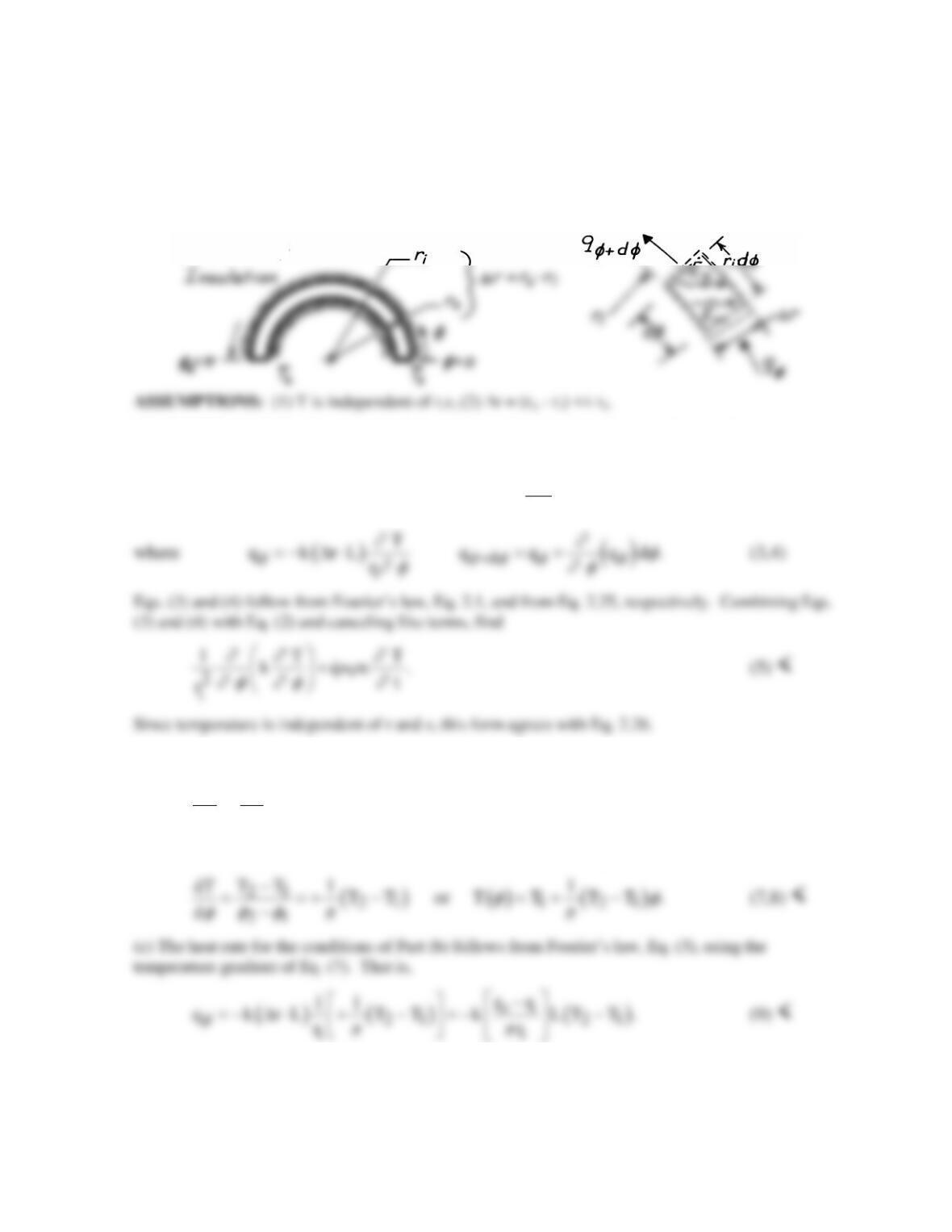
FIND: (a) Heat equation beginning with a properly defined control volume, (b) Temperature
distribution T(φ) for steady-state conditions with no internal heat generation and constant properties,
(c) Heat rate for Part (b) conditions.
SCHEMATIC:
ANALYSIS: (a) Define the control volume as V = ridφ⋅∆r⋅L where L is length normal to page.
Apply the conservation of energy requirement, Eq. 1.12c,
E E E E q q qV = Vc T
t
in out g st +d
− + = − +
φ φ φ
r∂
∂
(1,2)
(b) For steady–state conditions with
q = 0,
the heat equation, (5), becomes
d dT
k 0.
dd
φφ
=
(6)
With constant properties, it follows that dT/dφ is constant which implies T(φ) is linear in φ. That is,
COMMENTS: Note the expression for the temperature gradient in Fourier’s law, Eq. (3), is
∂T/ri∂φ not ∂T/∂φ. For the conditions of Parts (b) and (c), note that qφ is independent of φ;
this is first indicated by Eq. (6) and confirmed by Eq. (9).
PROBLEM 2.35
KNOWN: Heat diffusion with internal heat generation for one–dimensional cylindrical,
radial coordinate system.
FIND: Heat diffusion equation.
SCHEMATIC:
ASSUMPTIONS: (1) Homogeneous medium.
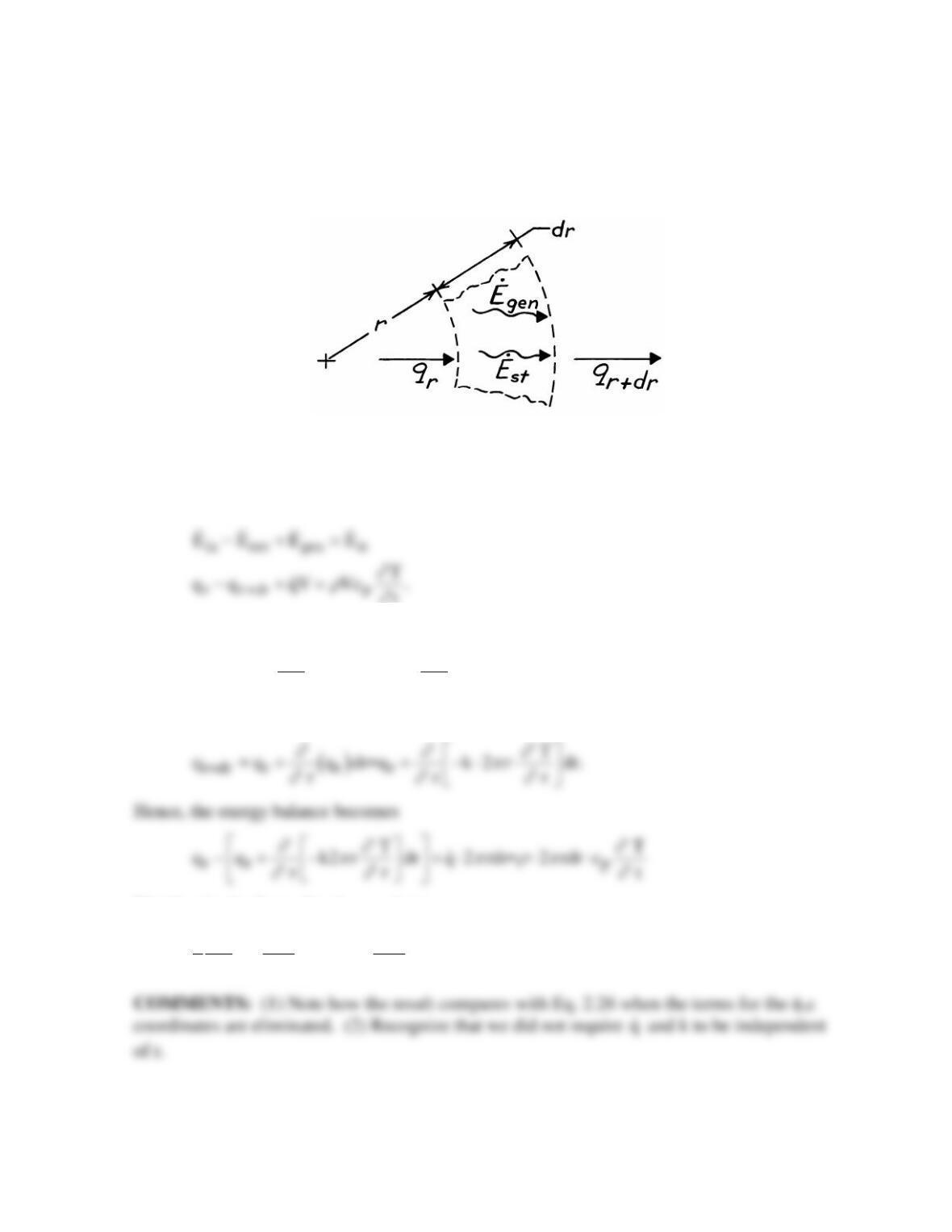
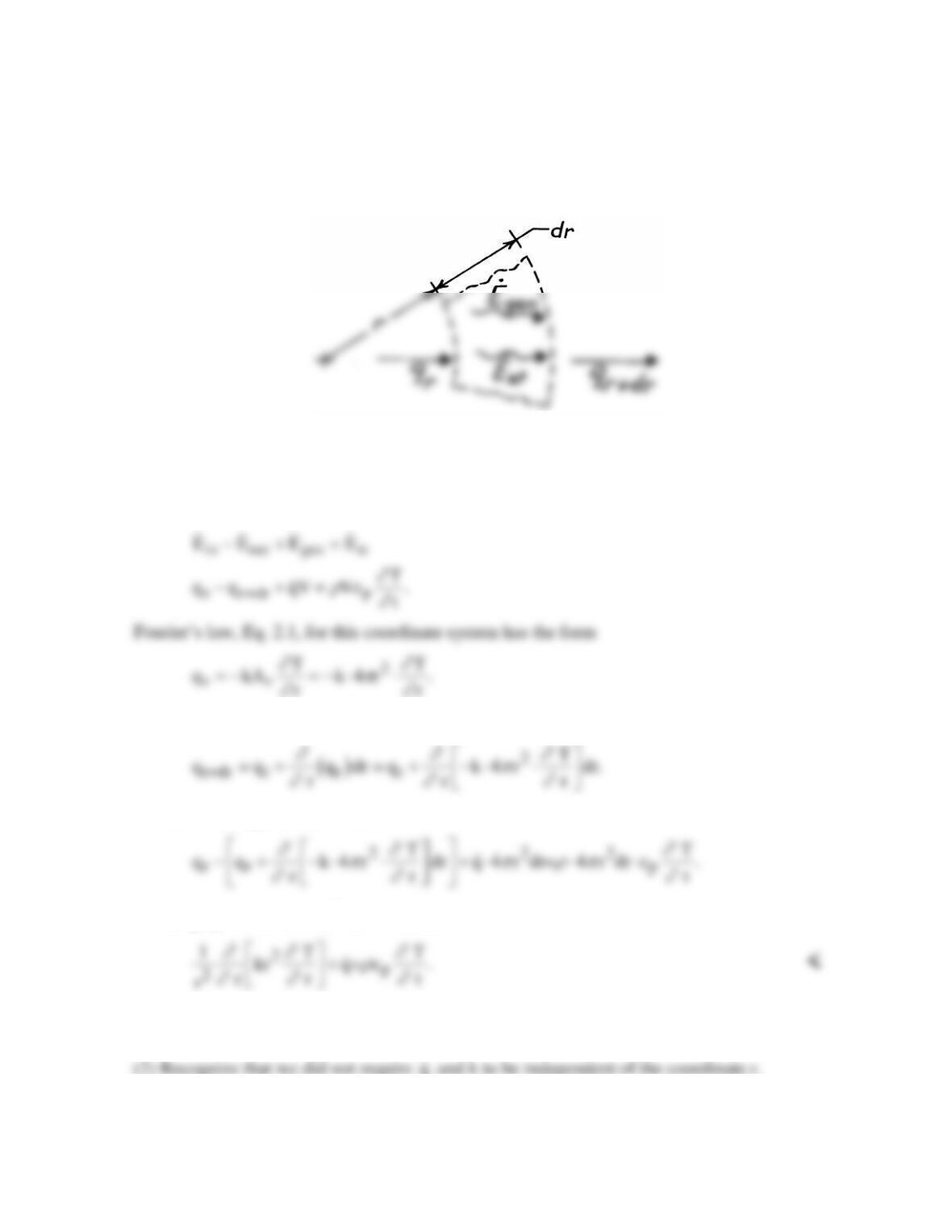
ANALYSIS: Control volume has volume,
V = A dr = 2 r dr 1,
r
⋅ ⋅ ⋅
π
with unit thickness
normal to page. Using the conservation of energy requirement, Eq. 1.12c,
t
∂
Fourier’s law, Eq. 2.1, for this one-dimensional coordinate system is
q kA T
r k 2 r 1 T
r
r r
= − = − × ⋅ ×
∂
∂π∂
∂
.
At the outer surface, r + dr, the conduction rate is
Dividing by the factor 2πr dr, we obtain
p
1 T T
kr q= c .
r r r t
∂∂ ∂
r
∂∂ ∂
+
<
PROBLEM 2.36
KNOWN: Heat diffusion with internal heat generation for one-dimensional spherical, radial
coordinate system.
FIND: Heat diffusion equation.
SCHEMATIC:
ASSUMPTIONS: (1) Homogeneous medium.
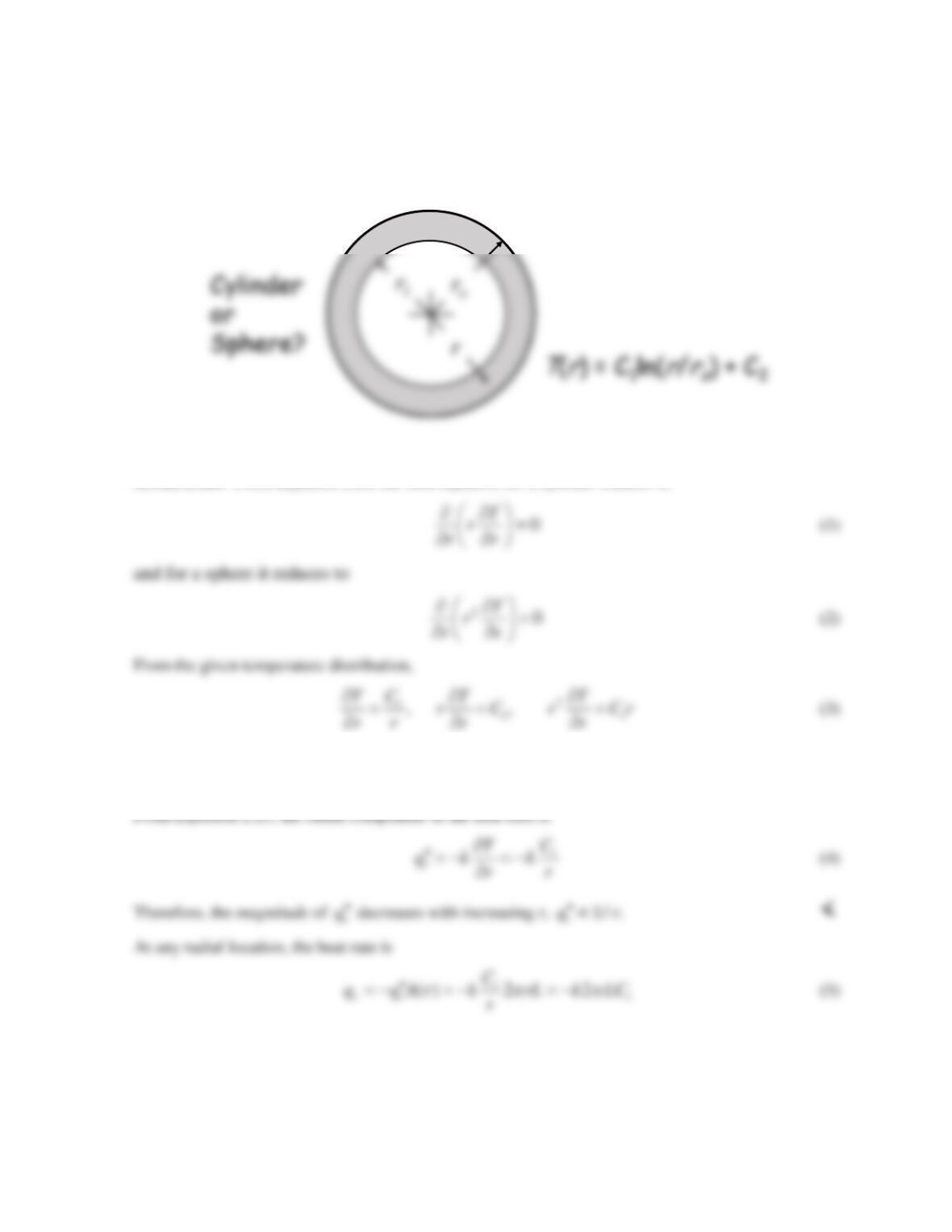
ANALYSIS: Control volume has the volume, V = Ar ⋅ dr = 4πr2dr. Using the conservation
of energy requirement, Eq. 1.12c,
At the outer surface, r + dr, the conduction rate is
Hence, the energy balance becomes
Dividing by the factor
42
π
rdr,
we obtain
COMMENTS: (1) Note how the result compares with Eq. 2.29 when the terms for the θ,φ
directions are eliminated.
q
PROBLEM 2.37
KNOWN: Steady–state temperature distribution in a radial wall.
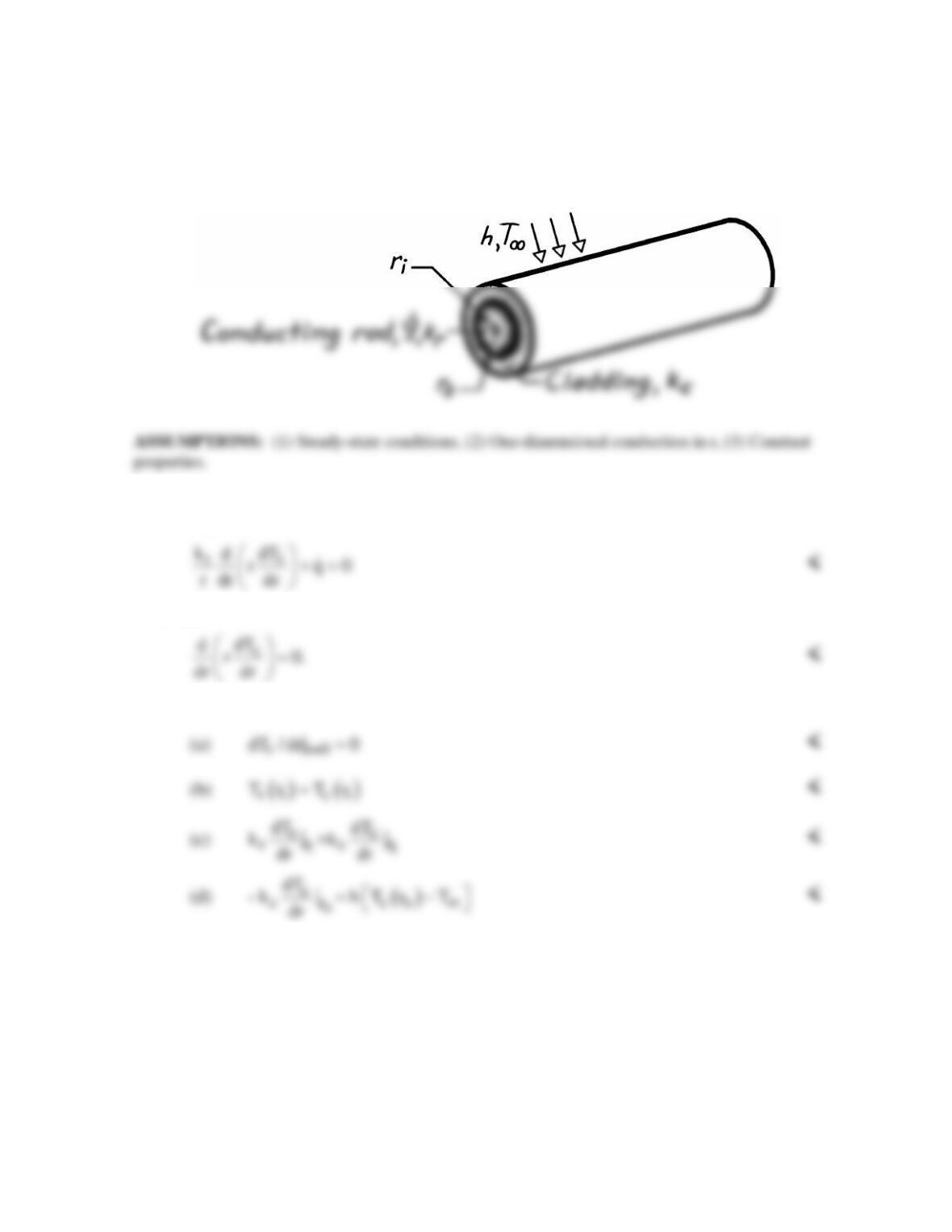
FIND: Whether the wall is that of a cylinder or sphere. Manner in which heat flux and heat rate vary
with radius.
SCHEMATIC:
ASSUMPTIONS: (1) One-dimensional conduction in r, (2) Constant properties.
ANALYSIS: From Equation 2.26, the heat equation for a cylinder reduces to
Substituting terms into Eqs. (1) and (2), it can be seen that Eq. (1) is satisfied and Eq. (2) is not.
Hence, the wall is cylindrical. <
Hence,
r
q
is independent of r. <
COMMENTS: The result that
r
q
is invariant with r is consistent with the energy conservation
requirement. If
r
q
is constant, the heat flux must vary inversely with the area perpendicular to the
direction of heat flow. Thus,
r
q′′
varies inversely with r as seen.
PROBLEM 2.38
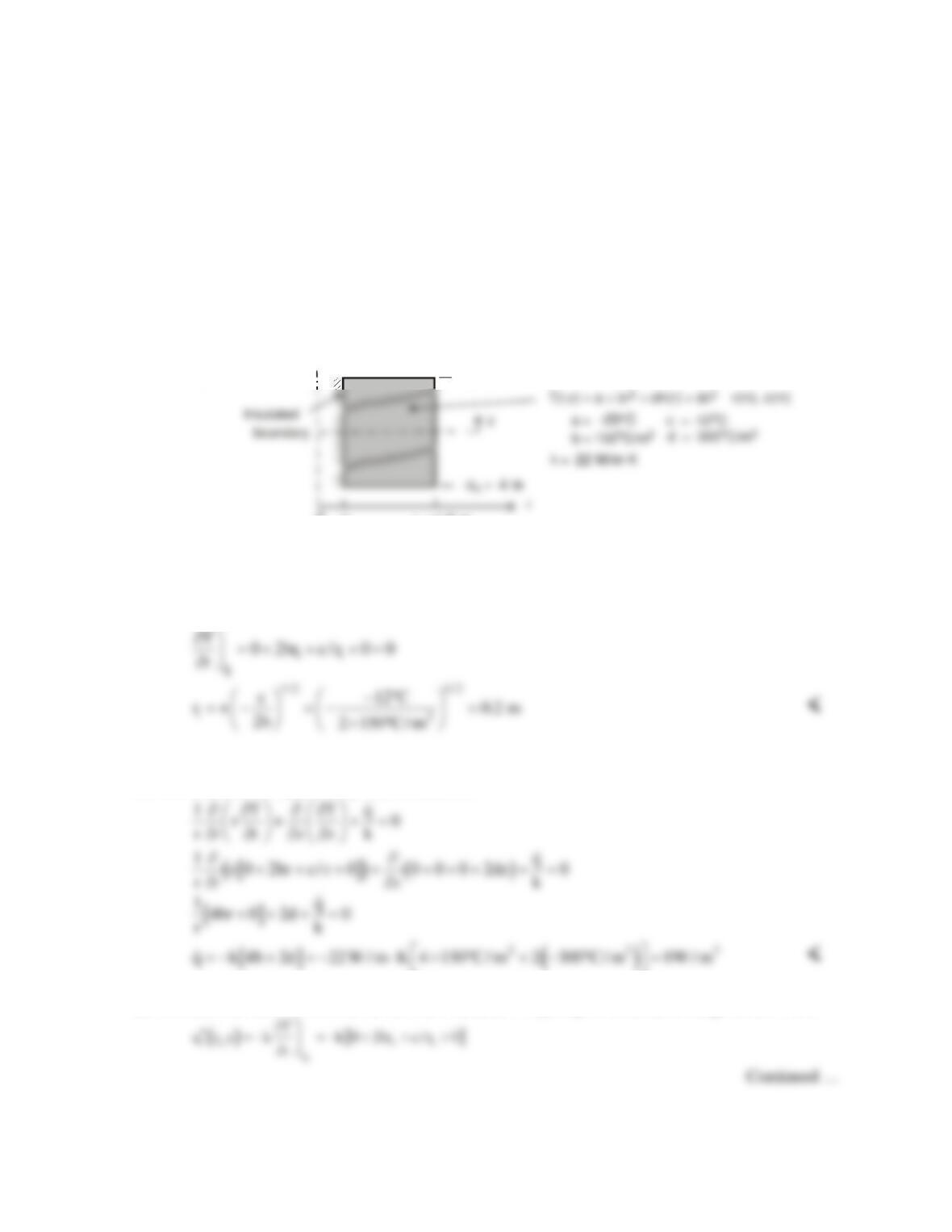
KNOWN: Radii and thermal conductivity of conducting rod and cladding material. Volumetric rate
of thermal energy generation in the rod. Convection conditions at outer surface.
FIND: Heat equations and boundary conditions for rod and cladding.
SCHEMATIC:
ANALYSIS: From Equation 2.26, the appropriate forms of the heat equation are
Conducting Rod:
Cladding:
Appropriate boundary conditions are:
COMMENTS: Condition (a) corresponds to symmetry at the centerline, while the interface
conditions at r = ri (b,c) correspond to requirements of thermal equilibrium and conservation of
energy. Condition (d) results from conservation of energy at the outer surface. Note that contact
resistance at the interface between the rod and cladding has been neglected.
PROBLEM 2.39
KNOWN: Steady–state temperature distribution for hollow cylindrical solid with volumetric heat
generation.
FIND: (a) Determine the inner radius of the cylinder, ri, (b) Obtain an expression for the volumetric
rate of heat generation,
q,
(c) Determine the axial distribution of the heat flux at the outer surface,
( )
ro
qr ,
,z
′′
and the heat rate at this outer surface; is the heat rate in or out of the cylinder; (d)
Determine the radial distribution of the heat flux at the end faces of the cylinder,
( )
zo
q r, z
′′ +
and
( )
zo
q r, z
′′ −
, and the corresponding heat rates; are the heat rates in or out of the cylinder; (e)
Determine the relationship of the surface heat rates to the heat generation rate; is an overall energy
balance satisfied?
SCHEMATIC:
ASSUMPTIONS: (1) Steady–state conditions, (2) Two-dimensional conduction with constant
properties and volumetric heat generation.
ANALYSIS: (a) Since the inner boundary, r = ri, is adiabatic, then
( )
ri
q r z 0.
,
′′ =
Hence the
temperature gradient in the r–direction must be zero.
(b) To determine
q,
substitute the temperature distribution into the heat diffusion equation, Eq. 2.26,
for two–dimensional (r,z), steady-state conduction
(c) The heat flux and the heat rate at the outer surface, r = ro, may be calculated using Fourier’s law.
+z = 2.5 m
o
r
i
0 r = 1 m
o
4 m
ro=1.5 m
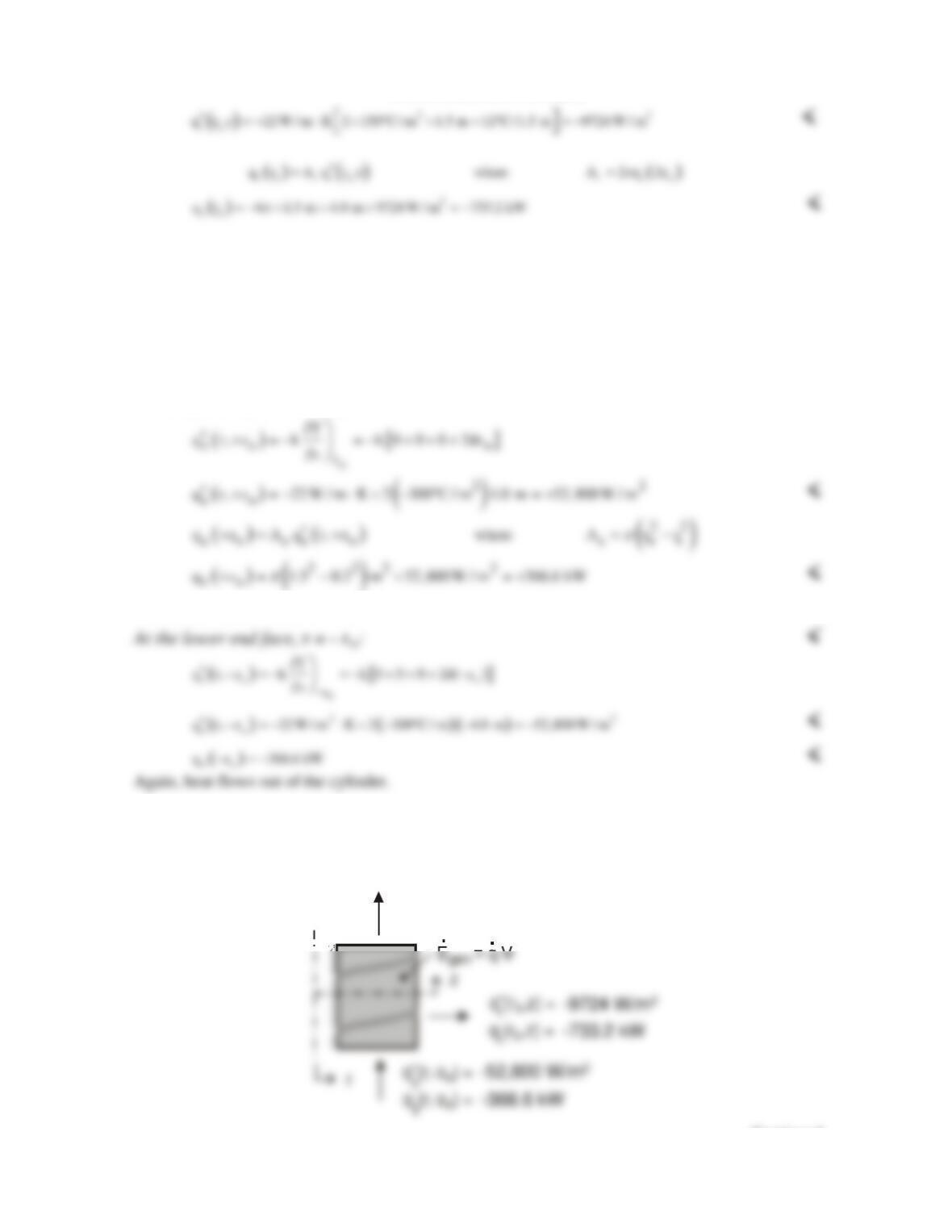
PROBLEM 2.39 (Cont.)
Note that the sign of the heat flux and heat rate in the positive r-direction is negative, and hence the
heat flow is into the cylinder.
(d) The heat fluxes and the heat rates at end faces, z = + zo and – zo, may be calculated using
Fourier’s law. The direction of the heat rate in or out of the end face is determined by the sign of the
heat flux in the positive z-direction.
At the upper end face, z = + zo: <
Thus, heat flows out of the cylinder.
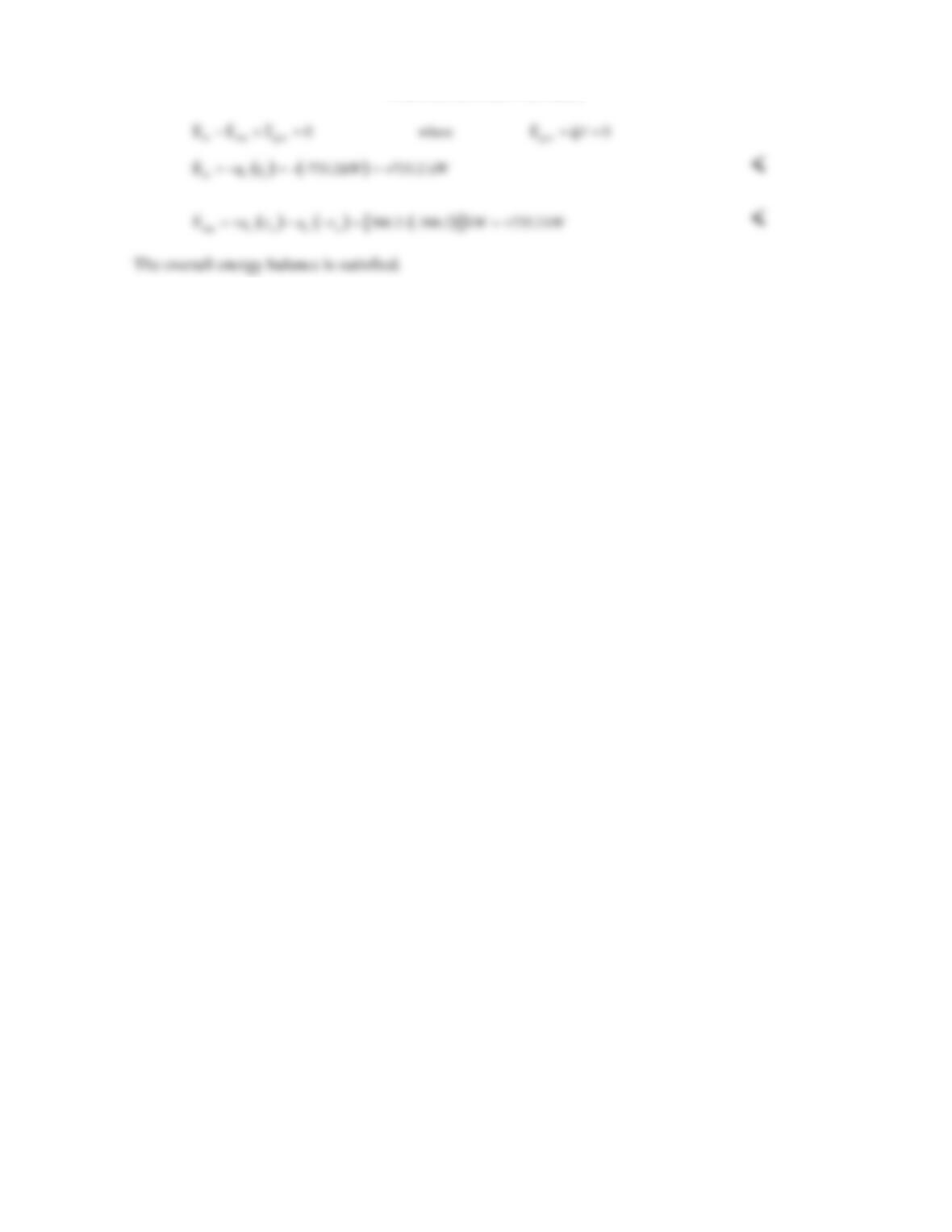
(e) The heat rates from the surfaces and the volumetric heat generation can be related through an
overall energy balance on the cylinder as shown in the sketch.
Continued…
z
z
q”(r,+z ) = +24,000 W/m
o2
q (r,+z ) = +72,382 W
o
+52,800 W/m
2
+366.6 kW
PROBLEM 2.39 (Cont.)
COMMENTS: When using Fourier’s law, the heat flux
z
q′′
denotes the heat flux in the positive z-
direction. At a boundary, the sign of the numerical value will determine whether heat is flowing into
or out of the boundary.
PROBLEM 2.40
KNOWN: Temperature distribution in a spherical shell.
FIND: Whether conditions are steady–state or transient. Manner in which heat flux and heat rate
vary with radius.
SCHEMATIC:
ASSUMPTIONS: (1) One-dimensional conduction in r, (2) Constant properties.
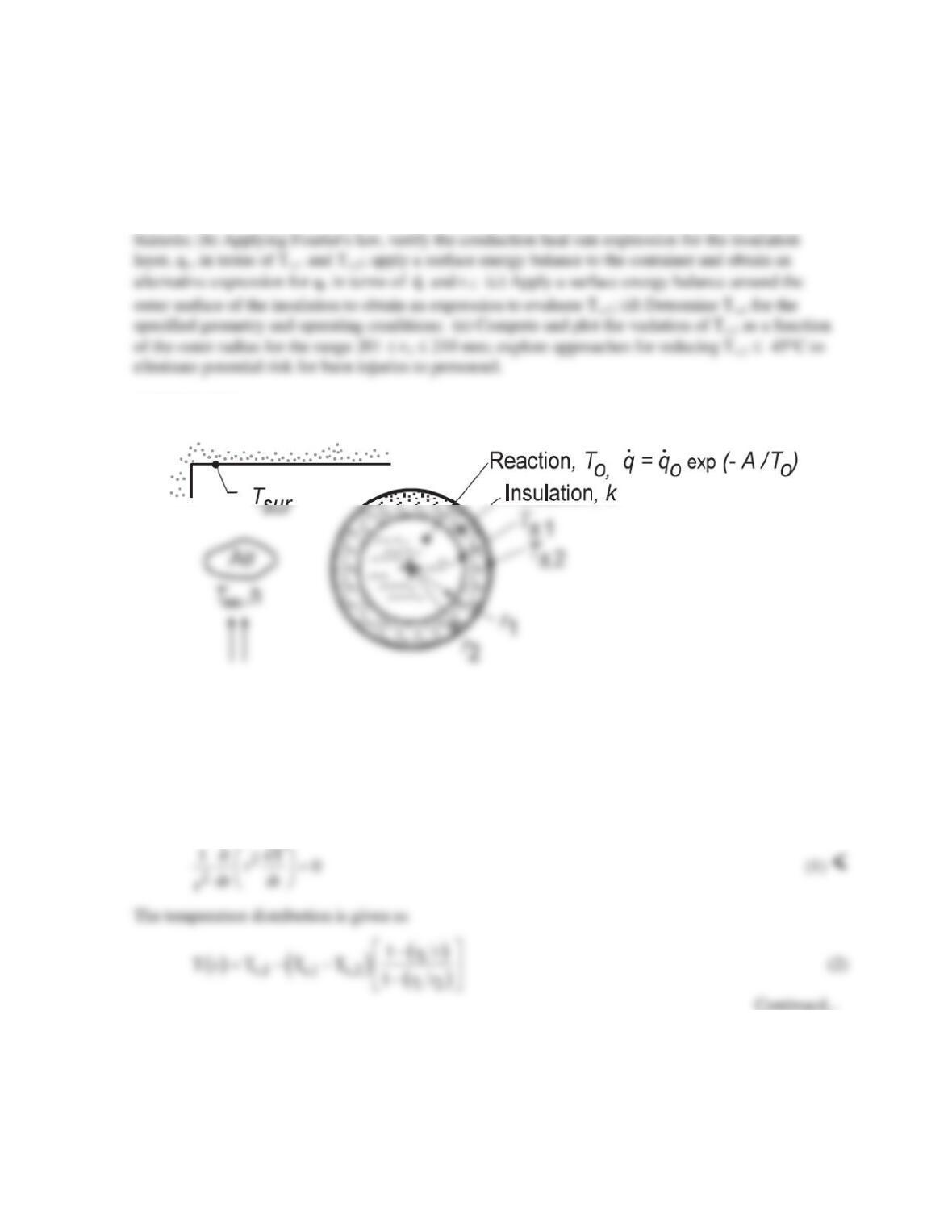
ANALYSIS: From Equation 2.29, the heat equation reduces to
r
Substituting for T(r),
Hence, steady–state conditions exist. <
From Equation 2.28, the radial component of the heat flux is
Hence,
′′
qr
decreases with increasing
()
22
r
r q 1/r .
′′ ∝
<
At any radial location, the heat rate is
Hence, qr is independent of r. <
COMMENTS: The fact that qr is independent of r is consistent with the energy conservation
requirement. If qr is constant, the flux must vary inversely with the area perpendicular to the
direction of heat flow. Hence,
′′
qr
varies inversely with r2.
PROBLEM 2.41
KNOWN: Spherical container with an exothermic reaction enclosed by an insulating material whose
outer surface experiences convection with adjoining air and radiation exchange with large
surroundings.
FIND: (a) Verify that the prescribed temperature distribution for the insulation satisfies the
appropriate form of the heat diffusion equation; sketch the temperature distribution and label key
SCHEMATIC:
ASSUMPTIONS: (1) One-dimensional, radial spherical conduction, (2) Isothermal reaction in
container so that To = Ts,1, (2) Negligible thermal contact resistance between the container and
insulation, (3) Constant properties in the insulation, (4) Surroundings large compared to the insulated
vessel, and (5) Steady-state conditions.
ANALYSIS: The appropriate form of the heat diffusion equation (HDE) for the insulation follows
from Eq. 2.29,