Problem 2.2
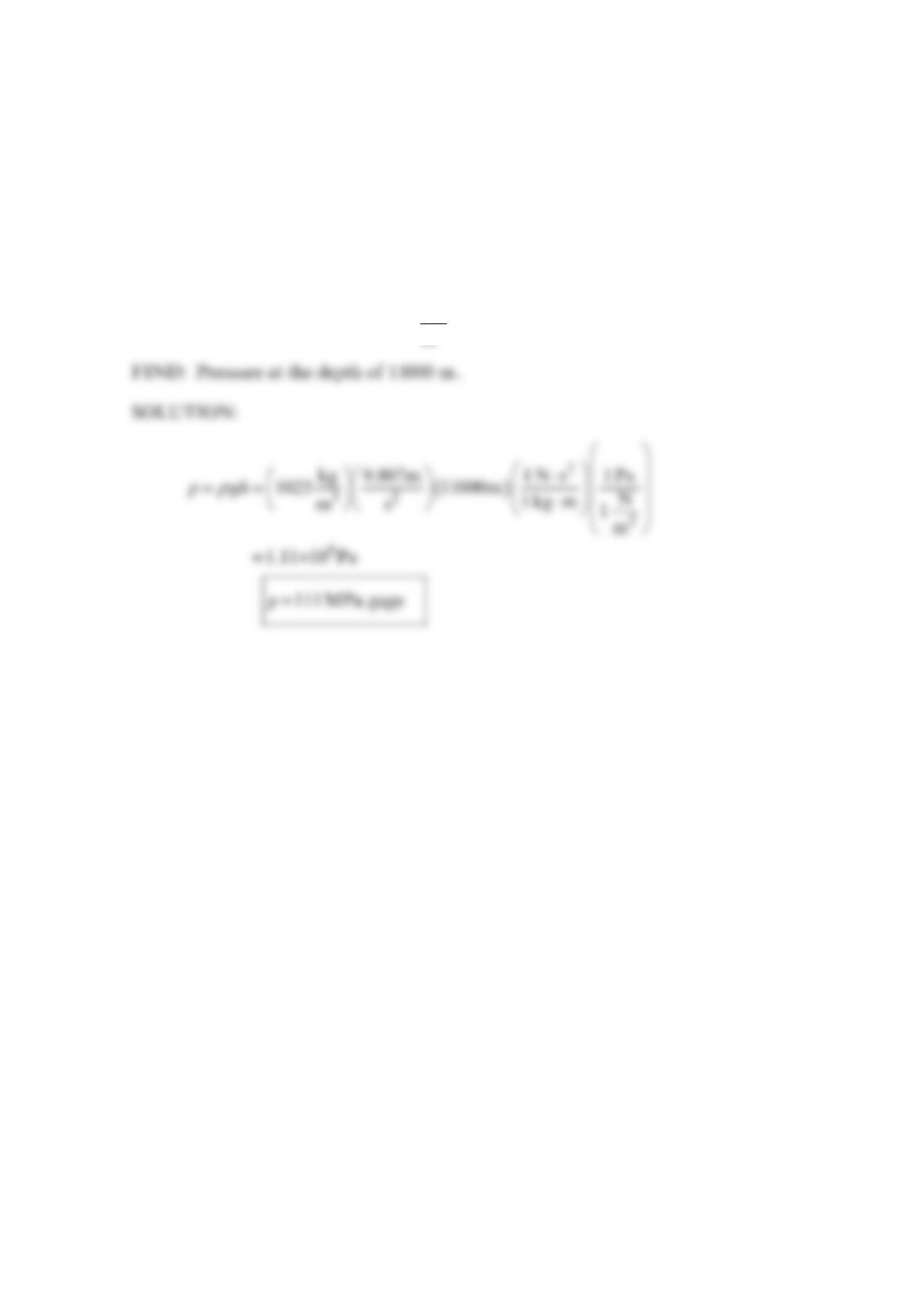
The deepest known spot in the oceans is the Challenger Deep in the Mariana Trench of the
Pacific Ocean and is approximately 11,000 m below the surface. Assume that the salt-water
density is constant at 3
1025kg/m and determine the pressure at this depth.
Solution 2.2
GIVEN: Density of the fluid is 3
kg
1
025 m, and the depth of the Challenger Deep is 11000 m .

Problem 2.3
A closed tank is partially filled with glycerin. If the air pressure in the tank is 2
6lb/in. and
the depth of glycerin is 10 ft , what is the pressure in 2
lb / ft at the bottom of the tank?
Solution 2.3

Problem 2.4
A 3-m- diameter vertical cylindrical tank is filled with water to a depth of 11m . The rest of
the tank is filled with air at atmospheric pressure. What is the absolute pressure at the
bottom of the tank?
Solution 2.4
Known: water filled tank, =dia. 3 m , =depth 11m
Problem 2.5
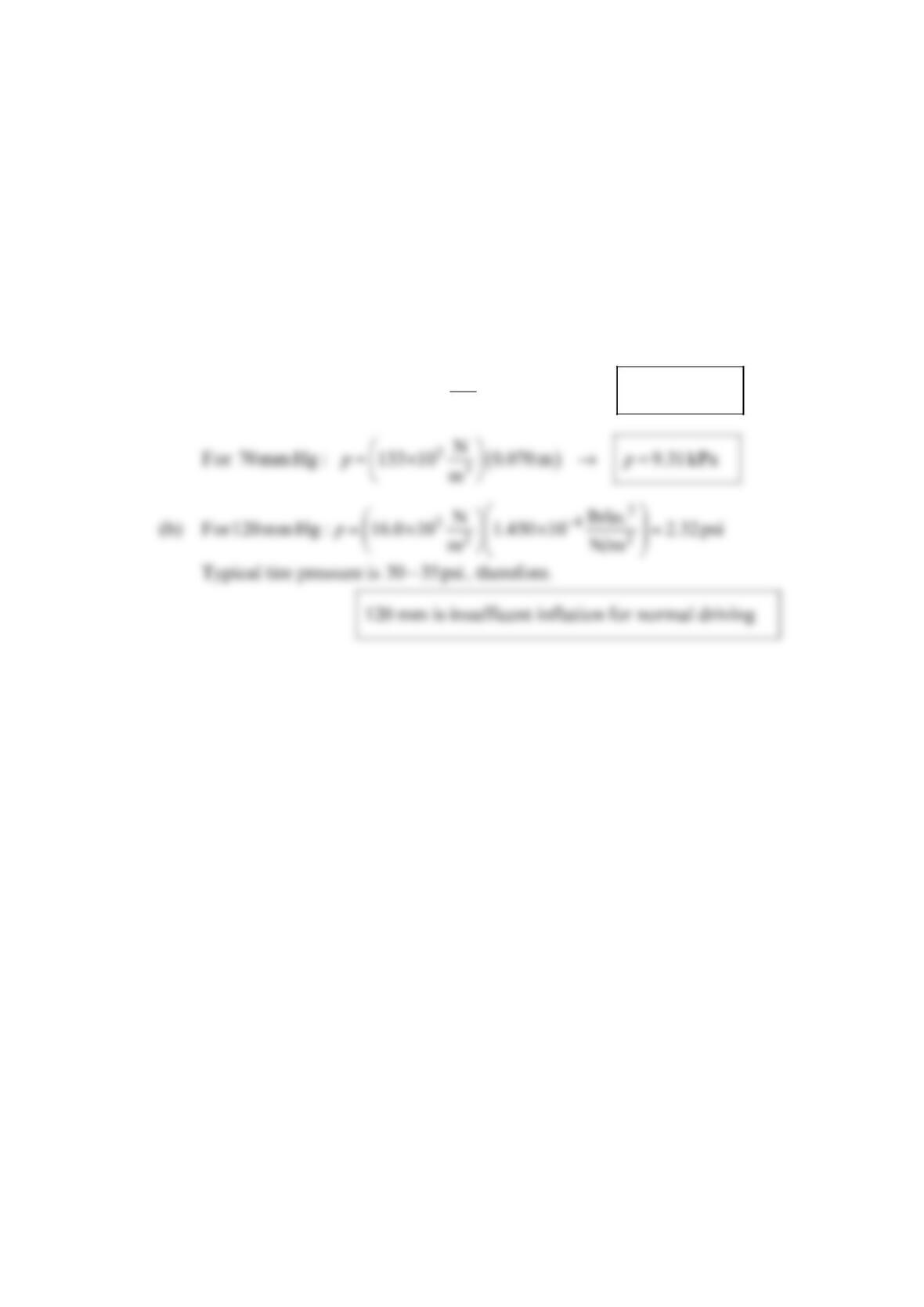
Blood pressure is usually given as a ratio of the maximum pressure (systolic pressure) to the
minimum pressure (diastolic pressure). Such pressures are commonly measured with a
mercury manometer. A typical value for this ratio for a human would be 120/70, where the
pressures are in mm Hg. (a) What would these pressures be in pascals? (b) If your car tire
was inflated to 120 mm Hg, would it be sufficient for normal driving?
Solution 2.5
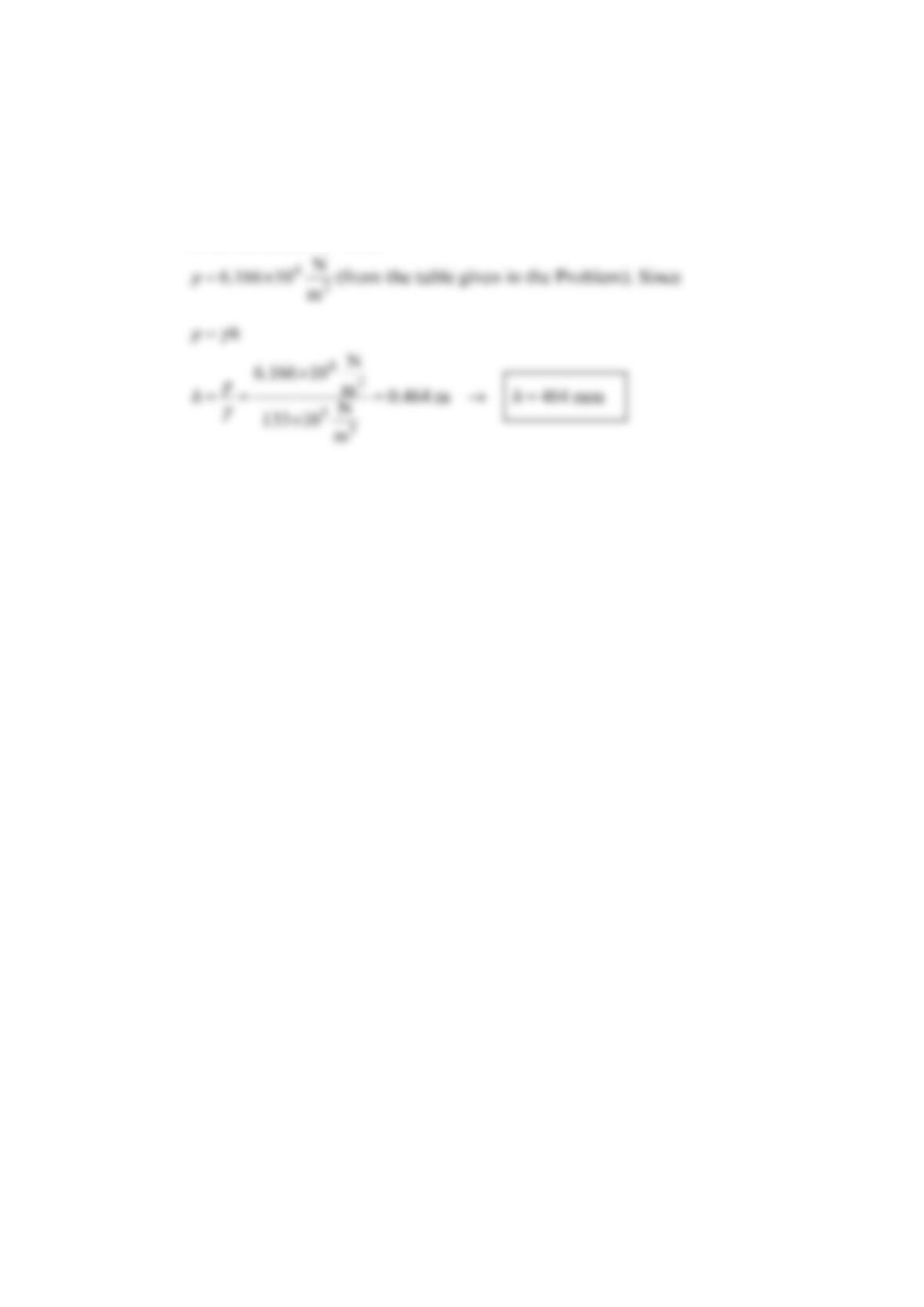
γ
=
p
h
(a) For
120 mm Hg :
()
3
3
N
133 10 0.120 m 16.0 kPa
m
p
p
=× →=
Problem 2.6
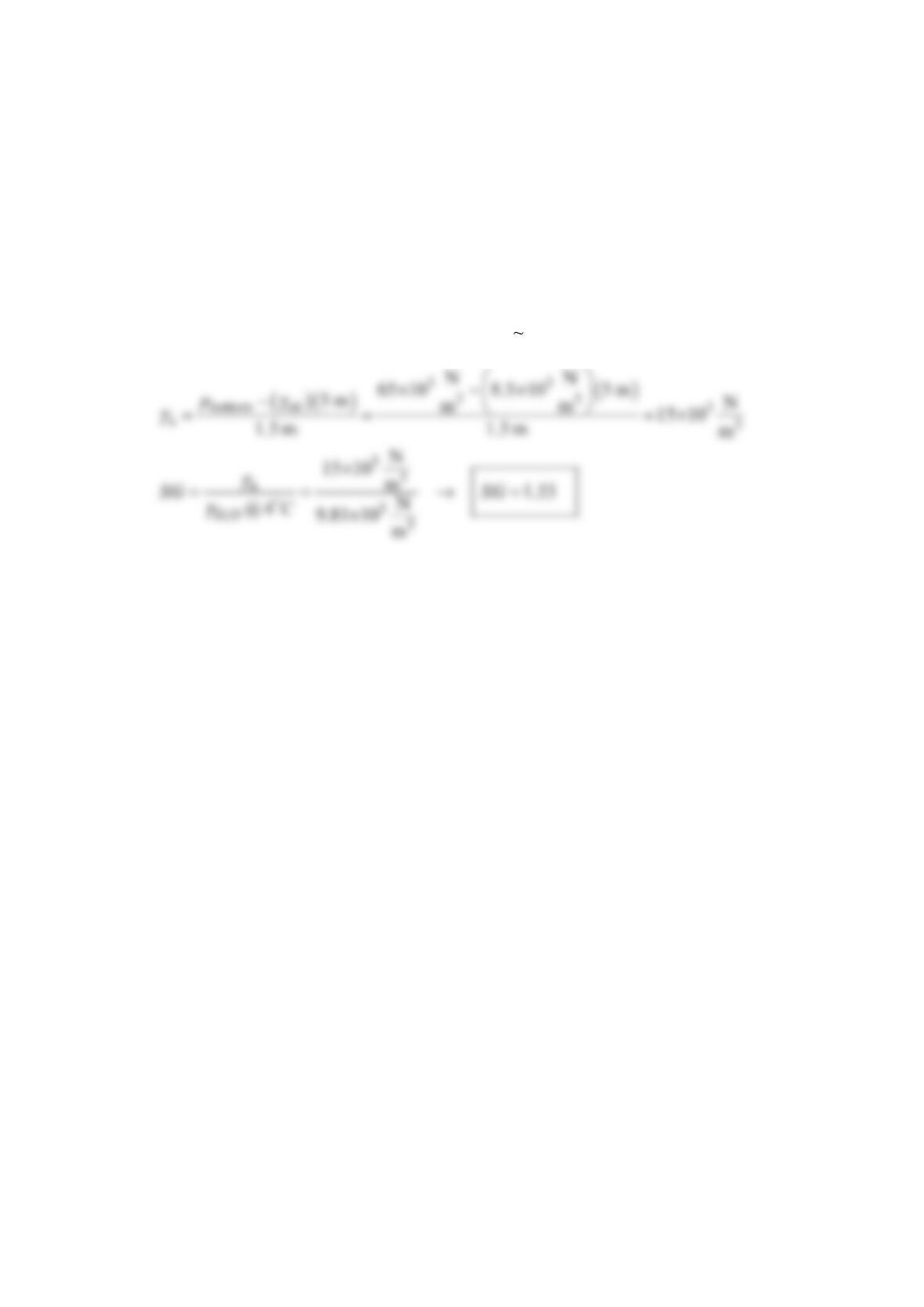
An unknown immiscible liquid seeps into the bottom of an open oil tank. Some
measurements indicate that the depth of the unknown liquid is 1. 5 m and the depth of the
oil
()
3
specific weight 8.5 kN / m= floating on top is5.0 m . A pressure gage connected to
the bottom of the tank reads 65 kPa . What is the specific gravity of the unknown liquid?
Solution 2.6
()
()
()
()
γγ
=+
bottom oil u
5m 1.5mp where u
γ
unknown liquid
γ
Problem 2.7
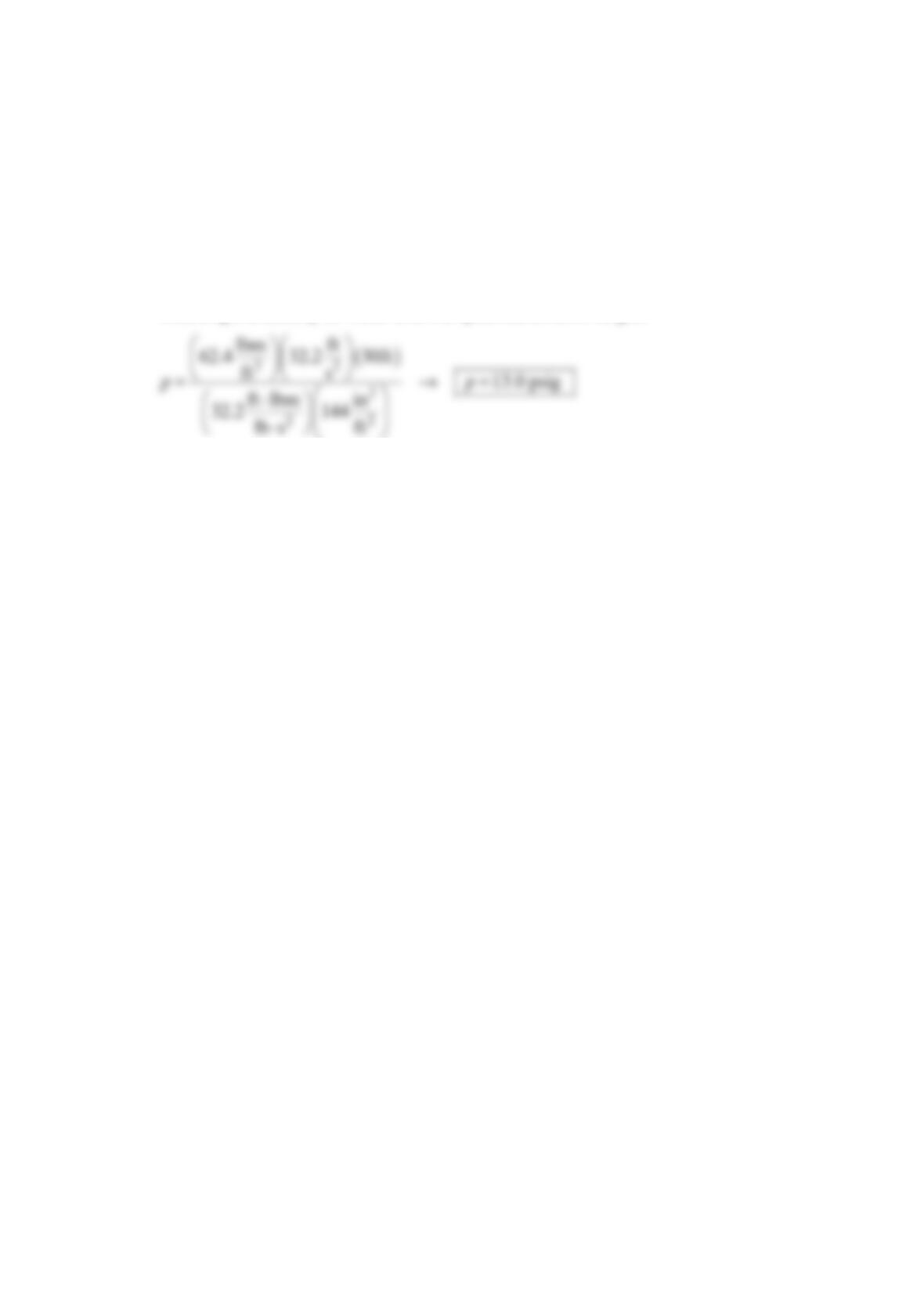
A 30-ft- high downspout of a house is clogged at the bottom. Find the pressure at the
bottom if the downspout is filled with °60 F rainwater.
Solution 2.7
ρ
=
Inserting the density of water and the specified column height:
p
gh
p
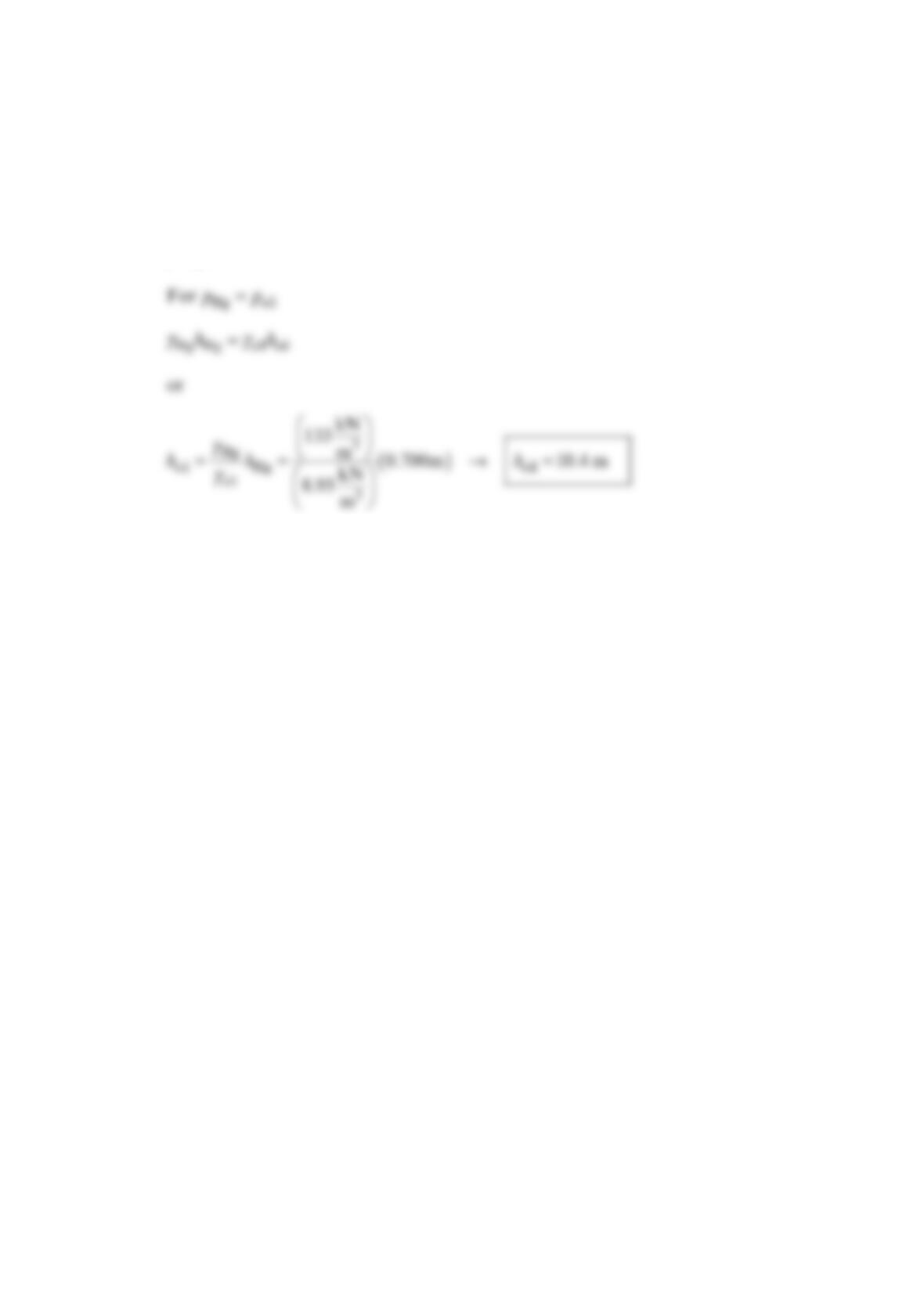
Problem 2.8
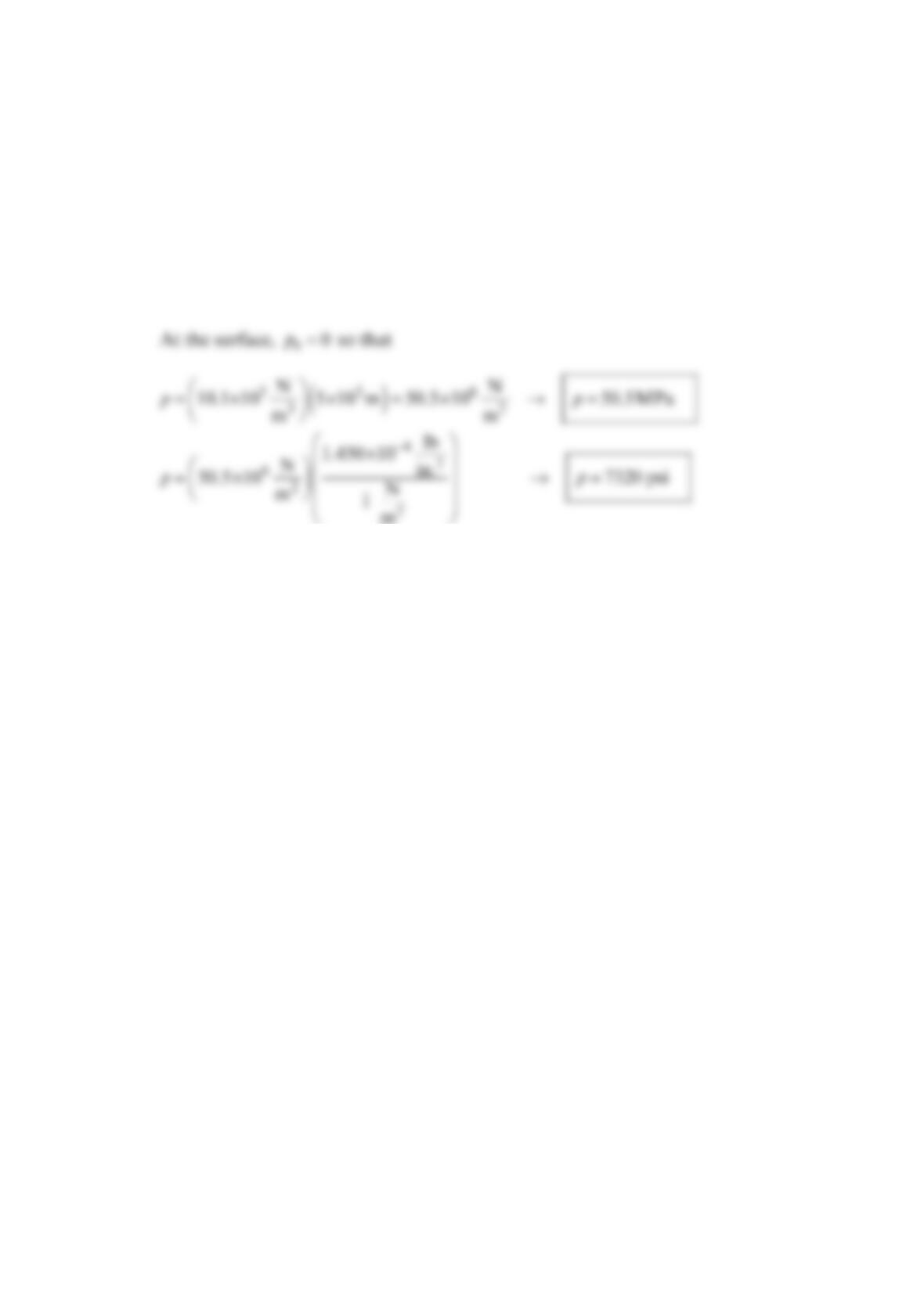
How high a column of SAE 30 oil would be required to give the same pressure as
700 mm Hg?
Solution 2.8
p
h
γ
=
Problem 2.9
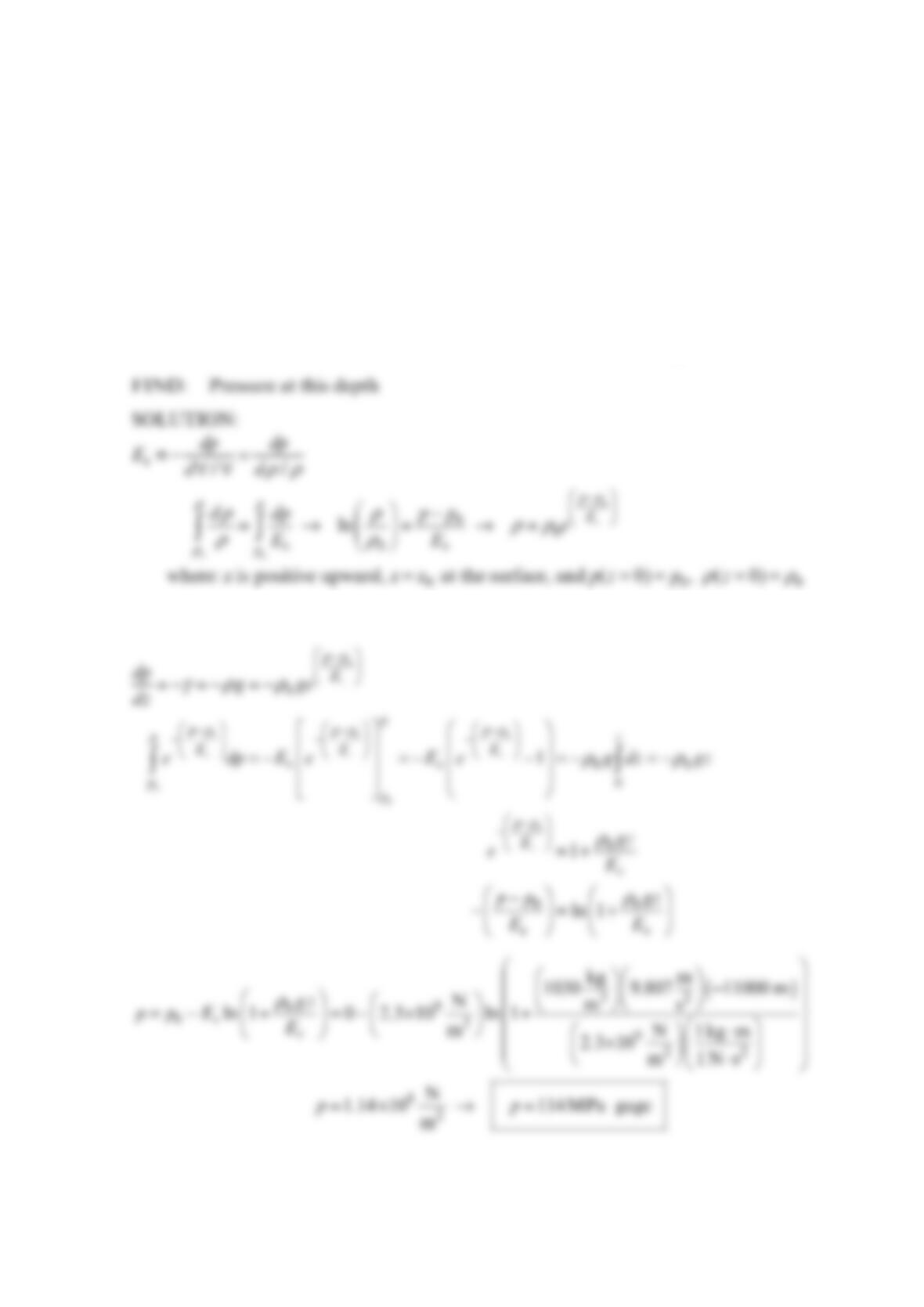
Bathyscaphes are capable of submerging to great depths in the ocean. What is the pressure
at a depth of 5 km, assuming that seawater has a constant specific weight of 3
10.1 kN / m ?
Express your answer in pascals and psi.
Solution 2.9
0
p
hp
γ
=+
Problem 2.10
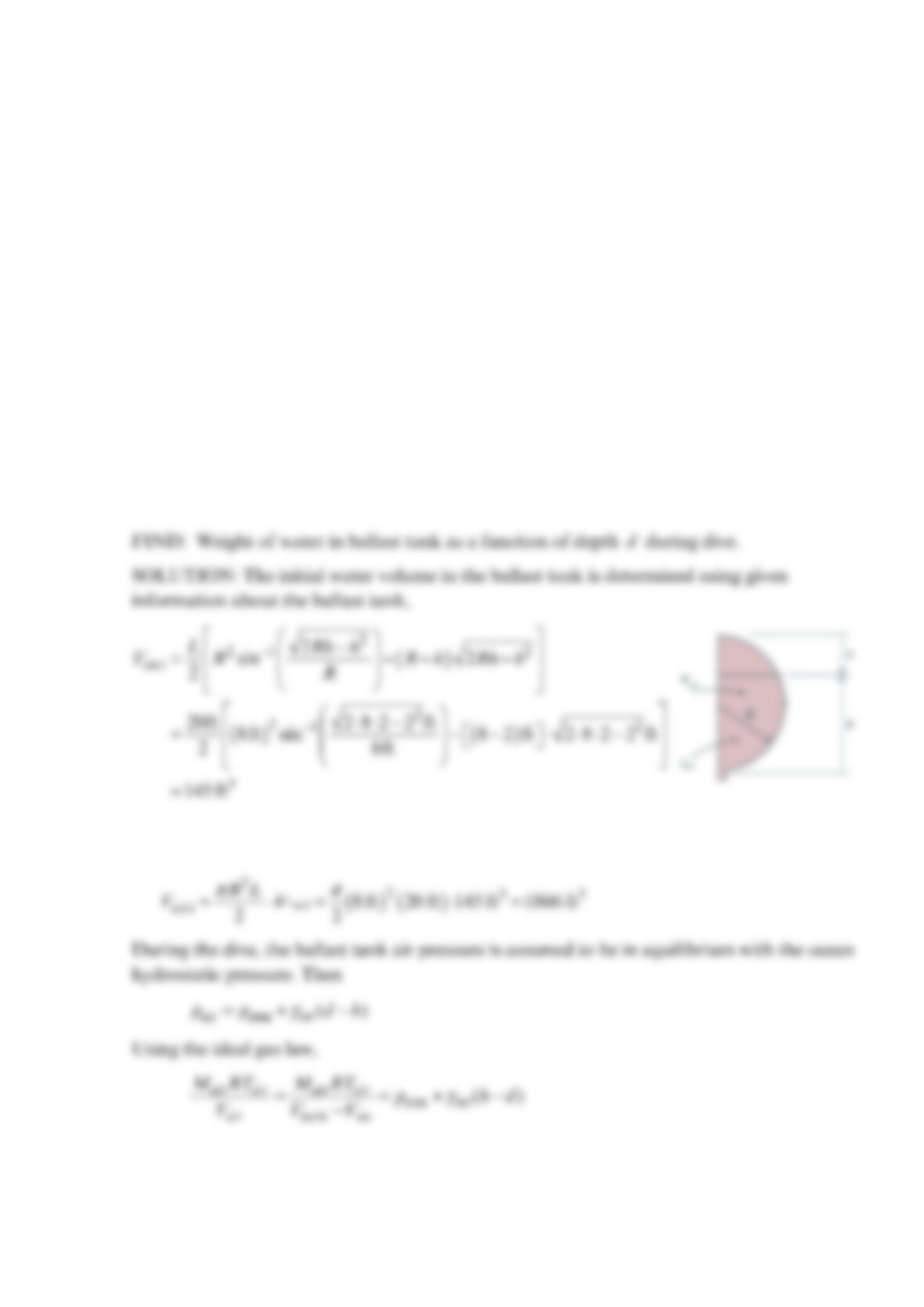
The deepest known spot in the oceans is the Challenger Deep in the Mariana Trench of the
Pacific Ocean and is approximately 11,000 m below the surface. For a surface density
of 3
1030 kg/m , a constant water temperature, and an isothermal bulk modulus of elasticity
of 92
2
.3 10 N/m×, find the pressure at this depth.
Solution 2.10
GIVEN: Ocean depth of 11,000 m, surface density of 3
1
030 kg/m , constant water
temperature, and isothermal bulk modulus of elasticity =92
,2.3 × 10 N/m
VT
E.
Substitution into the hydrostatic pressure equation yields:
Problem 2.11
A submarine submerges by admitting seawater SG = 1.03 into its ballast tanks. The amount
of water admitted is controlled by air pressure, because seawater will cease to flow into the
tank when the internal pressure (at the hull penetration) is equal to the hydrostatic pressure
at the depth of the submarine. Consider a ballast tank, which can be modeled as a vertical
half-cylinder ( 8 ft
R
=,20ftL=) for which the air pressure control valve has failed shut. The
failure occurred at the beginning of a dive from 60 ft to1000 ft . The tank was initially filled
with seawater to a depth of 2 ft and the air was at a temperature of °40 F . As the weight of
water in the tank is important in maintaining the boat’s attitude, determine the weight of
water in the tank as a function of depth during the dive. You may assume that tank internal
pressure is always in equilibrium with the ocean’s hydrostatic pressure and that the inlet
pipe to the tank is at the bottom of the tank and penetrates the hull at the “depth” of the
submarine.
Solution 2.11
GIVEN: Ballast tank, =L20ft, =R 8ft , initial condition of d 60 ft=, h2ft=., air
T
40 F=°,
Final condition d = 1,000 ft.
The initial air volume is
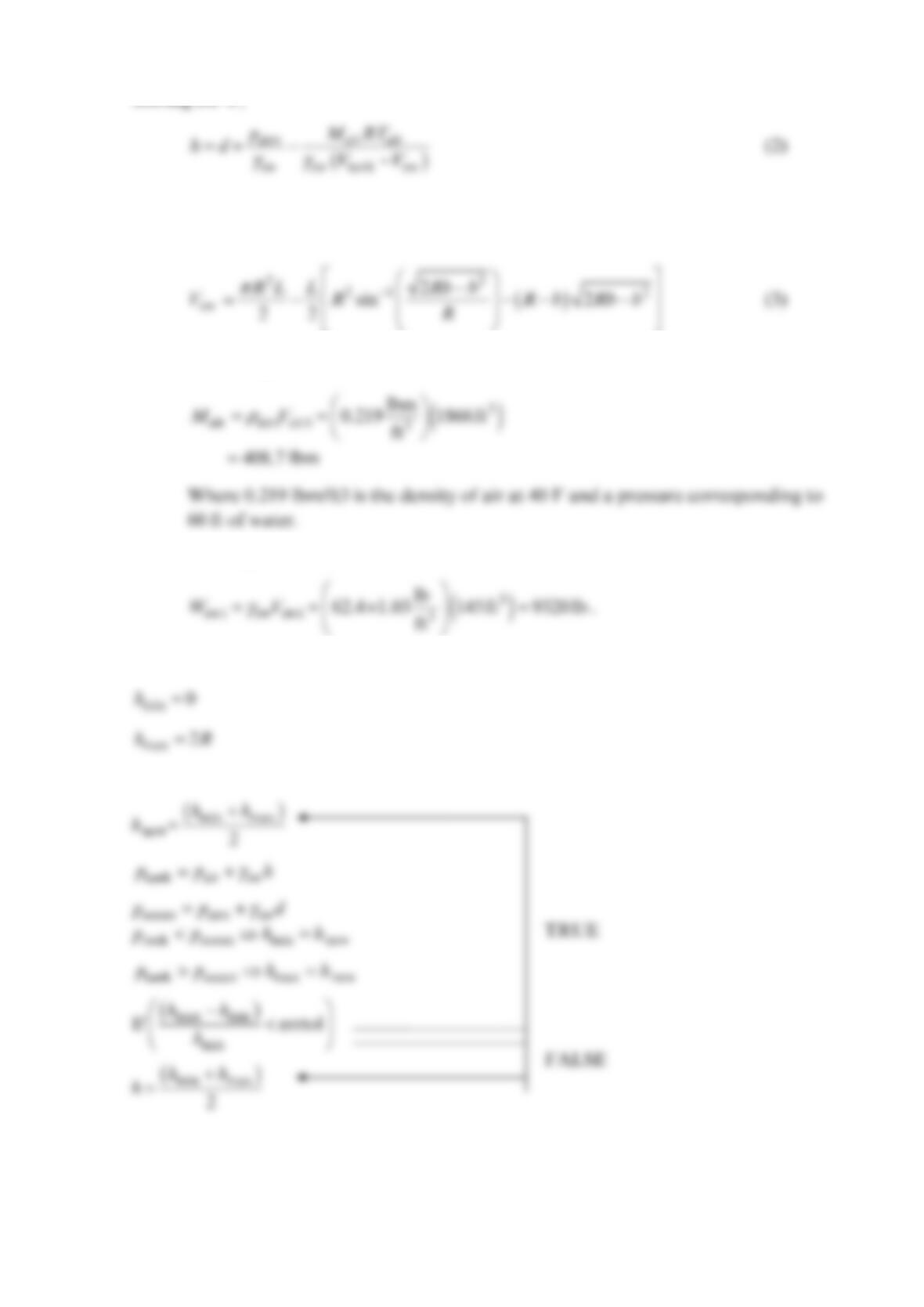
Solving for h,
sw
V is a function of h, given by Eq. (1) for <hR. For >hR, define =−2bRh and
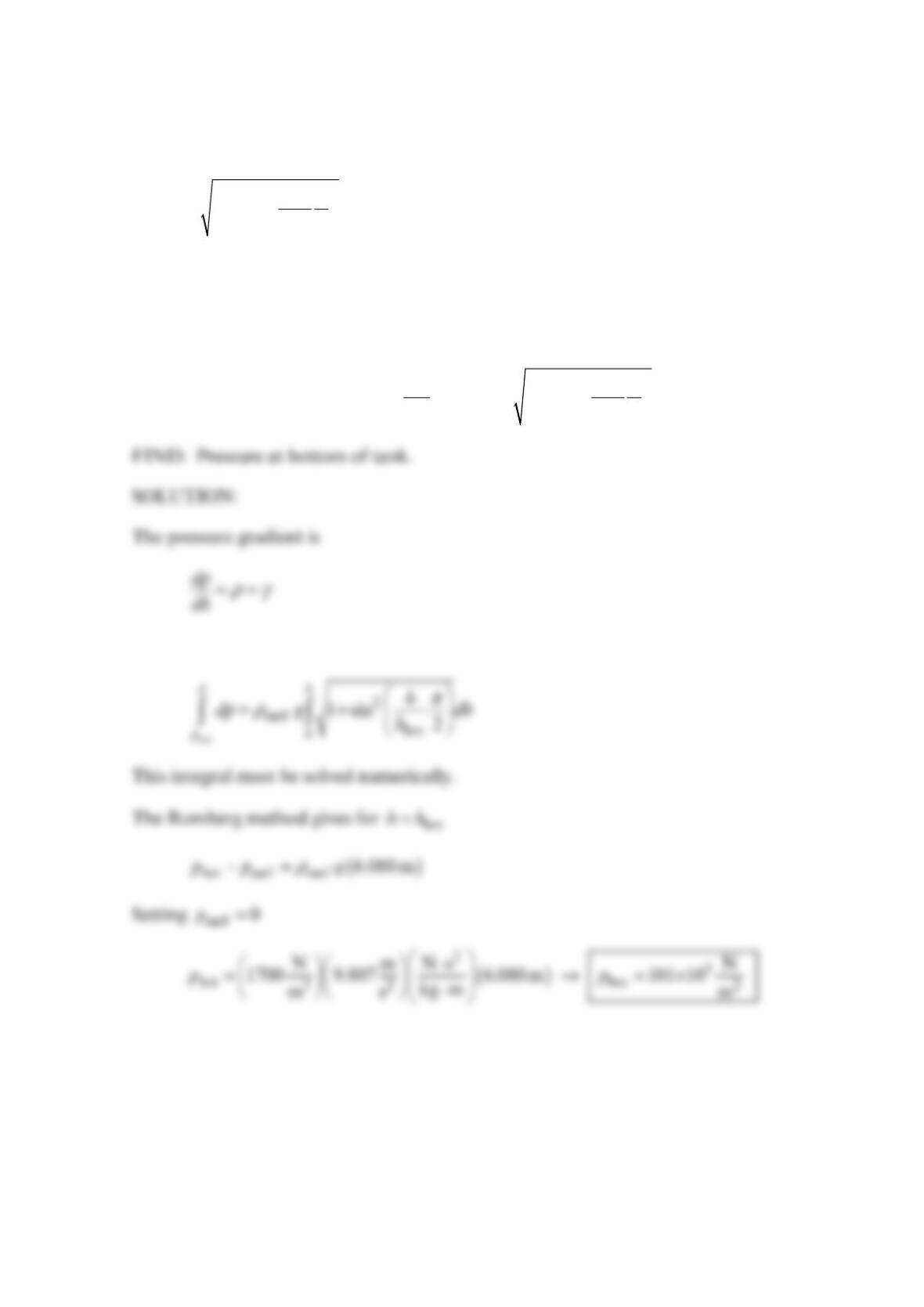
The air mass air
M is
The initial weight of the water is
Pseudocode for procedural language:
Problem 2.12
Determine the pressure at the bottom of an open 5-m– deep tank in which a chemical
process is taking place that causes the density of the liquid in the tank to vary as
2
surf
bot
1sin 2
h
h
π
ρρ
=+
,
where h is the distance from the free surface and 3
surf 1700 kg/m
ρ
=.
Solution 2.12
GIVEN: bot 5mH=, surf 3
kg
1700 m
ρ
=; 2
surf
bot
1sin 2
h
h
π
ρρ
=+
,
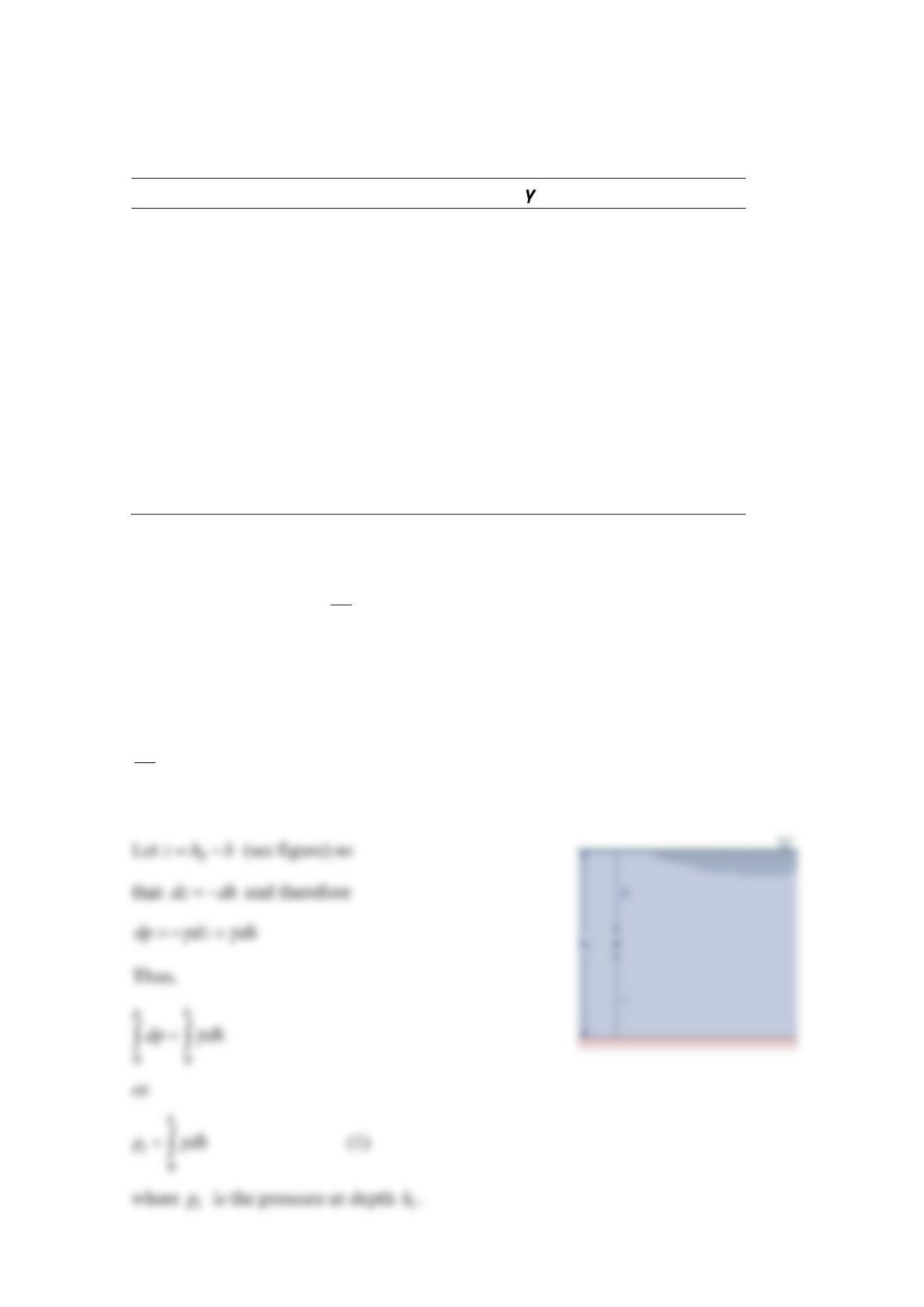
Separating variables, substituting for
ρ
, and integrating give
Problem 2.13
In a certain liquid at rest, measurements of the specific weight at various depths show the
following variation:
h (ft) (lb/ft3)
0 70
10 76
20 84
30 91
40 97
50 102
60 107
70 110
80 112
90 114
100 115
The depth =0h corresponds to a free surface at atmospheric pressure. Determine, through
numerical integration of
γ
=−
dp
dz , the corresponding variation in pressure and show the
results on a plot of pressure (in psf) versus depth (in feet).
Solution 2.13
γ
=−
dp
dz
γ
γ
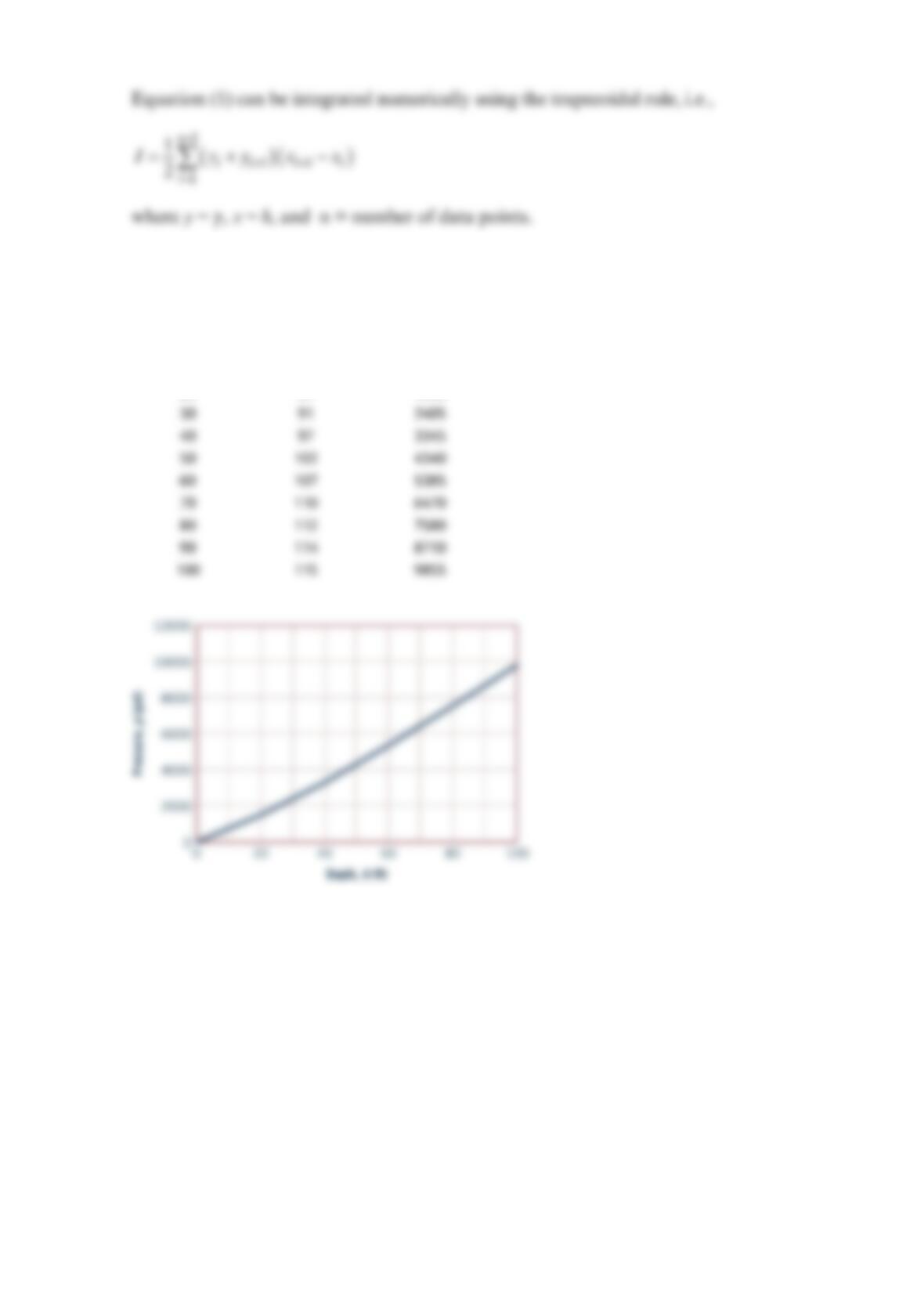
The tabulated results are given below, along with the corresponding plot of pressure versus
depth.
h (ft)
γ
(lb/ft^3) Pressure, psf
0 70 0
10 76 730
20 84 1530
Problem 2.15
Under normal conditions, the temperature of the atmosphere decreases with increasing
elevation. In some situations, however, a temperature inversion may exist so that the air
temperature increases with elevation. A series of temperature probes on a mountain give
the elevation–temperature data shown in the table below. If the barometric pressure at the
base of the mountain is 12.1 psia, determine by means of numerical integration the pressure
at the top of the mountain.
Elevation (ft) Temperature (°F)
5000 50.1 (base)
5500 55.2
6000 60.3
6400 62.6
7100 67.0
7400 68.4
8200 70.0
8600 69.5
9200 68.0
9900 67.1 (top)
Solution 2.15
For an ideal gas, the hydrostatic equation becomes
In the table below the temperature in °R is given and the integrand
()
°
1
TR
tabulated.
Elevation (ft)
T
(°F)
T
(°R) 1/
T
(°R)
5000 50.1 509.8 0.001962
5500 55.2 514.9 0.001942
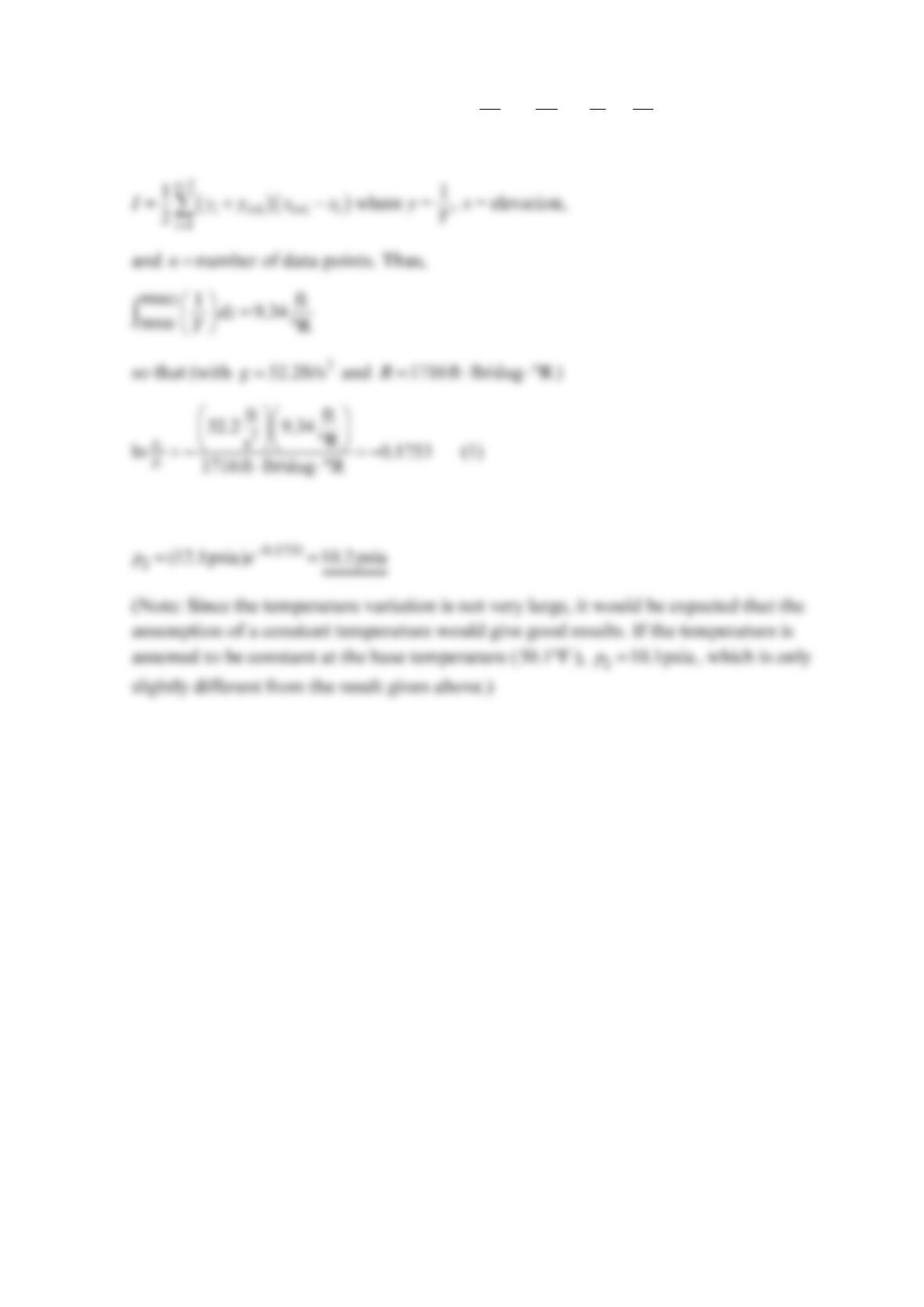
The approximate value of the integral in 22
11
2
1
ln
pz
pz
p
dp g dz
p
pRT
==−
is 9.34 obtained using
the trapezoidal rule, i.e.,
It follows from Eq. (1) with =
112.1psiap that
Problem 2.16
Often young children drink milk 3
(
1030 kg / m )
ρ
= through a straw. Determine the
maximum length of a vertical straw that a child can use to empty a milk container,
assuming that the child can develop 75 mmHg of suction, and use this answer to determine
if you think this is a reasonable estimate of the suction that a child can develop.
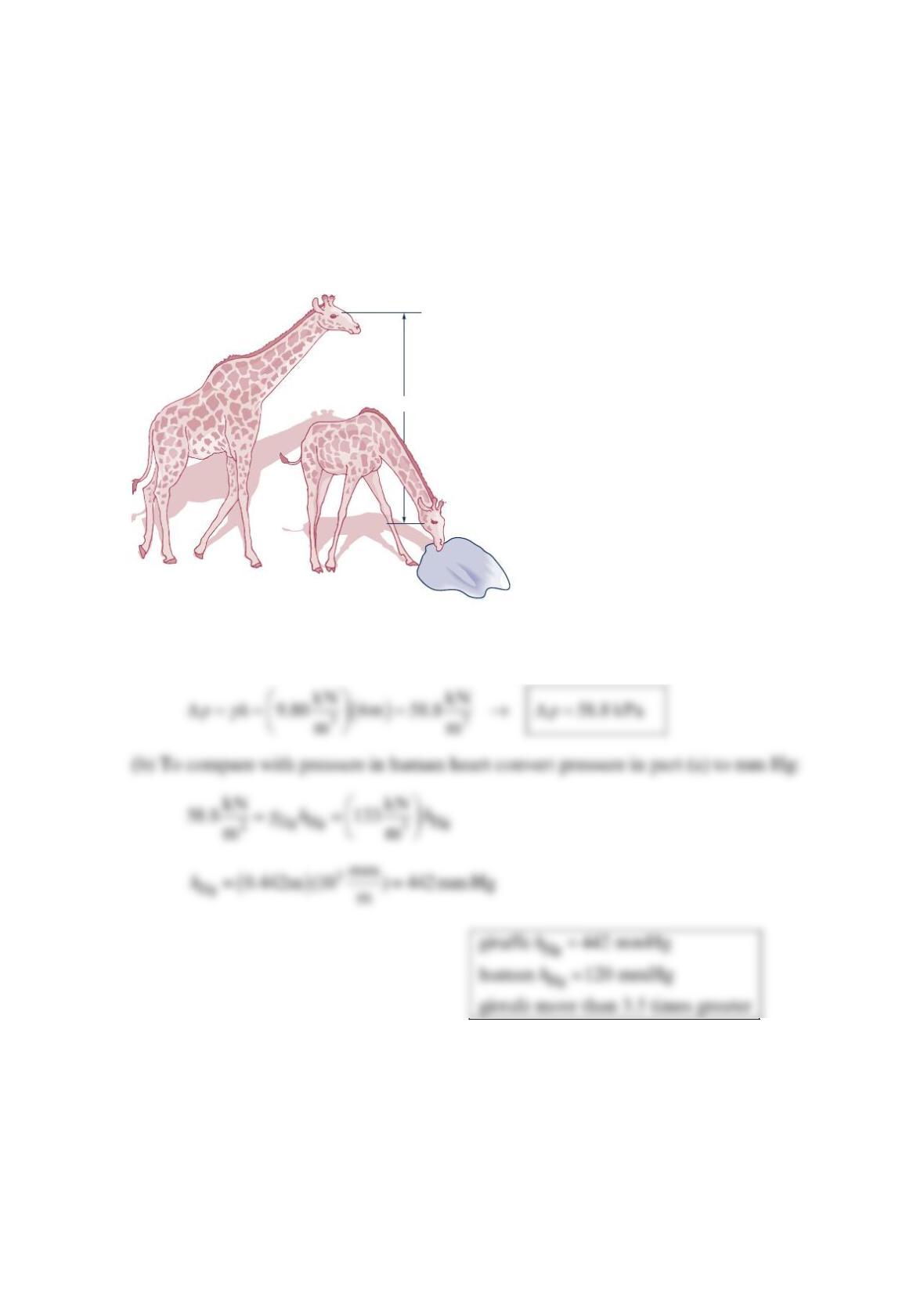
Solution 2.16
Known:
milk 3
kg
1030 m
ρ
=, suction 75 mm Hg=
Problem 2.17
(a) Determine the change in hydrostatic pressure in a giraffe’s head as it lowers its head
from eating leaves 6 m above the ground to getting a drink of water at ground level as
shown in the figure below. Assume the specific gravity of blood is SG = 1. (b) Compare the
pressure change calculated in part (a) to the normal 120 mm of mercury pressure in a
human’s heart.
Solution 2.17
(a) For hydrostatic pressure change,
6 m
Water
Problem 2.18
What would be the barometric pressure reading, in mm Hg, at an elevation of 4 km in the
U.S. standard atmosphere? Refer to Table C.2 Properties of the U.S. Standard Atmosphere
(SI Units).
Solution 2.18
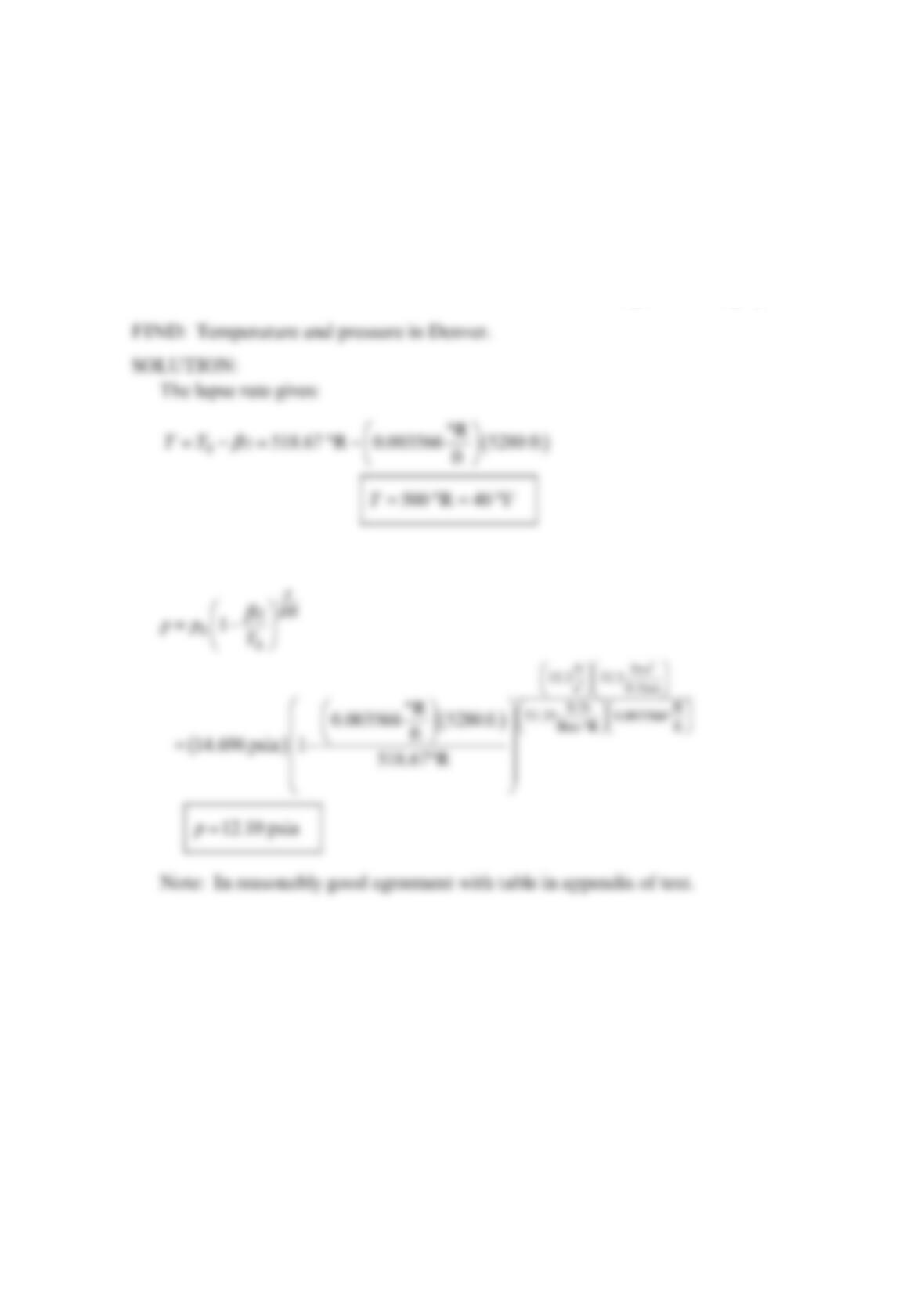
At an elevation of 4 km,
Problem 2.19
Denver, Colorado, is called the “mile-high city” because its state capitol stands on land
1 mile above sea level. Assuming that the Standard Atmosphere exists, what is the pressure
and temperature of the air in Denver? The temperature follows the lapse rate ( 0
TT z
β
=−).
Solution 2.19
GIVEN: Denver altitude = =1mile 5280 ft and standard atmosphere.
β
=−
0
TT z
Using Equation and Table: