Chapter 19
The Citric Acid Cycle
SUMMARY
Section 19.1
The citric acid cycle is amphibolic. It plays a role in both catabolism and
anabolism. It is the central metabolic pathway.
Section 19.2
The citric acid cycle takes place in the mitochondrial matrix, with exception that
Section 19.3
The two-carbon unit needed at the start of the citric acid cycle is obtained by
converting pyruvate to acetyl-CoA.
Section 19.4
Section 19.5
The citric acid cycle is exergonic in terms of overall free-energy changes. In
addition, it produces four NADH and one FADH2 for each pyruvate that enters
Section 19.6
In plants and bacteria, the glyoxylate cycle is a pathway that bypasses the two
2 Chapter 19
Section 19.7
All metabolic pathways are related, and all operate simultaneously.
Section 19.8
The citric acid cycle plays a central role in anabolic pathways as well as in
catabolism.
Section 19.9
The citric acid cycle is considered part of aerobic metabolism because of the link
LECTURE NOTES
The citric acid cycle plays a central role in both central energy metabolism and
biosynthesis. As such, at least two lectures should be devoted to this chapter. The
LECTURE OUTLINE
I. Central role of the citric acid cycle
A. Central energy metabolism – ETC and OxPhos
B. Amphibolic nature – catabolism and anabolism
II. Overall Pathway
A. Mitochondrial structure review
III. Pyruvate conversion to acetyl-CoA
A. Pyruvate dehydrogenase complex
B. Coenzyme A
C. Pyruvate dehydrogenase
The Citric Acid Cycle 3
E. Dihydrolipoyl dehydrogenase
1. Reoxidation to disulfide form
IV. The reactions of the citric acid cycle
A. Citrate formation
1. Condensation reaction
B. Isomerization
1. Aconitase
2. Stereospecificity of product
3. Requirement of Fe(II)
C. First oxidation
1. Isocitrate dehydrogenase
E. Succinate formation
1. Production of GTP
2. Succinyl-CoA synthetase
3. Transfer of phosphate between GTP and ATP
F. Fumarate formation
1. Succinate dehydrogenase
2. Integral membrane protein – inner mitochondrial membrane
3. Use of FAD
4 Chapter 19
I. Overall reactions
1. Pyruvate dehydrogenase complex
V. Energetics and control
A. General thermodynamic considerations
B. Control of pyruvate dehydrogenase
1. Inhibition by ATP and NADH
2. Activation by ADP
VI. Glyoxylate cycle
A. Use of acetyl-CoA for carbohydrate synthesis in non-animals
B. Isocitrate lyase and malate synthase
VII. CAC and catabolism
A. Stages of catabolism
B. CAC as central point for catabolic pathways
ANSWERS TO PROBLEMS
19.1 The Central Role of the Citric Acid Cycle in Metabolism
1. Anaerobic glycolysis is the principal pathway for the anaerobic metabolism of
2. Anaerobically, two ATPs can be produced from one glucose molecule.
Aerobically, this figure is 30 to 32, depending on in which tissue it is occurring.
and the TCA cycle.
The Citric Acid Cycle 5
4. Amphibolic means that the pathway is involved in both catabolism and
anabolism.
19.2 The Overall Pathway of the Citric Acid Cycle
5. The citric acid cycle takes place in the mitochondrial matrix. Glycolysis takes
place in the cytosol.
19.3 How Pyruvate Is Converted to Acetyl-CoA
9. Five enzymes are involved in the pyruvate dehydrogenase complex of mammals.
Pyruvate dehydrogenase transfers a two-carbon unit to TPP and releases CO2.
10. Lipoic acid plays a role both in redox and in acetyl-transfer reactions.
11. Five enzymes are all in close proximity for efficient shuttling of the acetyl unit
between molecules and efficient control of the complex by phosphorylation.
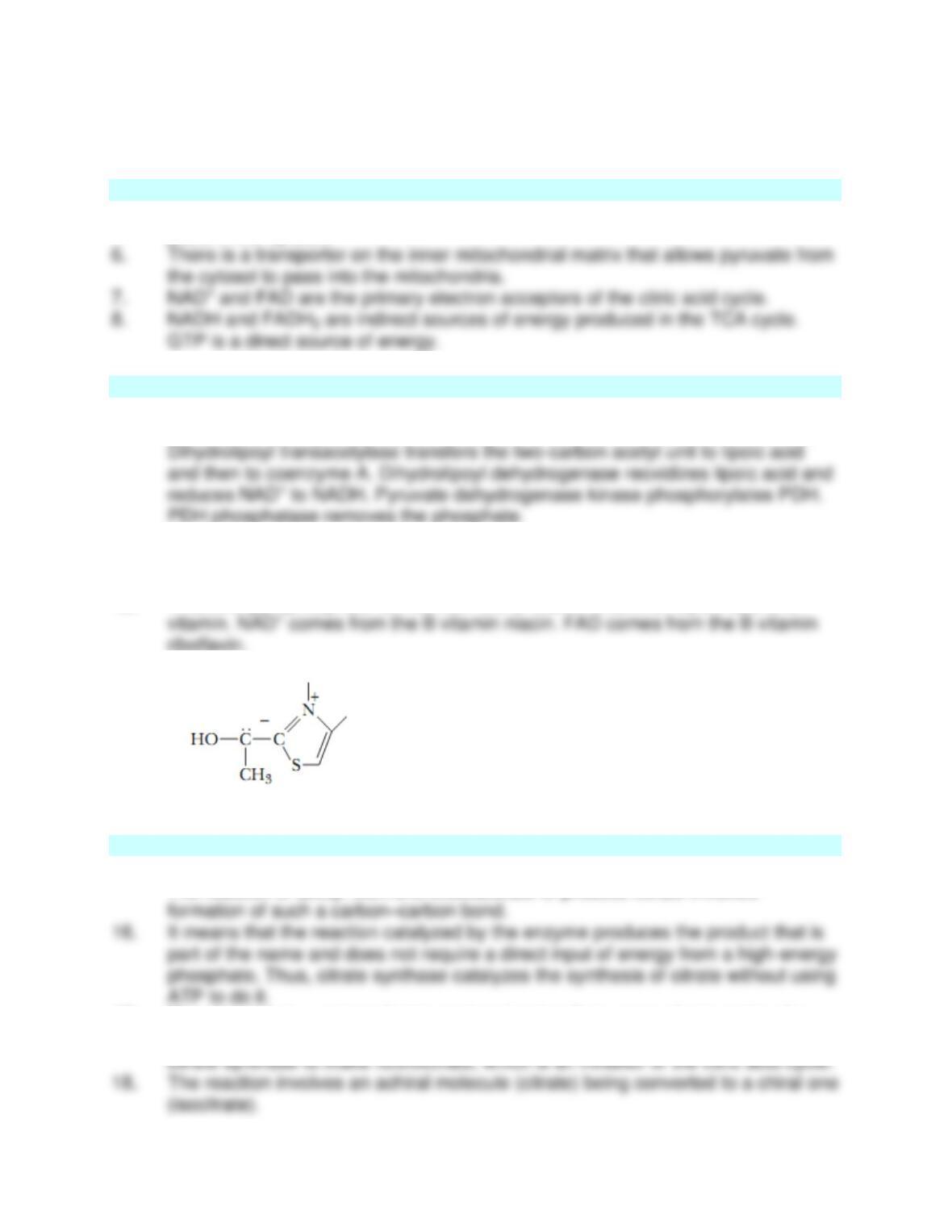
12. Thiamine pyrophosphate comes from the B vitamin thiamine. Lipoic acid is a
riboflavin.
13.
14. See Figure 19.4.
19.4 The Individual Reactions of the Citric Acid Cycle
15. A condensation reaction is one in which a new carbon–carbon bond is formed.
The reaction of acetyl-CoA and oxaloacetate to produce citrate involves
17. Fluoroacetate is a poison that is produced naturally in some plants and is also
used as a poison against undesirable pests. It is poisonous because it is used by
6 Chapter 19
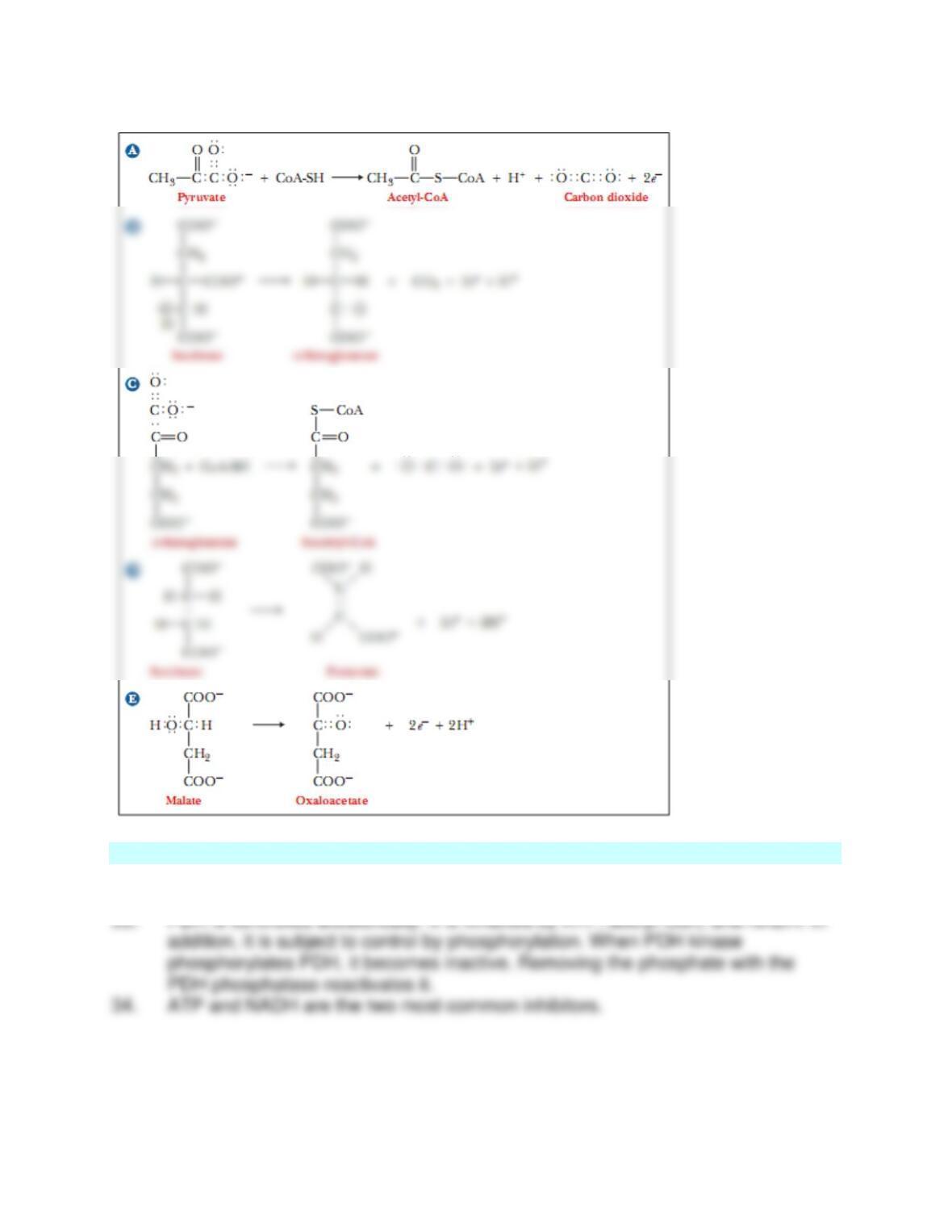
19. Conversion of pyruvate to acetyl-CoA, conversion of isocitrate to -ketoglutarate,
21. These enzymes catalyze oxidative decarboxylations.
22. The reactions proceed by the same mechanism and use the same cofactors. The
difference is the initial substrate, which is pyruvate or -ketoglutarate. During the
course of the reaction, pyruvate dehydrogenase shuttles an acetyl unit through
the reaction while -ketoglutarate dehydrogenase shuttles a succinyl unit.
23. A synthetase is an enzyme that synthesizes a molecule and uses a high-energy
chain generates energy to allow the conversion of ADP to ATP.
25. We have previously encountered substrate-level phosphorylation in glycolysis.
An example is the transfer of a phosphate from 1,3-bisphosphoglycerate to ADP
to afford 3-phosphoglycerate and ATP
26. GTP is equivalent to ATP because an enzyme, nucleoside diphosphate kinase, is
able to interconvert GTP and ATP.
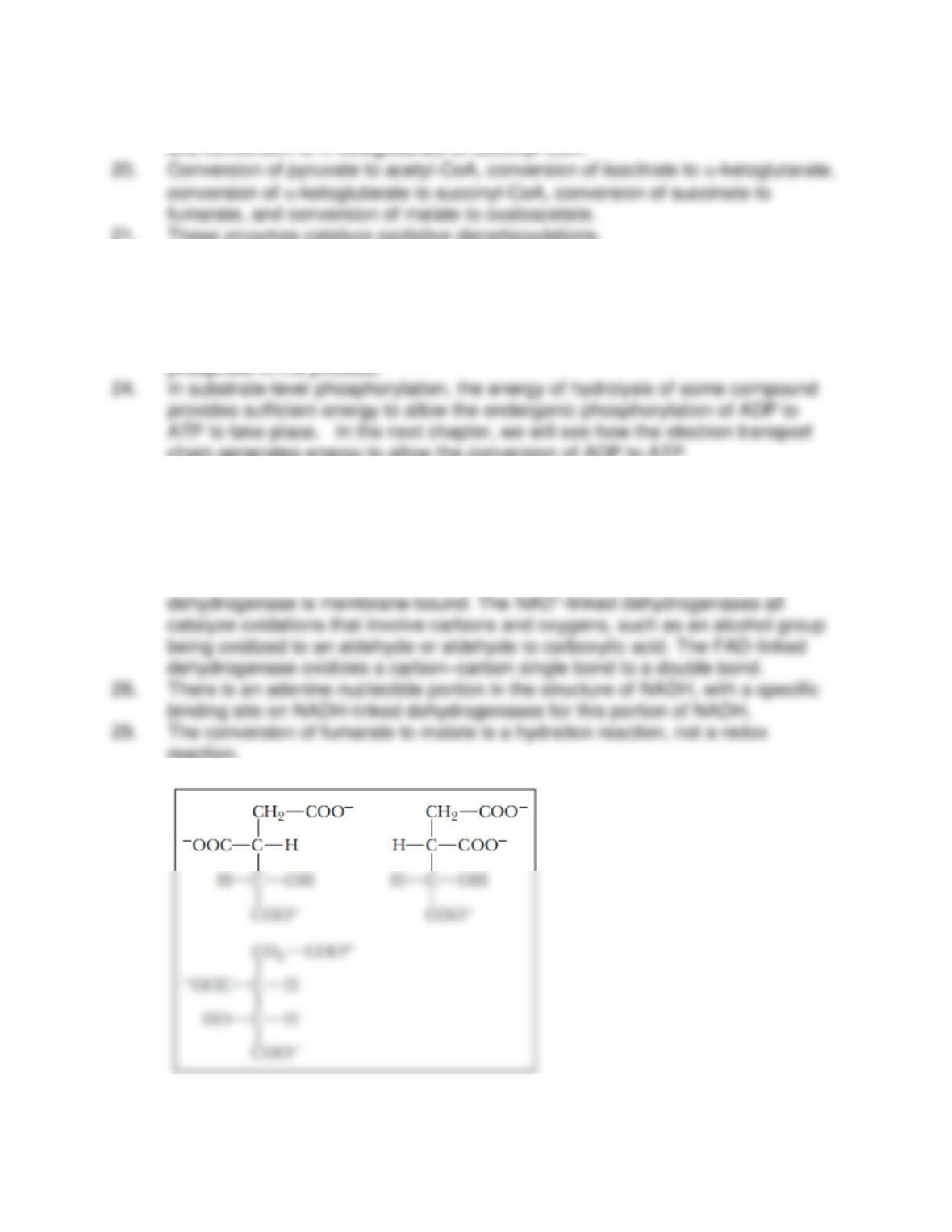
27. The enzymes that reduce NAD+ are all soluble, matrix enzymes, while succinate
reaction.
30.
The Citric Acid Cycle 7
31.
19.5 Energetics and Control of the Citric Acid Cycle
32. The reactions are catalyzed by pyruvate dehydrogenase, citrate synthase,
isocitrate dehydrogenase, and -ketoglutarate dehydrogenase.
8 Chapter 19
35. If the amount of ADP in a cell increases relative to the amount of ATP, the cell
needs energy (ATP). This situation not only favors the reactions of the citric acid
cycle, which release energy, activating isocitrate dehydrogenase, but also
37. The citric acid cycle is less active when a cell has a high ATP/ADP ratio and a
high NADH/NAD+ ratio. Both ratios indicate a high “energy charge” in the cell,
indicating less of a need for the energy-releasing reactions of the citric acid cycle.
38. Thioesters are “high–energy” compounds that play a role in group-transfer
reactions; consequently, their G°′ of hydrolysis is large and negative to provide
energy for the reaction.
42. Lactose is a disaccharide of glucose and galactose. There is no energy cost in
the hydrolysis of the bond between the two monosaccharides, so essentially
there are two hexoses to consider. Because the processing of any of the
hexoses yields the same amount of energy, the aerobic processing of lactose
would lead to 60 to 64 ATPs, depending on the tissue and on the shuttle system
used.
19.6 The Glyoxylate Cycle: A Related Pathway
43. Isocitrate dehydrogenase, -ketoglutarate dehydrogenase, and succinyl-CoA
synthetase.
44. The conversion of isocitrate to succinate and glyoxylate catalyzed by isocitrate
The Citric Acid Cycle 9
19.7 The Citric Acid Cycle in Catabolism
46. The citric acid cycle is the central metabolic pathway and indirect producer of
energy. It receives fuels from the other pathways at many points and generates
reduced electron carriers that go into the electron transport chain. It is also
involved in anabolism, as many of its intermediates can be drawn off to
synthesize other compounds.
19.8 The Citric Acid Cycle in Anabolism
50. The following series of reactions exchanges NADH for NADPH.
Oxaloacetate + NADH + H+ Malate + NAD+
19.9 The Link to Oxygen
53. The NADH and FADH2 produced by the citric acid cycle are the electron donors
in the electron transport chain linked to oxygen. Because of this connection, the
citric acid cycle is considered part of aerobic metabolism.