19-1
CHAPTER 19
ACCOUNTING FOR INCOME TAXES
CONTENT ANALYSIS OF EXERCISES AND PROBLEMS
Number
Content
Time Range
(minutes)
E19-1
Future Taxable Amount. (Easy) Deferred tax liability. Higher
future tax rate. Scheduling. Preparation of income tax journal
entry.
10-15
E19-5
Valuation Account. (Moderate) Deferred tax asset and
valuation allowance. Preparation of income tax journal entries
and partial income statement.
10-15
E19-9
Operating Loss. (Easy) Preparation of income tax journal entry
and partial income statement for carryback.
10-15
19-2
Number
Content
Time Range
(minutes)
E19-12
Intraperiod Tax Allocation. (Moderate) Year-end journal entry.
Income statement. Statement of retained earnings.
20-25
E19-15
Balance Sheet Disclosure. (Easy) Presentation of income tax
disclosures.
10-15
E19-16
Change in Tax Rates. (Easy) Correction of deferred tax liability.
Calculation of amount and preparation of journal entry.
10-15
P19-3
Multiple Temporary Differences. (Moderate) Estimated
warranty expense, depreciation. Preparation of income tax
journal entry and partial income statement. Balance sheet
disclosure. IFRS disclosure.
20-30
P19-4
Interperiod Tax Allocation: Change in Rate. (Moderate)
Warranty expense, depreciation, rent receipts, gross profit.
Preparation of income tax journal entry and condensed
income statement. Balance sheet disclosures.
20-30
P19-7
Deferred Tax Liability: Depreciation. (Moderate) Depreciation
schedule, deferred tax liability schedule. Preparation of
income tax journal entry. Explanation of change in deferred
tax liability.
25-40
19-3
Number
Content
Time Range
(minutes)
P19-9
Deferred Taxes: Multiple Rates. (Moderate) One future taxable
and one future deductible amount. Higher future tax rate.
30-40
P19-10
Operating Loss. (Challenging) Preparation of income
statement and journal entries for two years. Carryback and
carryforward. Valuation allowance.
30-45
P19-13
Comprehensive: Intraperiod and Interperiod Tax Allocation.
(Challenging) Allocation schedule. Preparation of income tax
journal entry, partial income statement, statement of retained
earnings. Balance sheet disclosures.
35-45
ANSWERS TO QUESTIONS
Q19-1 The objective of financial reporting is to provide useful information to decision makers
about companies. This information is intended to enable investors to make buy-hold-
Q19-2 The five groups of possible differences between pretax financial income and taxable
income (or between income tax expense and income taxes payable) are as follows:
Q19-2 (continued)
2. Temporary differences. Items of revenue or expense that a corporation reports
for financial accounting purposes in one period and for income tax purposes in
an earlier or later period.
Q19-3 A permanent difference is a difference between a corporation’s pretax financial
income and taxable income in an accounting period that will never reverse in a later
Q19-4 A temporary difference is a difference between the tax basis (i.e., book value) of a
corporation’s asset (or liability) for income tax purposes and the reported amount
(i.e., book value) of the asset (or liability) in its financial statements that will result in
Q19-5 The FASB concluded that GAAP requires:
1. Interperiod income tax allocation of temporary differences.
Q19-6 The two objectives of accounting for income taxes identified by the FASB are: (1)
that a corporation should recognize the amount of its income tax obligation or
Q19-7 Under GAAP, a corporation uses interperiod income tax allocation to determine its
deferred tax assets and liabilities for all temporary differences. These deferred items
Q19-8 The three characteristics of a liability are: (1) it is a responsibility of the corporation to
another entity that will be settled in the future, (2) the responsibility obligates the
corporation so that it cannot avoid the future sacrifice, and (3) the transaction or
other event obligating the corporation has already occurred.
Q19-9 The three characteristics of an asset are: (1) it will contribute to the corporation’s
future net cash inflows, (2) the corporation must be able to obtain the benefit and
control other entities‘ access to it, and (3) the transaction or other event resulting in
Q19-10 A corporation establishes a valuation allowance if, based on available evidence, it is
more likely than not that a deferred asset will not be realized. Positive evidence that
Q19-11 To measure and record a corporation’s current and deferred income taxes, the
following steps are completed:
1. Measure the income tax obligation for the year by applying the applicable tax
rate to the current taxable income.
2. Identify the temporary differences and classify each as either a future taxable
amount or a future deductible amount.
19-6
Q19-11 (continued)
3. Measure the year-end deferred tax liability for each future taxable amount using
the applicable tax rate.
assets, and change in valuation allowance (if any).
Q19-12 An operating loss carryback occurs when a corporation carries a reported operating
loss back 2 years (in sequential order, starting with the earliest of the 2 years) to offset
previously reported taxable income. In such a case, the corporation files amended
income tax returns showing a lower taxable income for those years and receives a
refund of income taxes previously paid.
The two conceptual questions concerning how a corporation accounts for a
carryback are:
Q19-13 An operating loss carryforward occurs when a corporation sequentially carries a
reported operating loss forward 20 years to offset the loss against future taxable
income, should there be any. The corporation then pays lower income taxes in the
future based on lower future taxable income.
Q19-14 The generally accepted accounting principles for the financial reporting of operating
loss carrybacks and carryforwards are as follows:
1. A corporation must recognize the tax benefit of an operating loss carryback in
19-7
Q19-14 (continued)
2. A corporation must recognize the tax benefit of an operating loss carryforward in
the period of the loss as a deferred tax asset. However, it must reduce the
Q19-15 Intraperiod income tax allocation is the allocation of a corporation’s total income tax
expense for a period to the various components of its income statement (and
occasionally the statement of retained earnings, statement of comprehensive
Q19-16 A corporation reports its deferred tax liabilities and assets in two classifications: a net
current amount and a net noncurrent amount. It bases these classifications on the
Q19-17 If the income tax laws or rates are changed in a future year so that they differ from
those laws or rates previously used to calculate the corporation’s deferred tax liability
(or asset), then the corporation adjusts the deferred tax liability (or asset) for the
Q19-18 The first step for a company is to determine whether to recognize an uncertain tax
position by evaluating whether the tax position is “more likely than not” (greater than

Q19-19 Under IFRS, a company may recognize a deferred tax asset when it is probable that it
will have future taxable income against which it can use the deferred tax asset.
Because “probable” is not defined by IAS 12 for deferred taxes, a company that
Q19-20 IFRS requires that a deferred tax liability be reported as a non-current liability on the
ANSWERS TO MULTIPLE CHOICE
19-9
SOLUTIONS TO REVIEW EXERCISES
RE19-1
It is a deferred tax liability because Frankfort will owe greater income taxes in
RE19-2
RE19-3
RE19-4
RE19-5
Financial Income Tax
Reporting
Reporting
Cost of asset $10,000 $10,000
RE19-6
Financial Income Tax
Reporting
Reporting
Book value of warranty liability $2,000 $0
RE19-7
Pretax financial income $55,000
Less: Tax-exempt interest revenue on municipal bonds
RE19-8
Year
Pretax Financial Income
and Taxable Income
Offset by Carryback
x
Income
Tax Rate
=
Income
Tax Refund
RE19-9
19-11
RE19-10
Component (Pretax)
Pretax
Amount
x
Income
Tax Rate
=
Income Tax
Expense (Credit)
Income from continuing operations $40,000 0.30 $12,000
RE19-11
Combine (net) the noncurrent assets with the noncurrent liabilities:
Assets – Liabilities = $12,000 – $10,500 = $1,500 noncurrent deferred tax asset
RE19-12
The deferred tax liability at the end of Year 1 was $200 (20% x $1,000). The
SOLUTIONS TO EXERCISES
E19-1
2010
Dec. 31 Income Tax Expense ($2,940 + $560) 3,500
E19-2
1. 2010
Dec. 31 Income Tax Expense ($29,100 + $2,100) 31,200
2. Noncurrent Liabilities
Deferred tax liability $2,100
E19-3
2010
Dec. 31 Income Tax Expense ($3,600 + $510) 4,110
19-13
E19-4
1. 2010
Dec. 31 Income Tax Expense ($15,300 – $1,440) 13,860
2. Current Assets
Deferred tax asset $1,800
3. If the Pito Company uses IFRS, it would report the $1,800 deferred tax asset as a
noncurrent asset on its December 31, 2010 balance sheet.
E19-5
1. 2010
Dec. 31 Income Tax Expense ($11,400 – $1,080) 10,320
Deferred Tax Asset 1,080a
2. Income before income taxes $34,400
Income tax expense (10,968)a
E19-6
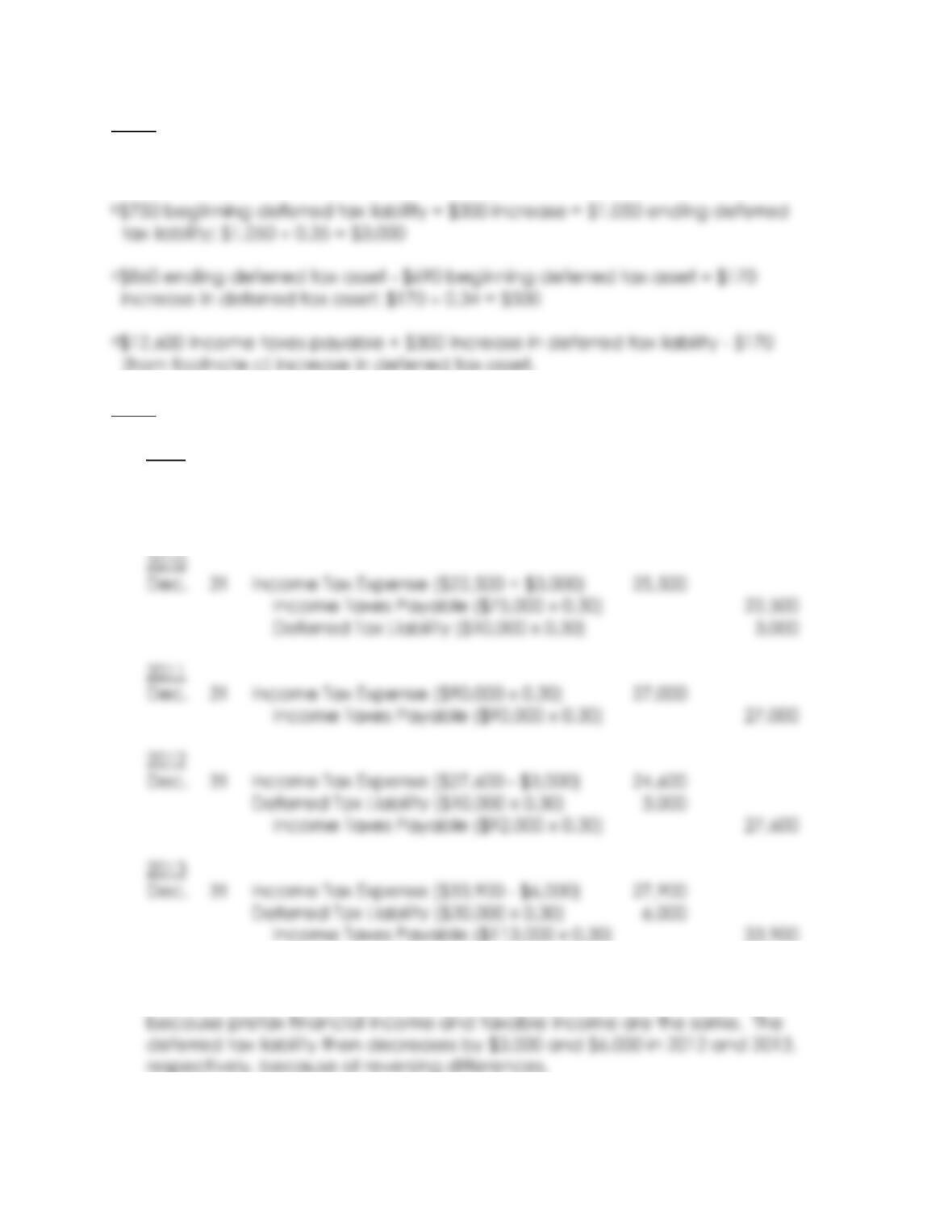
Taxable income for 2010: $42,000a
19-14
E19-6 (continued)
a$12,600 income taxes payable ÷ 0.30
E19-7
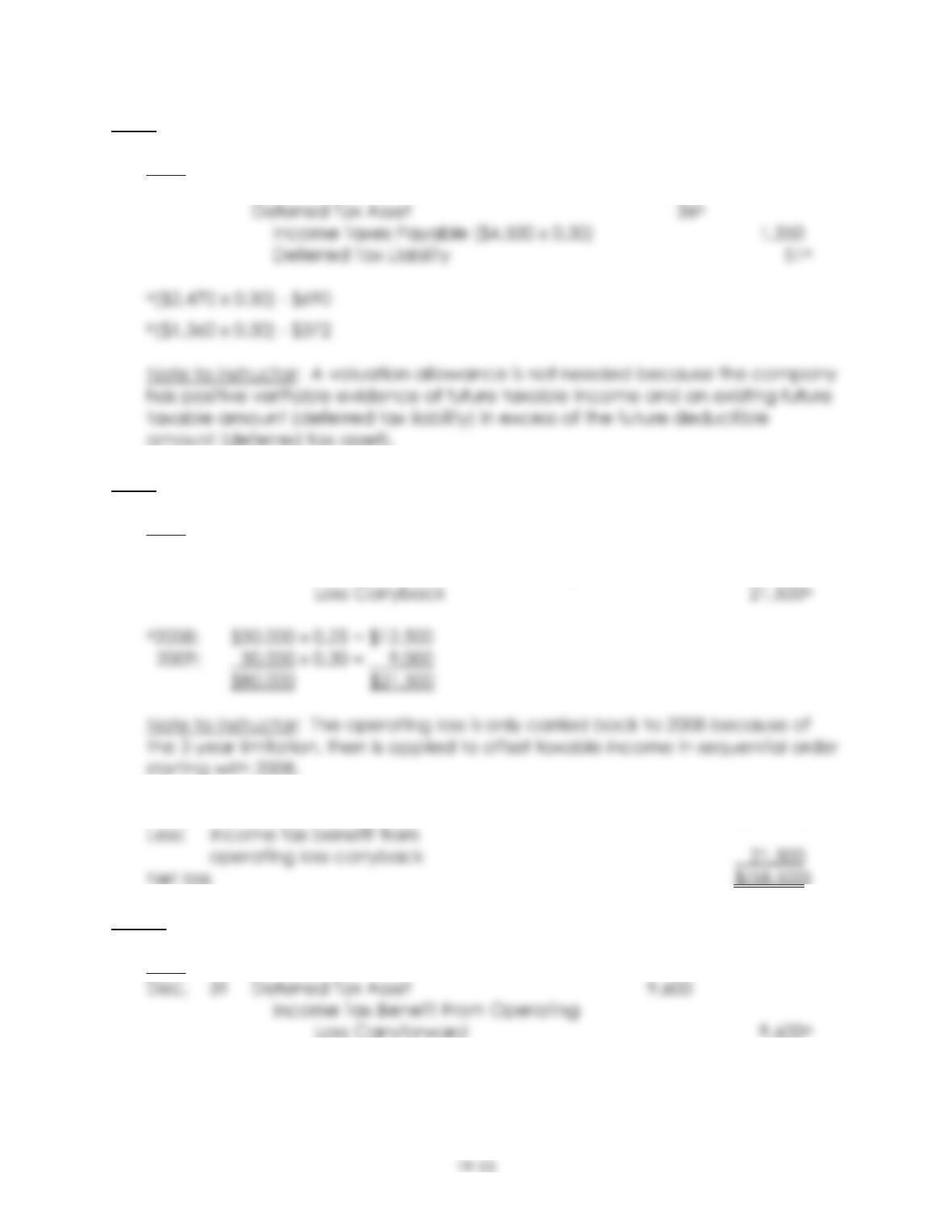
1. 2009
Dec. 31 Income Tax Expense ($15,000 + $6,000) 21,000
Income Taxes Payable ($50,000 x 0.30) 15,000
Deferred Tax Liability ($20,000 x 0.30) 6,000
2. The deferred tax liability increases by $6,000 and $3,000 in 2009 and 2010,
respectively, because of originating differences. There is no change in 2011
E19-8
2010
Dec. 31 Income Tax Expense ($1,350 + $51 – $36) 1,365
E19-9
1. 2010
Dec. 31 Income Tax Refund Receivable 21,500
Income Tax Benefit From Operating
2. Pretax operating loss $(80,000)
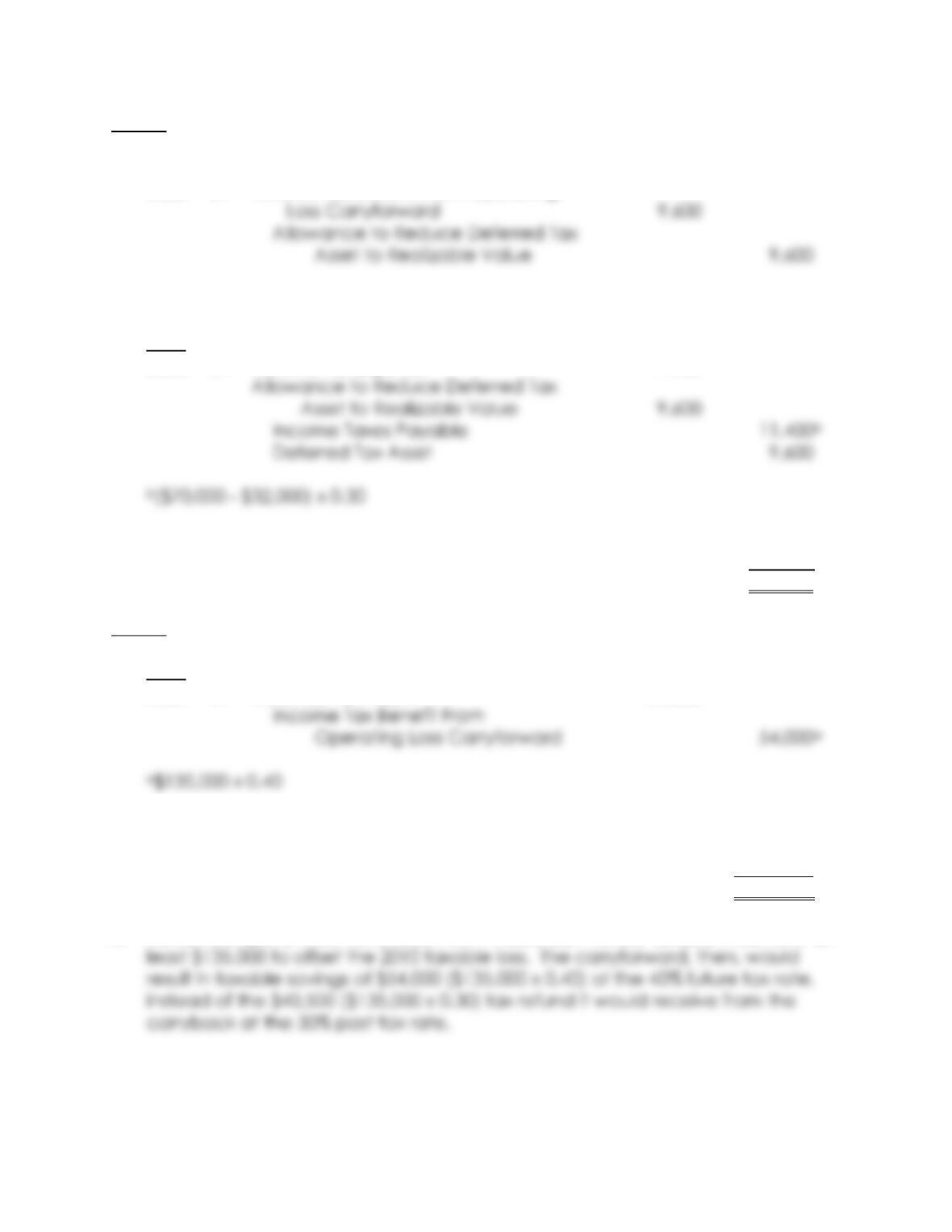
E19-10
1. 2010
19-16
E19-10 (con tinued)
1. (continued)
Dec. 31 Income Tax Benefit From Operating
a$32,000 x 0.30
2. 2011
Dec. 31 Income Tax Expense 11,400
3. Pretax operating income $70,000
Income tax expense ( 11,400)
Net income $58,600
E19-11
1. 2010
Dec. 31 Deferred Tax Asset 54,000
2. Pretax operating loss $(135,000)
Less: Income tax benefit from operating
loss carryforward 54,000
Net loss $( 81,000)
3. Baxter Company must have assumed it would earn future taxable income of at
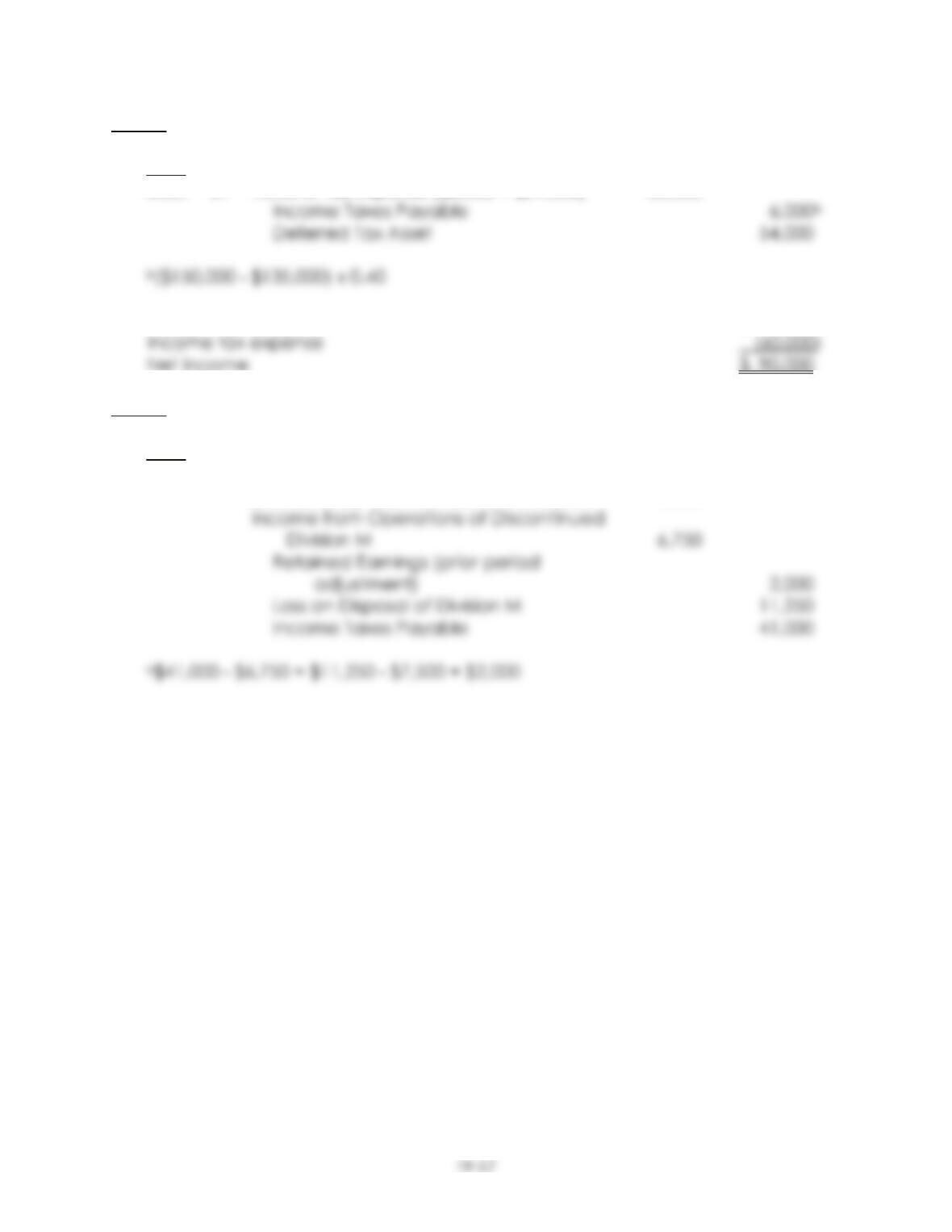
E19-11 (con tinued)
4. 2011
Dec. 31 Income Tax Expense ($6,000 + $54,000) 60,000
5. Pretax operating income $150,000
E19-12
1. 2010
Dec. 31 Income Tax Expense 40,000a
Extraordinary Gain on Sale of Investment 7,500
E19-12 (continued)
2. WRIGHT COMPANY
Income Statement
For Year Ended December 31, 2010
Revenues $400,000
Expenses (240,000)
Pretax income from continuing operations $160,000
WRIGHT COMPANY
Statement of Retained Earnings
For Year Ended December 31, 2010
Retained earnings, January 1, 2010 $410,000
E19-13
1. 2010
Dec. 31 Income Tax Expense [($40,000 x 0.15) +
($50,000 x 0.30)] 21,000
Gain from the Disposal of Discontinued
2. STAM CORPORATION
Income Statement
For Year Ended December 31, 2010
Revenues $320,000
E19-14
1. LESTER CORPORATION
Income Statement
For Year Ended December 31, 2010
Revenues $500,000
Expenses (340,000)b
Pretax income from continuing operationsa $160,000
Income tax expense [($50,000 x 0.20) +
($110,000 x 0.25)] (37,500)
aTotal pretax “income” $119,000
Less: Gain on disposal of Division W (15,000)
$104,000
Add: Loss from operations of