CHAPTER 19
Accounting for Income Taxes
ASSIGNMENT CLASSIFICATION TABLE (BY TOPIC)
Topics
Questions
Brief
Exercises
Exercises
Problems
Concepts
for Analysis
1. Reconcile pretax financial
income with taxable income.
1, 13
1, 2, 3, 4, 5,
12, 18, 20, 21
1, 2, 3, 4, 8
2. Identify temporary and
permanent differences.
3, 4, 5
4, 5, 6, 7
2, 3, 4
3, 4, 5
19, 21
4. Classification of deferred
taxes.
10, 11, 12
15
7, 11, 16, 18,
19, 20, 21, 22
3, 6
2, 3, 5
multiple tax rates, expected
future income.
18, 20, 22
6. Determine deferred taxes,
multiple rates, expected future
losses.
10
7. Carryback and carryforward
of NOL.
16, 17, 18,
12, 13, 14
9, 10, 23,
24, 25
5
8. Change in enacted future
tax rate.
14
11
2, 7
5, 6
9. Tracking temporary differences
through reversal.
8, 17
2, 7
10. Income statement presentation.
9
8
1, 2, 3, 4, 5, 7,
10, 12, 16, 19,
23, 24, 25
1, 2, 3, 5,
7, 8, 9
11. Conceptual issues—tax
allocation.
1, 2, 8, 19
7
1, 2, 7
12. Valuation allowance—deferred
tax asset.
8, 19
7
7, 14, 15, 23,
24, 25
ASSIGNMENT CLASSIFICATION TABLE (BY LEARNING OBJECTIVE)
Learning Objectives
Questions
Brief
Exercises
Exercises
Problems
Concepts
for
Analysis
1. Identify differences
between pretax
financial income and
taxable income.
1, 2
1, 2, 5
CA19-1
2. Describe a temporary
difference that
results in future
taxable amounts.
3, 4
1, 2, 4, 9, 10
1, 2, 3, 4, 5, 7,
8, 11, 12, 13,
1, 3, 4, 6,
7, 8, 9
4. Explain the purpose
of a deferred tax
asset valuation
allowance.
6, 7, 8, 9
7, 14
7, 14, 15, 23,
24, 25
5. Describe the
presentation of
income tax expense
in the income
statement.
10
4, 6, 8
1, 3, 4, 5, 8,
12, 15, 16
1, 2, 3, 4,
5, 7, 8, 9
6. Describe various
temporary and
permanent
differences.
11, 12, 13,
4, 6, 7
2, 3, 9
CA19-2,
CA19-3
7. Explain the effect of
various tax rates and
tax rate changes on
deferred income
taxes.
14, 15
11
13, 16, 17, 18,
21, 23, 24, 25
5, 7
CA19-4,
CA19-5
9. Describe the
presentation of
deferred income
taxes in financial
statements.
19
3, 15
8, 11, 16, 19,
20, 21, 22
3, 5, 6, 8, 9
C19-7
ASSIGNMENT CHARACTERISTICS TABLE
Item
Description
Level of
Difficulty
Time
(minutes)
E19-1
One temporary difference, future taxable amounts, one rate, no
beginning deferred taxes.
Simple
15–20
E19-2
Two differences, no beginning deferred taxes, tracked through
Simple
15–20
E19-3
One temporary difference, future taxable amounts, one rate,
beginning deferred taxes.
Simple
15–20
E19-4
Three differences, compute taxable income, entry for taxes.
Simple
15–20
E19-5
Two temporary differences, one rate, beginning deferred taxes.
Simple
15–20
E19-6
Identify temporary or permanent differences.
Simple
10–15
E19-7
Terminology, relationships, computations, entries.
Simple
10–15
E19-8
Two temporary differences, one rate, 3 years.
Simple
10–15
E19-9
Carryback and carryforward of NOL, no valuation account, no
temporary differences.
Simple
15–20
E19-10
Two NOLs, no temporary differences, no valuation account,
entries and income statement.
20–25
E19-11
Three differences, classify deferred taxes.
Simple
10–15
E19-12
Two temporary differences, one rate, beginning deferred taxes,
compute pretax financial income.
Complex
20–25
E19-14
Deferred tax asset with and without valuation account.
Moderate
20–25
E19-15
Deferred tax asset with previous valuation account.
Complex
20–25
E19-16
Deferred tax liability, change in tax rate, prepare section of
income statement.
Complex
15–20
E19-17
Two temporary differences, tracked through 3 years,
multiple rates.
Moderate
30–35
E19-18
Three differences, multiple rates, future taxable income.
Moderate
20–25
E19-19
Two differences, one rate, beginning deferred balance, compute
pretax financial income.
Complex
25–30
E19-20
Two differences, no beginning deferred taxes, multiple rates.
Moderate
15–20
E19-21
Two temporary differences, multiple rates, future taxable
Moderate
20–25
E19-22
Two differences, one rate, first year.
Simple
15–20
E19-23
NOL carryback and carryforward, valuation account versus no
Complex
30–35
E19-24
NOL carryback and carryforward, valuation account needed.
Complex
30–35
NOL carryback and carryforward, valuation account needed.
ASSIGNMENT CHARACTERISTICS TABLE (Continued)
Item
Description
Level of
Difficulty
Time
(minutes)
P19-1
Three differences, no beginning deferred taxes, multiple rates.
Complex
40–45
P19-2
One temporary difference, tracked for 4 years, one permanent
difference, change in rate.
Complex
50–60
P19-3
Second year of depreciation difference, two differences, single
Complex
40–45
P19-4
Permanent and temporary differences, one rate.
Moderate
20–25
NOL without valuation account.
P19-6
Two differences, two rates, future income expected.
Moderate
20–25
P19-8
Two differences, 2 years, compute taxable income and pretax
financial income.
Complex
40–50
P19-9
Five differences, compute taxable income and deferred taxes,
draft income statement.
Complex
40–50
CA19-1
Objectives and principles for accounting for income taxes.
Simple
15–20
CA19-2
Basic accounting for temporary differences.
Moderate
20–25
CA19-3
Identify temporary differences and classification criteria.
Complex
20–25
CA19-4
Accounting and classification of deferred income taxes.
Moderate
20–25
CA19-5
Explain computation of deferred tax liability for multiple tax rates.
Complex
20–25
and carryforward affects deferred taxes.
CA19-7
Deferred taxes, income effects.
Moderate
20–25
SOLUTIONS TO CODIFICATION EXERCISES
CE19-1
Master Glossary
(a) The deferred tax consequences attributable to deductible temporary differences and carryforwards.
A deferred tax asset is measured using the applicable enacted tax rate and provisions of the
CE19-2
According to FASB ASC 740-10–30-2 (Income Taxes—Initial Measurement):
The following basic requirements are applied to the measurement of current and deferred income taxes
at the date of the financial statements:
(a) The measurement of current and deferred tax liabilities and assets is based on provisions of the
CE19-3
According to FASB ASC 740-10-S99-2 (Income Taxes—SEC Materials):
CE19-4
According to FASB ASC 740-10–25-6 (Income Taxes—Recognition):
An entity shall initially recognize the financial statement effects of a tax position when it is more likely
than not, based on the technical merits, that the position will be sustained upon examination. The term
more likely than not means a likelihood of more than 50 percent; the terms examined and upon
ANSWERS TO QUESTIONS
1. Pretax financial income is reported on the income statement and is often referred to as income
2. One objective of accounting for income taxes is to recognize the amount of taxes payable or
3. A permanent difference is a difference between taxable income and pretax financial income that,
under existing applicable tax laws and regulations, will not be offset by corresponding differences
or “turn around” in other periods. Therefore, a permanent difference is caused by an item that:
(1) is included in pretax financial income but never in taxable income, or (2) is included in taxable
income but never in pretax financial income.
4. A temporary difference is a difference between the tax basis of an asset or liability and its
reported (carrying or book) amount in the financial statements that will result in taxable amounts
5. An originating temporary difference is the initial difference between the book basis and the tax basis
of an asset or liability. A reversing difference occurs when a temporary difference that originated
in prior periods is eliminated and the related tax effect is removed from the tax account.
6. Book basis of assets ……………………………………………………………………….. $900,000
Tax basis of assets …………………………………………………………………………. 700,000
Questions Chapter 19 (Continued)
7.
Book basis of asset
$90,000
Deferred tax liability (end of 2015)
$ 30,600
Tax basis of asset
–0–
Deferred tax liability (beginning of 2015)
68,000
Future taxable amounts
90,000
Deferred tax benefit for 2015
Tax rate
X 34%
Income taxes payable for 2015
230,000
Deferred tax liability (end of 2015)
$30,600
Income tax expense for 2015
8. A future taxable amount will increase taxable income relative to pretax financial income in future
periods due to temporary differences existing at the balance sheet date. A future deductible
amount will decrease taxable income relative to pretax financial income in future periods due to
9.
Taxable income
$100,000
Future taxable amounts
$70,000
Tax rate
X 40%
Tax rate
X 40%
Income taxes payable
Deferred tax liability (end of 2015)
$28,000
Deferred tax liability (end of 2015)
Current tax expense
$40,000
Deferred tax expense for 2015
Income tax expense for 2015
$68,000
10. Deferred tax accounts are reported on the balance sheet as assets and liabilities. They should be
classified in a net current and a net noncurrent amount. An individual deferred tax liability or
11. The balances in the deferred tax accounts should be analyzed and classified on the balance
sheet in two categories: one for the net current amount, and one for the net noncurrent amount.
This procedure is summarized as indicated below.
(1) Classify the amounts as current or noncurrent. If an amount is related to a specific asset or
liability, it should be classified in the same manner as the related asset or liability. If not so
Questions Chapter 19 (Continued)
13. Pretax financial income ……………………………………………………………………………. $550,000
15. Some of the reasons for requiring income tax component disclosures are:
(a) Assessment of the quality of earnings. Many investors seeking to assess the quality of a
company’s earnings are interested in the reconciliation of pretax financial income to taxable
income. Earnings that are enhanced by a favorable tax effect should be examined carefully,
particularly if the tax effect is nonrecurring.
(b) Better prediction of future cash flows. Examination of the deferred portion of income tax
expense provides information as to whether taxes payable are likely to be higher or lower in
the future.
16. The loss carryback provision permits a company to carry a net operating loss back two years and
receive refunds for income taxes paid in those years. The loss must be applied to the second
17. The company may choose to carry the net operating loss forward, or carry it back and then
forward for tax purposes. To forego the two-year carryback might be advantageous where a
taxpayer had tax credit carryovers that might be wiped out and lost because of the carryback of
18. Many believe that future deductible amounts arising from net operating loss carryforwards are
different from future deductible amounts arising from normal operations. One rationale provided
is that a deferred tax asset arising from normal operations results in a tax prepayment—a prepaid
Questions Chapter 19 (Continued)
19. Uncertain tax positions are tax positions for which the tax authorities may disallow a deduction in
whole or in part. Uncertain tax positions often arise when a company takes an aggressive approach
in its tax planning, such as instances in which the tax law is unclear or the company may believe
SOLUTIONS TO BRIEF EXERCISES
BRIEF EXERCISE 19-1
2014 taxable income ……………………………………………………… $120,000
Tax rate ………………………………………………………………………… X 40%
12/31/14 income taxes payable……………………………………….. $ 48,000
BRIEF EXERCISE 19-2
BRIEF EXERCISE 19-3
Income Tax Expense …………………………………………. $67,500***
BRIEF EXERCISE 19-4
Deferred tax liability, 12/31/15 ………………………………………… $42,000
Deferred tax liability, 12/31/14 ………………………………………… 25,000
BRIEF EXERCISE 19-5
Book value of warranty liability ……………………………………………. $105,000
BRIEF EXERCISE 19-6
Deferred tax asset, 12/31/15 …………………………………………………. $59,000
Deferred tax asset, 12/31/14 …………………………………………………. 30,000
BRIEF EXERCISE 19-7
Income Tax Expense ………………………………………………. 60,000
BRIEF EXERCISE 19-8
Income before income taxes …………………………………… $195,000
BRIEF EXERCISE 19-9
Income Tax Expense ………………………………………………. 71,100
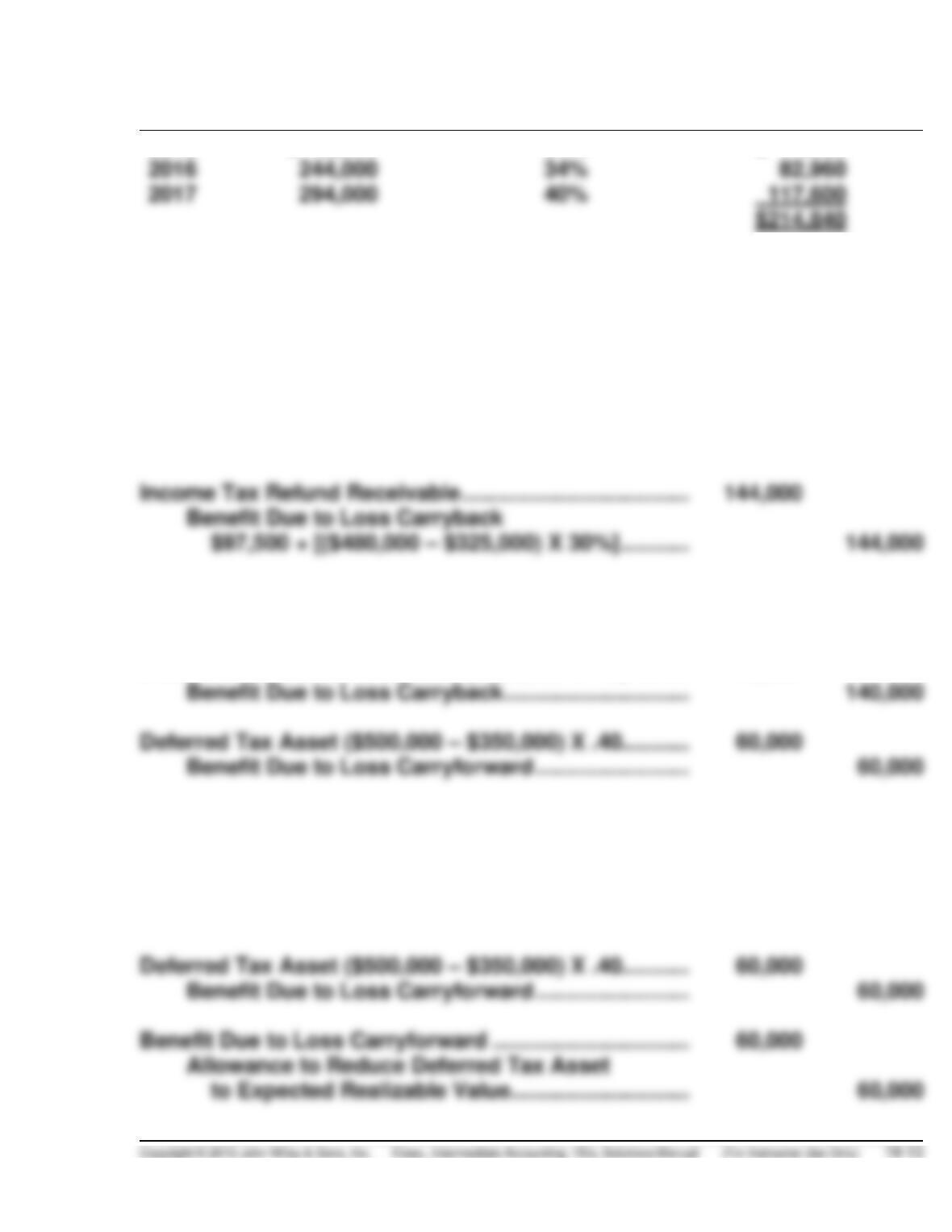
BRIEF EXERCISE 19-10
Year
Future taxable amount
X
Tax Rate
=
Deferred tax liability
2015
$ 42,000
34%
$ 14,280
2016
34%
2017
40%
BRIEF EXERCISE 19-11
Income Tax Expense ……………………………………………… 120,000
Deferred Tax Liability ($2,000,000 X 6%) …………… 120,000
BRIEF EXERCISE 19-12
BRIEF EXERCISE 19-13
Income Tax Refund Receivable ($350,000 X .40) ……… 140,000
BRIEF EXERCISE 19-14
Income Tax Refund Receivable ($350,000 X. 40) ……… 140,000
Benefit Due to Loss Carryback ………………………… 140,000
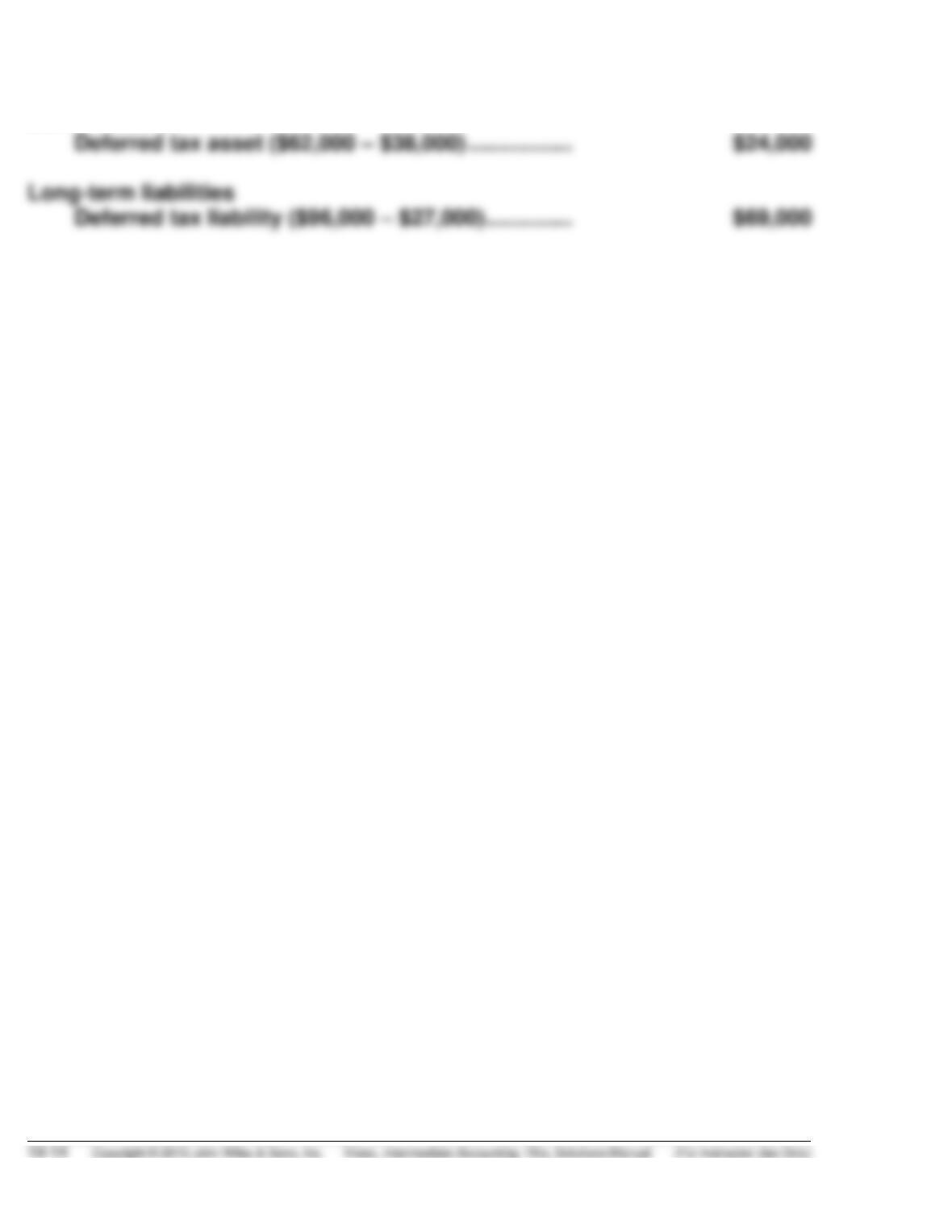
BRIEF EXERCISE 19-15
Current assets
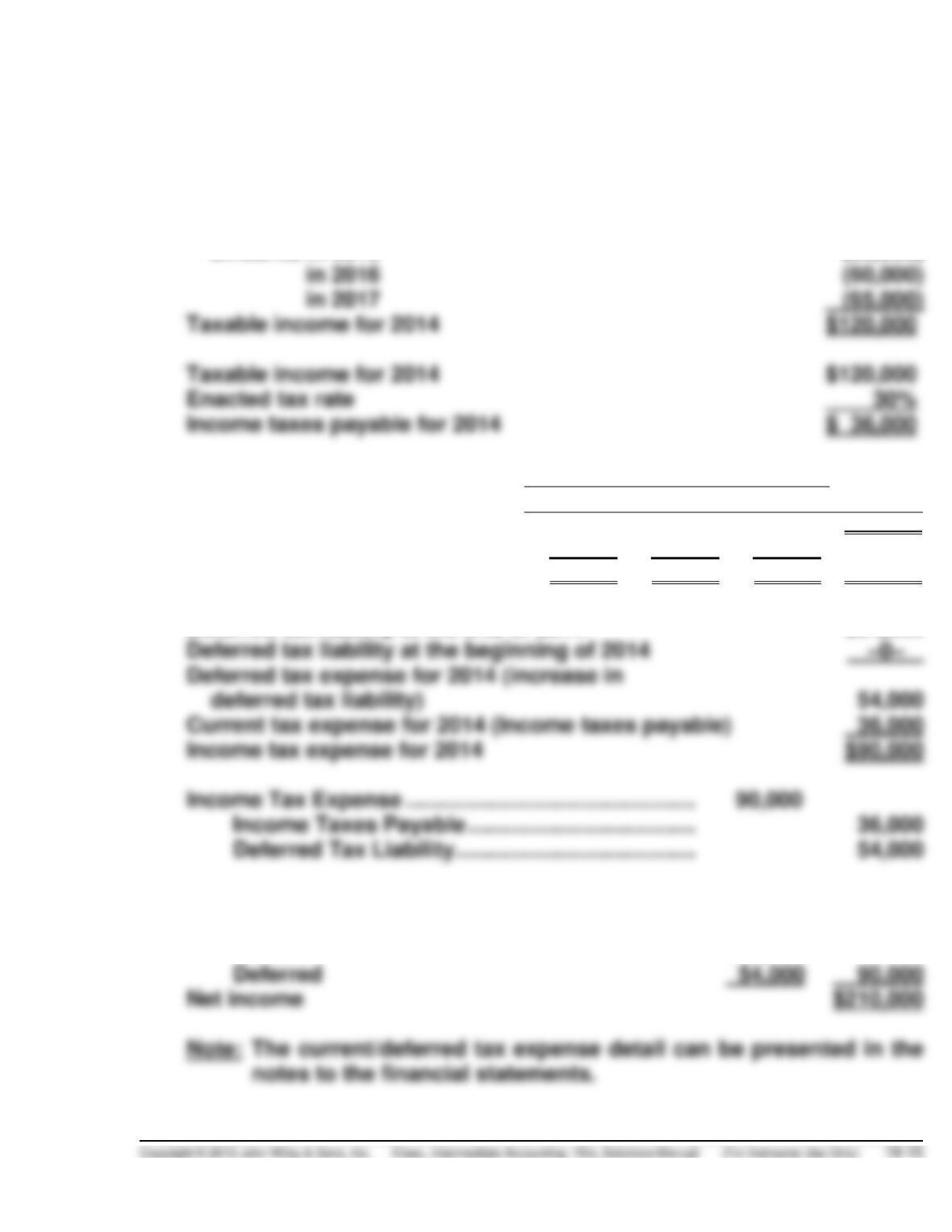
SOLUTIONS TO EXERCISES
EXERCISE 19-1 (15–20 minutes)
(a) Pretax financial income for 2014 $300,000
Temporary difference resulting in future taxable
amounts in 2015 (55,000)
(b)
Future Years
2015
2016
2017
Total
Future taxable (deductible) amounts
$55,000
$60,000
$65,000
$180,000
Tax rate
30%
30%
30%
Deferred tax liability (asset)
$16,500
$18,000
$19,500
$ 54,000
Deferred tax liability at the end of 2014 $54,000
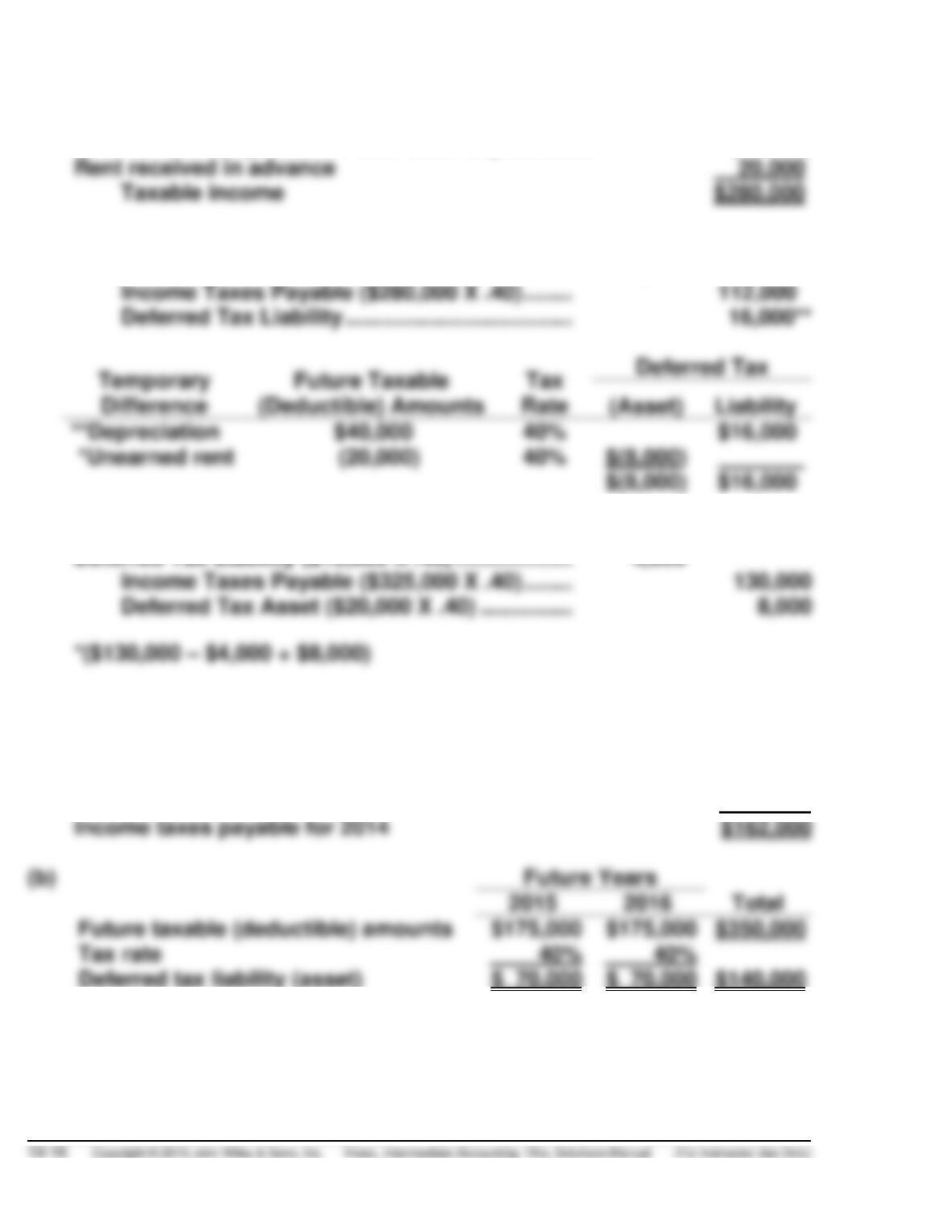
(c) Income before income taxes $300,000
Income tax expense
Current $36,000
EXERCISE 19-2 (15–20 minutes)
(a) Pretax financial income for 2013 $300,000
Excess of tax depreciation over book depreciation (40,000)
(b) Income Tax Expense ……………………………………… 120,000
Deferred Tax Asset ………………………………………… 8,000*
(c) Income Tax Expense ……………………………………… 134,000*
EXERCISE 19-3 (15–20 minutes)
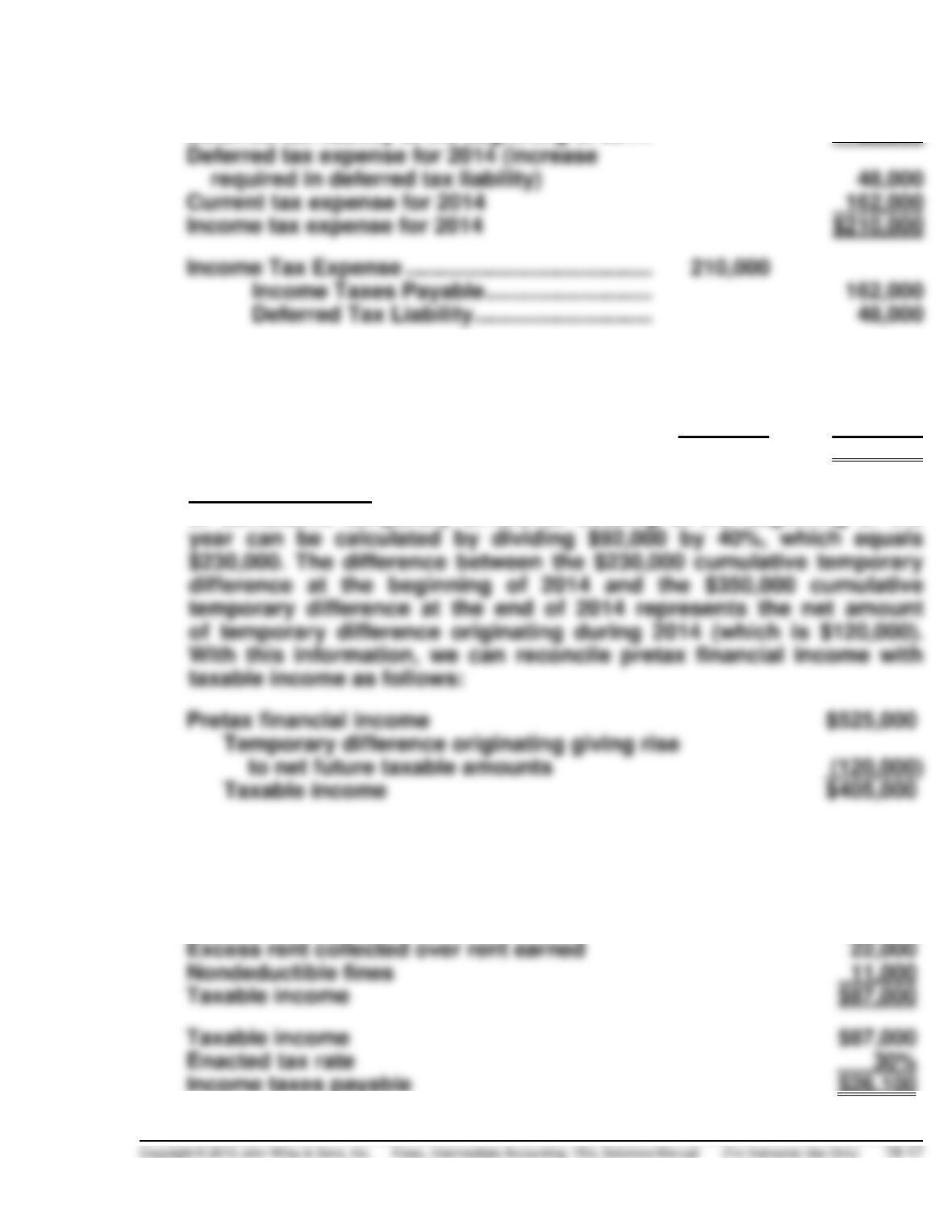
(a) Taxable income for 2014 $405,000
Enacted tax rate 40%
EXERCISE 19-3 (Continued)
Deferred tax liability at the end of 2014 $140,000
Deferred tax liability at the beginning of 2014 92,000
(c) Income before income taxes $525,000
Income tax expense
Current $162,000
Deferred 48,000 210,000
Net income $315,000
Note to instructor: Because of the flat tax rate for all years, the amount
of cumulative temporary difference existing at the beginning of the
EXERCISE 19-4 (15–20 minutes)
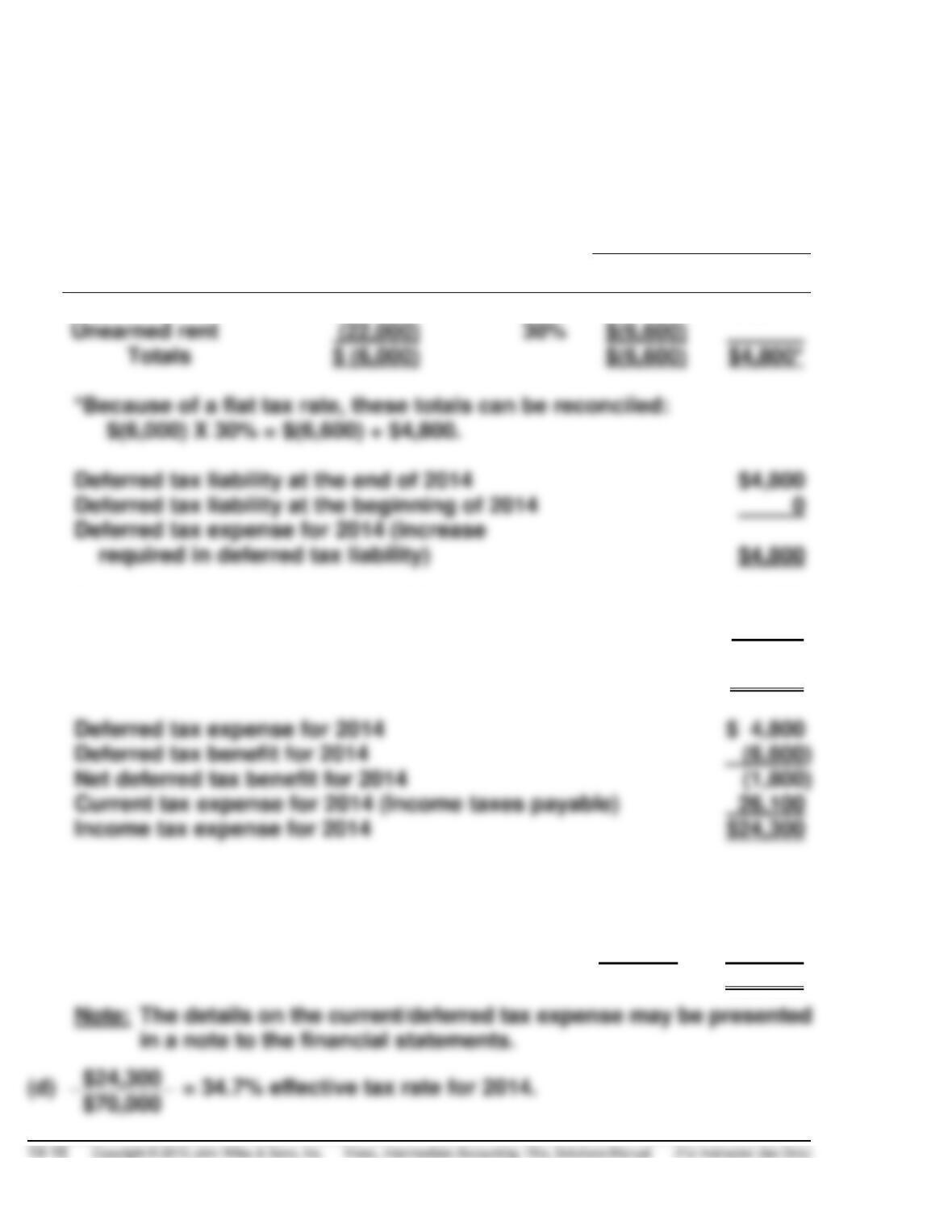
(a) Pretax financial income for 2014 $70,000
Excess depreciation per tax return (16,000)
EXERCISE 19-4 (Continued)
(b) Income Tax Expense ……………………………………….. 24,300
Deferred Tax Asset ………………………………………….. 6,600
Income Taxes Payable ………………………………. 26,100
Deferred Tax Liability ………………………………… 4,800
Temporary
Difference
Future Taxable
(Deductible) Amounts
Tax
Rate
Deferred Tax
(Asset)
Liability
Depreciation
($16,000
30%
$4,800
Unearned rent
( (22,000)
30%
Totals
Deferred tax asset at the end of 2014 $(6,600
Deferred tax asset at the beginning of 2014 0
Deferred tax benefit for 2014 (increase
required in deferred tax asset) $(6,600)
(c) Income before income taxes $70,000
Income tax expense
Current $26,100
Deferred (1,800) 24,300
Net income $45,700
EXERCISE 19-5 (15–20 minutes)
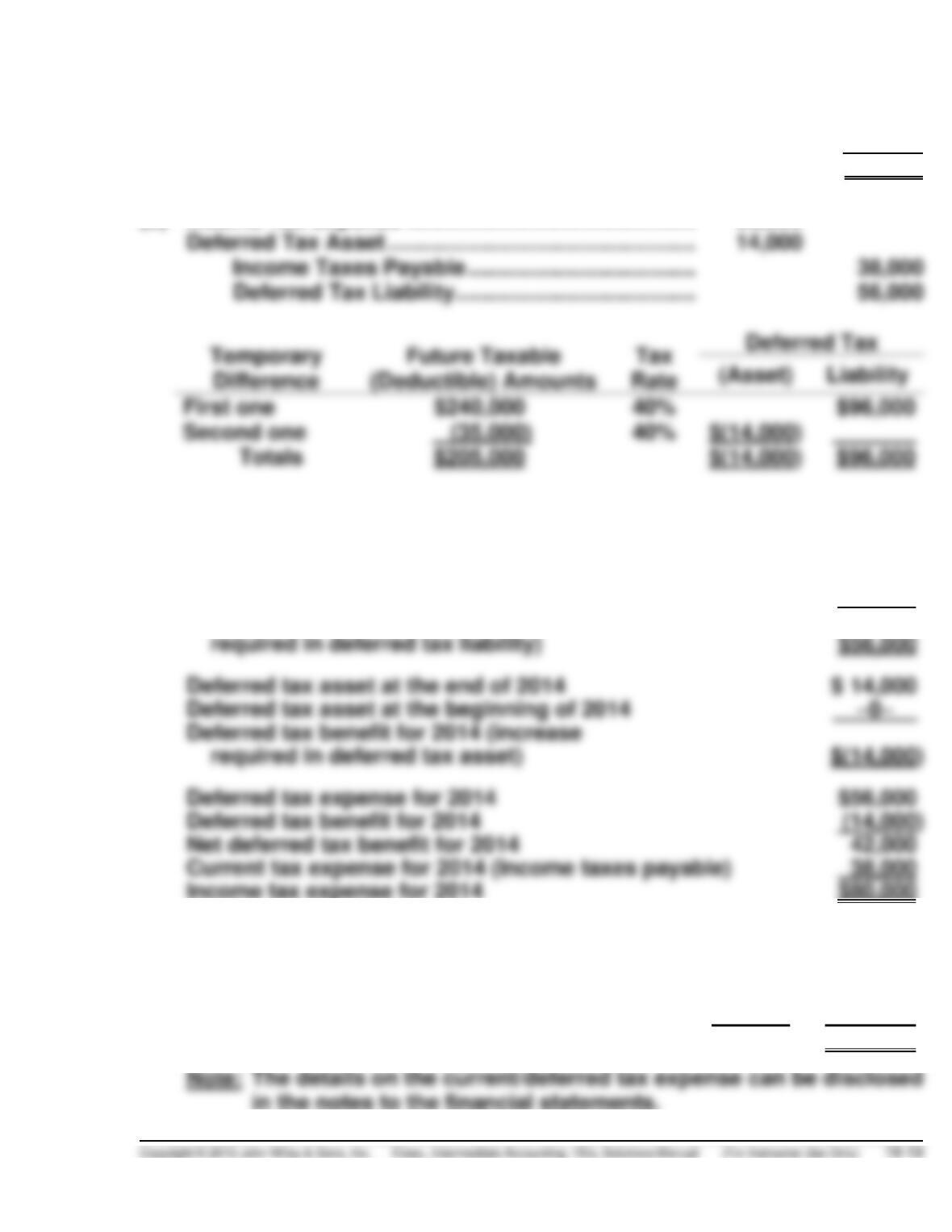
(a) Taxable income $95,000
Enacted tax rate 40%
Income taxes payable $38,000
(b) Income Tax Expense ……………………………………….. 80,000
*Because of a flat tax rate, these totals can be reconciled:
$205,000 X 40% = $(14,000) + $96,000.
Deferred tax liability at the end of 2014 $96,000
Deferred tax liability at the beginning of 2014 40,000
Deferred tax expense for 2014 (increase
(c) Income before income taxes $200,000
Income tax expense
Current $38,000
Deferred 42,000 80,000
Net income $120,000
EXERCISE 19-5 (Continued)
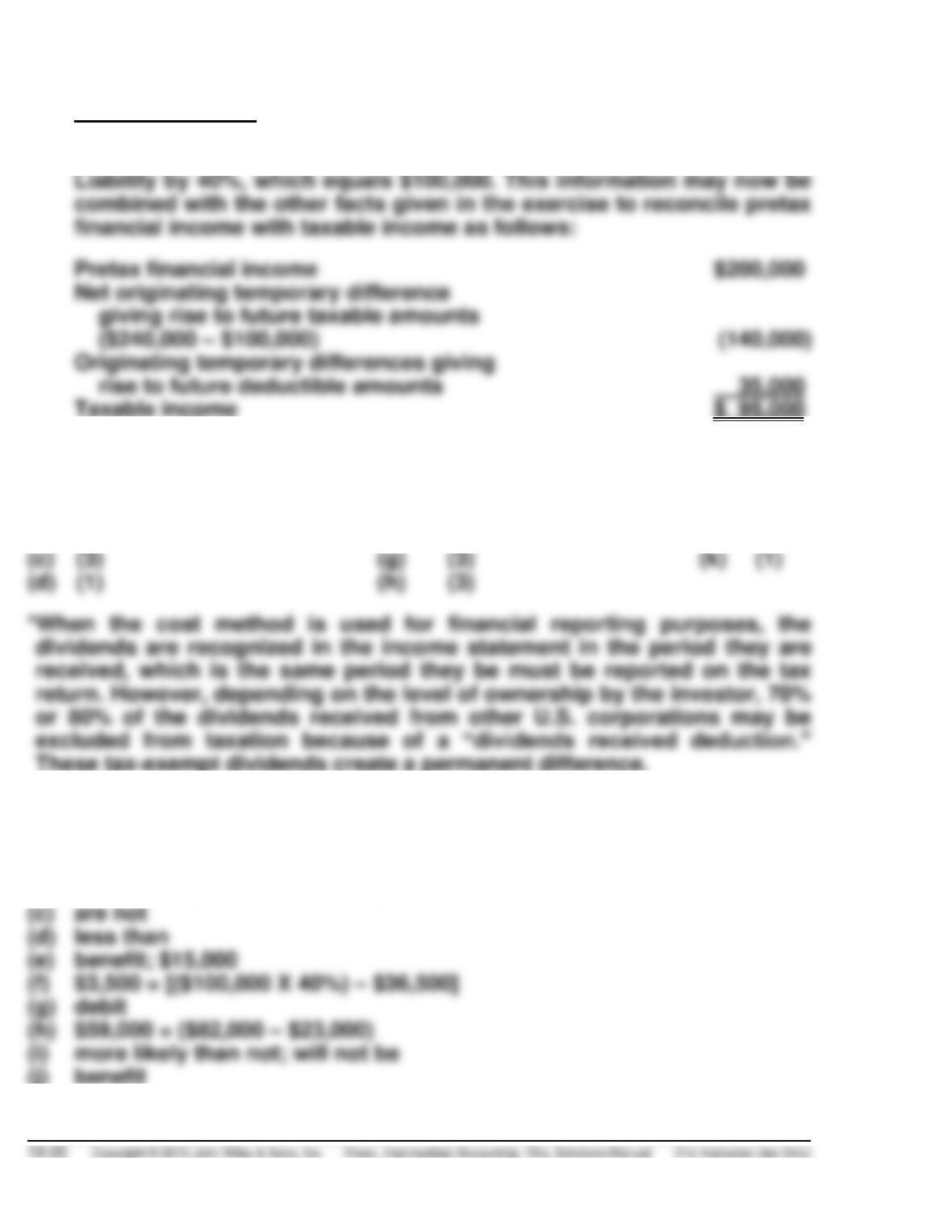
Note to instructor: Because of the flat tax rate for all years, the amount
of cumulative temporary difference existing at the beginning of the
year can be calculated by dividing the $40,000 balance in Deferred Tax
EXERCISE 19-6 (10–15 minutes)
(a) (2) (e) (2) (i) (3)*
(b) (1) (f) (2) (j) (1)
EXERCISE 19-7 (10–15 minutes)
(a) greater than
(b) $190,000 = ($76,000 divided by 40%)