19–79
FINANCIAL REPORTING PROBLEM
(a) 1. Per P&G’s 2009 income statement:
Provision for income taxes ………………………. $ 4,032 million
2. Per P&G’s June 30, 2009 balance sheet:
In current assets:
3. Per P&G’s 2009 statement of cash flows:
In cash flows provided by operating
activities:
Deferred income taxes ………………………… $ 596 million
In supplemental disclosure:
Cash payments for income taxes ………… $ 3,248 million
19–80
FINANCIAL REPORTING PROBLEM (Continued)
Deferred Tax Assets
Pension and postretirement benefits ……………………………… $ 1,395
Stock-based compensation …………………………………………… 1,182
Unrealized loss on financial and
foreign exchange transactions ……………………………………. 577
$ 5,218
Deferred Tax Liabilities
Goodwill and other intangible assets ……………………………… $11,922
19–81
COMPARATIVE ANALYSIS CASE
(a) 2009 provision for income taxes (In Millions):
Coca-Cola: Current portion ………………………………….. $1,687
Deferred portion …………………………………. 353
Total expense ……………………………… $2,040
(b) 2009 income tax payments (In Millions):
Coca-Cola ……………………………………………………………………. $1,534
PepsiCo (Note 14) ………………………………………………………… $1,498
(d)
(In Millions)
Coca-Cola
PepsiCo
1.
Gross deferred tax assets
$2,876
$2,979
Gross deferred tax liabilities
3,595
2,661
(e) Net operating loss carryforwards at year-end 2009:
Coca-Cola had $3,255 million of operating loss carryforwards available
19–82
FINANCIAL STATEMENT ANALYSIS CASE
(a) Of the total provision for income taxes (reported in the income
statement) the “current taxes” portion represents the taxes payable in
(b) Future taxable amounts increase taxable income relative to pretax
financial income in the future due to temporary differences existing at
the balance sheet date. Future deductible amounts decrease taxable
income relative to pretax financial income in the future due to existing
temporary differences.
(c) The carryback and carryforward provisions will affect the amounts to
be reported for the resulting deferred tax asset and deferred tax liability.
In computing deferred tax account balances to be reported at a balance
sheet date, the appropriate enacted tax rate is applied to future taxable
For future taxable amounts:
1. If taxable income is expected in the year that a future taxable
amount is scheduled, use the enacted rate for that future year to
calculate the related deferred tax liability.
19–83
FINANCIAL STATEMENT ANALYSIS CASE (Continued)
2. If an NOL is expected in the year that a future taxable amount is
scheduled, use the enacted rate of what would be the prior year
the NOL would be carried back to or the enacted rate of the future
year to which the carryforward would apply, whichever is appropriate,
to calculate the related deferred tax liability.
For future deductible amounts:
19–84
ACCOUNTING, ANALYSIS, AND PRINCIPLES
Accounting
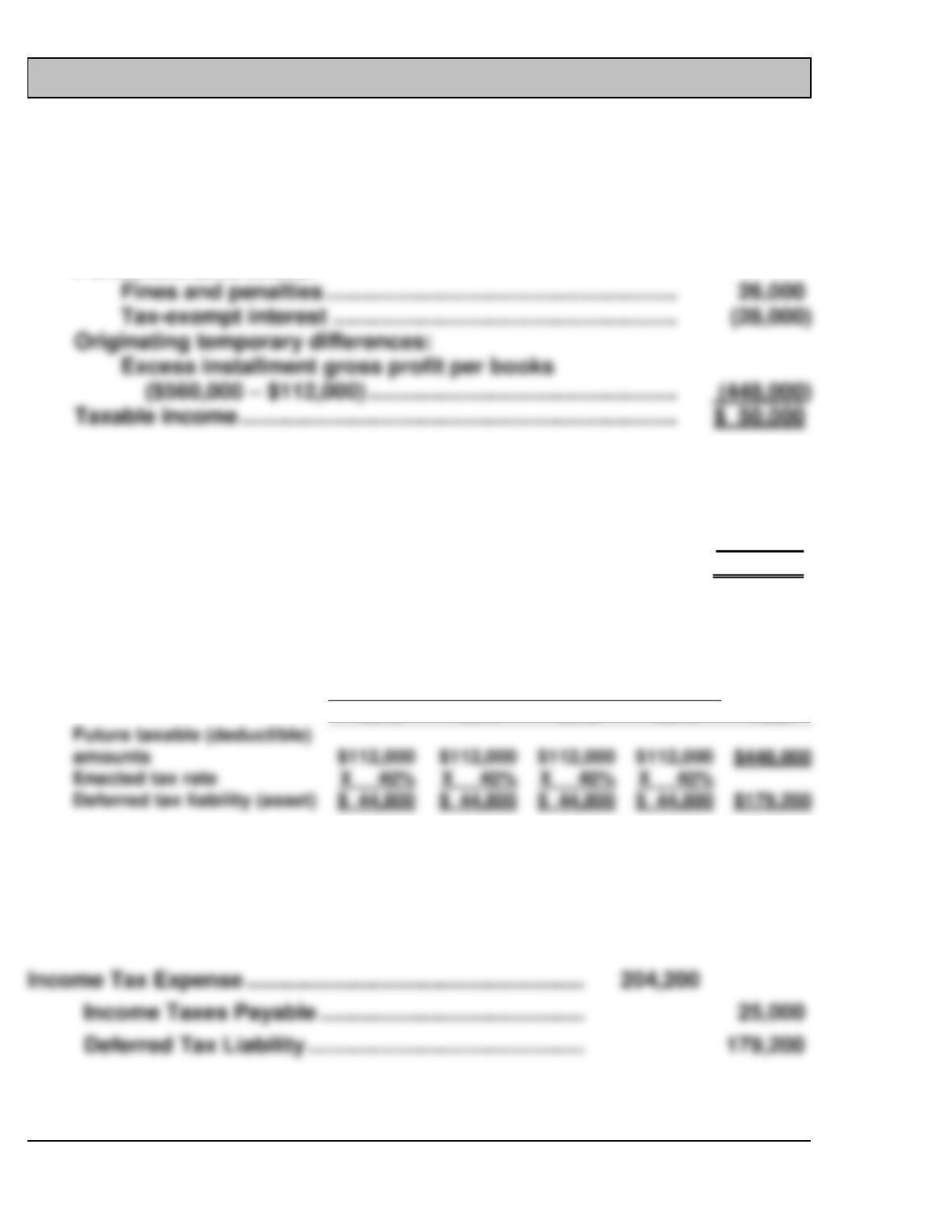
Taxable income for 2012:
Pretax financial income …………………………………………………. $500,000
Permanent differences:
Income taxes payable for 2012:
Taxable income …………………………………………………………….. $ 50,000
2012 Income tax rate ……………………………………………………… X 50%
Income taxes payable ……………………………………………………. $ 25,000
Allman has future taxable amounts arising from temporary differences as
follows:
Future Years
2013
2014
2015
2016
Total
Enacted tax rate
Deferred tax liability (asset)
$ 44,800
The $179,200 is a deferred tax liability because the temporary difference is
from future taxable amounts. The deferred tax liability needed = $179,200.
Journal entry:
19–85
ACCOUNTING, ANALYSIS, AND PRINCIPLES (Continued)
Analysis
The temporary difference in this case is due to the installment receivable.
The income tax expense portion of the income statement would look as
follows:
Income before income taxes ………………………………….
$500,000
Current …………………………..…………………………….
Deferred …………………………..…………………………..
Principles
We can use the conceptual framework to determine that deferred taxes
19–86
PROFESSIONAL RESEARCH
(a) According to FASB ASC 740-10–30-18 (Income Taxes, Overall, Initial
Measurement), future realization of the tax benefit of an existing
(b) According to FASB ASC 740-10–30-18 (Income Taxes, Overall, Initial
Measurement):
The following four possible sources of taxable income may be
available under the tax law to realize a tax benefit for deductible
temporary differences and carryforwards:
a. Future reversals of existing taxable temporary differences
d. Tax-planning strategies (see paragraph 740-10–30-19) that would, if
necessary, be implemented to, for example:
(1) Accelerate taxable amounts to utilize expiring carryforwards
(2) Change the character of taxable or deductible amounts from
ordinary income or loss to capital gain or loss
(3) Switch from tax-exempt to taxable investments.
19–87
PROFESSIONAL RESEARCH (Continued)
(c) According to FASB ASC 740-10-30 (Income Taxes, Overall, Initial
Measurement):
30–19 In some circumstances, there are actions (including elections
for tax purposes) that:
This Subtopic refers to those actions as tax-planning strategies.
An entity shall consider tax-planning strategies in determining
the amount of valuation allowance required. Significant expenses
to implement a tax-planning strategy or any significant losses
that would be recognized if that strategy were implemented (net
30–22 Examples (not prerequisites) of positive evidence that might
support a conclusion that a valuation allowance is not needed
when there is negative evidence include, but are not limited to,
the following:
19–88
PROFESSIONAL RESEARCH (Continued)
30–23 An entity shall use judgment in considering the relative impact
of negative and positive evidence. The weight given to the poten-
tial effect of negative and positive evidence shall be commensu-
30–24 Future realization of a tax benefit sometimes will be expected for
a portion but not all of a deferred tax asset, and the dividing line
between the two portions may be unclear. In those circum–
stances, application of judgment based on a careful assessment
of all available evidence is required to determine the portion of a
deferred tax asset for which it is more likely than not a tax benefit
will not be realized.
19–89
PROFESSIONAL SIMULATION
Journal Entries
Income Tax Expense …………………………………………… 40,840
Deferred Tax Asset ……………………………………………… 1,200
Deferred Tax Liability ……………………………………. 20,000
Income Taxes Payable ………………………………….. 22,040
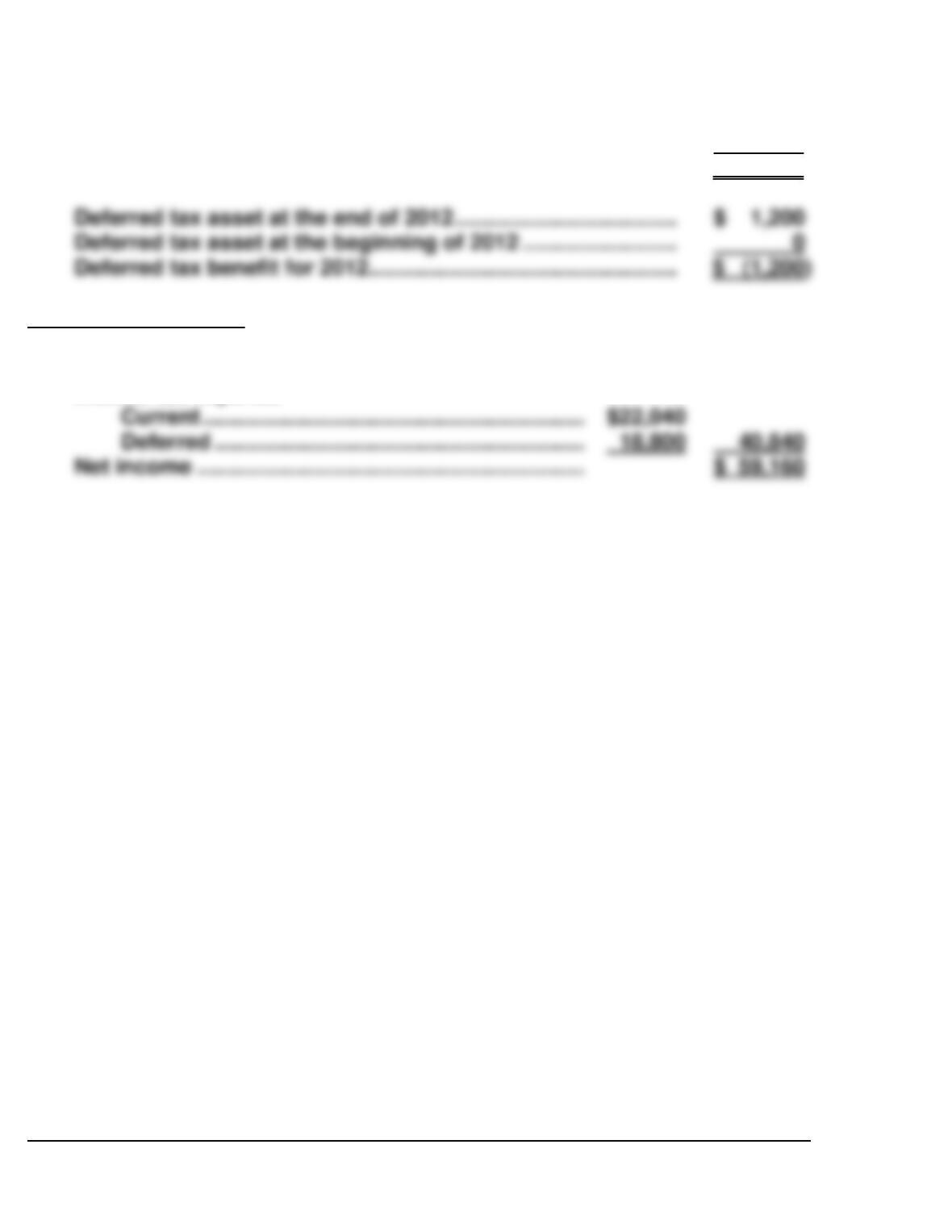
Calculation of Deferred Taxes
Calculation of Taxable Income
Pretax financial income …………………………………………………. $100,000
Permanent differences
Fine for pollution ……………………………………………………. 3,500
Tax-exempt interest …………………………..…………………… (1,400)
19–90
PROFESSIONAL SIMULATION (Continued)
Deferred tax liability at the end of 2012 …………………………... $ 20,000
Deferred tax liability at the beginning of 2012 …………………. 0
Deferred tax expense for 2012 ……………………………………….. $ 20,000
Financial Statements
Income before income taxes …………………………….. $100,000
Income tax expense
19–91
IFRS CONCEPTS AND APPLICATION
IFRS19-1
The accounting for income taxes in IFRS is covered in IAS 12 “Income
Taxes”.
IFRS19-2
Both IFRS and GAAP use the asset and liability approach for recording
deferred tax assets. In general, the differences between IFRS and GAAP
involve limited differences in the exceptions to the asset-liability approach,
some minor differences in the recognition, measurement and disclosure
criteria, and differences in implementation guidance. Following are some
key elements for comparison.
• IFRS uses the enacted tax rate or substantially enacted tax rate
(Substantially enacted means virtually certain). For GAAP the enacted
tax rate must be used.
• The tax effects related to certain items are reported in equity under
IFRS. That is not the case under GAAP, which charges or credits the
tax effects to income.
19–92
IFRS19-3
The IASB and the FASB have been working to address some of the
differences in the accounting for income taxes. Some of the issues under
discussion are the term “probable” under IFRS for recognition of a
deferred tax asset, which might be interpreted to mean “more likely than
IFRS19-4
Deferred tax accounts are reported on the statement of financial position
as assets and liabilities. They should be classified in a net non-current
amount.
IFRS19-5
19–93
IFRS19-7
Income Tax Refund Receivable ($350,000 X .40) .. 140,000
Benefit Due to Loss Carryback ………………….. 140,000
IFRS19-9
Non-current liabilities
Deferred tax liability ($69,000 – $24,000) …….. $45,000
IFRS19–11
(a) Income Tax Expense ………………………………… 290,000
Deferred Tax Asset …………………………………… 50,000
Income Taxes Payable ……………………….. 340,000
19–94
IFRS19-11 (Continued)
Deferred tax asset at the end of 2013 …………………………….. $200,000
Deferred tax asset at the beginning of 2012 …………………… 150,000
(b) The journal entry at the end of 2013:
Income Tax Expense ………………………………………. 30,000
Deferred Tax Asset …………………………………… 30,000
Pretax financial income for 2013 …………………………………… $ X
Originating difference which will result
in future deductible amounts …………………………………….. 125,000a
Taxable income for 2013 …………………………..………………….. $850,000
IFRS19–12
(a) According to IAS 12, paragraph 34, “A deferred tax asset shall be
recognised for the carryforward of unused tax losses and unused tax
19–95
IFRS19-12 (Continued)
(b) This question relates to the information found in paragraph 36, which
states, “An entity considers the following criteria in assessing the
probability that taxable profit will be available against which the
unused tax losses or unused tax credits can be utilised:
(1) whether the entity has sufficient taxable temporary differences
relating to the same taxation authority and the same taxable entity,
which will result in taxable amounts against which the unused tax
losses or unused tax credits can be utilised before they expire;
To the extent that it is not probable that taxable profit will be available
against which the unused tax losses or unused tax credits can be
utilised, the deferred tax asset is not recognised.
(c) Paragraph 30 discusses tax planning opportunities: “Tax planning
opportunities are actions that the entity would take in order to create
or increase taxable income in a particular period before the expiry of a
tax loss or tax credit carryforward. For example, in some jurisdictions,
taxable profit may be created or increased by:
(1) electing to have interest income taxed on either a received or
receivable basis;
19–96
IFRS19-13
(a) 1. Per M&S’s 2010 consolidated income statement:
Total income tax expense …………………………. £179.7 million
2. Per M&S’s 3 April, 2010 statement of financial position:
In non-current assets:
3. Per M&S’s 2010 statement of cash flows:
In cash flows provided by operating activities:
Tax paid …………………………………………….. £120.7 million
(d) Significant components of M&S’s deferred tax assets and liabilities at
3 April, 2010 were as follows:
Deferred Tax Assets
Pension temporary differences……………………………… £ 81.2