
PROBLEM 19-6
1.
Temporary
Difference
Future Taxable
(Deductible) Amounts
Tax
Rate
Deferred Tax
(Asset)
Liability
2013
$ 300
30%a
$ 90
2014
300
30%b
90
2015
300
30%c
90
2016
300
35%d
2016
2017
300
35%e
MOONEY CO.
Balance Sheet
December 31, 2012
Other assets (noncurrent)
Deferred tax asset ($560 – $480) ………………………………… $80
2.
Temporary
Difference
Future Taxable
(Deductible) Amounts
Tax
Rate
Deferred Tax
(Asset)
Liability
2013
$ 300
30%a
$ 90
2014
300
30%b
90
2015
300
30%c
90
2015
30%c
2016
300
35%d
19–62
PROBLEM 19-6 (Continued)
ROESCH CO.
Balance Sheet
December 31, 2012
PROBLEM 19-7
(a) Before deferred taxes can be computed, the amount of cumulative tem–
porary difference existing at the end of each year must be computed:
2012
2013
2014
Pretax financial income
$130,000
($70,000
($70,000
Taxable income
90,000
( 90,000
( 90,000
2012
Income Tax Expense ……………………………………….. 52,000
Income Taxes Payable ………………………………. 36,000
Deferred Tax Liability ………………………………… 16,000
Temporary
Difference
Future Taxable
(Deductible)
Amounts
Tax
Rate
December 31, 2013
Deferred Tax
(Asset)
Liability
Installment Accounts
Receivable
(
$ 40,000
40%a
$16,000
aTax rate enacted for 2012.
19–64
PROBLEM 19-7 (Continued)
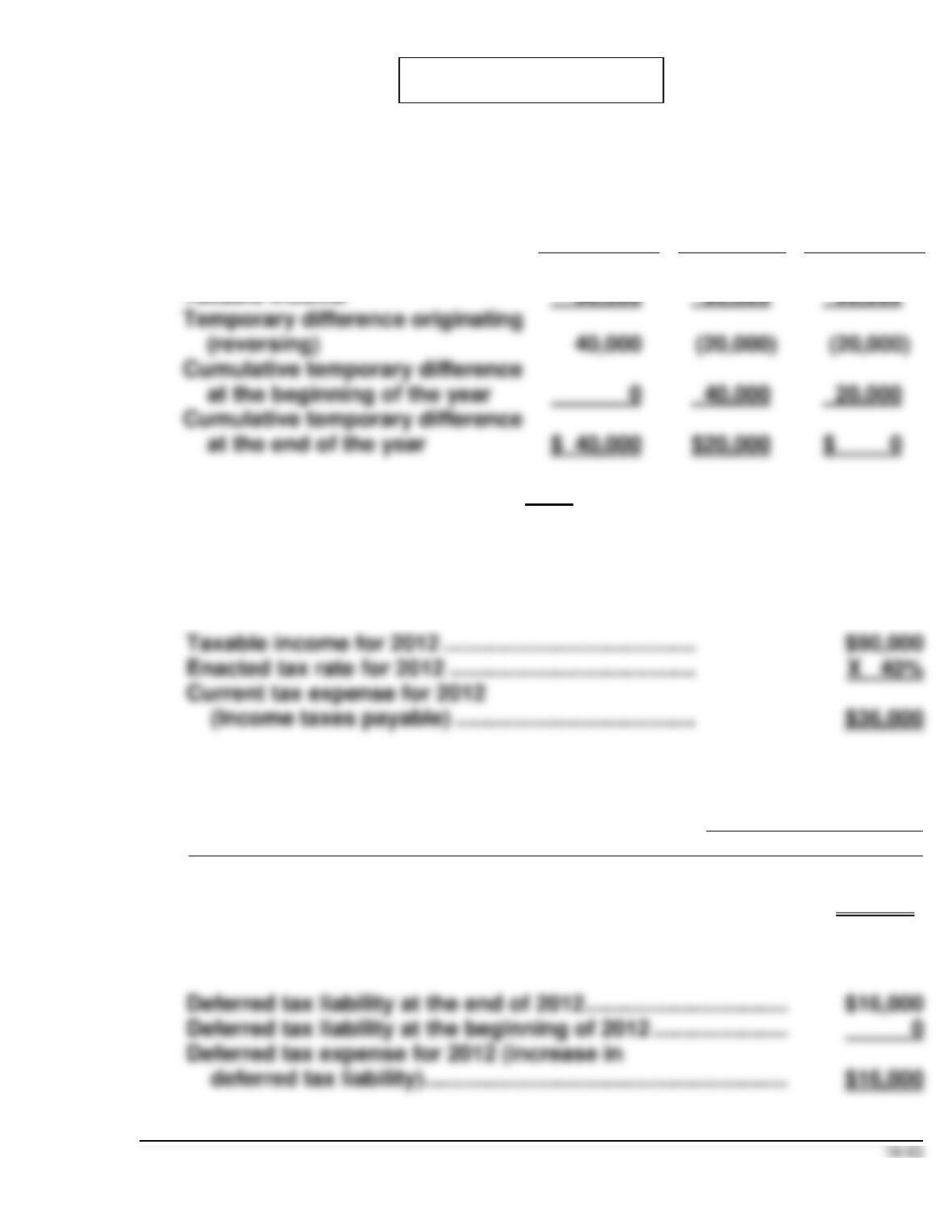
Deferred tax expense for 2012 ……………………………………….. $16,000
Current tax expense for 2012 (Income taxes payable) ……… 36,000
Income tax expense for 2012 …………………………………………. $52,000
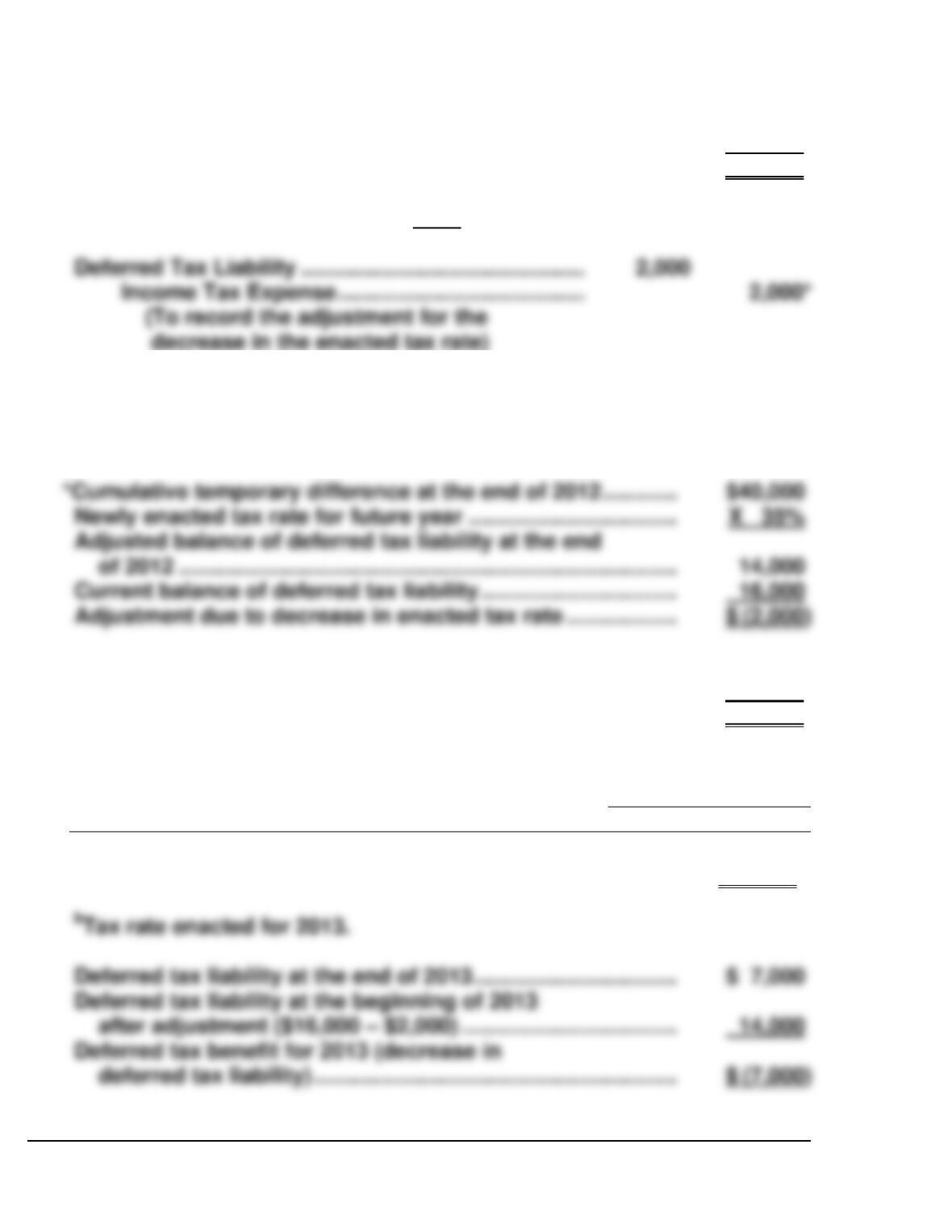
2013
Income Tax Expense …………………………..…………… 24,500
Deferred Tax Liability ………………………………………. 7,000
Income Taxes Payable ………………………………. 31,500
Taxable income for 2013 …………………………..…………………… $90,000
Enacted tax rate for 2013……………………………………………….. X 35%
Current tax expense for 2013 (Income taxes payable) ……… $31,500
Temporary
Difference
Future Taxable
(Deductible) Amounts
Tax
Rate
December 31, 2013
Deferred Tax
(Asset)
Liability
Installment Accounts
Receivable
$20,000
35%b
$ 7,000
PROBLEM 19-7 (Continued)
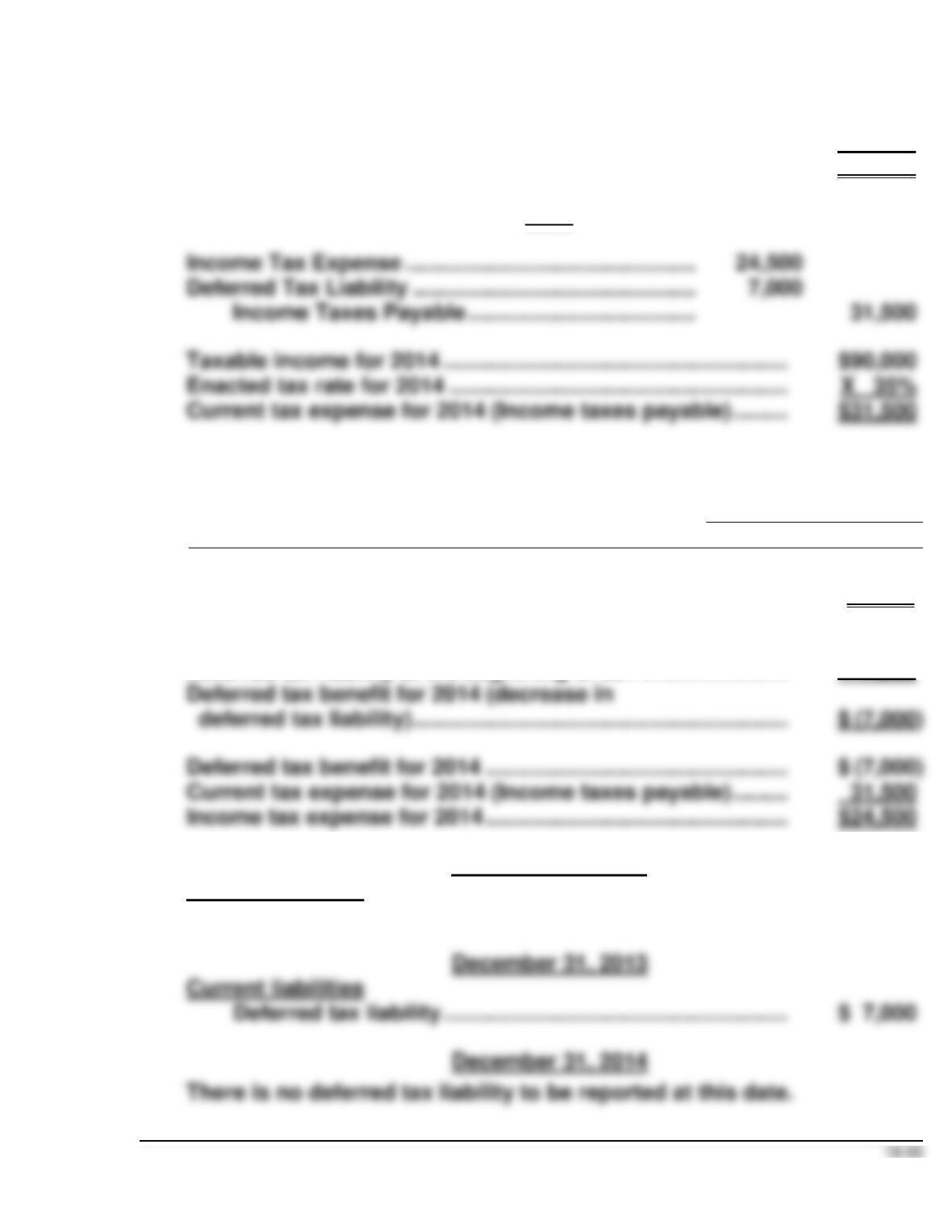
Deferred tax benefit for 2013 …………………………………………. $ (7,000)
Current tax expense for 2013 (Income taxes payable) ……… 31,500
Income tax expense for 2013 …………………………………………. $24,500
2014
Temporary
Difference
Future Taxable
(Deductible)
Amounts
Tax
Rate
December 31, 2014
Deferred Tax
(Asset)
Liability
Installment Accounts
Receivable
(
$—0—
30%
$—0—
Deferred tax liability at the end of 2014 …………………………... $ 0
Deferred tax liability at the beginning of 2014 …………………. 7,000
(b) December 31, 2012
Current liabilities
Deferred tax liability ……………………………………………….. $16,000
19–66
PROBLEM 19-7 (Continued)
(c) 2012
Income before income taxes ………………………………… $130,000
Income tax expense
2013
Income before income taxes ………………………………… $70,000
Income tax expense
2014
Income before income taxes ………………………………… $70,000
Income tax expense
PROBLEM 19-8
(a)
Temporary
Difference
Future Taxable
(Deductible) Amounts
Tax
Rate
Deferred Tax
(Asset)
Liability
Depreciation
$(60,000)*
40%
$(24,000)
(b) Income Tax Expense …………………………………….. 106,000
Deferred Tax Asset ……………………………………….. 24,000
Income Taxes Payable ……………………………. 130,000
$130,000 taxes due for 2012 ÷ 40% 2012 tax rate = $325,000 taxable
income for 2012.
(c) Income before income taxes ………………………….. $265,000a
Income tax expense
Current ………………………………………………….. $130,000
Deferred ………………………………………………… (24,000) 106,000
Net income …………………………………………………… $159,000
19–68
PROBLEM 19-8 (Continued)
Book Depreciation
Tax Depreciation
bDifference
2012
$120,000
$ 60,000*
($ 60,000
2013
120,000
120,000
0
(d)
Temporary
Difference
Future Taxable
(Deductible) Amounts
Tax
Rate
Deferred Tax
(Asset)
Liability
Depreciation
$ (60,000)
40%
$(24,000)
40%
(75,000)
40%
$(210,000)
Temporary
Difference
Resulting Deferred Tax
Related Balance
Sheet Account
Classification
(Asset)
Liability
Depreciation
$(24,000)
Plant Assets
Noncurrent
Unearned rent
(30,000)
Unearned Rent
Current
Unearned rent
(30,000)
Unearned Rent
Noncurrent
Totals
$(84,000)
2014
2015
2016
2017
0
( (60,000)
$600,000
($ 0
PROBLEM 19-8 (Continued)
(e) Income Tax Expense ………………………………………. 44,000
Deferred Tax Asset …………………………………………. 60,000
Income Taxes Payable ……………………………… 104,000
$104,000 taxes due for 2013 ÷ 40% 2013 tax rate = $260,000 taxable
income for 2013.
(f) Income before income taxes ……………………………. $110,000d
Income tax expense
Current ……………………………………………………. $104,000
Deferred ………………………………………………….. (60,000) 44,000
Net income …………………………………………………….. $ 66,000
19–70
PROBLEM 19-9
(a) Pretax financial income …………………………………………………. $100,000
Permanent differences:
Fine for pollution ……………………………………………………. 3,500
Taxable income …………………………………………………………….. $ 62,000
(b)
Temporary
Difference
Future Taxable
(Deductible) Amounts
Tax
Rate
Deferred Tax
(Asset)
Liability
Warranty costs
$ (5,000)
40%
$(2,000)
Construction profits
25,000
40%
$10,000
Depreciation
40%
Totals
$(2,000)
(c) Income Tax Expense …………………………..…………… 40,800
Deferred Tax Asset …………………………..……………… 2,000
Deferred Tax Liability ………………………………… 18,000
Income Taxes Payable ………………………………. 24,800
PROBLEM 19-9 (Continued)
Deferred tax asset at the end of 2013 ……………………………… $ 2,000
Deferred tax asset at the beginning of 2013 ……………………. 0
Deferred tax benefit for 2013 …………………………………………. $ (2,000)
(d) Income before income taxes ……………………………. $100,000
Income tax expense

19–72
TIME AND PURPOSE OF CONCEPTS FOR ANALYSIS
CA 19-1 (Time 15–20 minutes)
Purpose—to provide the student an opportunity to explain the objectives in accounting for income taxes
in the financial statements and the basic principles that are applied in meeting the objectives. The
student is also required to list the steps involved in the annual computation of deferred income taxes.
CA 19-2 (Time 20–25 minutes)
Purpose—to provide the student an opportunity to discuss the principles of the asset-liability method,
how the deferred tax effects of temporary differences are computed, and how the deferred tax
consequences of temporary differences are classified on a balance sheet.
CA 19-3 (Time 20–25 minutes)
Purpose—to develop an understanding of temporary and permanent differences. The student is
required to explain the nature of four differences and to explain why each is a permanent or temporary
difference. Two of the four situations are challenging. Also, the nature of and the classification of deferred
tax accounts are examined.
CA 19-4 (Time 20–25 minutes)
Purpose—to develop an understanding of deferred taxes and balance sheet disclosure. This case has
two parts. In the first part, the student is required to indicate whether deferred income taxes should be
recognized for each of four items. In the second part, the student must discuss the conditions under
which deferred taxes will be classified as a noncurrent item in the balance sheet.
CA 19-5 (Time 20–25 minutes)
Purpose—to develop an understanding of how to determine the appropriate tax rate to use in comput-
ing deferred taxes when different tax rates are enacted for various years affected by existing temporary
differences.
CA 19-6 (Time 20–25 minutes)
Purpose—to develop an understanding of the concept of future taxable amounts and future deductible
amounts. Also, to develop an understanding of how the carryback and carryforward provisions affect
the computation of deferred tax assets and liabilities when there are multiple tax rates enacted for the
various periods affected by existing temporary differences.
CA 19-7 (Time 20–25 minutes)
Purpose—to provide the student an opportunity to examine the income effects of deferred taxes,
including ethical issues.
19–73
SOLUTIONS TO CONCEPTS FOR ANALYSIS
CA 19-1
(a) The objectives in accounting for income taxes are:
1. To recognize the amount of taxes payable or refundable for the current year.
2. To recognize deferred tax liabilities and assets for the future tax consequences of events
that have been recognized in the financial statements or tax returns.
(c) The procedures for the annual computation of deferred income taxes are as follows:
1. Identify: (1) the types and amounts of existing temporary differences and (2) the nature and
amount of each type of operating loss and tax credit carryforward and the remaining length
of the carryforward period.
2. Measure the total deferred tax liability for taxable temporary differences using the enacted
tax rate.
CA 19-2
(a) The following basic principles are applied in accounting for income taxes at the date of the
financial statements:
1. A current tax liability or asset is recognized for the estimated taxes payable or refundable
(b) Dexter should do the following in accounting for the temporary differences.
1. Identify the types and amounts of existing temporary differences. The depreciation policies
give rise to a temporary difference that will result in net future taxable amounts (because
19–74
CA 19-2 (Continued)
2. Measure the total deferred tax liability for the taxable temporary difference using the
enacted marginal tax rate.
(c) Deferred tax accounts are reported on the balance sheet as assets and liabilities. They should be
classified in a net current and a net noncurrent amount. An individual deferred tax liability or
asset is classified as current or noncurrent based on the classification of the related asset or
liability for financial reporting. A deferred tax asset or liability is considered to be related to an
asset or liability if reduction of the asset or liability will cause the temporary difference to reverse
or turn around. A deferred tax liability or asset that is not related to an asset or liability for
CA 19-3
(a) 1. Temporary difference. The full estimated three years of warranty costs reduce the current
year’s pretax financial income, but will reduce taxable income in varying amounts each
respective year, as paid. Assuming the estimate as to each warranty is valid, the total
2. Temporary difference. The difference between the tax basis and the reported amount (book
basis) of the depreciable property will result in taxable or deductible amounts in future years
when the reported amount of the asset is recovered (through use or sale of the asset);
hence, it is a temporary difference.
3. Temporary difference and permanent difference. The investor’s share of earnings of an
investee (other than subsidiaries and corporate joint ventures) accounted for by the equity
method is included in pretax financial income while only 20% of dividends received from
19–75
CA 19-3 (Continued)
4. Temporary difference. For financial reporting purposes, any gain experienced in an
involuntary conversion of a nonmonetary asset to a monetary asset must be recognized in
the period of conversion. For tax purposes, this gain may be deferred if the total proceeds
are reinvested in replacement property within a certain period of time. When such a gain is
CA 19-4
Part A.
(a) Deferred income taxes are reported in the financial statements when temporary differences exist
at the balance sheet date. Deferred taxes are never reported for permanent differences.
The tax consequences of most events recognized in the financial statements for a year are
included in determining income taxes currently payable. However, tax laws often differ from the
A deferred tax liability is reported for the increase in taxes payable in future years as a result of
taxable temporary differences existing at the balance sheet date. A deferred tax asset is reported
for the increase in taxes refundable in future years as a result of deductible temporary differences
existing at the balance sheet date. The most common temporary differences arise from including
revenues or expenses in taxable income in a period later or earlier than the period in which they
are included in pretax financial income.
(b) 1. Gross profit on installment sales—Deferred income taxes would be recognized when gross
profit on installment sales is included in pretax financial income in the year of sale and
19–76
CA 19-4 (Continued)
3. Estimated costs of product warranty contracts—Deferred income taxes should usually be
4. Premiums on officers’ life insurance policies with Gumowski as beneficiary—This is a
permanent difference and deferred income taxes should not be recognized. Premiums on
officers’ life insurance policies with Gumowski as beneficiary should be recognized in
Gumowski Company’s income statement but are not a deductible expense for tax purposes.
Part B.
Deferred income taxes related to a noncurrent asset or liability would be classified as a noncurrent item
in the balance sheet. Deferred income taxes are related to an asset or liability if reduction of the asset
or liability causes the underlying temporary difference to reverse.
CA 19-5
(a) The 45% tax rate would be used in computing the deferred tax liability at December 31, 2012, if a
net operating loss (an NOL) is expected in 2013 that is to be carried back to 2012 (the enacted
tax rate is 45% in 2012). (See discussion below.)
Discussion:
In determining the future tax consequences of temporary differences, it is helpful to prepare a schedule
which shows in which future years existing temporary differences will result in taxable or deductible
amounts. The appropriate enacted tax rate is applied to these future taxable and deductible amounts.
In determining the appropriate tax rate, you must make assumptions about whether the entity will report
taxable income or losses in the various future years expected to be affected by the reversal of existing
temporary differences. Thus, you calculate the taxes payable or refundable in the future due to existing
temporary differences. In making these calculations, you apply the provisions of the tax laws and enacted
tax rates for the relevant periods.
19–77
CA 19-5 (Continued)
For future taxable amounts:
1. If taxable income is expected in the year that a future taxable amount is scheduled, use the
For future deductible amounts:
1. If taxable income is expected in the year that a future deductible amount is scheduled, use the
CA 19-6
(a) Future taxable amounts increase taxable income relative to pretax financial income in the future
due to temporary differences existing at the balance sheet date. Future deductible amounts decrease
taxable income relative to pretax financial income in the future due to existing temporary differences.
(b) The carryback and carryforward provisions will affect the amounts to be reported for the resulting
deferred tax asset and deferred tax liability.
For future taxable amounts:
1. If taxable income is expected in the year that a future taxable amount is scheduled, use the
enacted rate for that future year to calculate the related deferred tax liability.
2. If an NOL is expected in the year that a future taxable amount is scheduled, use the
enacted rate of what would be the prior year the NOL would be carried back to or the enacted
rate of the future year to which the carryforward would apply, whichever is appropriate, to
calculate the related deferred tax liability.
CA 19-7
(a) To realize a sizable deferred tax liability, Acme must have used an accelerated depreciation
method for tax purposes while using straight-line depreciation for its financial statements. Once
the temporary difference reversed, taxable income would exceed financial accounting income.
(b) The deferral of income taxes means that due to temporary differences caused by the difference
in financial accounting principles and tax laws, a company will be able to defer paying its income
taxes (or reaping an income tax benefit) until future periods. The practice of selling-off assets
before the temporary difference reverses means that the company may pay a lesser amount of taxes
to the government. Although some might be concerned that Acme is not paying its “fair share,”
Acme appears to be minimizing its taxes through a tax strategy plan which is perfectly legal. The
federal government has chosen to provide these incentives and there is nothing wrong with Acme
deferring the payable.