CHAPTER 19
Measuring Economic Profit
CHAPTER SUMMARY AND TEACHING OBJECTIVES
This is one of the more quantitative chapters in the text but without putting pencil to paper, students
will probably not understand what economic profit is and how it can be measured. Given the 2002
accounting scandals, how one measures profit is an especially important topic. The purpose of this
chapter is to distinguish economic and accounting measures of profit. How do we know whether a firm
is being successful or not? What is the role of accounting and economic profit? How do we measure
economic profit? What is the relationship between economic profit and a firm’s stock price or market
capitalization?
This is one of the most difficult and yet useful chapters in the text.
1. We want the students to understand the difference between accounting profit and economic
IMPORTANT TERMS
Net operating profit after taxes (NOPAT) one minus the tax rate multiplied by the remainder of
revenue minus the cost of land and labor
Cost of goods sold (COGS) cost that a company incurs in order to manufacture, create, and sell a
product
Selling and general and administrative costs (SG&A) costs incurred by a company that represent
TOPICS AND TEACHING SUGGESTIONS
1. Calculation of Economic Profit
2. Abnormal Net Income and Discounted Cash Flow Models
The abnormal net income model is an approach used by accountants to value a company.
3. Strategic Formulation of Economic Profit
To be useful, economic profit must be included in the development of business strategy.
ANSWERS TO EXERCISES
1. Calculate the added value for each of the following firms.
Microsoft:
Value of output
$2,750
Wages and salaries
400
Cost of capital
Cost of materials
Barclays Bank:
Value of output
$5,730
Wages and salaries
Cost of capital
Cost of material
556
General Motors:
Value of output
Wages and salaries
Cost of capital
15,528
Cost of materials
2. What follows is some standard accounting information for each of the firms shown. Can you
tell which firm is the most successful? Explain.
Boeing
Goodyear
Liz Claiborne
Circuit City
Sales
5601
423
622
1767
Profits
254
26.9
56.2
31.6
Return on sales
4.5%
5.2%
1.8%
Return on equity
10.2
13.9
15
14.5
3. A cost of capital figure for each of the firms is listed below. Explain what this figure means.
Motorola
11.6
Hershey Foods
12.8
Home Depot
12.2
Dillard Department Stores
10.5
Coca-Cola
12.0
Chapter 19: Measuring Economic Profit 89
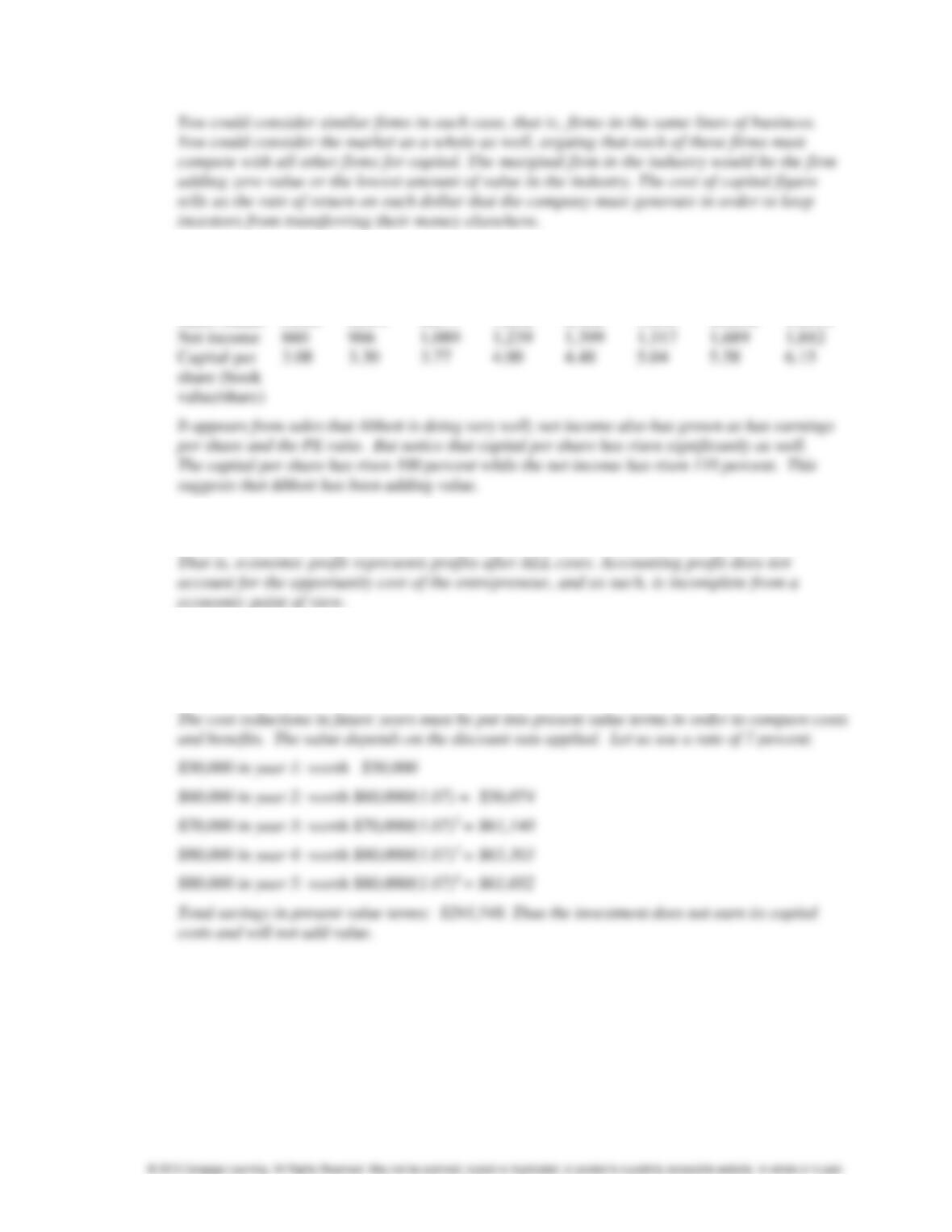
4. Listed below are financial figures for Abbott Labs. How well is Abbott doing? Explain
your answer.
89
90
91
92
93
94
95
96
Sales ($mil)
5,380
6,159
6,877
7,852
8,408
9,156
10,012
11,014
Net income
1,089
1,239
1,399
1,517
1,689
1,882
value/share)
5. Explain why economic profit provides a better measure of profit than accounting profit.
Economic profit is total revenue minus total costs. Total costs include the cost of capital.
6. The manager of Global X is contemplating the purchase of a new machine that will cost
$300,000 and has a useful life of five years. The machine is expected to yield cost reductions
to Global X of $50,000 in year 1, $60,000 in year 2, $70,000 in year 3, and $80,000 in each
year in years 4 and 5. Will the acquisition of the machine add value?
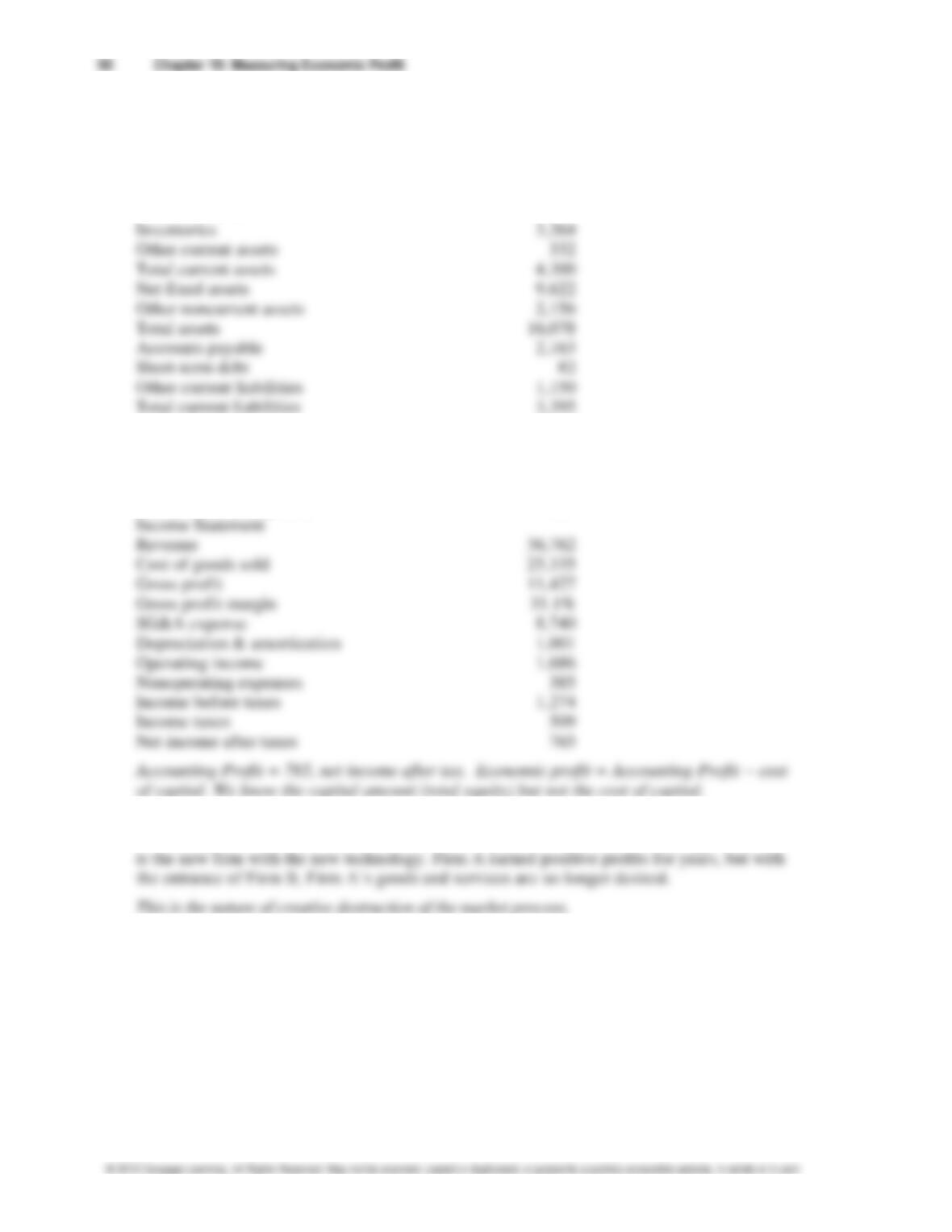
7. Using the following balance sheet and income statement information, calculate accounting
profit and economic profit:
Balance Sheet
Jan 01
Cash
57
Net receivables
547
Inventories
Other current assets
Total current assets
Net fixed assets
9,622
Other noncurrent assets
Total assets
16,078
2,163
Short-term debt
Other current liabilities
1,150
Total current liabilities
Long-term debt
5,942
Other noncurrent liabilities
931
Total liabilities
10,384
Total Equity
5,694
Shares Outstanding (mil)
405
Income Statement
Revenue
36,762
Cost of goods sold
25,335
Gross profit
Gross profit margin
31.1%
SG&A expense
8,740
Depreciation & amortization
Operating income
Nonoperating expenses
Income before taxes
Income taxes
Net income after taxes
765
8. Explain what occurs when a new technology makes another one obsolete in terms of
economic profit. Consider firm A to be an existing firm using the old technology. Firm B
9. In measuring economic profit:
a. How do you deal with a one-time event?
Consider this as something that will not influence future performance—such as a cost for
restructuring. The cost is not ongoing and will not appear again. Thus, it probably should
not be counted as costs in calculating economic profit. In most cases such costs are not
opportunity costs but merely bookkeeping entries.
Chapter 19: Measuring Economic Profit 91
b. How do you deal with money provided by relatives to get the business started?
This is capital no matter where it comes from.
c. How do you handle off-balance sheet expenses, that is, expenses that are incurred by the firm
but are not measured as part of the firm’s balance sheet?
10. The following type of report occurs each quarter as firms announce their earnings:
Weaker-than-expected results last week from Exxon Mobil have set a gloomy backcloth for
results on Thursday from Royal Dutch/Shell. A consensus of Wall Street analysts polled by
Thomson Financial/ First Call had projected ChevronTexaco would report earnings of 70 cents
per share. However, the company said that after excluding special items and merger-related
expenses in both periods, operating earnings were $931 million (88 cents). Using that math, the
company beat the analysts’ figure by 18 cents. The company said it lost $154 million in the first
quarter, compared with the year-ago quarter, in refining, marketing, and transportation operations.
The company said its profit margins in that sector were at their lowest levels since the mid-1990s.
Chevron stock closed up 90 cents, to $85.90, yesterday on the New York Stock Exchange.
a. Why does the stock market react to earnings reports?
The market is based on expectations. When information comes to light that changes those
expectations, then stock price revisions occur.
b. What do the earnings reports mean?
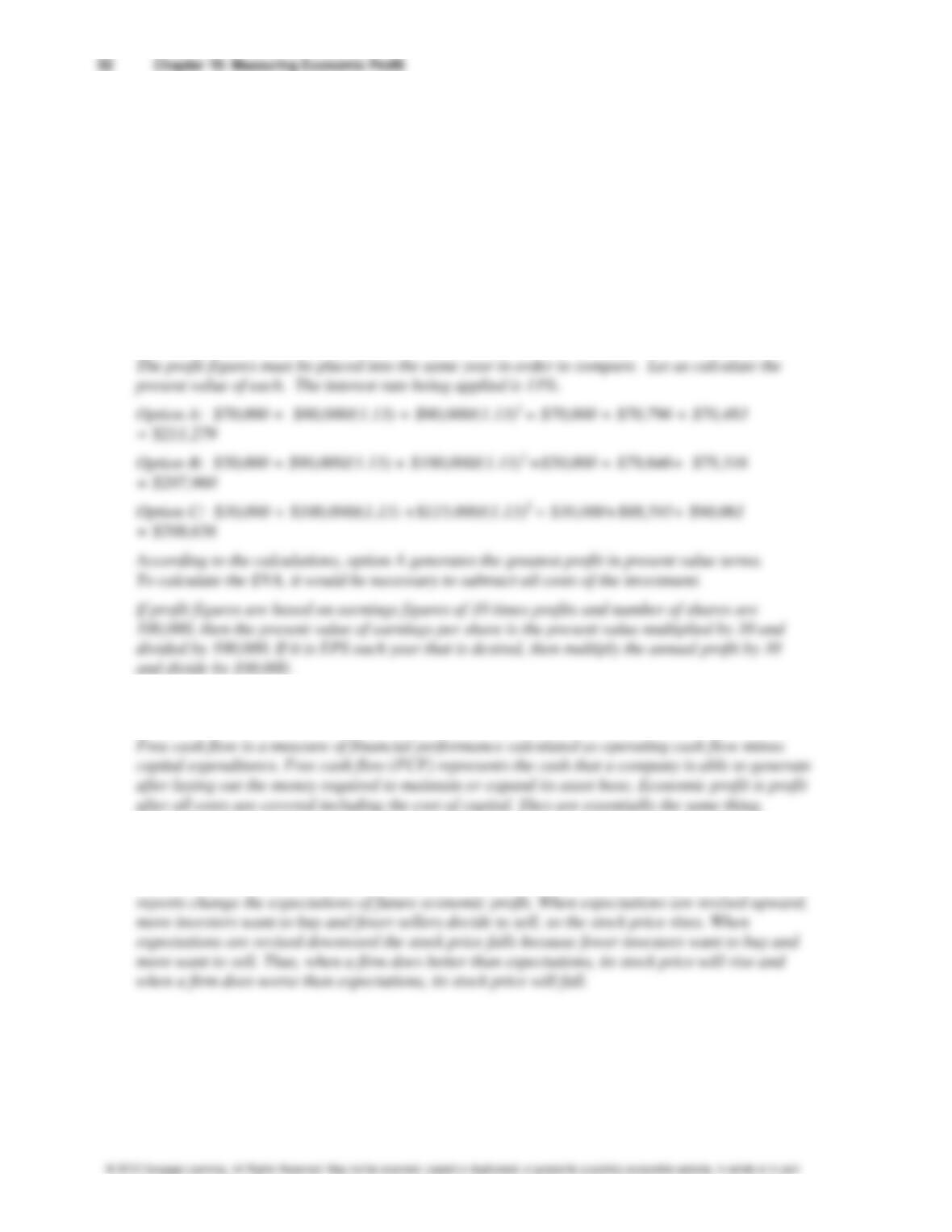
11. The manager of Global X is contemplating the purchase of a new machine that will cost $300,000
and has a useful life of five years. The machine is expected to yield cost reductions to Global X of
$50,000 in year 1, $60,000 in year 2, $70,000 in year 3, and $80,000 in each year in years 4 and 5.
Will the acquisition of the machine add value?
The cost reductions in future years must be put into present value terms in order to compare costs
and benefits. The value depends on the discount rate applied. Let us use a rate of 7 percent.
12. You have just been hired as a consultant to help a firm determine which of three options to take
to increase shareholder wealth. The following table shows year-end profits for each option.
Assume that the risk-free cost of capital is 5 percent and the risk premium is 8 percent.
OptionProfit in Year 1Profit in Year 2Profit in Year 3
A $70,000 $ 80,000 $ 90,000
B $50,000 $ 90,000 $100,000
C $30,000 $100,000 $115,000
a. Calculate the economic profit for each option.
b. Suppose that the profit figures are based on earnings figures of 10 times profits and that there
are 100,000 shares of stock outstanding. What are the earnings per share for each option?
13. It is often stated that free cash flow is the same as economic profit. Define free cash flow.
Demonstrate whether it is or is not the same as economic profit.
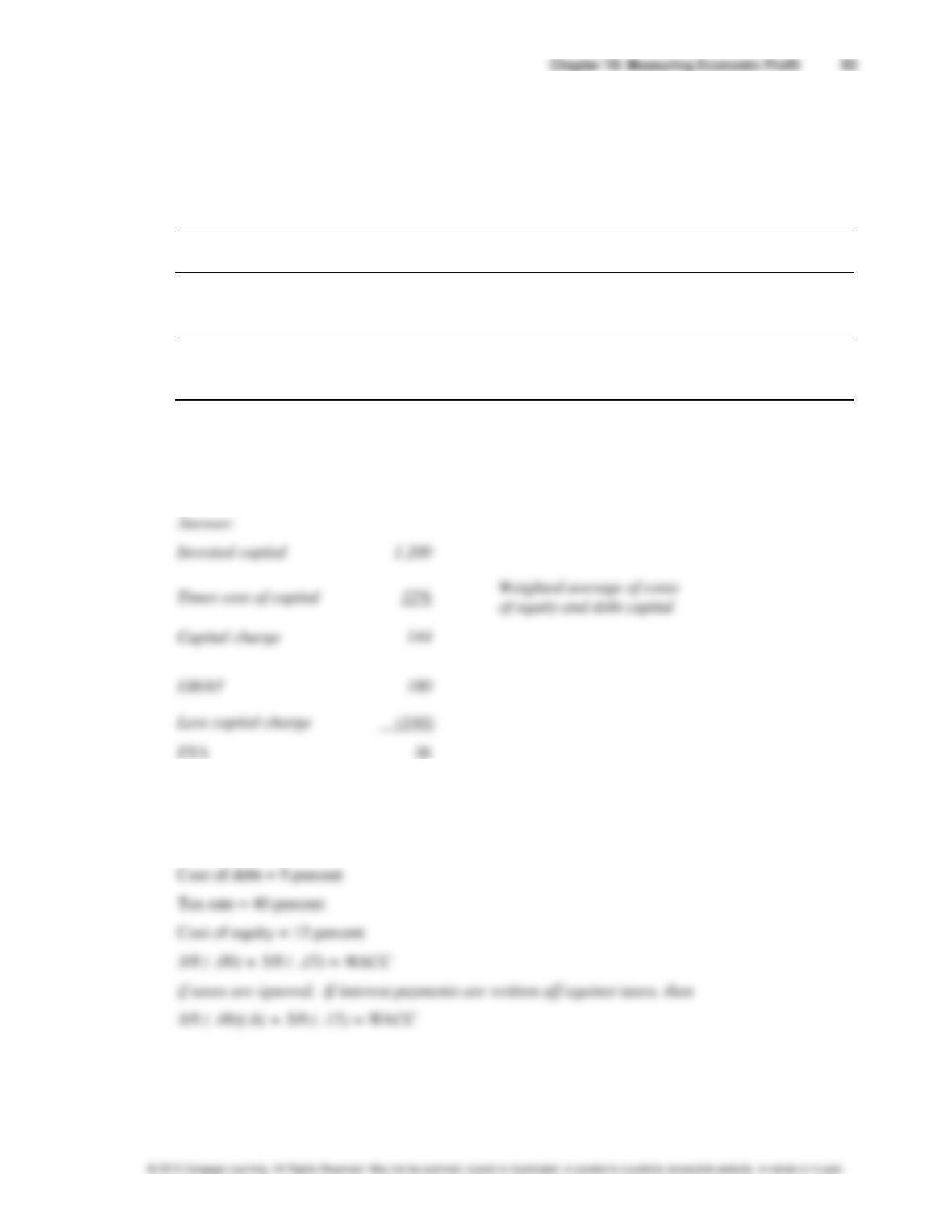
14. Using the formula given in the text for stock price determination, explain why stock prices move
up or down in response to quarterly earnings reports.
The answer is expectations revisions—changes in E (Economic Profit). Thus, quarterly earnings
15. Use the following data to calculate economic profit in year 1.
Year 0 1
Sales 1,000
Expenses other than interest 500
Depreciation 200
Earnings before interest and taxes (EBIT) 300
Taxes on EBIT @40% 120
Earnings before interest and after taxes (EBIAT) 180
Current assets less excess cash and securities 300 340
Non-interest-bearing current liabilities 100 120
Adjusted net working capital 200 220
Gross property, plant and equipment 2,000 2,300
Accumulated depreciation 1,000 1,200
Net property, plant and equipment 1,000 1,100
Invested capital 1,200 1,320
Return on invested capital (EBIAT /
invested capital) 15%
based on previous year’s invested capital
16. Calculate the WACC—the weighted average cost of capital—using the following data:
Market value of debt = $30 million
Market value of equity = $50 million
17. You have the following betas for firms. Calculate the cost of capital for each.
Intel 1.
GE 1.26
IBM 1.2
Merck 1.4
GM 1.1
Assuming that the risk free rate is 5 percent and the risk premium is 4 percent then the beta is
as follows:
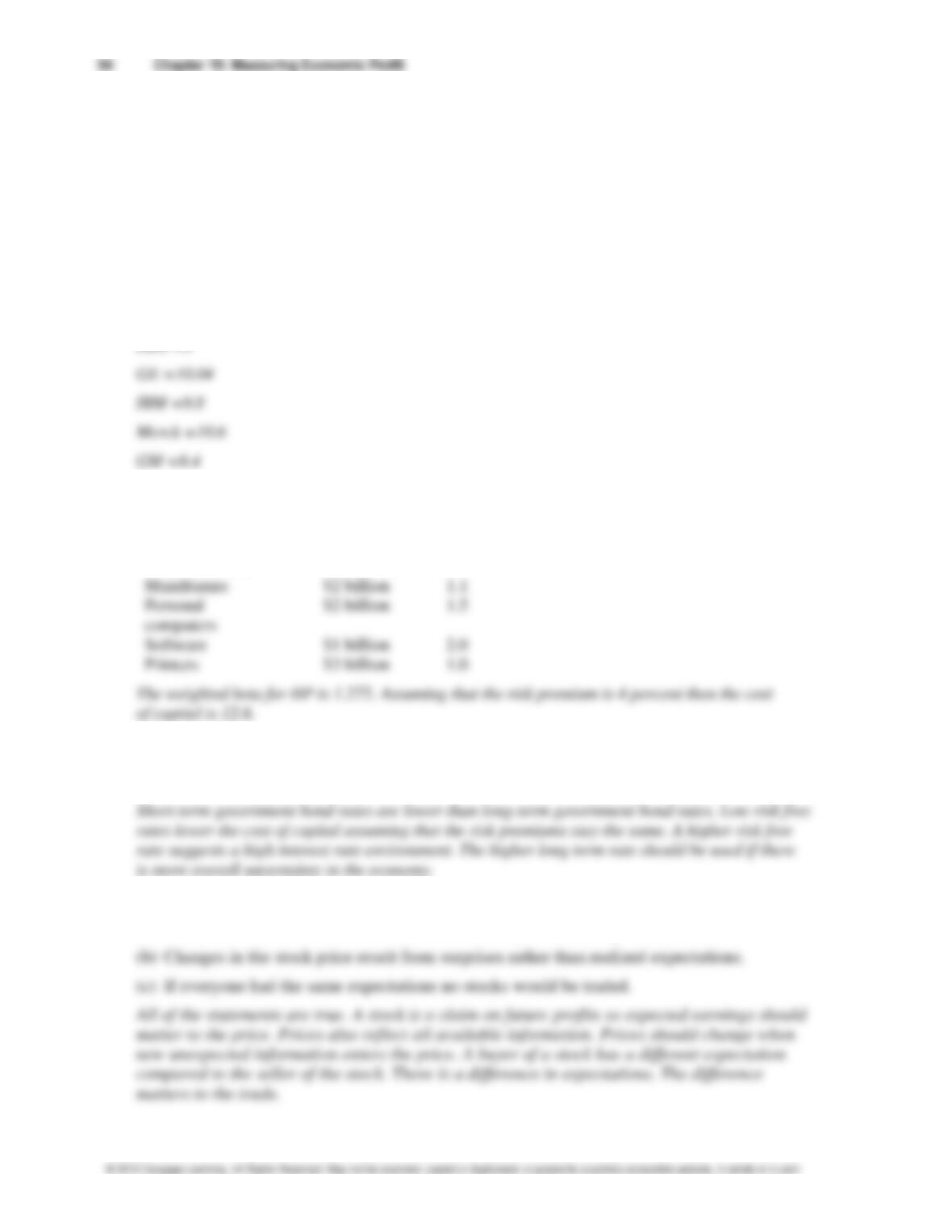
18. You are analyzing the beta for Hewlett-Packard and have broken the company into four business
groups with equity value and betas for each group. Calculate the beta for HP as a company. If the
Treasury bond rate is 7.5 percent, calculate the cost of capital.
Business Group
Equity
Beta
19. Would it make a difference in the calculation of the cost of capital whether you looked at the
short-term U.S. government rate rather than the long-term U.S. government rate as your risk-free
rate? Under what conditions would you choose long term? Short term?
20. Evaluate the following statements:
(a) The price of a firm’s stock is a function of the expected earnings of that firm.