19–41
EXERCISE 19-22 (Continued)
Deferred tax liability at the end of 2012 ……………………… $ 17,000
Deferred tax liability at the beginning of 2012 ……………. 0
Deferred tax expense for 2012 (increase
required in deferred tax liability) …………………………... $ 17,000
(b)
Temporary
Difference
Resulting Deferred Tax
Related Balance
Sheet Account
Classification
(Asset)
Liability
Accounts receivable
$17,000
Accounts Receivable
Current
Litigation liability
$(6,800)
Lawsuit Obligation
Current
Totals
$(6,800)
$17,000
The deferred tax asset is current because the related liability is current.
The liability from the accrual of the litigation loss is current because it is
expected to be settled in the year that immediately follows the balance
sheet date.
EXERCISE 19-23 (30–35 minutes)
(a) 2011
Income Tax Expense ……………………………………… 37,400
Income Taxes Payable ($110,000 X 34%) …… 37,400
2012
Income Tax Refund Receivable ………………………. 68,000
Deferred Tax Asset ………………………………………… 22,800
Benefit Due to Loss Carryback ………………… 68,000**
Benefit Due to Loss Carryforward ……………. 22,800**
Income Tax Expense …………………………..…………. 83,600
Income Taxes Payable …………………………….. 60,800*
Deferred Tax Asset ………………………………….. 22,800
*[($220,000 – $60,000) X 38%]
(c) 2013
Income Tax Refund Receivable ………………………. 68,000
Deferred Tax Asset ………………………………………… 22,800
Benefit Due to Loss Carryback ………………… 68,000*
Benefit Due to Loss Carryforward ……………. 22,800**
19–43
EXERCISE 19-23 (Continued)
Benefit Due to Loss Carryforward ………………………. 5,700
Allowance to Reduce Deferred Tax Asset
to Expected Realizable Value
(25% X $22,800) ………………………………………. 5,700
Allowance to Reduce Deferred Tax Asset
to Expected Realizable Value ………………………….. 5,700
Benefit Due to Loss Carryforward ……………….. 5,700
Note: Using the assumption in part (a), the income tax section of the
2014 income statement would appear as follows:
Income before income taxes ……………………….. $220,000
Income tax expense
Current ……………………………………………….. $60,800
Deferred………………………………………………. 22,800 83,600
Net income $136,400
EXERCISE 19-24 (30–35 minutes)
2013
Income Tax Refund Receivable ………………………. 76,000
Deferred Tax Asset ………………………………………… 22,500
Benefit Due to Loss Carryback ………………….. 76,000*
Benefit Due to Loss Carryforward ……………… 22,500**
2014
Income Tax Expense …………………………..…………. 54,000
Deferred Tax Asset …………………………………… 22,500
Income Taxes Payable
[($120,000 – $50,000) X 45%] ………………….. 31,500
19–45
EXERCISE 19-24 (Continued)
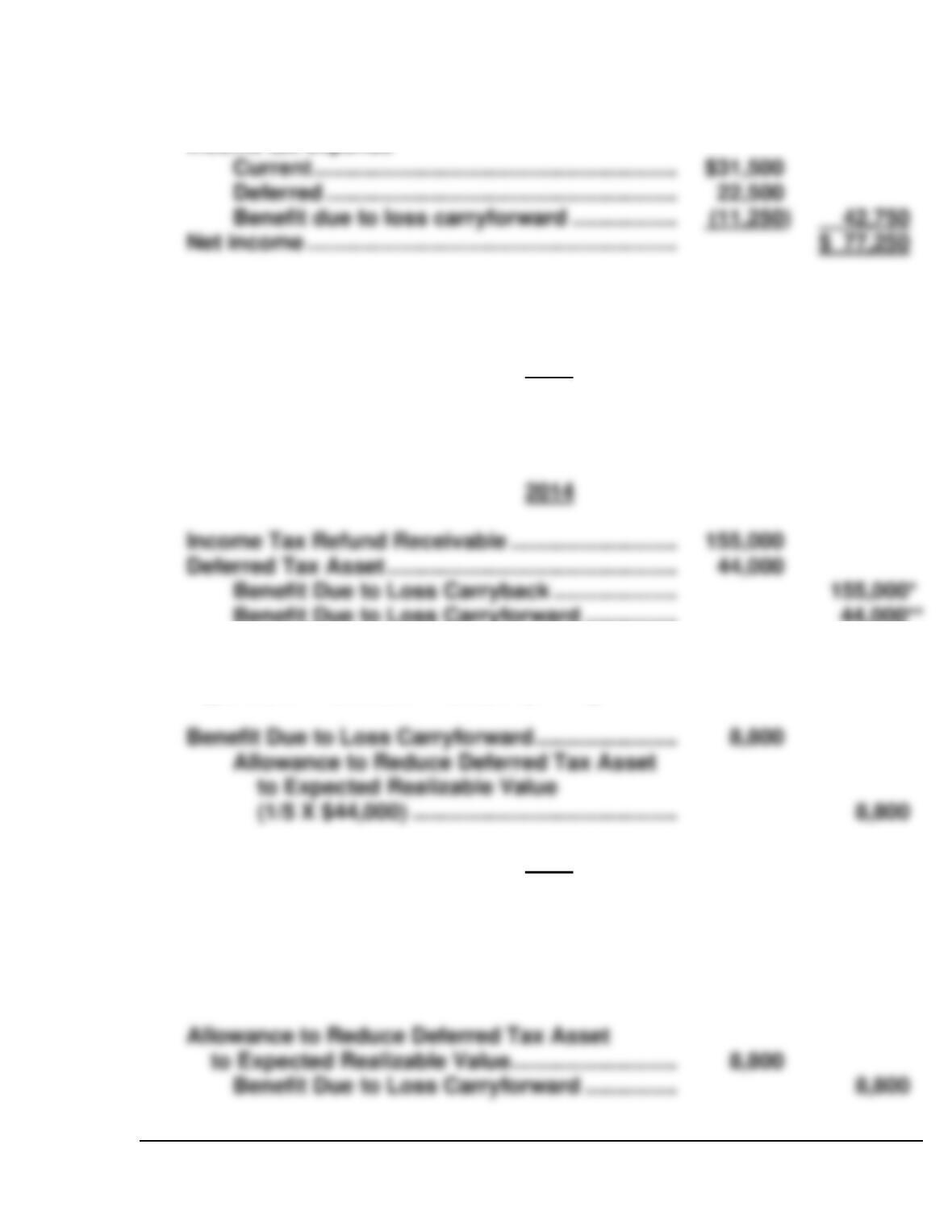
(c) Income before income taxes ………………………….. $120,000
Income tax expense
EXERCISE 19-25 (15–20 minutes)
(a) 2013
Income Tax Expense ($90,000 X .40) ………………. 36,000
Income Taxes Payable ……………………………. 36,000
Benefit Due to Loss Carryforward …………… 44,000**
**($350,000 X .34) + ($90,000 X .40)
**[($550,000 – $350,000 – $90,000) X .40]
2015
Income Tax Expense ($180,000 X .40) …………….. 72,000
Income Taxes Payable
[($180,000 – $110,000) X .40] ……………….. 28,000
Deferred Tax Asset ………………………………… 44,000
EXERCISE 19-25 (Continued)
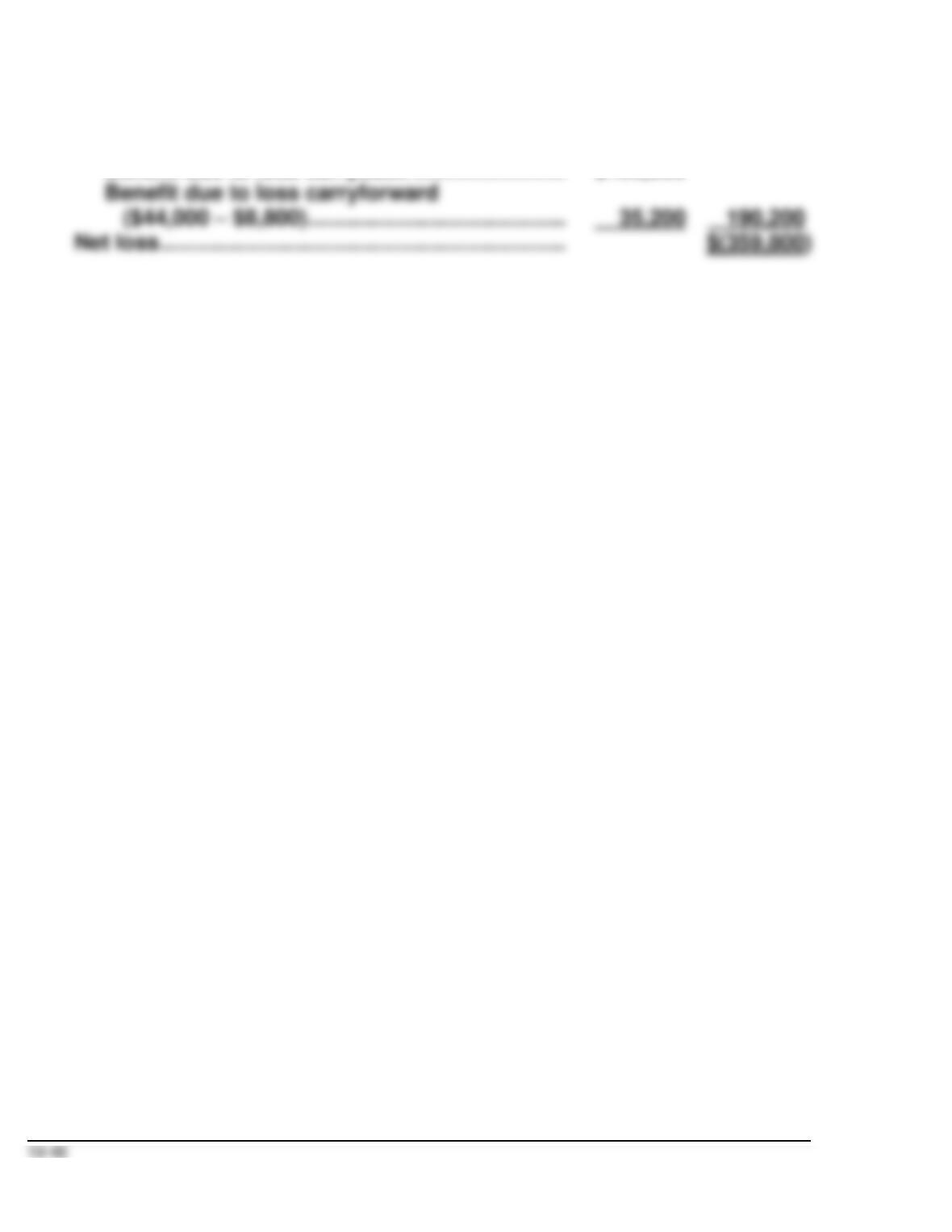
(b) Loss before income taxes ……………………………… $(550,000)
Income tax benefit
Benefit due to loss carryback ……………………. $155,000

19–47
TIME AND PURPOSE OF PROBLEMS
Problem 19-1 (Time 40–45 minutes)
Purpose—to provide the student with an understanding of how to compute and properly classify
deferred income taxes when there are three types of temporary differences. A single tax rate applies.
The student is required to compute and classify deferred income taxes. Also, the student must use data
given to solve for both taxable income and pretax financial income. The latter computation is complicated
by the fact there are deferred taxes at the beginning of the year.
Problem 19-2 (Time 50–60 minutes)
Purpose—to provide the student with a situation where: (1) a temporary difference originates over a
three-year period and begins to reverse in the fourth period, (2) a change in an enacted tax rate occurs
in a year in which there is a change in the amount of cumulative temporary difference, (3) the amount of
originating or reversing temporary difference must be calculated each year in order to determine the
cumulative temporary difference at the end of each year, and (4) there is a permanent difference along
with a temporary difference each year. Journal entries are required for each of four years, including the
entry for the adjustment of deferred taxes due to the change in the enacted tax rate.
Problem 19-3 (Time 40–45 minutes)
Purpose—to provide the student with an understanding of how future temporary differences for existing
depreciable assets are considered in determining the future years in which existing temporary
differences result in taxable or deductible amounts. The student is given information about pretax
financial income, one temporary difference, and one permanent difference. The student must compute
all amounts related to income taxes for the current year and prepare the journal entry to record them. In
order to determine the beginning balance in a deferred tax account, the student must calculate deferred
taxes for the prior year’s balance sheet. An income statement presentation is also required and an
extraordinary gain is recognized in the current period.
Problem 19-4 (Time 20–25 minutes)
Purpose—to provide the student with an understanding of permanent and temporary differences when
there are multiple differences and a single rate.
Problem 19-5 (Time 20–25 minutes)
Purpose—to provide the student with a situation involving a net operating loss which can be partially
offset by prior taxes paid using the carryback provision. Journal entries for the loss year and two
subsequent years are required. The benefits of the loss carryforward are realized in the year following
the loss year. Income statement presentations are required for the loss year where the benefits of the
carryback and the carryforward are recognized and the year following the loss year where the benefits
of the carryforward are realized.
Problem 19-6 (Time 20–25 minutes)
Purpose—to provide the student with an understanding of how the computation and classification of
deferred income taxes are affected by the individual future year(s) in which future taxable and
deductible amounts are scheduled to occur because of existing temporary differences. Two situations
are given and the student is required to compute and classify the deferred income taxes for each. A net
deferred tax asset results in both cases.
Problem 19-7 (Time 45–50 minutes)
Purpose—to provide the student with a situation where: (1) a temporary difference originates in one
period and reverses over the following two periods, (2) a change in an enacted tax rate occurs in a year
in which there is a change in the amount of cumulative temporary difference, and (3) the amount of
originating or reversing temporary difference must be calculated each year in order to determine the
cumulative temporary difference at the end of each year. Journal entries are required for each of three
years, including the entry for the adjustment of deferred taxes due to the change in the enacted tax rate.

Time and Purpose of Problems (Continued)
Problem 19-8 (Time 40–50 minutes)
Purpose—to test a student’s understanding of the relationships that exist in the subject area of
accounting for income taxes. The student is required to compute and classify deferred income taxes for
two successive years. The journal entry to record income taxes is also required for each year. A draft of
the income tax expense section of the income statement is also required for each year. An interesting
twist to this problem is that the student must compute taxable income for two individual periods based
on facts about the tax rate and amount of taxes paid for each period and then combine that information
with data on temporary differences to compute pretax financial income.
Problem 19-9 (Time 40–50 minutes)
Purpose—to test a student’s ability to compute and classify deferred taxes for three temporary
differences and to draft the income tax expense section of the income statement for the year.
19–49
SOLUTIONS TO PROBLEMS
PROBLEM 19-1
(a) X(.40) = $320,000 taxes due for 2012
X = $320,000 ÷ .40
X = $800,000 taxable income for 2012
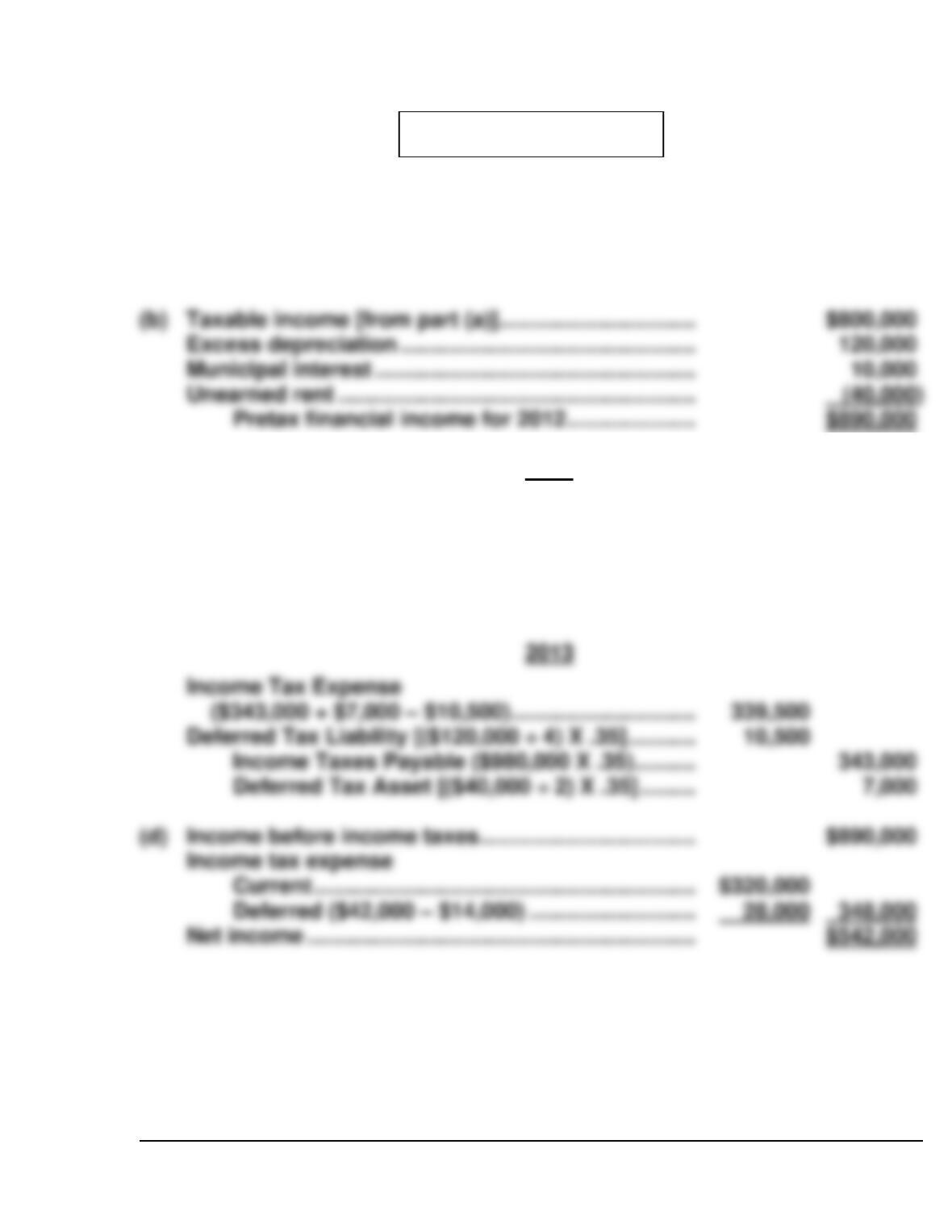
(c) 2012
Income Tax Expense
($320,000 + $42,000 – $14,000) ………………………. 348,000
Deferred Tax Asset ($40,000 X .35) ……………………. 14,000
Income Taxes Payable ($800,000 X .40) ………. 320,000
Deferred Tax Liability ($120,000 X .35) ……….. 42,000
PROBLEM 19-2
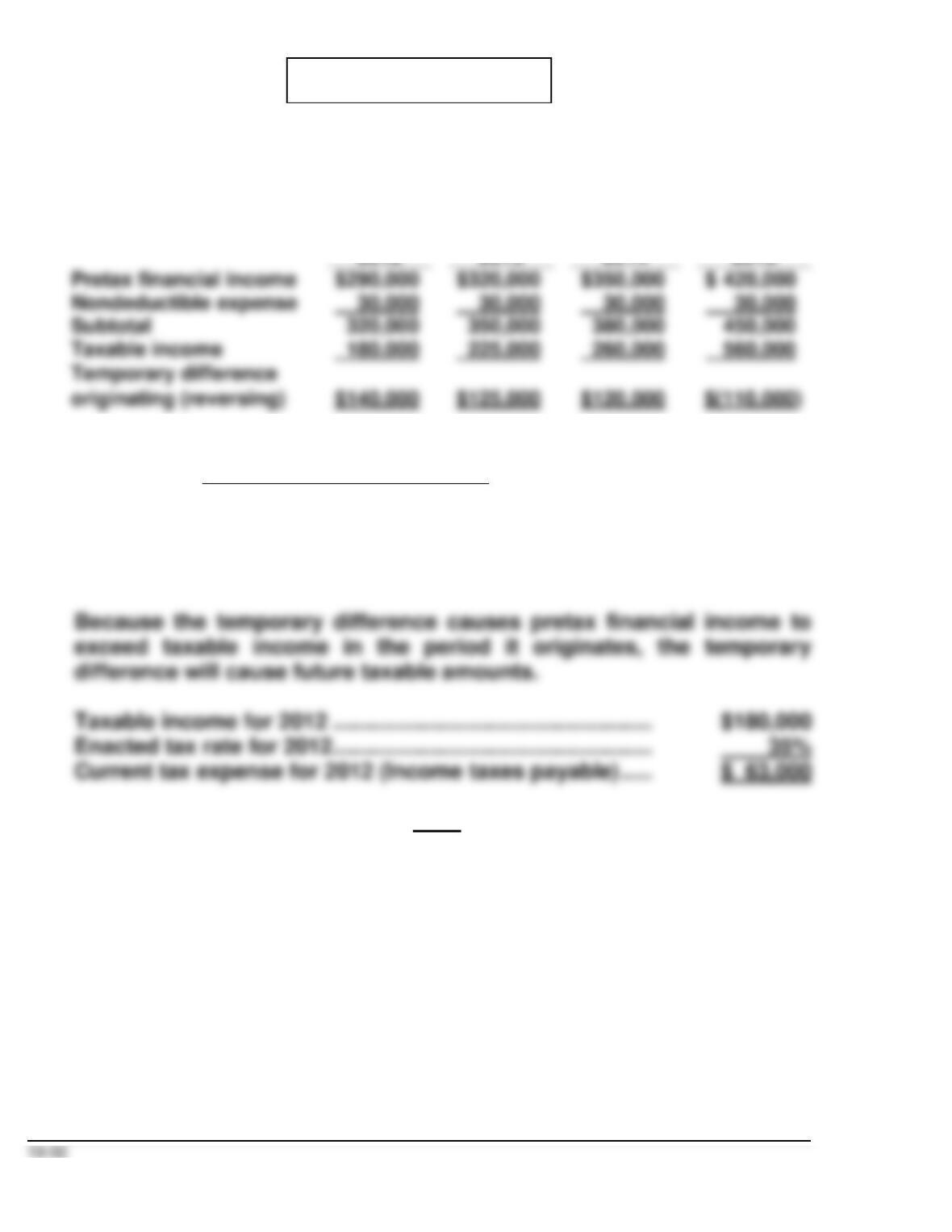
(a) Before deferred taxes can be computed, the amount of temporary
difference originating (reversing) each period and the resulting cumula-
tive temporary difference at each year-end must be computed:
2012
2013
2014
2015
$350,000
Cumulative Temporary
Difference At End of Year
2012
$140,000
2013
$265,000
($140,000 + $125,000)
2014
$385,000
($265,000 + $120,000)
2015
$275,000
($385,000 – $110,000)
2012
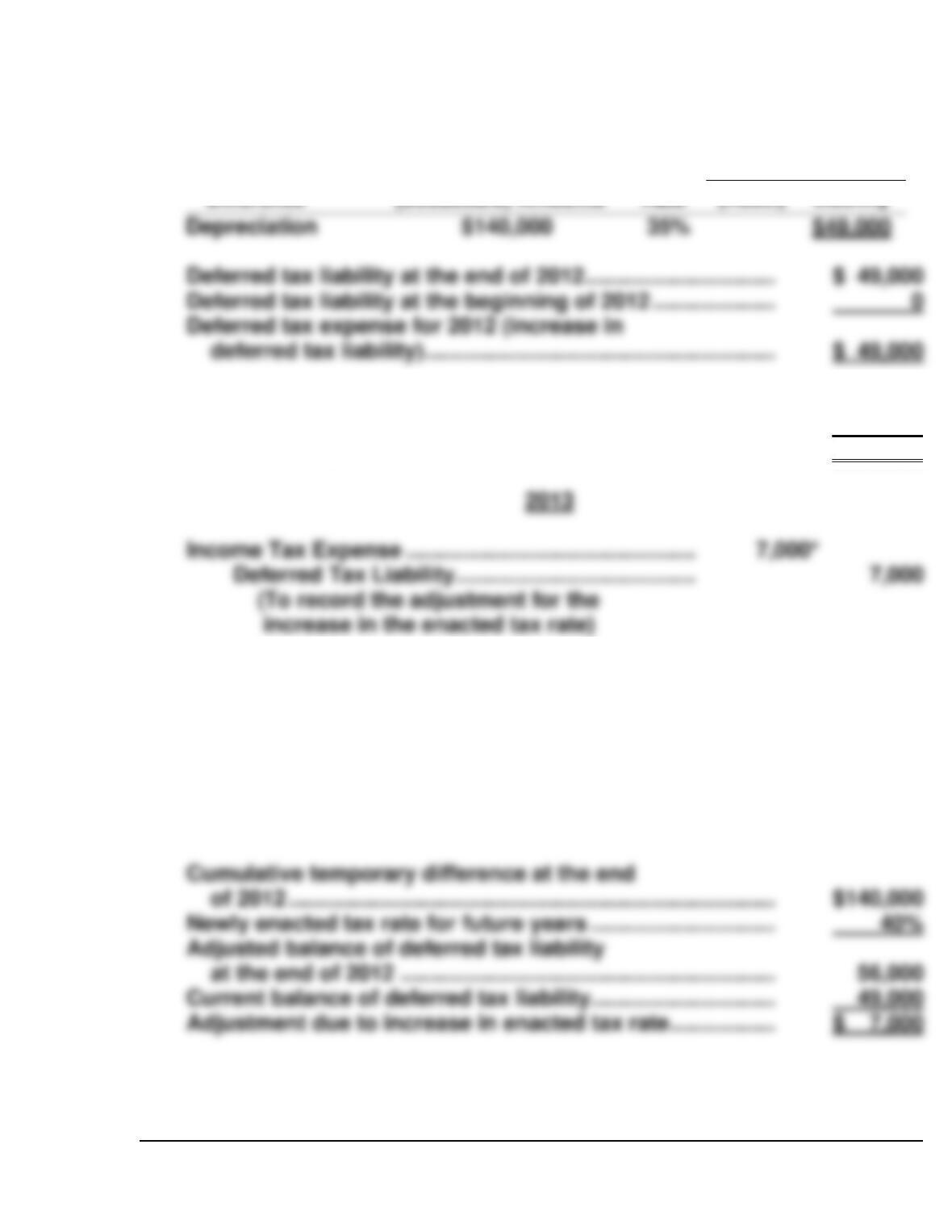
Income Tax Expense …………………………..…………… 112,000
Income Taxes Payable ………………………………. 63,000
Deferred Tax Liability ………………………………… 49,000
19–51
PROBLEM 19-2 (Continued)
The deferred taxes at the end of 2012 would be computed as follows:
Temporary
Difference
Future Taxable
(Deductible) Amounts
Tax
Rate
Deferred Tax
(Asset)
Liability
Deferred tax expense for 2012 ……………………………………… $ 49,000
Current tax expense for 2012 (Income taxes payable) ……. 63,000
Income tax expense for 2012 ……………………………………….. $112,000
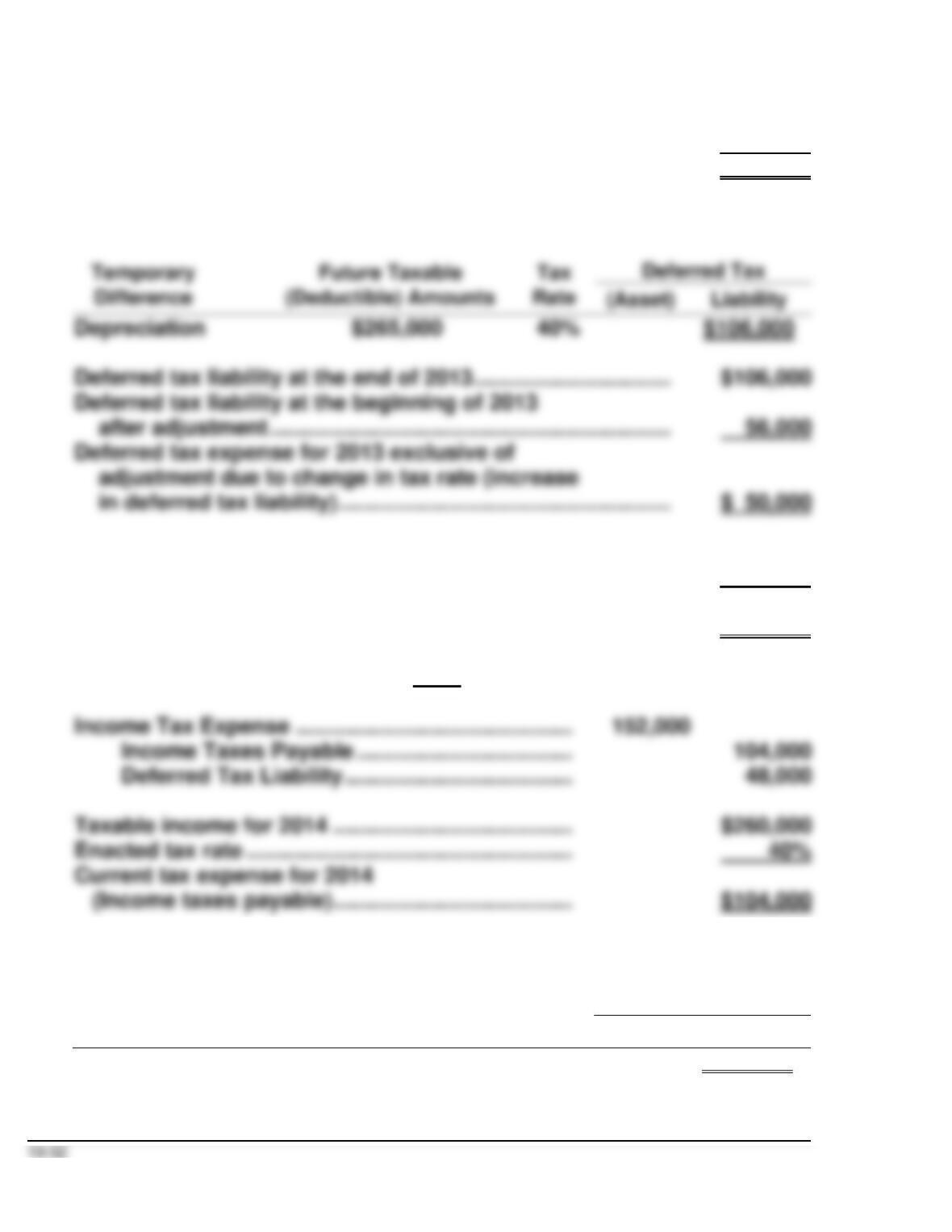
Income Tax Expense ……………………………………….. 140,000
Income Taxes Payable ………………………………. 90,000
Deferred Tax Liability ………………………………… 50,000
(To record income taxes for 2013)
*The adjustment due to the change in the tax rate is computed as
follows:
PROBLEM 19-2 (Continued)
Taxable income for 2013 ………………………………………………. $225,000
Enacted tax rate …………………………………………………………… 40%
Current tax expense for 2013 (Income taxes payable) …….. $ 90,000
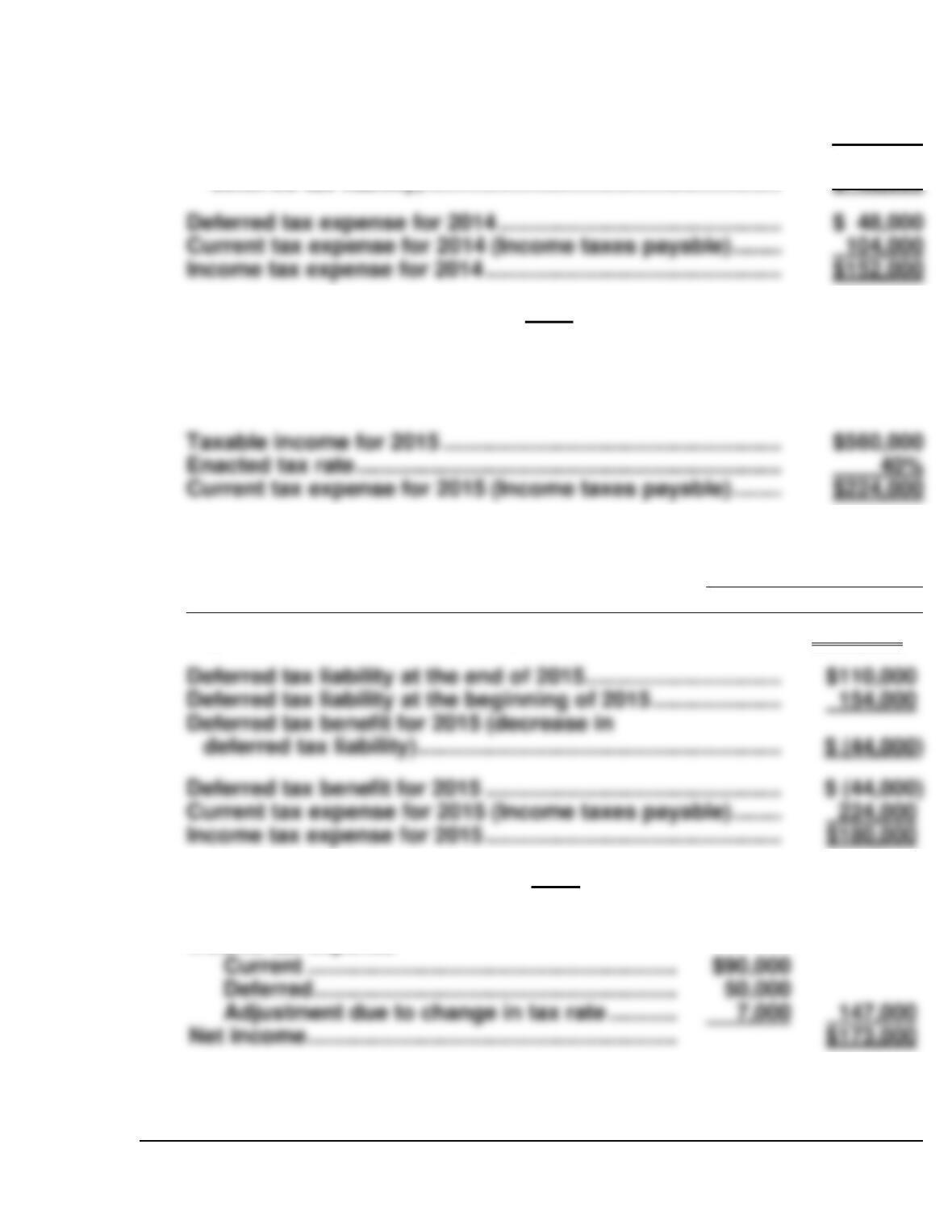
The deferred taxes at December 31, 2013, are computed as follows:
Depreciation
40%
$106,000
Deferred tax expense for 2013 ………………………………………. $ 50,000
Current tax expense for 2013 (Income taxes payable) …….. 90,000
Income tax expense (total) for 2013, exclusive
of adjustment due to change in tax rate ……………………… $140,000
2014
The deferred taxes at December 31, 2014, are computed as follows:
Temporary
Difference
Future Taxable
(Deductible) Amounts
Tax
Rate
Deferred Tax
(Asset)
Liability
Depreciation
$385,000
40%
$154,000
19–53
PROBLEM 19-2 (Continued)
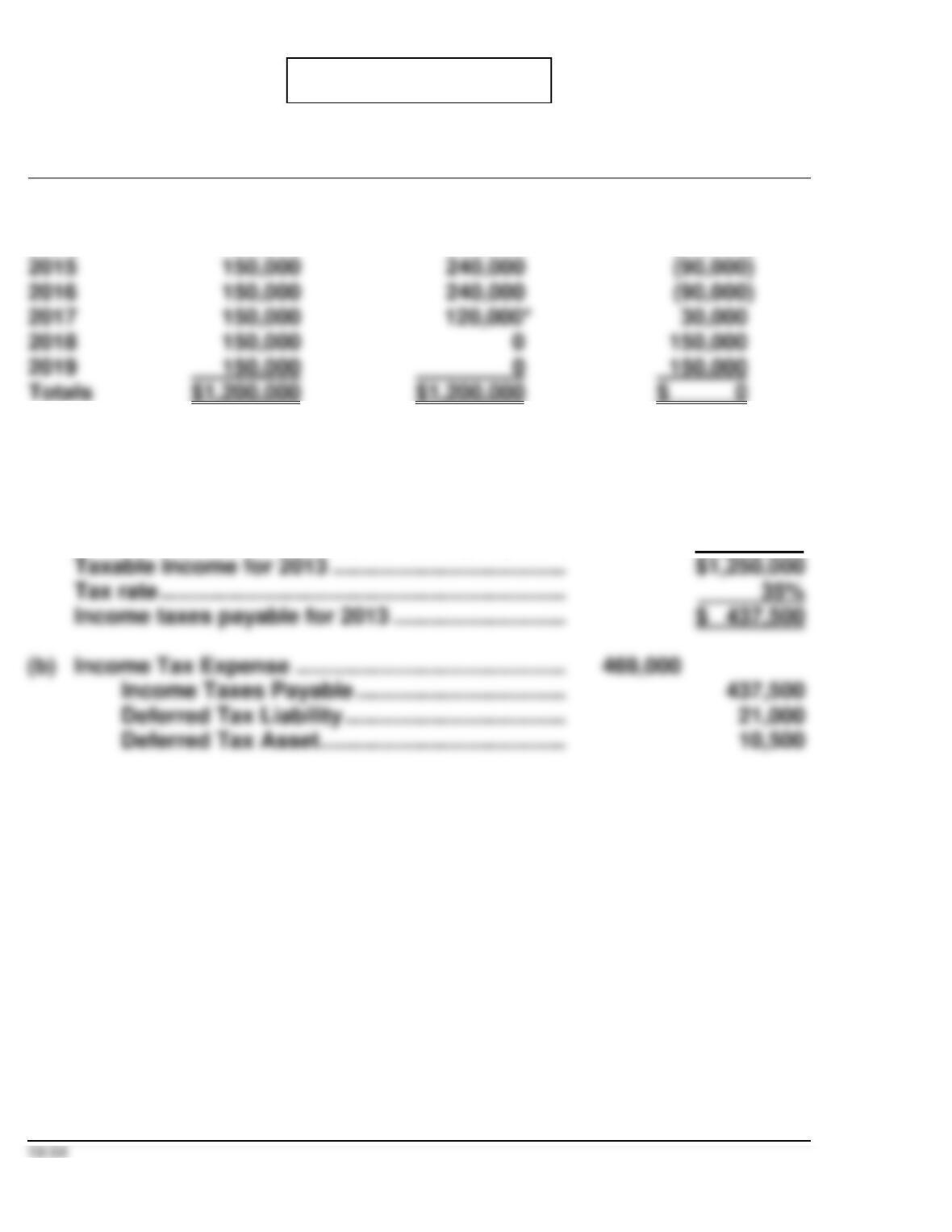
Deferred tax liability at the end of 2014 ………………………….. $154,000
Deferred tax liability at the beginning of 2014 ………………… 106,000
Deferred tax expense for 2014 (increase in
deferred tax liability) …………………………………………………. $ 48,000
2015
Income Tax Expense …………………………………….. 180,000
Deferred Tax Liability ……………………………………. 44,000
Income Taxes Payable ……………………………. 224,000
The deferred taxes at December 31, 2015, are computed as follows:
Temporary
Difference
Future Taxable
(Deductible) Amounts
Tax
Rate
Deferred Tax
(Asset)
Liability
Depreciation
$275,000
40%
$110,000
(b) 2013
Income before income taxes …………………………. $320,000
Income tax expense
PROBLEM 19-3
Book Depreciation
Tax Depreciation
Difference
2012
$ 150,000
$ 120,000*
($ 30,000
2013
150,000
240,000
(90,000)
2014
150,000
240,000
(90,000)
2015
150,000
240,000
(90,000)
2016
150,000
240,000
(90,000)
2017
150,000
120,000*
30,000
2018
150,000
2019
150,000
*($1,200,000 ÷ 5) X .5
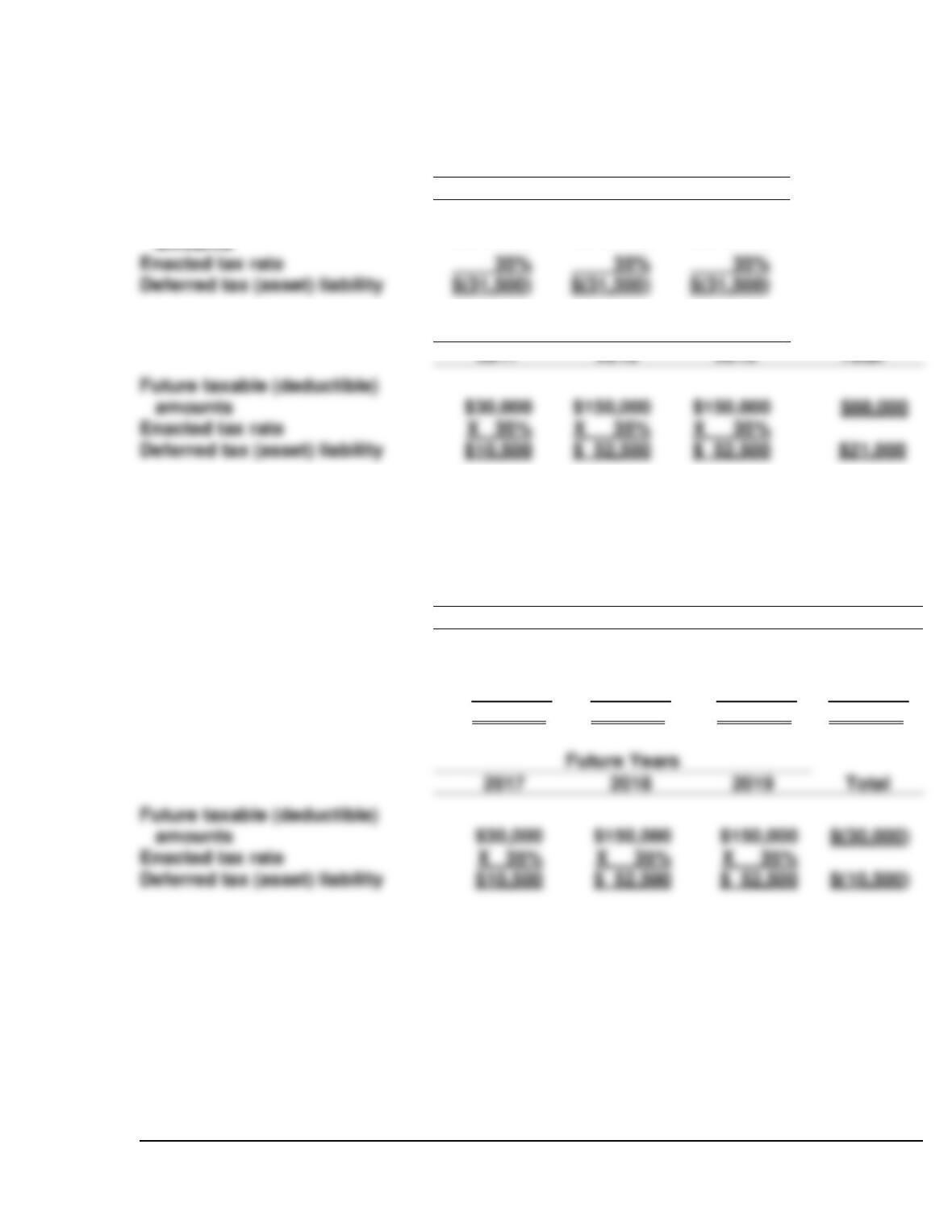
(a) Pretax financial income for 2013 ……………………. $1,400,000
Nontaxable interest ……………………………………….. (60,000)
Excess depreciation ($240,000 – $150,000) …….. (90,000)
19–55
PROBLEM 19-3 (Continued)
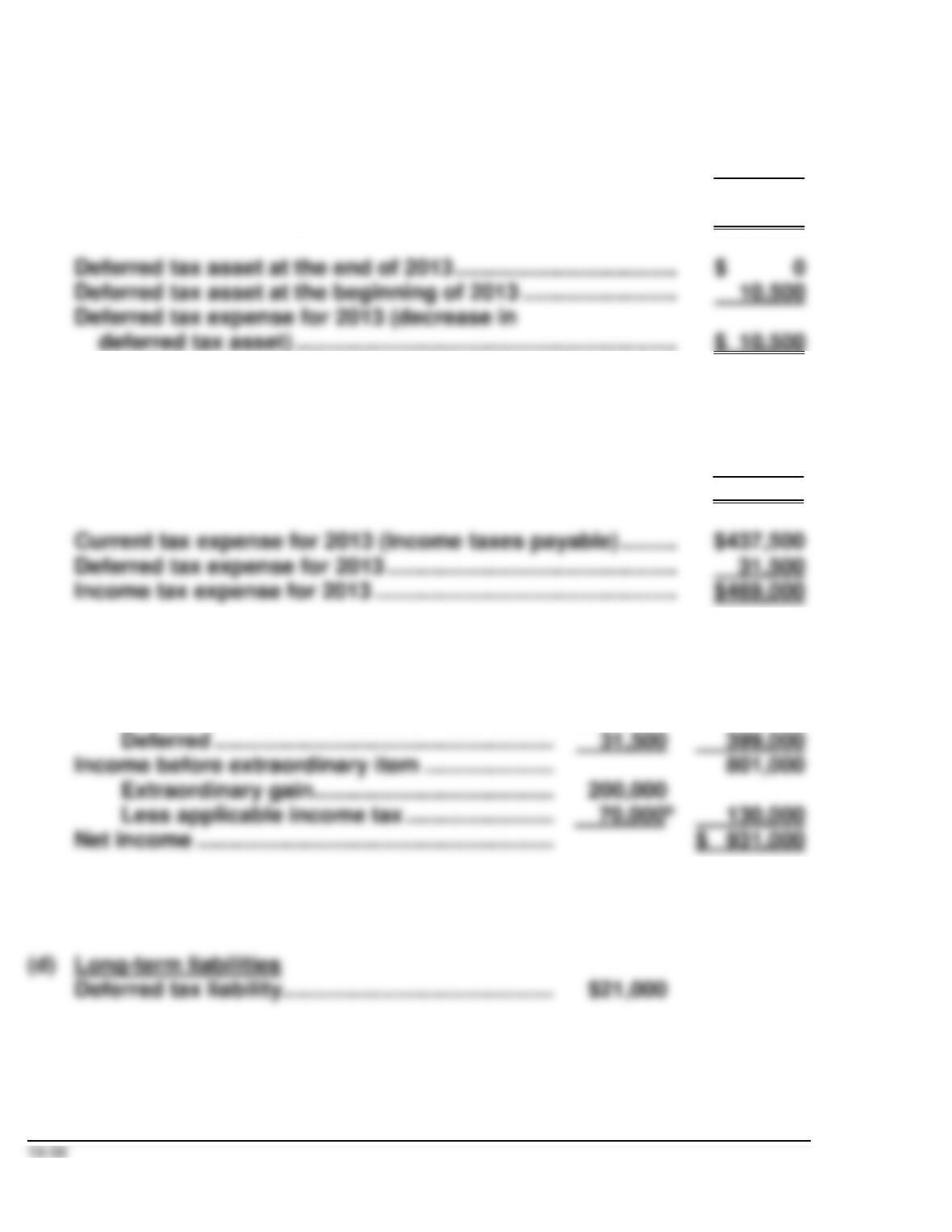
Scheduling—End of 2013
Future Years
2014
2015
2016
Future taxable (deductible)
$(90,000)
$(90,000)
$(90,000)
Future Years
2017
2018
2019
Future taxable (deductible)
amounts
Enacted tax rate
Deferred tax (asset) liability
The net deferred tax liability at December 31, 2013, is $21,000.
Scheduling—End of 2012
Future Years
2013
2014
2015
2016
Future taxable (deductible)
amounts
$(90,000)
$(90,000)
$(90,000)
$(90,000)
Enacted tax rate
X 35%
X 35%
X 35%
X 35%
Deferred tax (asset) liability
$(31,500)
$(31,500)
$(31,500)
$(31,500)
Future Years
2017
2018
2019
Enacted tax rate
Deferred tax (asset) liability
$(10,500)
Enacted tax rate
Deferred tax (asset) liability
$(31,500)
$(31,500)
$(31,500)
PROBLEM 19-3 (Continued)
The net deferred tax asset at December 31, 2012, is $10,500.
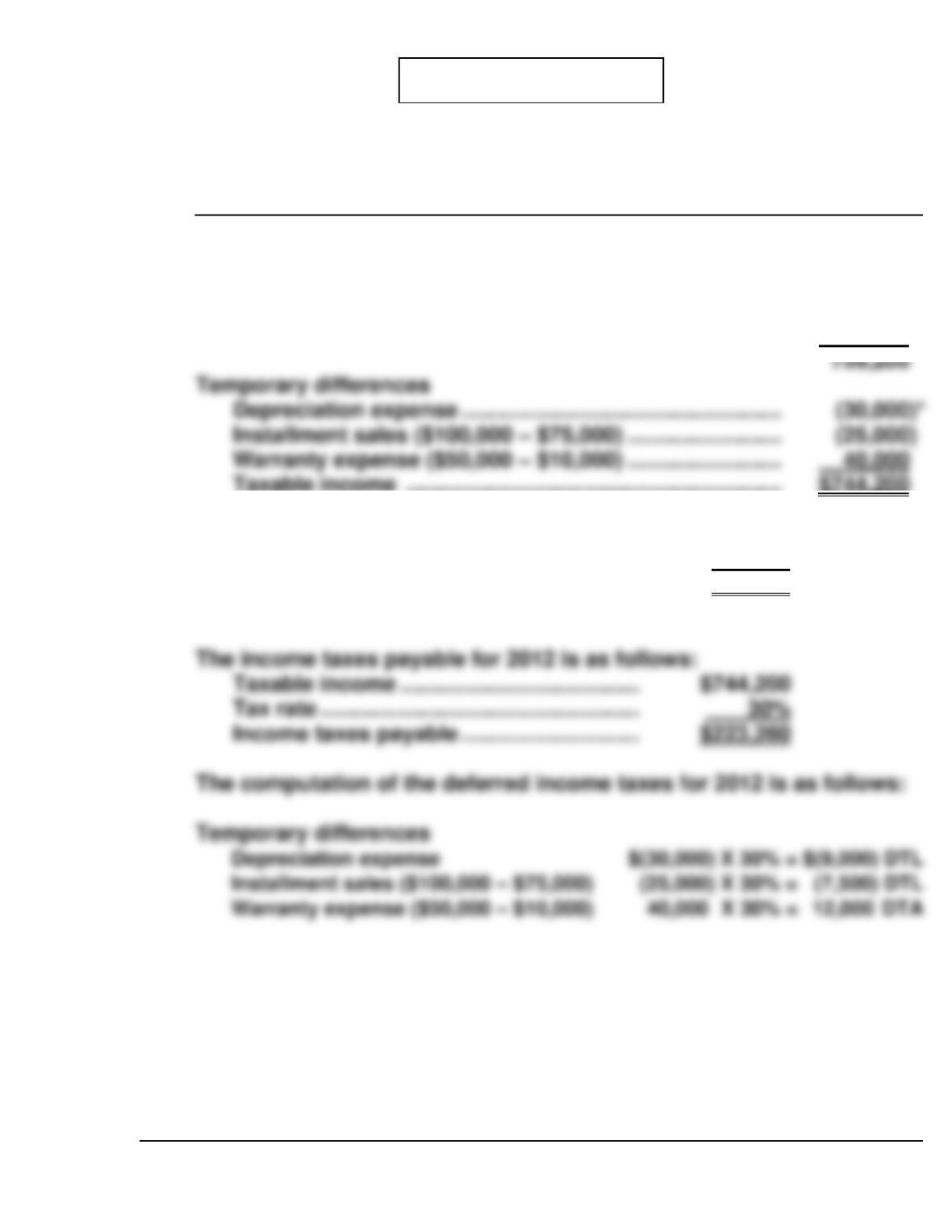
Deferred tax liability at the end of 2013 …………………………... $ 21,000
Deferred tax liability at the beginning of 2013 …………………. 0
Deferred tax expense for 2013 (increase in
deferred tax liability) ………………………………………………….. $ 21,000
Deferred tax expense for 2013
(from deferred tax liability) …………………………………………. $ 21,000
Deferred tax expense for 2013
(from deferred tax asset) …………………………..……………….. 10,500
Net deferred tax expense for 2013 ………………………………….. $ 31,500
(c) Income before income taxes and
extraordinary item ……………………………………. $1,200,000a
Income tax expense
Current ($437,500 – $70,000b) ………………… $367,500
a$1,400,000 pretax financial income – $200,000 extraordinary item = $1,200,000.
b($200,000 X 35%)
19–57
PROBLEM 19-4
(a) Schedule of Pretax Financial Income
and Taxable Income for 2012
Pretax financial income ………………………………………………. $750,000
Permanent differences
Insurance expense ………………………………………………… 9,000
Bond interest revenue …………………………..………………. (4,000)
Pollution fines ………………………………………………………. 4,200
Taxable income ……………………………………………………. $744,200
* Depreciation for books ($300,000/5) = $60,000
Depreciation tax return ($300,000 X 30%) = 90,000
Difference $30,000
PROBLEM 19-4 (Continued)
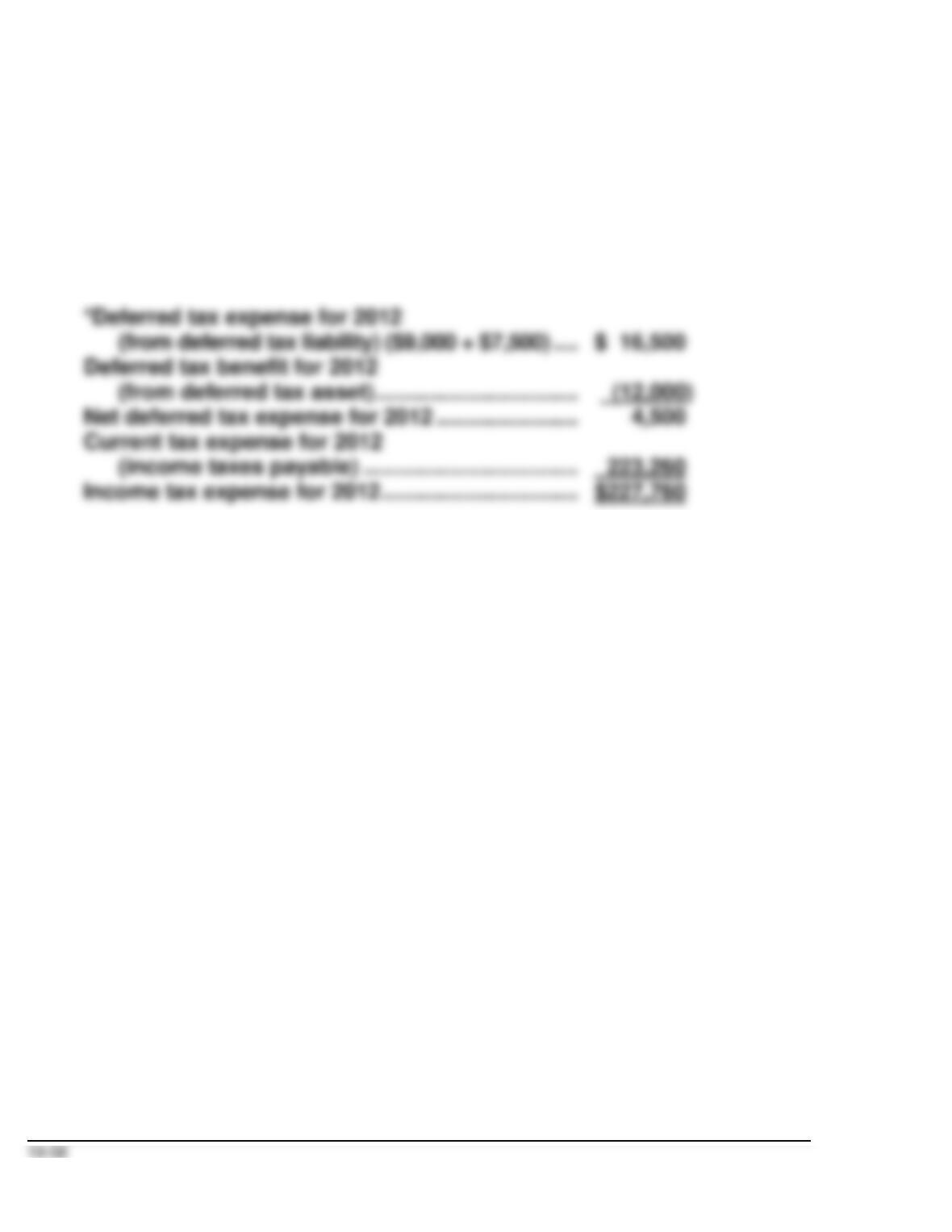
(b) The journal entry to record income taxes payable, income tax expense
and deferred income taxes is as follows:
Income Tax Expense ……………………………………… 227,760*
Deferred Tax Asset ………………………………………… 12,000
Deferred Tax Liability ($9,000 + $7,500) ……… 16,500
Income Taxes Payable ……………………………… 223,260
19–59
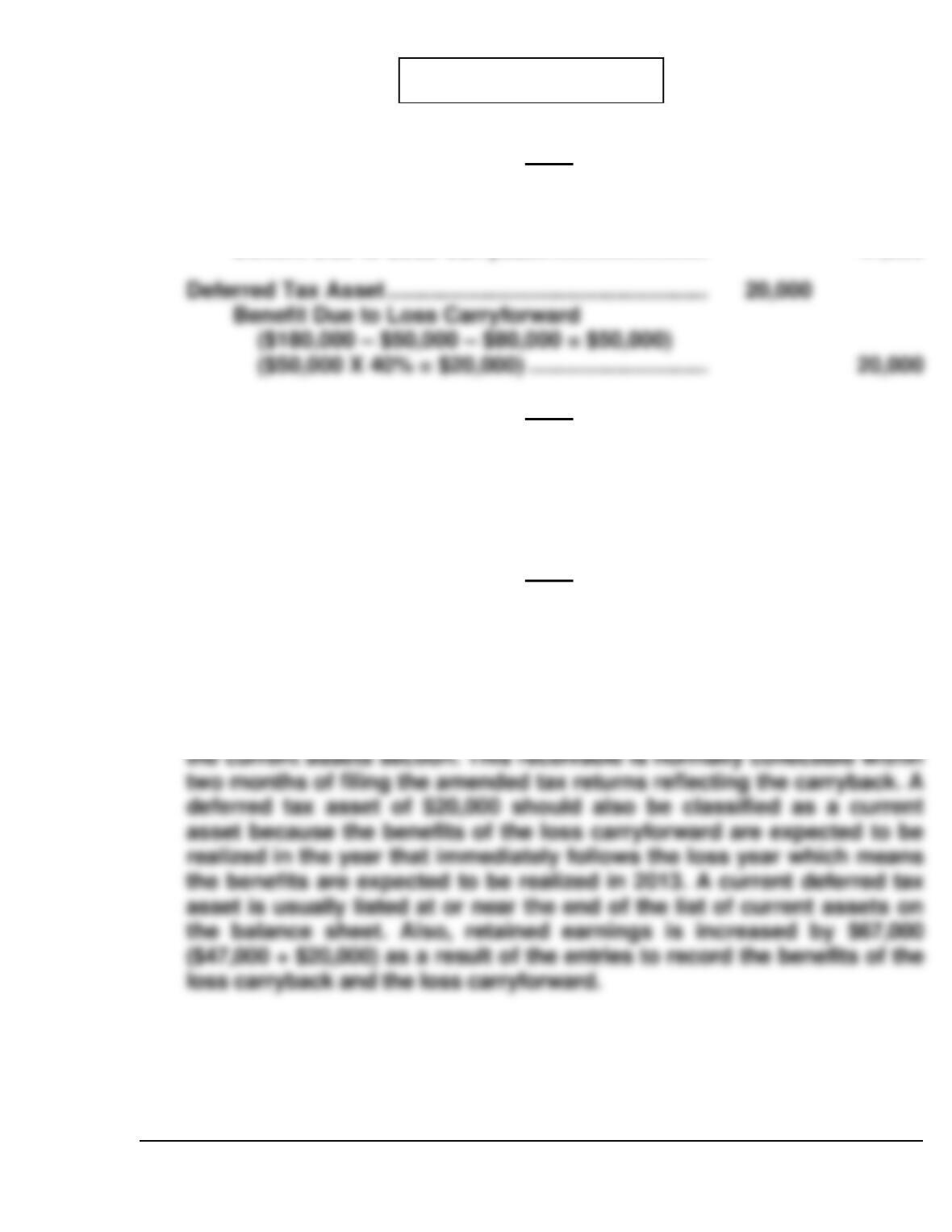
PROBLEM 19-5
(a) 2012
Income Tax Refund Receivable
[($50,000 X 30%) + ($80,000 X 40%)] ………………… 47,000
Benefit Due to Loss Carryback ……………………. 47,000
2013
Income Tax Expense …………………………………………. 28,000
Deferred Tax Asset …………………………………….. 20,000
Income Taxes Payable
[($70,000 – $50,000) X 40%] ……………………… 8,000
2014
Income Tax Expense …………………………………………. 35,000
Income Taxes Payable ($100,000 X 35%) ……… 35,000
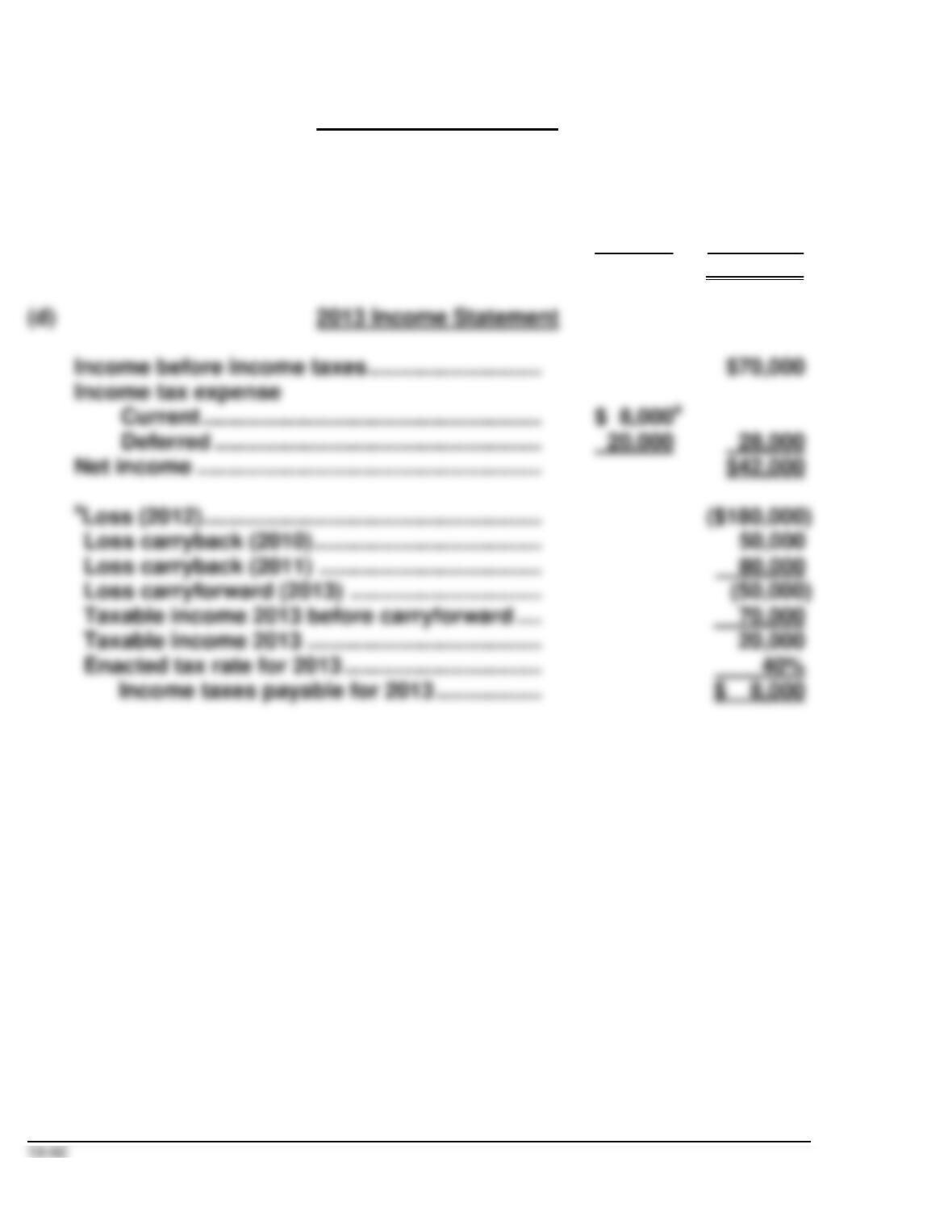
(b) The income tax refund receivable account totaling $47,000 will be
reported under current assets on the balance sheet at December 31, 2012.
This type of receivable is usually listed immediately above inventory in
PROBLEM 19-5 (Continued)
(c) 2012 Income Statement
Operating loss before income taxes …………… $(180,000)
Income tax benefit
Benefit due to loss carryback ……………… $47,000
Benefit due to loss carryforward ………….. 20,000 67,000
Net loss …………………………..………………………… $(113,000)