Chapter 19
Managing Net Working Capital
QUESTIONS
1. What is net working capital? Why should it be considered an investment that a firm
must make to increase its future profitability?
Answer: Every corporation maintains a stock of current assets and current liabilities to buffer
the inflows and outflows of cash generated by the firm’s business. The term working capital
2. What distinguishes international cash management from purely domestic cash
management? In particular, what constraints arise in the international environment?
Answer: The goals of an international money manager of a multinational corporation are (1)
to establish control over the cash resources of the organization, (2) to invest excess short–
3. Why is it important for a foreign affiliate to have a well-defined dividend policy for
repatriating profits to its parent corporation?
Answer: It is often advantageous for a multinational corporation to have an established
dividend policy that it can easily defend if government officials of the host country question
4. What is the difference between a royalty and a fee?
Answer: Royalties are payments made to the owners of a technology, a patent, or a trademark
for the use of the technology or the right to manufacture under the patent or the trademark.
5. What are the determinants of leading and lagging payments between related
international affiliates?
Answer: A leading payment is a payment made earlier than usual; while a lagging payment is
Chapter 19: Managing Net Working Capital
3
6. What principles determine the appropriateness of transfer prices under U.S.
regulations?
Answer: Transfer prices are the prices a firm charges its affiliates when selling goods and
services to them. These prices are set internally within a firm and thus are not directly
7. How can transfer pricing be used to shift income around the world?
8. How can transfer pricing be used to avoid tariffs?
9. What are blocked funds? How can a corporation structure its foreign affiliates to
mitigate problems with blocked funds?
Answer: Blocked funds arise when the government of a foreign country makes the nation’s
currency completely inconvertible. Foreign exchange controls that impose unattractive
10. What is a fronting loan? How does its structure potentially create value for a
multinational corporation?
Answer: A fronting loan is a parent-to-affiliate loan that uses a large international bank as a
financial intermediary. Rather than have the parent corporation make a loan directly to its
foreign affiliate, the parent instead makes a deposit with an international bank. The bank, in
11. Why is the threat of devaluation an insufficient reason for a firm to build up its stocks
of inventories?
Answer: The prospects of a depreciation of a local currency are insufficient in and of
12. What are the five tasks involved in issuing trade credit?
Answer: Any firm that decides to issue trade credit must perform five tasks within the firm or
hire an outside firm to do so. First, the credit risk of the customer must be assessed. Second,
13. What is wrong with the rule that firms should invoice their customers in hard
currencies?
14. Why does it make sense for a multinational corporation to allow its foreign customers
to pay on credit if there is rationing in the foreign credit market?
Chapter 19: Managing Net Working Capital
6
PROBLEMS
1. Euroshipping Corporation maintains separate production and distribution facilities in
Sweden, France, Spain, and Italy. The corporate headquarters is in France. As a
consultant to the treasurer of Euroshipping, you have been asked to estimate how
much money the firm could save by creating a centralized cash management pool.
Currently, each affiliate maintains precautionary cash balances equal to 3 standard
deviations above its expected demand for cash.
Affiliate
Mean Demand for
Money
1 Standard
Deviation
Swedish
€25,000,000
€7,000,000
French
€50,000,000
€13,000,000
Italian
€35,500,000
€10,000,000
Spanish
€20,000,000
€6,000,000
By how much could Euroshipping reduce its overall demand for cash if it were to create
a centralized cash pool for the four affiliates? (Assume that the cash needs are normally
distributed and are independent of each other.)
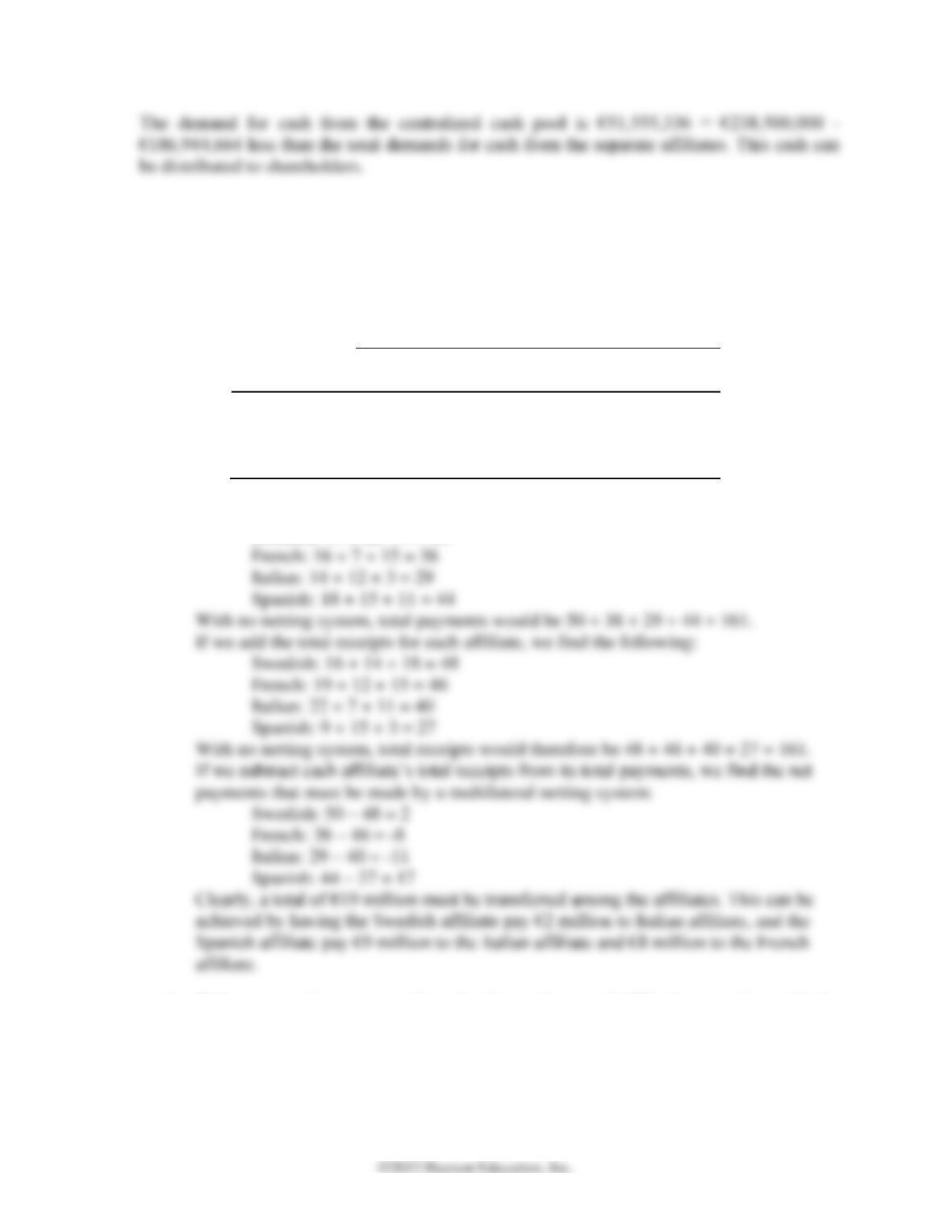
Answer: Currently, each of the four affiliates is holding cash equal to the mean of their
perceived demand plus three standard deviations. The total demand for cash by each affiliate
is therefore Swedish = €25,000,000 + 3
€7,000,000 = €46,000,000
Chapter 19: Managing Net Working Capital
7
2. Euroshipping is also considering developing a multilateral netting system.
a. Given the cumulative monthly payments in the following payments matrix,
derive the minimum transfers that could be made.
Euroshipping Intracompany Payments Matrix (millions of euros)
Paying Affiliate
Receiving
Affiliate
Swedish
French
Italian
Spanish
Swedish
—
16
14
18
French
19
—
12
15
Italian
22
7
—
11
Spanish
9
15
3
—
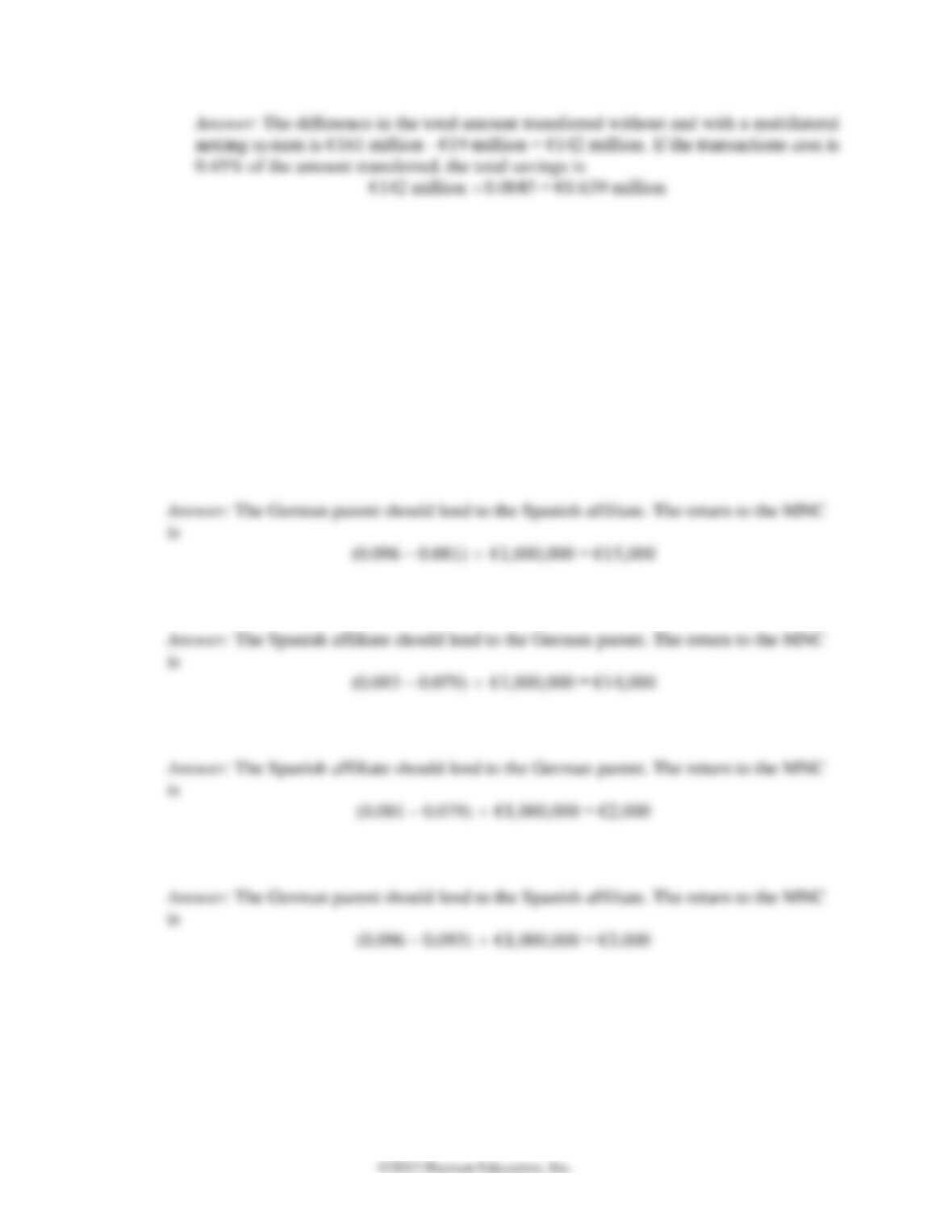
Answer: If we add the total payments for each affiliate, we find the following:
Swedish: 19 + 22 + 9 = 50
b. If the transaction costs on these fund transfers are 0.45%, how much would the
company save by switching to a multilateral netting system?
Chapter 19: Managing Net Working Capital
8
3. Suppose the euro borrowing and lending rates for a German parent and its Spanish
affiliate for a 90-day period are as follows:
Borrowing Rate
(in percent per annum)
Lending Rate
(in percent per annum)
German parent
9.3
8.1
Spanish affiliate
9.6
7.9
In each of the following cases, determine the direction funds should flow and the return to
the MNC of transferring EUR1,000,000:
a. The German parent has positive funds; the Spanish affiliate has negative funds.
b. The German parent has negative funds; the Spanish affiliate has positive funds.
c. The German parent has positive funds; the Spanish affiliate has positive funds.
d. The German parent has negative funds; the Spanish affiliate has negative funds.
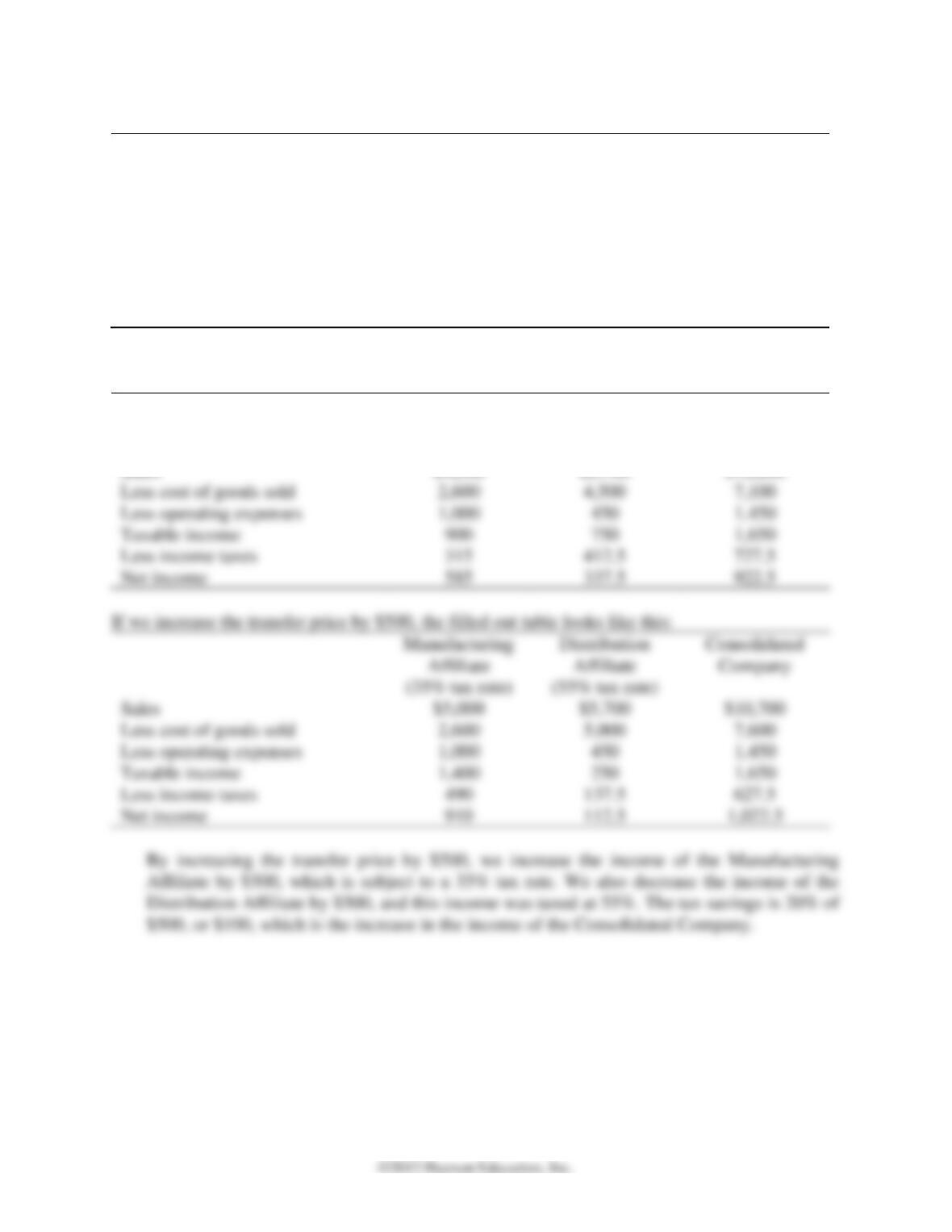
4. Consider a situation in which a manufacturing affiliate is selling to a distribution
affiliate. The relevant tax information, operating expenses, and cost of goods sold are
given in the following table. Fill out the entries in the table and determine how the
overall income of the consolidated company would change if it were to increase the
transfer price by $500:
Chapter 19: Managing Net Working Capital
9
Manufacturing
Affiliate
(35% tax rate)
Distribution
Affiliate
(55% tax rate)
Consolidated
Company
Sales
$4,500
$5,700
Less cost of goods sold
2,600
Less operating expenses
1,000
450
Taxable income
Less income taxes
Net income
Answer: The filled out table looks like this:
Manufacturing
Affiliate
(35% tax rate)
Distribution
Affiliate
(55% tax rate)
Consolidated
Company
Sales
$4,500
$5,700
$10,200
Less cost of goods sold
2,600
Less operating expenses
1,000
Taxable income
Less income taxes
Net income
Manufacturing
Affiliate
(35% tax rate)
Distribution
Affiliate
(55% tax rate)
Consolidated
Company
Sales
$5,000
$5,700
$10,700
Less cost of goods sold
2,600
Less operating expenses
1,000
Taxable income
1,400
Less income taxes
Net income
5. If a manufacturing affiliate faces a 55% income tax rate, and its distribution affiliate
faces a 40% income tax rate and a 15% import tariff, should transfer prices be high or
low?
Answer: Let τ be the tariff rate in the distribution country, which is 15% in our example. Let
τm be the income tax rate on the manufacturing affiliate, which is 55% in our example, and
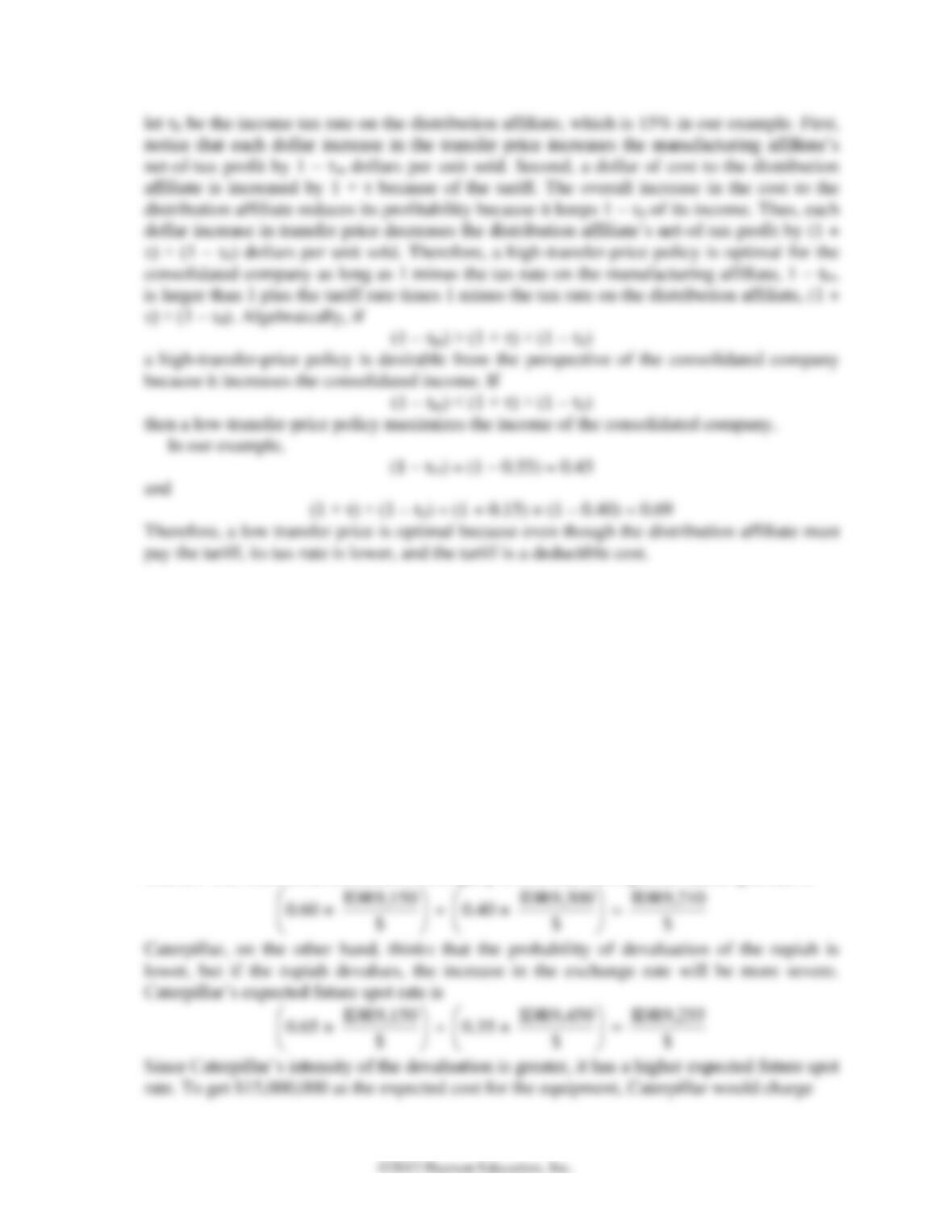
Chapter 19: Managing Net Working Capital
10
6. Caterpillar is selling earthmoving equipment to an Indonesian construction company.
Caterpillar must choose whether to denominate the contract in U.S. dollars or in
Indonesian rupiah. Suppose that the spot exchange rate is IDR9150/$ and that there is
no forward market. Suppose, too, that there is a possibility that the rupiah will be
devalued relative to the dollar during the next year. If Caterpillar prices the contract in
dollars, it will charge $15,000,000 and will expect to be paid in 1 year. It is also willing
to discuss pricing the machines in rupiah. The Indonesian firm thinks that there is a
60% chance the exchange rate will remain the same and a 40% chance it will increase
to IDR9300/$. Caterpillar thinks that there is a 65% probability of the exchange rate
remaining the same and a 35% probability that it will increase to ID9450/$. How
should the deal be priced, and who will bear the risk of devaluation of the rupiah?
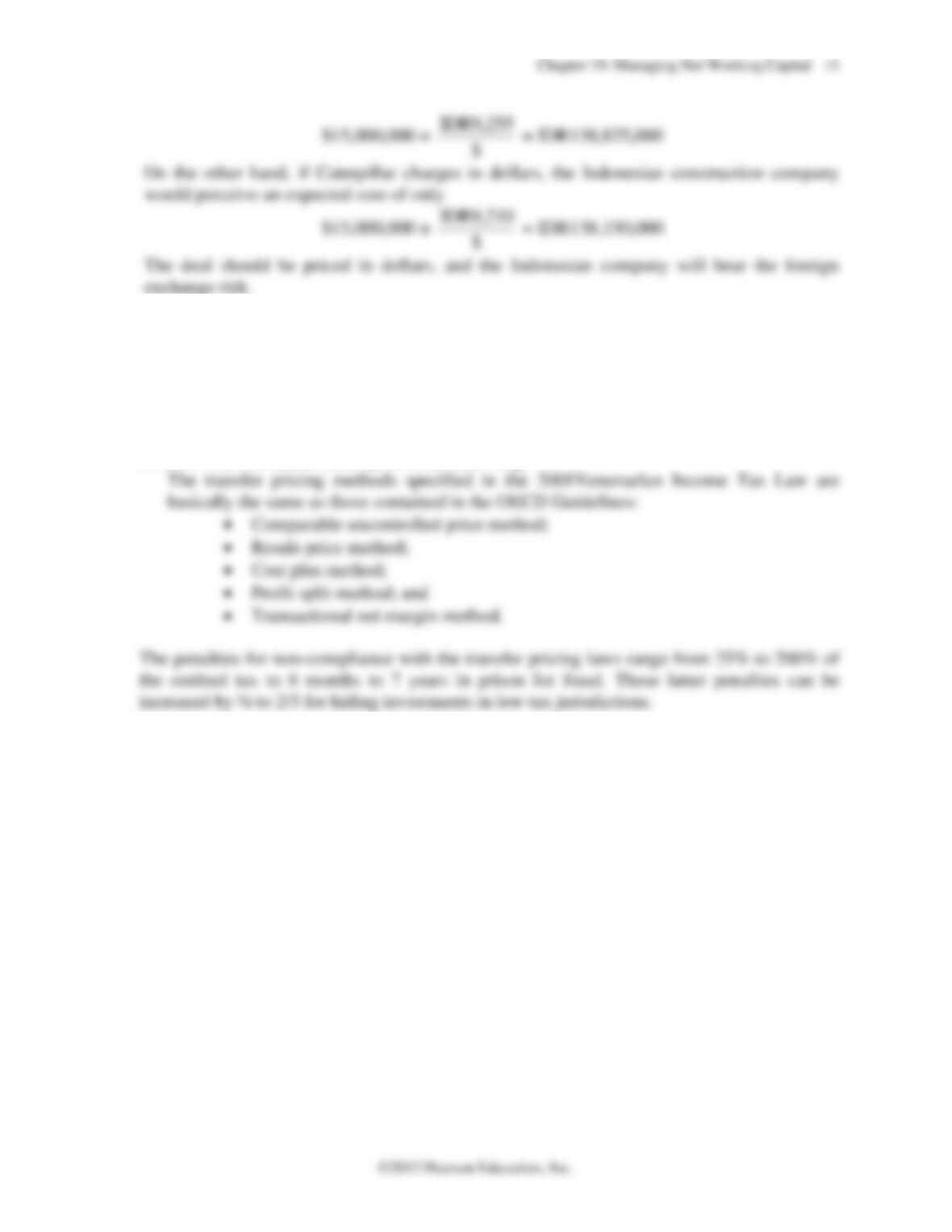
Answer: The Indonesian construction company thinks that the expected future spot rate is
7. Web Question: Go to the PwC Web site related to transfer pricing at
www.pwc.com/gx/en/international-transfer-pricing and download the latest version of
their manual on international transfer pricing. Determine how Venezuela handles
transfer pricing and what the penalties are for non-compliance.
Answer: The document states (p.830) the following: