CHAPTER 19
LEARNING OBJECTIVES
1. EXPLAIN VARIABLE, FIXED, AND MIXED COSTS AND
THE RELEVANT RANGE.
2. APPLY THE HIGH-LOW METHOD TO DETERMINE THE
COMPONENTS OF MIXED COSTS.
CHAPTER REVIEW
Cost Behavior Analysis
1. (L.O. 1) Cost behavior analysis is the study of how specific costs respond to changes in the
level of business activity. A knowledge of cost behavior helps management plan operations and
decide between alternative courses of action.
Variable and Fixed Costs
3. (L.O. 1) Variable costs are costs that vary in total directly and proportionately with changes in
the activity level. Examples of variable costs include direct materials and direct labor, cost of
Relevant Range
5. The range over which a company expects to operate during the year is called the relevant range.
Although a linear (straight-line) relationship for costs may not be realistic, the linear
assumption produces useful data for CVP analysis as long as the level of activity remains
within the relevant range.
Mixed Costs
6. (L.O. 2) Mixed costs are costs that contain both a variable element and a fixed element; they
increase in total as the activity level increases, but not proportionately. For purposes of CVP
analysis, mixed costs must be classified into their fixed and variable elements.
Cost-Volume-Profit Analysis
9. (L.O. 3) Cost-volume-profit (CVP) analysis is the study of the effects of changes in costs and
volume on a company’s profits. It is a critical factor in such management decisions as profit
planning, setting selling prices, determining product mix, and maximizing use of production facilities.
Basic CVP Components
11. The following assumptions underlie each CVP analysis:
a. The behavior of both costs and revenues is linear throughout the relevant range of the
activity index.
Contribution Margin
12. Contribution margin is the amount of revenue remaining after deducting variable costs. The
formula for contribution margin per unit is:
Break-Even Analysis
14. (L.O. 4) The break-even point is the level of activity at which total revenue equals total costs
(both fixed and variable). Knowledge of the break-even point is useful to management when it
decides whether to introduce new product lines, change sales prices on established products, or
enter new market areas.
15. A common equation used for CVP analysis is as follows:
Sales – Variable Costs – Fixed Costs = Net Income
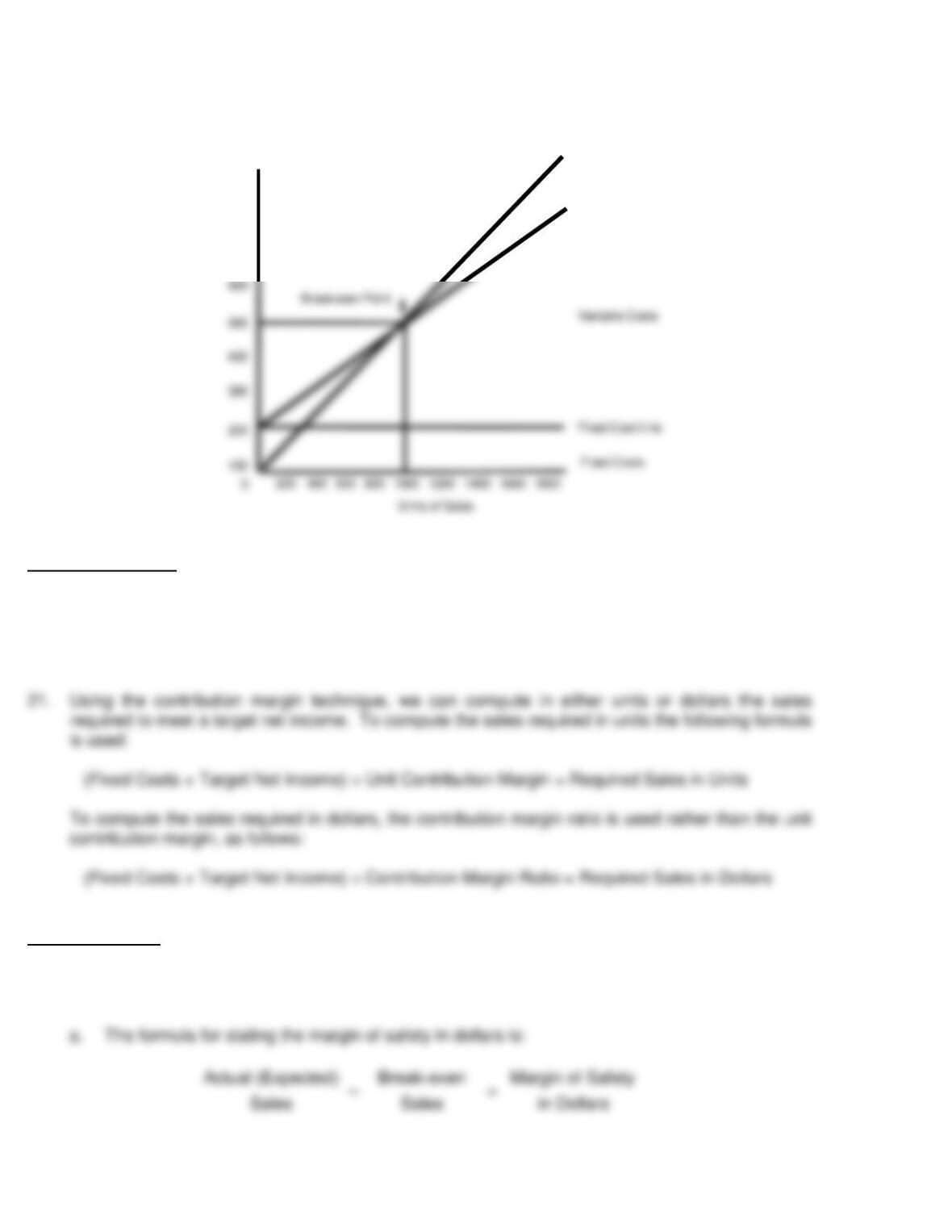
19. A chart (or graph) can also be used as an effective means to determine and illustrate the break–
even point. A cost-volume-profit (CVP) graph is as follows:
900
800
700
Sales Line
Total Cost Line
Dollars (000)
Target Net Income
20. (L.O. 5) Target net income is the income objective for individual product lines. The following
equation is used to determine target net income sales:
Required Sales – Variable Costs – Fixed Costs = Target Net Income
Margin of Safety
22. Margin of safety is the difference between actual or expected sales and sales at the break-even
point.
LECTURE OUTLINE
A. Cost Behavior Analysis.
1. Cost behavior analysis is the study of how specific costs respond to
changes in the level of business activity.
4. Fixed costs are costs that remain the same in total regardless of changes
in the activity level.
MANAGEMENT INSIGHT
As the population increases and farmable land becomes more scare, growing food
hydroponically in skyscrapers has been studied as an alternative way to grow food
without incurring some of the common costs associated with farming (transportation
to cities, pesticides, etc.). But, even while some costs are reduced by farming
hydroponically, other costs are likely to increase.
What are some of the variable and fixed costs that are impacted by hydroponic
farming?
MANAGEMENT INSIGHT
The recent recession produced a surprise for some manufacturers— the number of
jobs lost was actually lower than in previous recessions. In the years preceding
the recession, many factories adopted lean manufacturing practices that relied
less on large numbers of low skilled workers, and more on machines and a few
highly skilled workers. Because the employees are highly skilled, employers are
reluctant to lose them.
Would you characterize labor costs as being a fixed cost, a variable cost, or
something else in this situation?
B. Cost-Volume-Profit Analysis.
2. CVP analysis considers the interrelationships among the following
components:
a. Volume or level of activity.
3. The following assumptions underlie each CVP analysis:
a. The behavior of both costs and revenues is linear throughout the
relevant range of the activity index.
4. Contribution margin is the amount of revenue remaining after deducting
variable costs. It can be expressed as a per unit amount or as a ratio.
C. Break-even Analysis.
1. At the break-even point, the company will realize no income but will
suffer no loss.
b. Computed by using contribution margin: Break-even Point in Units =
Fixed Costs ÷ Contribution Margin per Unit. Break-even Point in
Dollars = Fixed Costs ÷ Contribution Margin Ratio.
4. The income objective set by management is called target net income. To
meet target net income, required sales must be determined.
a. Mathematical equation: Required Sales – Variable Costs – Fixed
Costs = Target Net Income. Required sales may be expressed in
either sales units or sales dollars.
SERVICE COMPANY INSIGHT
FlightServe, a chartered aircraft company, decided to match up executives with
charter flights in small “private jets”. The company noted that the average charter
jet had eight seats, but it would break even at an average of 3.3 seats per flight.
How did FlightServe determine that it would break even with 3.3 seats full per flight?
5. Margin of safety is the difference between actual or expected sales and
sales at the break-even point. The margin of safety can be expressed in
dollars or as a ratio.
MANAGEMENT INSIGHT
The promoter for the Rolling Stones’ tour guaranteed $1.2 million to the group. In
addition, 20% of the gross goes to the stadium where the performance is staged
and another $400,000 for other expenses such as ticket takers and advertising.
What amount of sales dollars are required for the promoter to break even?
20 MINUTE QUIZ
Circle the correct answer.
True/False
1. The range over which a company is expected to operate is called the relevant range of
the activity index.
True False
2. A mixed cost contains both selling and administrative cost elements.
True False
3. Variable costs are costs that remain the same per unit at every level of activity.
True False
4. If a salesperson incurs $2,000 of expenses in servicing two customers and $4,000 of
expenses in servicing four customers, the fixed costs are $1,000.
True False
5. If revenue = $80 and variable cost = 40% of revenue, then contribution margin = $48.
True False
6. The contribution margin is the amount of revenue remaining after deducting fixed costs.
True False
7. Sales mix is the percentage that each product represents of total sales.
True False
8. If the unit contribution margin is $300 and fixed costs are $240,000 then the break-even
point in units would be 800 units.
True False
9. In a CVP income statement, contribution margin is reported in the body of the statement.
True False
10. Margin of safety is the difference between actual sales and contribution margin.
True False
Multiple Choice
1. Which of the following is a false statement regarding assumptions of CVP analysis?
a. Total fixed costs remain constant over the relevant range.
b. Unit selling prices are constant.
c. Changes in volume or level of activity increase variable costs per unit.
d. All units produced are sold.
2. Mixed costs may be separated into fixed costs and variable costs by using
a. the relevant range method.
b. the high-low method.
c. the contribution margin method.
d. all of the above.
3. If the unit selling price is $500, the unit variable cost is $300, and the total monthly fixed
costs are $300,000, then the contribution margin ratio is
a. 30%.
b. 40%.
c. 50%.
d. 60%.
4. If activity level increases 25% and a specific cost increases from $40,000 to $50,000, this
cost would be classified as a
a. variable cost.
b. mixed cost.
c. fixed cost.
d. none of the above.
5. If total fixed costs are $900,000 and variable costs as a percentage of unit selling price
are 40%, then the break-even point in dollars is
a. $1,500,000.
b. $360,000.
c. $2,250,000.
d. not determinable with the information given.

ANSWERS TO QUIZ
True/False
Multiple Choice