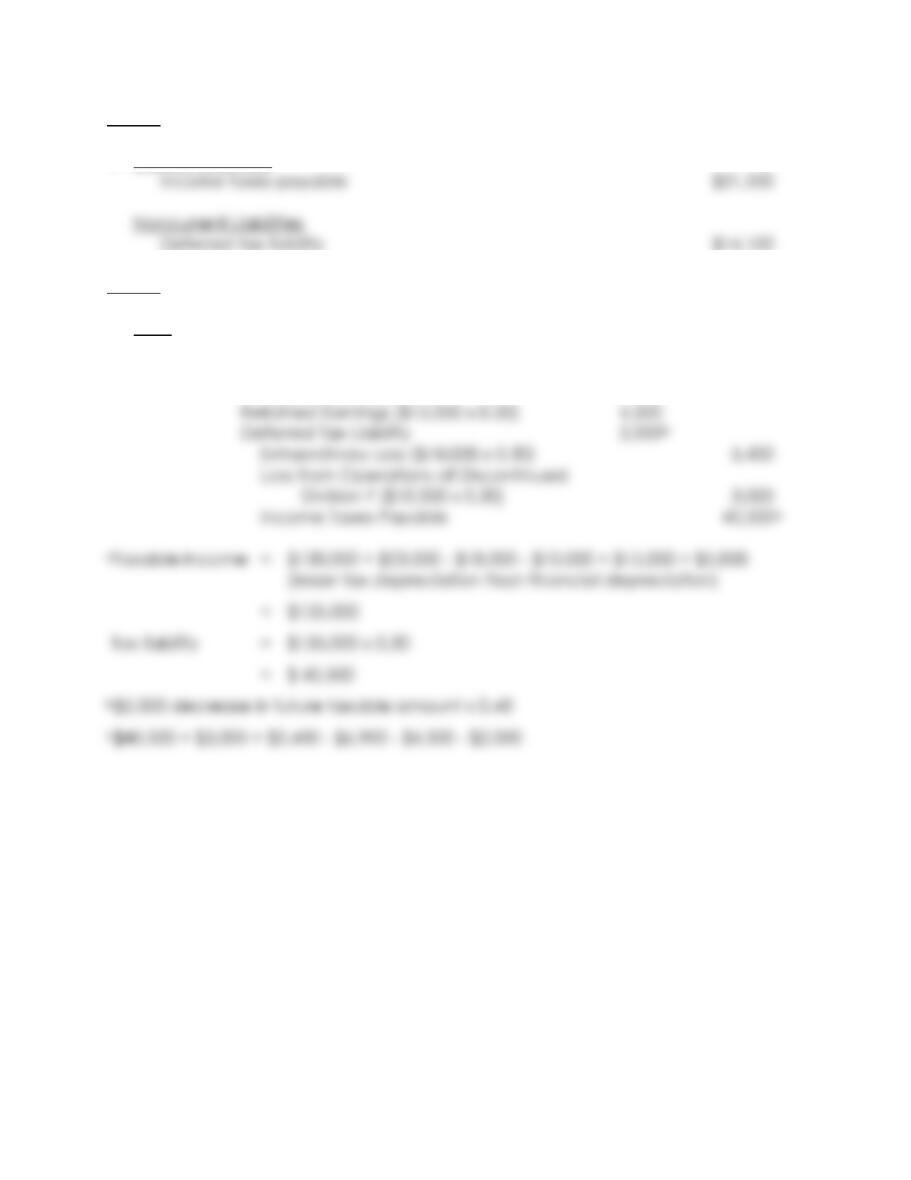
19-36
P19-13 (continued)
5. Current Liabilities
P19-14
1. 2010
Dec. 31 Income Tax Expense 35,500c
Gain on Disposal of Division F
($23,000 x 0.30) 6,900
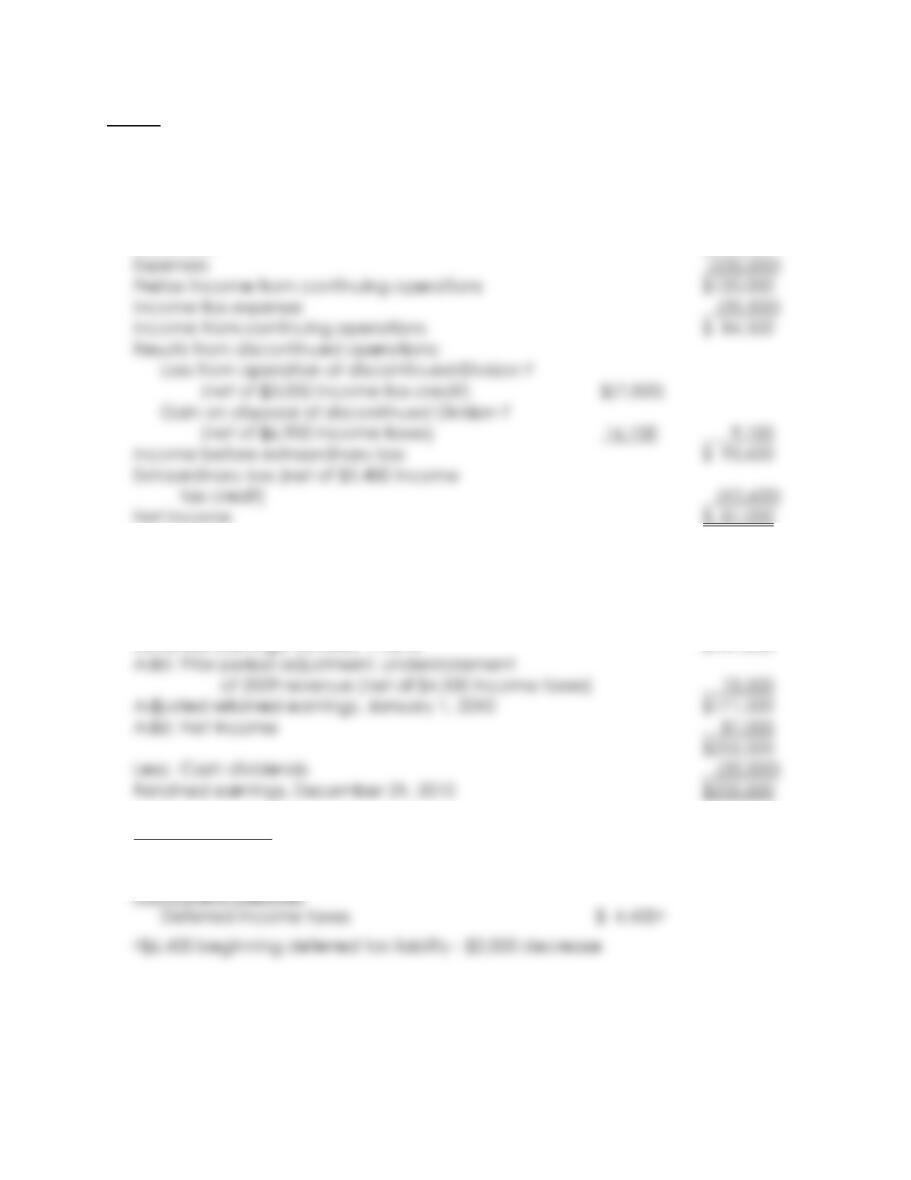
19-37
P19-14 (continued)
2. NORRIS COMPANY
Income Statement
For Year Ended December 31, 2010
Revenues $352,000
3. NORRIS COMPANY
Statement of Retained Earnings
For Year Ended December 31, 2010
Retained earnings, January 1, 2010 $161,000
4. Current Liabilities
Income taxes payable $40,500
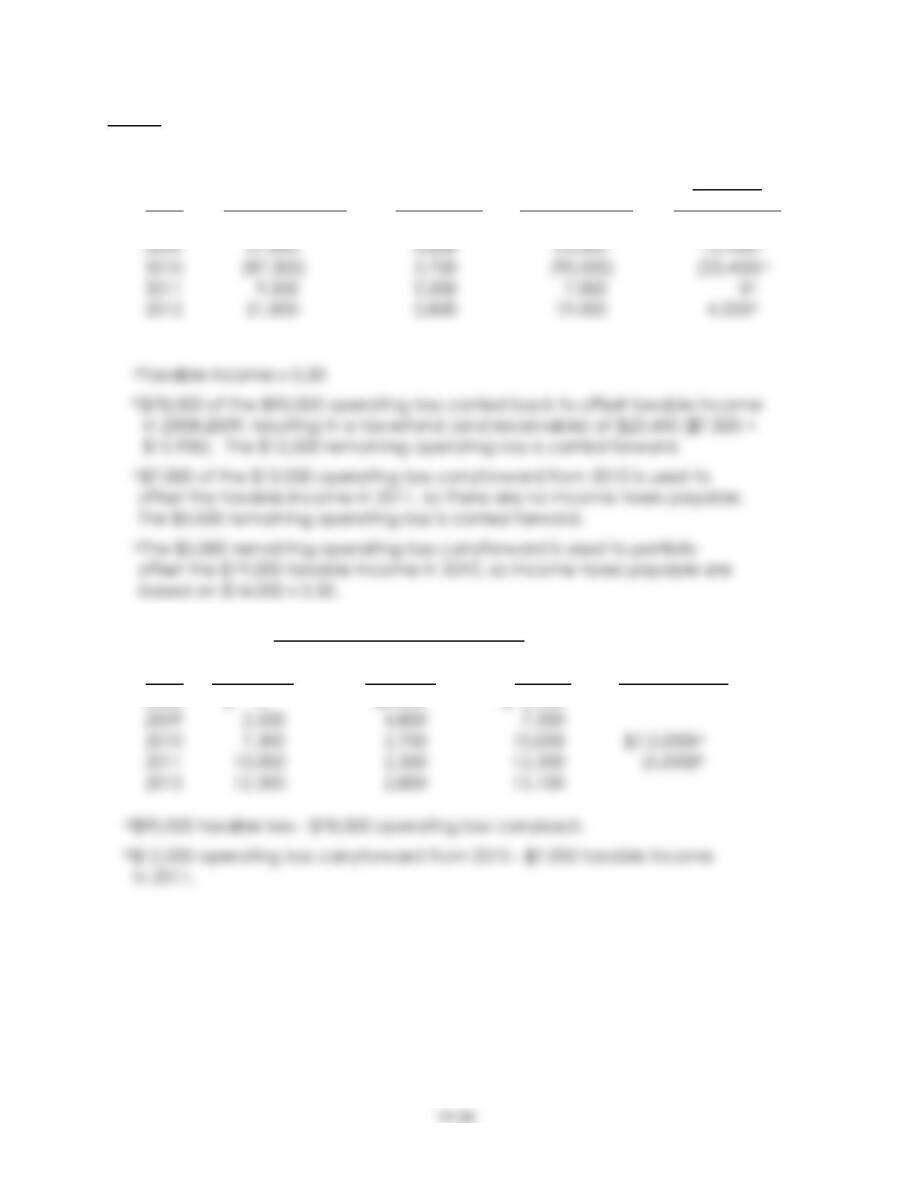
P19-15
1.
Year
Pretax Financial
Income (Loss)
Taxable
Temporary
Difference
Taxable
Income (Loss)
Income Taxes
Payable
(Receivable)
2008
$27,500
$2,500
$25,000
$ 7,500a
Taxable Temporary Difference
2.
Year
Beginning +
Addition =
Ending
Operating Loss
Carryforward
2008
$ 0
$2,500
$ 2,500

19-39
Deferred Tax Liability Deferred Tax Asset Valuation Allowance
Year Beginning Endinga Adjustment Beginning Ending Adjustment Beginning Ending Adjustment
2008
2009
2010
$ 0
750
2,190
$ 750
2,190
3,000
$ 750
1,440
810
–
–
–
–
–
$3,600b
–
–
$3,600
–
–
–
–
–
$600c
–
–
$600
19-39
P19-15 (continued)
3.
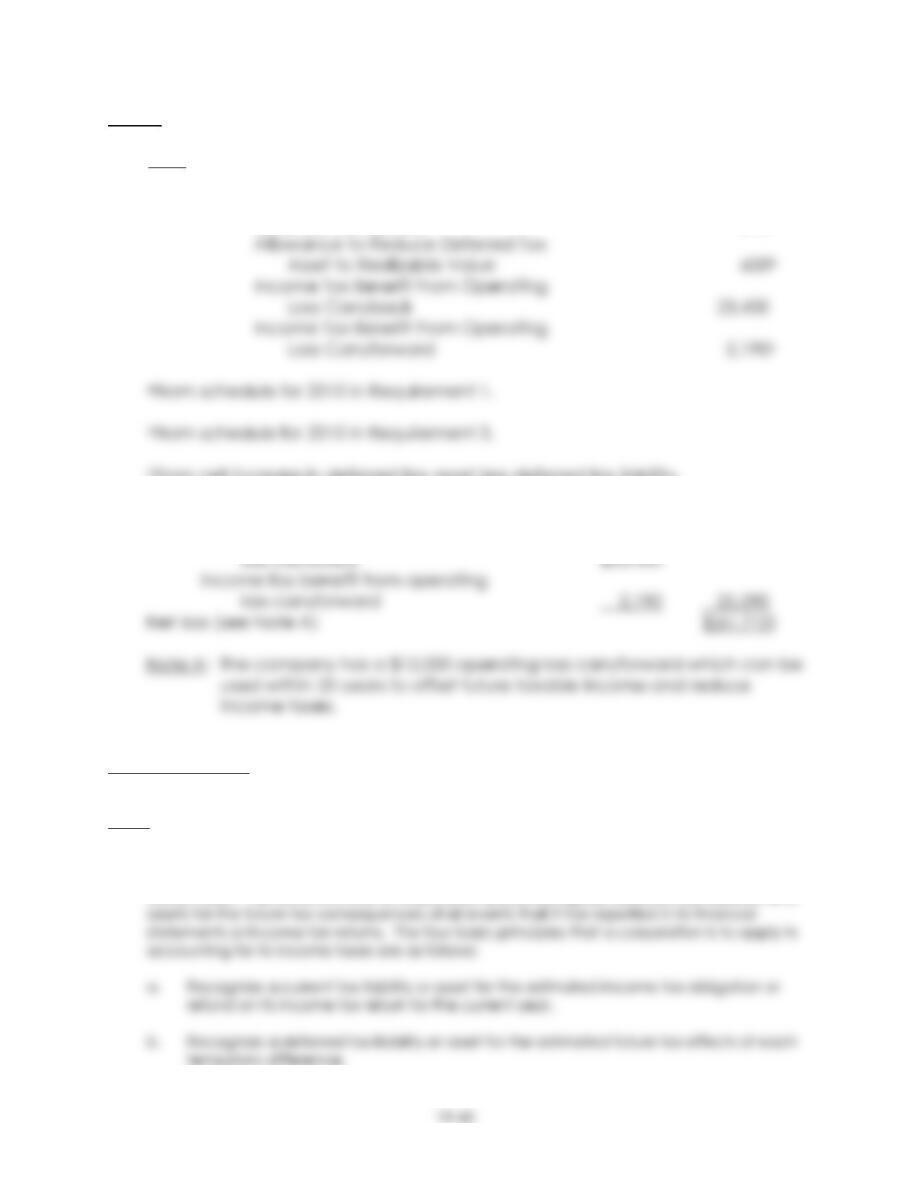
P19-15 (continued)
4. 2010
Dec. 31 Income Tax Refund Receivable 23,400a
Deferred Tax Asset 3,600b
Deferred Tax Liability 810b
5. Pretax operating loss $(87,300)
Less: Income tax benefit from operating
ANSWERS TO CASES
C19-1
1. According to the FASB, there are two goals in accounting for income taxes. The first is that
a corporation should recognize the amount of its income tax obligation or refund for the
current year. The second is that a corporation should recognize deferred tax liabilities and

19-1 (continued)
1. (continued)
c. Measure its deferred tax liabilities and assets based on the provisions of the enacted
tax law; the effects of future changes in tax laws or rates are not anticipated.
3. Temporary differences may be classified into four groups. The first two groups result in
future taxable income being more than future pretax financial income. The last two
groups result in future taxable income being less than future pretax financial income. The
groups and examples of each are as follows:
Future Taxable Income Will Be More Than Future Pretax Financial Income
a. Revenues or gains are included in pretax financial income prior to the time they are
included in taxable income. Examples include gross profit on certain installment
sales, when gross profit on long-term construction contracts is recognized for financial
Future Taxable Income Will Be Less Than Future Pretax Financial Income
a. Revenues or gains are included in taxable income prior to the time they are included
in pretax financial income. Items such as rent, interest, and royalties received in

C19-1 (continued)
3. (continued)
b. Expenses or losses are subtracted to compute pretax financial income prior to the
time they are deducted to compute taxable income. For example product warranty
costs, bad debts, compensation expense for share option plans, and losses on
C19-2
Interperiod income tax allocation is the allocation of a corporation’s income tax obligation
as an expense to various accounting periods. The use by a corporation of generally
accepted accounting principles for financial reporting purposes and the Internal Revenue
Code provisions for income tax reporting purposes results in both permanent and
based on the currently enacted rate when the differences will reverse.
Under comprehensive allocation, the income tax expense that a corporation reports in an
accounting period is affected by all the transactions and events that it included in
determining its pretax financial income for that period. Thus, the corporation recognizes
C19-3
Interperiod income tax allocation is the allocation of a corporation’s income tax obligation
as an expense to various accounting periods. Three methods of interperiod income tax

C19-3 (continued)
The asset/liability method is balance-sheet oriented. The intent is to accrue and report the
total tax that will actually be assessed on temporary differences when they reverse. Under
this method, the deferred tax amount that a corporation reports on its balance sheet is the
effect of temporary differences that will reverse in the future and that it measures using the
C19-4
1. The Internal Revenue Code allows a corporation reporting an operating loss for income tax
purposes in the current year to carry this loss back and forward to offset other reported
taxable income. A corporation may first carry a reported operating loss back 2 years (in
2. The two conceptual questions concerning how a corporation accounts for a carryback
are:
a. Should the corporation recognize the tax benefit of an operating loss carryback as a
retrospective adjustment or in the current period?

19-44
C19-4 (continued)
2. (continued)
For an operating loss carryback, the corporation obtains a tax benefit in the year of the
operating loss. This benefit is a refund of prior income taxes paid (which the corporation
3. The two conceptual questions concerning how a corporation accounts for a carryforward
are:
a. Should the corporation recognize the tax effect of an operating loss carryforward in
the current period or in the future when it is realized?
b. How should the corporation report the tax effect of an operating loss carryforward on
its income statements?
(2) there is better matching, (3) it enables better comparisons, and (4) it is consistent with
the going concern assumption.
Another alternative is for the corporation to defer recognition of an operating loss
carryforward until it is realized. If this approach were taken, the corporation would not
(1) deduct the tax effect from that year’s income tax expense, or (2) report the tax effect
as a prior period adjustment of the year in which the operating loss occurred. An argument

19-45
C19-4 (continued)
4. The generally accepted accounting principles for the financial reporting of operating loss
carrybacks and carryforwards are as follows:
a. A corporation must recognize the tax benefit of an operating loss carryback in the
C19-5
1. Interperiod income tax allocation is the allocation of a corporation’s income tax obligation
as an expense to various accounting periods, while intraperiod income tax allocation is the
2. For intraperiod income tax allocation purposes, on its income statement a corporation
reports the income tax expense applicable to its pretax income from continuing
operations separately. The disclosure of the tax effect on its income from continuing
operations is important because, external users are very interested in the corporation’s
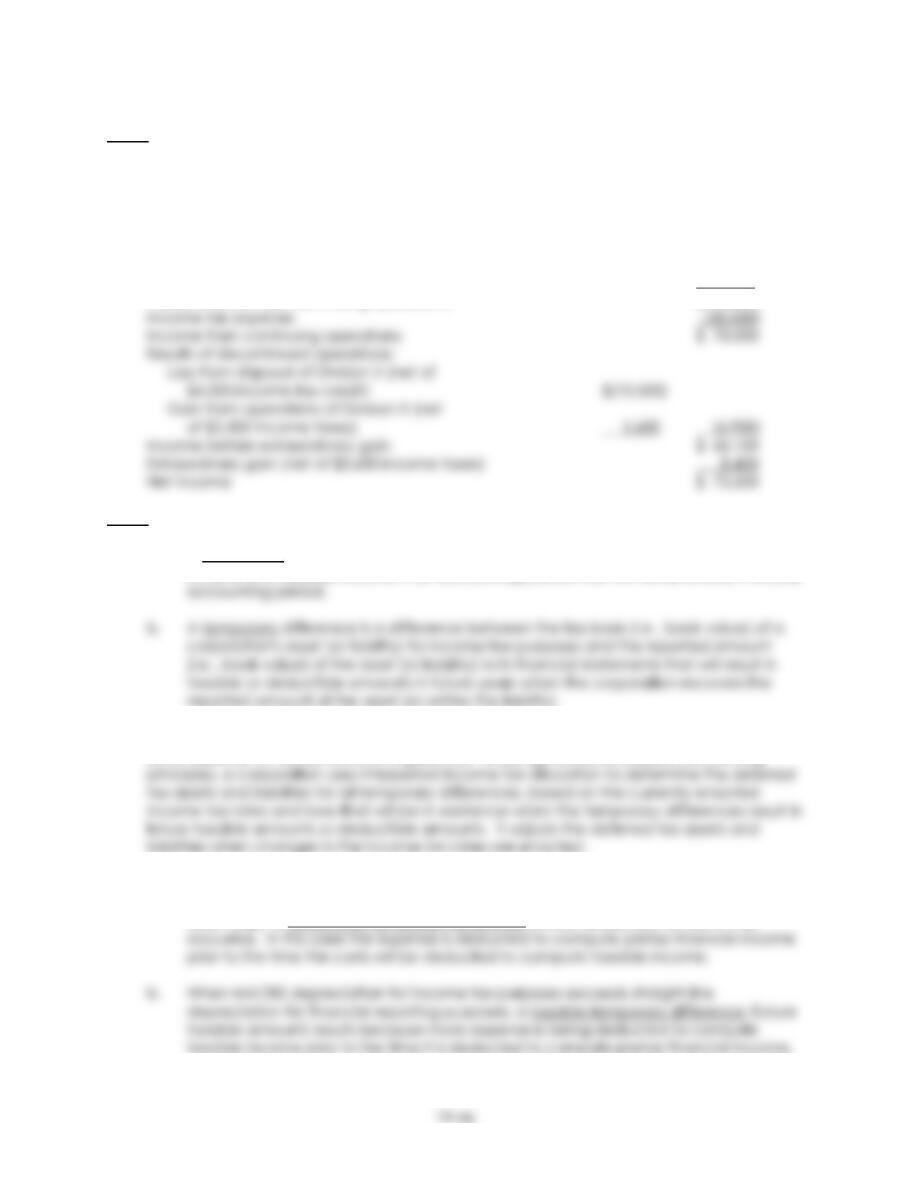
3. For example, assume the Hazelrigg Company reports the following items of pretax financial
(and taxable) “income” for 2010:
Income from continuing operations (revenues
C19-5 (continued)
3. (continued)
HAZELRIGG CORPORATION
Partial Income Statement
For Year Ended December 31, 2010
Revenues $260,000
Expenses (160,000)
Pretax income from continuing operations $100,000
C19-6
1. a. A permanent difference is a difference between a corporation’s pretax financial
income and taxable income in an accounting period that will never reverse in a later
2. Interperiod income tax allocation is the allocation of a corporation’s income tax obligation
as an expense to various accounting periods. Under generally accepted accounting
3. a. When estimated warranty costs (covering a 3-year warranty) are expensed for
financial reporting purposes at the time of sale but are deducted for tax purposes
when paid, a deductible temporary difference (future deductible amount) has

C19-6 (continued)
3. (continued)
c. When percentage depletion for tax purposes exceeds cost depletion for financial
C19-7
There are three characteristics of a liability. They are: (1) it is a responsibility of the
corporation to another entity that will be settled in the future, (2) the responsibility obligates
the corporation so that it cannot avoid the future sacrifice, and (3) the transaction or other
event obligating the corporation has already occurred. The deferred tax consequences
There are also three characteristics of an asset. They are: (1) it will contribute to the
corporation’s future net cash inflows, (2) the corporation must be able to obtain the benefit
and control other entities’ access to it, and (3) the transaction or other event resulting in the
corporation’s right to or control of the benefit has already occurred. The deferred tax
consequences of temporary differences of a corporation that will result in deductible

C19-7 (continued)
Furthermore, a corporation may realize the tax benefits from a deferred tax asset only if
C19-8
To: Dunn
From: Green
Re: Accounting for income taxes
Below is a brief overview of accounting for income taxes in accordance with FASB 109.
The objectives of accounting for income taxes are to recognize (a) the amount of taxes
payable or refundable for the current year, and (b) deferred tax liabilities and assets for
C19-9
1. $1,892 million total income tax expense relating to income before income taxes for 2007
(p. 66). $1,783 million current income tax expense and $109 million deferred income tax
expense (Note 17, p. 112).

19-49
C19-10
Note to Instructor: This case does not have a definitive answer. From a financial reporting
perspective, GAAP is identified and summarized. From an ethical perspective, various
issues are raised for discussion purposes.
From a financial reporting perspective, a corporation reports its deferred tax liabilities as
From an ethical perspective, the issue relates to whether to consider the impact of a
reclassification of a seemingly immaterial amount on the current ratio. This issue has an
impact on the company’s controller, creditors, and stockholders, as well as you and the
auditing firm for which you work. The amount may not be immaterial because the total