CA 18-4 (Continued)
a premium, the types of customers who receive credits, and the ease of exchanging credits for
premiums will all affect the proportion of credits actually redeemed in relation to the potential
redemptions. The difference between the five percent initial estimate and the actual proportion of
unredeemed credits affects the accrual of a liability for redemption of credits issued under the
first method and the rate of transfer of revenue from the advances account under the second and
third methods.
CA 18-5
(a) Receipts based on subscriptions should be credited to Unearned Sales Revenue. As each
monthly issue is distributed, Unearned Sales Revenue is reduced (Dr.) and Sales Revenue is
1. The seller’s price to the buyer is substantially fixed or determinable at the date of sale.
2. The buyer has paid the seller, or the buyer is obligated to pay the seller, and the obligation
is not contingent on resale of the product.
(b) The expected sales return must be indicated when revenue is recognized. Since Cutting Edge is
expecting a 25% return rate, as each issue is distributed and revenue is recognized, an amount
equal to one-fourth of the earned revenue must be recognized for returns and allowances.
CA 18-5 (Continued)
This is necessary because the expense recognition principle requires that the expected return be
recognized at the same time revenue is recognized. The account entitled Sales Returns and
(c) Since the atlas premium may be accepted whenever requested, it is necessary for Cutting Edge
to record a liability for estimated premium claims outstanding. According to GAAP, the estimated
premium claims outstanding is a contingent liability which should be reported since it can be
readily estimated [60% of the new subscribers X (cost of atlas – $2)] and its occurrence is
probable. As the new subscription is obtained, Cutting Edge should record the estimated liability
as follows:
(d) The current ratio (Current Assets Current Liabilities) will change, but not in the direction Embry
thinks. As subscriptions are obtained, current assets (cash or accounts receivable) will increase
CA 18-6
(a) Widjaja Company should recognize revenue as it performs the work on the contract (the
percentage-of-completion method) because the right to revenue is established and collectibility is
(b) Progress billings would be accounted for by increasing accounts receivable and increasing progress
billings on contract, a contra-asset that is offset against the Construction in Process account. If
CA 18-6 (Continued)
(c) The income recognized in the second year of the four-year contract would be determined using
the cost-to-cost method of determining percentage of completion as follows:
1. The estimated total income from the contract would be determined by deducting the estimated
total costs of the contract (the actual costs to date plus the estimated costs to complete) from
(d) Earnings per share in the second year of the four-year contract would be higher using the
percentage-of-completion method instead of the completed-contract method because income
CA 18-7
(a) Honesty and integrity of financial reporting versus higher corporate profits are the ethical issues.
Nies’s position represents GAAP. The financial statements should be presented fairly and that
*CA 18-8
(a) Two primary criteria must be met before revenue is recognized: (1) the related earnings process
must be substantially completed (the revenue must be earned), and (2) there must be objective
evidence of the market value of the output—this often is interpreted to require that an exchange
*CA 18-8 (Continued)
or
1.
Cash …………………………………………………………
20,000
20,000
Notes Receivable ………………………………………..
100,000
75,816
Revenue from Franchise Fees …………………
95,816
95,816
or
2.
Cash …………………………………………………………
20,000
20,000
Notes Receivable ………………………………………..
100,000
75,816
Discount on Notes Receivable …………………
24,184
Unearned Franchise Fees ………………………
95,816
95,816
or
3.
Cash …………………………………………………………
20,000
20,000
Notes Receivable ………………………………………..
100,000
75,816
Discount on Notes Receivable …………………
24,184
Revenue from Franchise Fees …………………
20,000
20,000
Unearned Franchise Fees ………………………
75,816
75,816
4.
Cash …………………………………………………………
20,000
Revenue from Franchise Fees …………………
20,000
This procedure would be consistent with the cash basis of accounting and would be
5.
Cash …………………………………………………………
20,000
Unearned Franchise Fees ………………………
20,000
*CA 18-8 (Continued)
6. Three additional alternatives would parallel the first three alternatives given above, except
that the notes would be reported at their face value. These alternatives would be appropriate
in situations where the notes bear interest or call for the payment of interest at the going rate.
(b) Because the initial cash collection of $20,000 must be refunded if the franchise fails to open, it is
not fully earned until the franchisee begins operations. Thus, Amigos Burrito should record the
initial franchise fee as follows:
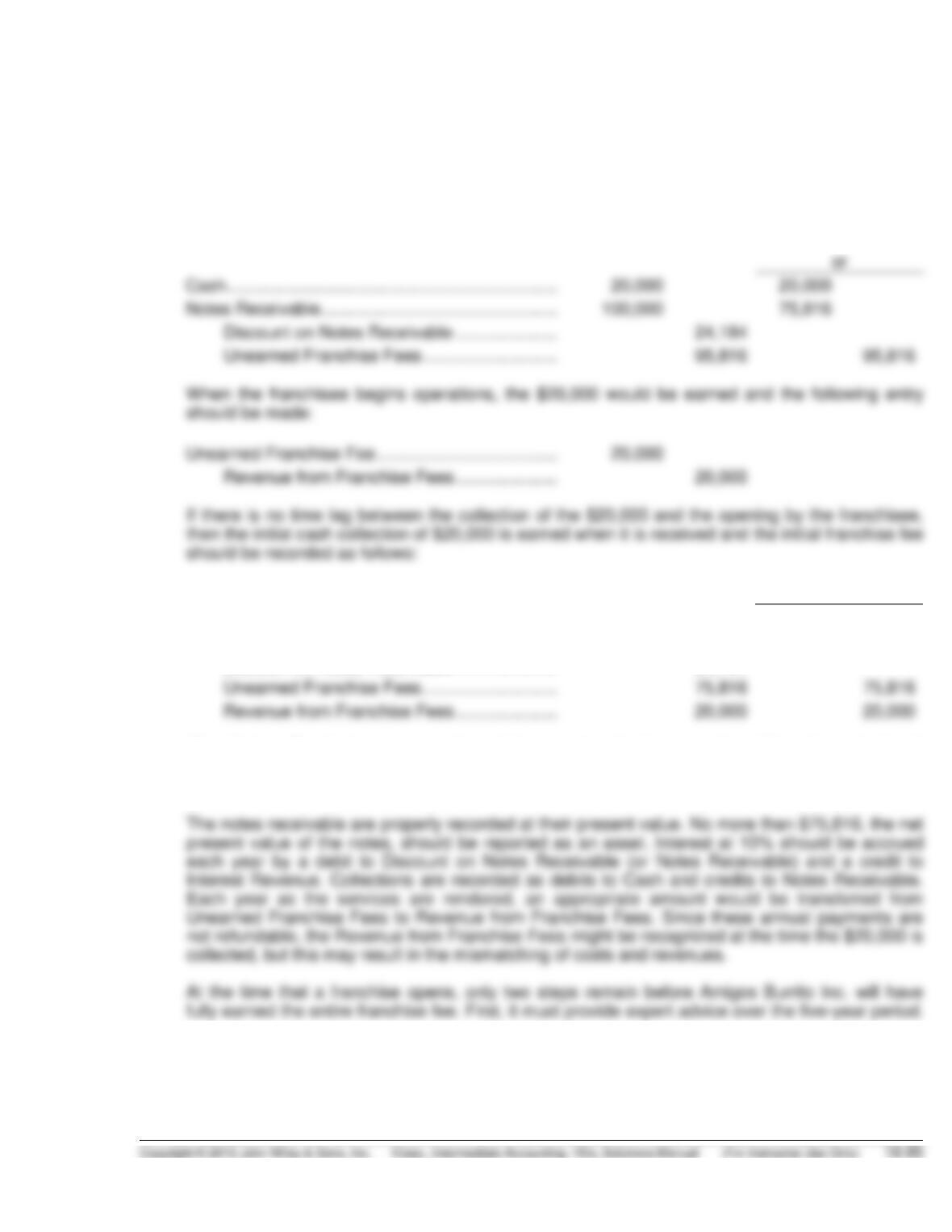
or
Cash …………………………………………………………..
20,000
20,000
Notes Receivable………………………………………….
75,816
Discount on Notes Receivable …………………
24,184
Unearned Franchise Fees ……………………….
95,816
95,816
Unearned Franchise Fee ……………………………….
20,000
Revenue from Franchise Fees …………………
20,000
or
Cash …………………………………………………………..
20,000
20,000
Notes Receivable………………………………………….
100,000
75,816
Discount on Notes Receivable …………………
24,184
Unearned Franchise Fees ……………………….
75,816
Revenue from Franchise Fees …………………
20,000
20,000
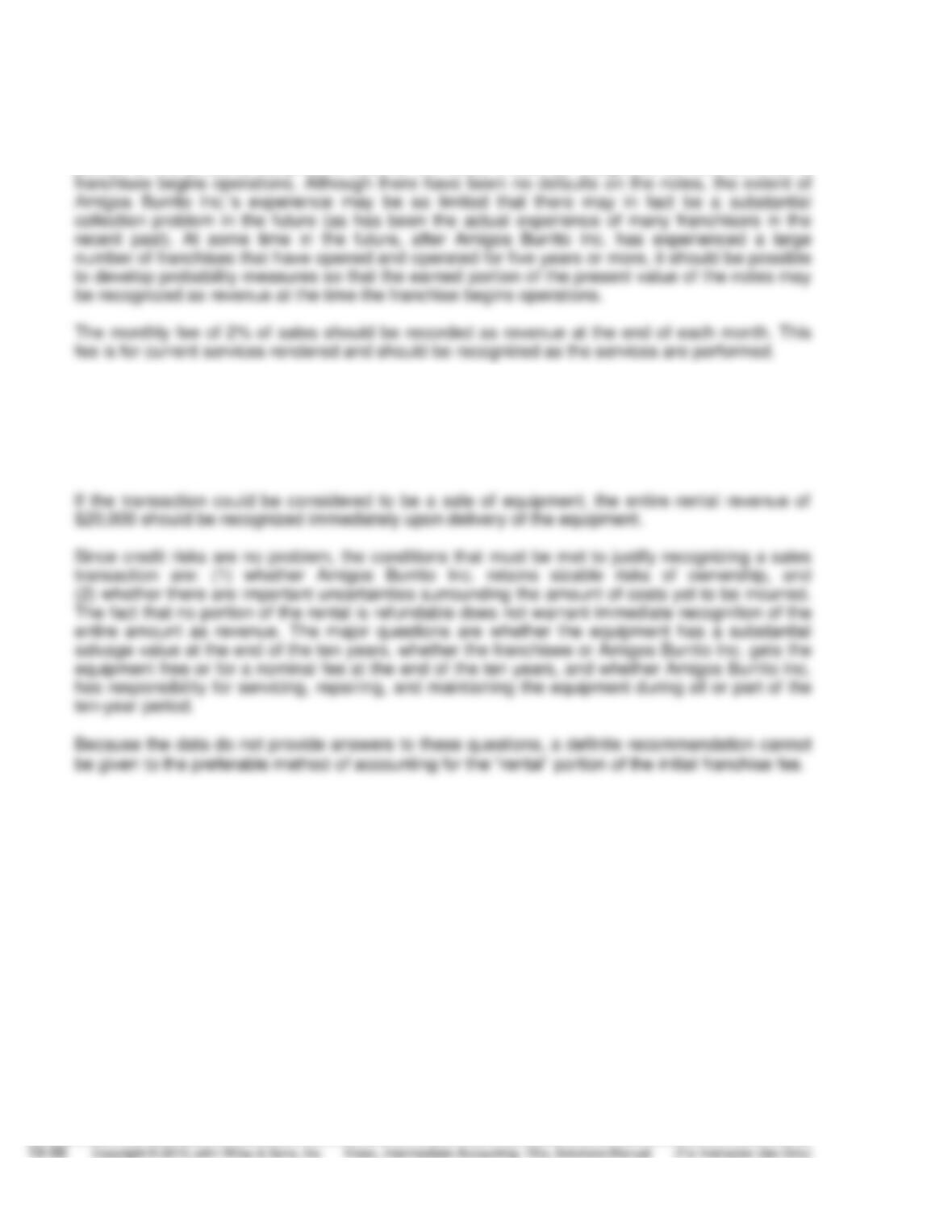
After Amigos Burrito Inc. has experienced the opening of a large number of franchises, it should
be possible to develop probability measures so that the expected value of the retained initial
franchise fee can be determined and recorded as earned at the time of receipt.
*CA 18-8 (Continued)
Second, it must wait until the end of each of the next five years so that it may collect each of the
$20,000 notes. Since collection has not been a problem, and since the advice may consist
largely of manuals and periodical service tip flyers, it could be maintained that a substantial
portion of the $75,816, the present value of the notes, should be recognized as revenue when a
(c) If the rental portion of the initial franchise fee, $20,000, represents the present value of monthly
rentals over a ten-year period, it should be recorded as Unearned Lease Revenue to be
recognized on an actuarially sound basis over the periods benefiting from the use of the leased
assets. This type of transaction does not necessarily represent a sale of the equipment and
immediate recognition of the entire rental as revenue may not be appropriate.
FINANCIAL REPORTING PROBLEM
(a) 2011 Net Sales: $82,559 million.
(b) P&G’s net sales increased from $78,938 million to $82,559 million from
(c) Sales are recognized when revenue is realized or realizable and has
been earned. Revenue transactions represent sales of inventory. The
revenue recorded is presented net of sales and other taxes we collect
(d) Trade promotions, consisting primarily of customer pricing allowances,
merchandising funds and consumer coupons, are offered through
various programs to customers and consumers. Sales are recorded
net of trade promotion spending, which is recognized as incurred,
generally at the time of the sale. Most of these arrangements have
COMPARATIVE ANALYSIS CASE
(a) For the year 2011, Coca-Cola reported net operating revenues of
$46,542 million and PepsiCo reported net revenue of $66,504 million.
(b) Revenue Recognition Policies
Coca-Cola provided the following revenue recognition note:
Our Company recognizes revenue when persuasive evidence of an
arrangement exists, delivery of products has occurred, the sales
PepsiCo’s Revenue Recognition note is as follows:
We recognize revenue upon shipment or delivery to our customers
in accordance with written sales terms that do not allow for a right
COMPARATIVE ANALYSIS CASE (Continued)
(c) In 2011, Coca Cola experienced significant amounts of revenue in
Eurasia and Africa, $2,841 million; Europe, $5,474 million; Latin
America, $4,690 million; and Pacific $5,838 million. In 2011, PepsiCo
FINANCIAL STATEMENT ANALYSIS CASE
WESTINGHOUSE ELECTRIC CORPORATION
(a) For product sales, Westinghouse Electric Corporation uses the date of
delivery, point of sale, basis for revenue recognition. For services ren-
dered, Westinghouse uses the “when services are complete and billable
(b) Point of sale or date of delivery is acceptable in ordinary product sale
transactions where the seller’s earning process is virtually complete,
no further obligations or costs remain, and the exchange transaction
The percentage-of–completion method of revenue recognition is accept-
able on long-term projects, usually construction contracts exceeding
one year in length. Its application is required if the following conditions
exist:
1. A firm contract price with a high probability of collection exists.
(c) WFSI is probably a wholly owned finance subsidiary of Westinghouse
that provides financing for customers of Westinghouse. The character
ACCOUNTING, ANALYSIS, AND PRINCIPLES
Accounting
Sales revenue ………………………………………………………………….. $9,500,000
Expenses ………………………………………………………………………… 7,750,000
1,750,000
* Gross profit from long-term contract
Contract price ………………………………………… $1,000,000
Costs:
Analysis
Net income ………………………………………………………………………. $1,925,000
Depreciation expense ………………………………………………………. 175,000