Chap. 18 Other Pile Types: Axial Load Capacity
18.1 As discussed in this chapter, the nominal downward load capacity of jacked piles is often greater
than the jacking force. Describe a) a situation in which this difference would likely be very large,
and b) a situation where this difference would be comparatively small. Explain the reasoning
behind your examples.
Solution
a) There can be a very large difference between the nominal downward load capacity and the
jacking force for longer piles in soft clays. The value of the Pn/Pj ratio depends on soil properties,
the pile length, pile spacing and the soil recovery time. For piles jacked into clays, the soil
Chap. 18 Other Pile Types: Axial Load Capacity
18.2 Pressure injected footings normally have higher fn and q’n values than other types of piles in the
same soil conditions. Explain why this is the case, and describe a soil condition where this
difference would likely be the greatest.
Solution
The pressure injected footing construction process creates an enlarged bulb at the pile toe as
shown in Figure 12.53. This bulb increases both the toe bearing area, At, and the net toe bearing
Chap. 18 Other Pile Types: Axial Load Capacity
18.3 An engineer is designing a deep foundation at a site underlain with loose to medium dense sandy
silt and silty sand. Three pile types are being considered: Driven prestressed concrete piles,
pressure injected footings, and drilled displacement piles. Discuss the advantages and
disadvantages of each type.
Solution
Driven prestressed concrete piles
Advantages:
• Driven prestressed concrete piles are best suited for use as friction piles that do not meet
• Mobilizing the driving equipment is typically more expensive compared to drilled shafts.
Pressure injected footings
Advantages:
• The construction of pressure injected footings can induce significant improvements in the
Drilled displacement (DD) piles
Advantages:
• DD piles have a very rough pile-soil interface, which is superior to that in driven piles.
• The side friction capacity in DD piles should be at least equal to, and probably somewhat
Chap. 18 Other Pile Types: Axial Load Capacity
Chap. 18 Other Pile Types: Axial Load Capacity
18.4 A helical pile with 12 inch diameter flights and a 2 inch square rod is to be installed to a depth of
30 ft in a silty clay. The undrained shear strength is 1000 lb/ft2 and the groundwater table is at a
depth of 40 ft. The individual helixes are located every 5 ft along the length of the pile, and the
pile has an average weight of 100 lb/ft (including the embedded soil). Using a factor of safety of
3, determine the ASD allowable uplift capacity, Pup,a.
Solution
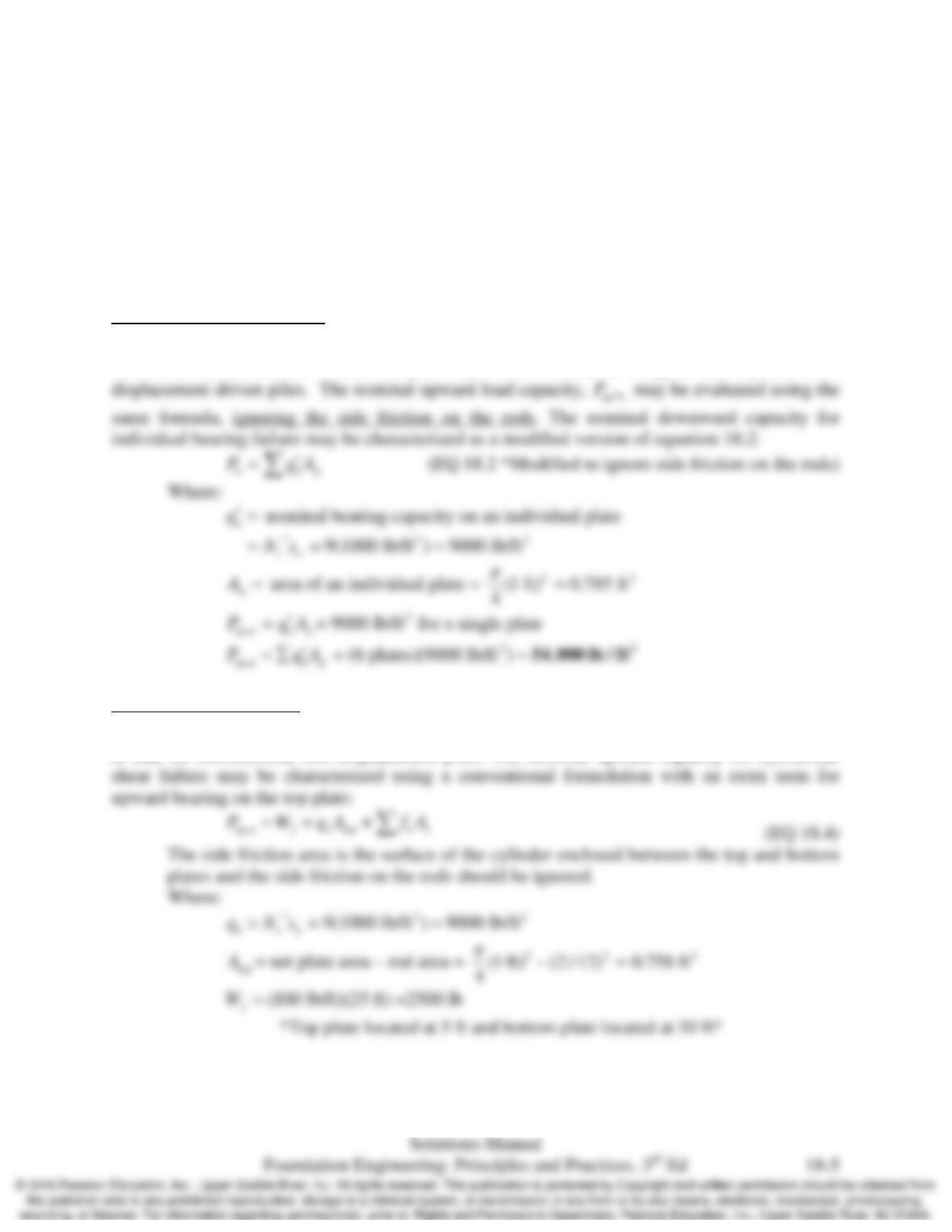
Individual Bearing Failure
The value of
n
q′
could be evaluated using the techniques for toe bearing in driven piles. This
term is summed to consider each of the plates. fn could be evaluated using the techniques for low
Cylindrical Shear Failure
The value of
n
q′
should be similar to that for driven piles. The value of fn also should be similar
to that for conventional low displacement piles. The nominal upward capacity for cylindrical
Chap. 18 Other Pile Types: Axial Load Capacity
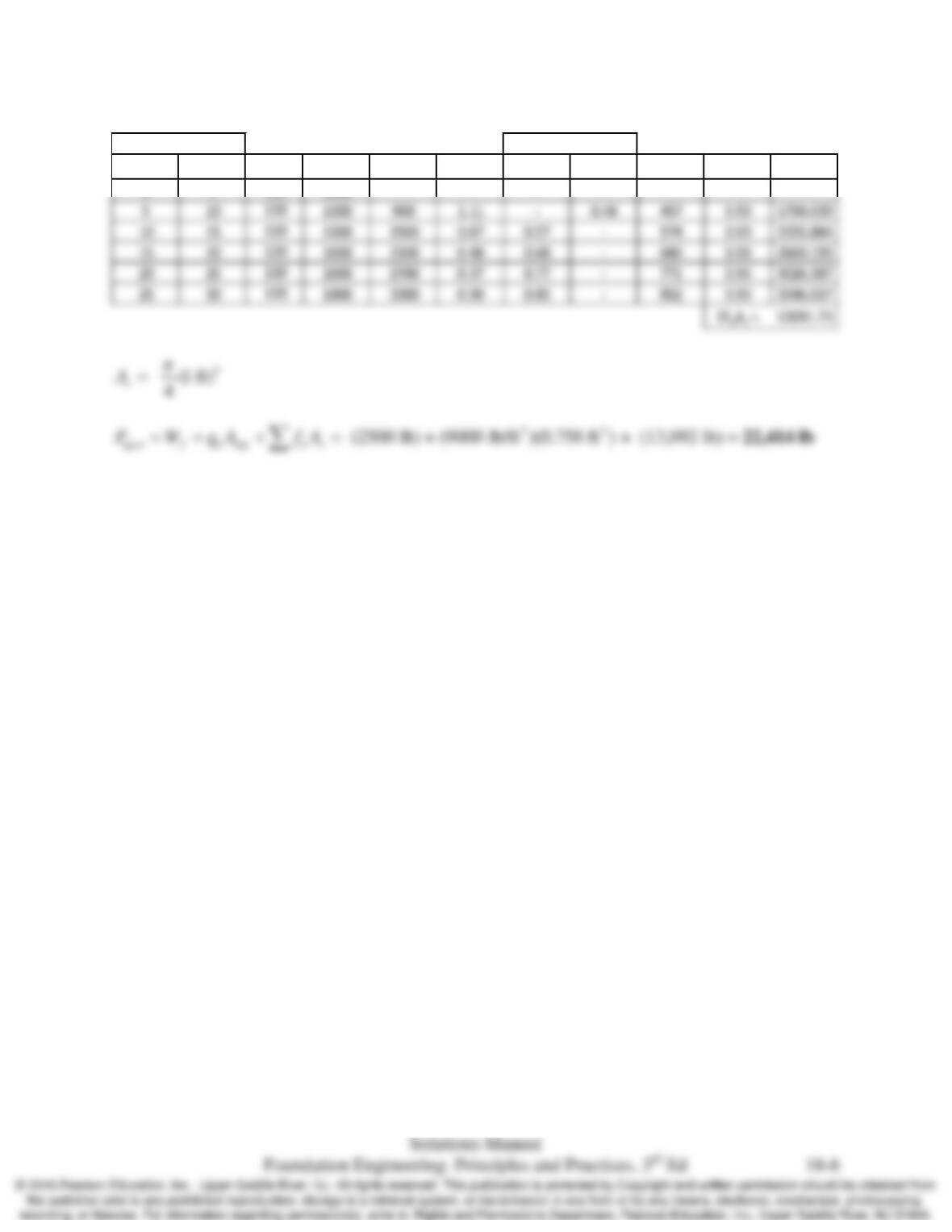
Top Bottom
su (psf) σ’z (psf) su / σ’zEQ 15.15 EQ 15.16 fnAs (ft2)fnAs
0 5 1000 ——-
α
ϒ (pcf)
Range of Depth (ft)
120