18-41
P18-9 (continued)
Deferred Gross Profit, 2009 11,800a
Gross Profit Realized on Installment Sales 11,800
a$16,000 – $700 – $3,500
Cash 87,500c
Installment Accounts Receivable, 2010 87,500
18-42
P18-10 (AICPA adapted solution)
HOBSON, INC.
Application of Cash Receipts from Sale of Idle
Plant Facility to Cost Recovery, Deferred Income, and
Income Recognized Under the Cost Recovery Method of Accounting
For the Period January 1, 2008 to February 1, 2012
Date
Cash
received
Debit
Note
receivable
Dr. (Cr.)
Idle plant
(net)
(Credit)
Deferred
income
Dr. (Cr.)
Income
recognized
(Credit)
January 1, 2008
$100,000
$600,000
$(500,000) $(200,000)
P18-11
1. Company A 2010 2011 2012
Gross profit, Contract X $360,000a $150,000c $ —
Gross profit, Contract Y 160,000b 140,000d 100,000f
18-43
P18-11 (continued)
2. Company B
COMPANY B
Condensed Income Statements
For Years Ended
December 31, 2010 December 31, 2011
Revenues $19,360b $20,640e
Expenses
Initial direct cost $1,694c $1,806f
3. Company C
COMPANY C
Condensed Income Statements
For Years Ended
December 31, 2010 December 31, 2011
Gross profit $45,020a $35,440b
P18-11 (continued)
2. (continued)
P18-12
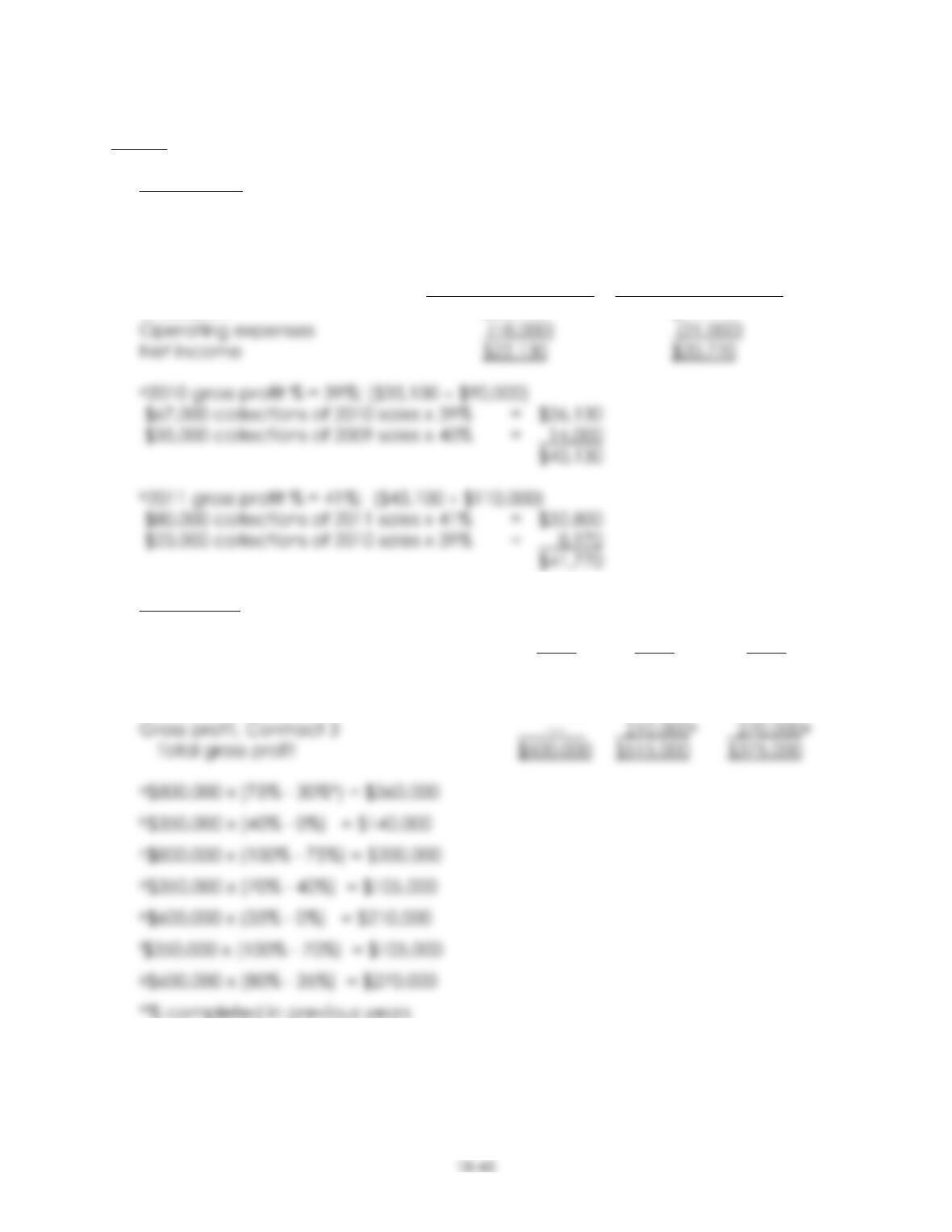
1. Company X
COMPANY X
Condensed Income Statements
For Years Ended
December 31, 2010 December 31, 2011
Revenues $72,960b $47,040e
Expenses
Initial direct costs $ 5,168c $3,332f
P18-12 (continued)
2. Company Y
COMPANY Y
Condensed Income Statements
For Years Ended
December 31, 2010 December 31, 2011
Gross profit $40,130a $41,770b
3. Company Z
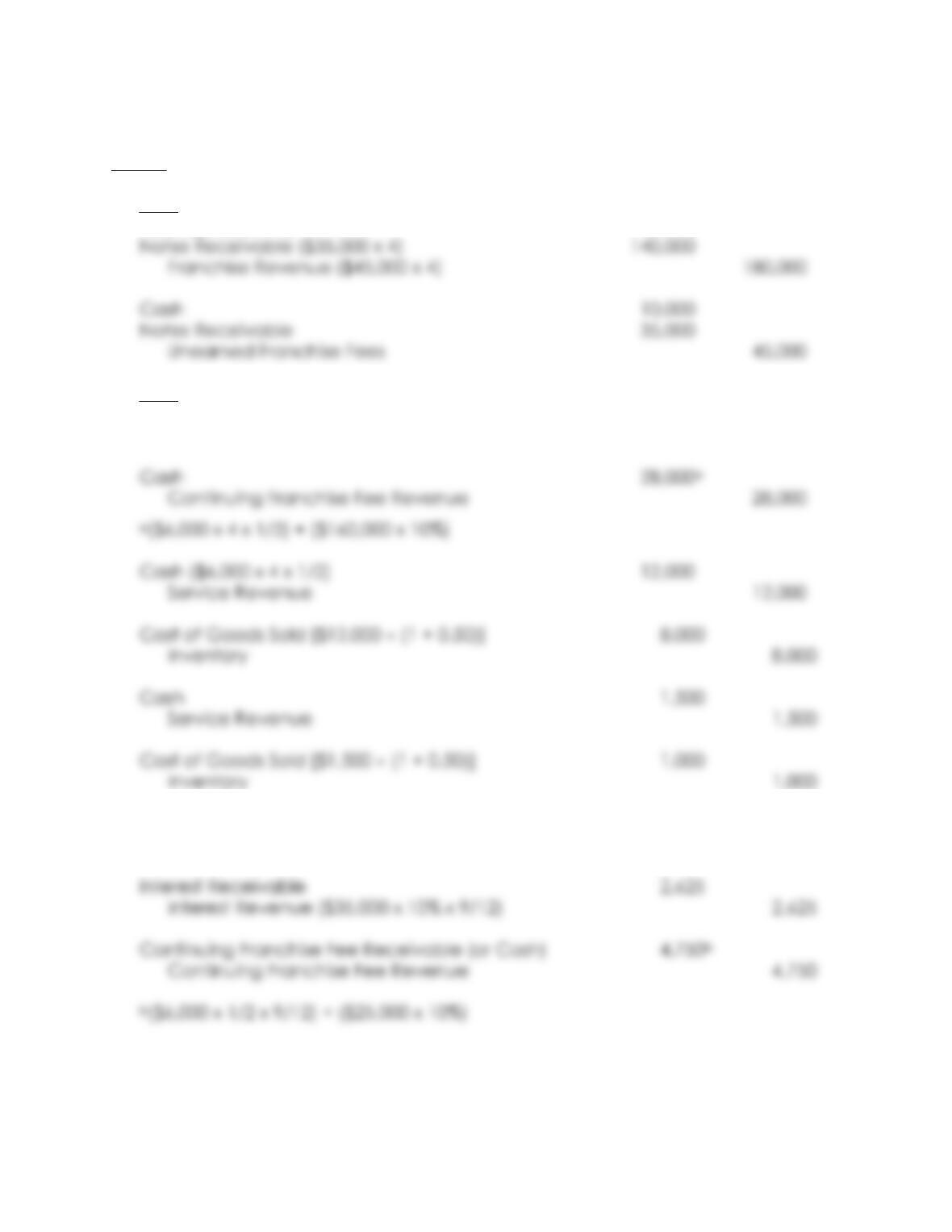
2010 2011 2012
Gross profit, Contract 1 $360,000a $200,000c $ —
Gross profit, Contract 2 140,000b 105,000d 105,000f
18-46
P18-13
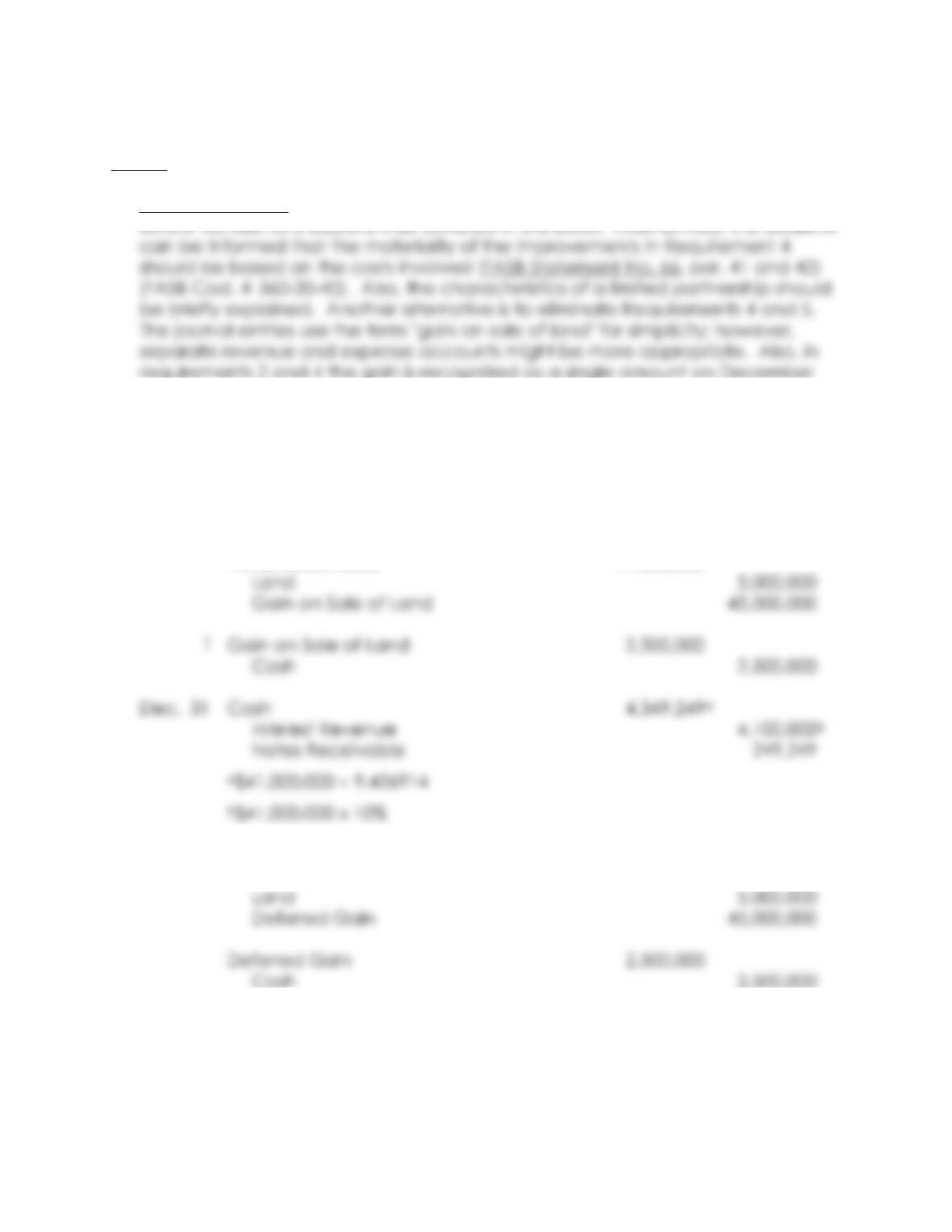
2010
Cash ($10,000 x 4) 40,000
2011
Unearned Franchise Fees 45,000
Franchise Revenue 45,000
Cash ($140,000 x 10%) 14,000
Interest Revenue 14,000
18-47
P18-14
Note to Instructor. This problem requires knowledge about accounting for real
requirements 2 and 4 the gain is recognized as a single amount on December
31. A portion of the gain could be recognized on January 1.
1. Given the information in the problem, the transaction is a sale. Some students
may question the fact that the note is only secured by the land, but that does
not, by itself, raise questions about collectibility because it is a common
characteristic of real estate sales.
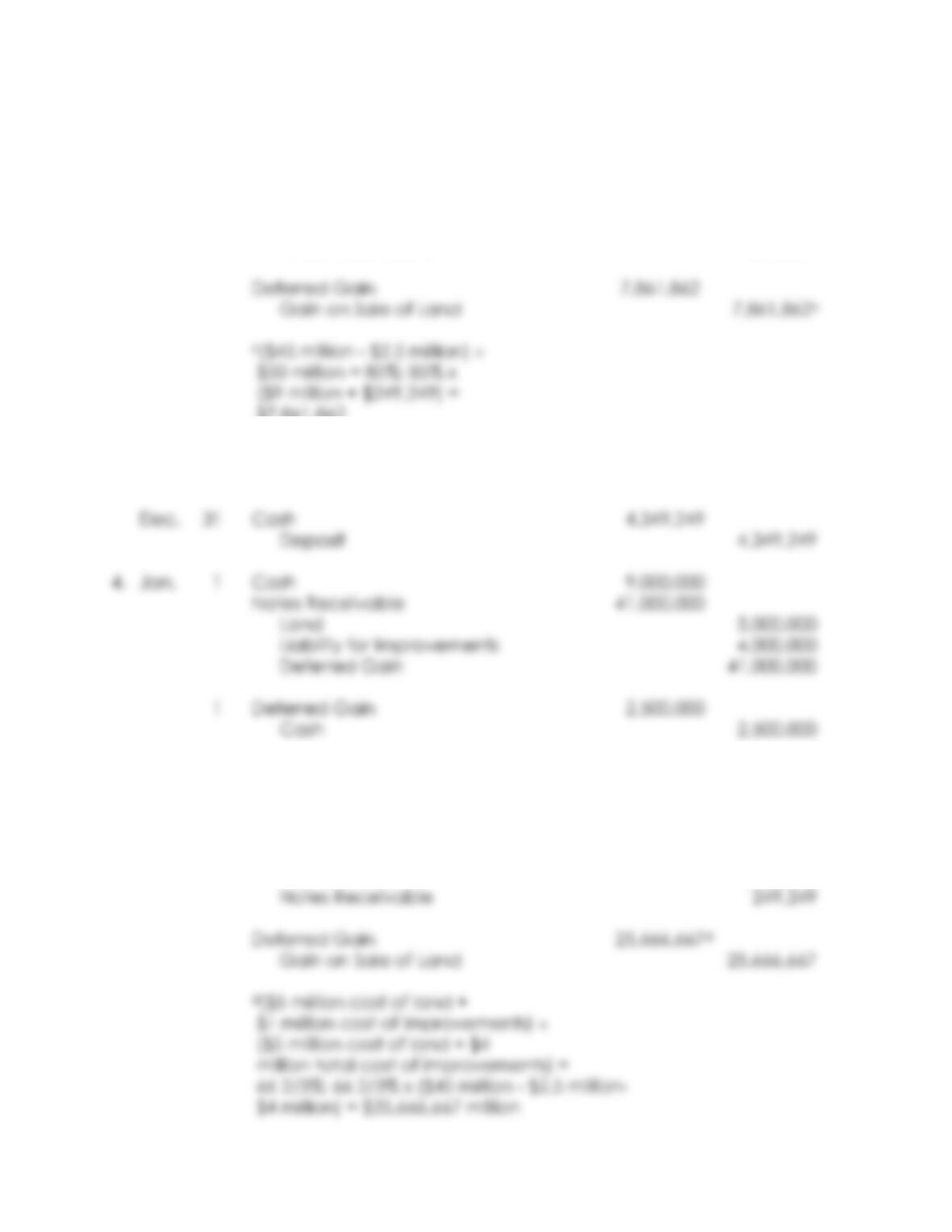
Jan. 1 Cash 9,000,000
Notes Receivable 41,000,000
2. Jan. 1 Cash 9,000,000
Notes Receivable 41,000,000
18-48
P18-14 (continued)
2. (continued)
Dec. 31 Cash 4,349,249
Interest Revenue 4,100,000
Notes Receivable 249,249
$7,861,862
3. Jan. 1 Cash 9,000,000
Deposit 9,000,000
During Liability for Improvements 1,000,000
the Cash, etc. 1,000,000
year
Dec. 31 Cash 4,349,249
Interest Revenue 4,100,000
18-49
P18-14 (continued)
4. (continued)
P18-15
Note to Instructor: Journal entries are not specifically illustrated in the chapter
discussion.
1. Consignment-out 308,000
Inventory 300,000
Cash 8,000
Cash 162,000
Advertising Expense 15,000
Sales Commissions Expense 18,000a
Sales 195,000
P18-15 (continued)
2. The company would include a current asset, Consignment Inventory, of $123,200
3. Memorandum Entry: Merchandise costing $300,000 was received from the
Hadad Company on consignment.
Consignment-in 15,000
Cash 15,000
4. The company would include a current liability, Consignment Obligation, of
$32,400 on its balance sheet.
ANSWERS TO CASES
C18-1 (AICPA adapted solution)
1. Most merchandising companies deal in finished products and recognize revenue at the
point of sale. This is often identified as the moment when title legally passes from seller to
purchaser. At the point of sale there is an arm’s-length transaction to measure reliably the
amount of revenue recognized. With accounting theory based heavily on reliable
2. For service-type companies, accounting recognition of revenue approximates the earning
process. The recognition of revenue for accounting purposes takes place (is recorded)
during the period the services are rendered. Although it is theoretically possible to accrue
revenue continuously as the services are rendered, for practical reasons revenue is usually
accrued periodically with emphasis on the appropriate period of recognition.
C18-1 (continued)
3. Revenue is sometimes recognized at completion of the production activity, or after the
point of sale. The recognition of revenue at completion of production is justified only if
certain conditions are present. The necessary conditions are that there must be a
relatively stable market for the product, marketing costs must be nominal, and the units
C18-2
The percentage-of-completion method is used for certain long-term construction
contracts to recognize revenue prior to the completion of the contract. In such cases,
recognition of revenue at the time of sale (completed contract) can lead to a distortion
of the economic substance of a company’s operations. Under the percentage-of-
The proportional performance method is used to recognize revenue prior to the
completion of long-term service contracts that require services to be performed in more
18-53
C18-2 (continued)
The installment method of revenue recognition is used in special cases where receivables
from credit sales are collected over an extended period and there is no reasonable basis
C18-3 (AICPA adapted solution)
1. a. The percentage-of-completion method is justified because revenue is earned as work
is performed under the long-term construction contract. As a result, it provides more
relevant information. Revenues represent actual or expected cash inflows (or the
2. The income recognized in each year of this long-term construction contract would be
determined using the cost-to-cost method of determining percentage of completion as
follows:
The contract price is the first part of the determination of the total
3. Progress billings sent and collections on these billings would not affect the income
recognized in each year of this long-term contract.
18-54
C18-4 (AICPA adapted solution)
1. The revenue recognized on a long-term contract under the percentage-of-completion
method is determined by applying a percentage representing the degree of completion
to the total contract price at the end of the accounting period. The percentage is
derived by dividing the costs incurred to date by the total estimated costs of the entire
contract based on the most recent information. The percentage may also be derived by
2. The percentage-of-completion method is preferable when estimates of the bases upon
3. Interim billings on long-term contracts are not generally accepted as a method of
recognizing earnings because such billings often do not bear a meaningful relationship to
4. Under the percentage-of-completion method, a schedule is made of the contracts in
process, showing the total costs incurred as of the end of a given period, the estimated
gross profit recognized based on the degree of completion, and the total billings rendered
on each individual contract. If costs incurred plus recognized profits exceed the related
18-55
C18-5 (AICPA adapted solution)
1. The propriety of choosing one method or the other depends primarily on the degree of
completion of the installment transaction at the time the sale is recorded and the
objectivity of its measurement. No sound theoretical reason apparently exists for the use
of the installment method for financial statement purposes in the case of completed
transactions in which collection is dependent merely upon a lapse of time. The
2. Installment contracts receivable which conform generally to normal trade practices and
terms are classified as current assets under both methods of revenue recognition. Current