18-1
CHAPTER 18
INCOME RECOGNITION AND MEASUREMENT OF NET ASSETS
CONTENT ANALYSIS OF EXERCISES AND PROBLEMS
Number
Content
Time Range
(minutes)
E18-1
Revenue Recognition Alternatives. (Moderate) Computation
of revenue, expense, and gross profit over 3 year period for
various recognition alternatives.
10-15
E18-6
(AICPA adapted). Long-Term Construction Contract.
(Moderate) Completed contract, percentage-of-completion
methods. Schedule.
15-20
E18-7
Proportional Performance. (Easy) Preparation of income
statement.
10-15
E18-8
Revenue Recognition at Completion of Production. (Easy)
Summary journal entries, inventory valuation.
10-15
E18-9
Sales Under the Installment Method. (Easy) Preparation of
condensed income statement.
10-15
18-2
Number
Content
Time Range
(minutes)
E18-14
Cost Recovery. (Easy) Preparation of journal entries.
10-15
E18-15
Deposit Method. (Easy) Preparation of journal entries.
10-15
P18-2
Revenue Recognition Alternatives. (Challenging) Income
statement and balance sheet preparation under various
methods. Determination of ending retained earnings.
20-30
P18-3
(AICPA adapted). Percentage-of-Completion. (Moderate)
Total contract income and amount of cash in first year
determined from balance sheet and income statement
accounts.
10-15
P18-7
Proportional Performance. (Moderate) Preparation of income
statements. Theoretical question.
20-30
P18-8
Sales Under the Installment Method. (Challenging) Preparation
of journal entries.
20-30
18-3
Number
Content
Time Range
(minutes)
P18-12
Revenue Recognition Alternatives. (Challenging) Schedules of
gross profit and condensed income statements for three
different companies.
40-60
ANSWERS TO QUESTIONS
Q18-1 Revenue is recognized prior to the sale or after the sale in exceptional cases to
Q18-2 Recognition is the process of formally recording and reporting an item in the financial
statements whereas realization is the process of converting noncash resources into
cash or rights to cash.
Q18-3 In all three situations, a company increases its net assets from cost to selling price
when it recognizes revenue. When it recognizes revenue at the time of sale, it
records the account receivable at the selling price and reduces inventory at cost.
Q18-4 The following three factors are important in the decision as to when to recognize
revenue:
1. The economic substance of the event takes precedence over the legal form.
18-4
Q18-5 The five revenue recognition alternatives are:
1. Revenue recognition in the period of the sale.
Q18-6 A company recognizes revenue prior to the period of sale in order to reflect
Q18-7 The major difference between the two methods of accounting for long-term
construction contracts deals with revenue (and gross profit) recognition. Under the
percentage-of-completion method, revenue (and gross profit) is recognized over the
life of the contract whereas the completed-contract method only recognizes
revenue (and gross profit) upon the completion, or virtual completion, of the
contract.
Q18-8 A company uses the percentage of completion method for long-term contracts
when the following conditions are met:
1. Reasonably dependable estimates can be made of the extent of progress
towards completion, contract revenues, and contract costs.
Q18-9 Revenue generally is recognized when realization has taken place and the revenues
have been earned. If a project is viewed as a continuous sale, the revenue is earned
Q18-10 Input measures use an input to the production activity to measure the percentage of
Output measures use the results achieved to measure the percentage of
Q18-11 Under both the percentage-of-completion method and the completed-contract
Q18-12 A company nets Construction in Progress and Partial Billings accounts against each
other for presentation on the balance sheet. If Construction in Progress exceeds
Q18-13 Under the proportional performance method, a company defers initial direct costs
and allocates them over the performance period in proportion to the recognition of
Q18-14 A company recognizes revenue after the period of sale when the collectibility of the
receivable is highly uncertain or there is no reliable basis for estimating the
collectibility. The two methods used are the installment method and the cost
recovery method.
Q18-15 The steps involved in the installment method are as follows for a company:
1. It records total sales, cost of goods sold, and collections in the normal manner
during the year.
Q18-15 (continued)
5. In future years, it reduces the remaining deferred gross profit and recognizes the
gross profit based on the cash collected during each year from the previous sales
recognized under the installment method times the gross profit rate for the year in
which those installment sales were made.
Q18-16 Under the cost recovery method, a company does not recognize gross profit until all
the cost of the item sold has been recovered. Once the cost has been recovered,
Q18-17 Under the deposit method, the “seller” does not record a note receivable and
continues to report the property, and any related debt, on its balance sheet. The
Q18-18 Revenue recognition under IFRS contain very little industry specific guidance. On the
other hand, U.S. GAAP contains numerous guidance on specific industry standards.
For motion picture companies, U.S. GAAP contains guidance in AICPA Statement of
Position No. 00-2 (FASB Cod. # 926-10-15 through 926-855-35). In general, IFRS contains
less industry specific guidance than U.S. GAAP.
Q18-19 IFRS require a company to use a cost recovery method when the outcome of long-
term construction contracts cannot be estimated reliably. U.S. GAAP would require
Q18-20 The initial franchise fee relates to services performed in connection with the
beginning of a franchise, such as site selection and construction, equipment
Q18-21 Revenue is recognized for real estate sales in the period of sale on the accrual basis if
all the following conditions are met:
1. A sale is made (otherwise the deposit method is used).
Q18-22 Revenue is recognized for retail land sales in the period of the sale on the accrual
basis if all the following conditions are met:
1. The buyer has made the down payment and each required subsequent
payment until the period of cancellation with refund has expired.
amenities or other facilities applicable to lots sold.
If the first four criteria are met, the percentage-of-completion method is used if there
has been progress on the improvements and there are indications that the work will
be completed according to plan.
The installment method is used if only the first two criteria are met and the seller is
financially capable of honoring its obligations.
ANSWERS TO MULTIPLE CHOICE
18-8
SOLUTIONS TO REVIEW EXERCISES
RE18-1
(a) Inventory 150
Cash 150
RE18-2
(a) Inventory 150
Cash 150
RE18-3
Construction costs incurred to date $174,000
Estimated costs to complete 426,000
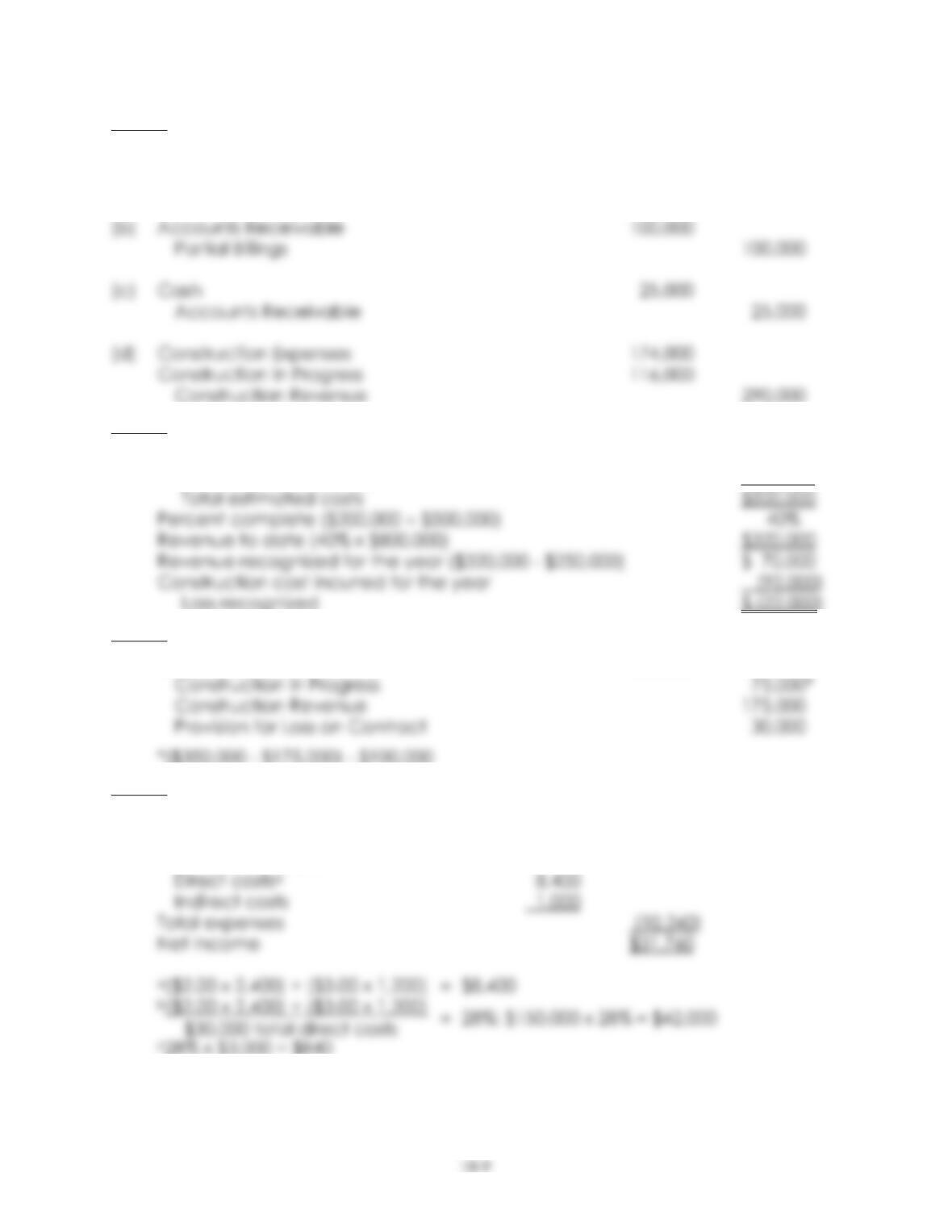
RE18-4
(a) Construction in Progress 174,000
Accounts Payable, Raw Materials, Cash, etc. 174,000
RE18-5
Construction costs incurred to date $200,000
Estimated costs to complete 300,000
RE18-6
Construction Expense 280,000
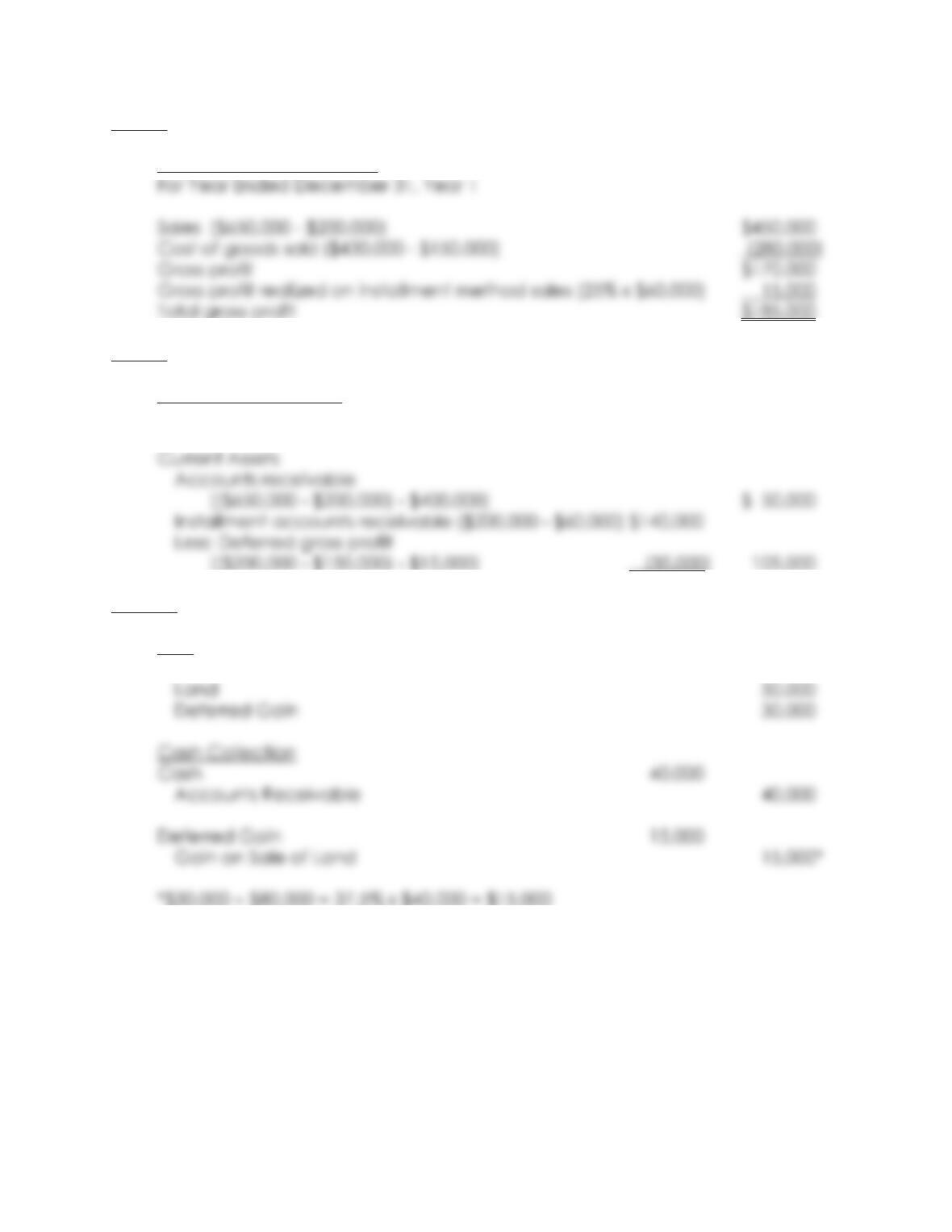
RE18-7
Revenues $42,000b
Expenses:
Initial direct costsc $ 840
18-10
RE18-8
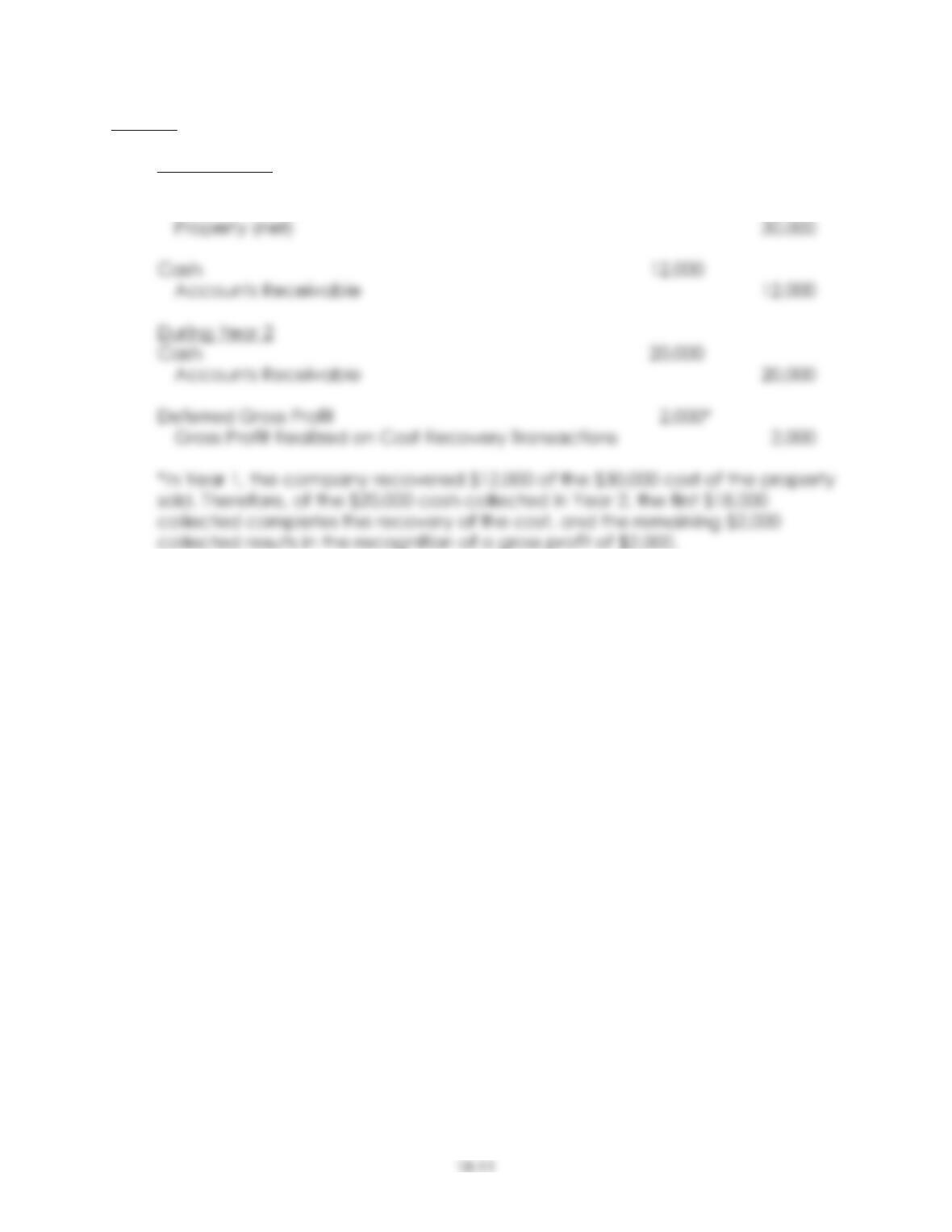
Partial Income Statement
RE18-9
Partial Balance Sheet
December 31, Year 1
RE18-10
Sale
Accounts Receivable 80,000
RE18-11
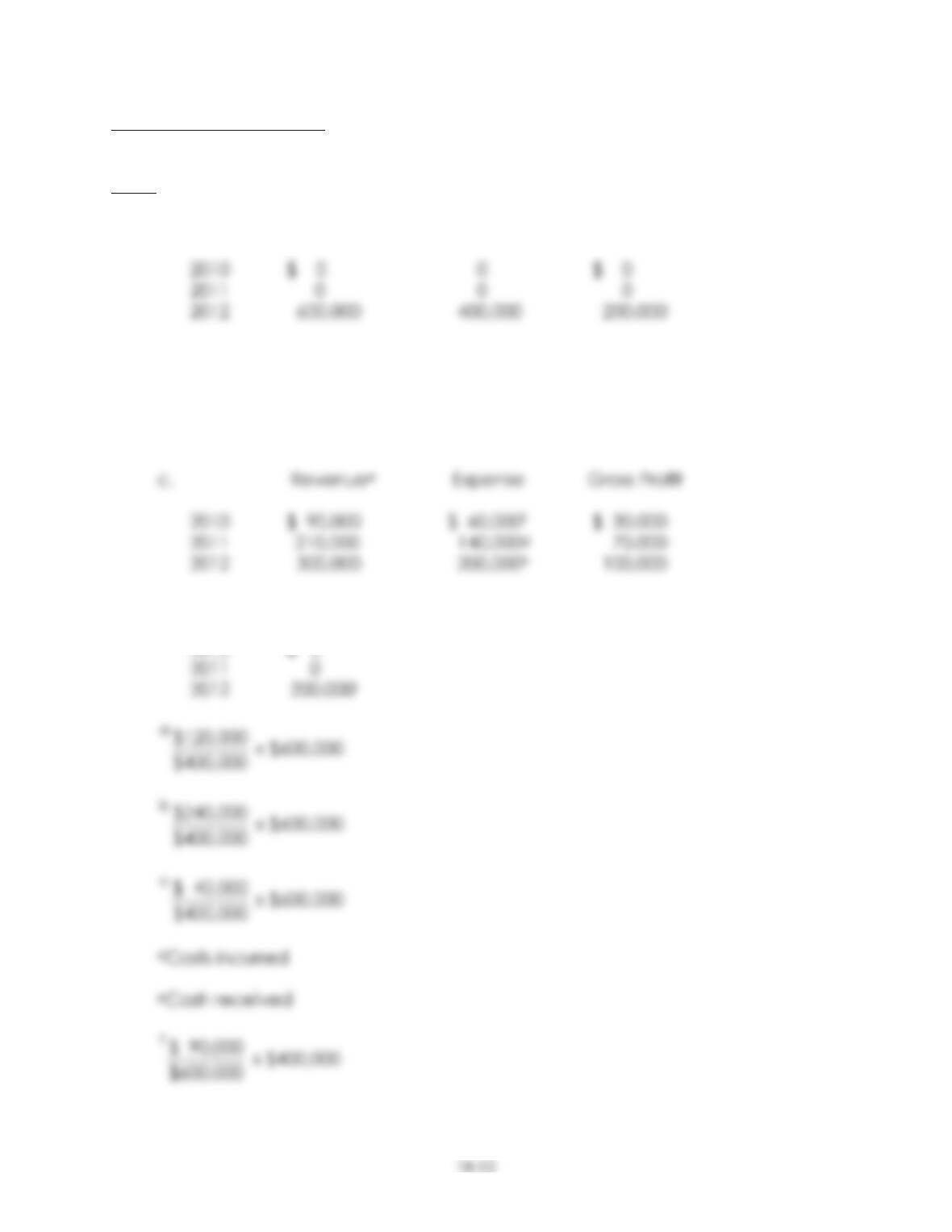
During Year 1
Accounts Receivable 50,000
Deferred Gross Profit 20,000
SOLUTIONS TO EXERCISES
E18-1
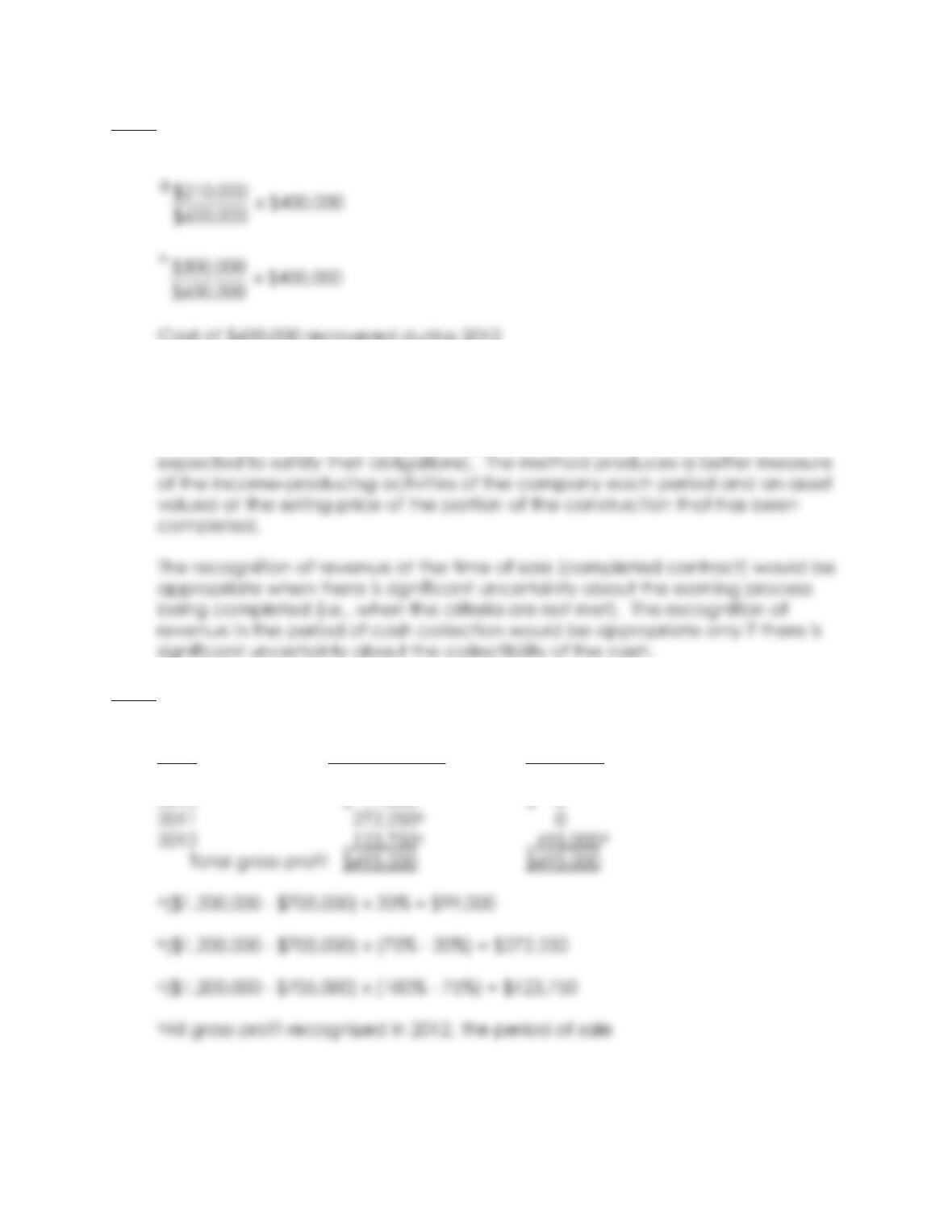
1. a. Revenue Expense Gross Profit
b. Revenue Expensed Gross Profit
2010 $180,000a $120,000 $ 60,000
2011 360,000b 240,000 120,000
2012 60,000c 40,000 20,000
d. Gross Profit
2010 $ 0
18-13
E18-1 (continued)
1. (continued)
2. In the situation of a long-term construction contract, recognition of revenue
during production is generally the most useful, if the criteria discussed in the
chapter are met (reasonably dependable estimates can be made, the
contract specifies the enforceable rights, and the buyer and seller can be
E18-2
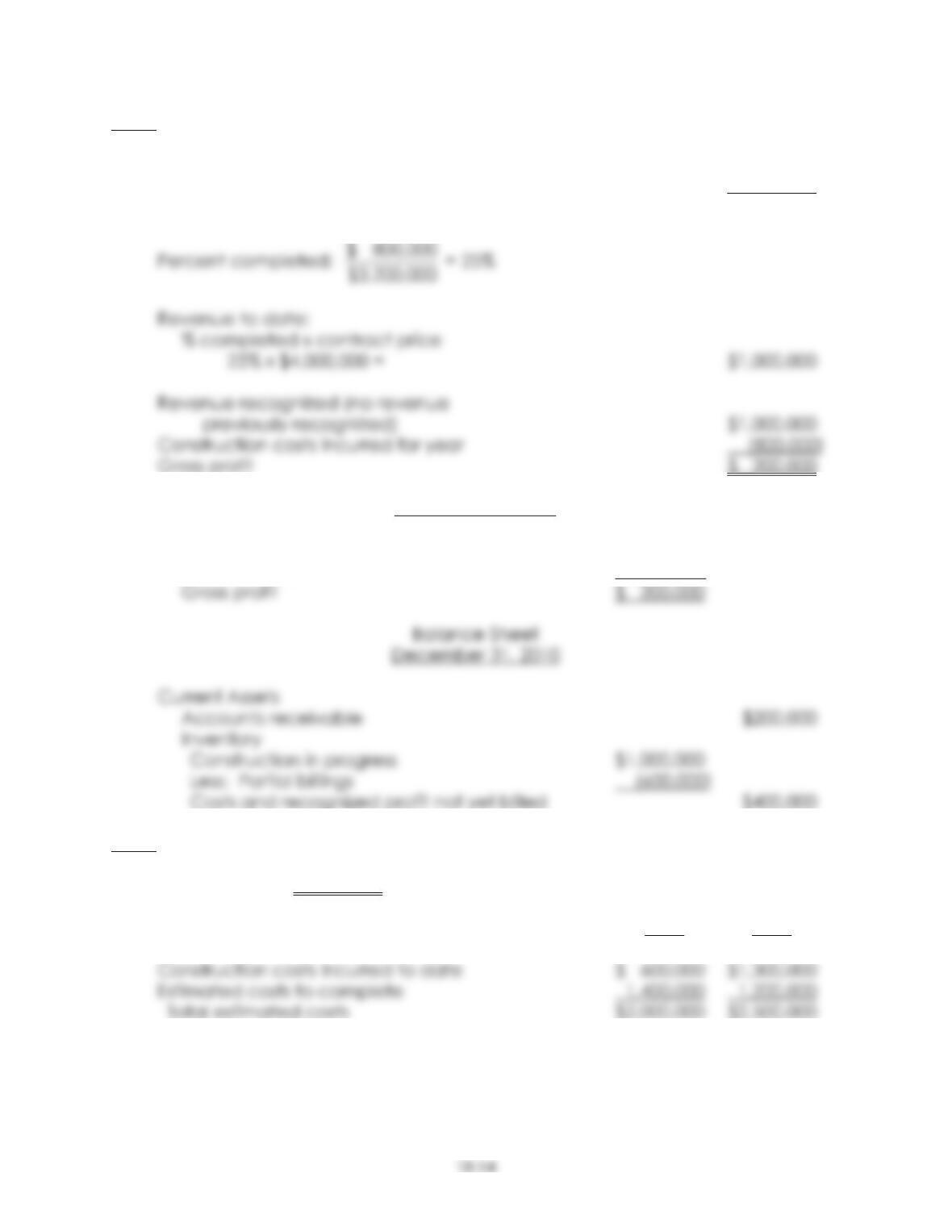
(1) (2)
Percentage of Completed
Year Completion Contract
2010 $ 99,000a $ 0
E18-3
1. Construction costs incurred to date $ 800,000
Estimated costs to complete 2,400,000
Total estimated costs $3,200,000
2. Income Statement
Construction revenue $1,000,000
Construction expense (800,000)
E18-4
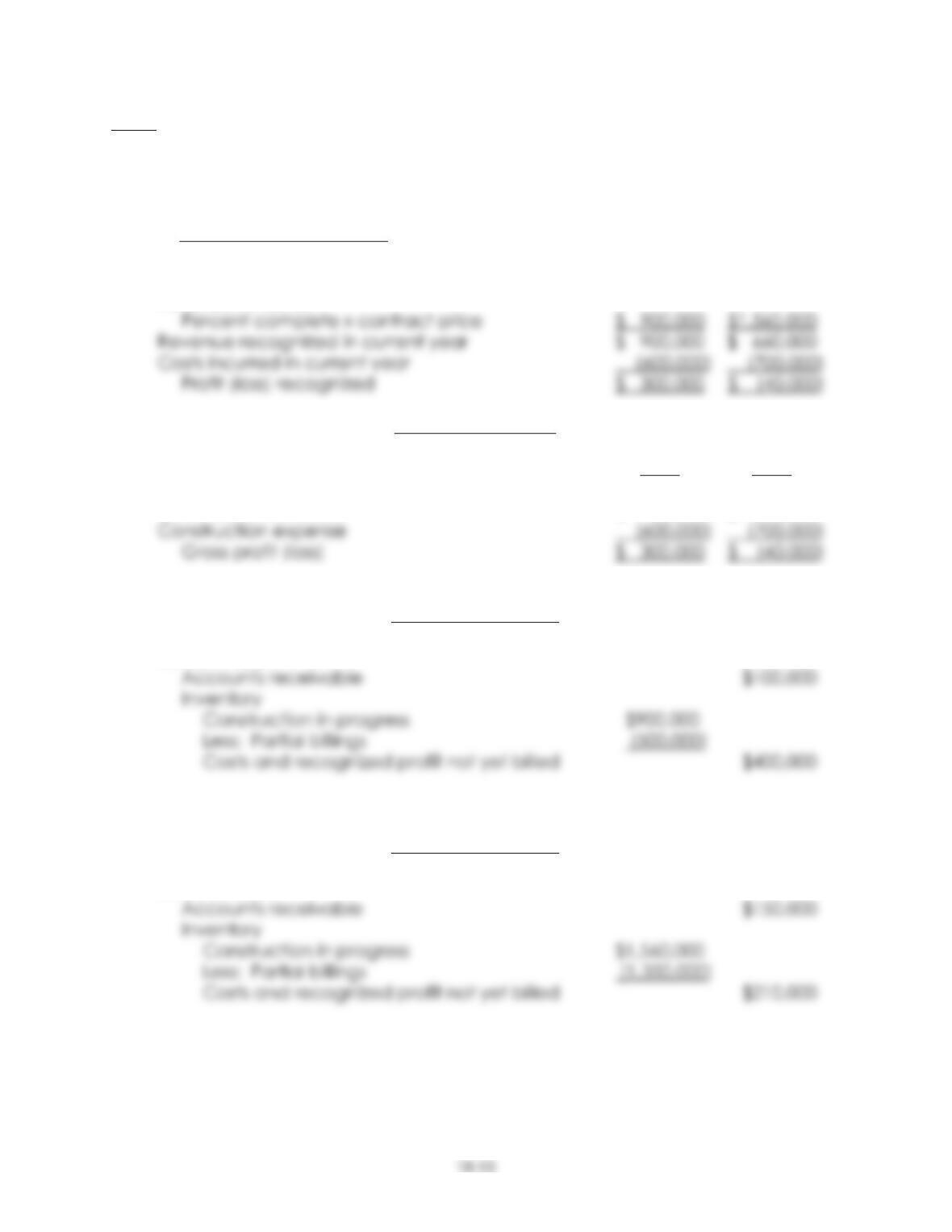
1. Contract Price $3,000,000
2010 2011
E18-4 (con tin ued)
1. (continued)
Percentage completed:
costestimatedTotal
datetoincurredCosts 30% 52%
Revenue to date:
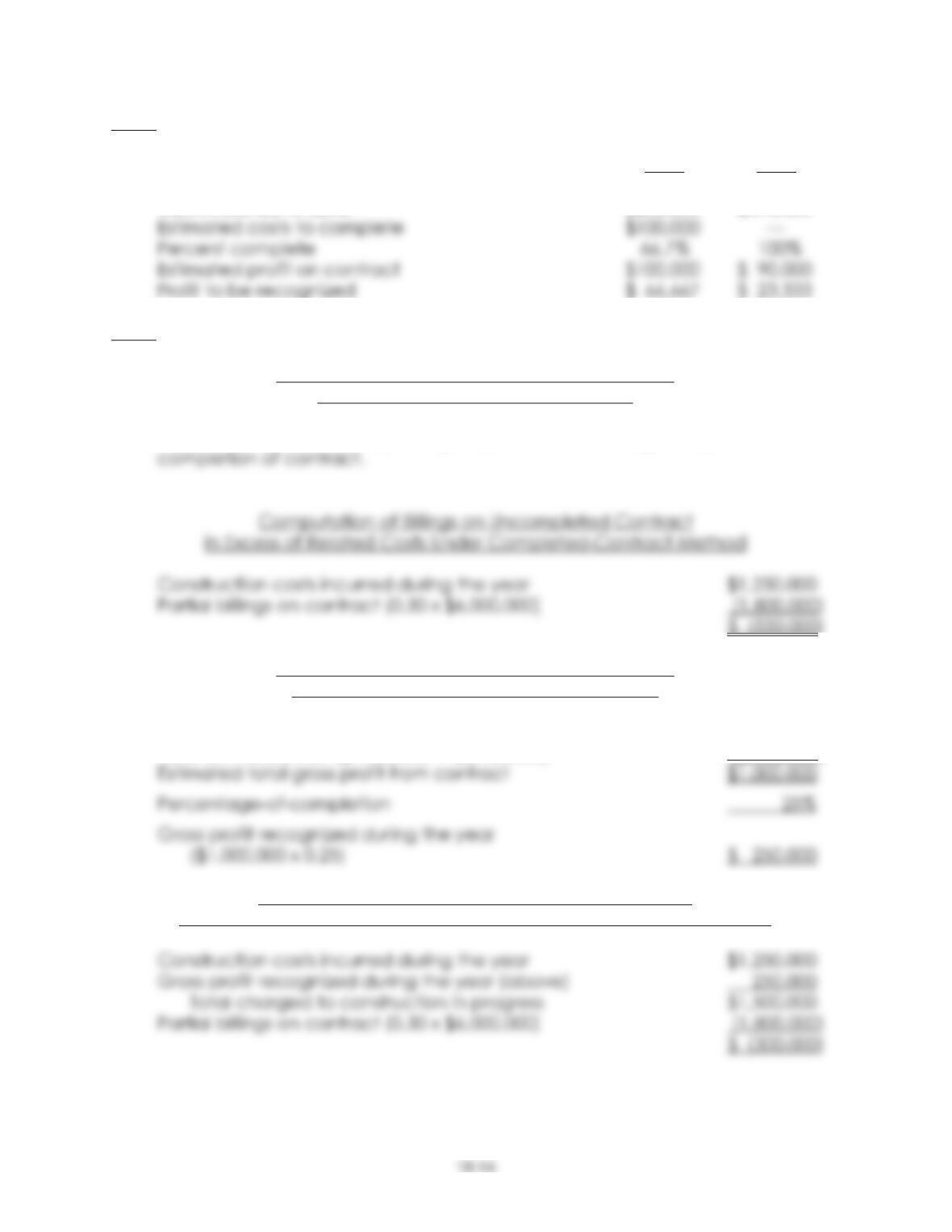
2. Income Statement
2010 2011
Construction revenue $ 900,000 $ 660,000
Balance Sheet
December 31, 2010
Current Assets
Balance Sheet
December 31, 2011
Current Assets
E18-5 (AICPA adapted solution)
2010 2011
Costs incurred to date $200,000 $310,000
E18-6 (AICPA adapted solution)
1. Computation of Gross Profit to be Recognized
Under Completed-Contract Method
No computation necessary. No gross profit is to be recognized prior to
2. Computation of Gross Profit to be Recognized
Under Percentage-of-Completion Method
Total contract price $6,000,000
Total estimated cost ($1,250,000 + $3,750,000) (5,000,000)
Computation of Billings on Uncompleted Contract
in Excess of Related Costs Under Percentage-of-Completion Method
E18-7
NEW RECREATIONAL COMPANY
Condensed Income Statement
For Year Ended December 31, 2010
Revenues $352,000b
Expenses
E18-8
1. 2010
Inventory ($2 x 100,000) 200,000
Cash, etc. 200,000
2. The remaining inventory is valued at its cost of $40,000 (20,000 x $2) because
E18-9
ANIBONITA COMPANY
Condensed Income Statements
For Years Ended
December 31
2010 2011
E18-10
1. Accounts Receivable 205,000
Sales 205,000
18-19
E18-10 (continued)
2. Cash 45,000
Accounts Receivable 45,000
Deferred Gross Profit, 2010 18,000b
E18-11
1. 2010
Accounts Receivable 100,000
Sales 100,000
Gross Profit Realized on Installment
Method Sales 7,500
Income Summary 7,500
18-20
E18-11 (continued)
1. (continued)
2011
Accounts Receivable 160,000
Sales 160,000
Deferred Gross Profit, 2011 10,500d
Gross Profit Realized on Installment
Method Sales 10,500
2. BUTLER COMPANY
Partial Income Statement
For Year Ended December 31, 2010
Sales $40,000
a