Storage Mechanisms and Control in Carbohydrate
Metabolism 1
SUMMARY
Section 18.1
Glycogen is the storage form of glucose in animals, including humans. Glycogen
releases glucose when energy demands are high.
Section 18.2
Glucose is formed from pyruvate, which, in turn, can be obtained from lactate
that accumulates in muscle during exercise. This process, called
Section 18.3
A number of control mechanisms operate in carbohydrate metabolism. They
include allosteric effects, covalent modification, substrate cycles, and genetic
Section 18.4
In the pentose phosphate pathway, two important processes take place. One is
LECTURE NOTES
The material in this chapter extends carbohydrate metabolism beyond glycolysis.
Glycogen metabolism and gluconeogenesis add relatively few new reactions and
2 Chapter 18
LECTURE OUTLINE
I. Glycogen metabolism
A. Glycogen breakdown
1. Glycogen phosphorylase
2. Phosphoglucomutase
5. Reciprocal control via enzyme cascade
II. Gluconeogenesis
A. Importance of oxaloacetate
1. Pyruvate carboxylase
2. Biotin
III. Control of carbohydrate metabolism
A. Control of PFK and FBPase
1. Fructose-2,6-bisphosphate
B. Control of pyruvate kinase
C. Control of hexokinase
D. Cori cycle
IV. The pentose phosphate pathway
A. Oxidative reactions
1. Glucose-6-phosphate dehydrogenase
Storage Mechanisms and Control in Carbohydrate
Metabolism 3
1
ANSWERS TO EXERCISES
18.1 How Glycogen Is Produced and Degraded
1. These two pathways occur in the same cellular compartment, and, if both are on
at the same time, a futile ATP hydrolysis cycle results. Using the same
mechanism to turn them on/off or off/on is highly efficient.
4. Each glucose residue is added to the growing glycogen molecule by transfer
from UDPG.
5. Glycogen synthase is subject to covalent modification and to allosteric control.
7. It “costs” one ATP equivalent (UTP to UDP) to add a glucose residue to
glycogen. In degradation, about 90% of the glucose residues do not require ATP
to produce glucose-1-phosphate. The other 10% require ATP to phosphorylate
glucose. On average, this is another 0.1 ATP. Thus, the overall “cost” is 1.1 ATP,
compared with the three ATP that can be derived from glucose-6-phosphate by
glycolysis.
8. The ATP cost is the same, but more than 30 ATP can be derived from aerobic
metabolism.
9. Eating high-carbohydrate foods for several days before strenuous activity is
12. The sprint is essentially anaerobic and produces lactate from glucose by
glycolysis. Lactate is then recycled to glucose by gluconeogenesis.
13. It is unlikely that this finding will be confirmed by other researchers. The highly
4 Chapter 18
15. The enzyme that catalyzes addition of glucose residues to a growing glycogen
17.
(a) Increasing the level of ATP favors both gluconeogenesis and glycogen synthesis.
(b) Decreasing the level of fructose-1,6-bisphosphate would tend to stimulate
glycolysis, rather than gluconeogenesis or glycogen synthesis.
(c) Levels of fructose-6- phosphate do not have a marked regulatory effect on these
18.2 Gluconeogenesis Produces Glucose from Pyruvate
20. Reactions that require acetyl-CoA: none. Reactions that require biotin:
carboxylation of pyruvate to oxaloacetate.
21. Three reactions of glycolysis are irreversible under physiological conditions. They
are the production of pyruvate and ATP from phosphoenolpyruvate, the
22. Biotin is the molecule to which carbon dioxide is attached to the process of being
transferred to pyruvate. The reaction produces oxaloacetate, which then
undergoes further reactions of gluconeogenesis.
23. In gluconeogenesis, glucose-6-phosphate is dephosphorylated to glucose (the
24. Of the three processes—glycogen formation, gluconeogenesis, and the pentose
25. The hydrolysis of fructose-1,6-bisphosphate is a strongly exergonic reaction. The
reverse reaction in glycolysis, phosphorylation of fructose-6-phosphate, is
irreversible because of the energy supplied by ATP hydrolysis.
Storage Mechanisms and Control in Carbohydrate
Metabolism 5
1
18.3 Control of Carbohydrate Metabolism
26. Reactions that require ATP: formation of UDP-glucose from glucose-1-phosphate
and UTP (indirect requirement, because ATP is needed to regenerate UTP),
27. Fructose-2,6-bisphosphate is an allosteric activator of phosphofructokinase (a
glycolytic enzyme) and an allosteric inhibitor of fructose bisphosphate
phosphatase (an enzyme in the pathway of gluconeogenesis).
28. Hexokinase can add a phosphate group to any of several six-carbon sugars,
whereas glucokinase is specific for glucose. Glucokinase has a lower affinity for
29. The Cori cycle is a pathway in which there is cycling of glucose due to glycolysis
in muscle and gluconeogenesis in liver. The blood transports lactate from muscle
to liver and glucose from liver to muscle.
30. Substrate cycles are futile in the sense that there is no net change except for the
31. Having two control mechanisms allows for fine-tuning of control and for the
32. Different control mechanisms have inherently different time scales. Allosteric
control can take place in milliseconds, whereas covalent control takes seconds to
minutes. Genetic control has a longer time scale than either.
control over the rates of the forward and reverse process.
35. Muscle tissue uses large quantities of glucose, producing lactate in the process.
The liver is an important site of gluconeogenesis to recycle the lactate to glucose.
36. Fructose-2,6-bisphosphate is an allosteric activator of phosphofructokinase (a
glycolytic enzyme) and an allosteric inhibitor of fructose bisphosphate
6 Chapter 18
38. Glycogen is more extensively branched than starch. It is a more useful storage
form of glucose for animals because the glucose can be mobilized more easily
when there is a need for energy.
42. Insulin triggers the series of events that leads to glycogen synthesis.
43. Glucagon and epinephrine start the chain of events leading to glucagon
breakdown.
18.4 Glucose Is Sometimes Diverted through the Pentose Phosphate Pathway
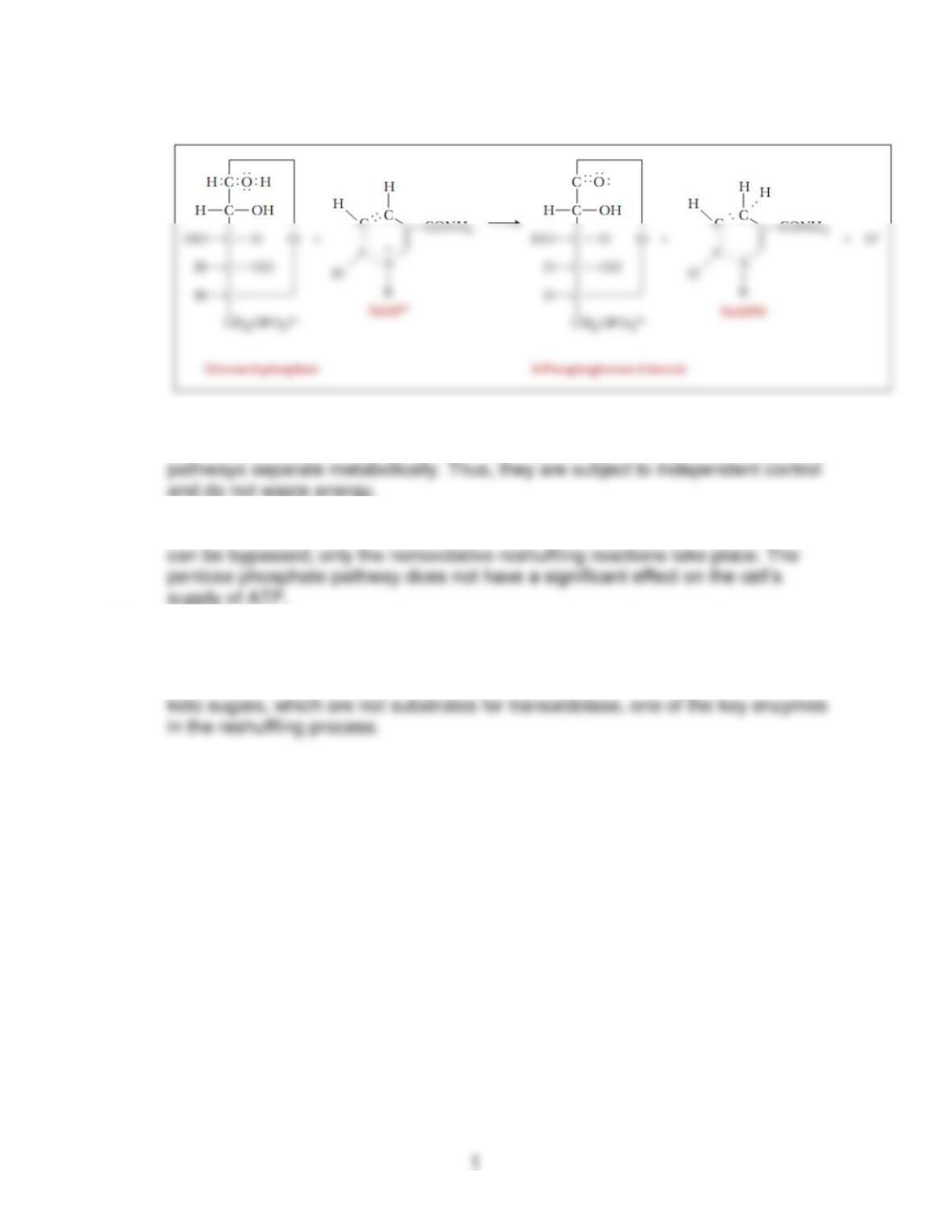
45. NADPH has one more phosphate group than NADH (at the 2′ position of the
ribose ring of the adenine nucleotide portion of the molecule). NADH is produced
in oxidative reactions that give rise to ATP. NADPH is a reducing agent in
biosynthesis. The enzymes that use NADH as a coenzyme are different from
source of NADPH in red blood cells.
48.
(a) By using only the oxidative reactions.
(b) By using the oxidative reactions, the transaldolase and transketolase reactions,
and gluconeogenesis.
(c) By using glycolytic reactions and the transaldolase and transketolase reactions in
reverse.
49. Transketolase catalyzes the transfer of a two-carbon unit, whereas transaldolase
Storage Mechanisms and Control in Carbohydrate
Metabolism 7
52.
53. Having different reducing agents for anabolic and catabolic pathways keeps the
54. If a cell needs NADPH, all the reactions of the pentose phosphate pathway take
place. If a cell needs ribose-5-phosphate, the oxidative portion of the pathway
55. The ester bond is more easily broken than any of the other bonds that form the
sugar ring. Hydrolysis of that bond is the next step in the pathway.
56. The reshuffling reactions of the pentose phosphate pathway have both an
epimerase and an isomerase. Without an isomerase, all the sugars involved are