E18-11 (continued)
2. (continued)
Partial Balance Sheet
December 31, 2010
Current Assets
Accounts receivable $12,000c
E18-12
2010 2011
Installment method sales $120,000 (3)$90,000e
Installment method cost of goods sold (1) 96,000b 63,000
18-22
E18-13
Note to Instructor: For simplicity, the account titles are the same as that used
in the chapter. Use of the titles, Installment Accounts Receivable and
Installment Method Sales, is acceptable.
E18-14
2010
Land 60,000
Cash 60,000
18-23
E18-14 (continued)
2011
Cash 45,000
Accounts Receivable 45,000
Deferred Gross Profit 10,000a
E18-15
1. 2010
Jan. 1 Cash 5,000
Deposit from Purchaser 5,000
2. 2011
Jan. 1 Note Receivable 195,000
E18-16
1. Cash 8,000
Notes Receivable 20,000
Franchise Revenue 28,000
4. Cash 8,000
Unearned Franchise Fees 8,000
E18-17
Note to Instructor: Journal entries are not specifically illustrated in the chapter
discussion.
2010
Apr. 17 Memorandum Entry: 10 tractors costing $30,000 each were
received from the Winger Company on consignment.
E18-18
Note to Instructor: Journal entries are not specifically illustrated in the chapter
discussion.
1. 2010
Apr. 17 Consignment-out 301,000
Inventory ($30,000 x 10) 300,000
Cash 1,000
18-26
SOLUTIONS TO PROBLEMS
P18-1
Note to Instructor. The answer to k is not included in the chapter, and is based
on AICPA Statement of Position No. 00-2. (FASB Cod. # 926-10 and 926-605).
a. As the interest is earned.
b. As the cash is received. Alternatively, interest could still be accrued with
an appropriate recognition for bad debts.
h. When the period of cancellation has expired, cumulative payments
exceed 10%, collection of 90% is expected, the receivable is not subject to
subordination, and the seller is not obligated to complete improvements.
18-27
P18-1 (continued)
m. The revenue should be recognized for the selling price of one cent (as
P18-2
1. a. SLATTERY COMPANY
Income Statement
For Year Ended December 31, 2010
Revenue $315,000a
Balance Sheet
December 31, 2010
Cash $335,000a Common stock, no par $300,000
18-28
P18-2 (continued)
1. (continued)
b. SLATTERY COMPANY
Income Statement
For Year Ended December 31, 2010
Revenuea $350,000b
Production expense (200,000)c
Balance Sheet
December 31, 2010
Cash $335,000 Accrued selling expenses $ 5,000c
c. SLATTERY COMPANY
Income Statement
For Year Ended December 31, 2010
Revenuea $280,000b
Cost of goods sold (160,000)c
18-29
P18-2 (continued)
1.c. (continued)
Balance Sheet
December 31, 2010
2. In the situation of selling a product, recognition of revenue at the time of sale
(delivery) is generally the most useful, because realization has taken place
and the revenues have been earned. The method produces a better
3. At December 31, 2011, the company has produced, shipped, and received
P18-3 (AICPA adapted solution)
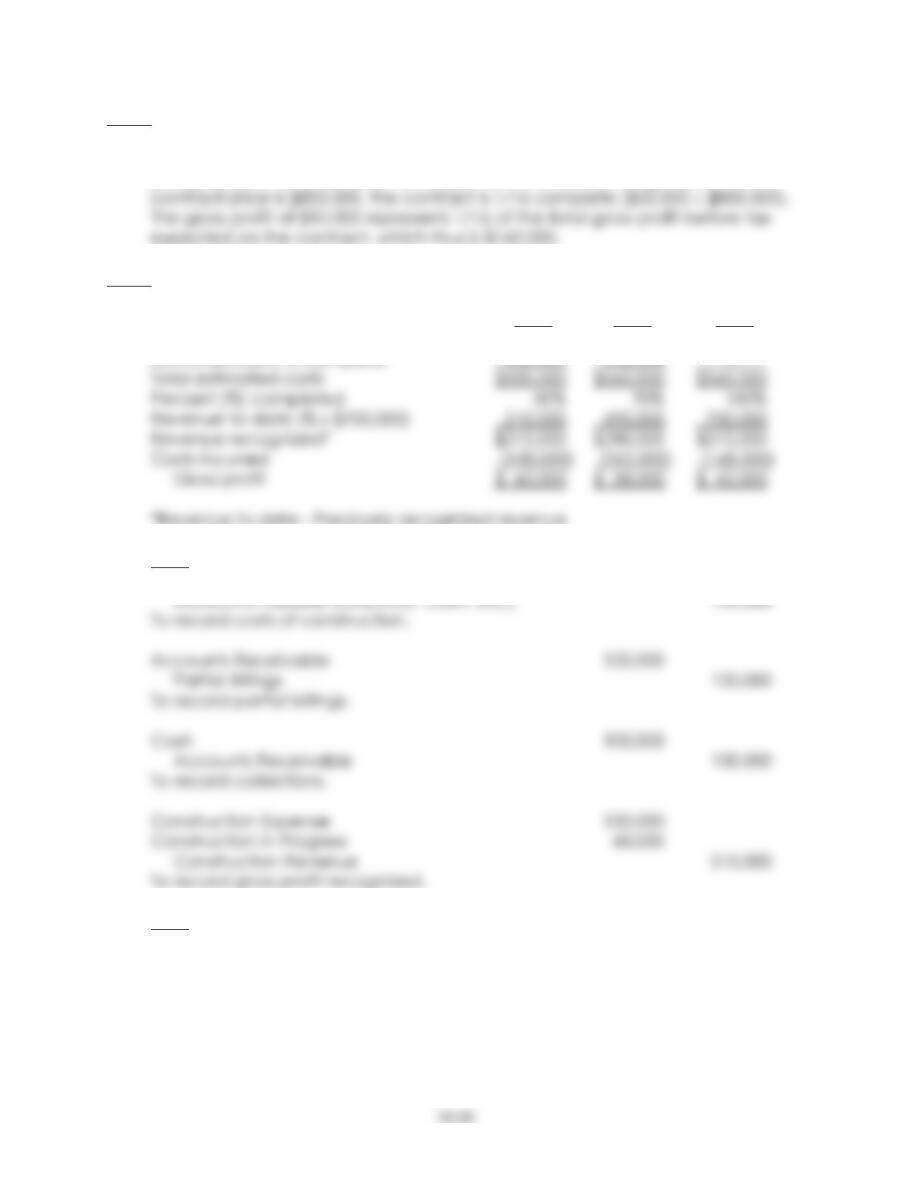
1. The cash collected is the difference between the contract billings and the
accounts receivable. Therefore, it is $32,000 ($47,000 – $15,000).
P18-3 (continued)
2. Since the construction-in-progress balance is $50,000 (costs incurred of $40,000
plus gross profit of $10,000) and is equal to the revenue recognized, and the
P18-4
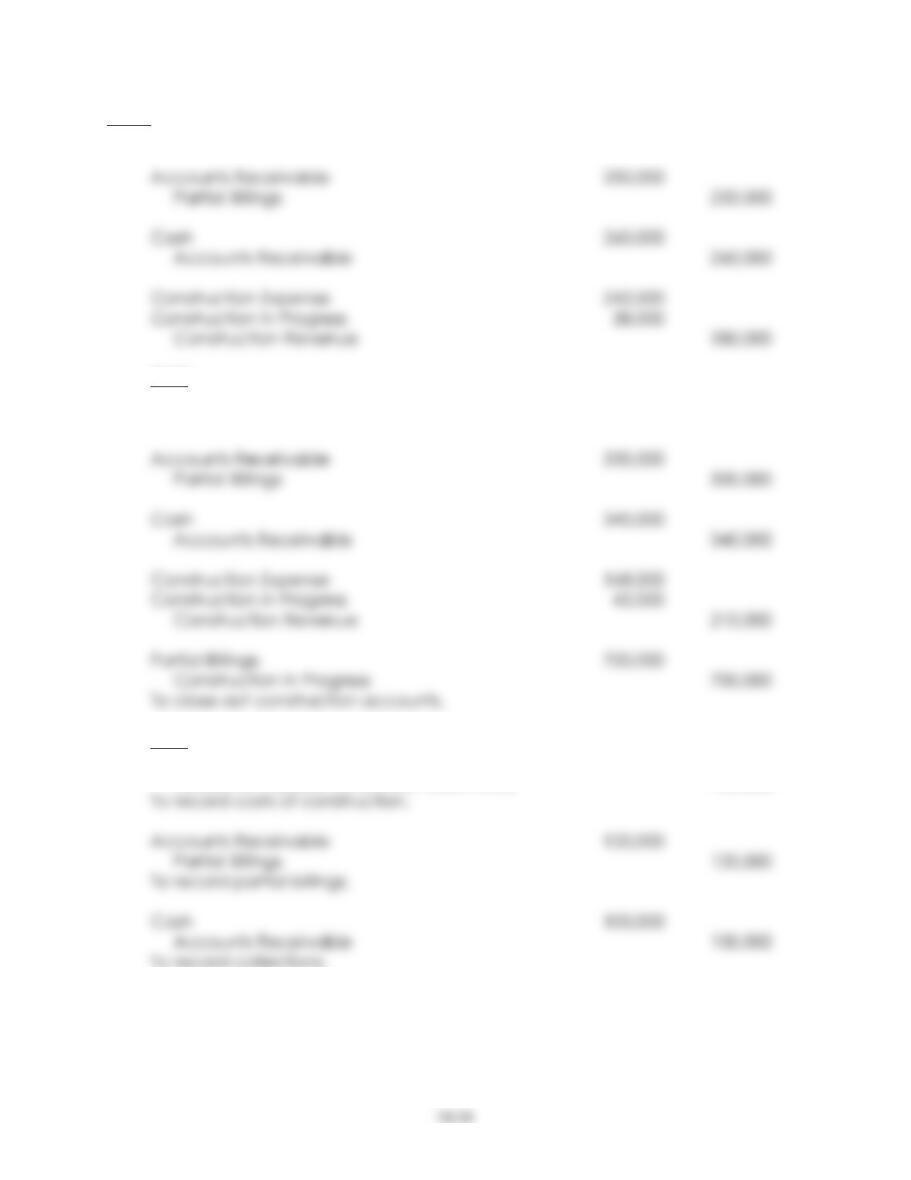
1. 2010 2011 2012
Construction costs incurred to date $150,000 $392,000 $560,000
*Revenue to date – Previously recognized revenue
2010
Construction in Progress 150,000
2011
Construction in Progress 242,000
Accounts Payable (Inventory, Cash, etc.) 242,000
P18-4 (continued)
1. (continued)
2012
Construction in Progress 168,000
Accounts Payable (Inventory, Cash, etc.) 168,000
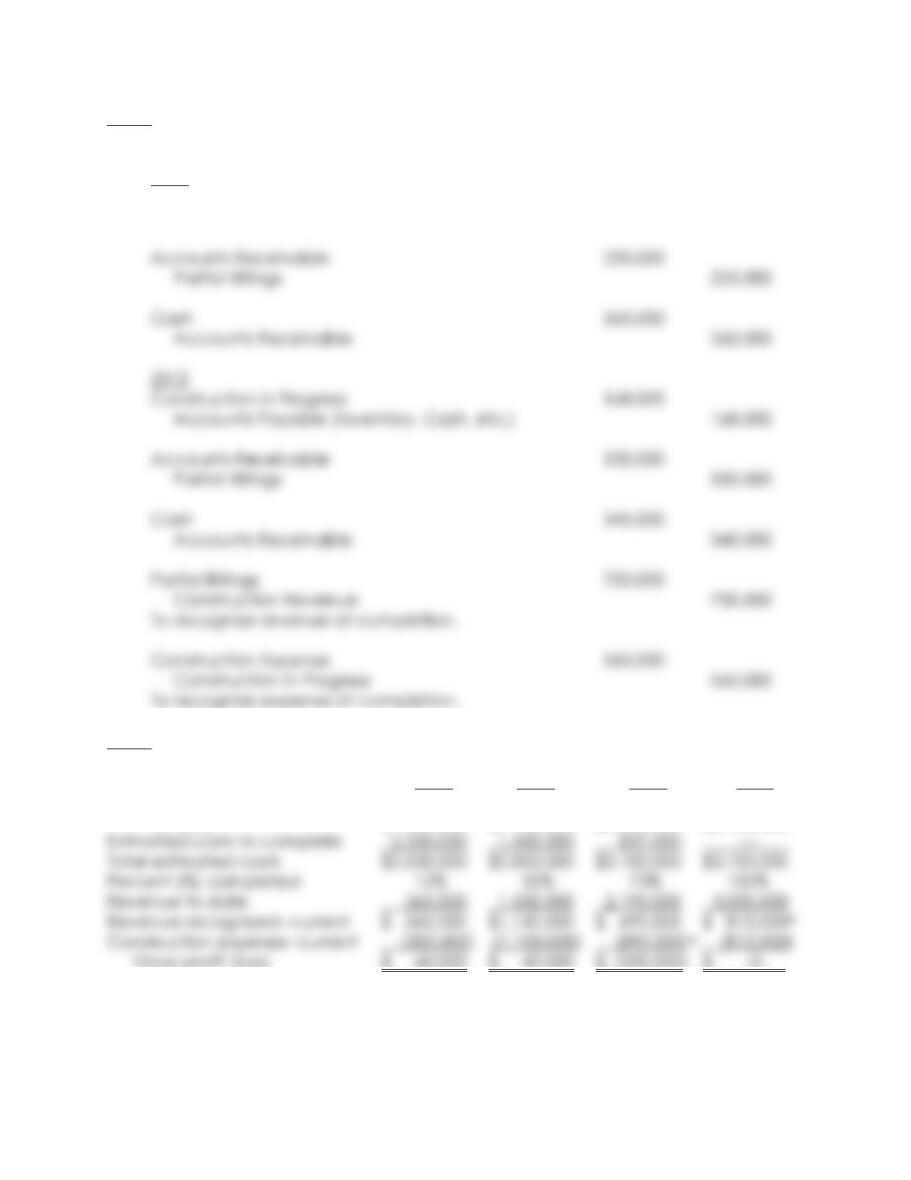
2. 2010
Construction in Progress 150,000
Accounts Payable (Inventory, Cash, etc.) 150,000
18-32
P18-4 (continued)
2. (continued)
2011
Construction in Progress 242,000
Accounts Payable (Inventory, Cash, etc.) 242,000
P18-5
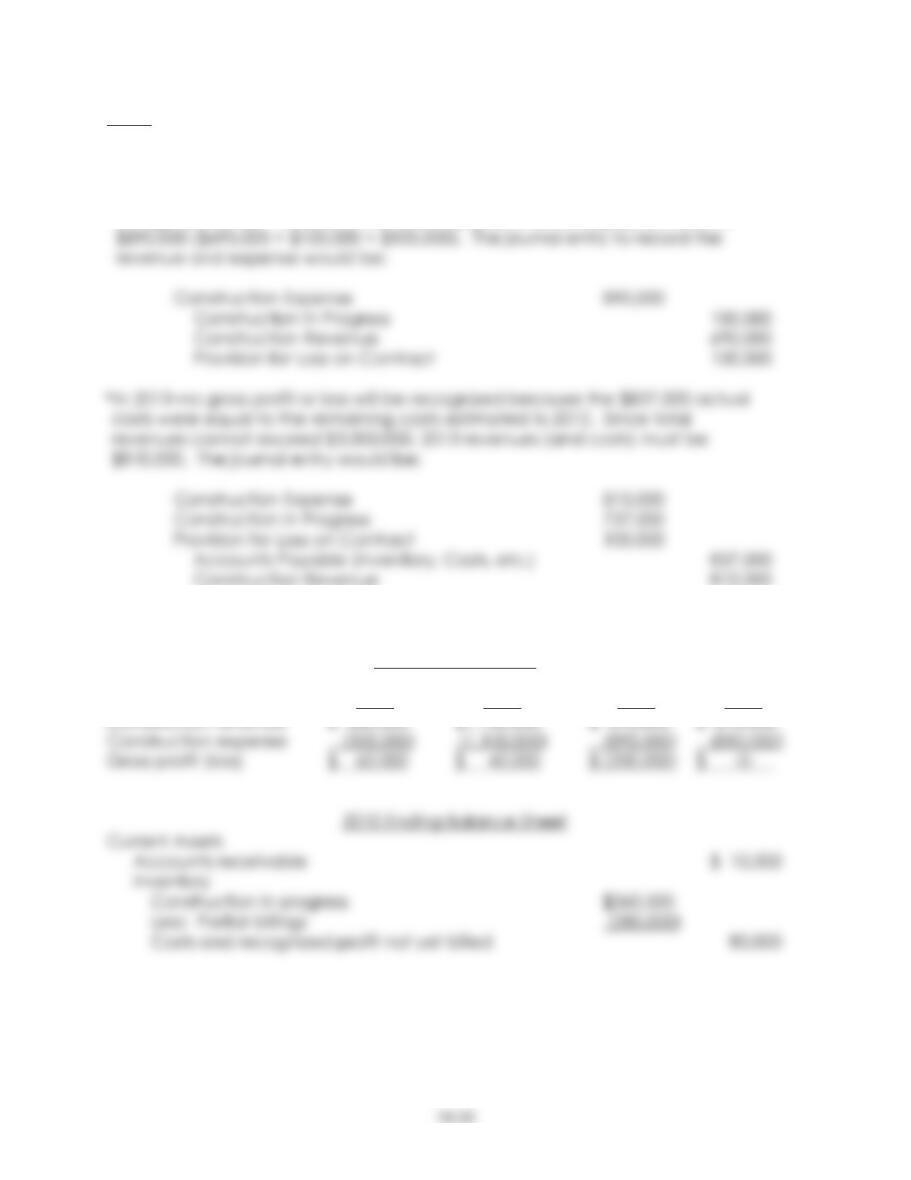
1. a. 2010 2011 2012 2013
Construction costs incurred
to date $ 300,000 $1,400,000 $2,263,000 $3,100,000
P18-5 (continued)
1.a. (continued)
aIn 2012–a negative gross profit (loss) of $100,000 is expected on the entire contract.
This must be recognized in 2012 along with eliminating the $100,000 in gross profit
recognized so far. Therefore, the total expense to be recognized in 2012 is
1. b. (combined with 2. b., following 2. a.)
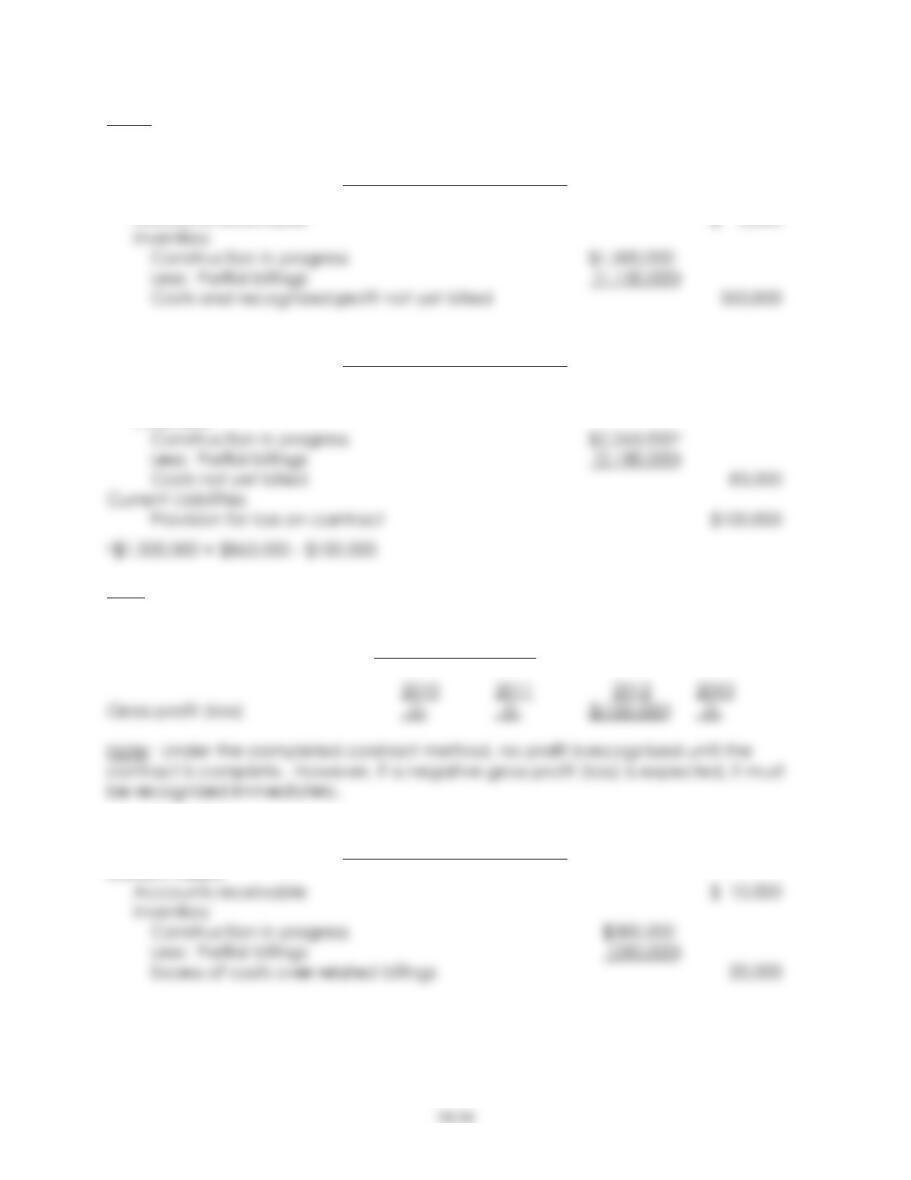
2. a. Income Statements
2010 2011 2012 2013
P18-5 (continued)
2.a. (continued)
2011 Ending Balance Sheet
Current Assets
Accounts receivable $ 5,000
2012 Ending Balance Sheet
Current Assets
Accounts receivable $ 25,000
Inventory
2010
Ending Balance Sheet: All accounts have been closed.
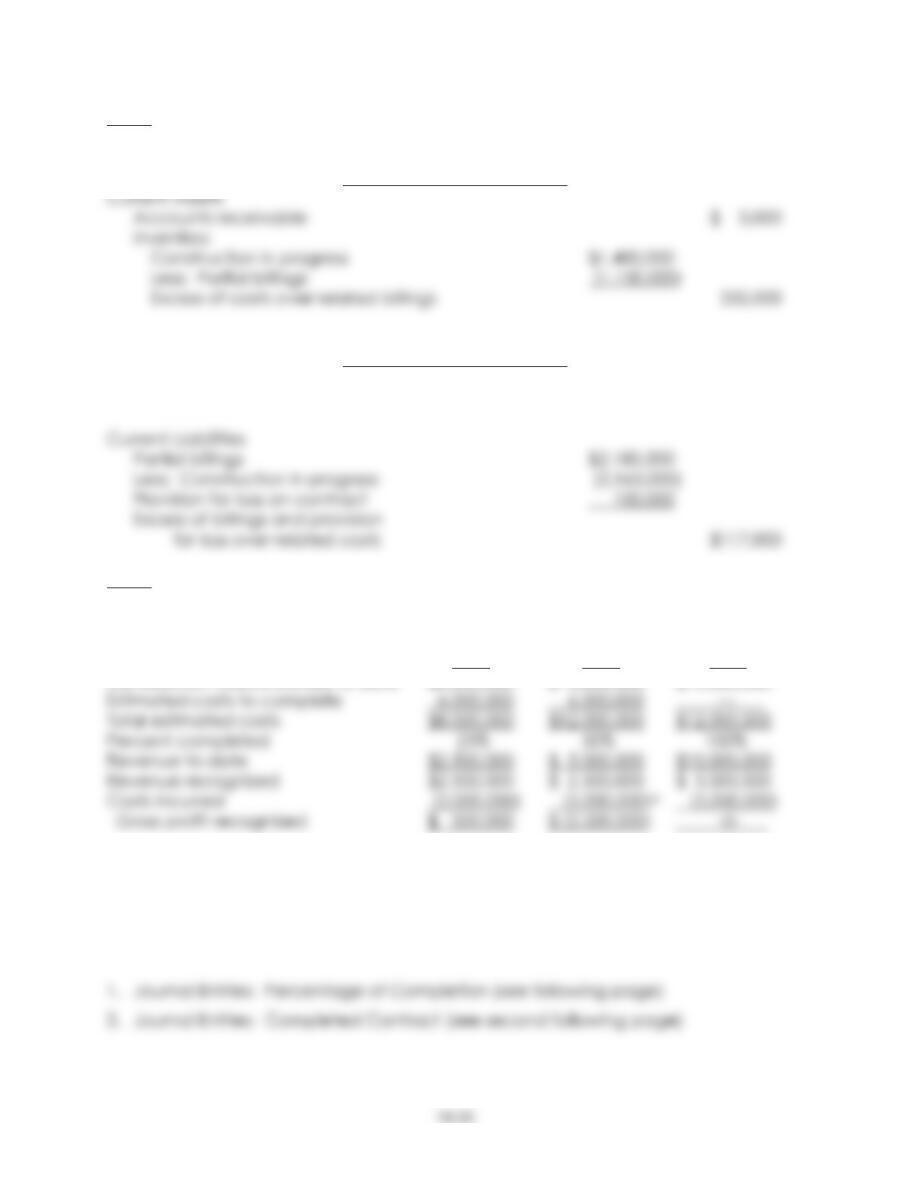
1. b. and 2. b. Income Statements
2010 Ending Balance Sheet
Current Assets
P18-5 (continued)
1.b. and 2.b. (continued)
2011 Ending Balance Sheet
2012 Ending Balance Sheet
Current Assets
Accounts receivable $ 25,000
P18-6
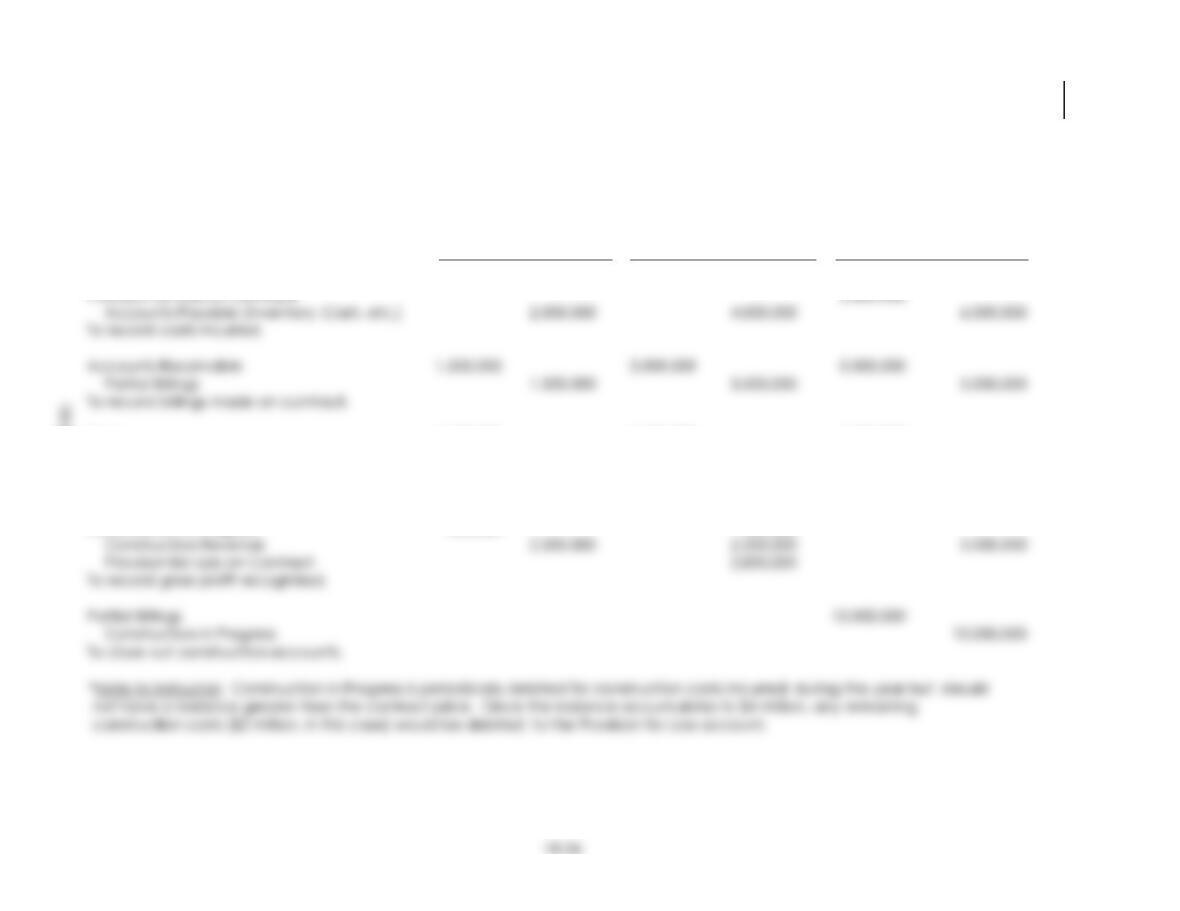
Computation of Gross Profit (for percentage of completion method):
2010 2011 2012
Construction costs incurred to date $2,000,000 $ 6,000,000 $12,000,000
aSince a negative gross profit (loss) of $2,000,000 ($12,000,000 – $10,000,000) is
expected for the contract, a negative gross profit of $2,500,000 (the $2,000,000
negative gross profit plus the $500,000 gross profit previously recognized) must be
recognized in 2010. Therefore the expense is $5,000,000 ($2,500,000 + $500,000 +
$2,000,000).
1. Journal Entries: Percentage of Completion
2010 2011
2012
Construction in Progress
Cash
Accounts Receivable
To record payment by customer.
Construction Expense
Construction in Progress
2,000,000
1,300,000
2,000,000
500,000
1,300,000
4,000,000
3,600,000
5,000,000
3,600,000
500,000
4,000,000*
5,100,000
5,000,000
5,100,000
P18-6 (continued)
1.
2. Journal Entries: Completed Contract
2010
2011
2012
Construction in Progress
Provision for Loss on Contract
Cash
Accounts Receivable
To record payment by customer.
2,000,000
1,300,000
1,300,000
4,000,000
3,600,000
3,600,000
4,000,000*
2,000,000
5,100,000
5,100,000
18-38
P18-7
1. HILT COMPANY
Condensed Income Statements
For Years Ended
December 31, 2010 December 31, 2011
Revenues $224,000b $416,000e
2. From a theoretical viewpoint, the depreciation would typically be calculated
under the straight-line method since it is unlikely that there would be sufficient
P18-8
2010
P18-8 (continued)
Cash (25% x $520,000) 130,000
Accounts Receivable 130,000
Repossessed Inventory (40% x $10,000) 4,000
Deferred Gross Profit, 2010 (20% x $9,000) 1,800
Allowance for Doubtful Installment
Accounts Receivable 3,200
Accounts Receivable ($10,000 – $1,000) 9,000
Gross Profit Realized on Installment Sales 26,000
Income Summary 26,000
2011
Accounts Receivable 600,000
Sales 600,000
18-40
P18-8 (continued)
Sales 600,000
Cost of Goods Sold 456,000
Deferred Gross Profit, 2011 144,000
P18-9
Note: The gross profit percentage is 20% in both years, as indicated by the
relationship between the balance in the deferred gross profit and accounts
receivable accounts for 2009 ($16,000 and $80,000), before the repossession in