Chapter 18
Taxes
Student Performance Objectives:
Section I Sales and Excise Taxes
18-1 Determining Sales Tax by Using Sales Tax Tables
Section II Property Tax 606
18-5 Calculating the Amount of Property Tax
Section III Income Tax
18-7 Calculating Taxable Income for Individuals
18-8 Using the Tax Table to Determine Tax Liability
Chapter Notes, Teaching Tips and lecture Launchers
• Lecture Launcher: Discuss with the class the quote by Supreme Court Justice Oliver
Wendell Holmes, Jr., “Taxes are the price we pay for living in a civilized society.”
• By definition, taxation is the imposition of a mandatory levy or charge by a
government unit to provide financing for public services.
• The Collaborative Learning Activity at the end of the chapter, “Your Tax Dollars at
• This chapter’s Business Decision, “The 90% Rule, Happy New Year!,” at the end of
the chapter, places students in the role of an accountant who is advising a client about
• Spotlight: Invite a certified public accountant or a tax consultant to class to discuss
current tax issues with the students.
• Lecture Launcher: Ask students if they can explain the proposition that income taxes
are progressive, while sales taxes are regressive. Does this mean that sales taxes are
less fair to the poor? Would a flat tax be fairer? Discuss.
• Homework Activity: Ask students how they think your state ranks among all 50
• For easy reference, remind students that all of the formulas used in this chapter are
listed at the beginning of the Summary Chart.
Section I Sales and Excise Taxes
• Spotlight: Be sure students know the difference between sales tax and excise tax.
• Sales tax is a tax based on the retail selling or rental price of tangible personal
property. This tax is collected by the retailer at the time of purchase, and paid
to the state or local government.
• Excise tax is a tax levied by federal, state, and local governments on certain
luxury or nonessential products and services such as alcoholic beverages, furs,
• Point out that automobile tires are subject to excise tax.
• Emphasize that sales tax and excise tax are each calculated separately on the actual
selling price.
• Use Exhibit 18-1 to illustrate Sales Tax Brackets Tables.
• Point out that sales tax rates are expressed as a percent and vary from state to
state.
• Currently, state tax rates range from 3% to 8%, while city and county rates
• Point out that in some areas, certain educational and religious institutions,
government agencies and charities are exempt from paying sales tax when making
purchases.
• Research Assignment:
• Have students research your local area and state to determine “what
entities do not pay sales tax?” What other taxes don’t they pay?
• Be sure students are aware that there is no sales tax on shipping, handling or setup
charges.
• Collaborative Learning Activity: As a review of Section I, have students work
Review Exercises 8-13 in groups. Next, have the groups compare answers with
another group and resolve any differences.
Section II Property Tax
• Lecture Launcher: Point out to students that ad valorem or property tax is a tax
based on the assessed value of property, generally collected at the city or county
• Spotlight: Be sure students understand that property tax rates may be expressed in
four ways:
• Decimal or percent of assessed value – .041 or 4.1%
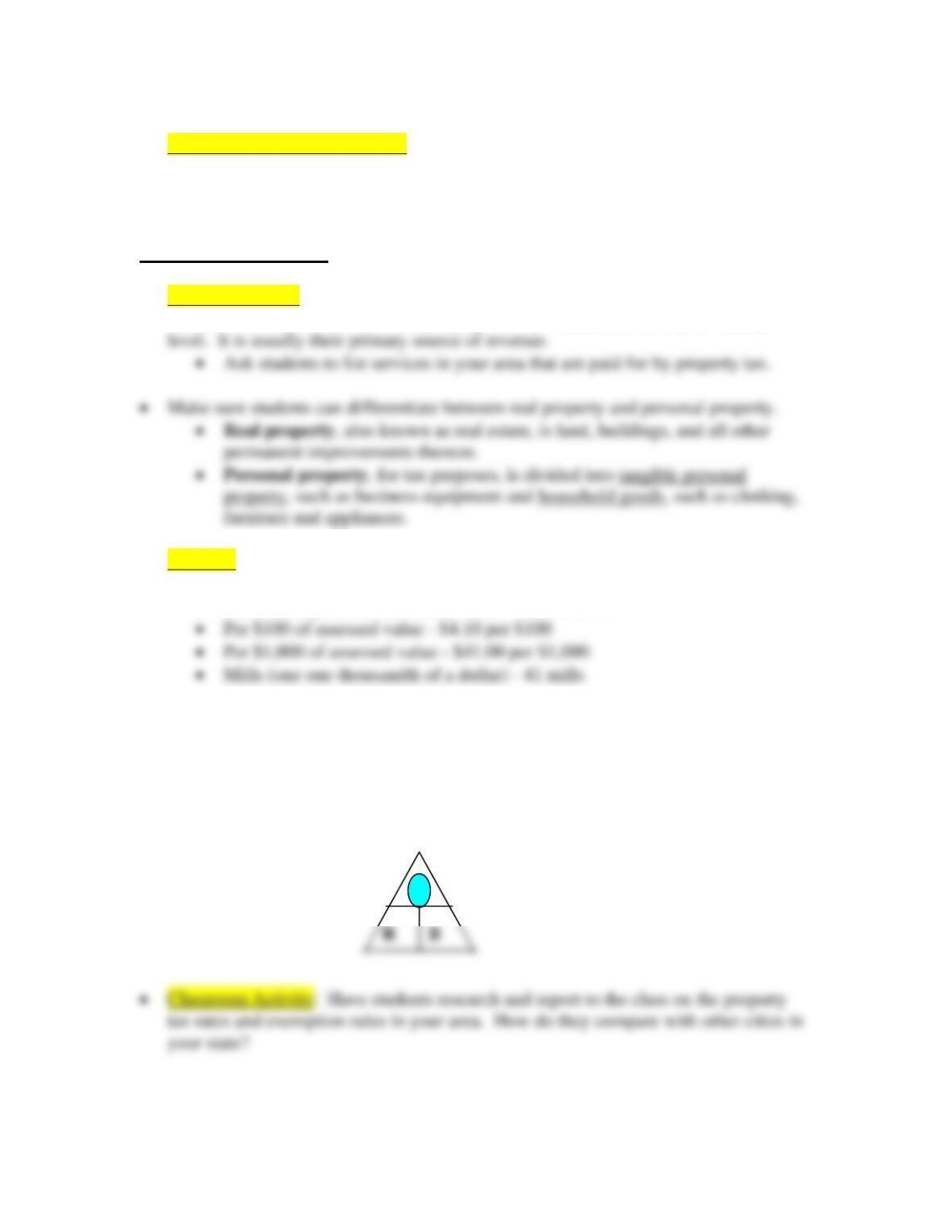
• Remind students that calculating the amount of property tax as a percent is an
application of the percentage formula, Portion = Rate x Base:
Amount of property tax (Portion) = Tax rate (Rate) x Assessed value (Base)
P
• Many areas have Homeowner’s Tax Exemptions for people who have lived in their
home for more than a specified period of time, such as one year. Some areas also
• Classroom Activity: Remind students that each year cities and counties must estimate
the amount of tax dollars required to pay for all governmental services.
your area? Discuss.
Section III Income Tax
• Be sure students know that income tax is a pay-as-you-go tax based on the amount of
income of an individual or corporation.
• Spotlight Here is some important information to share with the class. Adopted from
The Miami Herald. “Loose Change,” by Meg Green, page 3F.
• How To Avoid An Income Tax Audit
• Don’t Be Greedy The IRS uses 35% of your income as the point at
• According to Kiplinger’s Personal Finance magazine and CCH Standard
Federal Tax Reporter, these are your audit odds:
• All individuals: 1 in 200
• High income ($100,000-plus): 1 in 100
• Be sure students understand that income tax rules change every year. Have them call
the IRS (1-800-TAX FORM) to order the latest 1040 Instruction booklet. (These can
also be ordered by you, in bulk, for the class.)
• Spotlight: Remind students:
• Collaborative Learning Activity: In groups of two’s, have students work Try-It
Exercise 11 using the Tax Rate Schedule to determine tax liability.
Questions Students Always Ask
“Why are sales taxes applied to some of my purchases over the Internet, but not to all of
them?”
• In general, the seller will be responsible for collecting and remitting to the proper
authorities taxes for all sales made in any state or locality in which the business
“Why is the property tax rate always rounded up?”
“Why do we deduct one-half of self-employment taxes as an adjustment to income but
then add on the whole amount later as other taxes?”
• Self-employment taxes cover Social Security and Medicare for self-employed
“Why do tax credits save more in taxes than tax deductions?”
• Tax credits are deducted directly from the amount of tax owed. Thus, they reduce
“If tax credits reduce my tax below zero, will I get a refund?
• Most tax credits are not refundable. However, the Earned Income Tax Credit and
the Child Tax Credit may result in a refund, even if no taxes were paid. The
“What is the marriage penalty I hear so much about?
• The marriage penalty is what happens when two people earning roughly the same
“What is the difference between an S corporation and a regular corporation?”
• A regular, or C, corporation has its profits taxed at the corporate level. What’s
left may then be distributed to shareholders as dividends, which count as taxable