Curled Metal Products, Inc.
Teaching Commentary
OVERVIEW
This case deals with a conventional managerial accounting topic, customer profitability analysis, approached in a
very unconventional way, focusing on a product’s impact on the profitability of the customer rather than the
ANSWERS TO ASSIGNMENT QUESTIONS
Question 1
Exhibit 2 in the case shows that the $50,000 investment in new tooling saves $17.16 ($28.80 – $11.64) in
labor cost per pad, up to 3,000 pads per year (250 pads per month). The annual labor savings at $51,480 pays back
the investment in a little less than one year.
Question 2
The issue here is two sided. CMP needs to commit enough capacity so that a successful product
introduction does not sell out the factory too quickly, undercutting customer confidence that the company is
prepared to offer an adequate supply of the product.
12-2
Question 3
Variable manufacturing cost per pad is given in the case at $27.28 (material cost of $15.64 plus labor at
$11.64). The factory overhead absorption rule in Exhibit 2 (360% of factory labor) is a “set up” to see if students are
aware of the problems using an overall average to estimate the cost for a new product. Using this rule would
substantially overstate the manufacturing overhead involved in producing CMP pads.
can do is eliminate the $2.4 million pool related to automotive R&D.
A rough assignment of overhead per unit should also allow for the excess capacity in the factory.
Conceptually, excess capacity should not be charged to current production. If labor is a plausible driver for factory
overhead, in the long run, the $5.2 million should be spread across $3.5 million of labor ($2.1 million ÷ .6). This
implies an overhead rate of about 150% (5.2/3.5). For pads, this implies a manufacturing cost of about $45, as
follows:
Question 4
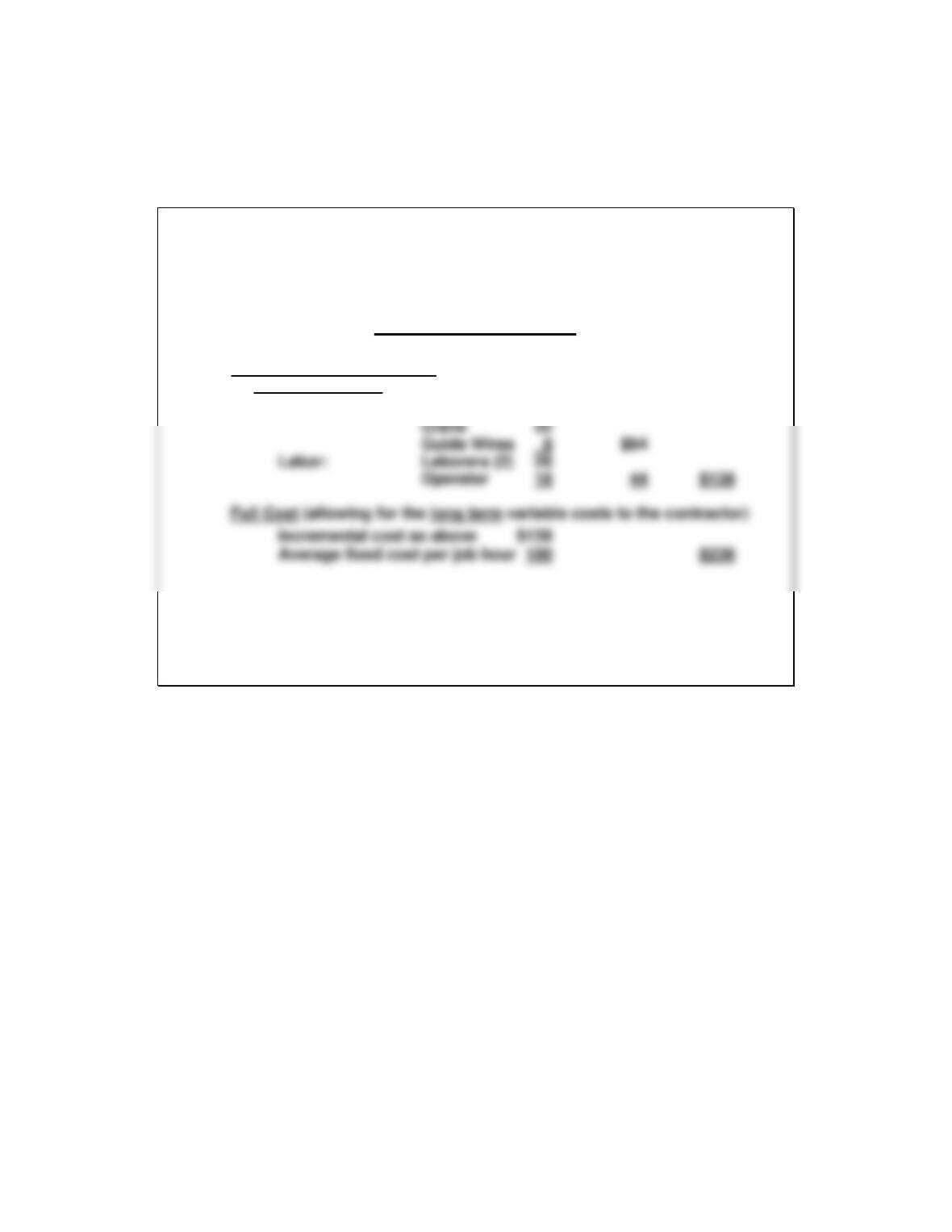
Exhibits TC-2 and TC-3 provide some necessary background calculations for this question. The key idea
for the question is that EVC per pad depends on the impact of the pad on the contractor’s operations. That impact
varies widely across the three segments highlighted in the case. In segment one, the contractor is operating at
capacity. Faster pile-driving converts directly to more revenue per year for the contractor. Costs of operation for the
contractor won’t change, but total feet driven will. The impact of the pads is the incremental revenue they will
produce.
In segment two, the pads will only save about twenty-two hours per job out of a total of about 4,100 hours
12-3
Question 5
Exhibit TC-5 summarizes the analysis for this question. This analysis shows the CMP can earn its normal
Questions 6 and 7
Exhibit TC-7 summarizes the marketing considerations that should lead the student to decide that segment
one, alone, is very probably the way to go. A price of about $1,000 per pad (50% of EVC) should be attainable for
some significant portion of the volume in segment one. This is a “skimming” price, but the high customer value
Question 8
Exhibits TC-8, TC-9, TC-10, and TC-11 summarize the key ideas for this question. There is no one right
TEACHING STRATEGY
In class, I go through the assigned questions, one by one. Students tend to have problems understanding the logic in
Question 4, so it can easily absorb thirty minutes or more of class time. This is the key idea in the case – customer
value depends totally on how the customer uses the product or service. If the case is used early in the term and/or
12-4
Exhibit TC-1
Sizing the Market
Number of Hammers in Operation
(Segments 1 and 2) Owned 7,000
(Segment 3) Leased 4,500
Use for Each Hammer
Estimated 11,500
12-5
Exhibit TC-2
Time Saved by Contractor from Using
CMP Pads
Colerick Job Average Job
300 55 foot steel piles,
Saved Asbestos Pads Cost $1000. $1000.
12-6
Exhibit TC-3
Cost of One Hour of Piledriver Time to the
Contractor?
Average Cost per Job Hour
Incremental Cost
Equipment: Hammer $34
Per Case Table A
12-7
Exhibit TC-4
SEGMENT 1
Here, the value is incremental revenue.
22 hours saved converts to about 11 hours driving time (“Hidden
Costs”).
11 hrs 200 ft/hr $5/foot = $11,000
Economic Value to the Customer (EVC)
(for an Average Job)
12-8
Exhibit TC-5
Cost-Based Pricing
Variable Manufacturing Cost (with $50,000 tooling investment—the payback on $50,000
is less than one year for 11 1/2” pads!)
Material $15.64
Labor $11.64 $27.28
Full Manufacturing Cost:
12-9
Exhibit TC-6
Pricing Options (Per Pad)
Cost-Based: to Distributor $81.35
to Contractor $125.15
Customer Value-Based:
EVC To Contractor (Average Job)
12–10
Exhibit TC-7
1. Many factors point toward Segment 1 as the strongly
preferred segment
• EVC is much higher
—$2000 versus $850 (in 3) and $167 (in 2)
2. If target multiple segments simultaneously, will have to face the
“price discrimination” issue head on. Selling only in Segment 1
avoids the price discrimination.
3. A reasonable manufacturing level for CMP seems to be three to
12–11
Exhibit TC-8
Potential Financial Impact for CMP?
Size of Market = 207,000 CMP pads/year —Segment 1 = 41,000 pads
10,000 Units = 25% SOM—still very modest for such a great innovation, if we
can “sell” value pricing to contractors and:
–Figure out the marketing plan to go with the pricing and segmentation
12–12
Exhibit TC-9
•Manufacture to Stock?
—Inventory levels?
•Distribute through Contractor Supply Houses?
How to Manufacture and Distribute?
Exhibit TC-10
Direct Sales Force (How many) or use Manufacturers Reps?
Who is CMP’s customer
How to promote?
Marketing Budget?
Revenue = ? $6 million at 15% SOM
Real, On-the-Ground, Marketing Plan?