EXERCISE 18-7 (Continued)
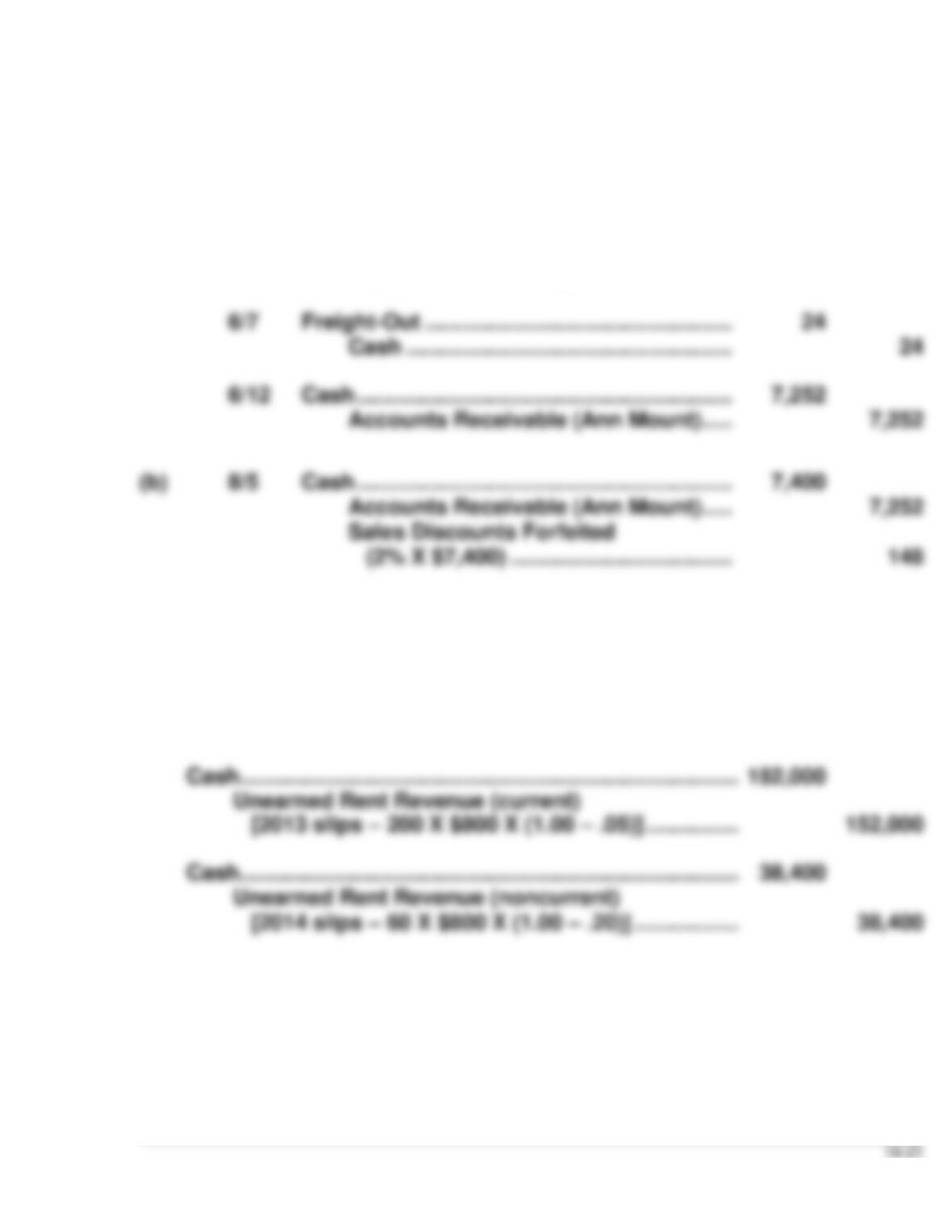
2. 6/3 Accounts Receivable (Ann Mount) ………… 7,840
Sales Revenue
[$8,000 – (2% X $8,000)] ………………. 7,840
6/5 Sales Returns and Allowances ……………… 588
Accounts Receivable (Ann Mount)
[$600 – (2% X $600)] ……………………. 588
EXERCISE 18-8 (10–15 minutes)
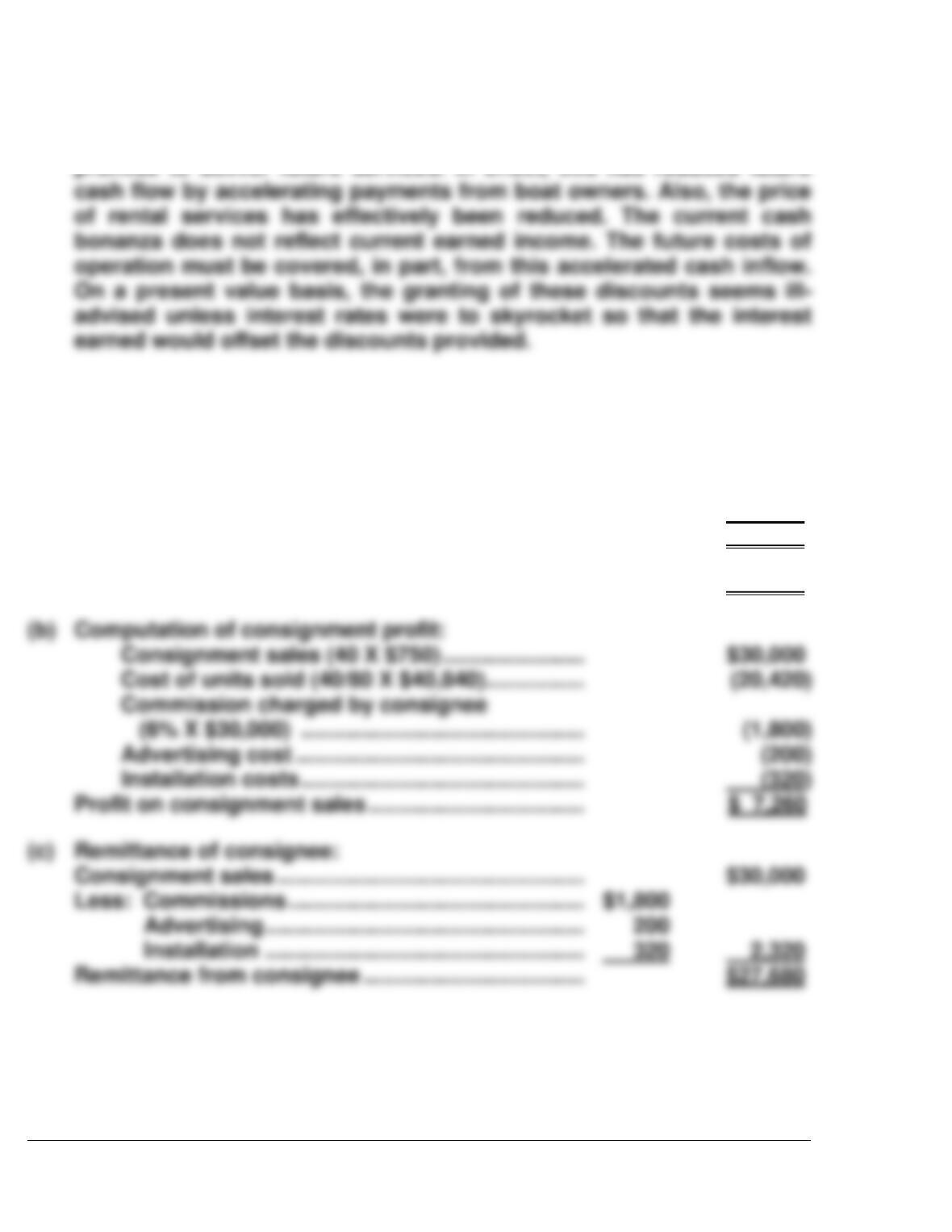
(a) Cash ……………………………………………………………………… 240,000
Rent Revenue
(2012 slips – 300 X $800) ………………………………. 240,000
18–22
EXERCISE 18-8 (continued)
(b) The marina operator should recognize that advance rentals generated
$190,400 ($152,000 + $38,400) of cash in exchange for the marina’s
promise to deliver future services. In effect, this has reduced future
EXERCISE 18-9 (15–20 minutes)
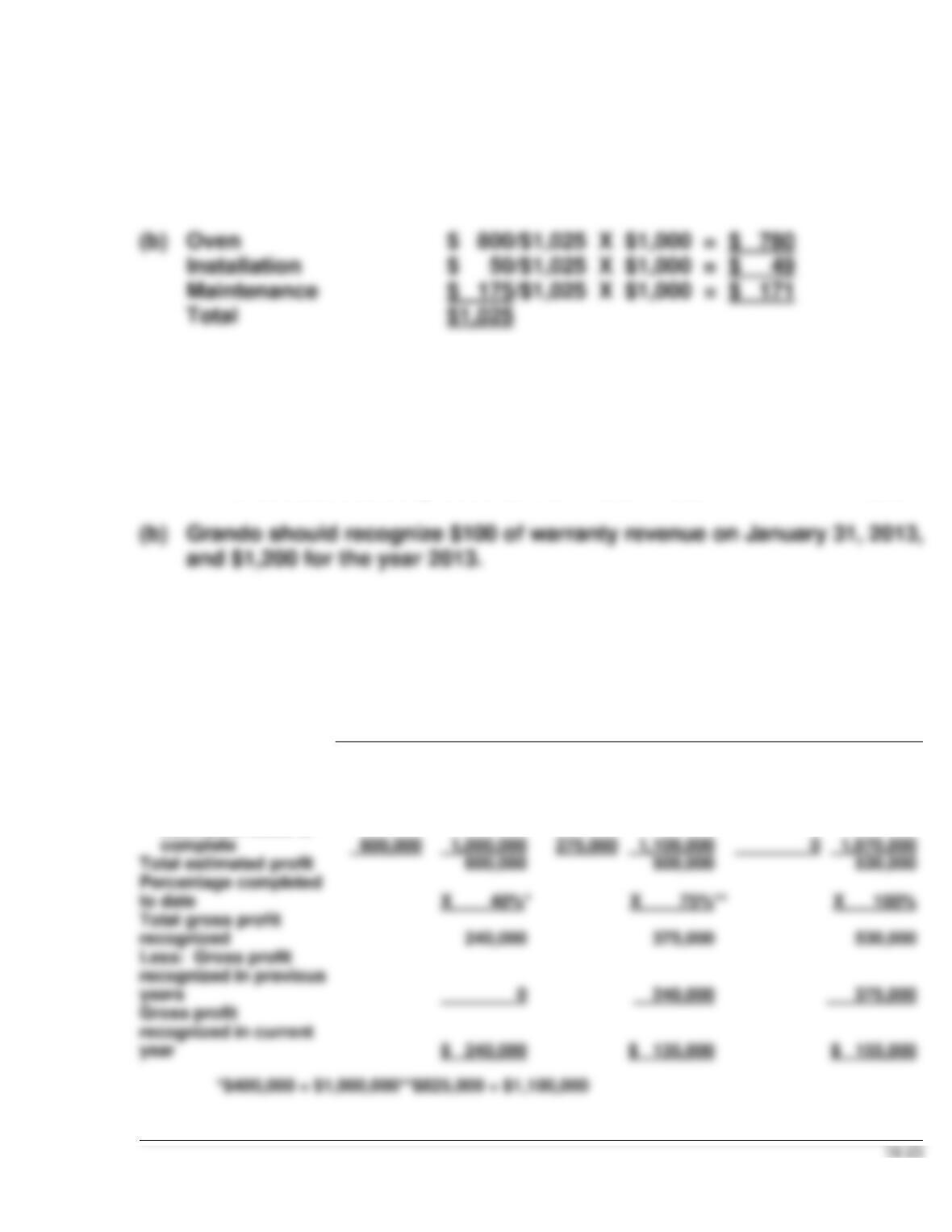
(a) Inventoriable costs:
80 units shipped at cost of $500 each ………… $40,000
Freight ……………………………………………………… 840
Total inventoriable cost ………………………. $40,840
40 units on hand (40/80 X $40,840) …………….. $20,420
EXERCISE 18-10 (10–15 minutes)
(a) The conditions for a multiple-deliverable arrangement exist for Appliance
Center since the delivered item has value to the customer on a stand–
alone basis, the agreement includes a general right of return, and per-
formance of the undelivered item (installation) is considered probable.
EXERCISE 18-11 (5–10 minutes)
(a) Cash …………………………………………………………………. 50,000
Sales Revenue ……………………………………………. 48,800
Unearned Warranty Revenue ………………………. 1,200
EXERCISE 18-12 (20–25 minutes)
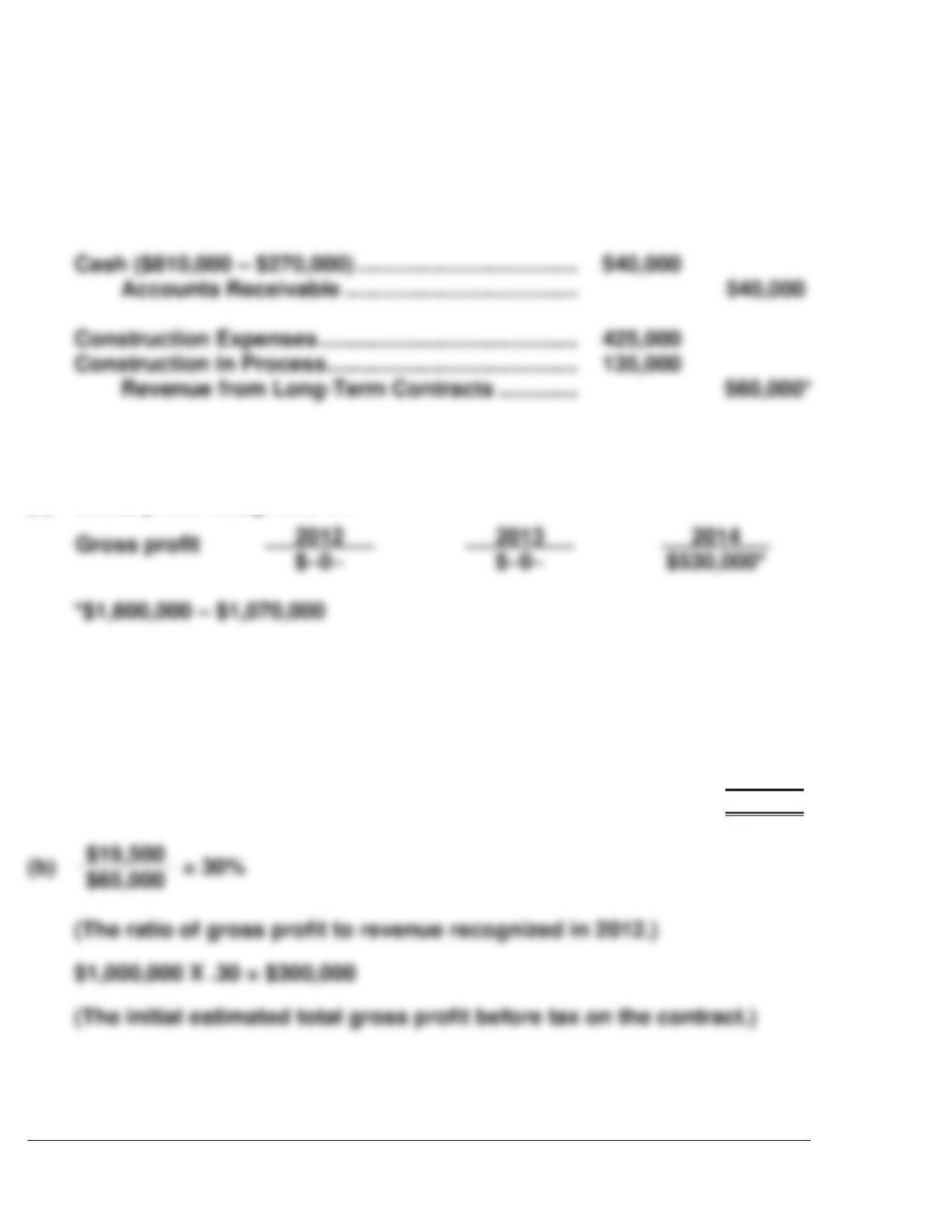
(a) Gross profit recognized in:
2012
2013
2014
Contract price
$1,600,000
$1,600,000
$1,600,000
Costs:
Costs to date
$400,000
$825,000
$1,070,000
Total estimated profit
to date
recognized
years
Estimated costs to
18–24
EXERCISE 18-12 (Continued)
(b) Construction in Process ($825,000 – $400,000) …. 425,000
Materials, Cash, Payables …………………………. 425,000
Accounts Receivable ($900,000 – $300,000) ……… 600,000
Billings on Construction in Process ………….. 600,000
*$1,600,000 X (75% – 40%)
(c) Gross profit recognized in:
EXERCISE 18-13 (10–15 minutes)
(a) Contract billings to date ………………………………….. $61,500
Less: Accounts receivable 12/31/12 ………………… 18,000
Portion of contract billings collected ……………….. $43,500
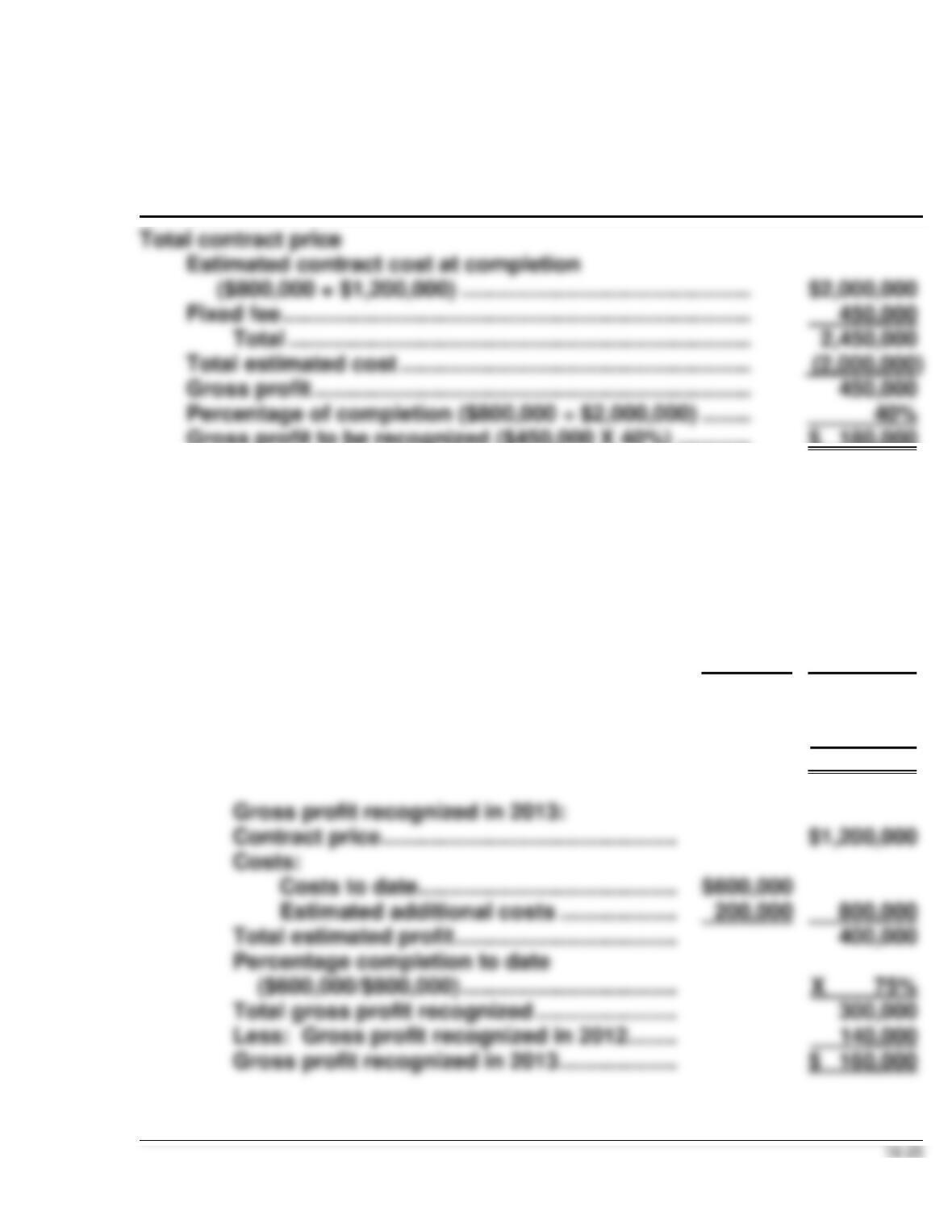
EXERCISE 18-14 (10–12 minutes)
DOUGHERTY INC.
Computation of Gross Profit to be
Recognized on Uncompleted Contract
Year Ended December 31, 2012
Gross profit to be recognized ($450,000 X 40%) ………… $ 180,000
EXERCISE 18-15 (25–30 minutes)
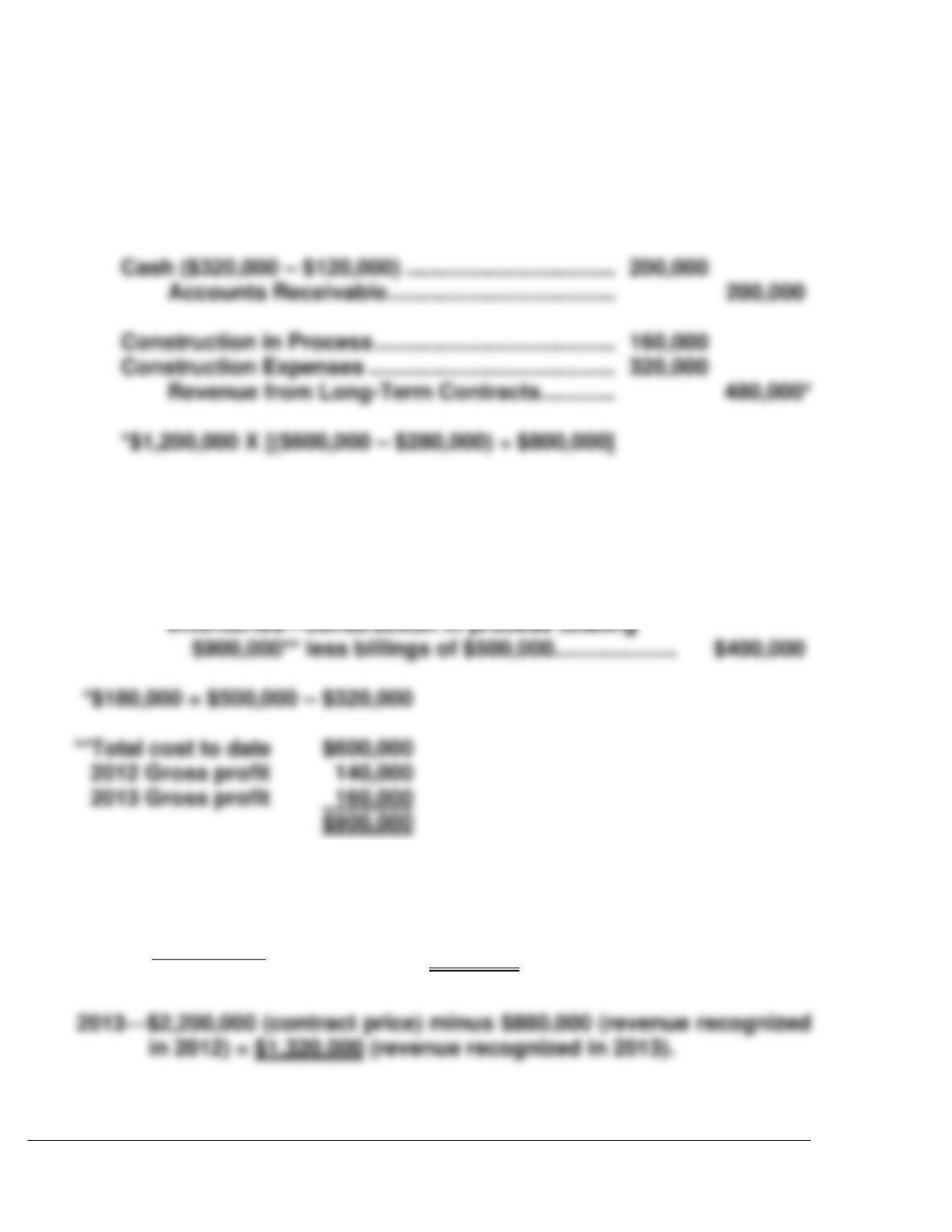
(a) 1. Gross profit recognized in 2012:
Contract price ………………………………………… $1,200,000
Costs:
Costs to date …………………………………… $280,000
Estimated additional costs ………………. 520,000 800,000
Total estimated profit ……………………………… 400,000
Percentage completion to date
($280,000/$800,000) …………………………….. X 35%
Gross profit recognized in 2012 ………………. $ 140,000
18–26
EXERCISE 18-15 (Continued)
2. Construction in Process ($600,000 – $280,000) … 320,000
Materials, Cash, Payables ……………………….. 320,000
Accounts Receivable ($500,000 – $150,000) ……. 350,000
Billings on Construction in Process ………… 350,000
(b) Income Statement (2013)—
Gross profit on long-term construction contract ………. $160,000
Balance Sheet (12/31/13)—
Current assets:
Receivables—construction in process ……………… $180,000*
EXERCISE 18-16 (15–20 minutes)
(a)
2012—
$640,000
X $2,200,000 = $880,000
$1,600,000
EXERCISE 18-16 (Continued)
(b) All $2,200,000 of the contract price is recognized as revenue in 2013.
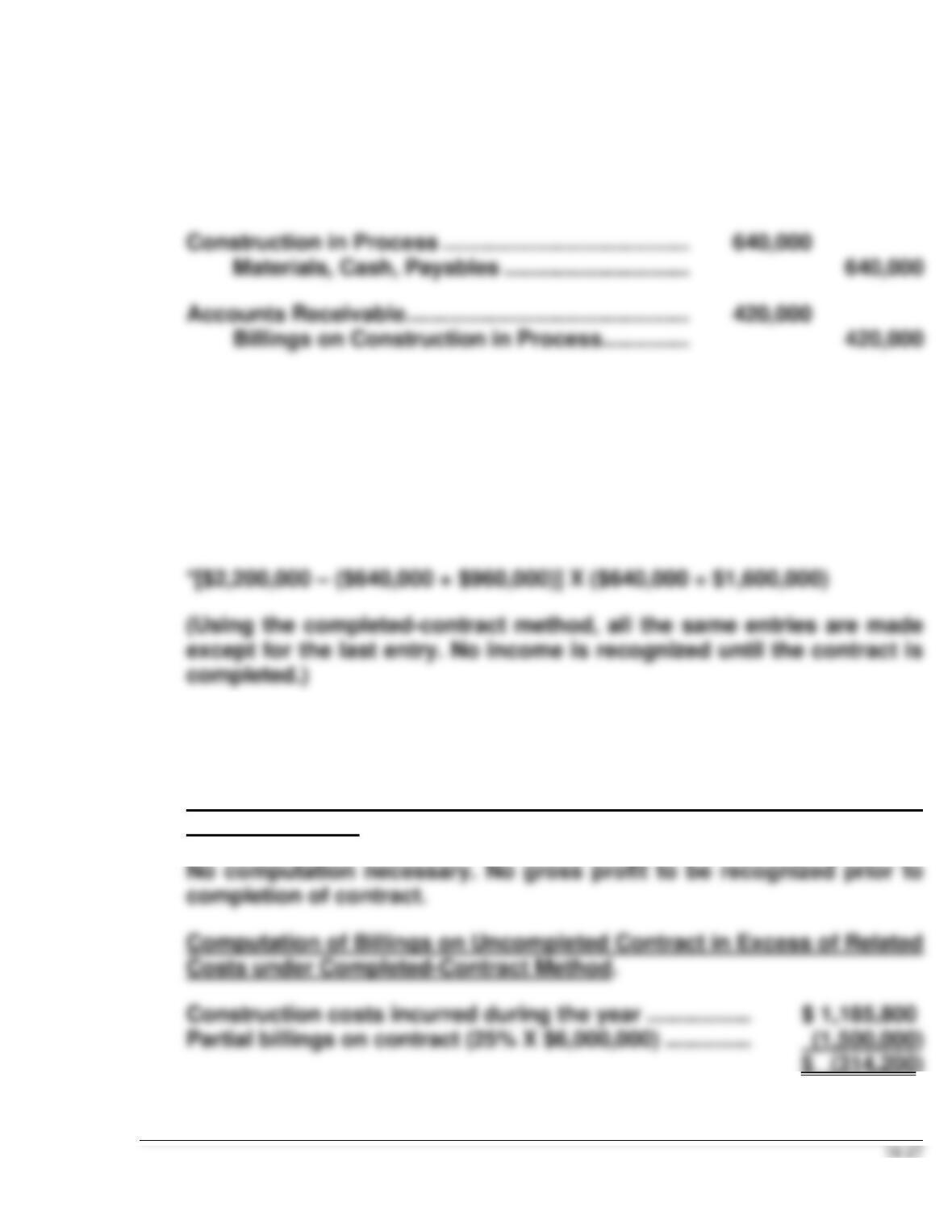
(c) Using the percentage-of-completion method, the following entries
would be made:
Cash …………………………..………………………………….. 350,000
Accounts Receivable ……………………………….. 350,000
Construction in Process …………………………………. 240,000*
Construction Expenses …………………………………… 640,000
Revenue from Long-Term Contracts
[from (a)] ……………………………………………… 880,000
EXERCISE 18-17 (15–25 minutes)
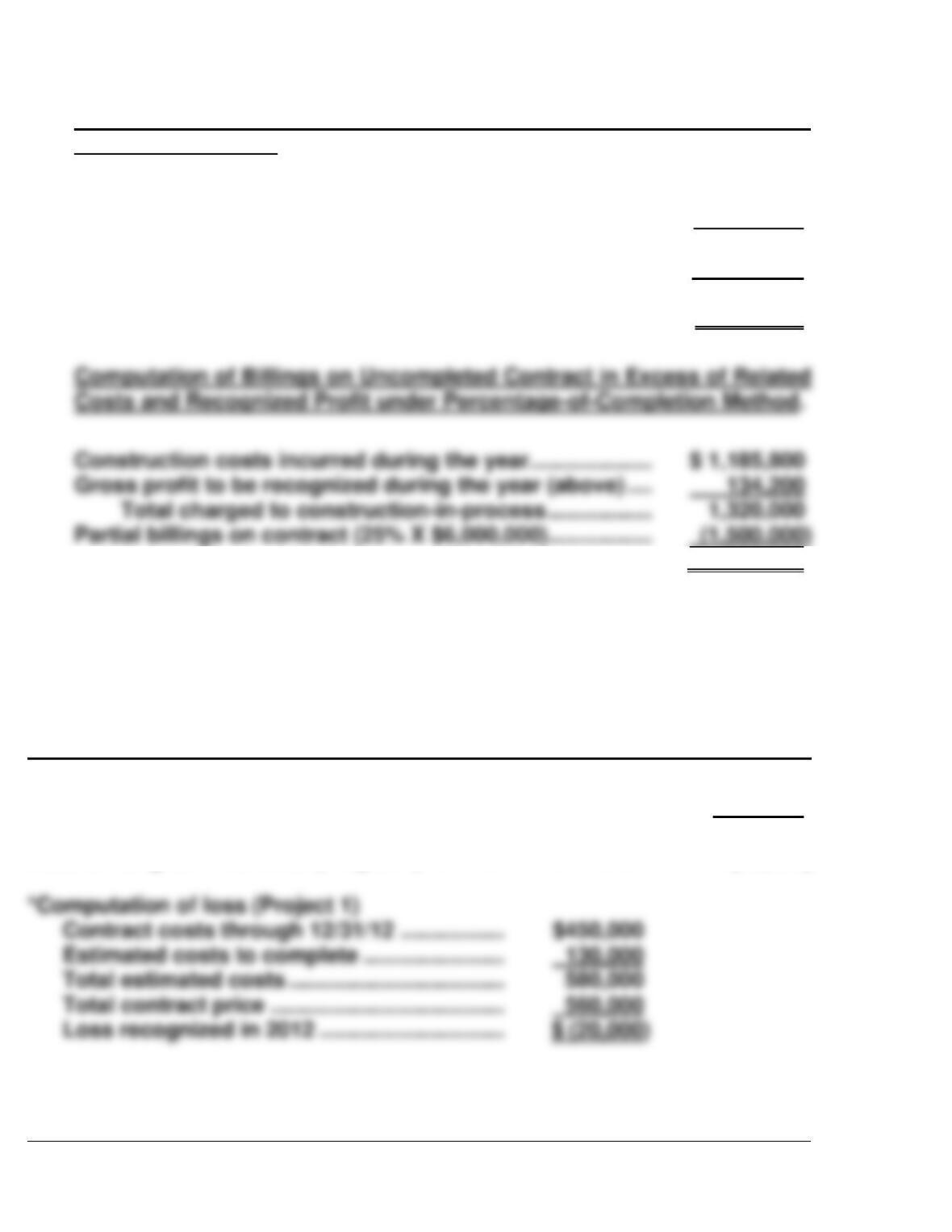
(a) Computation of Gross Profit to Be Recognized under Completed–
Contract Method.
18–28
EXERCISE 18-17 (Continued)
(b) Computation of Gross Profit to Be Recognized under Percentage-of–
Completion Method.
Total contract price ……………………………………………………. $6,000,000
Total estimated cost ($1,185,800 + $4,204,200) ……………. (5,390,000)
Estimated total gross profit from contract …………………… 610,000
Percentage-of-completion ($1,185,800/$5,390,000) ………. X 22%
Gross profit to be recognized during the year
($610,000 X 22%) …………………………………………………….. $ 134,200
$ (180,000)
EXERCISE 18-18 (15–25 minutes)
BERSTLER CONSTRUCTION COMPANY
Partial Income Statement
Year Ended December 31, 2012
Revenue from long-term contracts (Project 3) ……………………. $520,000
Costs of construction (Project 3) ………………………………………. 330,000
Gross profit ……………………………………………………………………… 190,000
Loss on long-term contract (Project 1)* ……………………………… (20,000)
EXERCISE 18-18 (Continued)
BERSTLER CONSTRUCTION COMPANY
Partial Balance Sheet
December 31, 2012
Current assets:
Accounts receivable ($1,080,000 – $990,000) …. $90,000
Inventories
EXERCISE 18-19 (15–20 minutes)
(a) Computation of gross profit recognized:
2012
2013
$370,000 X 34%*
$125,800
$350,000 X 34%*
$119,000
$450,000 X 32%**
144,000
$125,800
$263,000
18–30
EXERCISE 18-19 (Continued)
Cash ………………………………………………………………. 800,000
Installment Accounts Receivable (2012) ………. 350,000
Installment Accounts Receivable (2013) ………. 450,000
EXERCISE 18-20 (15–20 minutes)
(a) Deferred Gross Profit (2012) ……………………………. 2,800*
Deferred Gross Profit (2013) ……………………………. 12,800**
Deferred Gross Profit (2014) ……………………………. 69,400***
Realized Gross Profit ……………………………….. 85,000
(To recognize gross profit on installment sales)
Adjustment ………………………………………………………. $ 2,800
**Adjustment for deferred gross profit—2013:
Balance in deferred gross profit account
prior to adjustment ………………………………………………. $26,000
Balance after adjustment ($40,000 X 33%) …………………. (13,200)
Adjustment ………………………………………………………. $12,800
EXERCISE 18-20 (Continued)
(b) Cash collected in 2014 on accounts receivable of 2012:
$2,800/35% = $8,000.
EXERCISE 18-21 (15–20 minutes)
Gross Profit Rate—2012: ($750,000 – $510,000) ÷ $750,000 = 32%
Gross Profit Rate—2013: ($840,000 – $588,000) ÷ $840,000 = 30%
(a) Balance, December 31, 2012:
Deferred Gross Profit Account—2012 Installment Sales
Gross profit on installment sales—2012
($750,000 – $510,000) ………………………………………………… $240,000
Less: Gross profit realized in 2012 ($310,000 X 32%) ……… 99,200
Balance at 12/31/12 ……………………………………………… $140,800
EXERCISE 18-21 (Continued)
(b) Repossessed Merchandise ……………………………….. 8,000
Deferred Gross Profit ($12,000 X 32%) ……………….. 3,840
EXERCISE 18-22 (10–15 minutes)
BECKER CORPORATION
Income before Income Taxes on Installment-Sale Contract
For the Year Ended December 31, 2012
Sales …………………………………………………………………………………… $586,842
Schedule 1
Computation of Interest Revenue on Installment-Sale Contract
Cash selling price ………………………………………………………………… $586,842
Deduct payment made July 1, 2012 ………………………………………. 100,000
EXERCISE 18-23 (10–15 minutes)
(a) Realized gross profit recognized in 2013 under the installment-sales
method of accounting is $83,000. When gross profit is expressed as a
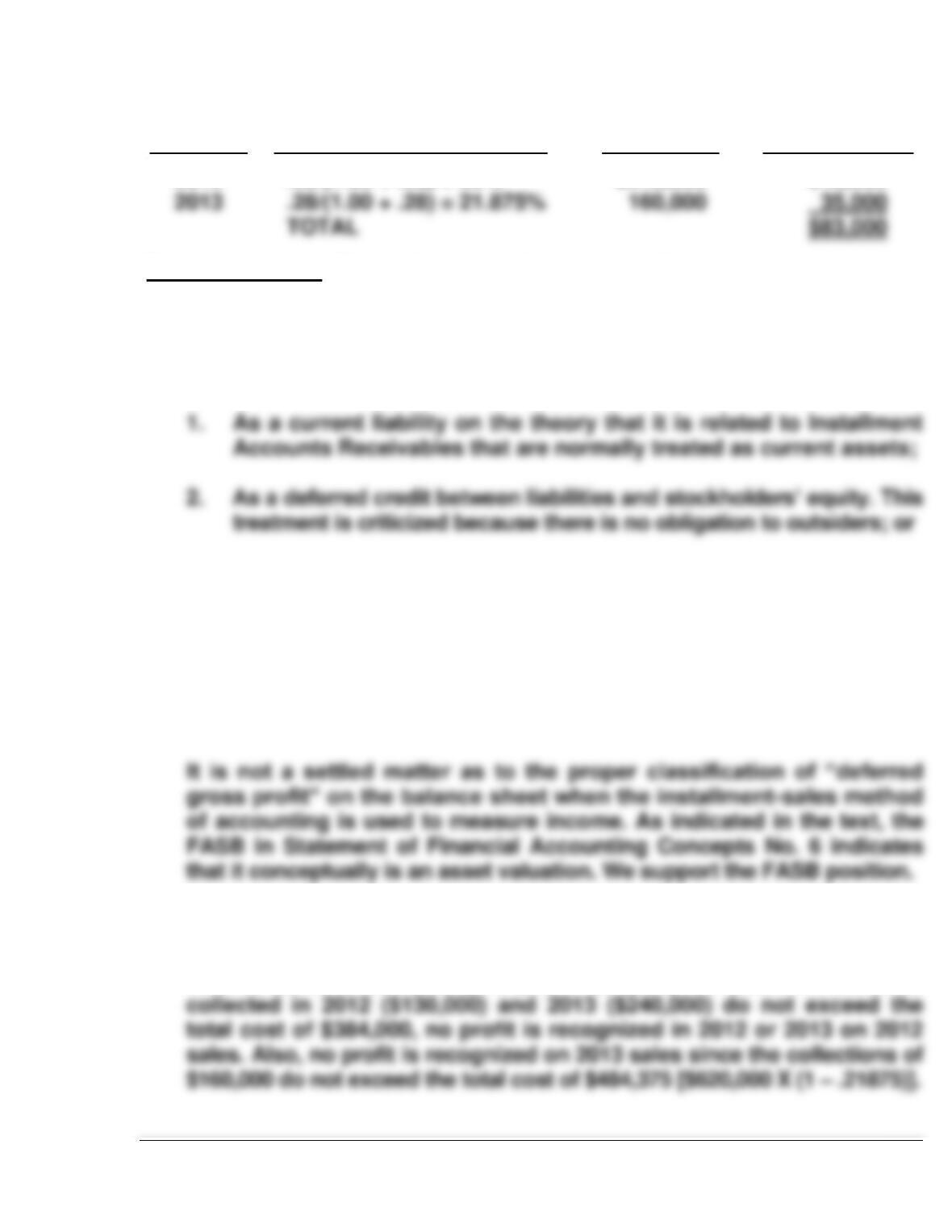
18–33
EXERCISE 18-23 (Continued)
Sale Year
Gross Profit Percentage
2013
Collections
2013
Realized Profit
2012
.25/(1.00 + .25) = 20%
$240,000
$48,000
(Note to instructor: The problem provides gross profit as a percent of cost.)
(b) The balance of “Deferred Gross Profit” could be reported on the balance
sheet for 2013:
3. As an adjustment or offset to the related Installment Accounts
Receivable. This is because the deferred gross profit is a part of reve–
nue from installment sales not yet realized. The related receivable
will be overstated unless the deferred gross profit is deducted.
On the other hand, the amount of deferred gross profit has no
direct relationship with the estimated collectibility of the accounts
receivable.
(c) Gross profit as a percent of sales in 2012 is 20% (as computed in (a)
above); gross profit therefore is $96,000 ($480,000 X .20) and the cost
of 2012 sales is $384,000 ($480,000 – $96,000). Because the amounts
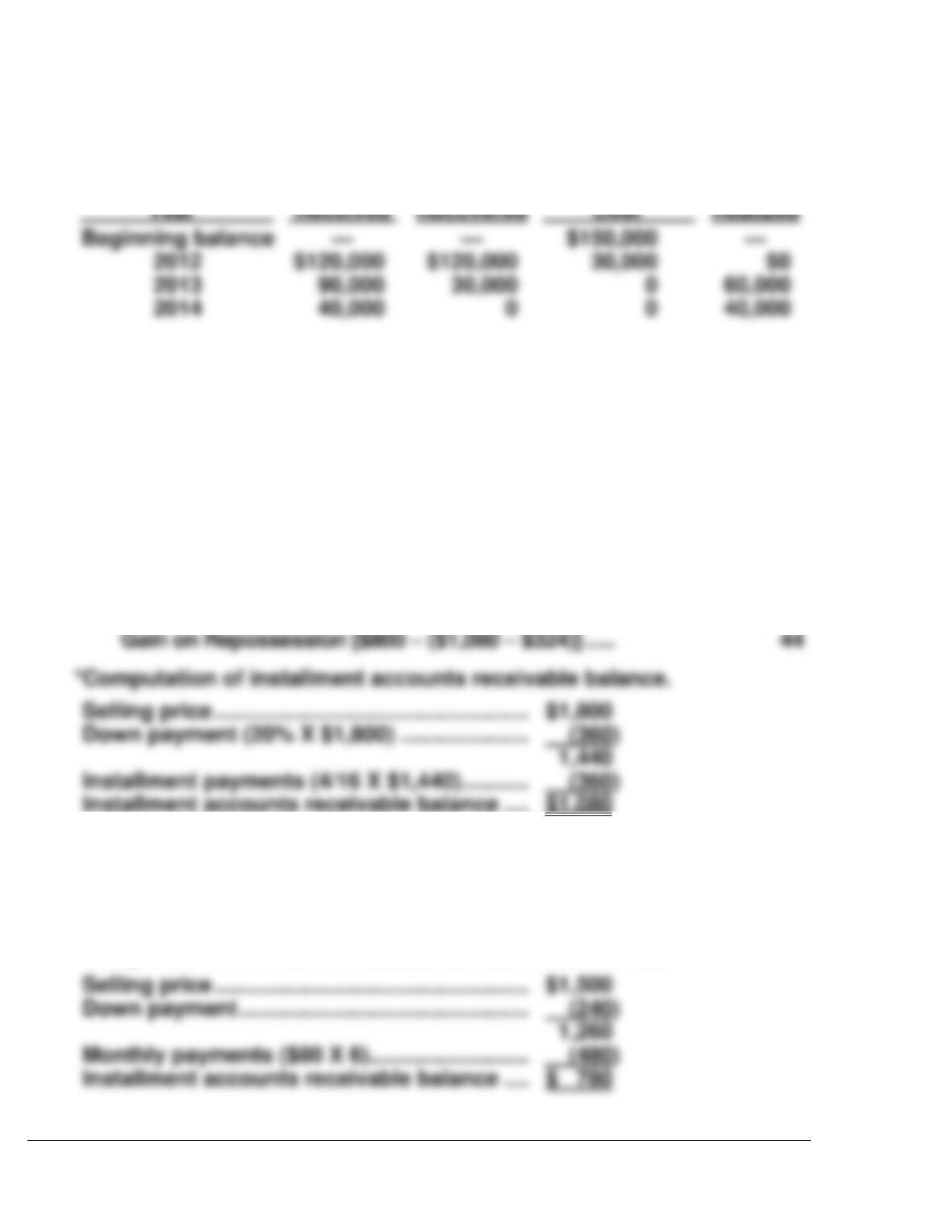
18–34
EXERCISE 18-24 (15–20 minutes)
(a) Computation of gross profit realized—cost-recovery method:
Cash
Original
Cost
Balance of
Unrecovered
Gross
Profit
(b) Computation of gross profit realized—installment-sales method:
Gross profit rate: ($250,000 – $150,000) ÷ $250,000 = 40%
2012 Gross profit realized: $120,000 X 40% = $48,000
2013 Gross profit realized: $ 90,000 X 40% = $36,000
2014 Gross profit realized: $ 40,000 X 40% = $16,000
EXERCISE 18-25 (10–15 minutes)
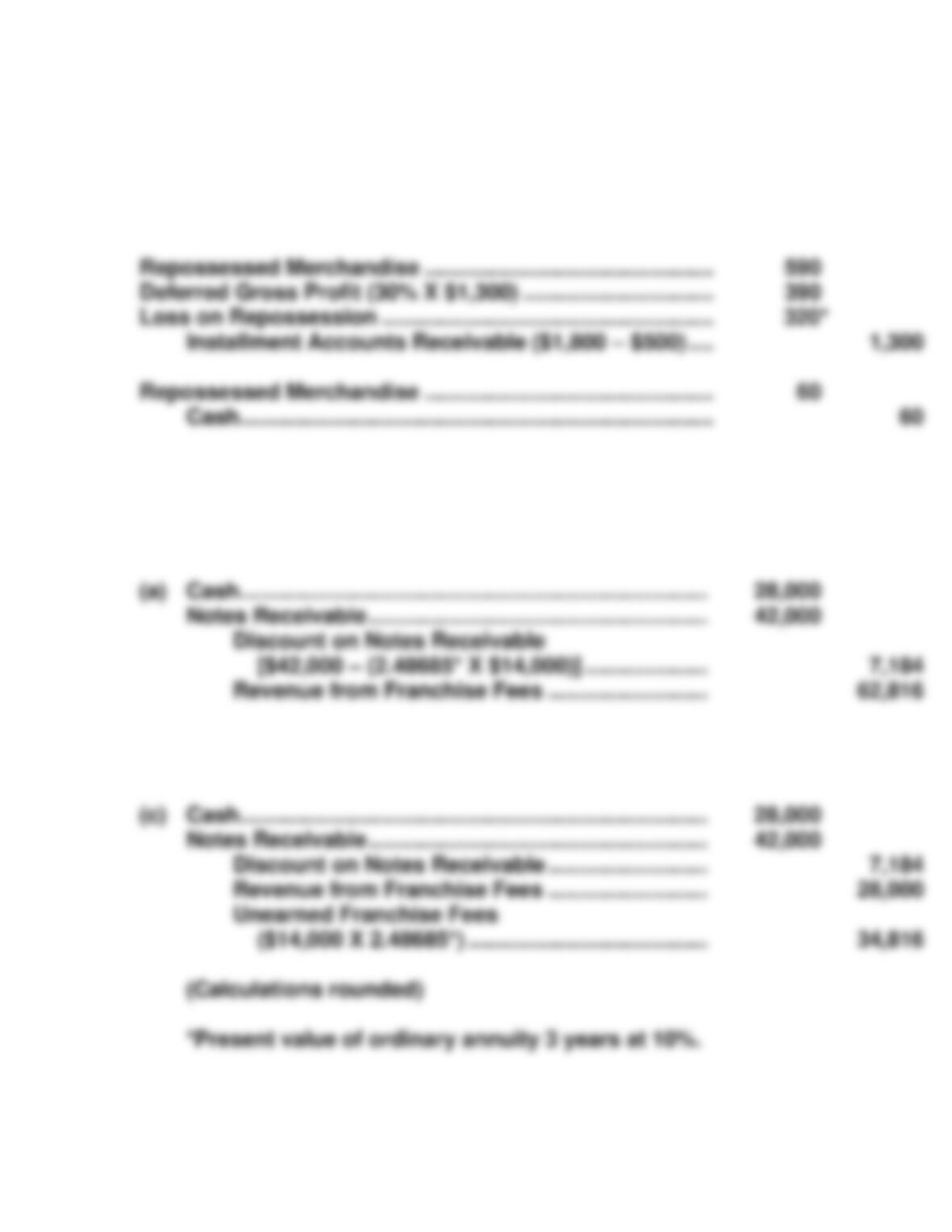
1. Repossessed Merchandise …………………………………… 800
Deferred Gross Profit (30% X $1,080*)……………………. 324
Installment Accounts Receivable ……………………. 1,080*
2. Repossessed Merchandise …………………………………… 750
Deferred Gross Profit (20% X $780*) ……………………… 156
Installment Accounts Receivable ……………………. 780*
Gain on Repossession [$750 – ($780 – $156)] …….. 126
*Computation of installment accounts receivable balance.
18–35
EXERCISE 18-26 (15–20 minutes)
Cash ………………………………………………………………………… 500
Installment Accounts Receivable ………………………… 500
Deferred Gross Profit (30% X $500) ……………………………. 150
Realized Gross Profit …………………………………………. 150
*[$590 – ($1,300 – $390)]
*EXERCISE 18-27 (14–18 minutes)
(b) Cash …………………………..…………………………………….. 28,000
Unearned Franchise Fees ……………………………. 28,000
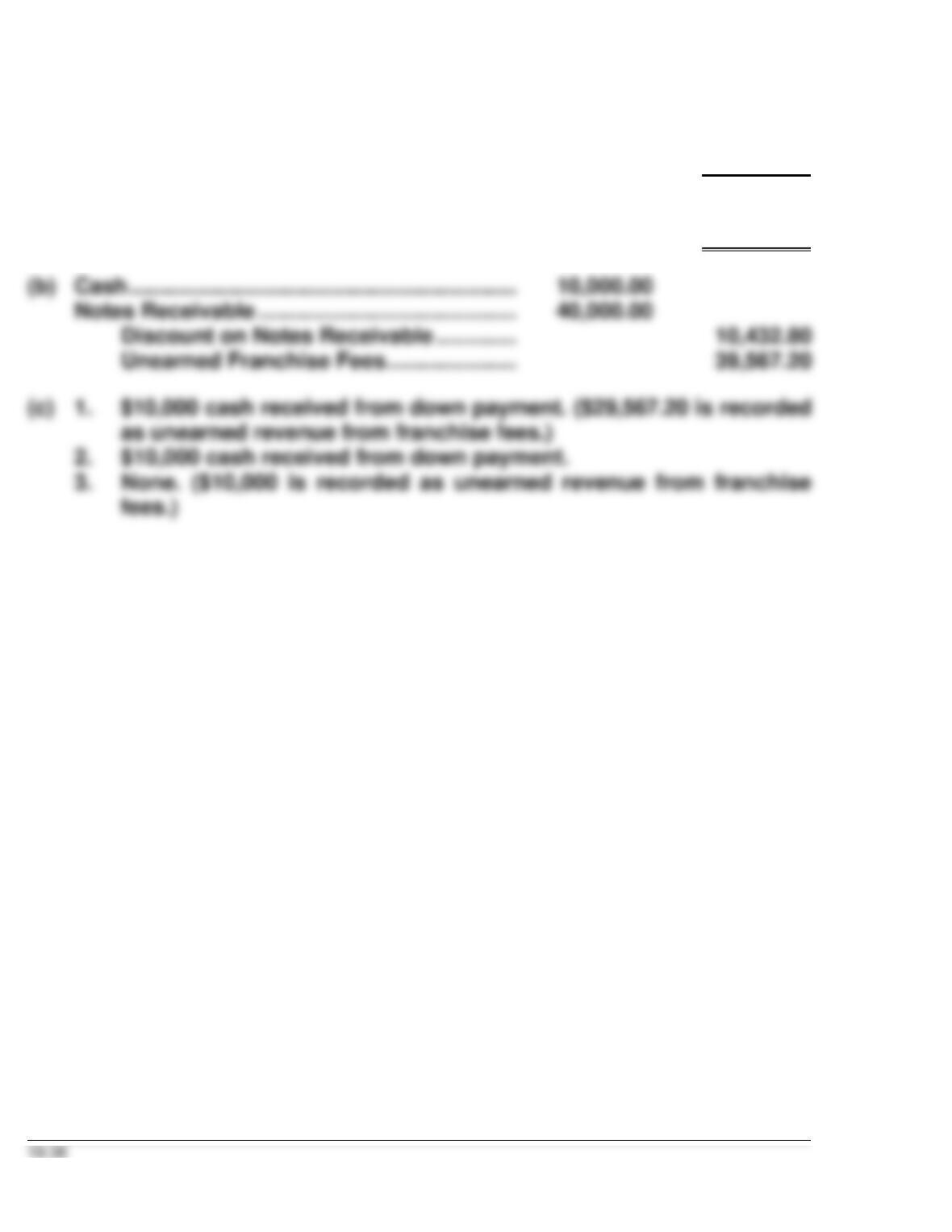
*EXERCISE 18-28 (12–16 minutes)
(a) Down payment made on 1/1/12 ……………….. $10,000.00
Present value of an ordinary annuity
($8,000 X 3.69590) ……………………………….. 29,567.20
Total revenue recorded by Campbell and
total acquisition cost recorded by
Lesley Benjamin ………………………………….. $39,567.20
18–37
TIME AND PURPOSE OF PROBLEMS
Problem 18-1 (Time 30–45 minutes)
Purpose—the student defines and describes the point of sale, completion of production, percentage-of–
completion, and installment-sales methods of revenue recognition. Then the student computes revenue
to be recognized in situations using a percentage-of-completion method, when the right of return exists,
and using the point of sale method.
Problem 18-2 (Time 20–25 minutes)
Purpose—to provide the student with an understanding of both the percentage-of-completion and
completed-contract methods of accounting for long-term construction contracts. The student is required
to compute the estimated gross profit that would be recognized during each year of the construction
period under each of the two methods.
Problem 18-3 (Time 25–35 minutes)
Purpose—to provide the student with an understanding of the percentage-of-completion method of
accounting for long-term construction contracts. The student is required to compute the estimated gross
profit during the three–year period using the percentage–of–completion method, and to prepare the
necessary journal entries to record the events which occurred during the last year.
Problem 18-4 (Time 20–30 minutes)
Purpose—to provide the student with an understanding of both the accounting procedures involved
under the percentage–of-completion method and the respective balance sheet presentation for long-
term construction contracts. The student is required to compute the estimated gross profit realized
during the construction periods, plus prepare a partial balance sheet showing the balances in the
receivable and inventory accounts.
Problem 18-5 (Time 25–30 minutes)
Purpose—to provide the student with a multiple-year long-term project problem (with an interim loss)
applying the percentage-of-completion method. The student is also required to prepare the income
statement and balance sheet presentations for this uncompleted project.
Problem 18-6 (Time 20–25 minutes)
Purpose—to provide the student with a long-term construction contract problem that requires the
recognition of a loss during an interim year on a contract that is profitable overall. This problem requires
application of both the percentage-of-completion method and the completed-contract method to an
interim loss situation.
Problem 18-7 (Time 20–25 minutes)
Purpose—to provide the student with a long-term construction contract problem that requires the
recognition of a loss during an interim year on an unprofitable contract overall. This problem requires
application of both the percentage-of-completion method and the completed-contract method to this
unprofitable contract.
Problem 18-8 (Time 25–30 minutes)
Purpose—to provide the student with an understanding of the proper accounting under the installment-
sales method. The student is required to compute the realized gross profit for each of the years, plus
prepare the necessary journal entries to record the transactions applying the installment-sales method
of accounting.
Problem 18-9 (Time 30–35 minutes)
Purpose—to provide the student with an understanding of the installment-sales method of accounting
for sales transactions. The student is required to determine the net income for each of three years,
utilizing the installment-sales method.
Time and Purpose of Problems (Continued)
Problem 18-10 (Time 30–40 minutes)
Purpose—to provide the student with an understanding of the applications of the installment-sales
method of accounting for sales transactions. The student is required to analyze the trial balance and
accompanying information of a company, and to compute the rate of gross profit on the company’s
installment sales. The student is also asked to prepare both the closing entries under the installment-
sales method of accounting and an income statement for the year, including only the realized gross
profit in the statement.
Problem 18-11 (Time 20–25 minutes)
Purpose—to provide the student with an understanding of the proper accounting on the installment-sales
basis. The student is required to prepare the respective journal entries to reflect the sales transactions,
including the entry to record the gross profit realized during the year.
Problem 18-12 (Time 40–50 minutes)
Purpose—to provide the student with an understanding of the applications of the installment-sales
method of accounting. The student is required to analyze the company’s trial balance and accom–
panying information, and to prepare the adjusting and closing entries for the year. The student is also
asked to prepare an income statement for the year, including only the realized gross profit in the
statement.
Problem 18-13 (Time 20–25 minutes)
Purpose—to provide the student with an understanding of the proper entries under the installment-
sales method of accounting. The student is required to prepare the necessary journal entries to reflect
the respective sales transactions, including that of a merchandise repossession.
Problem 18-14 (Time 50–60 minutes)
Purpose—to provide the student with an understanding of the installment-sales method of accounting
for sales. The student is required to prepare schedules for the cost of goods sold on installments, the
gross profit percentage on the sales, the gain or loss on repossession, and the net income from
installment sales.
Problem 18-15 (Time 20–30 minutes)
Purpose—to provide the student with a problem requiring the computation of “cost of uncompleted
contract in excess of related billings” or “billings on uncompleted contract in excess of related costs”
and “profit or loss.” Each of these computations is required for each year of the three-year contract
applying the completed-contract method.
Problem 18-16 (Time 40–50 minutes)
Purpose—to provide the student with an understanding of how to write a letter comparing the percentage-
of-completion method to the completed-contract method.
Problem 18-17 (Time 50–60 minutes)
Purpose—to provide the student with an understanding of how to compute gross profit on five different
long-term contracts (using both percentage-of-completion and completed contract methods). In addition,
partial balance sheet and income statement data must be prepared.
18–39
SOLUTIONS TO PROBLEMS
PROBLEM 18-1
(a) 1. The point of sale method recognizes revenue when the earnings
2. The completion–of-production method recognizes revenue only when
the project is complete and the contract is completed. This is used
primarily with short-term contracts, or with long-term contracts when
3. The percentage-of-completion method of revenue recognition is
used on long-term projects, usually construction. To apply it, the
following conditions must exist:
(i) A firm contract price with a high probability of collection.
(ii) A reasonably accurate estimate of costs (and, therefore, of
gross profit).
PROBLEM 18-1 (Continued)
recognized to that date. That total less the income that was recog–
4. The installment-sales method may be applicable when the sales
price is received over an extended period of time. The installment–
sales method recognizes revenue as the cash is collected and is used
when the collection of the sales price is not reasonably assured.
be used in special circumstances when collectibility is very unsure.
(b) Depp Construction
A change of cost estimates calls for a revision of revenue and
profit to be recognized in the period in which the change was
made (in this case, the first period).
Contract price ………………………………… $30,000,000
Costs: Actual costs to 11/30/12 ……….. $ 7,200,000
Estimated costs to complete … 16,800,000