CHAPTER 18
LEARNING OBJECTIVES
1. DISCUSS THE DIFFERENCE BETWEEN TRADITIONAL
COSTING AND ACTIVITY-BASED COSTING.
2. APPLY ACTIVITY-BASED COSTING TO A
MANUFACTURER.
CHAPTER REVIEW
Traditional Costing And Activity-Based Costing
1. (L.O. 1) Often the most difficult part of computing accurate unit costs is determining the proper
2. Activity-based costing (ABC) allocates overhead to multiple activity cost pools and assigns the
activity cost pools to products and services by means of cost drivers. In ABC, an activity is any
3. ABC allocates overhead in a two-stage process: In the first stage, overhead costs are allocated to
activity cost pools, rather than to departments or jobs. Each is a distinct type of activity. In the
4. Activity-based costing involves the following four steps:
a. Identify and classify the activities involved in the manufacture of specific products and assign
overhead to cost pools.
Unit Costs Under ABC
5. (L.O. 2) A well designed activity-based costing system starts with an analysis of the activities
6. After costs are allocated to the activity cost pools, the cost drivers for each cost pool must be
identified. The cost driver must accurately measure the actual consumption of the activity by the
various products. To achieve accurate costing, a high degree of correlation must exist between
the cost driver and the actual consumption of the overhead costs in the cost pool.
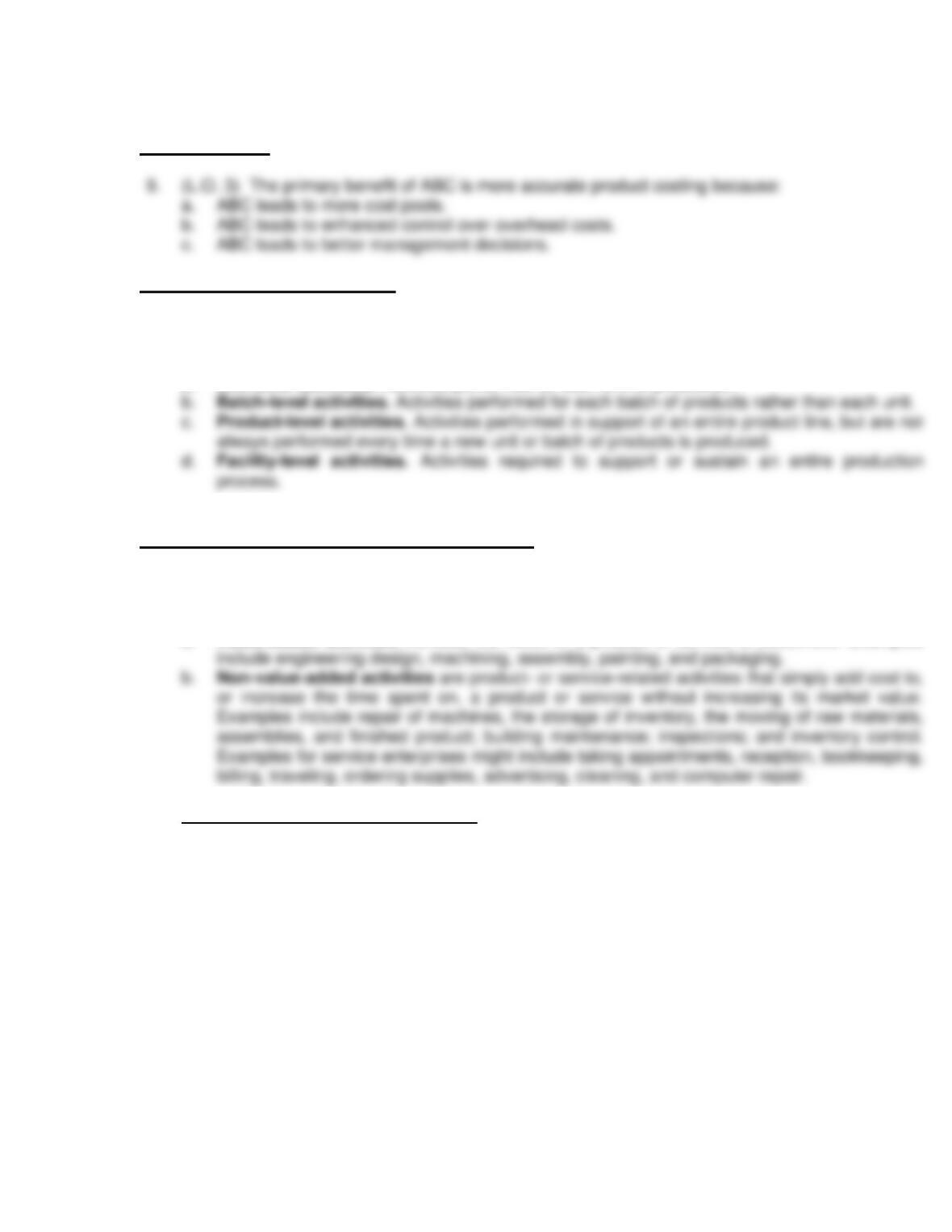
8. In assigning overhead costs, it is necessary to know the expected use of cost drivers for each
product. To assign overhead costs to each product, the activity-based overhead rates are
multiplied by the number of cost drivers expected to be used per product.
Benefits of ABC
Classification of Activity Levels
10. The recognition that some activity costs are not driven by unit-based cost drivers has led to the
development of a classification of ABC activities consisting of four levels. The four levels are
classified and defined as follows:
a. Unit-level activities. Activities performed for each unit of production.
Value-Added Versus Non-Value-Added Activities
11. In developing an ABC system, managers increase their awareness of the activities performed by
the company in its production and supporting processes. This helps managers classify activities
as value-added or non-value-added.
a. Value-added activities increase the worth of a product or service to customers. Examples
12. Activity-based management (ABM) extends the use of ABC from product costing to a
comprehensive management tool that focuses on reducing costs and improving processes and
decision making. The purpose of ABM is to reduce or eliminate the time and cost devoted to non–
value-added activities.
Limitations of ABC and When to Use ABC
13. Although ABC systems often provide better product cost data than traditional volume-based
14. The presence of one or more of the following factors would point to possibly using ABC:
a. Product lines differ greatly in volume and manufacturing complexity.
Activity-Based Costing in Service Industries
15. (L.O. 4) The general approach to identifying activities, activity cost pools, and cost drivers is the
Just–In-Time Processing
*17. (L.O. 5) Just-in-time (JIT) manufacturing is dedicated to having the right amount of materials,
products, or parts at the time they are needed. Under JIT processing, raw materials are received
just in time for use in production, subassembly parts are completed just in time for use in finished
goods, and finished goods are completed just in time to be sold.
*20. The major benefits of implementing JIT processing are:
a. Manufacturing inventories are significantly reduced or eliminated.
LECTURE OUTLINE
A. Traditional Costing Systems
1. A traditional costing system allocates overhead to products on the basis
of predetermined plantwide or departmentwide volume of unit-based
output rates such as direct labor or machine hours.
B. Activity-Based Costing
1. Activity-based costing (ABC) allocates overhead to multiple activity cost
pools and then assigns the activity cost pools to products and services
by means of cost drivers.
C. Unit Costs Under ABC.
1. Activity-based costing involves the following steps:
a. Identify and classify the activities involved in the manufacture of
specific products, and assign manufacturing overhead costs to the
appropriate cost pools.
2. A well designed activity-based costing system starts with an analysis of
the activities performed to manufacture a product or provide a service.
D. Identify Cost Drivers, Compute Overhead Rates, and Assign Overhead
Costs to Products.
1. After costs are allocated to the activity cost pools, the company must
identify the cost drivers for each cost pool.
4. In assigning overhead costs, it is necessary to know the expected use of
cost drivers for each product.
SERVICE COMPANY INSIGHT
Have you flown since airline baggage fees have been implemented? Baggage
handling is extremely labor intensive. The tagging, sorting, loading on carts,
loading in planes, unloading, etc., adds up to about $9/bag. Then there’s equip–
ment costs and storage facilities ($4/bag) and $2 fuel cost.
Why do airlines charge even higher rates for heavier bags, bags that are odd
shapes, and bags with hazardous materials in them?
E. Benefits of ABC.
1. The primary benefit of ABC is more accurate product costing because
a. ABC leads to more cost pools being used to assign overhead costs
to products; therefore, costs are assigned more directly based on
cost drivers
F. Classification of Activity Levels.
1. A classification of ABC activities consisting of four levels are defined as
a. Unit-level activities: activities performed for each unit of production.
2. Companies may achieve greater accuracy in overhead cost allocation by
recognizing the different levels of activities and developing specific
activity cost pools and their related cost drivers.
MANAGEMENT INSIGHT
Production line technicians from General Mills flew to North Carolina to observe
first-hand how race-car pit crews operate. In a NASCAR race the value-added
activity is driving toward the finish-line. General Mills technicians were able to
reduce setup time from 5 hours to just 20 minutes from what they learned at the
car race.
What are the benefits of reducing setup time?
G. Value-Added Versus Non-Value-Added Activities.
1. In developing an ABC System, managers increase their awareness of
the activities performed by the company in its production and supporting
processes. This helps managers classify activities as value-added or
non-value-added.
H. The Limitations and When to Use ABC.
1. The limitations of ABC are:
a. ABC can be expensive to use; identifying multiple activities and
applying numerous cost drivers results in increased costs.
2. The presence of one or more of the following factors would point to
ABC’s possible use.
a. Product lines differ greatly in volume and manufacturing complexity.
I. Activity-Based Costing in Service Industries.
1. The overall objective of ABC in service firms is no different than it is for a
manufacturing company: The objective is to identify the key activities
that generate costs and to keep track of how many activities are
performed for each service provided.
SERVICE COMPANY INSIGHT
Surveys show that approximately 50% of companies actually use ABC. At the
same time, a world-wide survey of almost 350 companies showed that 87% of
respondents said that their ideal costing system would include some form of
ABC. What are some of the reasons that explain why so many companies say
that ideally they would use ABC, but haven’t yet adopted it?
*J. Just-in-Time Processing.
1. Traditionally, continuous process manufacturing has been based on a
just-in-case philosophy: inventories of raw materials are maintained just
in case some items are of poor quality or a key supplier is shut down by
a strike. This philosophy results in a “push approach”, in which raw
materials are pushed through each process and often results in the
buildup of extensive manufacturing inventories.
4. JIT processing consists of three important elements:
a. Suppliers must be dependable and willing to deliver on short notice
exact quantities of materials, and to specified work stations. Online
computer linkage between the company and its suppliers facilitates
this arrangement.
5. The major benefits of JIT processing include:
a. Significant reduction or elimination of manufacturing inventories.

20 MINUTE QUIZ
Circle the correct answer.
True/False
1. Even in today’s automated environment, direct labor is sometimes the appropriate basis
for assigning overhead cost to products.
True False
2. In the first stage of activity-based costing, overhead is assigned to products using cost
drivers.
True False
3. The first step in activity-based costing is to identify and classify the major activities
involved in the manufacture of specific products, and allocate manufacturing overhead to
the appropriate cost pools.
True False
4. Before costs are allocated to the cost pools, the cost drivers for each cost pool must be
identified.
True False
5. Under ABC, overhead costs are shifted from the high-volume product to the low-volume
product.
True False
6. Activity-based costing does not change the amount of overhead costs, but it does
allocate those costs in a more accurate manner.
True False
7. Overhead costs are not allocated by means of arbitrary volume-based cost drivers under
ABC.
True False
8. Value-added activities increase the worth of a product or service to customers and
involve resource usage that customers are willing to pay for.
True False
9. Product-level activities in ABC are required to support or sustain an entire production
process.
True False
*10. Just-in–time processing strives to eliminate inventories by using a “pull approach” in
manufacturing.
True False
Multiple Choice
1. The last step in activity-based costing is to
a. identify the major activities involved in the manufacture of specific products.
b. compute the overhead rate per cost driver.
c. identify the cost driver that has a strong correlation to the costs accumulated in the
cost pool.
d. assign manufacturing overhead costs for each cost pool to products.
2. Machine hours would be an accurate cost driver for
a. assembly costs.
b. inspecting costs.
c. machining costs.
d. machine setup costs.
3. All of the following are benefits of ABC except it leads to
a. elimination of all arbitrary cost allocations.
b. more accurate cost data.
c. enhanced control over overhead costs.
d. better management decisions.
4. The level of ABC activities performed in support of an entire product line are classified as
a. batch-level activities.
b. facility-level activities.
c. product-level activities.
d. unit-level activities.
*5. Just-in-time processing strives to eliminate inventories by using a
a. just in case approach.
b. pull approach.
c. push approach.
d. process approach.

ANSWERS TO QUIZ
True/False
Multiple Choice