18-1
CHAPTER 18
Revenue Recognition
ASSIGNMENT CLASSIFICATION TABLE (BY TOPIC)
Topics
Questions
Brief
Exercises
Exercises
Problems
Concepts
for Analysis
*1. Realization and recognition;
sales transactions; high
rates of return.
1, 2, 3, 4,
5, 6, 7, 8,
9, 10, 12,
13, 29
1, 2, 3,
4, 6
1, 2, 3, 4,
5, 6, 7, 8,
10, 11
1
1, 2, 3, 4,
5, 7, 8, 9
*4. Installment sales.
20, 21, 23,
24, 25, 26,
27, 28, 29
12, 13, 14
19, 20, 21,
22, 23, 24
1, 8, 9, 10,
11, 12, 14
1, 2, 3
*5. Repossessions on
installment sales.
13
21, 25, 26
10, 11, 12,
13, 14
*6. Cost-recovery method;
deposit method.
20, 21, 22,
30, 31
15
23, 24
8, 9
*7. Franchising.
32, 33,
34, 35
16
27, 28
10
11, 29
5
9
*3. Long-term contracts.
14, 15, 16,
17, 18,
19, 29
7, 8, 9,
10, 11
12, 13, 14,
15,16,
17, 18
1, 2, 3, 4, 5,
6, 7, 15, 16,
1, 2, 3, 6
18-2
ASSIGNMENT CLASSIFICATION TABLE (BY LEARNING OBJECTIVE)
Learning Objectives
Brief
Exercises
Exercises
Problems
3. Apply the percentage-of-completion
method for long-term contracts.
7, 8
12, 13, 14,
15, 16, 17
1, 2, 3, 4, 5,
6, 7, 16, 17
4. Apply the completed-contract method
for long-term contracts.
9, 10
12, 16,
17, 18
1, 2, 3, 5, 6, 7,
15, 16, 17
5. Identify the proper accounting for losses
on long-term contracts.
11
18
5, 6, 7, 15
6. Describe the installment-sales method
of accounting.
12, 13, 14
19, 20, 21, 22,
23, 24, 25, 26
1, 8, 9, 10, 11,
12, 13, 14
7. Explain the cost-recovery method
of accounting.
15
23, 24
27, 28
6, 7, 8, 9
2. Describe accounting issues for revenue
recognition at point of sale.
1, 2, 3, 4, 5, 6
1, 2, 3, 4, 5, 6,
7, 8, 9, 10, 11
1
18-3
ASSIGNMENT CHARACTERISTICS TABLE
Item
Description
Level of
Difficulty
Time
(minutes)
E18-1
Revenue recognition-point of sale.
Simple
5–10
E18-2
Revenue recognition-point of sale.
Simple
5–10
E18-3
Revenue recognition-point of sale.
Simple
5–10
E18-9
Consignment computations.
Simple
15–20
E18-10
Multiple-deliverable agreement.
Simple
10–15
E18-11
Multiple-deliverable agreement.
Simple
5–10
E18-12
Recognition of profit on long-term contracts.
Moderate
20–25
E18-13
Analysis of percentage-of–completion financial statements.
Moderate
10–15
E18-14
Gross profit on uncompleted contract.
Simple
10–12
E18-15
Recognition of profit, percentage-of-completion.
Moderate
25–30
E18-16
Recognition of revenue on long-term contract and entries.
Moderate
15–20
E18-17
Recognition of profit and balance sheet amounts for long-term
15–25
contracts.
E18-18
Long-term contract reporting.
Simple
15–25
E18-19
Installment-sales method calculations, entries.
Simple
15–20
E18-20
Analysis of installment-sales accounts.
Moderate
15–20
E18-21
Gross profit calculations and repossessed merchandise.
Moderate
15–20
E18-22
Interest revenue from installment sale.
Simple
10–15
E18-23
Installment-sales method and cost-recovery method.
Simple
10–15
E18-24
Installment-sales method and cost-recovery method.
Simple
15–20
Installment-sales—default and repossession.
Simple
10–15
Installment-sales—default and repossession.
Simple
15–20
*E18-27
Franchise entries.
Simple
14–18
*E18-28
Franchise fee, initial down payment.
Simple
12–16
P18-1
Comprehensive three-part revenue recognition.
Moderate
30–45
P18-2
Recognition of profit on long-term contract.
Simple
20–25
P18-3
Recognition of profit and entries on long-term contract.
Moderate
25–35
P18-4
Recognition of profit and balance sheet presentation,
percentage-of-completion.
Moderate
20–30
P18-5
Completed contract and percentage-of-completion
with interim loss.
Moderate
25–30
P18-6
Long-term contract with interim loss.
Moderate
20–25
P18-7
Long-term contract with an overall loss.
Moderate
20–25
P18-8
Installment-sales computations and entries.
Moderate
25–30
P18-9
Installment-sales income statements.
Moderate
30–35
E18-4
Revenue recognition-point of sale.
Simple
10–15
E18-5
Right of return.
Simple
5–10
E18-6
Revenue recognition on book sales with high returns.
Moderate
15–20
E18-7
Sales recorded both gross and net.
Simple
15–20
E18-8
Revenue recognition on marina sales with discounts.
Moderate
10–15
ASSIGNMENT CHARACTERISTICS TABLE (Continued)
Item
Description
Level of
Difficulty
Time
(minutes)
P18-10
Installment-sales computations and entries.
Complex
30–40
P18-11
Installment-sales entries.
Simple
20–25
P18-12
Installment-sales computations and entries—periodic
inventory.
Complex
40–50
P18-13
Installment repossession entries.
Moderate
20–25
P18-14
Installment-sales computations and schedules.
Complex
50–60
P18-15
Completed-contract method.
Moderate
20–30
P18-17
Comprehensive problem—long-term contracts.
Complex
50–60
CA18-1
Revenue recognition—alternative methods.
Moderate
20–30
CA18-2
Recognition of revenue—theory.
Moderate
35–45
CA18-3
Recognition of revenue—theory.
Moderate
25–30
CA18-4
Recognition of revenue—bonus dollars.
Moderate
30–35
CA18-5
Recognition of revenue from subscriptions.
Complex
35–45
CA18-6
Moderate
20–25
CA18-7
Revenue recognition—real estate development.
Moderate
30–40
CA18-8
Revenue recognition, ethics.
Moderate
25–30
CA18-9
Revenue recognition—membership fees, ethics.
Moderate
20–25
* CA18-10
Franchise revenue.
Moderate
35–45
18-5
SOLUTIONS TO CODIFICATION EXERCISES
CE18-1
Master Glossary
(a) Under the cost-recovery method, no profit is recognized until cash payments by the buyer,
including principal and interest on debt due to the seller and on existing debt assumed by the
buyer, exceed the seller’s cost of the property sold.
CE18-2
According to FASB ASC 605-10–25-3 (Revenue Recognition—Recognition):
Revenue should ordinarily be accounted for at the time a transaction is completed, with appropriate provi-
sion for uncollectible accounts. Revenue and gains generally are not recognized until being realized or
realizable and until earned. Accordingly, unless the circumstances are such that the collection of the sale
price is not reasonably assured, the installment-sales method of recognizing revenue is not acceptable.
CE18-3
According to FASB ASC 910-605–50-2 (Contractors—Revenue Recognition—Disclosure):

18-6
CE18-4
According to FASB ASC 605-10–25-4 (Revenue Recognition—Recognition):
There may be exceptional cases where receivables are collectible over an extended period of time and,
because of the terms of the transactions or other conditions, there is no reasonable basis for estimating
the degree of collectibility. When such circumstances exist, and as long as they exist, either the installment-
ANSWERS TO QUESTIONS
1. A series of highly publicized cases of companies recognizing revenue prematurely has caused
the SEC to increase its enforcement actions in this area. In some of these cases, significant
2. GAAP has numerous standards related to revenue recognition, but many believe the standards
are often inconsistent with one another.
3. The revenue recognition principle indicates that revenue is recognized when it is 1) realized or
realizable and 2) when it is earned.
4. Revenues are recognized generally as follows:
(a) Revenue from selling products—date of delivery to customers.
6. The three alternatives available to a seller that is exposed to risks of ownership due to a return of
the product are:
(1) Not recording the sale until all return privileges have expired.
(2) Recording the sale, but reducing sales by an estimate of future returns.
(3) Recording the sale and accounting for the returns as they occur in the future.
7. GAAP requires that such sales transactions not be recognized as current revenue unless all of
the following six conditions are met:
(1) The seller’s price to the buyer is substantially fixed or determinable at the date of sale.
8. Bill and hold sales result when the buyer is not yet ready to take delivery but the buyer takes title
and accepts billing. Revenue is recognized at the time title passes, provided (1) the risks of
ownership has passed;(2) the buyer makes a fixed commitment ot purchase the goods, requests
the transaction be on a buy and hold basis, and sets a fixed delivery date; and (3) goods must be
segregated, complete, and ready for shipment.
18-8
Questions Chapter 18 (Continued)
10. In a principal-agency relationship, amounts collected on behalf of the principal are not revenue of
the agent. The revenue for the agent is the amount of the commission it receives.
11. A sale on consignment is the shipment of merchandise from a manufacturer (or wholesaler) to
a dealer (or retailer) with title to the goods and the risk of sale being retained by the manufacturer
who becomes the consignor. The consignee (dealer) is expected to exercise due diligence in
12. A multiple deliverable arrangement provides multiple products or services to customers as part of
a single arrangement. The major accounting issue related to this type of arrangement is how to
allocate the revenue to the various products and services.
13. Once the separate units of a multiple deliverable arrangement are determined, the amount paid
14. The two basic methods of accounting for long-term construction contracts are: (1) the percentage-
of-completion method and (2) the completed-contract method.
The percentage-of-completion method is preferable when estimates of costs to complete and
extent of progress toward completion of long-term contracts are reasonably dependable. The
percentage-of-completion method should be used in circumstances when reasonably dependable
estimates can be made and:
15.
Costs Incurred
X Total Revenue = Revenue Recognized
Total Estimated Cost
$50 million
16. Under the percentage-of-completion method, income is reported to reflect more accurately the
production effort. Income is recognized periodically on the basis of the percentage of the job
completed rather than only when the entire job is completed. The principal disadvantage of the
Questions Chapter 18 (Continued)
17. The methods used to determine the extent of progress toward completion are the cost–to-cost
method and units-of-delivery method. Costs incurred and labor hours worked are examples of
input measures, while tons produced, stories of a building completed, and miles of highway
completed are examples of output measures.
18. The two types of losses that can become evident in accounting for long-term contracts are:
(1) A current period loss involved in a contract that, upon completion, is expected to produce
a profit.
(2) A loss related to an unprofitable contract.
19. The dollar amount of difference between the Construction in Process and the Billings on Con–
struction in Process accounts is reported in the balance sheet as a current asset if a debit and as
a current liability if a credit. When the balance in Construction in Process exceeds the billings,
this excess is reported as a current asset, “Costs and Recognized Profit in Excess of Billings.”
When the billings exceed the Construction in Process balance, the excess is reported as a
current liability, “Billings in Excess of Costs and Recognized Profit.”
20. Under the installment-sales method, income recognition is deferred until the period of cash
collection. At the end of each year, the appropriate gross profit rate is applied to the cash
21. The two methods generally employed to account for cash received when cash collection of the sales
price is not reasonably assured are: (1) the cost-recovery method and (2) the installment-sales method.
22. The deposit method postpones recognizing a sale by treating the cash received from a buyer as
a deposit. The deposit method is applied when the seller receives cash but has not performed
under the contract and has no claim against the purchaser.
Questions Chapter 18 (Continued)
23. An installment sale is a special type of credit arrangement which provides for payment in periodic
installments over a predetermined period of time and results from the sale of real estate,
24. Under the installment-sales method of accounting, emphasis is placed on collection rather than
sale. Because of the unique characteristics of installment sales, particularly the longer collection
period and higher risk of loss through bad debts, gross profit is considered to be realized in
25. In the application of the installment-sales method, most companies record operating expenses
without regard to the fact that some portion of the year’s gross profit is to be deferred revenue.
This is often justified on the basis that: (1) these expenses do not follow sales as closely as does
the cost of goods sold, and (2) accurate apportionment among periods would be so difficult as
not to be justified by the benefits gained.
26.
Year
Cash
Collected
X
*Gross Profit
Percentage
=
Gross Profit
Recognized
27. When interest is involved in installment sales, it should be separately accounted for as interest
revenue distinct from the gross profit recognized on the installment-sales collections during the
period. The amount of interest recognized each period is dependent upon the installment payment
schedule.
28. With respect to the income statement, the degree of detail to be reported frequently will vary,
depending upon the magnitude of installment-sales revenues in relation to total sales. If install-
ment sales are relatively insignificant in amount, they may be merged with regular sales with no
separate designation. In this case the realized gross profit on installment sales normally is reported
on the income statement as a separate item immediately below gross profit.
18–11
Questions Chapter 18 (Continued)
29. (a) Income (gross profit) on certain installment sales may be recognized on a basis of:
Gross Profit
X Collections.
30. Under the cost-recovery method, revenue is recognized (along with the relevant cost of goods sold)
in the period of the sale. However, the gross profit is deferred and is not recognized in the income
statement until cash payments received from the buyer exceed the cost of the merchandise sold.
In those periods in which the cash payments exceed the costs, the excess receipts (representing
gross profits deferred) are reported as a separate item of revenue.
*31. Under the deposit method, revenue is not recognized. The deposit method treats cash advances
and other payments received as refundable deposits. The sales transaction is not considered
*32. It is improper to recognize the entire franchise fee as revenue at the date of sale when many of
the services of the franchisor are yet to be performed and/or uncertainty exists regarding collection
of the entire fee.
*33. In a franchise sale, the franchisor may record initial franchise fees as revenue only when the
franchisor makes “substantial performance” of the services it is obligated to perform. Substantial
*34. Continuing franchise fees should be reported as revenue when they are earned and receivable
from the franchisee, unless a portion of them have been designated for a particular purpose. In

18–12
Questions Chapter 18 (Continued)
*35. (a) If it is likely that the franchisor will exercise an option to purchase the franchised outlet, the
initial franchise fee should not be recorded as a revenue but as a deferred credit. When
the option is exercised, the deferred amount would reduce the franchisor’s investment in
the outlet.
18–13
SOLUTIONS TO BRIEF EXERCISES
BRIEF EXERCISE 18-1
Accounts Receivable ……………………………………….. 103,400
Sales Revenue ($110,000 X 94%) ………………… 103,400
BRIEF EXERCISE 18-2
BRIEF EXERCISE 18-3
Cash ($70,000 X 6%) …………………………………………. 4,200
Sales Revenue ………………………………………….. 4,200
BRIEF EXERCISE 18-4
18–14
BRIEF EXERCISE 18-5
Cash ………………………………………………………………………. 18,850*
Advertising Expense ……………………………………………….. 500
Commission Expense ……………………………………………… 2,150
Revenue from Consignment Sales …………………….. 21,500
BRIEF EXERCISE 18-6
January ………………………………………………………………….. $ 0
February income ($4,000 – $3,000) X 50% …………………. $500
March income ($4,000 – $3,000 X 30%) ……………………… $300
April income ($4,000 – $3,000 X 20%) ……………………….. $200
BRIEF EXERCISE 18-7
Cash ………………………………………………………………. 960,000
Accounts Receivable ………………………………… 960,000
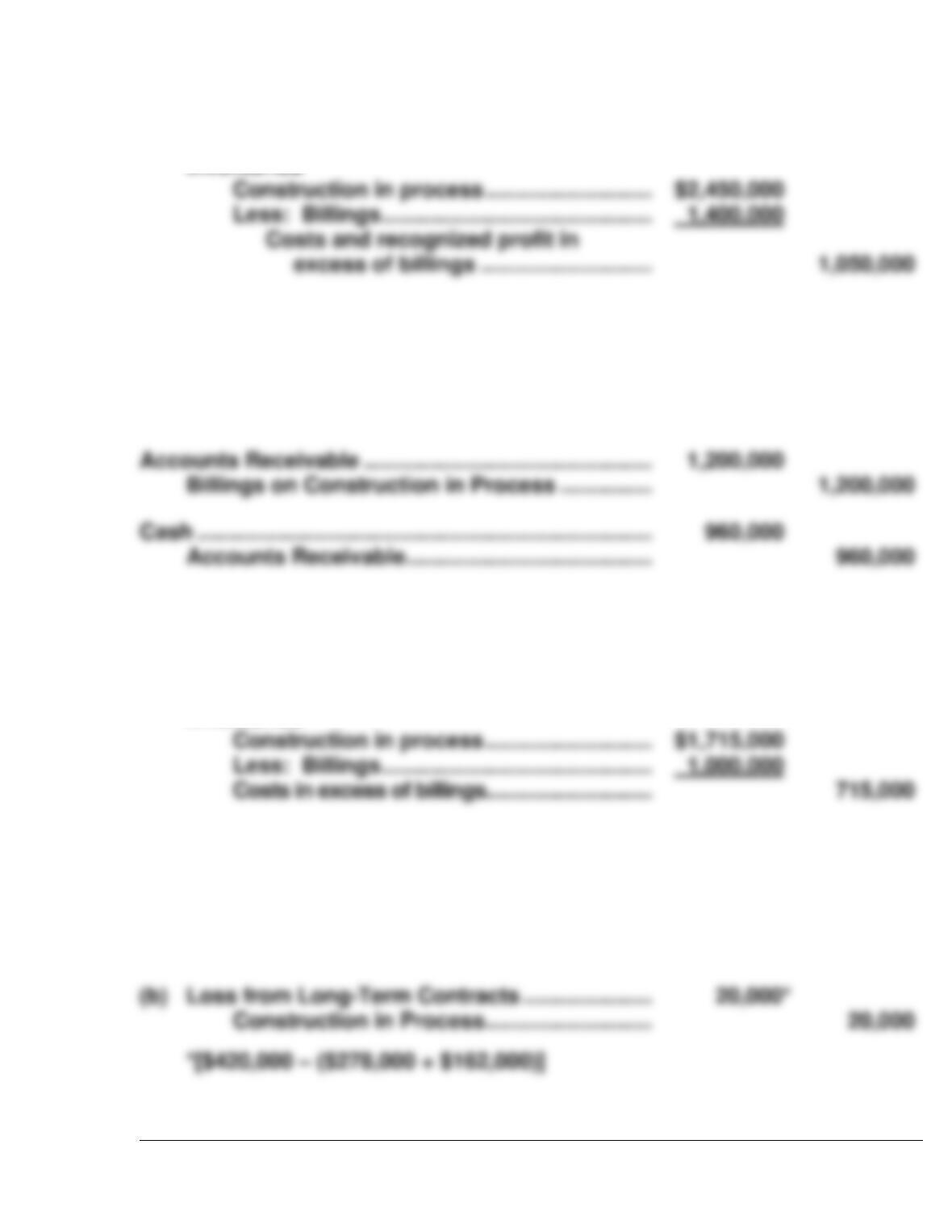
Construction in Process
[($1,700,000 ÷ 5,000,000) X $2,000,000] …………… 680,000
18–15
BRIEF EXERCISE 18-8
Current Assets
Accounts Receivable …………………………………. $ 240,000
Inventories
BRIEF EXERCISE 18-9
Construction in Process …………………………………… 1,700,000
Materials, Cash, Payables ………………………….. 1,700,000
BRIEF EXERCISE 18-10
Current Assets
Accounts Receivable …………………………………. $240,000
Inventories
BRIEF EXERCISE 18-11
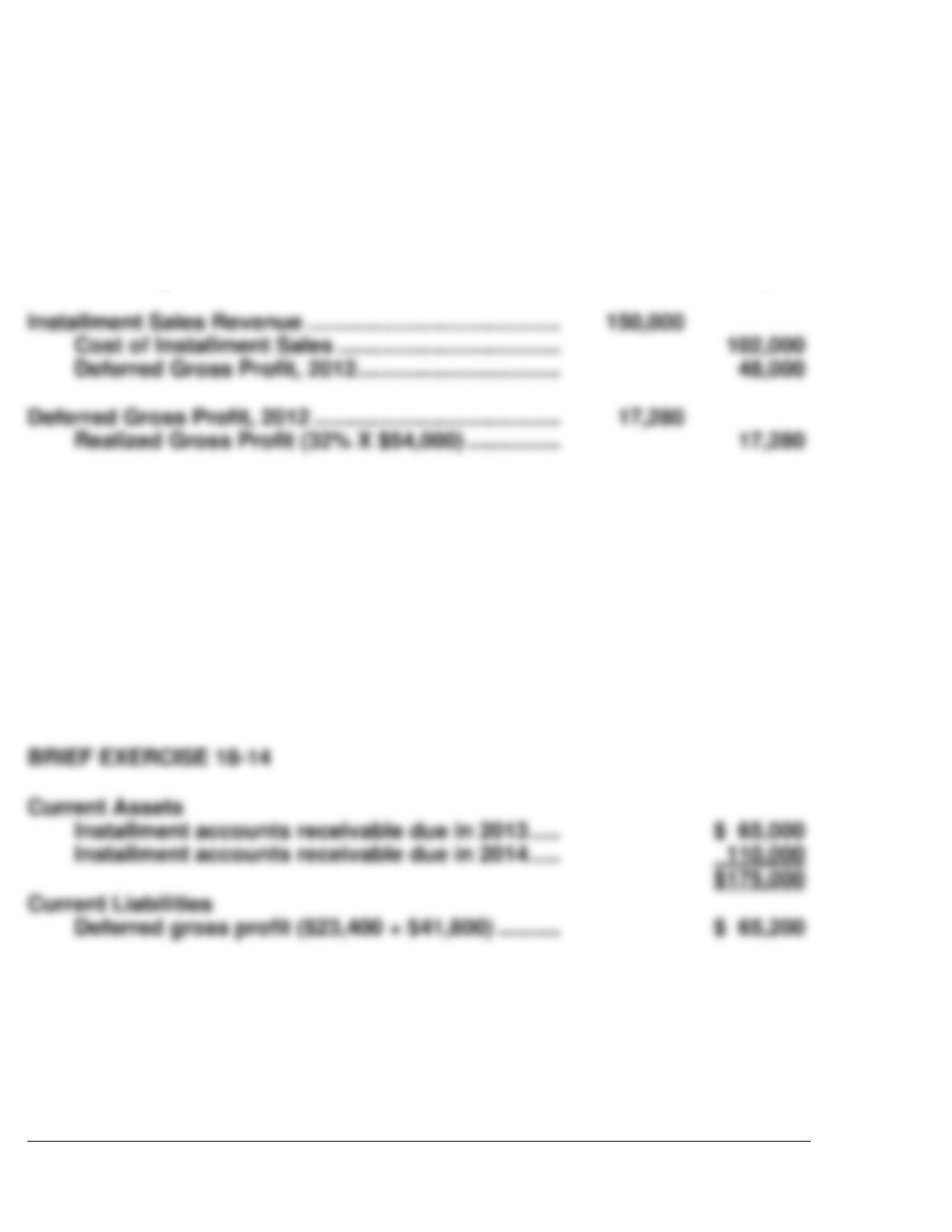
(a) Construction Expenses ……………………………… 278,000
Construction in Process ……………………… 20,000*
Revenue from Long-Term Contracts ……. 258,000
18–16
BRIEF EXERCISE 18-12
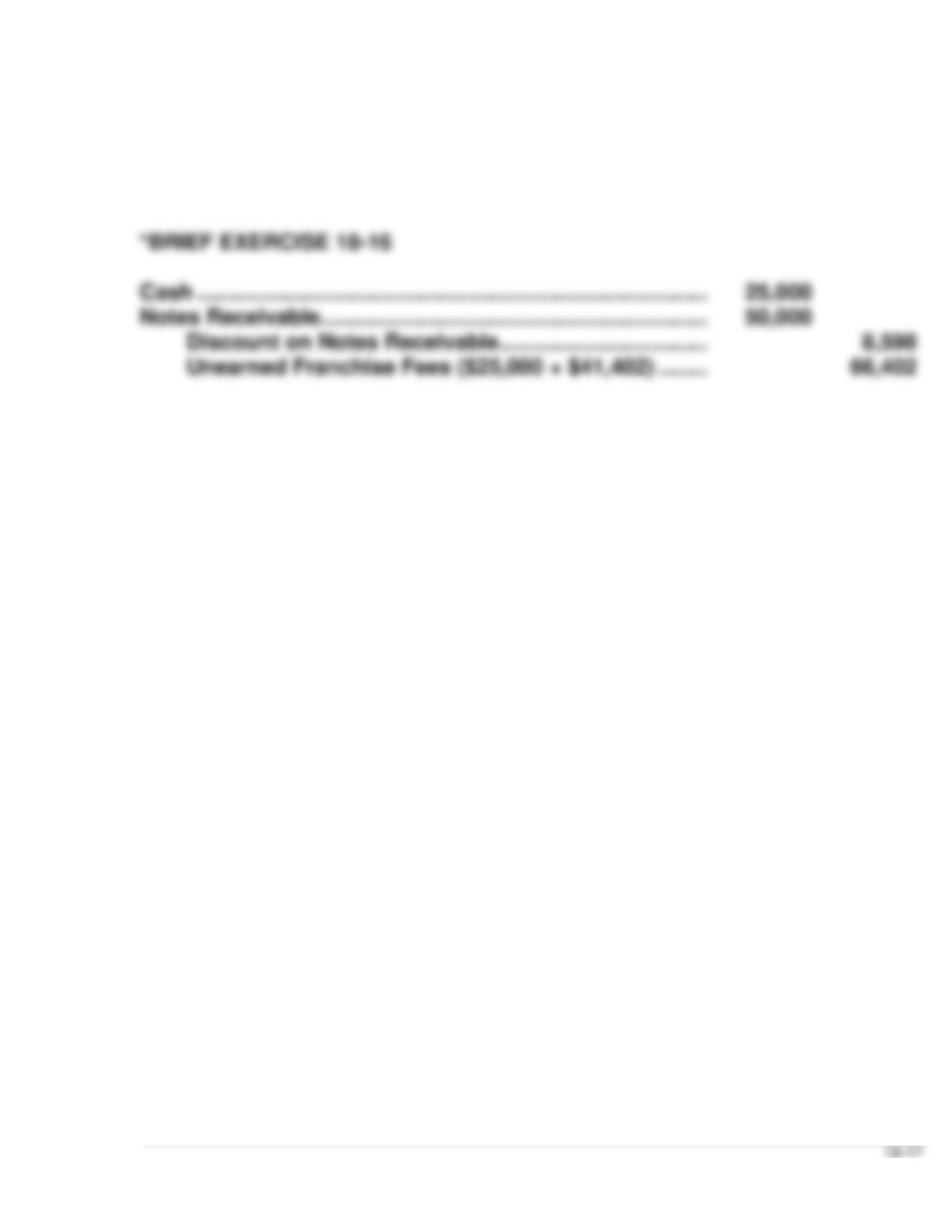
Installment Accounts Receivable, 2012 ………………… 150,000
Installment Sales Revenue ……………………………. 150,000
Cash ………………………………………………………………….. 54,000
Installment Accounts Receivable, 2012 …………. 54,000
Cost of Installment Sales …………………………………….. 102,000
Inventory …………………………………………………….. 102,000
BRIEF EXERCISE 18-13
Repossessed Merchandise ………………………………….. 275
Loss on Repossession ……………………………………….. 37*
Deferred Gross Profit ($520 X 40%) ……………………… 208
Installment Accounts Receivable ………………….. 520
*[$275 – ($520 – $208)]
BRIEF EXERCISE 18-15
2012 $0
2013 $2,000 ($15,000 – $13,000)
2014 $5,000
18–18
SOLUTIONS TO EXERCISES
EXERCISE 18-1 (5–10 minutes)
(a) Notes Receivable ……………………………………. 600,000
Sales Revenue ($610,000 – $10,000) ….. 600,000
EXERCISE 18-2 (5–10 minutes)
(a) Accounts Receivable ………………………………. 410,000
Sales Revenue …………………………………. 370,000
Unearned Service Revenue ………………. 40,000
EXERCISE 18-3 (5–10 minutes)
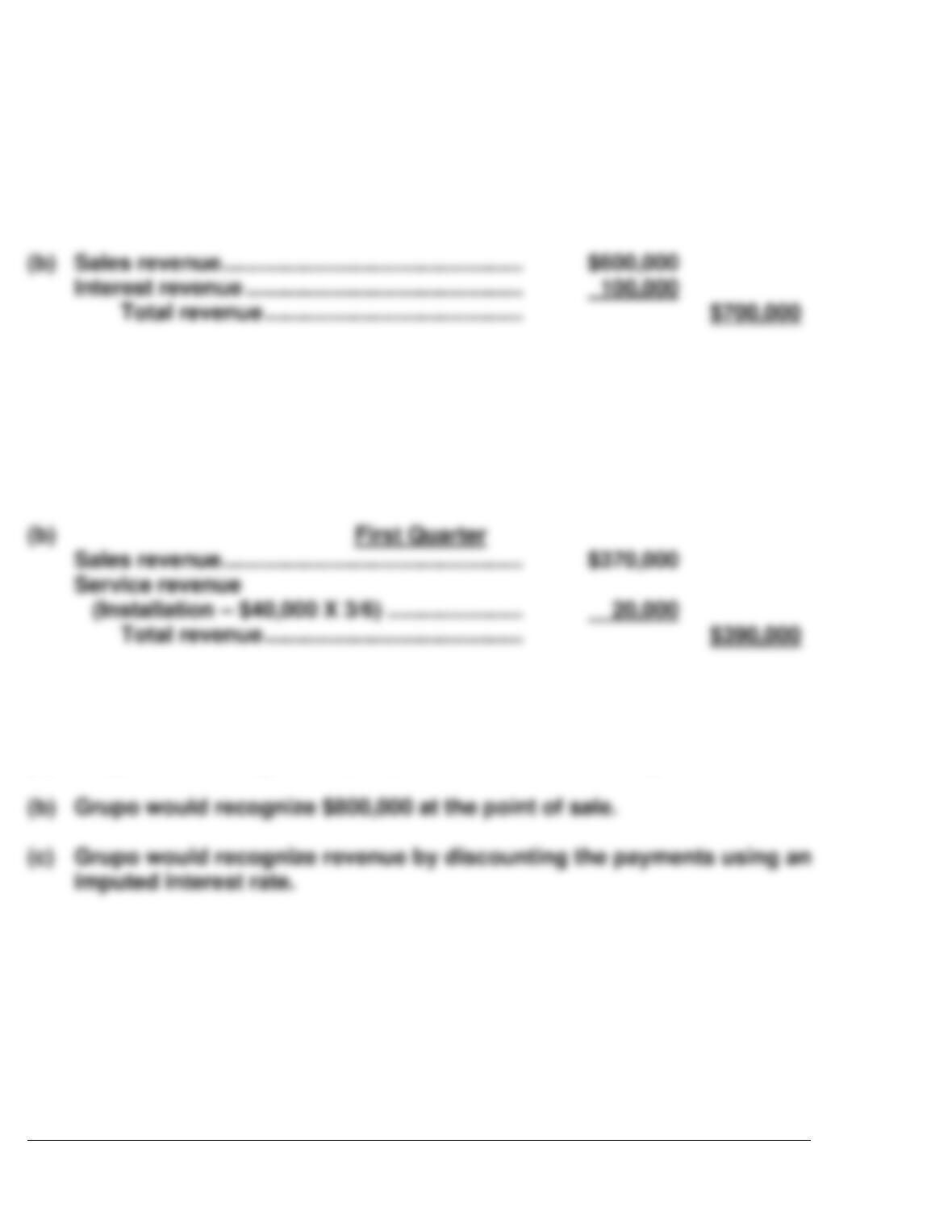
(a) Grupo would recognize $1,000,000 of revenue at delivery.
EXERCISE 18-4 (10–15 minutes)
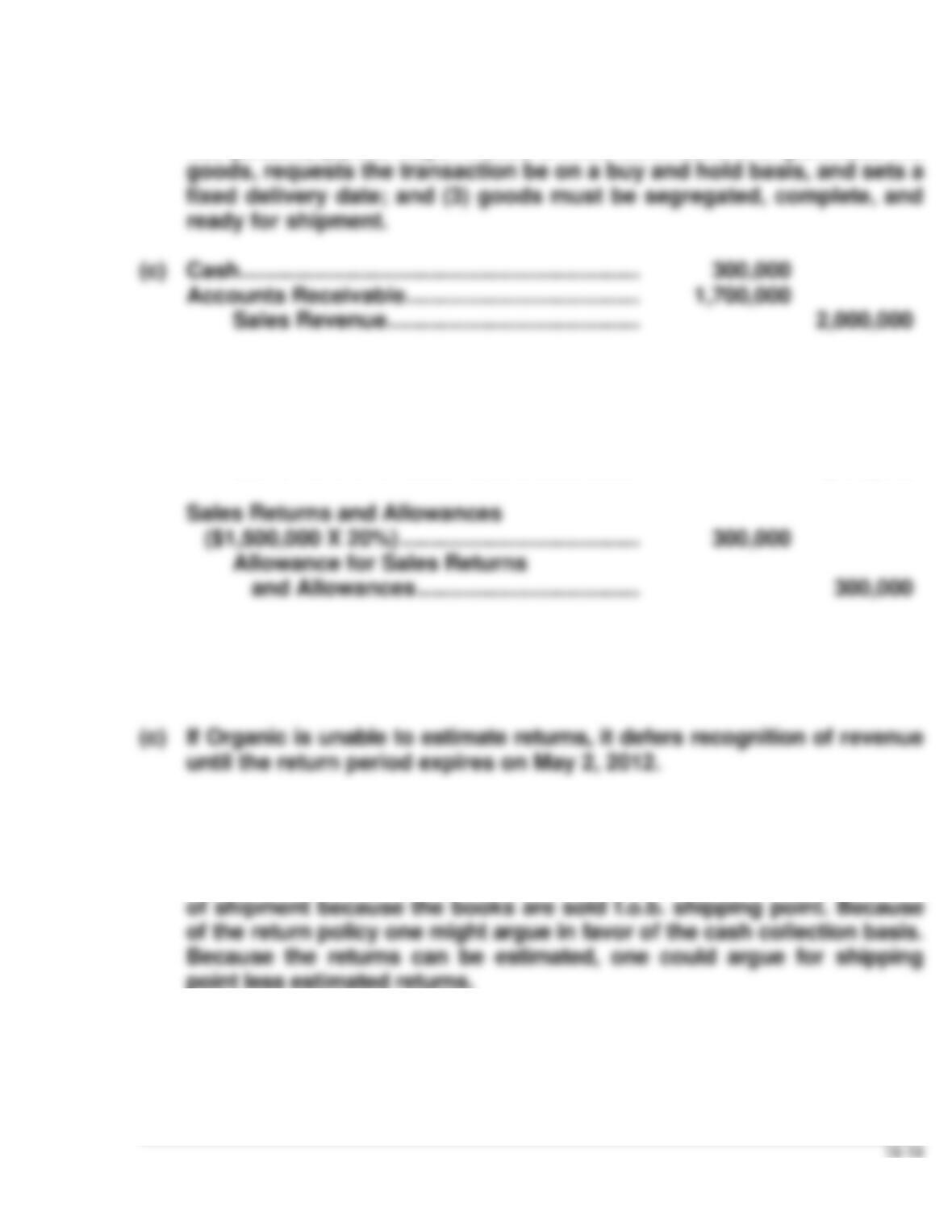
(a) This transaction is a bill and hold situation. Delivery of the counters is
delayed at the buyer’s request, but the buyer takes title and accepts
billing.
EXERCISE 18-4 (Continued)
(b) Revenue is reported at the time title passes if (1) the risks of ownership
has passed; (2) the buyer makes a fixed commitment of purchase the
EXERCISE 18-5 (5-10 minutes)
(a) Accounts Receivable ……………………………….. 1,500,000
Sales Revenue ………………………………….. 1,500,000
(b) Allowance for Sales Returns
and Allowances …………………………………….. 100,000
Accounts Receivable ………………………… 100,000
EXERCISE 18-6 (15–20 minutes)
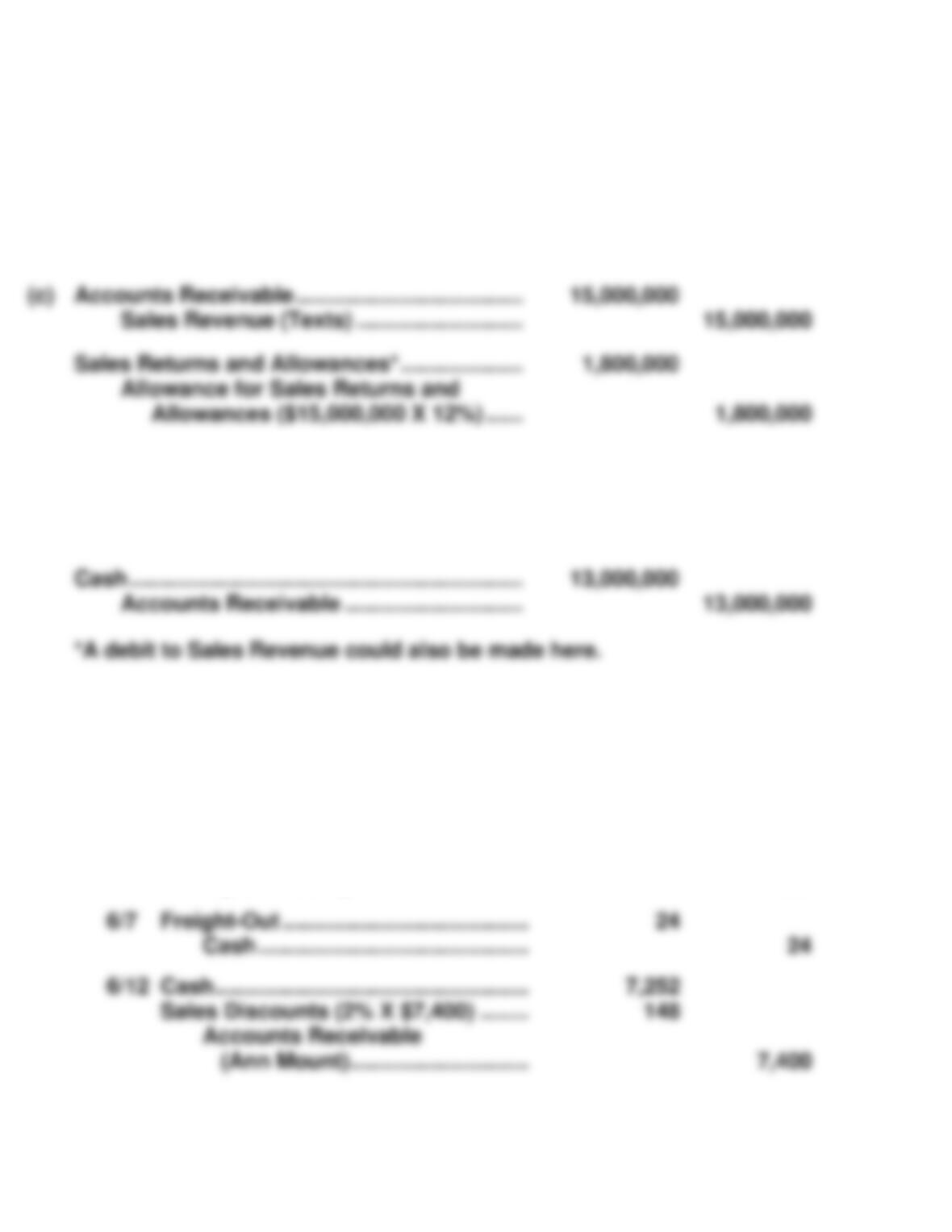
(a) Uddin could recognize revenue at the point of sale based upon the time
18–20
EXERCISE 18-6 (continued)
(b) Based on the available information and lack of any information indi–
cating that any of the criteria in GAAP were not met, the correct treatment
is to report revenue at the time of shipment as the gross amount less
the 12% normal return factor. This is supported by the legal test of
transfer of title and the criteria in GAAP. One could be very conservative
and use the 30% maximum return allowance.
(d) Sales Returns and Allowances* ……………….. 200,000
Allowance for Sales Returns and
Allowances ………………………………………… 1,800,000
Accounts Receivable ……………………….. 2,000,000
EXERCISE 18-7 (15–20 minutes)
(a) 1. 6/3 Accounts Receivable (Ann Mount) …. 8,000
Sales Revenue ………………………. 8,000
6/5 Sales Returns and Allowances …….. 600
Accounts Receivable
(Ann Mount) ……………………….. 600