CHAPTER 17 – 1
CHAPTER 18
INTERNATIONAL ASPECTS OF
FINANCIAL MANAGEMENT
Answers to Concepts Review and Critical Thinking Questions
1. a. The dollar is selling at a premium, because it is more expensive in the forward market than in the
spot market (SF 1.13 versus SF 1.10).
2. The exchange rate will increase, as it will take progressively more rubles to purchase a dollar as the
higher inflation in Russia will devalue the ruble. This is the relative PPP relationship.
3. a. The Australian dollar is expected to weaken relative to the dollar, because it will take more A$
in the future to buy one dollar than it does today.
4. A Yankee bond is most accurately described by d.
5. Either. For example, if a country’s currency strengthens, imports become cheaper (good), but its
exports become more expensive for others to buy (bad). The reverse is true for a currency depreciation.
CHAPTER 17 – 2
8. a. False. If prices are rising faster in Great Britain, it will take more pounds to buy the same amount
of goods that one dollar can buy; the pound will depreciate relative to the dollar.
c. True. The market would only be correct on average, while you would be correct all the time.
9. a. American exporters: their situation in general improves because a sale of the exported goods for
a fixed number of pesos will be worth more dollars.
American importers: their situation in general worsens because the purchase of the imported
goods for a fixed number of pesos will cost more in dollars.
10. False. If the financial markets are perfectly competitive, the difference between the Eurodollar rate
and the U.S. rate will be due to differences in risk and government regulation. Therefore, speculating
in those markets will not be beneficial.
Solutions to Questions and Problems
NOTE: All end-of-chapter problems were solved using a spreadsheet. Many problems require multiple
steps. Due to space and readability constraints, when these intermediate steps are included in this solutions
manual, rounding may appear to have occurred. However, the final answer for each problem is found
without rounding during any step in the problem.
Basic
1. Using the quotes from the table, we get:
a. $100(Z3.3598/$1) = Z335.98
b. $1.2452
CHAPTER 17 – 3
2. a. You would prefer £100, since:
(£100)($1.5649/£1) = $156.49
b. You would still prefer £100. Using the $/£ exchange rate and the C$/$ exchange rate to find the
amount of Canadian dollars £100 will buy, we get:
3. a. F180 = ¥118.37(per $). The yen is selling at a premium because it is more expensive in the forward
market than in the spot market ($.008430 versus $.008448).
b. F90 = $.8452/A$. The Australian dollar is selling at a discount because it is less expensive in the
forward market than in the spot market ($.8507 versus $.8452).
CHAPTER 17 – 4
b. The cost in U.S. dollars is:
(Can$2.49)/(Can$1.09/$1) = $2.28
Among the reasons that absolute PPP doesn’t hold are tariffs and other barriers to trade,
transactions costs, taxes, and different tastes.
5. a. The cross rate in ¥/£ terms is:
(¥121/$1)($1.53/£1) = ¥185.13/£1
b. The yen is quoted high relative to the pound. Take out a loan for $1 and buy £.6536. Use the
pounds to purchase yen at the cross-rate, which will give you:
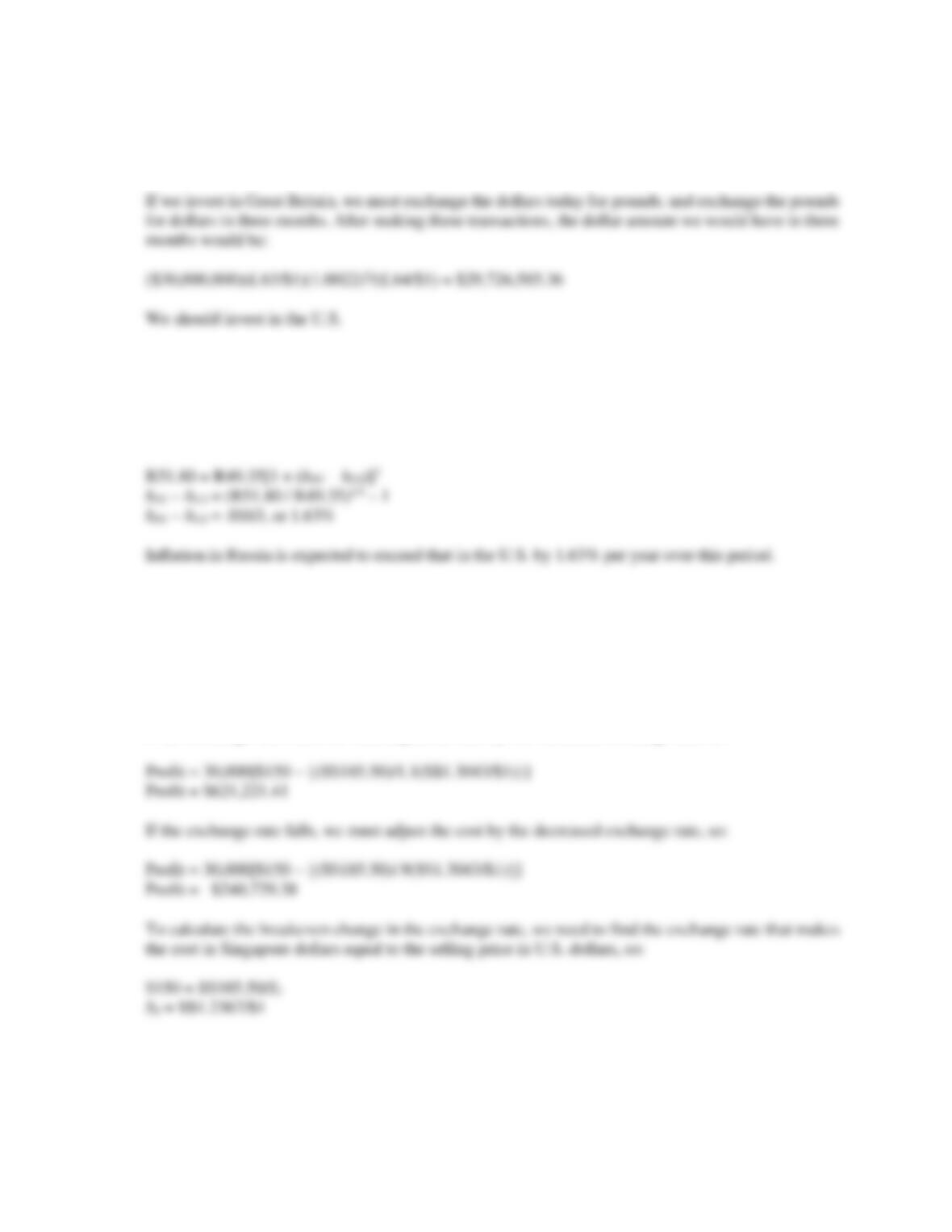
6. We can rearrange the approximate interest rate parity condition to answer this question. The equation
we will use is:
RFC = (Ft – S0) / S0 + RUS
Using this relationship, we find:
CHAPTER 17 – 5
7. If we invest in the U.S. for the next three months, we will have:
$30,000,000(1.0019)3 = $30,171,325.11
8. Using the relative purchasing power parity equation:
Ft = S0 × [1 + (hFC – hUS)]t
We find:
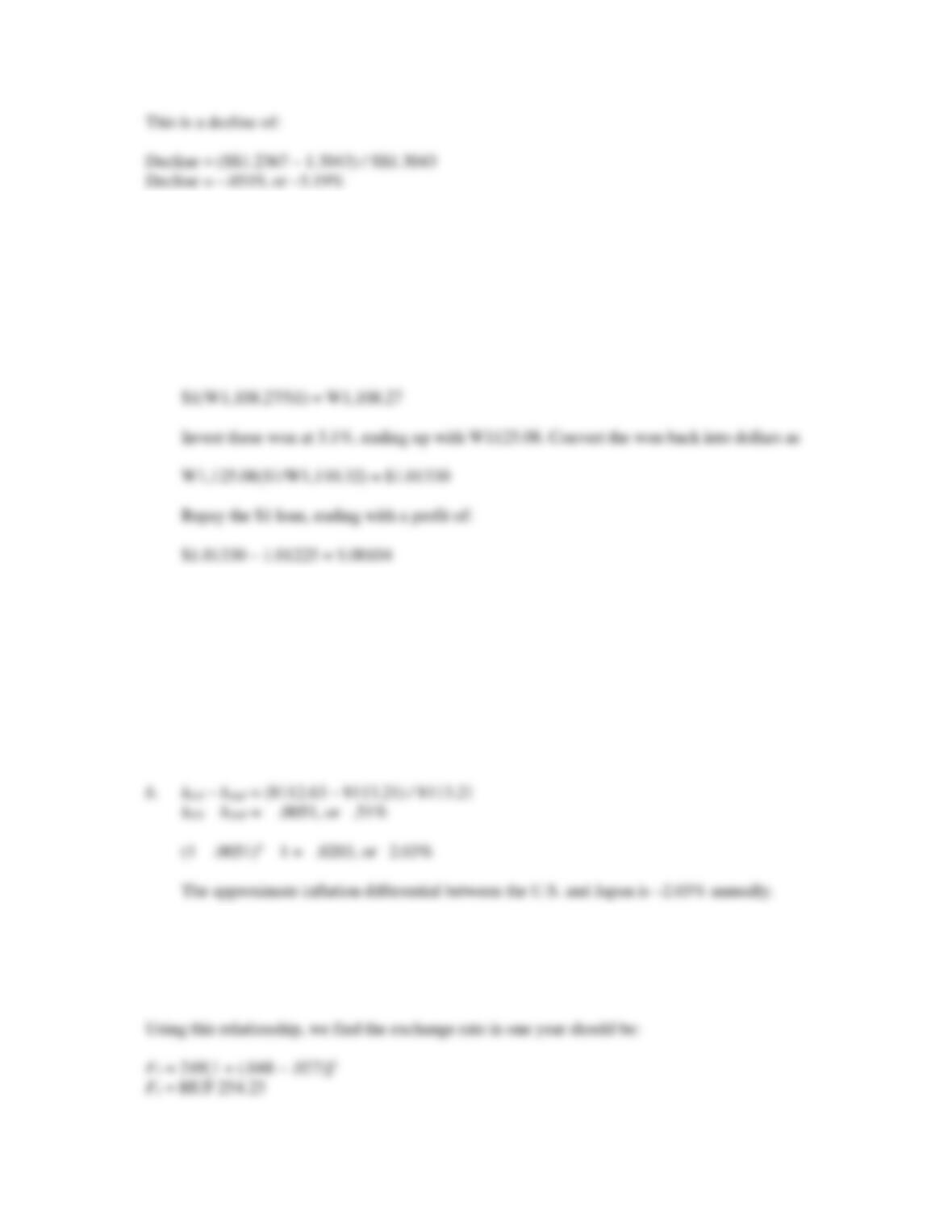
9. The profit will be the quantity sold, times the sales price minus the cost of production. The production
cost is in Singapore dollars, so we must convert this to U.S. dollars. Doing so, we find that if the
exchange rate stays the same, the profit will be:
Profit = 30,000[$150 – {(S$185.50)/(S$1.3043/$1)}]
Profit = $233,343.56
If the exchange rate rises, we must adjust the cost by the increased exchange rate, so:
CHAPTER 17 – 6
10. a. If IRP holds, then:
F180 = (W1,108.27)[1 + (.031 – .025)]1/2
F180 = W1,111.5898
Since given F180 is W1,110.32, an arbitrage opportunity exists; the forward premium is too low.
Borrow $1 today at 2.5% interest. Agree to a 180-day forward contract at W1110.32. Convert the
loan proceeds into won:
b. To find the forward rate that eliminates arbitrage, we use the interest rate parity condition, so:
F180 = (W1,108.27)[1 + (.031 – .025)]1/2
F180 = W1,111.5898
Intermediate
11. a. The yen is expected to get stronger, since it will take fewer yen to buy one dollar in the future
than it does today.
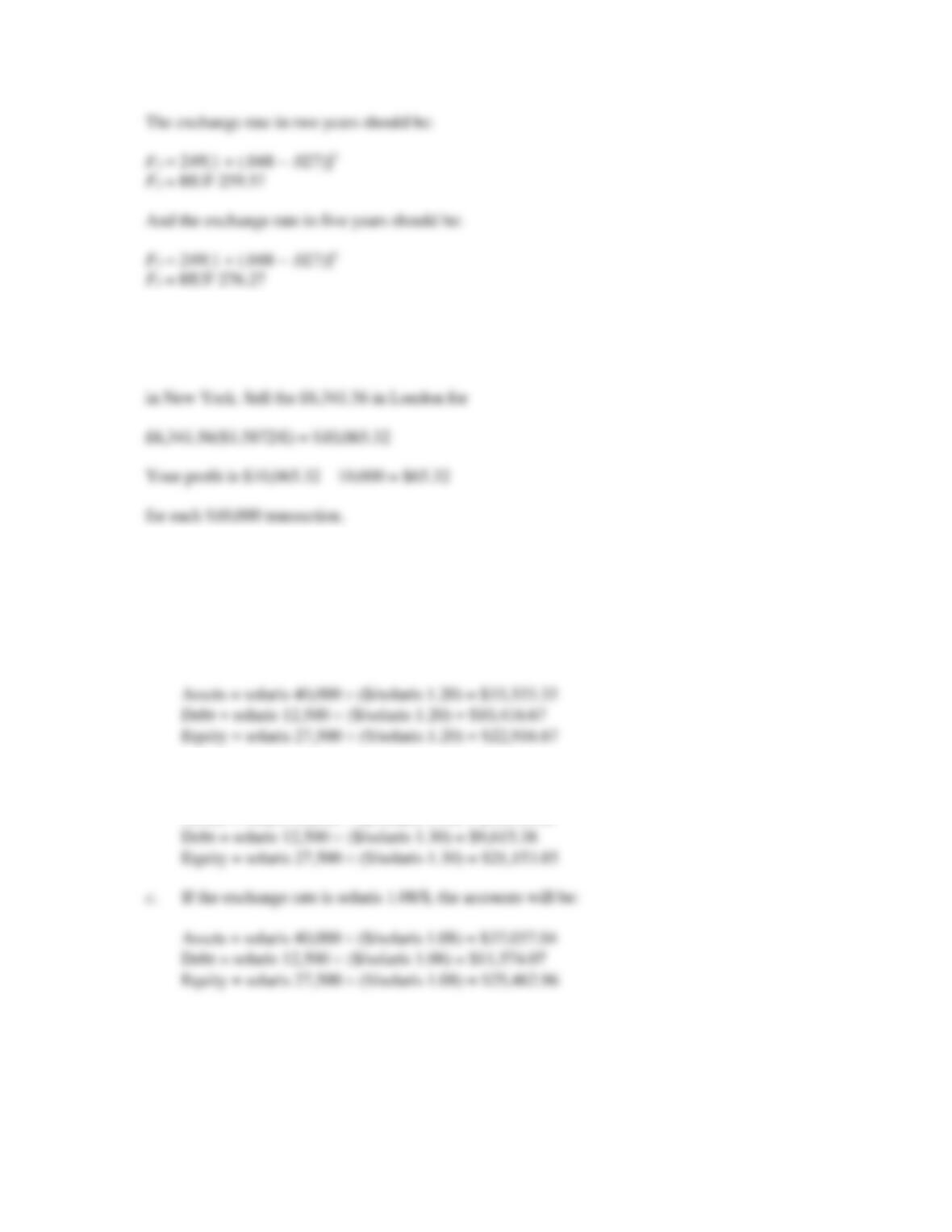
12. We need to find the change in the exchange rate over time, so we need to use the interest rate parity
relationship:
Ft = S0 × [1 + (RFC – RUS)]t
CHAPTER 17 – 7
13. Pounds are cheaper in New York, so we start there. Buy:
$10,000(£/$1.5769) = £6,341.56
14. If purchasing power parity holds, the exchange rate will be:
Krona135.34 / $4.79 = Krona28.2547/$
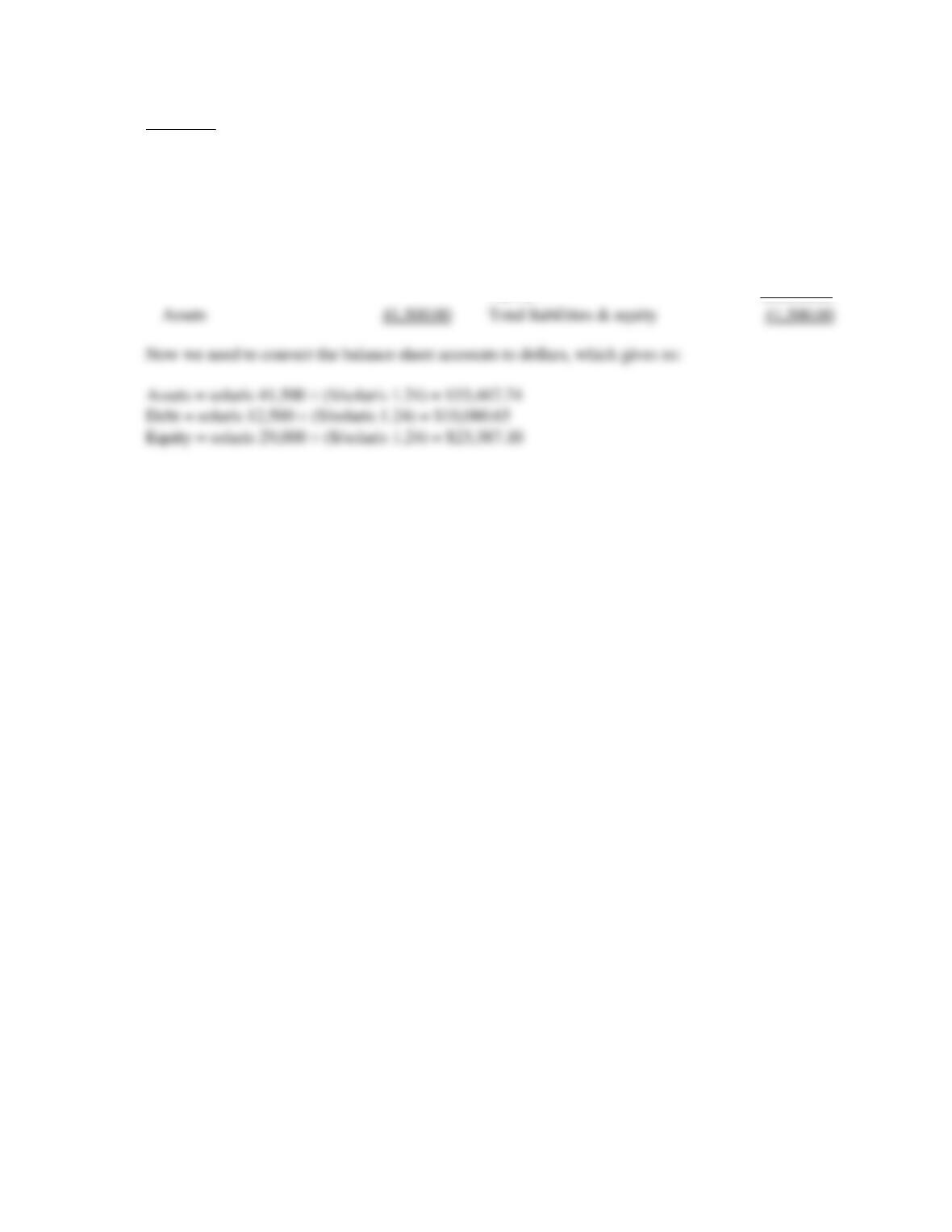
15. a. To construct the balance sheet in dollars, we need to convert the account balances to dollars. At
the current exchange rate, we get:
b. In one year, if the exchange rate is solaris 1.30/$, the accounts will be:
Assets = solaris 40,000 ($/solaris 1.30) = $30,769.23
CHAPTER 17 – 8
Challenge
16. First, we need to construct the end of year balance sheet in solaris. Since the company has retained
earnings, the equity account will increase, which necessarily implies the assets will also increase by
the same amount. So, the balance sheet at the end of the year in solaris will be:
Balance Sheet (solaris)
Liabilities
12,500.00
Equity
29,000.00